Tokenized Real Estate DeFi: Lending Against Property Guide
Tokenized real estate DeFi: lending against property guide
What is tokenized real estate DeFi?
Tokenized real estate DeFi means using blockchain-based property tokens as collateral in decentralized finance apps, so a property owner or investor can borrow against a real-world asset without selling it, while lenders earn interest from a loan backed by enforceable property-related rights.
Plain-English definition
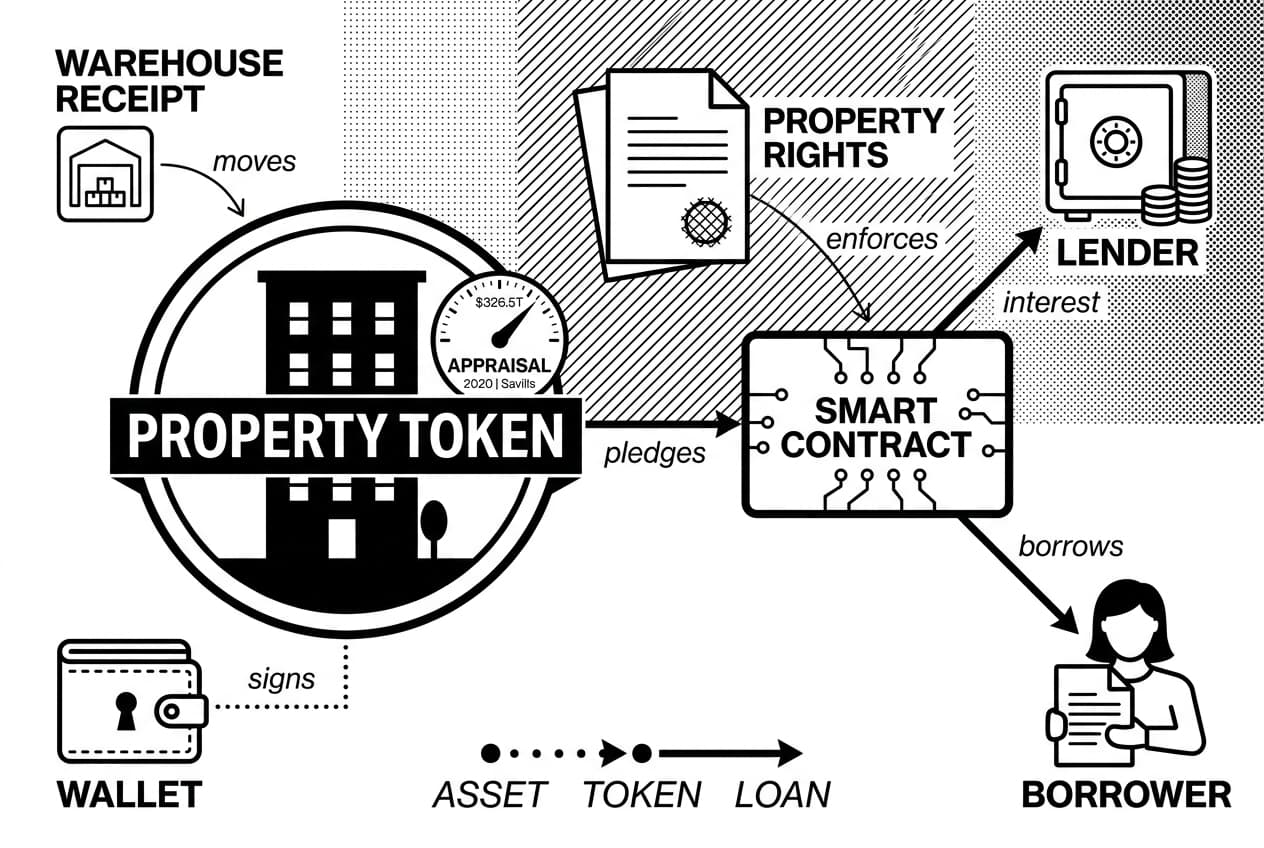
A blockchain is a shared digital ledger that many computers maintain together. A useful analogy is a warehouse receipt: the receipt can move quickly between buyers, but collecting the goods still depends on the warehouse honoring the receipt. A token is the digital record on that ledger. A wallet is software that holds tokens and signs transactions. DeFi, short for decentralized finance, means financial applications that run through blockchain-based programs instead of a bank ledger. Those programs are called smart contracts. Collateral is the asset a borrower pledges so the lender has a recovery path if the borrower fails to repay.
Why it matters for borrowers and lenders
Real estate stores enormous value, but owners usually cannot borrow against a small slice of a building quickly. Savills estimated global real estate value at $326.5 trillion at the end of 2020 (Savills, September 2021). Tokenized real estate DeFi tries to connect some of that value to programmable lending markets. The borrower wants liquidity without selling the property exposure. The lender wants yield backed by something more tangible than a volatile crypto token.
The common pitch says tokenization will make property liquid and global. The stricter view is more useful: that promise only works when the token has enforceable legal claims, credible valuation data, and a default path that can reach the real property or the entity that owns it. A blockchain transfer cannot replace courts, land registries, mortgage liens, or local insolvency rules.
Two approved expert perspectives frame the issue. Stani Kulechov, founder and CEO at Aave, is relevant because Aave helped make overcollateralized DeFi lending familiar to crypto users. Sergey Nazarov, co-founder at Chainlink Labs, is relevant because oracle networks carry off-chain data, such as prices and attestations, into smart contracts. Tokenized property lending needs both pieces: lending rules and trustworthy real-world data.
Our May 2026 collateral-path test
For this guide, we use a five-part editorial framework called the collateral-path test. A property-backed token is lender-ready only if a reviewer can answer five questions from public documents or loan files:
- Asset: which property, note, or income stream backs the token?
- Legal claim: what right does the token holder actually receive?
- Valuation: who appraises the asset, and how often is the value refreshed?
- Cash flow: how do rent, interest, or sale proceeds reach token holders?
- Default path: what happens after missed payments, covenant breach, or insolvency?
As of May 2026, this test is the practical dividing line between a property token that can support careful lending and a token that is only a tradable story. If the default path is vague, the loan should be treated as high risk even when the smart contract looks clean.
- Tokenized real estate DeFi connects property-related rights to on-chain lending apps.
- The token is not the building; it is a claim defined by legal documents.
- Borrowers may access liquidity without selling their property exposure.
- Lenders need enforceable rights, current valuation data, and a real recovery path.
- RWA.xyz tracked tokenized real-world asset value at more than $8 billion in early 2025 (RWA.xyz, April 2025), showing that the category has moved beyond small experiments.
A brief history of real estate tokenization
Real estate was financially sliced long before blockchains existed. The hard part has always been making those slices easy to transfer, easy to value, and legally enforceable.
Background: from paper ownership to programmable claims
Traditional deeds record ownership at a local registry. Later structures, including public property funds and online crowdfunding, let investors buy economic exposure without owning a whole building. Tokenization adds a blockchain record to that older idea. The improvement is not magic digital ownership. The improvement is that a claim to equity, debt, or cash flow can be represented in software, transferred under programmed rules, and connected to lending applications.
Why 2026 looks different
Earlier property-token projects often lacked the surrounding infrastructure. By 2026, the stack is more mature: regulated issuers, stablecoins for settlement, institutional custody, digital identity checks, and oracle networks. The oracle part matters because a smart contract cannot inspect a roof, read a lease, or check whether a lien was filed. It needs verified data from outside the chain. This is why the work associated with Sergey Nazarov, co-founder at Chainlink Labs, is central to the topic: real-world asset lending depends on trustworthy off-chain data arriving on-chain in a form the contract can use.
How real estate gets tokenized
Tokenizing real estate means converting a legally defined property-related right into digital tokens that can be held in wallets, transferred under rules, and sometimes pledged as collateral. The building does not move onto a blockchain. The legal claim moves into a format that software can track.
Step-by-step tokenization process
- Select property: a sponsor chooses a building or loan with clear title, documented cash flow, and rules that allow the planned structure.
- Appraise: an independent valuation sets the starting reference price for issuance and future collateral limits.
- Create legal wrapper: the asset is placed in an entity or trust so token holders receive defined economic or ownership rights.
- Issue tokens: smart contracts create the tokens. A gas fee is the network transaction fee paid to record the action.
- Verify investors: the platform checks identity and eligibility because most property tokens are treated as regulated financial instruments.
- Distribute income: rent, interest, or sale proceeds move from the property structure to token holders according to the offering documents.
- Enable trading or lending: approved holders may sell tokens on a permitted marketplace or deposit them as collateral in a compatible lending app.
The evidence trail behind each step should include a title report, appraisal, operating statement, entity documents, token terms, investor restrictions, servicing agreement, and default procedure. Without that paper trail, the token is difficult for a lender to underwrite.
Fungible tokens versus NFTs for property
Fungible tokens are interchangeable units, similar to shares of the same class. If two wallets each hold 500 units of the same property token, the units are meant to carry the same rights. This format is easier for lending markets because collateral can be valued in batches.
NFTs, or non-fungible tokens, are unique records. A property NFT might point to a specific title record, mortgage document, or single-asset certificate. Uniqueness can help provenance, but it creates a pricing problem. A lending protocol can sell common units more easily than a one-of-one claim tied to a specific building and local registry process.
Concrete example
Suppose a rental building is valued at $1,000,000 after an appraisal. A sponsor places it in a legal wrapper and issues 100,000 tokens at $10 each. A buyer who holds 1,000 tokens has 1% economic exposure. If the property produces $50,000 in net annual rent after expenses, that holder would expect $500 before taxes and platform fees, assuming the documents give token holders that cash-flow right.
If a lending protocol accepts those tokens at a 50% loan-to-value limit, the same $10,000 token position could support up to $5,000 of borrowing. The borrower keeps the property exposure but takes on interest expense, collateral risk, and default risk.
How lending against tokenized property works
Property-backed tokens can become collateral once a lender trusts the legal structure, pricing data, custody setup, and default path. The loan still has a familiar shape: pledge collateral, borrow funds, repay with interest, and release collateral if the loan is paid.
- The borrower pledges tokens: property-backed tokens are deposited into a smart contract or controlled custody account.
- Lenders supply funds: lenders deposit stablecoins or other approved assets into a pool. For the pool mechanics, see how DeFi liquidity pools work.
- The smart contract tracks the loan: it records principal, interest, maturity date, collateral value, and repayment status.
- The borrower repays: if the loan is paid on time, the collateral is released back to the borrower.
- Default triggers recovery: if the borrower fails to pay or collateral falls too far, the protocol sells tokens, draws a reserve, starts a buyback, or begins off-chain legal enforcement.
The borrower, lender, and smart contract
The borrower is the party seeking funds. The lender supplies those funds, often through a shared pool. The smart contract is the program that applies the loan rules. In pure crypto lending, the contract can often liquidate collateral quickly. In property lending, the contract may hold the token, but the recovery process may still depend on trustees, servicers, courts, or company law.
Loan-to-value, interest, and liquidation
Loan-to-value, often shortened to LTV, means loan amount divided by collateral value. If collateral is worth $100,000 and the LTV cap is 50%, the maximum loan is $50,000. Property tokens usually need lower LTVs than highly liquid crypto collateral because appraisals update slowly and secondary markets can be thin.
Liquidation is the process of selling or seizing collateral after the borrower breaks the loan terms. With a liquid crypto asset, that may happen in minutes. With tokenized property, liquidation may mean selling tokens to approved buyers, forcing a manager buyback, transferring interests in a legal entity, or enforcing a security interest under local law.
Why oracles and appraisals matter
An oracle is a service that brings outside information onto a blockchain. Property lending may need appraisal values, rent collections, vacancy data, insurance status, debt seniority, and lien information. A bad oracle feed can make a loan look safe when the real asset has weakened. This is why property-backed lending is not only a smart contract problem; it is also a data-quality problem.
What happens if the borrower defaults?
Default is where tokenized real estate DeFi differs most from standard DeFi. A normal crypto lending protocol can often sell collateral on public markets. A property-backed lender may need a slower path: notify the borrower, freeze token transfers, appoint a servicer, enforce a pledge over entity interests, or begin foreclosure-like proceedings under local law. That process can take months.
In our May 2026 collateral-path test, the most important default question is not, "Can the smart contract lock the token?" It is, "Can the lender turn the locked token into cash or control of the legal claim?" If the answer is unclear, the collateral should be discounted heavily.
Benefits of tokenized real estate DeFi lending
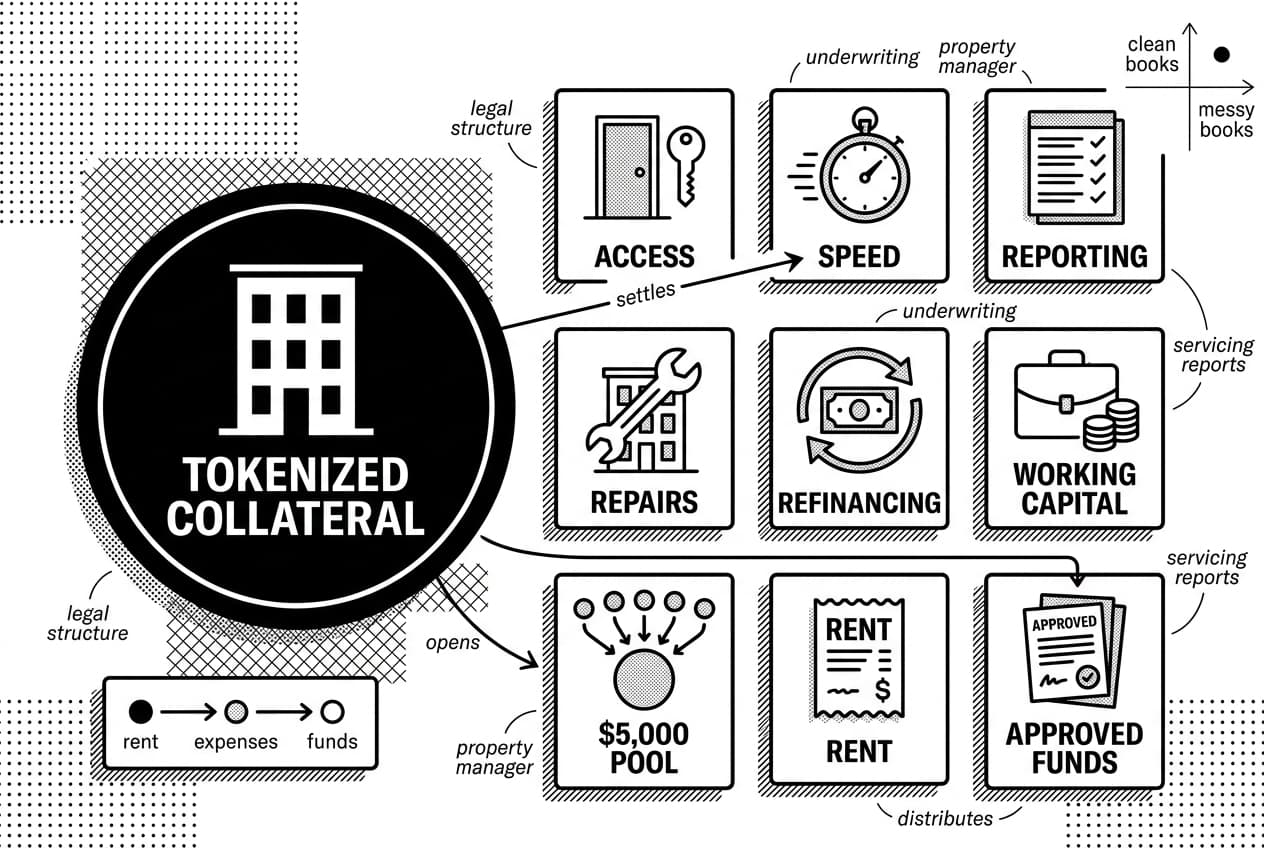
The benefits are real, but they are narrower than the marketing often suggests. Tokenization can improve access, speed, and reporting when the legal structure is sound.
Liquidity without selling the whole property
A property owner may want capital for repairs, refinancing, or working capital without selling the building. Tokenized collateral can help if the owner already has a compliant token structure and a lender willing to accept it. The benefit is not automatic cheap credit. The benefit is another financing route that can settle faster than some private real estate loans.
Fractional collateral and broader access
Fractional tokens can let smaller lenders participate in property-backed credit. A lender might supply $5,000 to a pool instead of funding an entire mortgage. That does not remove underwriting. It changes who can participate in the loan and how the loan is administered.
Automated cash flows
Smart contracts can distribute income once a property manager collects rent, reconciles expenses, and sends approved funds to the token structure. Automation works best after the off-chain accounting is finished. If leases, bank accounts, and servicing reports are messy, the blockchain cannot fix the economics.
Legal structures: what do the tokens actually represent?
A property token is only as strong as the rights behind it. Before lending against a token, the lender must know whether it represents ownership, debt, income, or only a record linked to a document.
Token type | What it represents | Typical use in lending | Key legal risk |
|---|---|---|---|
equity token | Interest in an entity that owns the property | Collateral over the entity interest | Recovery depends on company law, transfer restrictions, and insolvency rules |
debt token | Claim on a loan or mortgage-like instrument | Often stronger collateral if the debt has a valid security interest | Foreclosure or enforcement still depends on local law |
cash-flow token | Right to receive rent, interest, or other income | Usually discounted because cash flows can stop | Vacancy, tenant default, caps on rent, or expense spikes can reduce value |
NFT linked to title | Unique record pointing to a deed, file, or ownership certificate | Rare as collateral because pricing and transfer are difficult | Most registries do not treat an NFT transfer as a legal deed transfer |
Equity, debt, and cash-flow tokens
Equity tokens are common because a property can be held by a single-purpose entity and the token can represent an interest in that entity. A lender may be able to seize or sell those interests after default, but the process depends on the governing documents and local law.
Debt tokens may be better collateral when they represent a secured loan with a clear claim against the property. Cash-flow tokens are weaker because the lender depends on income continuing. If tenants leave or expenses rise, the token value can fall even if the building still exists.
NFTs, deeds, and legal reality
Minting a deed reference as an NFT does not usually transfer legal title. In most jurisdictions, title changes only when the official land registry records the transfer. A blockchain record may help prove a transaction history, but it does not override local property law unless the relevant government has adopted that process.
Compliance in 2026
The crypto regulation timeline shows why compliance cannot be treated as an afterthought. Property-backed tokens often fall under securities, lending, fund, tax, and transfer-agent rules. Platforms may need customer identity checks, anti-money-laundering controls, investor eligibility screening, and transfer restrictions.
Regional examples show the uneven rule set. Switzerland brought parts of its distributed ledger law into force in February 2021 (Swiss government announcement, 2021). Other markets use different licensing, securities, or private-offering regimes. A token that is lawful for one investor group may be unavailable to another.
The practical takeaway is simple: check the token terms, issuer registration, investor restrictions, tax reporting, and default documents before treating a property token as collateral. The token is the interface; the legal wrapper is the product.
Risks and technical challenges
Tokenized real estate DeFi introduces crypto risks on top of property risks. A careful lender has to underwrite both.
The liquidity gap
Token liquidity and property liquidity are not the same. A token may trade all day, but the underlying building may still take months to sell. Nareit noted that private real estate transactions can involve long sale periods, and industry commentary commonly frames direct property sales in month-long windows rather than instant exits (Nareit, 2023). If a lending model assumes immediate sale value, it may overstate recovery.
Smart contract and custody risk
Custody means how an asset is held and protected. With tokenized real estate, custody includes the digital token and the legal documents behind it. A lost private key can block token access. Weak admin controls can expose the smart contract. Serious projects use smart contract access control, audits, role limits, and multisignature approvals, where more than one key holder must approve sensitive actions.
Security risk is not theoretical. The rekt.news incident leaderboard tracked more than $3.8 billion in losses across major crypto exploits by 2024 (rekt.news leaderboard, 2024). The custody model also matters for users. Understanding custodial vs non-custodial wallets helps clarify who can move the tokens and who bears key-management risk.
Real-world asset risk
A property token does not remove vacancies, repairs, insurance gaps, zoning disputes, fraud, or falling local demand. If the roof fails or a major tenant leaves, the collateral can weaken. Insurance may help, but coverage differs. Borrowers and lenders should check whether any crypto insurance or property policy covers digital custody, legal-document failure, smart contract loss, and physical-asset damage.
Regulatory and tax uncertainty
A property token may be treated as a security, fund interest, loan instrument, partnership interest, or property right depending on jurisdiction. Each label can change taxes, investor protections, reporting, and transfer rights. This is why tokenized real estate lending remains better suited to borrowers and lenders that can pay for legal review.
- Token liquidity is not property liquidity: a quick token sale does not guarantee a quick building sale.
- Oracle failures can misprice collateral: bad off-chain data can produce bad on-chain decisions.
- Smart contract and custody risk remain: audits reduce risk but cannot remove it.
- Physical property risk follows the asset: rent, repairs, taxes, and fraud still matter.
- Legal classification changes outcomes: the same token may be treated differently across markets.
When does lending against tokenized property make sense?
Tokenized property lending makes sense when the borrower values speed, transparency, programmable servicing, or access to crypto-native lenders enough to justify the added legal and technical work.
Best-fit use cases
- Commercial refinancing: an asset owner needs temporary liquidity while a conventional refinancing is in progress.
- Landlord working capital: a rent-producing property has documented cash flow, but the owner needs short-term funds.
- Construction bridge financing: a developer needs a short loan between completion milestones and permanent financing.
- On-chain income reporting: property cash flows are already reported in a form that DeFi lending apps can review.
The best cases usually involve commercial or semi-institutional borrowers, not first-time homebuyers. The borrower needs clean documents, a credible appraisal, and a lender base comfortable with both crypto and property law.
When traditional finance may be better
For many homeowners, a regulated mortgage, home-equity loan, or bank credit line is cheaper and clearer. Traditional lenders offer established consumer protections, known foreclosure rules, and familiar tax reporting. A tokenized loan can add custody, oracle, transfer, and eligibility issues that do not help a simple household borrower.
The stricter rule is this: use tokenized real estate DeFi when the token structure improves the financing outcome after legal, valuation, servicing, and technology costs. If those costs add more friction than they remove, the traditional route is better.
Key takeaways
What readers should remember
- Tokenized real estate DeFi turns property-related rights into blockchain tokens that may be used as loan collateral.
- The legal claim matters more than the token label. Lenders need to know whether the token represents equity, debt, cash flow, or only a document reference.
- Default handling is the real test. A smart contract can freeze tokens, but courts, registries, trustees, and servicers may still control recovery.
- Good collateral needs good data. Appraisals, rent records, insurance status, liens, and oracle feeds all affect lending safety.
- The best use cases are selective. Tokenized property lending is most useful for sophisticated borrowers with clean documents and lenders that understand both DeFi mechanics and real estate law.
Frequently Asked Questions
- What does "tokenized real estate" mean?
- Tokenized real estate means issuing blockchain tokens that represent a right tied to a property — such as equity, debt, rental income, or ownership of a legal entity that holds the asset. The token itself is not a deed unless the relevant legal system explicitly recognizes that connection, which most jurisdictions currently do not.
- What is the 7% rule in real estate?
- The 7% rule is a traditional investor heuristic used to gauge whether a property's rental income or projected returns justify its purchase price. It has no direct role in DeFi lending or collateral requirements. Tokenized property loans are underwritten separately, based on appraisals, loan-to-value ratios, and platform-specific risk criteria.
- What is the downside of tokenization?
- Key downsides include legally ambiguous ownership rights, thin secondary markets, smart contract vulnerabilities, oracle failures that distort valuations, custody risks, and heavy compliance burdens. Enforcement against real-world property is also slow and jurisdiction-dependent. Tokenization improves transferability and recordkeeping, but it does not remove the underlying risks of property ownership.
- How is real estate going to be tokenized?
- The process typically involves appraising the property, establishing a legal holding structure such as an LLC or SPV, defining exactly what the token represents, and issuing tokens on a blockchain. Investors are then onboarded through compliant platforms that also manage rental cash flows, reporting, and any secondary trading or lending access.
Sources
Author

Crypto analyst and blockchain educator with over 8 years of experience in the digital asset space. Former fintech consultant at a major Wall Street firm turned full-time crypto journalist. Specializes in DeFi, tokenomics, and blockchain technology. His writing breaks down complex cryptocurrency concepts into actionable insights for both beginners and seasoned investors.