Liquidity Pools Explained: How DeFi Pools Work in 2026
Liquidity Pools Explained: How DeFi Pools Work in 2026
What Is a Liquidity Pool?
Liquidity pools are shared reserves of crypto tokens locked inside a smart contract that let DeFi apps run swaps, lending, and yield without a bank or broker. Anyone can add tokens to a liquidity pool and become one of its liquidity providers.
Plain-English Definition
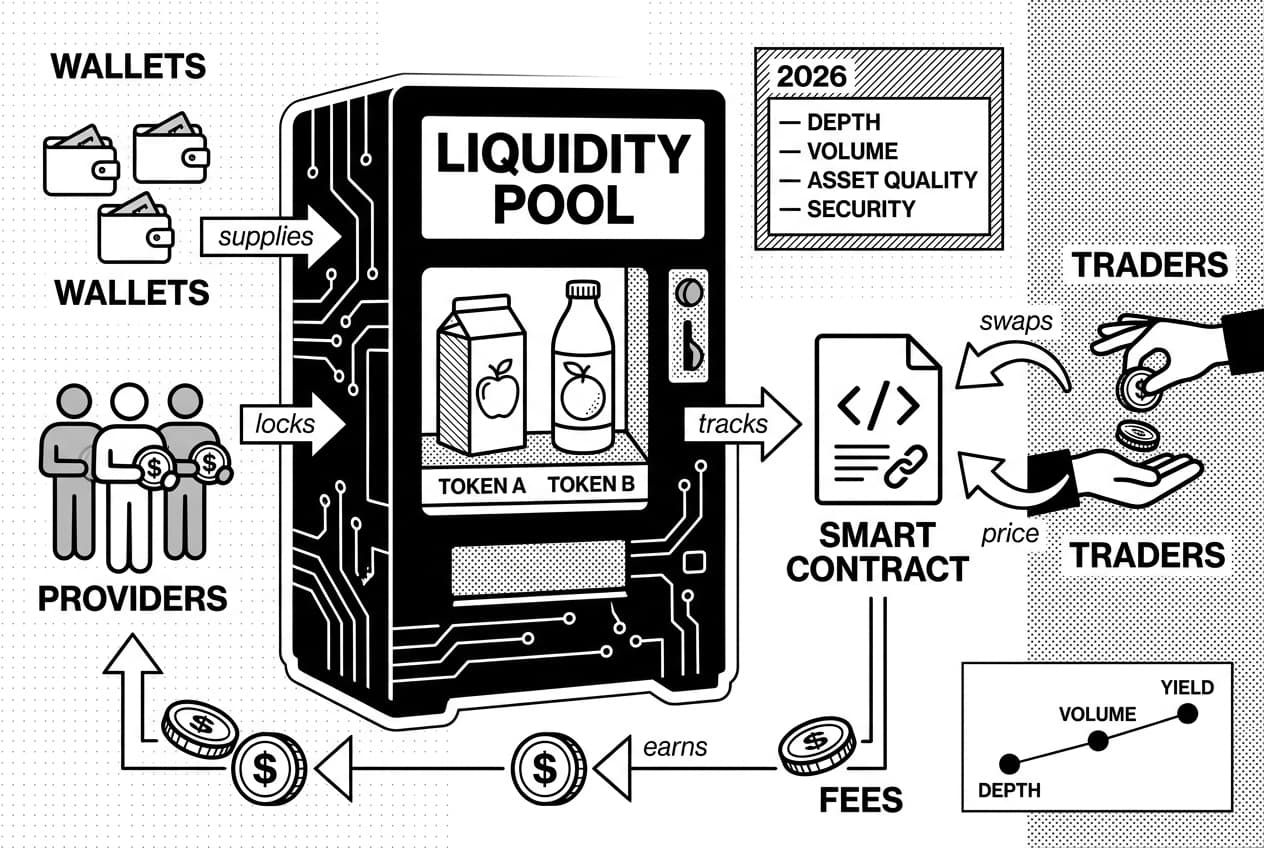
A liquidity pool is a token reserve controlled by code. A smart contract is software that runs on a blockchain, meaning it follows preset rules once a user signs a transaction from a crypto wallet. A crypto wallet is the account and signing tool you use to control your own assets. In a pool, users supply assets, traders trade against those assets, and the contract tracks who owns what.
Why it matters for readers
If you use DeFi, liquidity pools affect the price you receive, the fees you pay, the yield you may earn, and the risks you take. The headline yield is not the full story. In 2026, the better beginner question is not “which pool pays the most?” It is “does this pool have enough depth, volume, asset quality, and security to make the yield worth the risk?”
A simple analogy: the shared digital vending machine
Use one concrete mental model: a shared digital vending machine. Several people stock it with two products, such as apple juice and orange juice. Customers can swap one for the other at any hour, and the machine charges a small fee. At payout time, the stockers split fees based on how much inventory they supplied. In DeFi, the stockers are liquidity providers, the products are tokens, and the machine is the smart contract.
Background: from order books to automated pools
Traditional exchanges use order books, which are lists of buy and sell offers. If no buyer and seller agree on a price, no trade happens. DeFi popularized automated market makers, or AMMs, which are smart contracts that price trades with formulas instead of matching two people directly. Hayden Adams, Founder at Uniswap Labs, is associated with the AMM model that helped bring this design to mainstream Ethereum users. Uniswap launched in November 2018, and its v3 announcement said the protocol had supported more than $135 billion in trading volume by May 2021 (Uniswap Labs, May 2021). That growth showed that pools were no longer a small experiment.
Why Liquidity Pools Matter in DeFi
Liquidity is how easily an asset can be bought or sold without moving its price too much. Deep liquidity helps traders get better prices, helps apps value collateral, and helps users exit positions without taking a surprise loss from slippage.
Why liquidity is important in crypto
Slippage is the gap between the price you expected and the price you actually received. A $5,000 swap in a deep ETH/USDC pool may move the price only a little. The same $5,000 swap in a thin pool with $80,000 of total liquidity can move the price far more. This is why pool depth matters as much as advertised APR.
Liquidity also affects lending. A lending app needs reliable markets so it can value collateral, process liquidations, and keep borrowers from pushing the system into bad debt. Stani Kulechov, Founder and CEO at Aave, leads one of the largest DeFi lending protocols, and Aave’s design depends on liquid collateral markets rather than isolated prices inside one app.
The impact of liquidity on traders and apps
Traders want low slippage. Liquidity providers want real trading volume, because volume creates fees. Developers want stable market data, because lending, derivatives, and vault strategies all rely on markets that can absorb trades. For a beginner, this means a pool with lower APR but steadier volume can be more attractive than a new pool with a huge yield and almost no organic trading.
If you are comparing apps, our beginner guide to DeFi apps explains which lending, swapping, and earning tools rely most heavily on liquidity depth.
How Liquidity Pools Work Step by Step
The core process is simple once you separate each action:
- Deposit assets: a liquidity provider sends tokens to the pool’s smart contract.
- Receive LP tokens: the protocol issues a receipt that represents the provider’s pool share.
- Traders swap: users trade against the pool’s token balances.
- AMM reprices assets: the pricing formula updates the exchange rate after each trade.
- Fees accrue: swap fees are added to the pool or credited to positions.
- Withdraw liquidity: the provider redeems LP tokens for their share of assets and fees.
Step 1: liquidity providers deposit assets
A liquidity provider, often shortened to LP, is any user who deposits tokens into a pool. Classic two-token pools usually require equal dollar values of both assets. If you want to supply an ETH/USDC pool, you might deposit $500 of ETH and $500 of USDC. The pool needs both sides because traders may want to buy either token.
Step 2: traders swap against the pool
A trader does not wait for another person to accept the trade. The trader sends one token to the smart contract and receives the other token from the pool. A gas fee is paid to the blockchain network to process the transaction. If Ethereum gas is new to you, read ETH and gas fees explained before sending funds on-chain.
Step 3: LP tokens track ownership
LP tokens act like a claim receipt. If you own 2% of the LP tokens for a pool, you own about 2% of that pool’s assets, adjusted for trading, fees, and price changes. Do not treat LP tokens as random wallet clutter. If you send them to the wrong address or lock them in a risky contract, recovering your position may be difficult.
Worked example: a $1,000 ETH/USDC deposit
Assume an ETH/USDC pool holds $100,000 in total assets. You deposit $500 of ETH and $500 of USDC, so your $1,000 deposit gives you roughly 1% of the pool. If the pool later earns $200 in swap fees, your 1% share is $2 before token-price changes. If ETH moves sharply against USDC, impermanent loss may reduce or erase that fee income.
This example is simple on purpose. The lesson is that LP returns come from both sides of the equation: fees earned and value lost or gained as the token mix changes.
AMMs, Pricing, and Impermanent Loss
Once assets sit inside a liquidity pool, an automated market maker handles pricing. The AMM is the rule set that decides how much of one token a trader receives for another.
What is an automated market maker?
An AMM is a smart contract that uses a formula to quote trades. The best-known formula is x * y = k. In that model, x is the amount of one token, y is the amount of the other token, and k is the product that the pool tries to preserve. When one side falls, the other side must rise. That makes the bought token more expensive inside the pool.
How pool prices move
Suppose a pool holds 10 ETH and 20,000 USDC. The product is 200,000. If traders buy ETH from the pool, the ETH balance falls and the USDC balance rises. The formula therefore quotes a higher ETH price after the trade. This is why larger trades in smaller pools create more price impact.
Uniswap v3 added a new design that lets LPs place liquidity inside selected price ranges. The official announcement described up to 4,000 times capital efficiency compared with v2 in certain ranges (Uniswap Labs, May 2021). That improvement can help active LPs, but it also means beginners need to understand what happens if the market price leaves their chosen range.
Impermanent loss in plain English
Impermanent loss is the gap between the value of your LP withdrawal and the value you would have had by simply holding the same tokens in your wallet. It appears when the two token prices move away from your entry ratio.
Example: you deposit $500 of ETH and $500 of USDC. ETH later doubles. Arbitrage traders rebalance the pool, so you may withdraw about $1,300 instead of the $1,500 you might expect from simply holding $500 of USDC plus ETH that doubled to $1,000. The missing value is the tradeoff for providing liquidity. Fees can offset it, but they do not always.
- AMMs use formulas instead of human market makers.
- x * y = k is the classic two-token pricing model.
- Large trades in shallow pools create more price impact.
- Impermanent loss grows when paired assets move apart in price.
- Fees matter, but fees are only one part of LP performance.
Types of Liquidity Pools and Popular Platforms
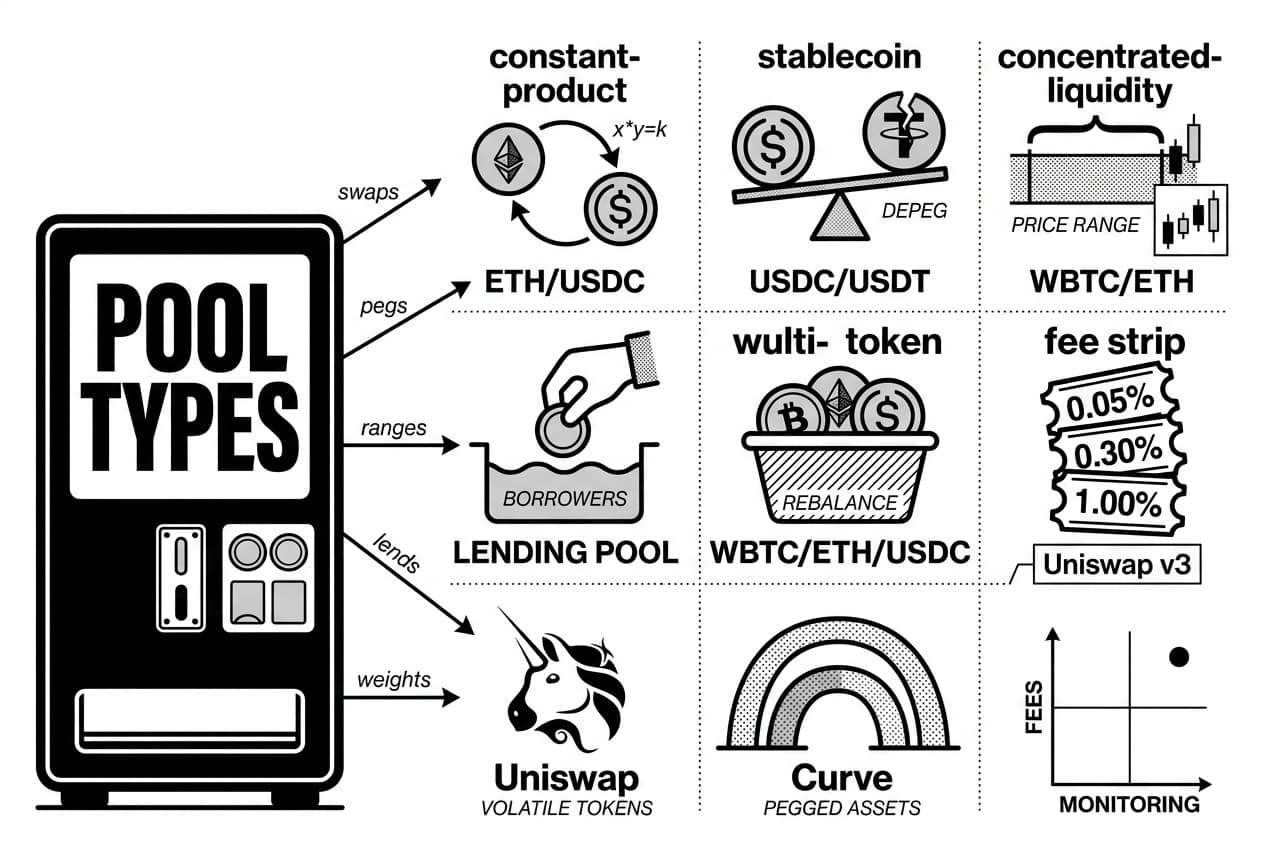
Liquidity pools are not one design. Different pool types exist for volatile tokens, stablecoins, lending markets, and multi-token exposure.
Common types of liquidity pools
Pool type | Typical assets | Main purpose | Key risk |
|---|---|---|---|
Constant-product pool | ETH/USDC, ETH/UNI | General token swaps using x * y = k | Impermanent loss on volatile pairs |
Stablecoin pool | USDC/USDT, DAI/USDC | Low-slippage swaps between pegged assets | Depeg risk if one stablecoin breaks its target |
Concentrated-liquidity pool | ETH/USDC, WBTC/ETH | Place capital inside a chosen price range | Position stops earning if price exits range |
Lending pool | USDC, ETH, WBTC | Supply assets for borrowers and earn interest | Smart contract bugs and liquidation stress |
Multi-asset weighted pool | WBTC/ETH/USDC baskets | Hold several tokens with custom weights | More complex rebalancing and exposure |
Stablecoin pools often have lower impermanent loss because both assets aim to track the same value. Concentrated-liquidity pools can earn more fees per dollar of capital, but they require closer monitoring. Uniswap v3 introduced fee tiers such as 0.05%, 0.30%, and 1.00% for different pool types (Uniswap Docs, accessed March 2026), which lets LPs match fee levels to expected volatility.
Most popular liquidity pool platforms
In our analysis of the top DeFi protocols by TVL, several platform categories appear again and again:
- Uniswap: widely used for volatile-token pools and concentrated-liquidity positions.
- Curve: known for stablecoin and pegged-asset swaps.
- Balancer: supports pools with more than two assets and custom weights.
- Sushi: offers multi-chain AMM pools and community-governed products.
- PancakeSwap: popular on lower-fee EVM networks, especially for retail-sized trades.
Do not choose a pool only because you recognize the brand. Match the pool design, fee tier, asset pair, and chain to your goal. A large, old pool can still be the wrong choice if the two assets do not fit your risk tolerance.
How Liquidity Providers Make Money
Liquidity providers make money when pool revenue exceeds the costs and risks of providing liquidity. The three main sources are trading fees, incentive tokens, and lending interest in pool designs that support borrowing.
Trading fees
Trading fees are the cleanest source of LP income because they come from real users swapping. If a pool holds $500,000 and you supply $10,000, you own 2% of the pool. If traders generate $3,000 in fees during a month, your share is about $60 before changes in token prices and pool composition.
Hayden Adams, Founder at Uniswap Labs, is relevant here because Uniswap’s fee model made user-paid swap fees central to LP returns. That does not mean every Uniswap pool is safe or profitable. It means the fee source is easier to inspect than a reward token whose price may fall quickly.
Yield farming and incentive tokens
Yield farming means moving crypto into positions that pay extra rewards, often in a protocol’s own token. A new pool may show 80% APY to attract deposits. That number can shrink if the token price drops, if rewards are cut, or if many new LPs dilute the rewards. Treat incentive APY as promotional income, not a salary.
The difference between real yield and subsidized yield
Real yield comes from user activity, such as swap fees or borrower interest. Subsidized yield comes from tokens printed or distributed by the protocol. Both can pay you, but they do not carry the same durability. A 12% return from steady fees may be healthier than a 120% return funded mostly by emissions.
The 2026 POOL framework for comparing yields
Use this original four-part check before chasing APR. P is pool depth. O is organic volume. O is operational risk, including audits, admin keys, and contract age. L is loss exposure, especially impermanent loss and reward-token volatility.
Check | Beginner question | Lower-risk signal | Higher-risk signal |
|---|---|---|---|
Pool depth | Is there enough liquidity for normal trades? | Deep liquidity relative to trade size | Thin pool where one trade moves price |
Organic volume | Are fees coming from real users? | Consistent swaps over time | High APR with little volume |
Operational risk | Can code or admin controls hurt LPs? | Audits, timelocks, public contracts | Anonymous team and upgradeable contracts |
Loss exposure | Can price movement erase fees? | Correlated assets and modest volatility | Volatile pair plus unstable reward token |
This is a generated 2026 editorial scorecard, not a guarantee. It forces the right order of analysis: first survival, then yield.
Liquidity Pool Risks and Safety Checks
Earning from a liquidity pool is possible, but the risk list is longer than the marketing page. Beginners should understand each hazard before depositing funds.
The main risks of using DeFi liquidity pools
- Impermanent loss: token prices move apart and your LP position underperforms simple holding.
- Smart contract bugs: flawed code can allow theft, frozen funds, or broken accounting.
- Oracle manipulation: a bad price feed can let attackers trade against a pool at unfair prices.
- Rug pulls: a malicious team can create hype, attract liquidity, and remove funds or abandon the project.
- Admin key risk: developer-controlled upgrade keys can change contract behavior. See smart contract access control risks for a deeper explanation.
- Bridge risk: cross-chain assets rely on bridge infrastructure. DeFi exploit dashboards tracked more than $2.8 billion in total crypto hack losses since 2021 (DefiLlama Hacks, accessed March 2026).
- Low liquidity: shallow pools create high slippage and can be easier to manipulate.
- Volatile rewards: a high APY paid in a weak token can collapse even if the pool contract works.
- Phishing: fake websites can steal approvals. Review self-custody wallet basics before connecting a wallet to any pool.
Security measures for DEXs and liquidity pools
Better protocols use several defenses. Audits are outside code reviews. Bug bounties pay researchers to report vulnerabilities. Multisig controls require several signatures for sensitive actions. Timelocks delay major changes so users can react. Open-source contracts let the public inspect the code.
None of these remove risk. They only reduce it. A protocol can be audited and still be exploited. A large pool can still expose you to impermanent loss. A familiar brand can still have a risky token pair. You can also review crypto insurance and DeFi risk, but LP coverage remains limited and policy terms matter.
Beginner safety checklist before depositing
- Verify the official URL from the protocol’s verified social accounts or documentation, then bookmark it.
- Check audits and confirm the audited contract address matches the pool you plan to use.
- Review TVL and volume on neutral dashboards, and be cautious with pools under $500,000 in liquidity.
- Understand impermanent loss for the exact token pair, not just the category.
- Start small with a test deposit and wait at least 24 hours before adding more.
- Revoke unused token approvals after sessions. Use this guide to revoke token approvals safely.
- Avoid unknown reward tokens unless you can verify supply, liquidity, and trading venues.
- Never deposit money you cannot afford to lose, because DeFi has no bank-style deposit insurance.
Liquidity Pools vs Staking, Order Books, and CEX Trading
Liquidity pools are one way to earn or trade in crypto. They are not the same as staking, order-book trading, or using a centralized exchange.
Liquidity pool vs staking
Staking usually means locking one token to help secure a blockchain or protocol and earning rewards. A liquidity pool usually requires two assets and supports trading. Staking avoids impermanent loss, but it may have lockups, validator risk, or slashing risk depending on the network.
Feature | Liquidity pool | Staking |
|---|---|---|
Assets required | Usually two | Usually one |
Main purpose | Power swaps and markets | Secure a network or protocol |
Impermanent loss | Yes | No |
Complexity | Higher for beginners | Usually lower |
Best fit | Users who can monitor risk | Users who want simpler exposure |
Liquidity pool vs order book
An order book matches buyers and sellers at agreed prices. An AMM pool lets traders swap directly against pooled assets. Order books can be efficient on large centralized exchanges, but they require trusting the venue to hold funds. Pools let users trade from self-custody, but they bring smart contract and slippage risk.
By 2026, routing systems often combine pools, market makers, and quote systems to find better execution. The beginner takeaway is practical: compare the final received amount, fees, custody model, and withdrawal risk. If custody is your main concern, read hardware wallets vs exchanges before deciding where to keep assets.
Frequently Asked Questions
- What is a liquidity pool?
- A liquidity pool is a reserve of crypto assets locked inside a smart contract and supplied by everyday users. Decentralized exchanges and other DeFi apps draw on these pools so traders can swap tokens, lend, or borrow without relying on a traditional market maker to sit on the other side of each trade.
- Do liquidity pools make money?
- They can. Liquidity providers may earn trading fees, governance tokens, or yield farming rewards. However, impermanent loss, fluctuating APR, smart contract vulnerabilities, and reward token price swings can significantly cut into — or completely erase — those returns. Earnings are never guaranteed.
- Which liquidity pool is best?
- There is no single best pool for everyone. The right choice depends on your goals, risk tolerance, preferred blockchain, assets you hold, fee tier, trading volume, and the pool's security track record. Also check whether yields come from real trading fees or short-term token incentives that may not last.
- What is an example of a liquidity pool?
- A common example is an ETH/USDC pool on a decentralized exchange like Uniswap. Liquidity providers deposit equal values of ETH and USDC into the pool. Traders then swap between the two assets, and liquidity providers earn a proportional share of the trading fees generated by those swaps.
- How does a liquidity pool work?
- Users deposit token pairs into a smart contract and receive LP tokens representing their share. Traders swap against the pool, and an automated market maker formula continuously adjusts prices based on supply and demand. Fees accumulate in the pool over time, and LPs can redeem their LP tokens to withdraw assets plus earned fees.
- What is better, a staking or liquidity pool?
- Staking is generally simpler — often requiring just one asset — and carries no impermanent loss risk. Liquidity pools can offer higher yields through trading fees but introduce added complexity and risk. The better option depends on whether you prioritize ease, yield potential, asset flexibility, or keeping your risk exposure low.
- Are crypto liquidity pools safe?
- No liquidity pool is entirely risk-free. Established, audited pools with deep liquidity tend to be more reliable than new experimental ones, but all pools carry smart contract risk, token approval exploits, phishing threats, asset volatility, and potential impermanent loss. Always research a pool thoroughly before depositing funds.
Sources
Author

Crypto analyst and blockchain educator with over 8 years of experience in the digital asset space. Former fintech consultant at a major Wall Street firm turned full-time crypto journalist. Specializes in DeFi, tokenomics, and blockchain technology. His writing breaks down complex cryptocurrency concepts into actionable insights for both beginners and seasoned investors.