DeFi Protocol Failure: Case Studies and Investor Lessons
DeFi protocol failure in 2026: the key finding
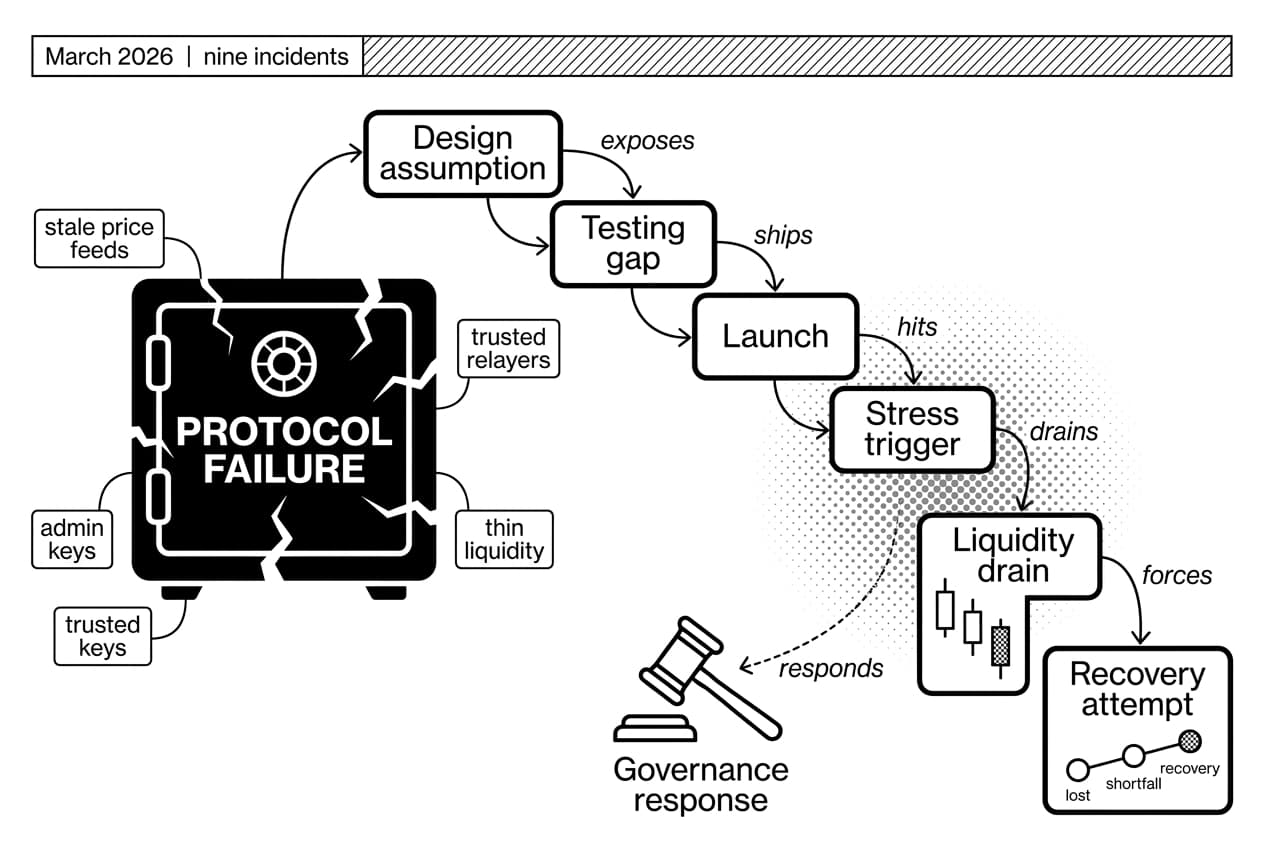
Key finding: a DeFi protocol failure is rarely just a coding bug. In the highest-impact cases, capital was lost when smart contracts, oracle assumptions, bridge trust, liquidity depth, admin keys and governance response failed together. As of March 2026, investors should treat protocol risk as a lifecycle: design assumption, testing gap, launch, stress trigger, liquidity drain, governance response and recovery attempt.
This article uses an author-compiled dataset of nine major incidents from 2016 to 2023, cross-checked against public post-mortems, chain analytics reports and exploit trackers. The dataset is not a full census of every loss. It is a focused comparison of failure modes that still matter in 2026: smart-contract defects, bridge compromises, oracle manipulation, governance weakness and economic design collapse.
The common framing says DeFi protocol failure is mainly a hack story. The record suggests a broader conclusion. Audited code can still fail when a protocol depends on thin liquidity, trusted relayers, concentrated validator keys, stale price feeds or a DAO that cannot act quickly during a crisis. For oracle-risk context, Sergey Nazarov, co-founder of Chainlink, is relevant because oracle infrastructure sits between off-chain information and on-chain execution. For lending and crisis governance context, Stani Kulechov, founder and CEO of Aave, is relevant because lending protocols must manage liquidation, shortfall and governance risk under stress. For automated market maker risk, Hayden Adams, founder of Uniswap, is relevant because liquidity pool design shapes how users enter and exit volatile markets.
The failure lifecycle: from assumption to loss
Our framework is the Failure Lifecycle. It separates the visible exploit from the earlier conditions that made the loss possible:
- Design assumption: a security, liquidity or economic premise is accepted without adversarial testing.
- Weak testing: audits cover code correctness but not live stress, oracle drift or cross-chain dependencies.
- TVL accumulation: deposits increase the reward for attackers and the damage from any withdrawal rush.
- Trigger: a hack, depeg, governance vote, oracle move or bridge message exposes the weak point.
- Liquidity drain: users, bots and attackers move faster than governance can respond.
- Governance response: teams pause contracts, publish incident reports, negotiate and vote.
- Recovery attempt: users receive reimbursement, partial repayment, token IOUs or nothing.
This lifecycle is visible in the Terra-linked collapse of May 2022, when the legacy luna token lost almost all market value in days and the algorithmic stablecoin model broke under redemption pressure. CoinGecko records the old luna price falling from above $80 in early May 2022 to fractions of a cent later that month (CoinGecko, May 2022 historical data). The chain kept producing blocks. The economic design failed.
By the numbers: DeFi losses, hacks and recovery rates
Raw figures prevent two common mistakes. The first is treating every incident as a one-off accident. The second is assuming that visible on-chain funds are recoverable. The table below uses public sources and an author-compiled incident sample to anchor the discussion. Figures should be read as risk indicators, not as live portfolio advice.
Key data points at a glance
Metric | Latest figure | Timeframe | Source | Why it matters |
|---|---|---|---|---|
Live DeFi TVL reference | Live dashboard figure changes daily | Accessed March 2026 | DefiLlama, March 2026 | TVL is the denominator for possible loss exposure. Use the live figure before committing capital. |
Crypto stolen in hacks | $2.2 billion | 2024 full year | Chainalysis, January 2025 | Shows that exploit losses rose again after the 2023 decline. |
Year-over-year change in stolen crypto | About 21% increase | 2024 vs. 2023 | Chainalysis, January 2025 | Loss pressure did not disappear as security tooling improved. |
Bridge losses in one peak year | More than $2.0 billion | 2022 | Chainalysis, August 2022 | Bridge architecture has been the largest recurring loss cluster. |
Largest bridge incident in the sample | $624 million | March 2022 | Chainalysis, 2024 review | The ronin bridge case shows how validator key compromise can exceed ordinary smart-contract losses. |
Author-compiled sample loss | About $2.29 billion across nine incidents | 2016-2023, reviewed March 2026 | Incident sources listed in the case table below | A cross-type sample makes technical, bridge, oracle and economic failures comparable. |
Sample recovery or recapitalization | About $1.4 billion to $1.7 billion, depending on how recapitalized bridge losses are counted | 2016-2023, reviewed March 2026 | Incident sources listed below | Recovery is uneven. Large backers improved outcomes in a few cases, while many users in smaller failures had little recourse. |
What the data shows and what it does not show
Verified facts: the largest incidents in this dataset cluster around bridges, oracle-dependent lending and economic designs with reflexive collateral. The ronin bridge loss was about $624 million in March 2022 (Chainalysis, 2024). The wormhole bridge loss was about $320 million in February 2022 (rekt.news, February 2022). The euler lending exploit was about $197 million in March 2023 (rekt.news, March 2023).
Interpretation: losses are not randomly distributed across DeFi. Attackers follow value, complexity and weak monitoring. Cross-chain messaging, price feed assumptions and upgradeable modules create attack surfaces that normal users cannot inspect quickly. That is why a protocol can look safe in marketing material while still carrying serious failure risk.
Caveat: recovery rates are difficult to compare across datasets. Some sources count attacker returns, some count frozen funds, some count recapitalization by investors and some count only on-chain reimbursement. For that reason, this article separates documented recovery outcomes by case rather than presenting one universal recovery rate.
What counts as a DeFi protocol failure?
A DeFi protocol failure is an event that stops users from accessing, valuing or recovering funds as expected. It can involve a hack, oracle manipulation, bridge compromise, governance failure, liquidity collapse, frontend attack or abandoned recovery process. The blockchain may keep working while the protocol rules, incentives or human response fail.
That distinction matters. When a centralized custodian fails, users usually lose access because an institution controls the assets. In DeFi, funds may remain visible on-chain while being trapped in a contract, drained into an attacker wallet or marked against a manipulated price. Understanding how liquidity pools work is a prerequisite for understanding how fast user exits can become a liquidity cascade.
Protocol failure is also different from ordinary market loss. A volatile token falling 80% is a market outcome. A lending protocol liquidating users against a manipulated collateral price is a structural failure. Mango markets in October 2022 is the clean example: an attacker used thin liquidity to inflate collateral value and extracted about $116 million (rekt.news, October 2022).
Technical failure vs. economic failure
Technical failures come from code or implementation: reentrancy, faulty access control, broken upgrade paths, compiler bugs or unchecked assumptions in a new module. Economic failures happen when the code runs as designed but the design collapses under incentives. Reflexive collateral, thin liquidity, excessive emissions and circular token backing can all fail without a classic hack.
The underreported category is economic failure. Post-mortems tend to focus on the transaction that caused the loss because it is easy to cite. Slow insolvency from poor incentives does not always produce a single transaction. For investors, the capital result can still be total loss.
Temporary disruption vs. permanent capital loss
Reversibility is the second axis. Some protocols pause, patch and repay users. Others lose the treasury, lose governance legitimacy or never pass a recovery vote. The ronin bridge incident was followed by user reimbursement through outside funding (ronin official incident notice, March 2022). Smaller protocols often lack that backstop.
Audits help, but they are not enough. A clean audit report does not prove that exit liquidity is deep, oracle feeds are hard to move, admin keys are distributed or governance can act within hours. This is the core reason DeFi protocol failure must be treated as a lifecycle rather than a single exploit.
Case studies: what actually happens when protocols break
The case studies below compare the trigger, loss estimate, recovery result and investor lesson. The goal is not to rank blame. The goal is to show how different failure types move through the same lifecycle.
Protocol or event | Failure type | Estimated loss | Trigger | Recovery outcome | Investor lesson |
|---|---|---|---|---|---|
the DAO, 2016 | Smart contract and governance | About $60 million, or 3.6 million ETH at the time (ethereum.org history, June 2016) | Reentrancy in withdrawal logic | Chain split and fund restoration through a hard fork | Code finality can collide with social consensus. |
iron finance, 2021 | Economic design | Market value fell from about $2 billion to near zero (CoinDesk, June 2021) | Partial-collateral confidence spiral | No meaningful user recovery | Reflexive collateral can fail without a hack. |
ronin bridge, 2022 | Bridge and validator keys | About $624 million (Chainalysis, 2024) | Five of nine validator keys compromised | Users were reimbursed after outside funding | Small validator sets can become single points of failure. |
wormhole bridge, 2022 | Bridge verification | About $320 million (rekt.news, February 2022) | Signature verification bypass | Hole was recapitalized within about 24 hours | Backer strength can matter as much as code quality. |
nomad bridge, 2022 | Bridge upgrade | About $190 million (rekt.news, August 2022) | Faulty message root after upgrade | Partial white-hat returns | Routine upgrades can create catastrophic exposure. |
poly network, 2021 | Cross-chain logic | About $611 million (Chainalysis, August 2021) | Privileged cross-chain call path abused | Attacker returned most funds | Do not model recovery on attacker goodwill. |
mango markets, 2022 | Oracle and market manipulation | About $116 million (rekt.news, October 2022) | Thin-liquidity price pump used as collateral | Partial negotiated return | Oracle design must account for liquidity depth. |
euler, 2023 | Lending module design | About $197 million (rekt.news, March 2023) | Donation attack via missing health check | Most funds returned after negotiation | New modules need audit depth equal to core code. |
curve pools, 2023 | Liquidity and compiler risk | About $70 million at risk across affected pools (curve official news, July 2023) | Compiler reentrancy guard issue | Partial recovery and governance response | Compiler and dependency risk can bypass app audits. |
the DAO hack: governance and code risk before DeFi had a name
In June 2016, the DAO exploit drained roughly 3.6 million ETH from a large on-chain investment vehicle, worth about $60 million at the time (ethereum.org history, June 2016). The immediate problem was a reentrancy flaw. The lasting issue was governance: should a chain reverse a major loss if enough users and developers agree?
The lesson is not simply to audit code. The lesson is that extreme losses force social coordination. That coordination can save users in one case and fracture a community in another. Investors should ask who can act, how decisions are made and whether emergency authority is legitimate before capital is at risk.
iron finance and titan: reflexive tokenomics under stress
Iron finance was not drained through a classic exploit. Its model backed a stable asset partly with a volatile native token. When confidence fell in June 2021, redemptions increased token issuance, which pushed the token price lower, which weakened confidence again. CoinDesk reported titan falling from about $65 to near zero in under 24 hours (CoinDesk, June 2021).
This is a pure economic design failure. The code did what the mechanism allowed. The failure was the assumption that liquidity and confidence would remain deep enough during stress. When collateral and governance token value depend on the same belief loop, sell pressure can become self-amplifying.
poly network, ronin, wormhole and nomad: why bridges remain a risk cluster
Bridge failures dominate the high-loss tail because bridges combine several systems at once: smart contracts, relayers, validators, wrapped assets, liquidity pools and finality assumptions. Chainalysis reported that cross-chain bridge hacks accounted for more than $2.0 billion in stolen crypto in 2022 (Chainalysis, August 2022).
Each major bridge case failed differently. Ronin concentrated signing power. Wormhole failed at verification. Nomad accepted bad messages after an upgrade. Poly network exposed a privileged cross-chain call path. That variety is the point. Bridge risk is not one bug class. It is a system category with many ways to break.
Recovery outcomes also diverged. Wormhole was recapitalized quickly. Ronin users were reimbursed after outside funding. Nomad users saw partial white-hat returns. Poly network recovered most funds only because the attacker chose to return them. Developers assessing these systems should also review front-running prevention in smart contracts, since message ordering and transaction timing can create related attack paths.
mango markets, euler and curve pools: oracle, liquidity and governance lessons
Mango markets showed how a thin market can become an oracle problem. The attacker inflated the marked value of collateral, borrowed against it and left the protocol with a deficit. The reported loss was about $116 million (rekt.news, October 2022). That incident was not about a missing semicolon. It was about liquidity depth, collateral parameters and governance incentives.
Euler showed a different pattern. A new lending module created a missing health-check path, leading to an exploit of about $197 million in March 2023 (rekt.news, March 2023). Most funds were returned, but the case still shows that protocol changes after maturity can be as dangerous as first launch.
The curve pool incident showed dependency risk. The affected contracts relied on compiler behavior that did not protect specific pools as expected. Application teams can audit their own source code and still inherit risk from compilers, libraries, deployment tooling and language versions.
Across all cases, the repeat pattern is the gap between stated security model and live attack surface. Audits, bug bounties and formal methods reduce that gap. None eliminate it.
Why bridges and cross-chain systems keep failing
Bridge failures are structurally predictable because they ask users to trust facts from one chain inside another chain. That sounds simple, but implementation requires validators, relayers, light clients, wrapped tokens, liquidity routing and upgrade controls. Every added layer creates a new place where a DeFi protocol failure can start.
The cross-chain attack surface
The ronin bridge incident is the clearest example of validator concentration. Attackers compromised five of nine validator keys and drained about $624 million in March 2022 (Chainalysis, 2024). Understanding DeFi interoperability and cross-chain messaging helps explain why this was not an isolated design problem.
Newer bridge designs often distribute message verification across more parties. That can reduce key-compromise risk, but it does not remove relayer censorship, replay risk, bad upgrades or admin-key exposure. If one privileged account can upgrade contracts without delay, a large validator set does not fully protect users.
Interoperability is useful, but not free
Cross-chain systems improve access and capital efficiency. They also transmit failures. If a bridge asset becomes unbacked on one chain, a lending protocol on another chain may inherit the damage even if its own contracts work as intended. This is why bridge exposure belongs in every serious risk screen.
For oracle and cross-chain context, Sergey Nazarov is one of the approved public figures cited in this analysis because Chainlink works on data and interoperability infrastructure. The investment takeaway is narrower than any one provider: users should identify exactly which bridge, oracle and message layer a protocol depends on before depositing.
Pre-launch testing gaps: where failure usually starts
Most failures begin before launch. The weak point is often not the absence of testing. It is a mismatch between what was tested and what was deployed. A protocol may audit one contract set, then launch with upgradeable proxies, new oracle feeds, changed parameters or bridge integrations that were outside the final audit scope.
Security disclosures should make that mismatch visible. Investors should look for deployed addresses, final audit dates, commit hashes, oracle feed IDs, admin roles, multisig thresholds and bridge dependencies. If those items are missing, the audit label alone is not enough.
How to tell whether the test scope matches the real protocol
Use the deployment-surface audit, a seven-item framework for checking whether security review matches the live system: verified deployed bytecode, proxy implementation, oracle integrations, admin roles, bridge dependencies, governance parameter ranges and post-audit commits. Solid smart contract testing and deployment practices treat these as release gates, not paperwork.
Where testing gaps show up before launch
The skipped categories are consistent. Fuzzing is shallow or absent. Invariant testing does not cover economic state. Fork testing uses idealized liquidity rather than current market depth. Pause functions are not tested against fast drains. Liquidation models assume orderly prices. Oracle failure tests do not cover stale data, deviation thresholds or missing updates.
Governance attack tests are also rare. A protocol can have clean contracts and still be vulnerable to a hostile proposal, concentrated voting power or an emergency signer who cannot respond in time. If a security page does not disclose these tests, the absence itself is a risk signal.
Recovery after failure: who gets paid, who waits and who decides?
After a failure, users care less about root cause and more about recovery. Outcomes depend on treasury depth, insurance coverage, governance speed, legal exposure and whether a credible team remains. Two users in similar incidents can see very different results because one protocol has a funded backstop and the other has only a forum thread.
The usual sequence is familiar: contracts pause, frontends warn users, incident reports appear, exploit wallets get labeled, negotiations begin and governance debates compensation. During that period, scammers often impersonate recovery agents, fake support accounts and claim portals. Users should document transactions before interacting with any recovery site.
Stani Kulechov, founder and CEO of Aave, is included here because lending governance and shortfall management are directly relevant to crisis response. The broader point is that recovery is a governance product. It must exist before the incident, not after the treasury is empty.
For users documenting exposure, hardware wallet safety best practices and crypto compliance and transaction monitoring tools can help preserve transaction records and reduce follow-on phishing risk.
Common recovery paths
Recovery path | Description | Example | User outcome |
|---|---|---|---|
Full reimbursement | Protocol, backer or parent entity covers losses. | Ronin bridge users were reimbursed after the March 2022 exploit (ronin official notice, 2022). | Best case, but uncommon. |
Partial recovery | Attacker returns funds or white hats return a fraction. | Nomad recovered part of the August 2022 loss (rekt.news, August 2022). | Users wait and may receive less than face value. |
Negotiated return | Protocol negotiates with attacker on-chain or through intermediaries. | Euler recovered most of the about $197 million loss (rekt.news, March 2023). | Better than liquidation, but not predictable. |
Bad-debt socialization | Losses spread across the protocol, reserve or remaining participants. | Lending markets sometimes use safety modules or reserves. | Loss is diluted, not erased. |
Token IOU | Affected users receive a new token claim. | Used by some smaller post-exploit protocols. | Value depends on future demand and governance. |
Protocol restart | Contracts are redeployed and old state is partly abandoned. | Seen in smaller post-incident relaunches. | Terms vary and may favor active claimants. |
Permanent shutdown | No credible compensation path remains. | Common among small, underfunded projects. | Users face total or near-total loss. |
In the author-compiled sample, the strongest predictor of user outcome was not just exploit size. It was the presence of a solvent backer, fast communication and an actionable recovery plan within the first 72 hours. If those three are absent, on-chain visibility does not translate into recovery.
Risk frameworks investors can use before depositing capital
The case studies point to a practical rule: most failure signals are visible before deposit. Thin liquidity, single-admin keys, unclear oracle design, bridge dependence and vague audit scope are not hidden. They are often disclosed in docs, governance forums or contract explorers. The problem is that investors often check yield first and risk second.
This article adapts security-control thinking into a DeFi screen: identify assets, protect privileged functions, detect abnormal state, define response authority and plan recovery. The translation is imperfect because DeFi is open, composable and market-driven. Still, pre-deposit threat modeling is better than post-exploit reaction.
Investor due-diligence checklist
Use this 10-point pre-deposit screen before committing capital to any protocol:
- Check audit coverage: confirm at least two independent audits and verify that the audited contracts match the live addresses.
- Verify deployed bytecode: compare contract addresses, proxy implementations and commit hashes against the audit scope.
- Review TVL concentration: identify whether one wallet, fund or protocol controls an outsized share of deposits.
- Verify admin keys: check multisig thresholds, signer transparency, timelocks and emergency powers.
- Check oracle design: identify feeds, update frequency, fallback rules and deviation limits.
- Compare bridge exposure: list every bridge, wrapped asset and cross-chain message layer the protocol relies on.
- Review incident history: read exploit databases, governance forums and post-mortems before treating age as safety.
- Monitor governance distribution: check whether a small group can pass proposals or block emergency action.
- Check pause functions: identify who can pause contracts, when they can act and whether the pause covers all loss paths.
- Monitor withdrawal liquidity: watch exit depth before stress, not after queues or slippage appear.
These checks overlap with rug pull warning signs, especially around admin-key opacity, concentrated token control and unclear recovery promises. The difference is that even non-scam protocols can fail if these controls are weak.
Forward-looking scenarios for 2026 and beyond
The risk surface is not static. The following scenarios are conditional, not predictions.
If cross-chain activity keeps growing, bridge risk becomes a first-order portfolio variable. More chains and more wrapped assets mean more message paths to verify. In that scenario, bridge dependency may matter more than the base lending or trading contract.
If tokenized real-world assets expand, oracle and legal risk rise together. Off-chain asset values, custodians, redemption windows and court processes cannot be verified purely on-chain. Protocols using those assets need tighter disclosure than pure crypto collateral systems.
If autonomous trading agents manage more capital, exploit propagation could speed up. Automated agents can move funds faster than human governance. That does not make systemic failure certain, but it compresses the response window from hours to minutes in some designs.
If regulation forces more disclosure, larger protocols may publish better risk reports, but smaller teams may shift activity to less visible venues. Better reporting helps investors only if they read it and compare it with live contracts.
Key takeaways: what DeFi failures mean for investors
The core lesson is simple: yield is compensation for layered risk. Smart-contract bugs, oracle manipulation, bridge exposure, liquidity design and governance response are separate layers. When two or more fail together, losses accelerate and recovery becomes uncertain.
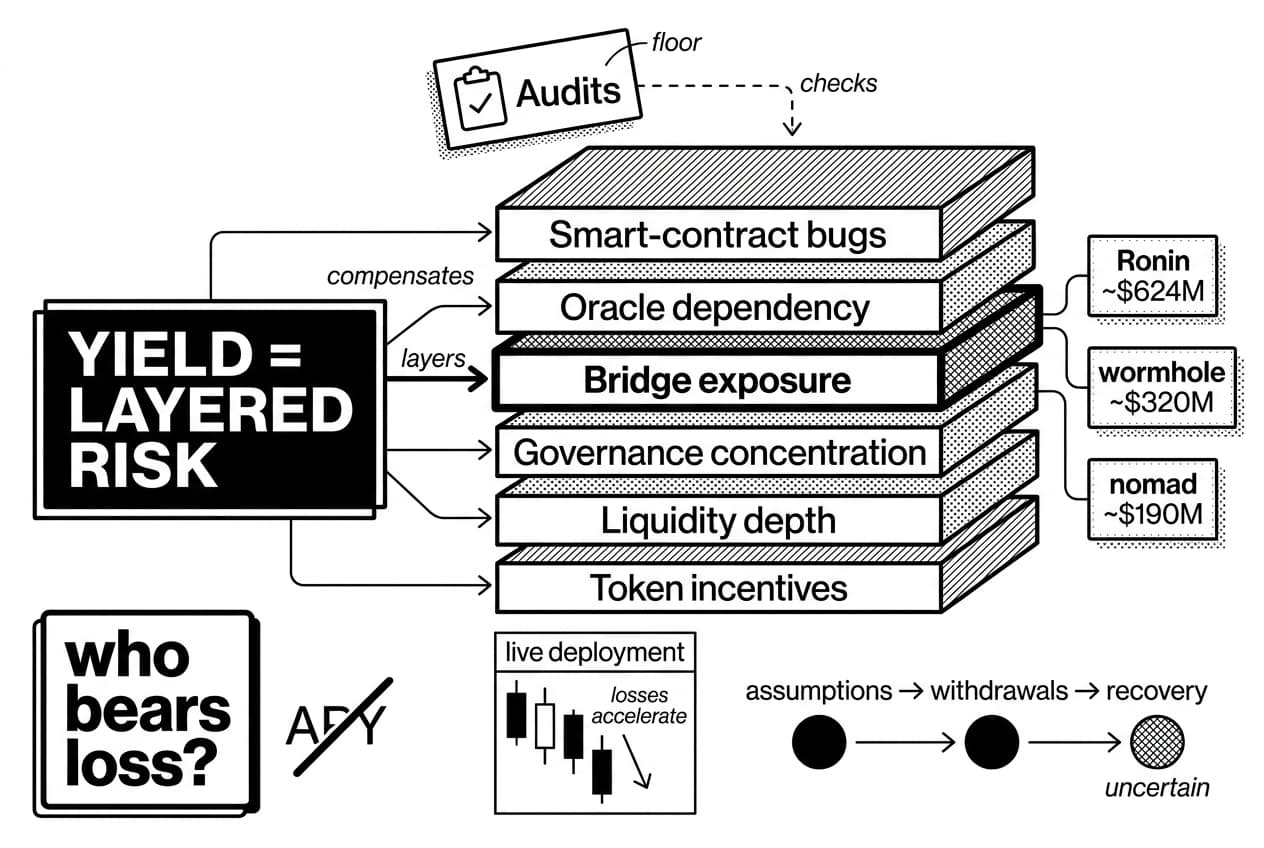
Audits remain valuable, but they are a floor. They do not automatically prove that oracle assumptions are safe, bridges are solvent, admin keys are distributed or liquidity can absorb withdrawals. As of March 2026, the better question is not whether a protocol has been audited. It is whether the live deployment, governance structure and economic design match the assumptions that were audited.
Bridge exposure deserves separate review in every portfolio. Ronin at about $624 million, wormhole at about $320 million and nomad at about $190 million show that cross-chain design can produce losses far larger than ordinary contract bugs (Chainalysis, 2024; rekt.news, 2022; rekt.news, 2022).
The bottom line
Evaluate how a protocol can fail before evaluating how much it can yield. Map smart-contract risk, oracle dependency, bridge exposure, governance concentration, liquidity depth and token incentives. If you cannot identify who bears the loss in each layer, the advertised APY is not yet an investable number. This is not financial advice. It is a risk screen for avoiding preventable exposure.
Frequently Asked Questions
- What does DeFi protocol mean?
- A DeFi protocol is blockchain-based software that delivers financial services — lending, trading, staking, derivatives, or asset bridging — without a traditional intermediary like a bank. Users interact through smart contracts, wallets, and governance systems, which creates genuine transparency but also introduces unique technical risks not present in conventional finance.
- How do I get my money out of DeFi?
- Connect your wallet, withdraw funds from the protocol, unwind any liquidity or staking positions, bridge assets to your target network if necessary, then transfer to a self-custody wallet or exchange. Watch out for gas fees, withdrawal queues, slippage, paused contracts, and phishing sites posing as recovery services — these are common traps during protocol stress events.
- How risky is DeFi?
- Risk ranges from moderate to extreme depending on protocol maturity, audit quality, liquidity depth, admin controls, and bridge exposure. Key threat categories include smart-contract exploits, oracle manipulation, governance attacks, stablecoin depegs, liquidation cascades, and plain user error. Newer or unaudited protocols carry significantly higher risk than established, battle-tested ones.
- Does DeFi have a future?
- DeFi likely has a future, but growth depends on meaningful improvements in security, compliance tooling, and risk management. Institutional adoption, tokenized real-world assets, and maturing cross-chain infrastructure could expand the sector considerably. That said, ongoing protocol failures will continue weeding out weaker projects, and long-term success is far from guaranteed for every participant.
Sources
Author

Crypto analyst and blockchain educator with over 8 years of experience in the digital asset space. Former fintech consultant at a major Wall Street firm turned full-time crypto journalist. Specializes in DeFi, tokenomics, and blockchain technology. His writing breaks down complex cryptocurrency concepts into actionable insights for both beginners and seasoned investors.