DeFi Staking Calculator: Estimate Your Returns Step by Step

DeFi staking calculator: estimate your returns step by step
Use this guide as a practical worksheet before you stake. You will collect the right inputs, enter them into a DeFi staking calculator, adjust the output for real costs, test price scenarios and compare options before moving funds.
What you'll accomplish with a DeFi staking calculator
A DeFi staking calculator is a tool that estimates potential staking returns by combining your stake amount, APY, duration, compounding frequency and fees. It helps you compare possible outcomes before depositing tokens, but it should be treated as a planning aid, not a promise of profit.
As of May 2026, the safest way to read a calculator result is as a range. The headline APY is only the first layer. Your real result also depends on token price movement, gas, platform fees, lockups, tax treatment and protocol risk.
For this guide, use a simple framework I call the net-return stack: gross rewards, compounding, direct costs, exit limits, token price change and failure risk. If any layer is missing, the estimate is incomplete.
The formula most staking calculators use
Most calculators start with the same basic math: reward = principal × rate × time. If rewards compound, the calculator reinvests rewards at the interval you choose and recalculates the next period from the larger balance.
For example, a $1,000 stake at 12% APY for 365 days shows about $120 before fees if you assume the token price stays flat. That number is useful only after you test what happens if fees rise or the token falls.
Why the output is not guaranteed income
A calculator only works with the numbers you enter. It cannot know whether a validator goes offline, a smart contract is exploited, a token depegs or a reward program is cut next month.
- Price volatility: A 20% token drop can erase a 12% staking gain in fiat terms.
- Changing rates: Flexible DeFi rates can move when liquidity enters or leaves a protocol.
- Validator risk: Some proof-of-stake systems can penalize validators and delegators for downtime or bad behavior.
- Smart contract risk: Audits reduce risk, but they do not remove it.
Stani Kulechov, founder and CEO of Aave, is a useful expert reference here because Aave's rate model shows how DeFi yields can respond to supply and demand. Treat any projected return as a decision input, not as fixed income.
What you'll need before you calculate returns
Before you open a DeFi staking calculator, gather your inputs. Missing one small cost can make the estimate look better than the result you actually receive.
Input checklist
You will also want to choose a DeFi wallet before staking, since wallet support can affect which staking routes you can use.
- Token amount: the exact number of tokens you plan to stake.
- Token price: the current price in USD or your local currency on the calculation date.
- APY or APR: confirm which rate the platform shows. They are not the same.
- Staking duration: your planned holding period in days or months.
- Compounding frequency: none, daily, weekly, monthly or automatic.
- Platform fee: the protocol, validator or service fee deducted from rewards.
- Gas fees: estimate the cost to stake, claim and unstake.
- Lockup period: the time your funds cannot be moved.
- Withdrawal rules: cooldowns, exit queues, penalties and minimum balances.
Warning: Many dashboard APYs do not subtract gas, service fees or tax. Always calculate net return, not just headline return.
Separate token rewards from fiat returns
Your calculator may show two outputs: the number of tokens you earn and the fiat value of those tokens. These can move in opposite directions.
If you earn 50 reward tokens but the token price falls by 40%, your wallet balance can be larger in token terms and smaller in dollar terms. That is why the calculator should include at least one bearish price scenario.
Step 1: choose the staking type you want to model
Start by choosing what kind of staking you are modeling. The staking type changes the inputs, the risks and the meaning of the calculator result.
- Native staking: you delegate or lock tokens directly to help secure a proof-of-stake network.
- Liquid staking: a protocol stakes for you and gives you a receipt token that may be used or sold elsewhere.
- Protocol staking: you deposit a token into a DeFi smart contract to earn a protocol reward.
- Liquidity incentives: you supply assets to a pool and may earn trading fees plus token rewards. Read how liquidity pools work before modeling this because impermanent loss can matter more than APY.
- Custodial staking: a platform holds the asset and pays a stated rate. It is easier, but you give up direct custody.
Hayden Adams, founder of Uniswap Labs, is relevant when you compare liquidity incentives because pool returns depend on trading fees, liquidity depth and price movement, not only on reward APY.
Compare fixed and flexible staking
Feature | Fixed staking | Flexible staking |
|---|---|---|
Lockup | Set term, such as 30, 90 or 180 days | Usually withdraw anytime |
Typical rate | Often higher | Often lower or variable |
Early exit | May be blocked or penalized | Usually allowed |
Best calculator setting | Exact term length | Conservative rolling rate |
Main risk | Token falls while locked | Rate falls after deposit |
Pro tip: If you model flexible staking, do not project one rate for a full year without a backup case. Run a lower-rate case so you know what happens if incentives are reduced.
Choose where you will stake
Your staking venue determines which costs to enter. Direct staking, liquid staking, DeFi app deposits, custodial platforms and wallet-integrated staking all have different fee paths.
For Ethereum solo validation, the deposit requirement is 32 ETH (ethereum.org staking docs, May 2026). If that is too high for your position size, your calculator should model pooled or liquid staking instead of solo validation.
Once your staking type and venue are clear, you can enter numbers that match the real product rather than a generic APY.
Step 2: enter your stake amount, APY and time period
Now open your calculator and fill in the core fields. In most tools, type your token amount into the amount field, enter the displayed rate in the APY or APR field, select your duration, choose the compounding setting and click the calculate button.
Read APY and APR correctly
APR is a simple annual rate before compounding. APY includes compounding, so it is usually higher than the matching APR.
If a protocol shows 15% APY and you also select daily compounding in a calculator that expects APR, you may double-count the compounding effect. Check the label before you click calculate.
Pro tip: Daily compounding on a 15% APR produces about 16.18% APY by standard compound-interest math. If the tool asks for APY, do not add another compounding layer unless the instructions say to.
Use a worked calculator transcript
Here is a small worksheet you can copy. It is an example dataset, not a recommendation.
Input or output | Example value | Why it matters |
|---|---|---|
Stake amount | 1,000 USDC | Starting principal |
Rate | 12% APY | Headline return before extra costs |
Duration | 30, 180 and 365 days | Shows time sensitivity |
Compounding | Daily | Assumes rewards are reinvested |
Raw 30-day result | About $9.86 | Short periods create modest gains |
Raw 180-day result | About $58.91 | Half-year estimate before costs |
Raw 365-day result | About $120.00 | One-year estimate before costs |
This transcript is evidence of the calculation path: input, setting, output and interpretation. Save the same fields for your own stake so you can compare the estimate with the payout later.
Step 3: adjust for compounding, fees and gas costs
The raw output is only the first answer. Now subtract the costs you will actually pay.
Choose a compounding frequency
Compounding can help only if the cost of claiming and restaking is lower than the extra reward. If each claim requires an on-chain transaction, frequent compounding can hurt smaller positions.
Use this rule: if one compounding transaction costs more than the reward earned since the last claim, wait longer. For small stakes, weekly or monthly compounding is often more realistic than daily manual compounding.
Subtract fees line by line
Use this fee-adjusted formula:
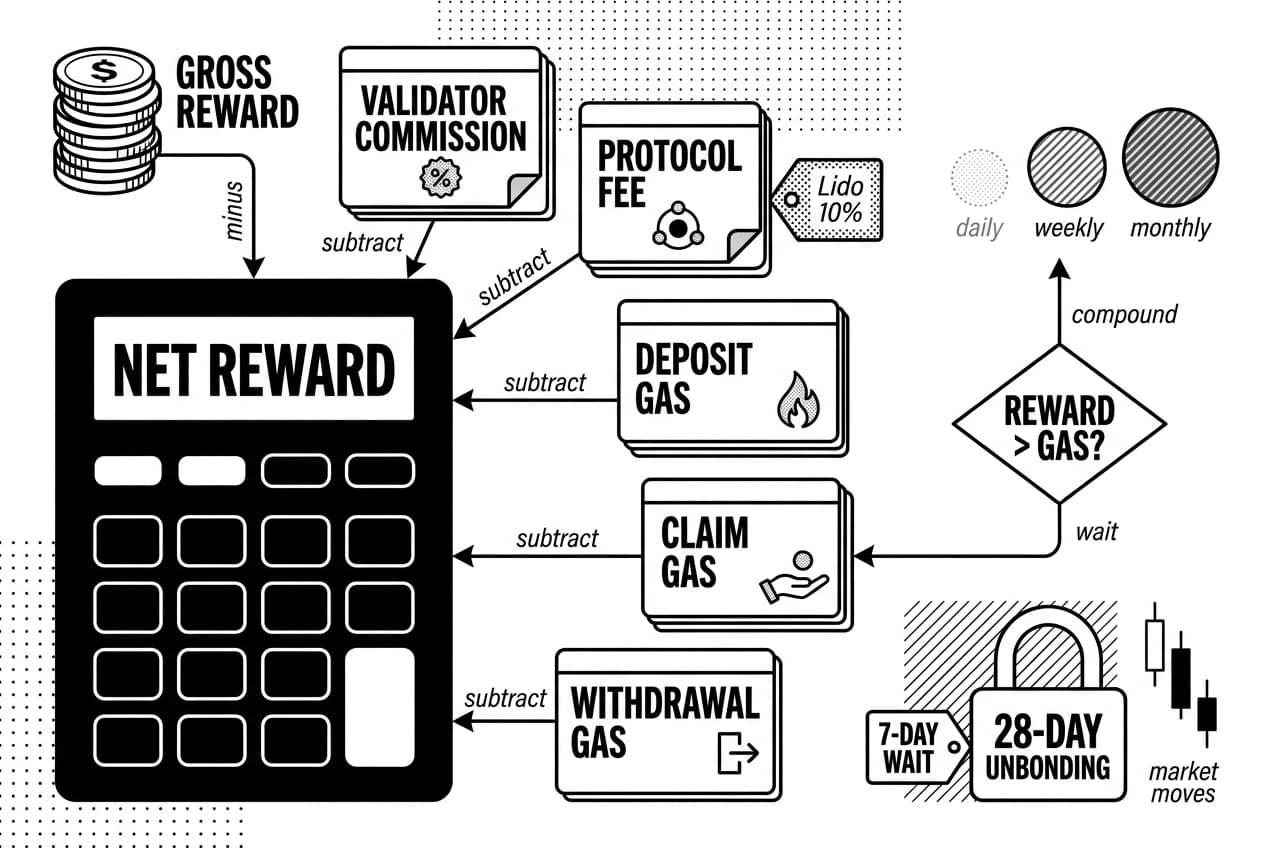
net reward = gross reward minus validator commission minus protocol fee minus deposit gas minus claim gas minus withdrawal gas
Lido states a 10% fee on staking rewards in its docs (Lido docs, May 2026). If you model liquid ETH staking through a service with a reward fee, enter that percentage before comparing it with a no-fee option.
Warning: Do not combine all costs into one vague adjustment. List them separately so you can see which cost matters most.
Account for unstaking delays
Some staking systems make you wait before funds are transferable. Polkadot staking has a 28-day unbonding period (Polkadot staking docs, May 2026). During an unbonding period, you may be unable to sell even if the market moves against you.
If your calculator has no field for an exit delay, add those days to your risk notes. A seven-day or 28-day wait can be more important than a small APY difference.
Step 4: convert token rewards into real return scenarios
After fees, convert your token result into fiat scenarios. This is the step that prevents a high APY from hiding a bad investment outcome.
Run base, bull and bear cases
Take the projected final token balance and multiply it by three price assumptions: flat price, 30% higher price and 30% lower price. You can change the percentages for volatile assets.
Scenario | Price move | Token balance | Fiat value |
|---|---|---|---|
base case | $1.00 | 1,120 tokens | $1,120 |
bull case | $1.30 | 1,120 tokens | $1,456 |
bear case | $0.70 | 1,120 tokens | $784 |
The bear case shows the problem. You gained 120 tokens, but the position lost $216 in fiat value. A DeFi staking calculator should make that risk visible.
Find your break-even price floor
Use this formula: break-even price = initial fiat investment divided by projected final token balance.
With a $1,000 starting value and 1,120 projected tokens, the break-even price is about $0.893. That means the token can fall about 10.7% before the staking reward is wiped out in fiat terms.
Warning: Higher APY does not make price risk disappear. It only gives you a wider buffer. Always calculate the break-even price before staking.
Step 5: check minimums, lockups, taxes and risk
Now review the conditions that sit outside the calculator. Minimums, lockups, taxes and protocol risk can change whether a stake makes sense.
Check the minimum amount to stake
Some products accept tiny deposits. Others require large balances or specific token lots. For example, Ethereum solo validation requires 32 ETH (ethereum.org staking docs, May 2026), while many pooled routes accept much smaller deposits.
If the minimum is too high, do not stretch your budget just to match the calculator. Model a smaller pooled option instead.
Review the main staking risks
- Smart contract exploits: code bugs can drain funds even after an audit.
- Slashing: validator downtime or misconduct can reduce rewards or principal on some networks.
- Oracle failure: bad price data can affect reward logic, liquidations or peg assumptions. Sergey Nazarov, co-founder of Chainlink Labs, is a relevant expert reference because Chainlink focuses on decentralized oracle networks.
- Depeg risk: stablecoins and liquid staking receipt tokens can trade below target value.
- Liquidity risk: locked tokens cannot be sold during a market drop.
- Governance risk: a vote can change fees, emissions or withdrawal rules.
- Wallet risk: a stolen seed phrase can cause total loss even if the protocol works correctly.
Before you deposit, take time to spot crypto scam warning signs. If the position is large for you, also review how to understand crypto insurance options.
Warning: Use the short-track risk test: new code, unclear yield source and no meaningful operating history. If a staking offer fails all three checks, reduce size or walk away.
Check whether rewards are taxable
In the United States, the IRS addressed staking rewards in revenue ruling 2023-14 (IRS, 2023), stating that rewards can be taxable as ordinary income when the taxpayer gains control over them. A later sale can create a separate capital gain or loss.
Rules differ by country. Record the date received, token amount, market value and later sale price. If the amount is meaningful, ask a qualified tax professional before year end.
Step 6: compare staking options before you commit
Run the same calculation for at least two or three options. This is where a DeFi staking calculator becomes a decision tool instead of a yield display.
Use a comparison table
Fill in the table below after you calculate each option. You can also compare DeFi protocols by TVL to understand how much on-chain capital is behind a platform.
Option | APY | Lockup | Fees | Liquidity | Key risk | Best for |
|---|---|---|---|---|---|---|
liquid ETH staking | around 3% to 4% | usually flexible | service fee may apply | high | contract or receipt-token discount | beginners who want flexibility |
stablecoin lending pool | around 4% to 9% | usually flexible | gas and protocol fees | medium to high | depeg or insolvency | users seeking lower volatility |
new incentive farm | 30% plus | often fixed | entry and exit gas | low | token inflation or rug pull | experienced users only |
The highest APY is rarely the cleanest choice. A lower-yielding option with flexible exit rights and clear fees may be better for a beginner than a locked farm with thin liquidity.
Pressure-test high APY
Ask where the yield comes from. If it comes from real fees paid by users, it is easier to reason about. If it comes mainly from newly issued reward tokens, model a falling token price.
Compare each option on the net-return stack: gross reward, compounding, direct costs, exit limits, token price change and failure risk. If one option wins on APY but fails the other layers, the calculator is warning you, not inviting you.
Summary and next steps
You now have the full process. Gather inputs, choose the staking type, enter amount, APY and duration, subtract costs, model token price scenarios, check lockups and taxes, then compare options side by side.
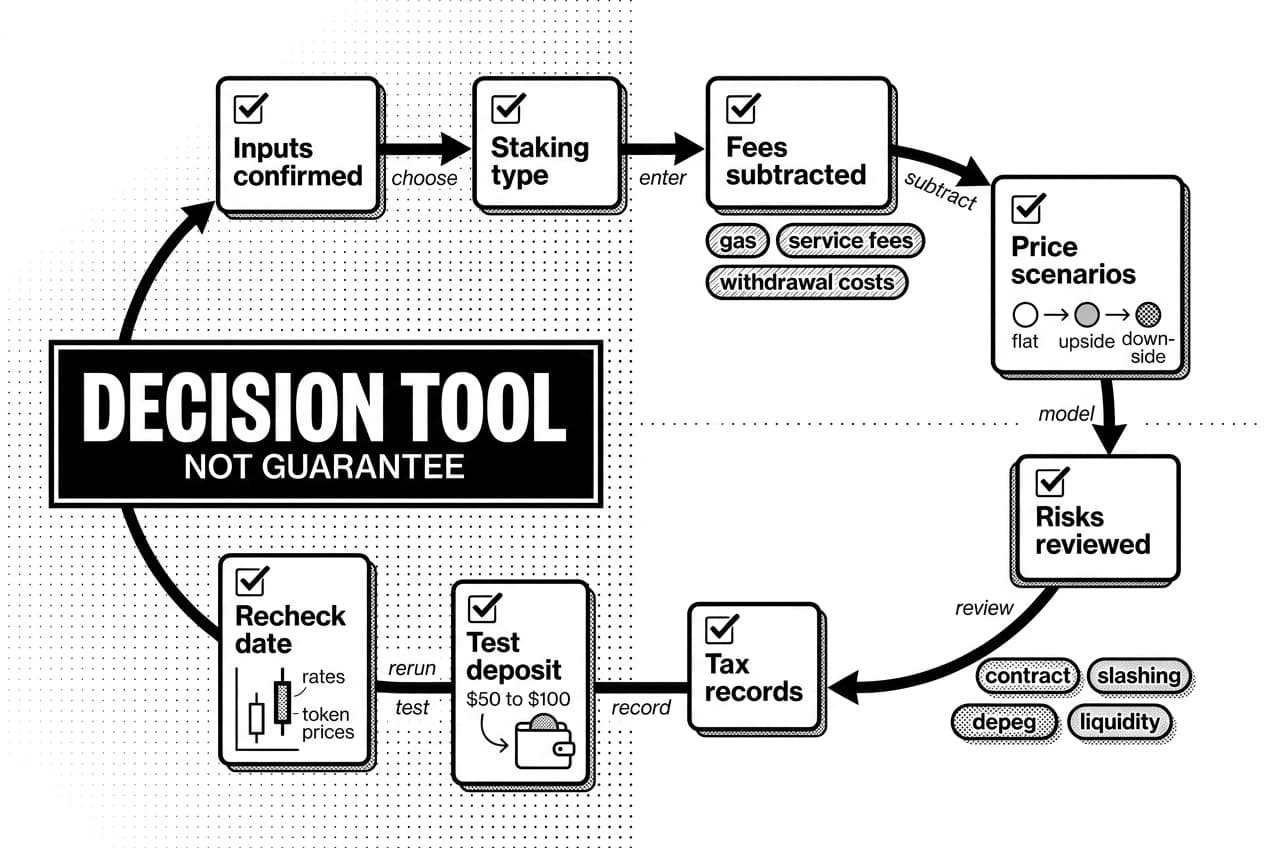
Start small. A test deposit of $50 to $100 can teach you how the platform handles approvals, reward claims, withdrawal timing and fees. Keep a spreadsheet with your calculator inputs and actual payouts so you can improve your assumptions over time.
Your quick pre-staking checklist
- Inputs confirmed: you know your stake amount, rate and time horizon.
- Staking type chosen: you know whether it is fixed, flexible, liquid, native or pool-based.
- Fees subtracted: gas, service fees and withdrawal costs are included.
- Price scenarios modeled: flat, upside and downside cases are complete.
- Risks reviewed: contract risk, slashing, depeg risk and liquidity limits are understood.
- Tax records planned: you know what to record when rewards arrive.
- Test deposit ready: you will not put the full amount in on the first try.
- Recheck date set: you will rerun the calculator when rates or token prices change materially.
A DeFi staking calculator is a decision tool, not a guarantee. Use it honestly, update it often and let the downside scenarios guide your position size.
Frequently Asked Questions
- How does a DeFi staking calculator work?
- A DeFi staking calculator estimates potential rewards by combining your stake amount, APY or APR, staking duration, compounding frequency, and fees. It gives you a planning estimate, not a guaranteed return, because token prices and protocol conditions can change.
Sources
Author

Crypto analyst and blockchain educator with over 8 years of experience in the digital asset space. Former fintech consultant at a major Wall Street firm turned full-time crypto journalist. Specializes in DeFi, tokenomics, and blockchain technology. His writing breaks down complex cryptocurrency concepts into actionable insights for both beginners and seasoned investors.