DeFi Interoperability: How Protocols Talk Across Chains
What Is DeFi Interoperability?
DeFi interoperability is the ability for decentralized finance protocols to exchange assets, data, and smart contract instructions across multiple blockchains, so users can trade, lend, borrow, or move value without relying on one central exchange to connect every app.
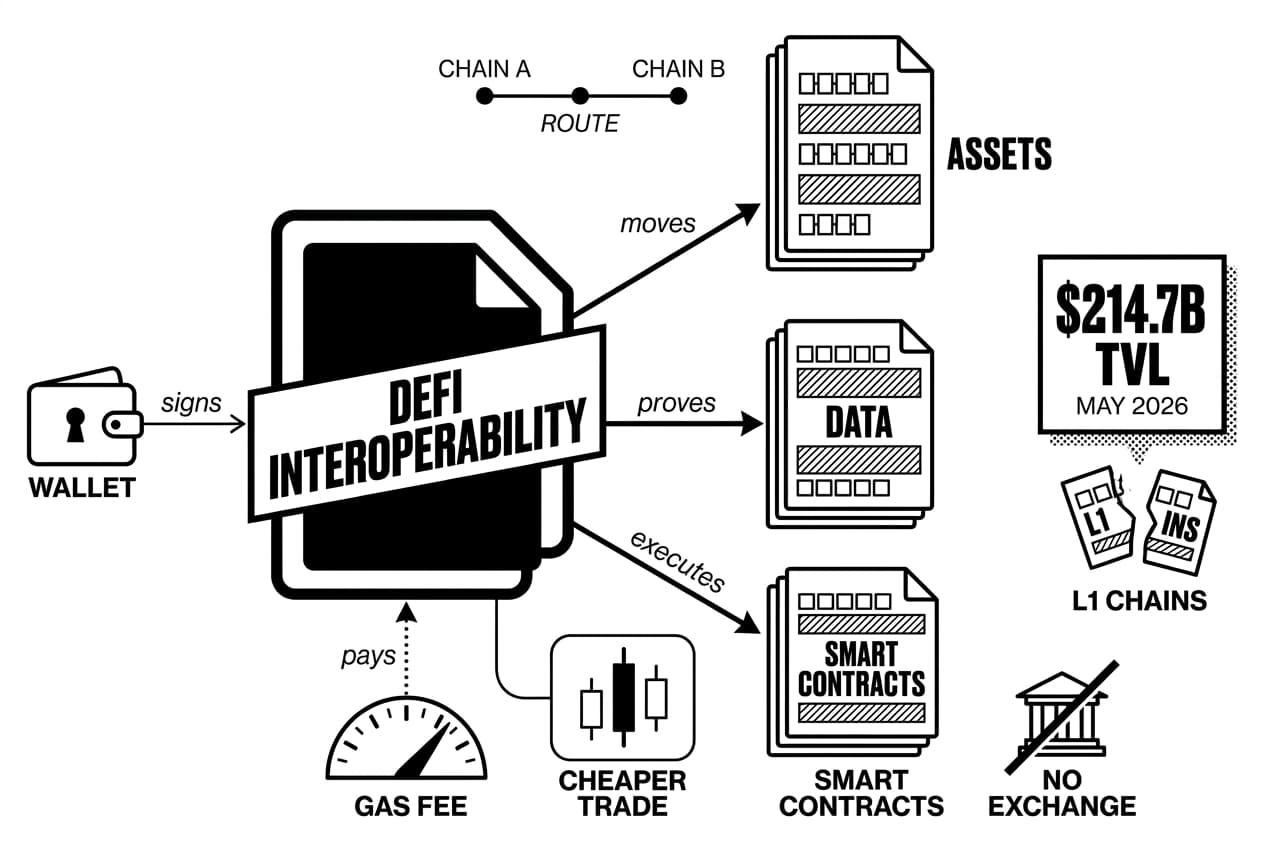
Why it matters to you: if a yield market, cheaper trade, or payment route sits on another chain, interoperability decides whether you can reach it safely, how much you pay in fees, what asset you receive, and who you must trust while the transaction is in motion.
Think of a blockchain like a shared Google Doc that nobody can edit after saving: everyone can read the final record, but each chain keeps its own file. DeFi interoperability is the set of tools that lets one file prove something to another without asking a bank, exchange, or private database to act as the referee.
A few definitions help. DeFi, or decentralized finance, means financial apps such as exchanges and lending markets that run through blockchain code. A protocol is a set of smart contracts, which are programs stored on-chain and executed by the network. A wallet is software or hardware that controls a private key. A gas fee is the payment made to have a blockchain process a transaction.
As of May 2026, cross-chain decisions affect a large pool of capital: decentralized finance dashboards showed $214.7 billion in total value locked across chains (DefiLlama, May 2026). That value is not held in one place. It is split across layer-1 chains, layer-2 networks, appchains, bridges, lending markets, and liquidity pools.
Plain-English definition
In plain English, defi interoperability means that one DeFi app can read, trust, or act on something that happened somewhere else. That could be a token transfer, a price update, a vote result, or a lending instruction sent from a source chain to a destination chain.
Why it is not just moving coins
Bridges are the most visible part of interoperability, but they are not the whole system. In our 2026 editorial route-review matrix, we separated cross-chain communication into five layers: asset movement, message delivery, data verification, liquidity coordination, and intent execution. That 5-layer communication stack is useful because each layer has a different failure point.
- Asset movement: tokens are locked, burned, minted, or released on another chain.
- Message delivery: a smart contract sends an instruction for another contract to execute.
- Data verification: an oracle or verifier proves that an event, price, or state change is valid.
- Liquidity coordination: pools on different chains are connected so users can trade without waiting for slow settlement.
- Intent execution: a user states the desired result, and competing solvers find the route.
Sergey Nazarov, co-founder of Chainlink Labs, has repeatedly framed cross-chain design as a verified data-delivery problem, not only an asset-transfer problem. That distinction matters because a bridge can move tokens while a messaging layer can tell a lending market, governance contract, or derivatives app what action to take.
The safer design is not always to connect everything to everything. Each added bridge, wrapped asset, verifier, and solver increases cost, latency, and attack surface. In many cases, better DeFi interoperability means sending fewer assets across chains and using cross-chain messages only where the user benefit is clear.
Why DeFi Interoperability Matters in 2026
By 2026, DeFi users often hold assets on one chain while the best price, loan rate, or payment rail sits on another. Ethereum scaling upgrades reduced some costs, including the Dencun upgrade activated on March 13, 2024 (ethereum.org, March 2024), but they did not remove fragmentation. Users still need safe ways for separate networks to coordinate.
The fragmentation problem
A trading pool on one chain cannot automatically share liquidity with a pool on another unless a protocol creates that link. A borrower may have collateral on Base, a loan on Ethereum, and a lower-cost repayment route through Arbitrum. Without interoperability, the user must bridge manually, switch networks, pay multiple fees, and accept several trust decisions.
Stani Kulechov, founder and CEO of Aave, has often discussed multi-chain DeFi as a practical user-experience problem. Lending markets need enough liquidity to quote fair rates, and fragmented liquidity can weaken those markets. If capital is split across too many isolated deployments, prices and borrowing rates become less efficient.
What users actually gain
Good interoperability removes repeated manual steps. The clearest user benefits in 2026 are:
- Cross-chain swaps: trade from one chain to another without visiting a separate bridge page.
- Better price discovery: routes can search more pools instead of one local market.
- Multi-chain lending: collateral and debt positions can coordinate across networks when the protocol supports it.
- Cleaner stablecoin movement: native mint-and-burn systems can reduce reliance on wrapped IOUs.
- Less operational risk: a carefully designed route can reduce the number of approvals, wallets, and web pages a user touches.
The tradeoff is that hidden complexity does not disappear. It moves below the interface. A one-click route may still depend on a verifier, liquidity provider, relayer, solver, or upgradeable contract.
Background: From Single-Chain DeFi to Multi-Chain Apps
Early DeFi was simpler because most activity happened on Ethereum. One smart contract could call another inside the same chain, which created direct composability: exchanges, lending markets, stablecoins, and derivatives could combine like software modules.
The early composability era
Hayden Adams, founder of Uniswap Labs, helped popularize the automated market maker model, where users trade against a pool rather than a traditional order book. Because Uniswap contracts lived on the same chain as other early DeFi apps, developers could route trades, deposits, and liquidations through them in one transaction.
That same-chain model is powerful because it relies on one execution environment. The chain decides the order of events, the contracts share the same state, and the user does not need a third party to prove that an event happened elsewhere.
The multi-chain shift
As demand grew, users moved to cheaper and faster networks. Layer-2 rollups, alternative layer-1 chains, and app-specific chains each attracted separate communities and liquidity. That growth made DeFi more accessible, but it also created a new problem: the best opportunity might be on a chain where the user holds no funds.
This is why defi interoperability became part of basic DeFi infrastructure. The question changed from whether one app can call another on the same chain to whether a contract can safely accept proof from a different chain with different validators, finality rules, and security assumptions.
How Protocols Talk to Each Other
A cross-chain action is a chain of proofs. The user signs one instruction, the source chain records what happened, a verifier checks it, and the destination chain acts only after receiving a valid message.
- The user signs an instruction. A wallet creates a cryptographic signature that proves approval without revealing the private key.
- The source contract records the event. A smart contract locks tokens, burns tokens, or emits a message on the source chain.
- A verifier checks the event. A validator set, oracle network, light client, or relayer confirms that the source event really happened.
- The message is delivered. The protocol sends a proof or signed packet to the destination chain.
- The destination contract executes. The receiving contract mints, releases, swaps, deposits, or calls another contract.
- The user receives the asset or result. The final balance, lending position, or swap output appears on the destination chain.
Step 1: a user signs an instruction
A wallet does not store coins in the physical sense. It stores the private key that controls addresses on-chain. When a user approves a bridge, swap, or cross-chain deposit, the wallet signs a message. The blockchain can verify that signature mathematically.
Step 2: smart contracts lock, burn, mint, or send messages
Cross-chain systems usually use one of four actions. Locking holds a token in a source-chain vault. Burning destroys a token so it can be recreated elsewhere. Minting creates a token representation on the destination chain. Messaging sends an instruction without necessarily moving a token.
Burn-and-mint systems reduce the risk of a large vault being drained, but they require the token issuer to support the destination chain. Lock-and-mint systems are easier to deploy, but their vaults can become high-value targets.
Step 3: validators, oracles, or relayers verify the message
The core question is simple: who tells the destination chain that the source-chain event is real? Relayers watch chains and submit messages. Validator committees vote on events. Oracle networks deliver verified data. Light-client systems verify cryptographic proofs directly on-chain. For a deeper technical explanation, see our guide to blockchain oracle architecture.
Chainlink's cross-chain interoperability protocol began mainnet-phase releases in 2023 (Chainlink, 2023). Its design reflects the same principle Sergey Nazarov has emphasized publicly: cross-chain systems should make verification explicit rather than ask users to trust a black box.
The verification step is where many failures begin. If the verifier is compromised, the destination chain may mint or release funds that were never validly locked or burned. Choosing a cross-chain route means choosing a verifier.
Key Approaches to DeFi Interoperability
Different DeFi apps need different communication tools. The table below compares the main approaches using the 5-layer communication stack from our 2026 review matrix.
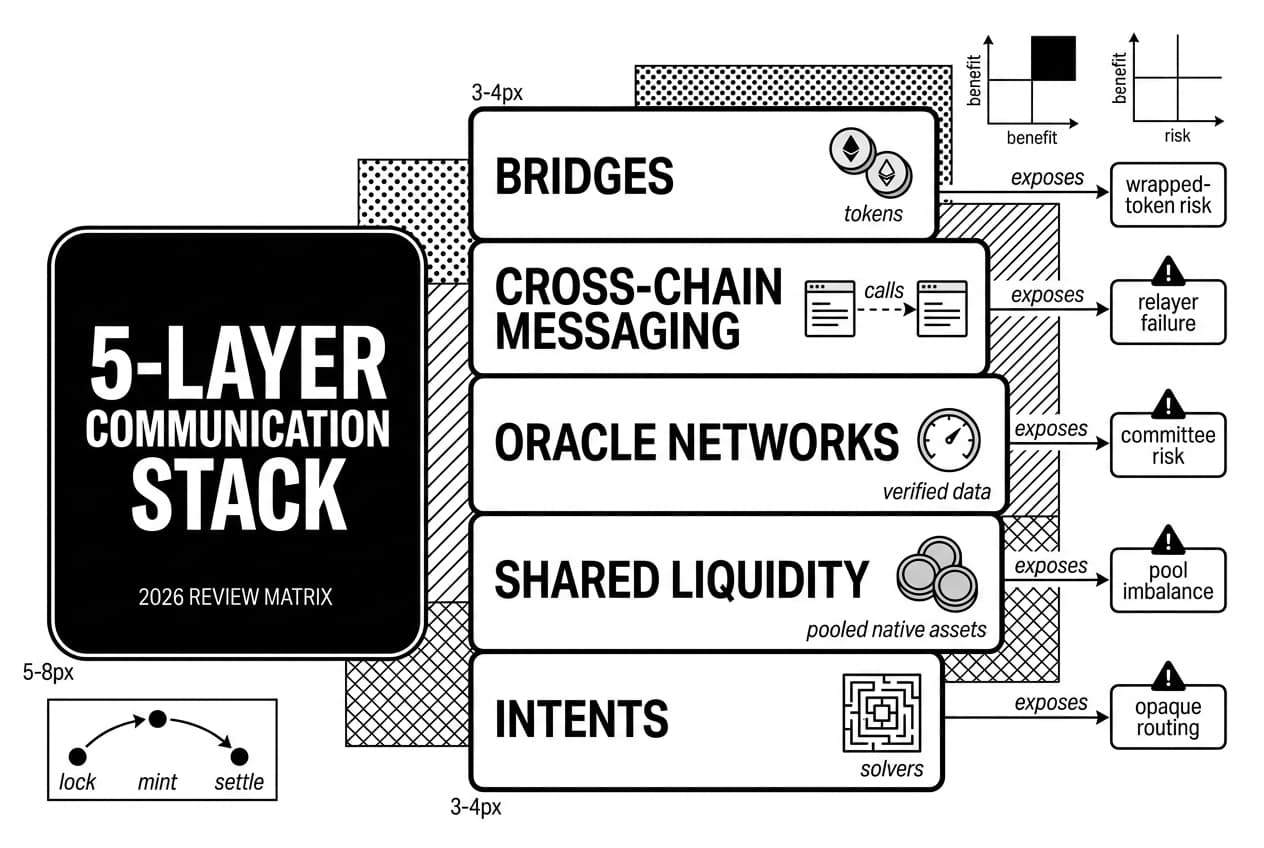
Approach | What it moves | Example use case | Main benefit | Main risk |
|---|---|---|---|---|
Bridges | Tokens, either wrapped or native | Move ETH from Ethereum to a layer-2 network | Broad asset movement | Vault exploits, weak signers, wrapped-token risk |
Cross-chain messaging | Instructions and contract calls | Tell a lending app on another chain to open a position | Programmable coordination | Bad verification or relayer failure |
Oracle networks | Verified data, prices, state proofs, and commands | Settle a cross-chain price-dependent contract | Clear data-verification layer | Oracle committee and configuration risk |
Shared liquidity | Access to pooled native assets | Swap stablecoins across chains without wrapped IOUs | Faster execution and less fragmented liquidity | Pool imbalance or insufficient exit liquidity |
Intents | Desired outcomes executed by solvers | Ask for USDC on Arbitrum and let solvers find the route | Simpler user flow and better route competition | Solver concentration and opaque routing |
Blockchain bridges
A bridge connects two chains that do not naturally share state. Some bridges lock tokens on the source chain and mint wrapped versions on the destination chain. Others burn on one side and mint native tokens on the other. Liquidity-network bridges pay the user from pre-funded pools and settle in the background.
The risk depends on what stands behind the promise. If a wrapped token is backed by a vault, the vault must remain secure. If a bridge relies on a committee, the committee must not be compromised. The Ronin incident shows the cost of weak control: attackers drained $625 million after compromising five of nine validator keys (Rekt News, March 2022).
Cross-chain messaging protocols
Messaging protocols send instructions. A governance contract on one chain might tell another chain to change a parameter. A lending app might request a remote deposit. A game or payment app might move state without moving the underlying asset.
The main design question is verification. Some systems use guardian networks. Others use oracle networks or light-client proofs. The safest-looking interface may still rely on a small off-chain signer set, so users should check the documentation before moving large amounts.
Shared liquidity and intents
Shared liquidity systems try to reduce duplicated pools. Instead of leaving the same asset thinly spread across many chains, they route users through coordinated reserves. Intents go one step higher: the user states the desired result, and solvers compete to deliver it.
Intents can improve user experience, but they also hide routing choices. A solver may use bridges, decentralized exchanges, and liquidity pools under the surface. Users should ask whether the solver can reorder, censor, or route trades in a way that creates hidden cost.
DeFi Interoperability in Action: Real-World Examples
Here are three common cross-chain scenarios and the trust assumptions inside each one.
Example 1: cross-chain DEX trading
A user has ETH on Ethereum and wants a token with deeper liquidity on Arbitrum. A cross-chain aggregator can route the trade through a bridge or solver, then complete the swap through an automated market maker. An automated market maker prices trades against a pool, which is why understanding how liquidity pools work matters before using cross-chain DEX routes.
The user sees one quote, but the route may include several costs: source gas, destination gas, solver spread, bridge fee, and slippage. A good interface should show these costs before signature.
Example 2: moving stablecoins between apps
A user wants to move 100 USDC from Ethereum to Base. With Circle's cross-chain transfer protocol, the source-chain USDC is burned and native USDC is minted on the destination chain. Circle describes that native burn-and-mint model in its public documentation, and the protocol launched in 2023 (Circle, 2023).
If the user instead receives a bridged token, the asset may be an IOU backed by tokens locked somewhere else. Native USDC and bridged USDC can look similar in a wallet, but they do not carry the same risk. The asset label matters.
Example 3: multi-chain yield or lending
A user deposits 100 USDC into a lending market on Base at 6 percent annual percentage yield, then sees another market on Optimism paying 11 percent. The higher rate may reflect real demand, but it may also compensate for bridge risk, liquidity risk, or liquidation risk during transfer.
Stani Kulechov, founder and CEO of Aave, has highlighted the practical difficulty of managing liquidity across multiple networks. For users, the lesson is simple: treat a yield gap as a risk signal, not a gift. Higher yield often means someone is taking additional risk.
Quick rule of thumb: before any cross-chain move, ask who validates the message, where the destination liquidity comes from, and what happens if the route fails midway. If those answers are hard to find, reduce the transfer size or choose a simpler route.
Risks and Tradeoffs: Security, Fees, Liquidity, and Compliance
Cross-chain DeFi can be useful, but every design moves trust somewhere. The main job is to find where that trust sits before funds are committed.
The security question: who are you trusting?
Our 2026 trust-depth test ranks routes from most human-dependent to most proof-dependent. At the risky end are small multisigs and validator committees with limited signer diversity. In the middle are larger validator networks and optimistic systems that depend on watchers. At the proof-heavy end are light-client designs that verify source-chain state on-chain.
The Ronin bridge hack remains a clear warning because it combined a large asset pool with concentrated key control. The same incident involved $625 million in losses and five of nine compromised validator keys (Rekt News, March 2022). Users should not treat a familiar brand or polished interface as a substitute for verifier analysis.
Other risks include oracle manipulation, replay attacks, chain reorganizations, upgrade-key abuse, wrapped-token depegs, and malicious wallet prompts. Before trusting a new bridge, review common crypto scam red flags. Solver and relayer systems can also create ordering risks, which overlap with front-running risks in smart contracts.
The cost question: is the route worth it?
Cross-chain fees stack quickly. A route can include source-chain gas, destination-chain gas, a bridge fee, a solver spread, and slippage. On a small transfer, fixed fees may consume a large share of the amount sent. On a larger transfer, the same absolute fee may be tolerable, but liquidity and security risk still matter.
Time is also a cost. Optimistic rollup withdrawals often include a 7-day withdrawal period (Optimism docs, accessed September 2026) unless a liquidity provider fronts the funds for a fee. Faster exits are useful, but they add another counterparty to evaluate.
The liquidity question: can you exit?
A token can be liquid on one chain and thinly traded on another. Deep liquidity means a user can buy or sell near the quoted price. Thin liquidity can cause slippage, partial fills, or a position that cannot be closed without a large loss.
Before bridging an asset to trade, check the destination pool size, recent volume, and route depth. Do not assume that a token with a strong Ethereum market has the same exit liquidity on every layer-2 or appchain.
Compliance and KYC considerations
Some cross-chain services now require identity checks, especially if they connect to regulated fiat rails or serve institutional users. Interoperability does not bypass compliance. It only changes how assets, data, and instructions move. If a route touches a regulated provider, know-customer checks may apply.
- Ask who controls upgrades and keys. A small emergency multisig is a real trust assumption.
- Add all fees before signing. Gas, bridge charges, solver spreads, and slippage should be visible.
- Check destination liquidity. The exit market matters as much as the entry route.
- Prefer native assets when practical. Wrapped assets add backing and custody risk.
- Read failure rules. Know what happens if a message is delayed, rejected, or delivered twice.
How to Evaluate a Cross-Chain DeFi Protocol in 2026
Use this checklist before moving funds. It is designed for smart beginners who want a clear way to compare routes without reading every line of code.
- Verifier model: identify whether the protocol uses a multisig, validator set, oracle network, optimistic proof, or light client.
- Audit record: check whether audits are public, recent, and tied to the exact contracts in use.
- Bug bounty: active bounties show that outside researchers are invited to test the system.
- Upgrade controls: find out who can pause, upgrade, or redirect contracts.
- Incident history: search the protocol name with exploit, hack, paused, and postmortem.
- Native versus wrapped asset: confirm what token arrives on the destination chain.
- Fee display: avoid routes that hide solver spreads or destination gas assumptions.
- Wallet support: make sure your wallet supports the destination chain. You can compare DeFi wallets before choosing a route.
Sergey Nazarov, co-founder of Chainlink Labs, argues for verifiable cross-chain guarantees. Gavin Wood, founder of Polkadot and co-founder of Ethereum, has also built around the idea that independent chains need a way to communicate rather than forcing all users onto one network. Those two perspectives point to the same due-diligence question: what proof does the receiving chain accept?
Beginner safety checklist
- Use the official URL. Bookmark it from a trusted source before connecting a wallet.
- Start small. Send a test amount before a larger transfer.
- Read the asset label. Native USDC, bridged USDC, and synthetic USDC are not the same risk.
- Review approvals. Revoke old permissions when they are no longer needed.
- Stop on strange prompts. If a signature request is unclear, close the page and restart from the official site.
Experienced users still make cross-chain mistakes because speed creates overconfidence. A repeatable checklist is not only for beginners. It is a way to slow down when an interface makes a complex route look simple.
Frequently Asked Questions
- What are the four types of interoperability?
- The four types are technical (systems can physically connect, like two blockchains sharing a bridge), semantic (data means the same thing across chains, like token standards), operational (workflows coordinate, like cross-chain liquidations), and governance (rules and upgrades align, like shared multisig controls across protocols).
- Is DeFi just crypto?
- No. Crypto is the broader universe of digital assets and blockchain networks. DeFi is a specific subset — financial applications built on top of those networks. That includes decentralized exchanges, lending markets, liquid staking platforms, derivatives protocols, and stablecoin payment systems. All DeFi uses crypto, but not all crypto is DeFi.
- What are the top 10 DeFi projects?
- Rankings shift constantly based on total value locked, active users, and market conditions, so any fixed list goes stale quickly. Major categories include DEXs, lending protocols, liquid staking, stablecoins, cross-chain bridges, and derivatives. For current comparisons, check live TVL dashboards like DeFiLlama before drawing conclusions.
- What does blockchain interoperability mean?
- Blockchain interoperability is the ability for separate blockchains to securely exchange assets, data, or instructions. For example, a user moves USDC from Ethereum to Avalanche, or a smart contract on one chain triggers a transaction on another. Without interoperability, each blockchain operates as an isolated system with no connection to others.
Sources
Author

Crypto analyst and blockchain educator with over 8 years of experience in the digital asset space. Former fintech consultant at a major Wall Street firm turned full-time crypto journalist. Specializes in DeFi, tokenomics, and blockchain technology. His writing breaks down complex cryptocurrency concepts into actionable insights for both beginners and seasoned investors.