DeFi Wallet Comparison 2026: MetaMask, Rabby, Phantom Ranked

DeFi wallet comparison 2026: MetaMask, Rabby, Phantom ranked
Choosing a DeFi wallet in 2026 is less about where tokens sit and more about what happens before you sign. We ranked MetaMask, Rabby and Phantom by transaction safety, dApp reach, chain support, hardware wallet support, privacy defaults, mobile quality, update pace and beginner fit. The result is decisive: Rabby is the best EVM daily driver, MetaMask is still the compatibility king, and Phantom is the best Solana and mobile wallet.
How we ranked these DeFi wallets in 2026
Our ranking uses the SIGN-8 framework, an editorial scoring model built for wallets used in live DeFi rather than passive storage. SIGN-8 scores eight factors from 1 to 5: signing clarity, incident reduction tools, gas and fee visibility, network support, dApp compatibility, hardware signer support, privacy defaults and new-user error resistance. The maximum score is 40.
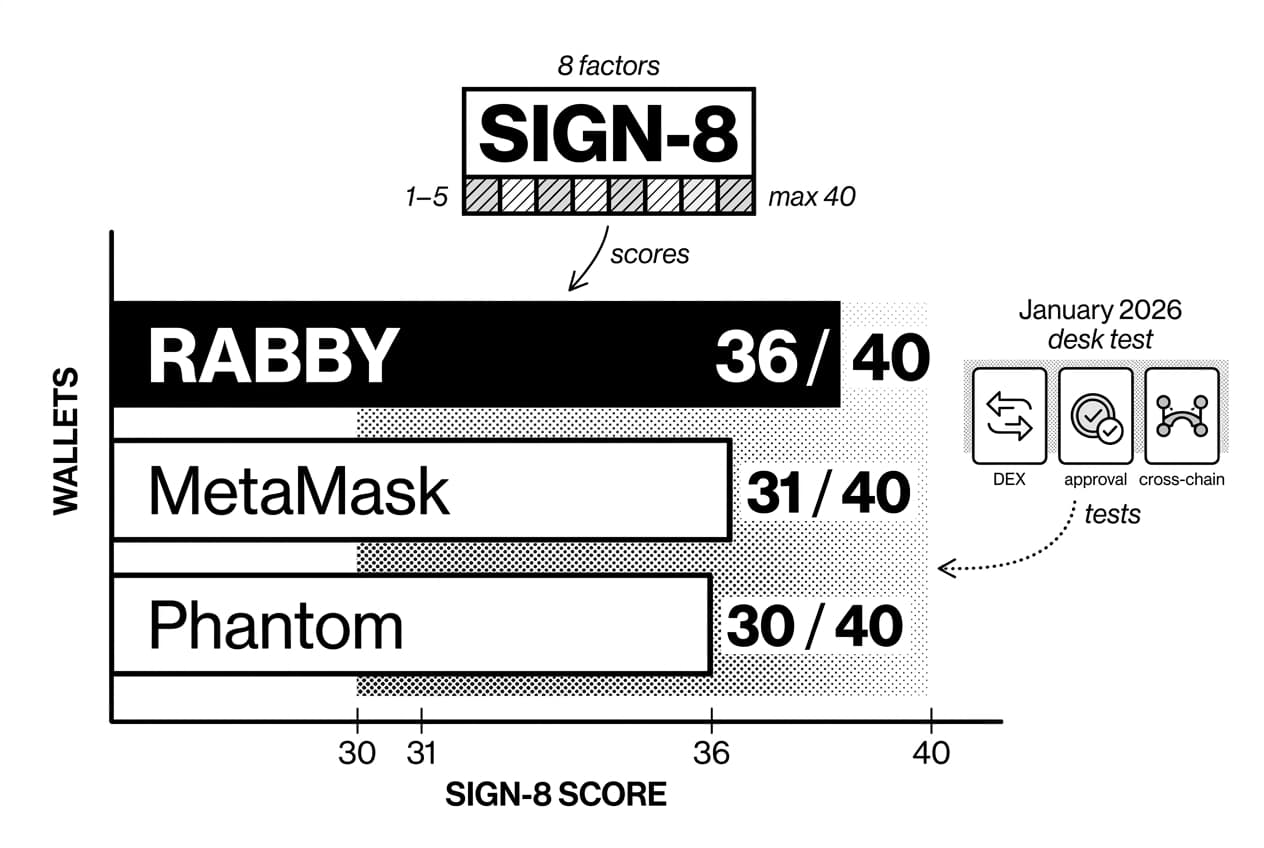
We also ran a January 2026 desk test across three common tasks: connecting to a blue-chip DEX, checking a token approval, and reviewing a cross-chain or multi-network transaction prompt. The test was not a security audit and did not involve private funds. It measured what a normal user sees before approval, which is where most wallet mistakes begin.
Wallet | SIGN-8 score | Best result in the desk test | Weakest result in the desk test |
|---|---|---|---|
Rabby | 36 / 40 | Clearest EVM pre-sign simulation and automatic chain detection | Weaker mobile maturity than Phantom or MetaMask |
MetaMask | 31 / 40 | Highest dApp recognition and easiest guide coverage for beginners | Less readable default signing flow than Rabby |
Phantom | 30 / 40 | Fastest mobile flow and strongest Solana experience | Lower depth for complex EVM DeFi activity |
Selection criteria: security, chains, UX and DeFi access
The scoring gives extra weight to signing safety because a wallet error is often permanent. Andreas Antonopoulos, an author and educator, has repeatedly emphasized the self-custody principle that whoever controls the keys controls the coins. That principle is useful, but a daily DeFi wallet also has to help users understand what they are signing.
Reach still matters. MetaMask reports more than 30 million monthly active users, ConsenSys, accessed January 2026, which explains why dApps support it first. Reach is not the same as safety, though. Hayden Adams, founder of Uniswap, has often pointed to wallet UX as a key adoption bottleneck for decentralized exchanges. This comparison treats UX as a risk control, not just a design preference.
Who this comparison is for
This guide is for users who sign on-chain transactions often: swaps, lending positions, staking, liquidity pools, NFT trades and approvals on EVM or Solana apps. If you mainly hold assets offline, pair any browser wallet with a hardware signer. If you keep assets on a centralized exchange, read our guide to self-custody wallet rules before moving funds.
What is a DeFi wallet?
A DeFi wallet is a self-custody crypto wallet that lets you control private keys, sign blockchain transactions and connect to decentralized applications. Unlike an exchange account, it does not hold assets for you. You manage the recovery phrase, approve activity and carry the security responsibility.
The wallet app is the interface. The recovery phrase is the root credential. If that phrase is lost, stolen or entered into a fake site, the wallet provider usually cannot reverse the damage. This is why wallet choice matters most at the signing screen, where risk warnings, simulation and readable approvals can prevent expensive errors.
DeFi wallet vs exchange wallet
An exchange wallet is custodial. The exchange controls the private keys and credits your account balance internally. A self-custody wallet is non-custodial. You can send, receive and interact with smart contracts without asking a platform to approve withdrawals. The trade-off is responsibility: there is no password reset for a lost recovery phrase and no routine chargeback for a mistaken transfer.
Why private keys and recovery phrases matter
Your recovery phrase, usually 12 or 24 words, can recreate the accounts derived from it. Never photograph it, store it in cloud notes or paste it into support forms. A legitimate wallet will not ask for it after setup. For larger balances, use a hardware signer so your private key stays off the browser and phone.
Quick comparison: MetaMask vs Rabby vs Phantom
The table below gives the short version for users who want a fast answer before the ranked reviews. It focuses on what changes day-to-day DeFi use: signing clarity, ecosystem coverage, mobile quality and hardware support.
Feature | MetaMask | Rabby | Phantom |
|---|---|---|---|
Best use case | Maximum EVM dApp compatibility | EVM power users who want safer signing | Solana-first and mobile-first users |
Supported ecosystems | EVM networks | EVM networks | Solana, Ethereum, Polygon and Bitcoin |
Transaction simulation | Partial, with security alerts and added tools | Yes, native pre-sign simulation | Yes, strongest on Solana |
Hardware wallet support | Ledger and Trezor support | Ledger, Trezor, Keystone and more | Ledger support, model support should be checked |
Mobile app | iOS and Android | iOS and Android, newer feature set | iOS and Android, strongest of the three |
Swap and on-ramp support | Built-in swaps and fiat partners | Aggregated swaps, weaker fiat access | Built-in swaps and fiat partners |
Main drawback | Signing clarity still trails Rabby | Less useful outside EVM chains | EVM depth trails Rabby and MetaMask |
MetaMask also remains the default browser wallet for many dApps. Its extension listing shows 10 million plus users, Google extension listing, accessed January 2026. Phantom reports a mobile rating of 4.8 stars with more than 150,000 ratings, Apple listing, accessed January 2026. Rabby lists support for 100 plus EVM chains, Rabby, accessed January 2026.
At-a-glance winner by user type
- EVM DeFi power users: Rabby. It gives the clearest pre-sign view and reduces manual chain-switching errors.
- Maximum dApp compatibility: MetaMask. It is still the wallet most Ethereum apps test first.
- Solana-first or mobile-first users: Phantom. It is faster and more polished on mobile than the other two.
- Hardware wallet users: Rabby for active EVM use, MetaMask for widest support documentation.
Ranked list: the best DeFi wallets compared
The ranking below orders the wallets by overall usefulness for active DeFi, not by brand awareness alone. Each wallet made the list because it solves a distinct problem: safer EVM signing, universal EVM access or Solana-first mobile use.
1. Rabby, best DeFi wallet for EVM power users
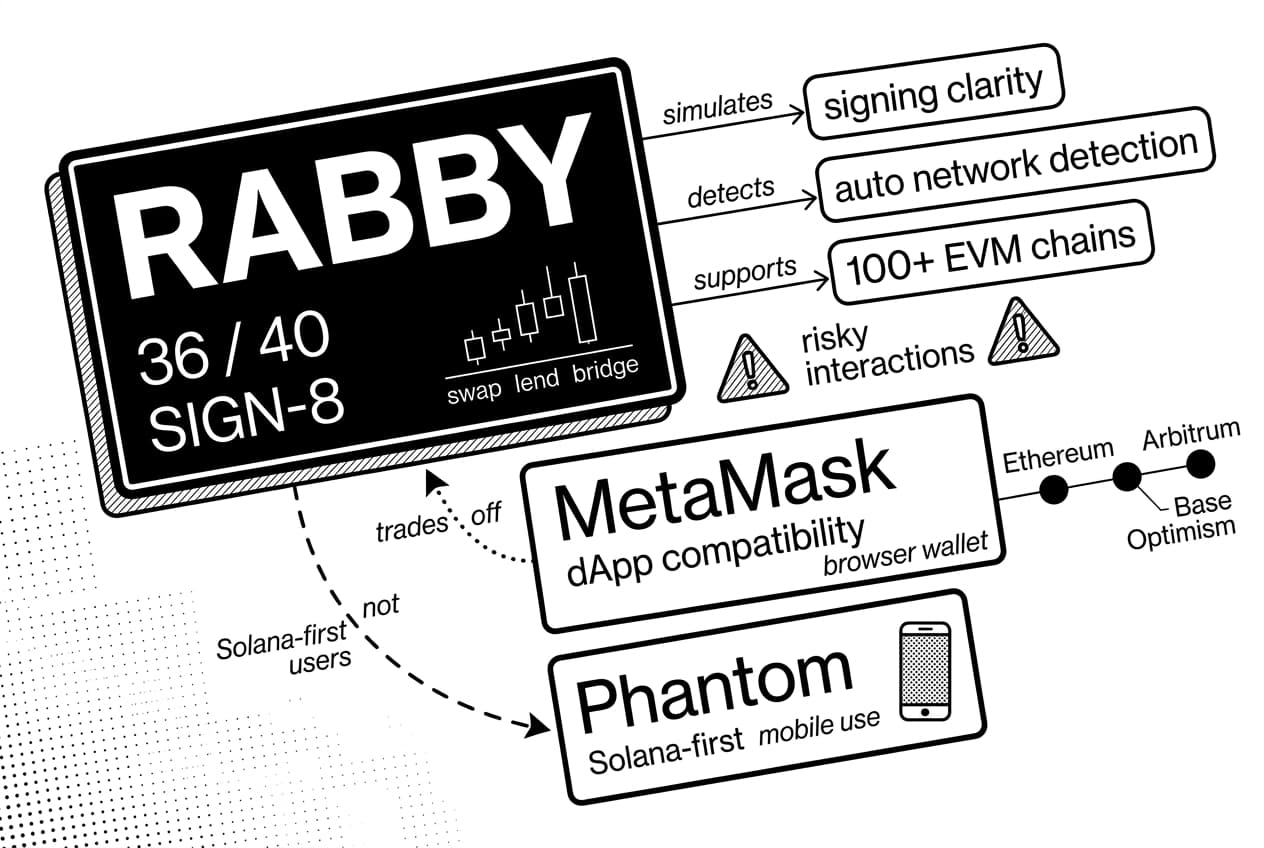
Rabby ranks first because it treats signing as the core product. Before approval, it simulates many EVM transactions, shows expected balance changes and warns about risky interactions. That matters for users who swap, lend, bridge and manage approvals across several chains each week. In our SIGN-8 test, Rabby scored 36 / 40, the highest of the group, mainly because of signing clarity and automatic network detection.
The biggest practical win is fewer wrong-chain moments. If a dApp needs Arbitrum, Base or Optimism, Rabby is better at detecting that context without forcing users through manual network menus. Its hardware support is also strong for an active wallet. As of January 2026, Rabby lists 100 plus EVM chains, which is enough for mainstream Ethereum, layer 2 and sidechain activity.
Best for: Ethereum, Arbitrum, Base, Optimism and other EVM users who sign often.
Key stat: 36 / 40 in our January 2026 SIGN-8 test.
Main drawback: It is not the right wallet for Solana-first users, and its mobile app is less mature than Phantom.
2. MetaMask, best DeFi wallet for dApp compatibility
MetaMask ranks second because compatibility still has value. If a DeFi app supports only one browser wallet, that wallet is usually MetaMask. Beginners also benefit from the sheer amount of tutorials, support threads and protocol documentation written around it. The wallet reports 30 million monthly active users, ConsenSys, accessed January 2026, and its browser listing shows 10 million plus users, Google extension listing, accessed January 2026.
The reason it does not rank first is signing clarity. MetaMask has improved risk alerts and transaction warnings, but Rabby still explains EVM outcomes more directly in our test. MetaMask also requires more active permission hygiene. Users should review connected sites, revoke old token approvals and avoid signing unclear messages. Sergey Nazarov, co-founder of Chainlink, often frames smart-contract security around verified data and clear execution assumptions; wallet users need that same bias toward verification before signing.
Best for: Beginners, developers and anyone who needs the widest EVM dApp support.
Key stat: 31 / 40 in our January 2026 SIGN-8 test.
Main drawback: Default transaction previews are less useful for active EVM users than Rabby.
3. Phantom, best DeFi wallet for Solana and mobile UX
Phantom ranks third overall but first for Solana. It began as a Solana wallet, and that origin still shows in its speed, token handling, NFT display and mobile flow. It now supports Solana, Ethereum, Polygon and Bitcoin, but its deepest advantage is still Solana-native activity. For users who swap on Solana, manage NFTs or sign mostly from a phone, Phantom is the cleanest pick.
Its mobile reputation is stronger than the other wallets in this comparison. The iOS listing shows 4.8 stars and more than 150,000 ratings, Apple listing, accessed January 2026. Phantom also discloses a 0.85% swap fee, Phantom, accessed January 2026, which users should compare against direct DEX routing before trading often inside the app.
Best for: Solana traders, NFT collectors and mobile-first users.
Key stat: 30 / 40 in our January 2026 SIGN-8 test.
Main drawback: It is not as strong as Rabby for complex EVM approvals, layer 2 workflows or hardware-heavy setups.
Feature-by-feature DeFi wallet comparison
The ranked list gives the recommendation. The sections below explain the trade-offs behind it, especially for users deciding whether to run one wallet or a multi-wallet setup.
Supported chains and dApp ecosystems
MetaMask is best when the priority is broad EVM access. It supports custom networks and is recognized by the widest range of Ethereum dApps. Rabby supports the EVM networks most active users need and does a better job of detecting the right chain at connection time. Phantom is the only wallet here that feels native on Solana while also offering Ethereum, Polygon and Bitcoin support.
Network type | MetaMask | Rabby | Phantom |
|---|---|---|---|
Ethereum mainnet | Yes | Yes | Yes |
Major EVM layer 2 networks | Yes | Yes | Limited |
Polygon | Yes | Yes | Yes |
Solana | No | No | Yes |
Bitcoin | No | No | Yes |
Custom EVM networks | Yes | Yes | Limited |
If you live mostly on Ethereum layer 2 networks, Rabby is the better daily signer. If you follow tutorials from new protocols, MetaMask reduces compatibility surprises. If Solana is your base chain, Phantom should be your first install.
Transaction signing, simulation and scam warnings
Simulation is the main reason Rabby wins. It helps answer the question users actually have before signing: what leaves my wallet, what enters it and what permission remains after this action? MetaMask has improved alerts, and Phantom does a good job on Solana, but Rabby gives the most readable EVM preview.
This matters because DeFi losses often come from approvals that were technically valid but poorly understood. Unlimited token approvals, fake signature prompts and malicious lookalike sites can all pass through a wallet if the user confirms them. Use the wallet with the clearest warning system for the chain where you take the most risk.
Fees, swaps and fiat on-ramps
Wallets do not set base network gas fees. The chain does that. Wallets can, however, charge for convenience services such as in-app swaps or fiat purchase routing. MetaMask discloses a 0.875% service fee on swaps, MetaMask, accessed January 2026. Phantom discloses a 0.85% swap fee, Phantom, accessed January 2026. Rabby is stronger as a signing interface than as a beginner fiat on-ramp.
Frequent traders should compare wallet swap quotes against direct DEX routes. If you already know how to use a DEX, the wallet can simply sign the transaction. If you are new, the built-in swap tool may be worth the fee for convenience, but only after checking the rate and slippage.
Hardware wallet support and privacy defaults
For balances above a few test transactions, a hardware signer changes the risk model. The browser wallet displays the dApp and transaction. The hardware device holds the private key and requires physical confirmation. Rabby and MetaMask are the better choices here because their EVM hardware workflows are more established. Phantom is useful for Solana with Ledger support, but users should check current device and firmware compatibility before relying on it.
Privacy defaults also matter. Any wallet can expose addresses to dApps, RPC providers or analytics services through normal use. Separate wallets by purpose: one for long-term storage, one for active DeFi and one for testing new apps. That simple separation limits the damage if one address signs a bad approval.
Wallet setup and security best practices
Set up a new wallet slowly. Download from the project's verified site, write the recovery phrase offline, add a small test amount and make one test transaction before moving serious funds. Do not paste your recovery phrase into password managers, chat windows, browser forms or screenshots.
Avoiding phishing, fake extensions and malicious approvals
Install wallet software only from official project pages or the verified marketplace listing linked from that page. Bookmark the dApps you use often. Avoid wallet links from ads, direct messages and search results during urgent market moves. If any page asks for your seed phrase after setup, close it.
Review old approvals after using unfamiliar protocols. Tools such as revoke.cash can show token allowances across EVM chains. Revoke permissions you do not recognize, especially unlimited approvals for tokens you no longer use. Approval cleanup is not exciting, but it is one of the easiest ways to cut wallet risk.
When to pair a DeFi wallet with a hardware wallet
Use a hardware signer when the wallet balance is large enough that losing it would hurt. A practical rule is to use browser wallets for small active balances and keep long-term holdings behind a hardware device. This setup does not stop every scam, but it prevents a website from extracting your private key directly from the browser.
How to choose the right DeFi wallet
Your best DeFi wallet depends on where you sign most often. Do not choose by logo recognition alone. Choose by the chain you use, the number of transactions you sign, whether you need mobile, and how much you depend on a hardware signer. If you plan to supply liquidity, read how DeFi liquidity pools work before connecting any wallet.
Best choice by scenario
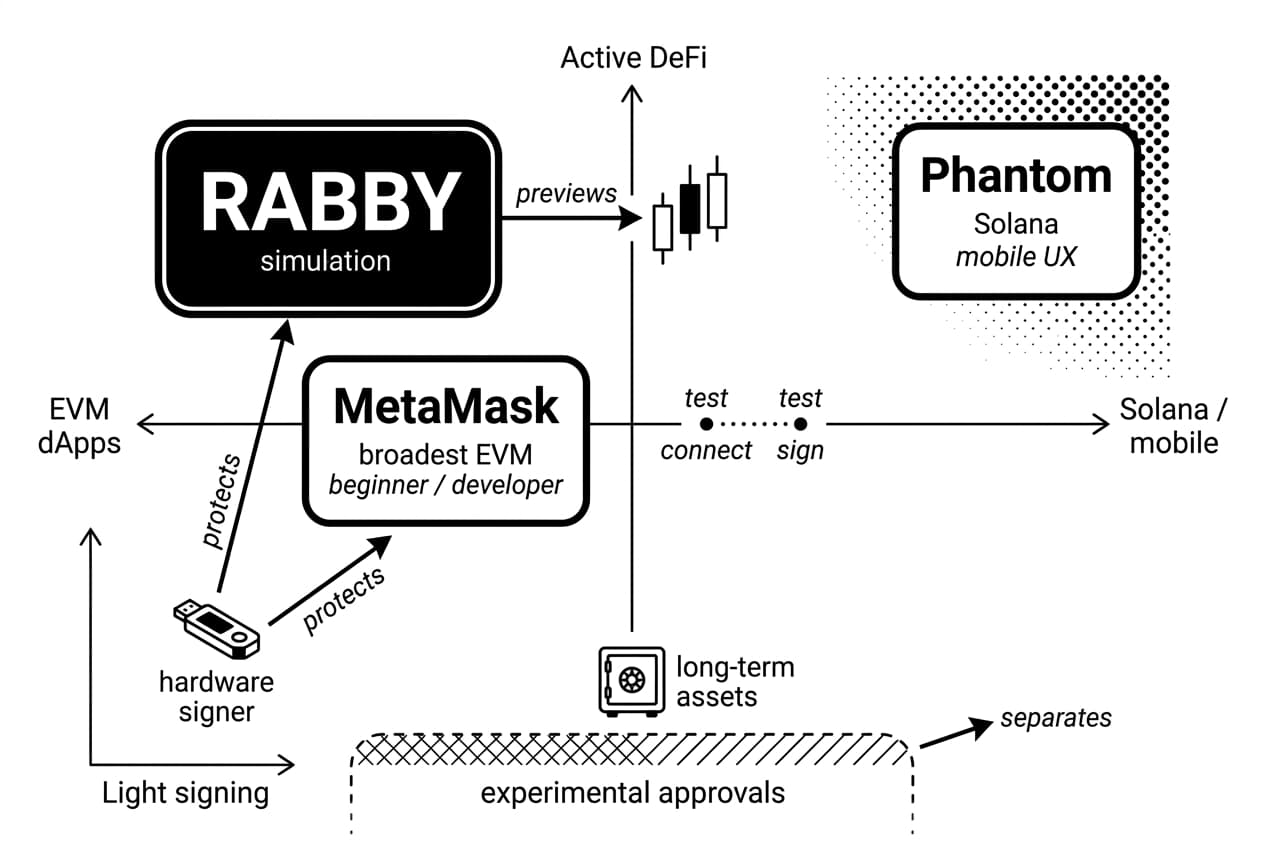
- choose Rabby if you are an EVM yield farmer, active trader or power user who wants transaction simulation before signing.
- choose MetaMask if you are a beginner, developer or user who needs the broadest EVM dApp compatibility.
- choose Phantom if you trade on Solana, collect NFTs or want the strongest mobile wallet experience in this group.
- Use Rabby or MetaMask with a hardware signer if you manage meaningful EVM balances.
- Use more than one wallet if you test new protocols. Keep long-term assets away from experimental approvals.
Final ranking: Rabby is the best daily DeFi wallet for active EVM users, MetaMask is the safest compatibility pick, and Phantom is the best wallet for Solana and mobile-first DeFi.
Frequently Asked Questions
- What is a DeFi wallet?
- A DeFi wallet is a self-custody crypto wallet that lets you store assets, control your private keys and connect to decentralized applications. You can swap, lend, stake or join liquidity pools, but you alone are responsible for your recovery phrase, transaction approvals and overall security.
- What is the best DeFi wallet?
- There is no single best option. Rabby suits EVM power users who want built-in transaction previews and multi-chain management. MetaMask offers the widest dApp compatibility. Phantom is the go-to choice for Solana-first users. The right pick depends on your chains, security needs, mobile use and hardware wallet preferences.
- How do I get my money out of a DeFi wallet?
- Send your crypto to a centralized exchange that supports fiat withdrawals, then sell and transfer funds to your bank. Always verify you are using the correct network, double-check the destination address and consider sending a small test transaction first. Gas fees apply, and sending to a wrong address is typically irreversible.
- Is DeFi legal in the US?
- Using DeFi is not categorically illegal in the US, but several legal considerations apply, including tax reporting obligations, sanctions compliance, securities regulations and money transmission rules. Specific platforms may also restrict US users. Regulations evolve quickly, so consult a qualified legal or tax professional for advice tailored to your situation.
- Is DeFi illegal in the US?
- DeFi itself is not automatically illegal, but certain activities can create real legal risk. Interacting with sanctioned protocols, trading unregistered securities, participating in fraudulent schemes or failing to report crypto gains can all trigger regulatory consequences. Always research the specific tokens and protocols you use and stay current with changing US rules.
- How do I get my money from a DeFi wallet?
- Select the asset you want to withdraw, choose the correct network, then send it to a centralized exchange or another wallet. Confirm the gas fees, verify the destination address carefully and test with a small amount before transferring larger sums. Once on an exchange, you can convert to fiat and withdraw to your bank. Blockchain transfers are rarely reversible.
Sources
Author

Crypto analyst and blockchain educator with over 8 years of experience in the digital asset space. Former fintech consultant at a major Wall Street firm turned full-time crypto journalist. Specializes in DeFi, tokenomics, and blockchain technology. His writing breaks down complex cryptocurrency concepts into actionable insights for both beginners and seasoned investors.