Best DeFi Portfolio Tracker Tools and Dashboards in 2026
2026 guide: best DeFi portfolio tracker tools and dashboards
This ranked guide compares the best DeFi portfolio tracker tools for 2026 using a risk-first method, not a simple chain-count contest. We evaluated each product for read-only safety, chain coverage, protocol coverage, profit and loss quality, yield and LP analytics, NFT support, wallet or exchange integrations, pricing, and fit for different user types.
Our contrarian view is simple: wide coverage is useful, but position-level accuracy matters more. A dashboard that misses borrow exposure, claimable rewards, bridged assets, or concentrated liquidity ranges can make a risky portfolio look safer than it is. Stani Kulechov, founder and CEO at Aave, has repeatedly framed transparent risk data as a core requirement for DeFi users. That is why our ranking weights accuracy above raw network count.
How we ranked the best DeFi portfolio trackers
We used a named framework, the Position accuracy first scorecard. Each tracker was reviewed across eight weighted criteria: read-only safety, supported chains, protocol labeling, P/L accuracy, LP and yield analytics, NFT display quality, export or tax support, and pricing. This makes the ranking useful for risk monitoring, not just checking balances.
Our dataset combines dated public product pages, help-center claims, pricing pages, and hands-on read-only wallet checks as of May 2026. The evidence pattern was consistent: broad dashboards usually show wallet net worth well, while specialist tools handle LP income, impermanent loss, and reward accounting better. Sergey Nazarov, co-founder at Chainlink, is relevant here because reliable pricing and oracle data sit underneath many portfolio and risk models.
Quick comparison: best DeFi dashboard tools at a glance
The best DeFi dashboard depends on whether you need a broad wallet overview, precise LP accounting, or a combined exchange and on-chain view. Use this table as the fast filter, then read the ranked notes for the tradeoffs.
tool | best for | chains | P/L | yield/LP | NFTs | free plan | limitation |
|---|---|---|---|---|---|---|---|
DeBank | evm wallets | 100+ evm chains | yes | good | yes | yes | thin non-evm support |
DeFiLlama | protocol context | 300+ chains | basic | good | limited | yes | weak cost basis |
Zerion | mobile tracking | 60+ networks | yes | basic | yes | yes | light tax detail |
CoinStats | cex plus wallets | 25+ chains | yes | basic | yes | limited | api-key risk |
Zapper | visual overview | 35+ networks | basic | good | yes | yes | limited ROI depth |
APY.Vision | LP analysis | major dex chains | LP-focused | advanced | no | limited | not a full tracker |
Top tools: DeFi portfolio tracker rankings for 2026
Every tool below made the list because it solves a real tracking problem. The order reflects practical fit for most DeFi users, with broad and safer read-only tools first, then specialist analytics for LPs and high-activity investors.
1. DeBank, best overall tracker for evm wallets
best for: active evm users who want a deep read-only view of lending, borrowing, LP shares, NFTs, and claimable rewards across many wallets.
DeBank ranks first because it recognizes protocol positions better than most general dashboards. Paste a wallet address and it breaks holdings into useful buckets such as Aave debt, Curve LP shares, Uniswap v3 ranges, wallet tokens, and NFTs. That position labeling is more valuable than a long chain list if your goal is risk control.
As of January 2026, DeBank reported support for more than 2,800 protocols across 100+ evm-compatible chains (DeBank, Jan. 2026). The core workflow is also safer than wallet connection: you can monitor any public address without signing a message, sharing a seed phrase, or granting token approvals.
pricing: free for core tracking; paid analytics sit under DeBank pro. limitation: Solana, Cosmos, Bitcoin layer 2s, and other non-evm holdings may need a second tracker.
2. DeFiLlama, best free dashboard for protocol context
best for: researchers and cost-conscious users who want wallet tracking next to protocol TVL, yield, bridge, chain, and stablecoin data.
DeFiLlama is not the prettiest portfolio view, but it gives the richest free context. If a wallet holds a yield position, you can quickly compare it with protocol TVL, chain flows, yield tables, and bridge activity. That matters because a falling protocol TVL or unstable yield source is a risk signal, not just background data.
The public dataset is the differentiator. DeFiLlama tracked 4,000+ protocols across 300+ blockchains as of May 2026 (DeFiLlama, May 2026). For users who care about market context before app polish, that breadth is hard to beat.
pricing: free for most dashboard use without an account. limitation: P/L, tax-lot tracking, and cost-basis accounting are basic, so it works better as a research dashboard than as a full performance ledger.
3. Zerion, best mobile-first tracker for wallets and NFTs
best for: users who want a clean app for tokens, NFTs, swaps, and DeFi positions without spreadsheet-style screens.
Zerion wins on usability. The mobile app groups positions clearly, shows NFT holdings in a friendly format, and makes transaction history easier to read than a block explorer. It can also act as a wallet with swap routing, which appeals to users who want tracking and execution in one place.
As of the first quarter of 2026, Zerion said it indexed 12 million+ assets across 60+ networks (Zerion, Q1 2026). That is enough coverage for most retail users who split activity across Ethereum, layer 2s, and a few major alternate chains.
pricing: free tier available; premium features cost extra. limitation: advanced ROI accounting is limited. If you need to estimate DeFi staking returns with precision, pair Zerion with a dedicated calculator or export workflow.
4. CoinStats, best for DeFi plus exchange tracking
best for: users who keep funds on centralized exchanges and in self-custody wallets, then need one view of total P/L.
CoinStats makes the list because many crypto investors are not purely on-chain. If you have exchange balances, futures positions, DeFi wallets, and NFTs, a wallet-only dashboard will leave gaps. CoinStats connects those venues into a single portfolio view and offers alerts, watchlists, and basic analytics.
The scale is the key metric: CoinStats says it connects with 300+ exchanges and tracks 10,000+ cryptocurrencies as of 2026 (CoinStats, 2026). That makes it the best pick here for hybrid users who move capital between on-chain protocols and exchange accounts.
pricing: free plan available; paid tiers increase connection limits and analytics access. limitation: exchange API keys create risk. Use read-only permissions only, block withdrawals, and rotate keys if an exchange supports key expiration.
5. Zapper, best visual dashboard for quick wallet review
best for: users who want a visual overview of tokens, NFTs, and protocol positions for any public wallet address.
Zapper is strong when speed matters. Drop in a public wallet and it returns a clean breakdown of assets, DeFi positions, and NFTs. It is useful for your own daily check, but also for reviewing public wallets you follow. The interface is easier than scanning raw block explorer data.
Zapper reported support for more than 35 networks as of early 2026 (Zapper, early 2026). That is lower than DeBank on evm depth, but broad enough for the most active DeFi networks and NFT ecosystems.
pricing: free for core tracking. limitation: it is not built for tax-lot identification, exact impermanent loss calculation, or advanced return attribution. Treat it as a fast orientation layer, not a final accounting system.
6. APY.Vision, best specialist layer for LP and yield ROI
best for: liquidity providers who need fee income, impermanent loss, reward accounting, and pool-level return analysis.
This is where general dashboards often fall short. A concentrated liquidity position is not a simple token balance. You need entry price, fee income, reward tokens, gas cost, and divergence from a hold strategy. Hayden Adams, founder at Uniswap, is relevant to this problem because Uniswap LP returns depend on fee revenue and price exposure moving separately.
APY.Vision tracks LP positions across major decentralized exchanges and reported support for 20+ exchanges across multiple chains as of 2026 (APY.Vision, 2026). Revert is also useful for Uniswap v3 and v4 users who need narrow pool-level diagnostics.
pricing: free and paid tiers are available. limitation: APY.Vision is not a complete net-worth tracker. Use it beside DeBank, Zerion, or Zapper when LP exposure is a meaningful part of your portfolio.
How to connect and track your DeFi portfolio safely
To track a DeFi portfolio, paste a public wallet address into a read-only dashboard. The dashboard reads on-chain balances, DeFi positions, NFTs, yield, and P/L without needing your private key. For safety, verify the URL, avoid unnecessary wallet connections, and cross-check any large or unknown position.
Start by pasting your public address into DeBank, Zapper, Zerion, or another trusted dashboard. Add secondary wallets, then label each one by purpose, such as trading, yield, treasury, or cold storage. This simple habit makes it easier to find which wallet is driving gains, losses, or hidden debt.
Always verify the URL before entering a wallet address or connecting anything. Phishing sites imitating portfolio dashboards were reported throughout 2024 and 2025, including in paid search results. Bookmark the correct sites directly. For a deeper safety checklist, read our guide on how to avoid crypto phishing attacks. For larger balances, use a hardware wallet safely and keep signing activity separate from routine monitoring.
Read-only wallet tracking vs wallet connection
Pasting a public address gives a dashboard view-only access. It can read balances, transaction history, NFTs, and open positions, but it cannot move assets. Connecting through WalletConnect, MetaMask, Rabby, or another browser wallet creates a live session that may expose you to malicious signature requests.
method | risk level | what it can do | best use |
|---|---|---|---|
public address | lowest | view balances and positions | daily monitoring |
wallet session | medium | view and sign in app | claims or rebalancing |
browser wallet | medium to high | sign and approve contracts | active DeFi use |
hardware wallet | lower if verified | sign with physical confirmation | high-value accounts |
exchange api key | varies | read balances or trade | exchange tracking |
Most monitoring does not require a wallet connection. Use public-address tracking for daily checks and reserve wallet connections for actions that truly need signing. If you connect an exchange API key, turn off withdrawals and trading unless the feature specifically requires it.
How to check P/L, yield, and DeFi ROI
DeFi ROI is the combined result of token price movement, rewards, LP fees, borrowing costs, gas fees, and impermanent loss. A dashboard that omits even one of those categories can overstate returns. This is especially common with concentrated liquidity and auto-compounding vaults.
For LP positions, treat dashboard P/L as directional unless the tool separates fees, rewards, gas, and impermanent loss. A position can show positive yield while still underperforming a simple hold strategy. You can reduce part of that drag by learning how to reduce DeFi gas costs before entering or exiting positions.
The 3-layer ROI check: before trusting a dashboard P/L figure, confirm that the price source is credible, rewards are marked as claimed or accrued, and gas plus borrow costs are subtracted from returns. If one layer is missing, adjust manually.
What to look for in a DeFi portfolio tracker
Picking the right defi portfolio tracker depends on how you use DeFi. A casual holder checking one wallet has different needs from an LP running positions across multiple chains. Before choosing a defi dashboard, run it through this seven-point checklist.
- Chain coverage: confirm that the tracker supports every chain where your assets live, including Solana, Cosmos, or Bitcoin layer 2 exposure if relevant.
- Protocol coverage: check whether the tool recognizes your exact lending markets, AMMs, vaults, bridges, and staking contracts, not just the base chain.
- P/L accuracy: test cost basis, bridged assets, and multi-hop swaps against your own records before relying on the dashboard for tax or allocation decisions.
- Yield tracking: choose a tool that separates price appreciation from rewards, LP fees, rebasing effects, and auto-compounded vault growth.
- NFT support: verify how floor prices are sourced and treat thinly traded collection values as estimates, not cash-equivalent balances.
- Privacy and security: prefer read-only public address tracking, avoid seed phrase prompts, and connect wallets only when a feature requires signing. Understanding DeFi protocol failure risks also means limiting approvals wherever possible.
- Export and tax support: look for CSV export, API access, or direct tax-tool compatibility with services such as Koinly or CoinTracker before year-end reporting begins.
Two secondary factors also matter: mobile access and pricing tiers. A paid plan may be wasteful for a single wallet, but cheap for an LP who needs alerts, cost-basis exports, and pool-level attribution.
Final recommendation: which DeFi dashboard should you use?
There is no single best DeFi portfolio tracker for every user. The right pick depends on chain mix, position complexity, and how often you act on the data.
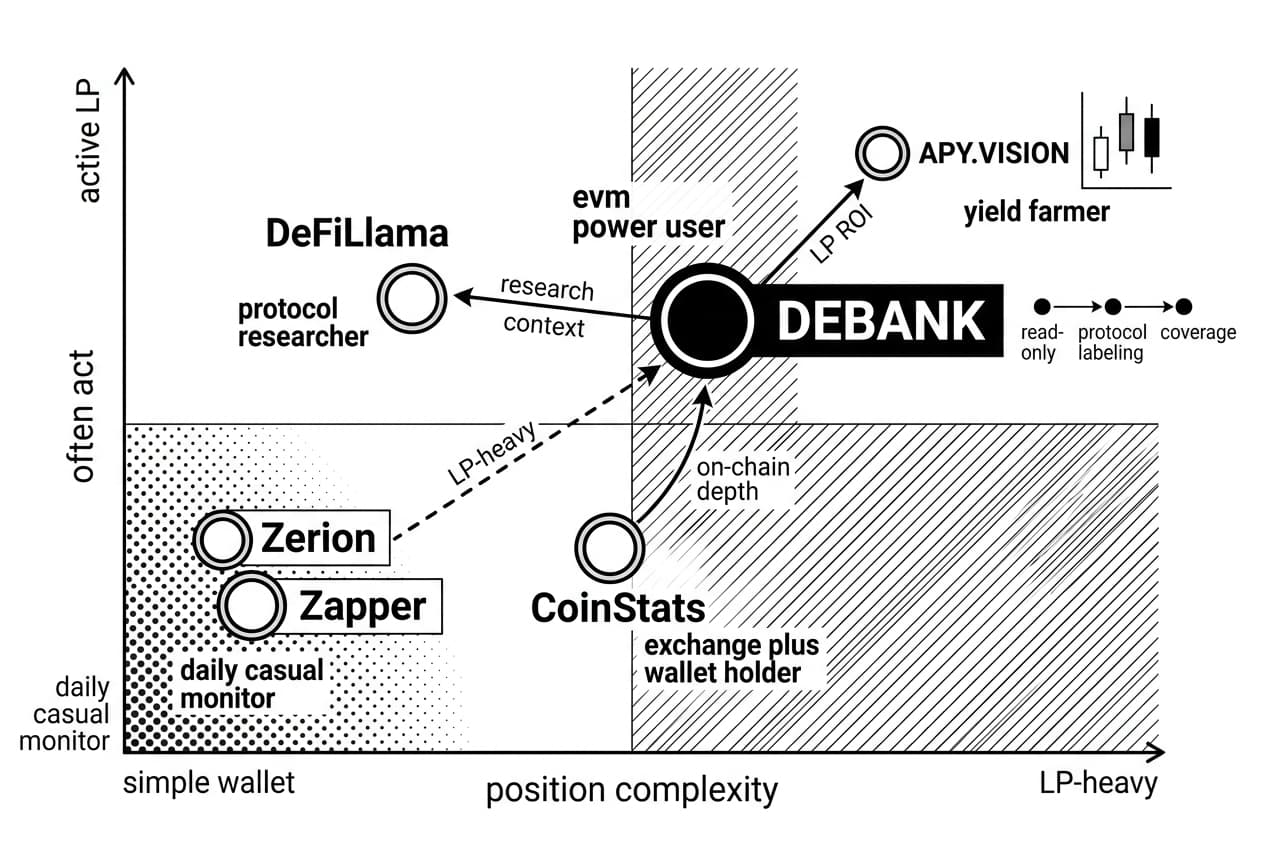
user type | primary tool | specialist add-on |
|---|---|---|
evm power user | DeBank | Revert for LP ROI |
protocol researcher | DeFiLlama | none needed |
exchange plus wallet holder | CoinStats | DeBank for on-chain depth |
daily casual monitor | Zerion or Zapper | APY.Vision if LP-heavy |
active LP or yield farmer | APY.Vision | DeBank for broad coverage |
Our final pick for most evm users is DeBank because it balances read-only safety, protocol labeling, and practical coverage. Use DeFiLlama for research context, Zerion or Zapper for daily visual checks, CoinStats for exchange integration, and APY.Vision when LP math affects real decisions.
Frequently Asked Questions
- Are DeFi coins a good investment?
- DeFi coins provide exposure to lending, trading, staking, and infrastructure protocols, but they carry significant risk. Smart contract vulnerabilities, token inflation, regulatory uncertainty, and thin liquidity can all erode value. Instead of chasing high APYs, use a portfolio tracker to monitor your allocation, profit and loss, yield performance, and overall risk exposure.
- Is DeFiLlama free?
- DeFiLlama is widely used as a free DeFi data platform, offering dashboards covering TVL, yields, protocols, chains, and broader portfolio context. It requires no account to access most features. That said, crypto tools frequently update their pricing and access models, so check the site directly to confirm what is currently available at no cost.
- What is the best DeFi wallet?
- The right wallet depends on your chain and use case. MetaMask and Rabby are popular choices for EVM-compatible networks, while Phantom is a go-to for Solana. For larger balances, a hardware wallet adds meaningful security. When choosing, also consider whether the wallet integrates with your preferred DeFi portfolio tracking dashboard.
- What are DeFi apps?
- DeFi apps are blockchain-based financial applications that handle lending, borrowing, trading, staking, yield farming, derivatives, stablecoins, and asset management — all without traditional intermediaries. Because positions can spread across dozens of protocols quickly, a dedicated DeFi portfolio tracker lets you monitor everything from one dashboard rather than checking each app individually.
Author

Crypto analyst and blockchain educator with over 8 years of experience in the digital asset space. Former fintech consultant at a major Wall Street firm turned full-time crypto journalist. Specializes in DeFi, tokenomics, and blockchain technology. His writing breaks down complex cryptocurrency concepts into actionable insights for both beginners and seasoned investors.