DeFi Gas Optimization: Reduce Transaction Costs in 2026
What you’ll accomplish with DeFi gas optimization
DeFi gas optimization is the practice of reducing transaction costs by timing activity, choosing lower-cost Layer 2 networks, avoiding failed transactions, setting wallet fees safely, and improving smart contract efficiency so you pay less for swaps, approvals, bridges, deposits, and other on-chain actions.
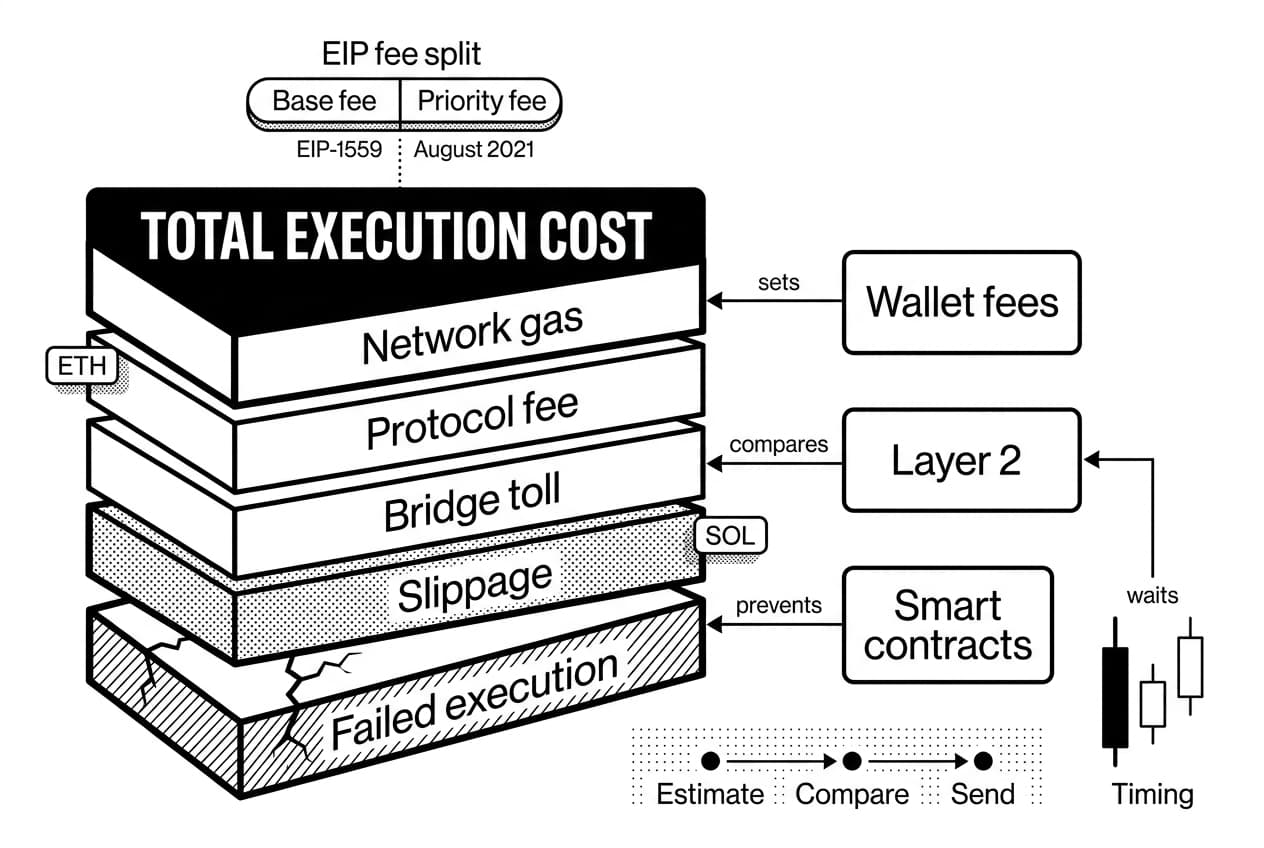
By the end of this guide, you will know how to estimate the full cost before you click send, compare networks without ignoring bridge costs, set safer gas and slippage values, and build a repeatable checklist to reduce gas fees DeFi users pay in 2026.
Why gas fees matter in DeFi
Every on-chain action consumes block space and computation. Swapping tokens, approving a contract, staking, bridging, claiming rewards, or transferring an NFT all require the chain’s native gas token, such as ETH on Ethereum or SOL on Solana.
The wallet fee is only one part of the bill. For example, Ethereum’s fee market changed under EIP-1559 in August 2021, which split fees into a base fee and a priority fee (EIP-1559, August 2021). That design helps wallets estimate fees, but it does not protect you from slippage, bridge tolls, bad routing, or failed execution.
Gas fee vs total execution cost
Use the total execution cost framework before confirming any DeFi transaction. Add each relevant cost line, then decide whether the action is still worth doing.
- Network gas: the native-token fee paid for computation and inclusion.
- Protocol fee: the app’s direct fee, such as a DEX pool fee. Uniswap v3 includes fee tiers such as 0.01%, 0.05%, 0.3%, and 1% (Uniswap docs, May 2026).
- Bridge cost: the fee to move assets between chains, plus any later withdrawal cost.
- Slippage: the gap between the quoted output and the settled output.
- Price impact: the movement caused by your own trade size in the pool.
- MEV exposure: losses from sandwiching, front-running, or stale execution.
- Failed-transaction loss: gas spent on a reverted transaction that produces no useful result.
The cheapest quoted gas is not always the cheapest trade. A route with a low network fee can still be more expensive if it adds a bridge hop, weak liquidity, or a higher chance of failure.
Hayden Adams, founder of Uniswap Labs, is a useful expert reference here because Uniswap’s design work focuses heavily on routing, liquidity depth, and execution quality. In practice, you should judge the whole trade outcome, not the gas line in isolation.
Prerequisites: Prepare your wallet before you optimize
Before you change any setting, prepare your wallet and sources. Most beginner losses come from using the wrong network, holding no native gas token, or signing without reading the confirmation screen.
What you’ll need
- A DeFi-compatible wallet with clear network and fee controls. See our best DeFi wallets for reviewing gas fees guide.
- The native gas token for the chain you are using, such as ETH on Ethereum and many rollups, MATIC on Polygon, BNB on BNB Chain, or SOL on Solana.
- The official app URL, bookmarked before you connect your wallet.
- A block explorer, such as Etherscan for Ethereum, so you can verify status, gas used, nonce, and logs.
Warning: token balance is not gas balance
You may hold $500 of USDC, but if your ETH balance is 0.00 on Ethereum, your transaction will not go through. The network charges the gas token of that chain, not the token you are trying to trade.
Keep a small native-token reserve on every chain you use. As of May 2026, also remember that Ethereum’s Dencun upgrade and EIP-4844 introduced blob space for rollup data, which changed rollup cost structure without making mainnet swaps free (ethereum.org, March 2024).
Step 1: Estimate the full cost before you click send
Start every transaction with a cost check. Your wallet shows useful numbers, but you need to read them before you click the blue Confirm or Send button.
Read the wallet confirmation screen
Most wallets show the same core fields. Read each one slowly, especially if you are using a new protocol.
- Gas limit: the maximum computation your wallet allows for this call.
- Base fee: the minimum network fee required for inclusion on Ethereum-style fee markets.
- Priority fee: the tip that can move your transaction ahead of lower-paying transactions.
- Estimated network fee: the amount your wallet expects you to pay in the native token and local currency.
- Minimum received: the worst acceptable output after slippage tolerance.
If the minimum received amount looks far below the quoted amount, stop and inspect slippage, price impact, and liquidity before signing.
Use a live gas source before submitting
Your wallet quote can become stale while you review it. Cross-check a live source such as the gas tracker on Etherscan, May 2026 before submitting a non-urgent Ethereum transaction.
If the live base fee has jumped sharply, wait unless the transaction is time-sensitive. Most token approvals, deposits, and routine swaps do not need to happen in the next 60 seconds.
Pro tip: apply the 1% cost test
Use this simple rule: if gas plus protocol fees exceed 1% of the value you are moving, reconsider. A $4 total fee on a $50 swap is an 8% cost before slippage and price impact.
Your options are to wait, increase the transaction size, batch the action with another task, or use a supported Layer 2. This is often the easiest form of defi gas optimization because you do not need advanced wallet settings.
Step 2: Time transactions when network demand is lower
After estimating the cost, decide when to send. Ethereum base fees rise when blocks are crowded, so timing can lower costs for non-urgent activity.
Check current and recent gas patterns
Use the gas tracker on Etherscan and ultrasound.money to compare current fees with recent conditions. Look for sudden spikes caused by token launches, NFT mints, liquidation waves, airdrop claims, or sharp market moves.
If you see a spike and your action can wait, give it 20 to 30 minutes and check again. Small delays often matter more than tiny manual changes to the priority fee.
Use low-priority settings for non-urgent actions
Most wallets offer slow, standard, and fast fee choices. Use the slower option for actions such as approving a token, moving funds to a rollup, or depositing into a stable pool when timing is not important.
Do not use slow settings for liquidations, volatile-pair swaps, or trades where a delay can change the price. In those cases, a cheap pending transaction can become an expensive bad fill.
Warning: do not underprice urgent trades
Warning: If your priority fee is too low, your transaction may sit pending while market prices move. A pending swap can later execute at a stale price, revert after slippage is exceeded, or force you to pay another fee to replace it.
If your wallet shows Speed up or Cancel, it will usually rebroadcast a replacement using the same nonce and a higher fee. Act before the original confirms.
Step 3: Choose the right chain, Layer 2, or route
Choosing the right network is one of the highest-impact DeFi gas optimization decisions. The goal is not to find the lowest fee in isolation. The goal is to find the cheapest safe outcome after gas, liquidity, bridge cost, and settlement risk.
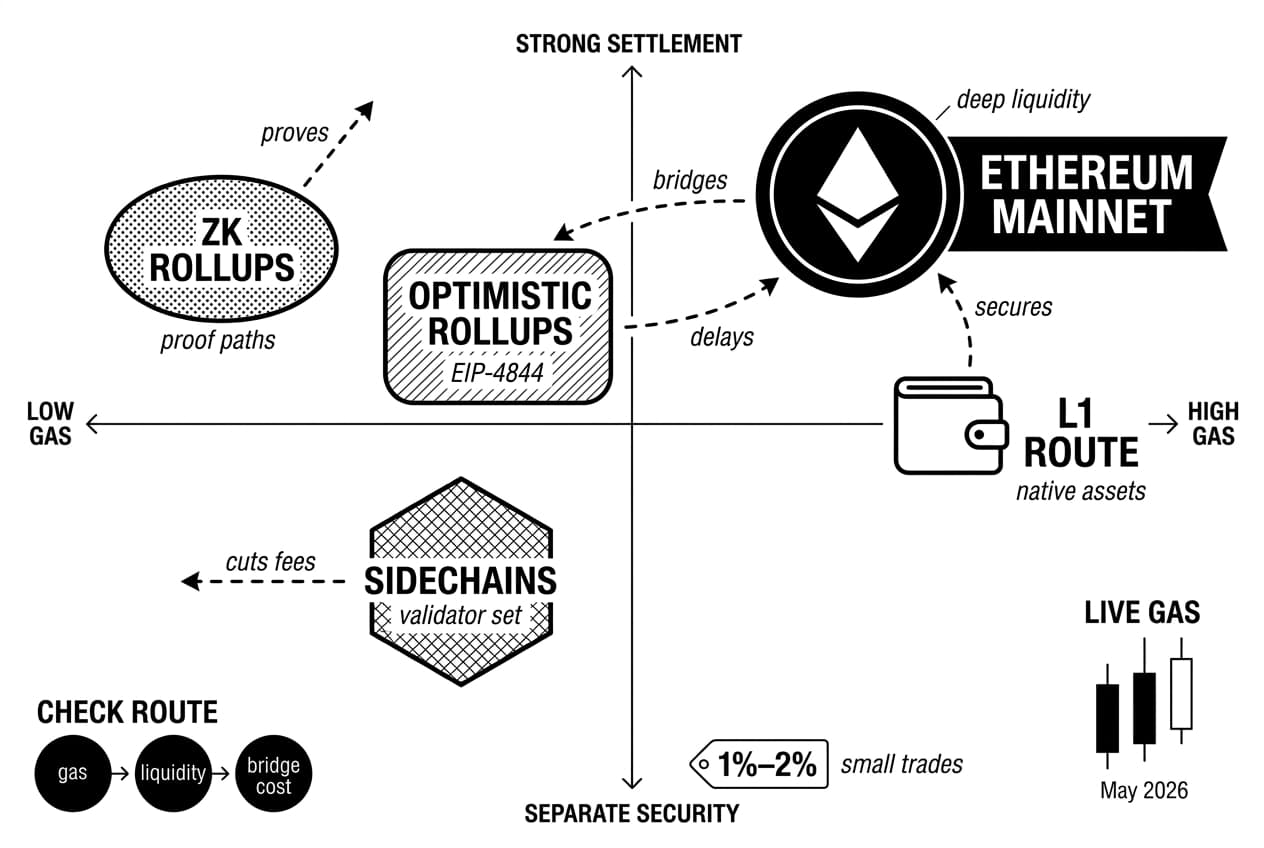
Compare L1, L2, and sidechain tradeoffs
Option | Best for | Gas-cost profile | Tradeoffs | When to avoid |
|---|---|---|---|---|
Ethereum mainnet | Large trades, high-value lending, deep liquidity | Highest fee environment; check live conditions before signing (Etherscan, May 2026) | Deep liquidity, strong settlement, no bridge needed for native Ethereum assets | Small trades where total cost is more than 1% to 2% of value |
Optimistic rollups | Frequent swaps, lending, yield actions, mid-size portfolios | Often much cheaper than mainnet after EIP-4844 rollup data changes (ethereum.org, March 2024) | Good app coverage, but native withdrawals to mainnet can involve a challenge period | When you need immediate mainnet liquidity or the app is not deployed there |
ZK rollups | Lower-cost trading, fast proof-based settlement paths, newer app ecosystems | Low per-transaction cost, with fees depending on prover and data costs | Growing support, but not every wallet or DeFi app is available | When the protocol, asset, or wallet you need is missing |
Sidechains | Small repeated transactions, games, NFT activity, low-value experiments | Very low network fees, but separate security assumptions | Cheap and fast, with a different validator set than Ethereum rollups | Large long-term balances if the security model does not fit your risk tolerance |
Alternative L1s | Ecosystem-native apps and low-cost retail activity | Solana’s base fee is 5,000 lamports per signature (Solana docs, May 2026) | Different wallets, validator sets, bridges, and app ecosystems | When bridging into the ecosystem costs more than you expect to save |
For a deeper side-by-side on fees and decentralization, see our Polygon vs Ethereum Layer 2 comparison and the Ethereum vs BNB fee and use case comparison. To understand how assets and messages move between networks, read about how DeFi protocols work across chains.
Vitalik Buterin, co-founder of Ethereum Foundation, has repeatedly pointed to rollups as Ethereum’s main scaling path. For you, that means a well-supported rollup can reduce execution cost without forcing you to leave the Ethereum security model entirely.
Check whether the app supports your network
Before you bridge funds, open the official app URL and click the network selector in the top-right area of the interface. If your target chain is not listed, do not bridge there for that app.
Warning: Do not click bridge links from search ads, social posts, or direct messages. Use the protocol’s official domain and confirm the URL before connecting your wallet.
Pro tip: use the bridge break-even test
Moving to a cheaper network only helps if future savings exceed bridge costs. Use this calculation: total round-trip bridge cost divided by expected savings per transaction equals the number of transactions needed to break even.
If the answer is 12 and you plan to make only two swaps, staying where you are may be cheaper. Repeat this test each time because gas, liquidity, and bridge pricing change.
Step 4: Batch actions and avoid wasteful approvals
Every signature that becomes an on-chain transaction costs gas. Reducing the number of transactions can save more than fine-tuning a priority fee.
Combine actions when the app supports it
Look for app buttons such as approve and supply, zap, claim and stake, or multicall. These flows combine several actions into one transaction.
Hayden Adams, founder of Uniswap Labs, is relevant again because DEX design increasingly focuses on routing and execution in one user action. Still, read the wallet simulation because a bundled transaction can contain several contract calls.
- Zap: convert and deposit in one flow.
- Claim and stake: collect rewards and restake without a separate manual step.
- Multicall: combine multiple contract calls into one transaction where supported.
Manage token approvals safely
Before a DeFi protocol can move your token, you usually sign an approval. That approval may cost gas, so you need to balance cost against exposure.
Exact approvals limit the amount a contract can move. Unlimited approvals reduce repeat approval costs but create more risk if the contract or approval target is compromised.
When available, use permit-style approvals. EIP-2612 lets a token approval happen through a signed message rather than a separate on-chain approval transaction (EIP-2612, 2020).
Review old approvals on a regular schedule and revoke those you no longer need. This is security hygiene, not just gas hygiene.
Avoid tiny repetitive transactions
Do not claim $0.80 of rewards if the total transaction cost is $1.20. Use a minimum-action threshold instead.
Apply the 3x claim rule: the expected value of a claim, compound, or rebalance should be at least three times the total transaction cost. If it is not, wait unless the protocol has an expiry rule.
Warning: Some protocols use reward windows or changing emissions. Read the docs before delaying a claim for weeks.
Step 5: Set gas limits, slippage, and priority fees safely
Advanced settings are useful only when you understand the tradeoff. Randomly lowering values can turn a normal swap into a failed transaction.
Adjust fee settings only when you understand them
The priority fee controls speed. The gas limit controls the maximum computation allowed. Do not lower the gas limit below the wallet estimate unless you understand the contract call.
For a complex DeFi call, the wallet may estimate hundreds of thousands of gas units. If you cut that limit too far, the transaction can run out of gas and fail while still charging you.
For safety, leave the gas limit at the wallet estimate or add a 10% to 20% buffer if the wallet allows it and the app is known to be complex.
Use slippage controls to prevent bad fills
Slippage tolerance is the worst price movement you accept between signing and settlement. Too low can cause reverts. Too high can invite sandwich attacks and poor fills.
For liquid pairs, 0.3% to 0.5% is often reasonable. For low-liquidity tokens, 0.5% to 1% may be needed, but check pool depth first. If you are building contracts, our front-running prevention for smart contract developers guide explains why wide slippage can become an MEV target.
Also set a transaction deadline, commonly 20 to 30 minutes. A deadline prevents an old pending trade from executing long after the quote is stale.
Warning: failed transactions still cost gas
When a transaction reverts, validators still processed computation. You pay for that work even though the action did not complete.
Prevent this by simulating the transaction in your wallet, checking the minimum received amount, confirming the correct approval amount, and avoiding gas limits that are too tight.
Field check: if your transaction fails, save the transaction hash, the status, the gas paid, and the revert reason. That small log gives you evidence for improving your next transaction instead of guessing.
Step 6: Write and deploy gas-efficient smart contracts
If you build DeFi contracts, your code choices shape what every user pays. Optimize the expensive paths, but never trade away correctness or security for a small fee reduction.
Optimize storage and computation
Storage is expensive on the EVM. A cold SSTORE can cost 20,000 gas, while a cold SLOAD can cost 2,100 gas under EIP-2929 (EIP-2929, October 2020).
- Pack storage variables: place smaller types in the same 32-byte slot where safe.
- Cache repeated reads: read storage once, then reuse a local variable.
- Prefer calldata for external read-only parameters: avoid unnecessary memory copies.
- Use events for off-chain history: do not store data on-chain if users only need it in an indexer.
- Avoid unbounded loops: shifting loops can hit block gas limits and revert.
Use efficient token standards and code structure
Avoid redundant storage writes. If a value is already correct, do not write it again.
Use custom errors where practical because they are cheaper than long revert strings in modern Solidity. Use audited libraries such as OpenZeppelin contracts rather than rewriting common security logic.
Reduce deployment and initialization costs
- Use minimal proxies: EIP-1167 defines a minimal clone pattern that uses 45 bytes of runtime code (EIP-1167, June 2018).
- Use deterministic deployment carefully: CREATE2 can pre-compute addresses, which helps with coordination.
- Use initializers for proxy contracts: constructors do not run on the proxy instance.
- Trim bytecode: remove unused imports and internal functions before deployment.
Pair gas work with a smart contract CI/CD testing workflow. Foundry gas snapshots or gas-reporting plugins can catch regressions before deployment.
Warning: never optimize gas at the expense of security
Security comes first. Do not remove reentrancy guards, skip validation, or use unsafe assembly just to save a small amount of gas. Vitalik Buterin, co-founder of Ethereum Foundation, is a useful reference point here because Ethereum engineering culture consistently treats correctness as a requirement before efficiency.
Run gas tests, then run security tests, then review the results with another engineer before mainnet deployment.
Step 7: Monitor results and fix failed transactions
After sending, verify what happened. Your own transaction history is the best training data for future DeFi gas optimization.
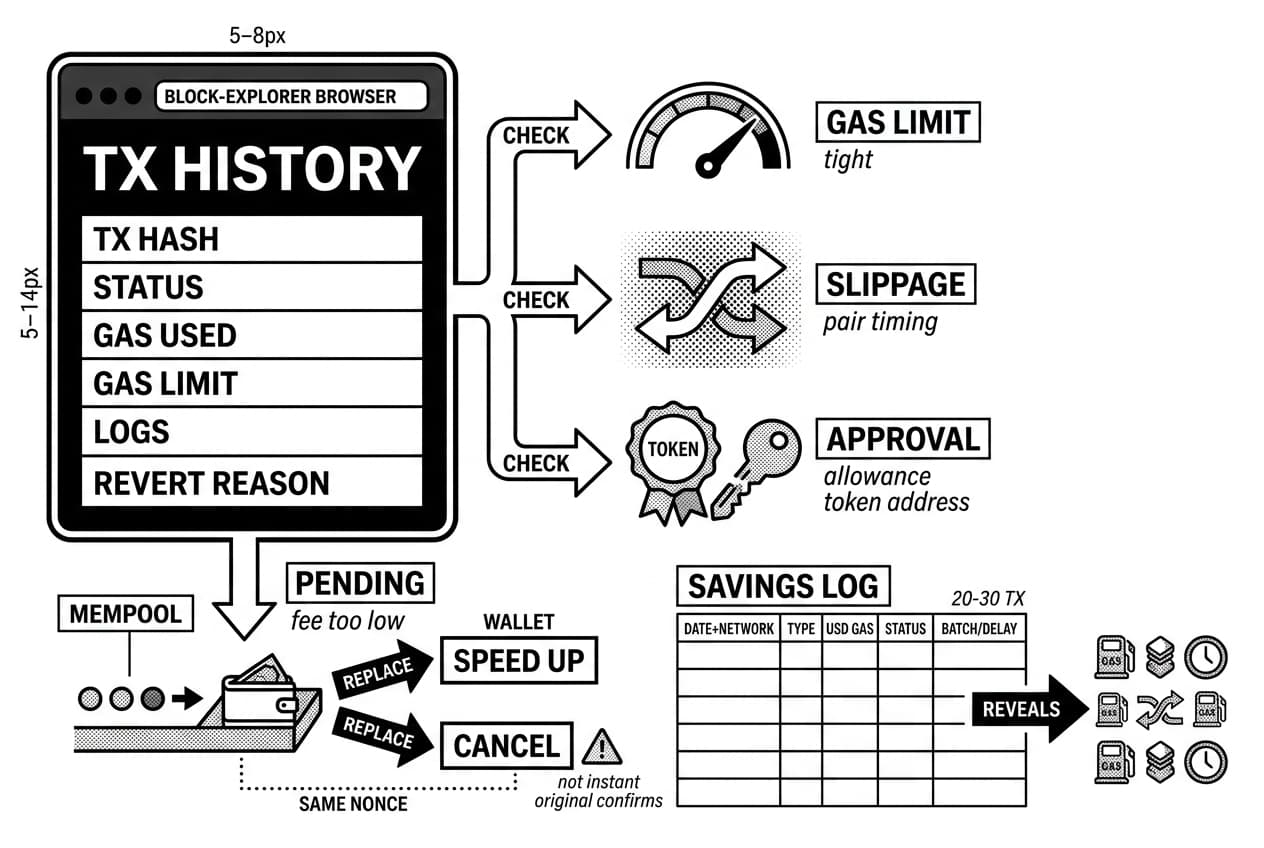
Review transaction status on a block explorer
Paste the transaction hash into Etherscan or the explorer for your chain. Check status, gas used, gas limit, logs, and any revert reason.
If gas used is very close to the gas limit, the limit was tight. If the transaction failed because of slippage, your tolerance was too low for the pair or timing. If approval failed, the allowance or token address may be wrong.
Handle pending transactions carefully
A pending transaction usually means the fee is too low for current demand. Use your wallet’s Speed up or Cancel button if it offers one.
Both actions normally submit a replacement transaction with the same nonce and a higher fee. Do not manually edit nonces unless you understand how transaction ordering works.
Warning: Canceling is not instant. If the original confirms first, the cancel attempt will not undo it.
Track your savings over time
Create a simple five-column log. Record the date and network, transaction type, gas paid in USD, status, and whether it could have been batched or delayed.
After 20 to 30 transactions, patterns become obvious. You will see which actions waste the most gas, which networks save money after bridge costs, and when waiting is worth it.
Frequently Asked Questions
- What can help reduce gas fees?
- Transacting during low-congestion periods, using Layer 2 networks, batching multiple actions, avoiding redundant token approvals, and checking a gas tracker before confirming all help lower costs. Keep in mind that the cheapest gas quote isn't always ideal — it can increase slippage, bridge costs, or the risk of a failed transaction.
- How to reduce Ethereum gas fees?
- Monitor live gas conditions using tools like Etherscan's gas tracker, wait for off-peak periods such as weekends or late nights, and use Layer 2 networks where the protocol supports it. Avoid small transactions and set reasonable priority fees. Ethereum fees shift constantly, so always confirm the exact cost in your wallet before submitting.
- What happens if I don't have enough ETH to pay the gas fees for a transaction?
- Most wallets will block submission and display an insufficient funds warning. If the transaction somehow reaches the network with inadequate gas parameters, it may fail or sit pending indefinitely. You must hold ETH on Ethereum mainnet, or the appropriate native gas token on whichever network you're using, before transacting.
- What do gas fees mean in crypto?
- Gas fees are payments made to validators for processing and securing transactions on a blockchain. In DeFi, gas is required for swaps, token approvals, deposits, withdrawals, reward claims, and bridge transfers — essentially any smart contract interaction. The cost fluctuates based on current network demand and the computational complexity of the action.
Author

Crypto analyst and blockchain educator with over 8 years of experience in the digital asset space. Former fintech consultant at a major Wall Street firm turned full-time crypto journalist. Specializes in DeFi, tokenomics, and blockchain technology. His writing breaks down complex cryptocurrency concepts into actionable insights for both beginners and seasoned investors.