Shiba Inu vs Pepe Coin: Which Meme Coin Is Better in 2026?
Shiba Inu vs Pepe Coin: Which Meme Coin Is Better in 2026?
Shiba Inu vs Pepe Coin: Quick Overview and Comparison Table
This Shiba Inu vs Pepe Coin comparison looks at SHIB and PEPE as speculative risk assets, not as fan communities. Both are Ethereum-based meme coins, but they differ in ecosystem depth, supply design, holder mix, liquidity quality and realistic upside. The better question is not which token has the louder community. It is which risk profile fits your time horizon, trade size and tolerance for sharp drawdowns.
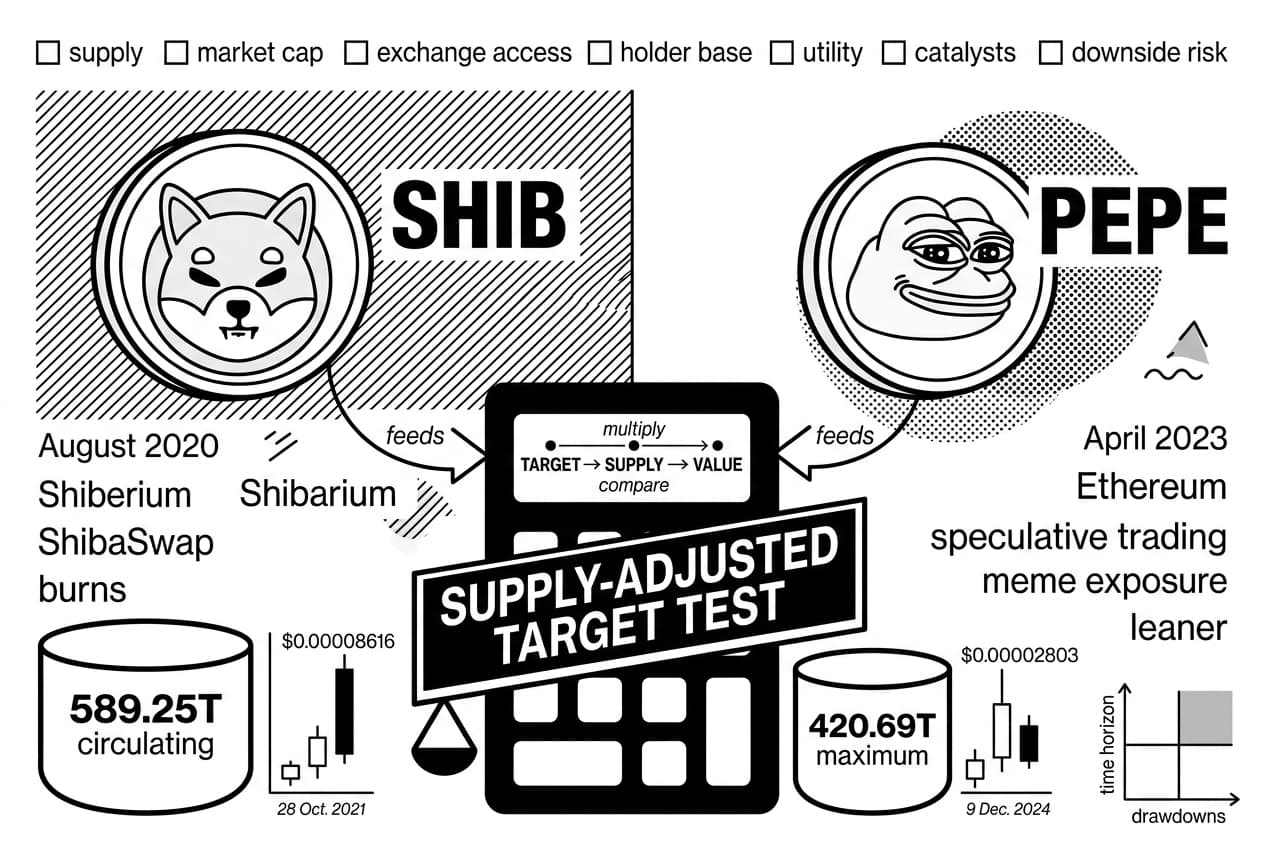
As of this review on 13 October 2026, the article uses the same checklist for both tokens: supply, market cap, exchange access, holder base, utility, catalysts and downside risk. It also applies an original framework called the Supply-Adjusted Target Test: multiply a price target by circulating or maximum supply, then compare the implied value with large crypto assets and the total crypto market. This keeps meme-coin targets tied to math rather than social posts.
Metric | Shiba Inu (SHIB) | Pepe Coin (PEPE) |
|---|---|---|
Launch | August 2020 | April 2023 |
Blockchain | Ethereum token with Shibarium as a related layer 2 | Ethereum token |
Supply | About 589.25 trillion circulating; live figure varies by feed (CoinGecko, 13 Oct. 2026) | 420.69 trillion maximum supply (CoinGecko, 13 Oct. 2026) |
Historic peak | $0.00008616 on 28 Oct. 2021 (CoinGecko, 13 Oct. 2026) | $0.00002803 on 9 Dec. 2024 (CoinGecko, 13 Oct. 2026) |
Utility | Linked to Shibarium, ShibaSwap and token burns | Mainly speculative trading and meme exposure |
Ecosystem | Broader, but adoption should be checked against live usage | Leaner, with no native app layer |
Volatility | Very high, but with a longer trading history | Very high, with a shorter record and sharper narrative swings |
Best for | Traders who want meme exposure plus ecosystem optionality | Traders who want pure meme momentum and can exit quickly |
How This Comparison Was Scored
The article applies six factors to both assets: supply math, ecosystem depth, liquidity, holder concentration, catalyst quality and downside risk. The method is conservative. Willy Woo, on-chain analyst at Independent, has long focused his public work on holder behavior, liquidity and network-level flows. That lens is useful here because meme coins can look large by market cap while still having fragile exit liquidity.
The comparison also separates verifiable data from sentiment. CoinGecko pages are used for market and supply references, Etherscan pages are used for holder visibility, and ShibariumScan is used for Shibarium activity checks. These sources do not prove future performance, but they make the SHIB-versus-PEPE trade easier to audit.
Overview of Shiba Inu (SHIB)
SHIB launched in August 2020 as an Ethereum meme token. It became known as a dog-themed retail asset, but its later story is broader: the community built ShibaSwap, supported a related layer-2 network called Shibarium, created a wider token structure and promoted recurring burn narratives. That gives SHIB more moving parts than most meme coins, although its price still depends heavily on speculative demand.
What SHIB Is
SHIB is the main token in a wider token family that also includes BONE and LEASH. Its biggest structural issue is supply. Even after burns, circulating supply remains near 589.25 trillion tokens (CoinGecko, 13 Oct. 2026). Shibburn reports more than 410 trillion SHIB burned from the original supply base (Shibburn, 13 Oct. 2026), but the remaining float is still large enough that small price targets can imply very large valuations.
SHIB Strengths
- Distribution: SHIB has deep exchange access and a long retail history, which can reduce friction when entering or exiting compared with smaller meme tokens.
- Ecosystem depth: Shibarium and ShibaSwap give SHIB more infrastructure than PEPE, even if usage is not yet comparable with the largest layer-2 networks.
- Brand durability: SHIB survived the 2022 bear market and several meme-coin rotations, which is a useful stress test for community persistence.
- Burn tracking: Public burn dashboards let holders monitor supply reduction, even though the burn rate is not large enough by itself to support extreme price targets.
SHIB Weaknesses
The main weakness is valuation math. A $0.01 SHIB price with roughly 589.25 trillion tokens outstanding would imply about $5.89 trillion in market value, using the supply figure above. That is larger than the total crypto market peak of about $3.7 trillion shown in global crypto charts during November 2021 (CoinGecko global chart, 13 Oct. 2026). The target is not impossible in theory, but it requires assumptions far beyond any past crypto cycle.
SHIB also faces attention risk. Newer meme coins can attract speculative capital faster because they start from lower valuations. While SHIB offers a deeper ecosystem, that depth matters only if users keep transacting, building and supplying liquidity. If activity is thin, SHIB behaves less like an ecosystem token and more like a large, high-beta meme asset.
Overview of Pepe Coin (PEPE)
PEPE launched in April 2023 with a simpler pitch. It did not promise a native chain, a staking economy or a detailed product roadmap. Its appeal came from meme recognition, exchange listings and rapid speculative volume. That makes it a cleaner but riskier asset in the Shiba Inu vs Pepe Coin debate.
What PEPE Is
PEPE is an Ethereum token with a 420.69 trillion maximum supply (CoinGecko, 13 Oct. 2026). It has no native fee burn, no official layer 2 and no built-in cash-flow mechanism. Its value comes from market attention, liquidity and the willingness of traders to assign a premium to meme culture. That simplicity is the main reason PEPE can move quickly in risk-on markets.
PEPE Strengths
- Clean meme exposure: PEPE gives traders direct exposure to meme-cycle momentum without needing to evaluate a complex product stack.
- Fast liquidity growth: It reached more than $1.6 billion in market value within weeks of launch in May 2023 (CoinGecko, 13 Oct. 2026), showing how quickly social attention can become tradable demand.
- Smaller base than SHIB: A lower market value than SHIB can allow larger percentage moves during strong meme cycles, although the same effect works in reverse during selloffs.
- Broad trading access: PEPE has enough centralized and decentralized market coverage for active traders to manage positions without depending on one venue.
PEPE Weaknesses
PEPE has less fundamental support than SHIB. There is no native app layer to generate recurring demand, no official burn engine tied to usage and no product roadmap that would change the token’s economic role. If attention fades, the token has fewer internal catalysts to rebuild demand. Anyone researching whether Pepe Coin is a good investment should start with that trade-off rather than with the chart alone.
Holder concentration is another risk. The PEPE token page on Ethereum shows a smaller holder base than SHIB, with live counts changing each day (Etherscan PEPE holders, 13 Oct. 2026). A smaller base can produce faster rallies, but it also means large wallets can affect liquidity more severely during crowded exits.
Key Differences Between Shiba Inu and Pepe Coin
The main differences between Shiba Inu and Pepe Coin are:
- Ecosystem: SHIB has Shibarium and ShibaSwap, while PEPE has no native infrastructure beyond the Ethereum token contract and exchange markets.
- Supply: SHIB has a large circulating float with ongoing burns, while PEPE has a fixed 420.69 trillion maximum supply.
- Use case: SHIB offers ecosystem optionality, while PEPE is mainly a pure meme-trading asset.
- Holder profile: SHIB has a longer-lived holder base, while PEPE has a younger and more reactive trading base.
- Risk pattern: SHIB’s risk is slow ecosystem underuse, while PEPE’s risk is a sharper collapse if meme attention fades.
Ecosystem and Utility
SHIB has the clearer utility story because Shibarium gives the community a lower-cost transaction layer and ShibaSwap provides a native trading venue. Shibarium mainnet launched in August 2023, and its live explorer tracks blocks, transactions and wallet activity (ShibariumScan, 13 Oct. 2026). That does not make SHIB low risk, but it gives analysts measurable activity beyond social media.
PEPE’s utility is narrower. It functions as a liquid meme token and does not try to be anything else. That can be an advantage for short-term traders because the thesis is easy to monitor: volume, exchange depth, social attention and whale movement. It is weaker for long-term holders who want demand sources that survive after hype cools.
Supply, Market Cap and Price Math
The Supply-Adjusted Target Test is harsh for both coins. For PEPE to reach $0.01 with a 420.69 trillion maximum supply, the implied value would be about $4.21 trillion. For SHIB to reach $0.01 with about 589.25 trillion tokens circulating, the implied value would be about $5.89 trillion. Both outcomes would require valuation levels far above historical meme-coin norms.
This is why per-token price alone misleads retail buyers. A token can look cheap at a fraction of one cent while already carrying a large network value. For a deeper version of this calculation, see the analysis of whether Pepe Coin can reach $1. The same logic applies to SHIB price targets: supply first, market cap second, chart pattern third.
Factor | SHIB | PEPE |
|---|---|---|
Supply base | About 589.25 trillion circulating (CoinGecko, 13 Oct. 2026) | 420.69 trillion maximum supply (CoinGecko, 13 Oct. 2026) |
One-cent implied value | About $5.89 trillion | About $4.21 trillion |
Burn model | Public burn tracking exists; more than 410 trillion SHIB burned from the original supply base (Shibburn, 13 Oct. 2026) | No native burn model |
Infrastructure | Shibarium plus ShibaSwap | Ethereum markets only |
Main trading risk | Slow drift if ecosystem use disappoints | Sharp reversal if attention rotates |
Fees, Speed and Infrastructure
SHIB has an infrastructure edge for users who interact on-chain because Shibarium can support cheaper transfers than Ethereum mainnet. PEPE users mostly rely on Ethereum mainnet or centralized exchanges. For small positions, this matters. A $10 gas fee is minor for a large trade but can be a high percentage cost for a small meme-coin position.
For traders who keep assets on centralized exchanges, the gap is smaller. Both tokens can be bought and sold on major venues, and exchange fees often matter more than chain fees. For self-custody users, SHIB’s related layer 2 gives it more flexibility, while PEPE remains simpler but more dependent on external trading venues.
Volatility and Trading Profile
SHIB has more historical data because it has traded through the 2021 bull market, the 2022 bear market and later meme rotations. PEPE has a shorter record, but its early performance shows stronger reflexivity. It climbed to more than $1.6 billion in market value in May 2023, then later printed a peak price of $0.00002803 on 9 Dec. 2024 (CoinGecko, 13 Oct. 2026).
That profile suits different users. SHIB may fit traders who want meme exposure with a longer record and more ecosystem optionality. PEPE may fit traders who are comfortable with faster entries, faster exits and tighter risk controls. For long-range scenario thinking, the Pepe Coin price prediction for 2030 gives useful bull and bear cases.
Community, Holders, Liquidity and News Catalysts
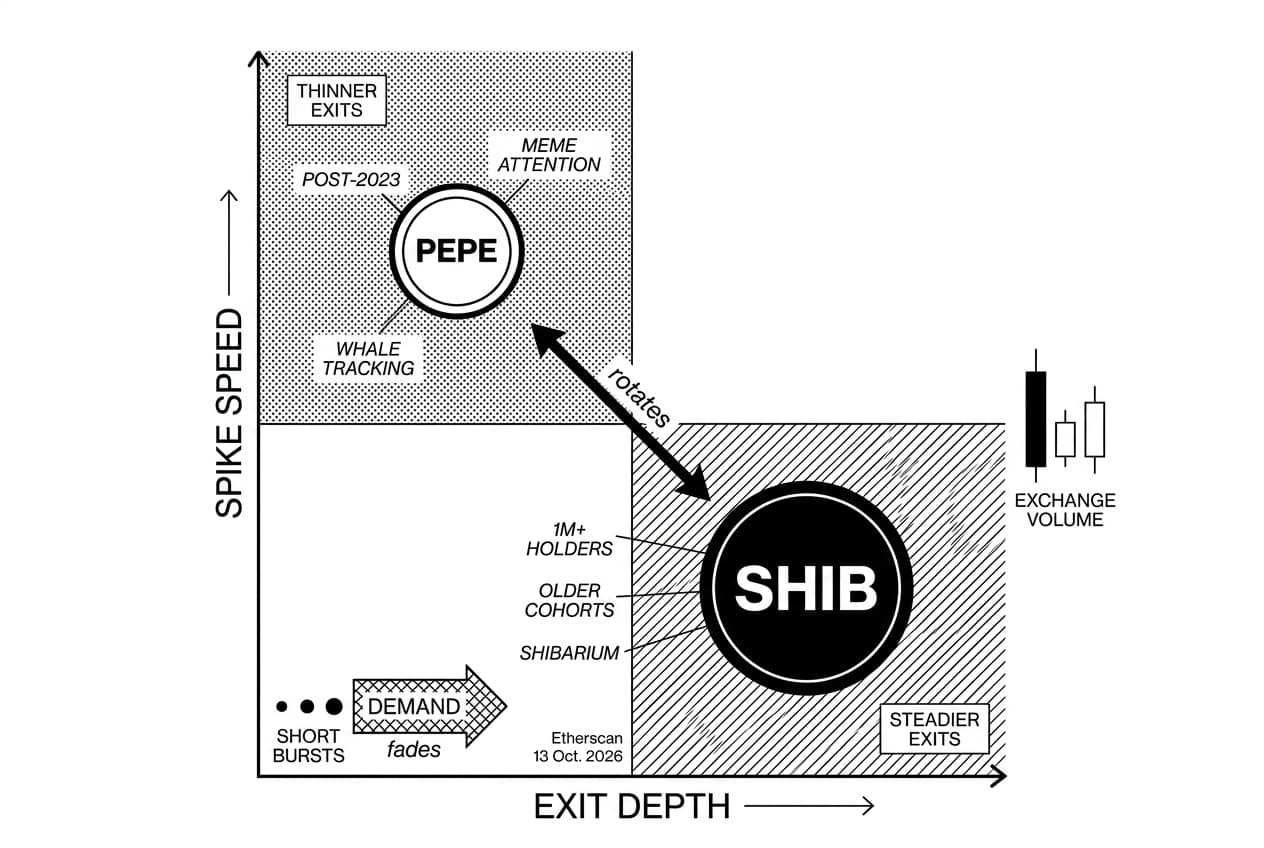
Meme coins often move when liquidity, holder behavior and attention align. A strong community can support volume, but it cannot remove market risk. The better signal is whether holders are adding liquidity, whether large wallets are distributing and whether catalysts create lasting activity or only short bursts of demand.
Community and Holder Base
SHIB has the older and larger holder base. Its Ethereum token holder page shows more than 1 million holder addresses on the live counter (Etherscan SHIB holders, 13 Oct. 2026). PEPE’s holder base is smaller on its live Ethereum page (Etherscan PEPE holders, 13 Oct. 2026). A larger base can reduce single-wallet pressure, although exchange-held balances make any holder count imperfect.
Liquidity quality matters more than social follower counts. SHIB usually benefits from deeper retail recognition, while PEPE often benefits from faster speculative rotation. The practical question is whether you need steadier exit depth or are willing to accept thinner exits in exchange for higher upside during meme spikes.
Signal | SHIB | PEPE |
|---|---|---|
Holder age | Older, with several cycle cohorts | Younger, mostly post-2023 cohorts |
Holder count | Live count above 1 million on Ethereum holder page (Etherscan, 13 Oct. 2026) | Smaller live count on Ethereum holder page (Etherscan, 13 Oct. 2026) |
Main catalyst | Burn data, Shibarium usage, exchange liquidity | Meme attention, exchange volume, whale tracking |
Weak signal | Roadmap claims without usage growth | Viral posts without spot volume |
News and Market Catalysts
SHIB catalysts tend to be more measurable: burn-rate spikes, Shibarium transaction activity, ShibaSwap liquidity and listings. PEPE catalysts are more sentiment-led: viral cycles, exchange volume surges and large-wallet transfers. For PEPE traders, the latest Pepe Coin news and market updates are most useful when they include volume, order-book depth or wallet movement rather than social posts alone.
Avoid Confusing SHIB and PEPE With Copycat Tokens
This article compares only SHIB and PEPE. Hybrid tickers and copycats on decentralized exchanges are separate assets and may have unrelated contracts. Always verify the official contract address through the project site, token explorer and exchange deposit page before buying. Copycat meme tokens often copy names, logos and tickers to catch rushed buyers.
Risks and Challenges for Both Meme Coins
Both assets share one central risk: neither produces cash flow. They do not pay dividends, own productive assets or create an earnings floor. When demand falls, there is no valuation anchor comparable to revenue or profit. That does not mean they cannot rally, but it does mean position sizing should be conservative.
Market and Liquidity Risks
Market cap can create false comfort. A meme coin can show billions in value while still having thin order books during stress. PEPE’s rapid move to more than $1.6 billion in May 2023 (CoinGecko, 13 Oct. 2026) shows how fast demand can appear. The reverse can happen just as quickly when traders rush for the same exits.
SHIB is not immune. Its larger holder base may reduce single-wallet risk, but its valuation still depends on sentiment and broad crypto liquidity. A bitcoin drawdown, higher funding stress or risk-off macro move can pressure both tokens at the same time. This is why meme-coin exposure should be treated as speculative capital, not as a core savings position.
Security and Scam Risks
Both communities attract impersonation sites, fake airdrops, copied contracts and phishing links. Before interacting with any token contract, review the rug pull warning signs. For storage, learn how to use a hardware wallet safely, use small test transfers and avoid signing unknown approvals from meme-token websites.
Common Questions Before Comparing SHIB and PEPE
Search interest around SHIB and PEPE often focuses on extreme targets, celebrity rumors and whether the trade is already over. The cleanest answers come from supply, liquidity and verifiable activity rather than slogans.
Is SHIB Dead?
No. A token is not dead just because it trades below its old high. SHIB still has exchange liquidity, an active holder base and Shibarium-linked activity. The bearish case is different: if ecosystem use fails to grow, SHIB may remain a speculative meme asset rather than becoming a high-utility network token.
Can SHIB Reach 1 Cent?
The Supply-Adjusted Target Test makes one cent highly unlikely under current supply conditions. At about 589.25 trillion circulating tokens, $0.01 implies roughly $5.89 trillion in value. That would exceed the total crypto market peak shown in historical global charts (CoinGecko global chart, 13 Oct. 2026).
Does Elon Musk Hold SHIB?
No reliable public filing or first-hand statement proves that Elon Musk, CEO of Tesla and owner of X, holds SHIB. Treat social media screenshots, parody accounts and unsourced claims as noise. Celebrity rumors are not due diligence. For a meme coin, volume, liquidity, supply and holder distribution matter more than speculation about one public figure.
What Could SHIB Be Worth in Five Years?
A five-year SHIB outcome depends on the crypto cycle, burn speed, Shibarium usage, exchange liquidity and regulation. Instead of using one target, model three cases: a bearish liquidity fade, a base case where SHIB tracks the meme market and a bullish case where ecosystem activity grows enough to support demand.
Which Should You Choose: Shiba Inu or Pepe Coin?
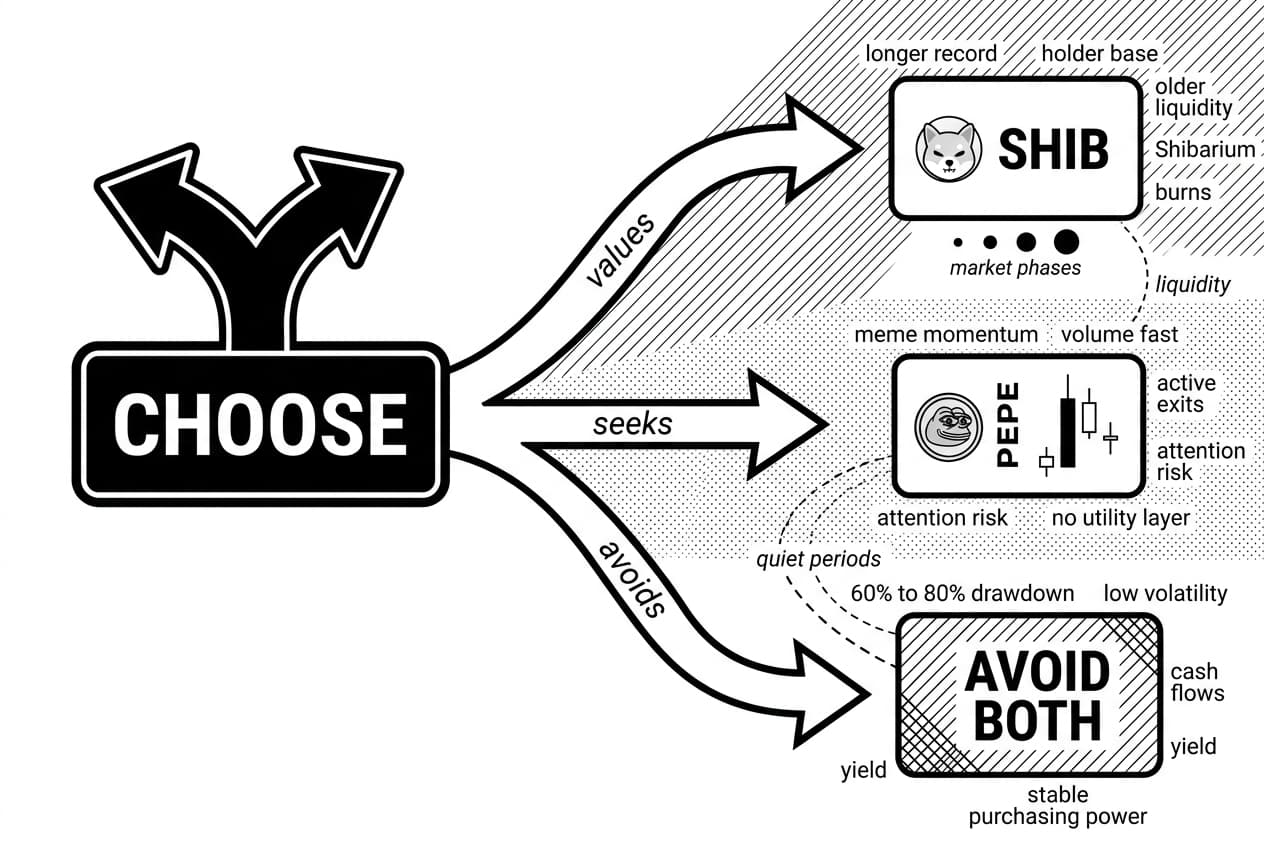
Choose SHIB if you want a meme coin with a longer record, a larger holder base and ecosystem optionality. Choose PEPE if you want cleaner meme momentum and accept sharper attention risk. Avoid both if you need income, low volatility or assets backed by cash flows, because neither token offers capital protection.
Choose SHIB If...
SHIB is the better fit if you value infrastructure, older liquidity and a community that has survived several market phases. It also suits traders who want measurable data points such as burns and Shibarium activity. The trade-off is that SHIB’s larger market base can make explosive percentage gains harder than in smaller meme tokens.
Choose PEPE If...
PEPE is the better fit if you want a simpler, culture-driven trade and can manage exits actively. Its strength is speed: when meme demand returns, PEPE can attract volume fast. Its weakness is the absence of a fallback utility layer, so holding through long quiet periods carries higher narrative risk.
Avoid Both If...
Avoid both if a 60% to 80% drawdown would create financial stress. Meme coins can rally hard, but they can also lose liquidity fast. If your goal is stable purchasing power, yield or exposure to productive assets, SHIB and PEPE are poor fits regardless of community size.
Frequently Asked Questions
- Is SHIB a dead coin?
- SHIB isn't necessarily dead if it still holds liquidity, exchange listings, active holders and Shibarium ecosystem activity. That said, a busy community doesn't automatically drive price growth. Check 2026 trading volume, developer updates and market-cap trends before drawing any conclusions about its long-term viability.
- Will Shiba hit 1 cent in 2030?
- Reaching $0.01 would give SHIB a staggering market cap — likely surpassing Bitcoin's current valuation. That math makes it extremely unlikely without massive, sustained token burns. Before buying into the hype, compare the implied market cap against Ethereum, Bitcoin and the entire crypto market to ground your expectations.
- Does Elon Musk hold Shiba Inu coin?
- No reliable public evidence confirms Elon Musk holds SHIB unless he has directly disclosed it himself. Rumors, impersonation accounts and viral tweets are not credible sources. Basing investment decisions on celebrity speculation is risky — always verify claims through official, first-hand statements before acting on them.
- What will Shiba be worth in 5 years?
- Any five-year SHIB price forecast depends heavily on market cycles, token burn rates, Shibarium adoption, regulatory changes and overall liquidity. Rather than chasing a single number, build conservative, moderate and bullish scenarios. This scenario-based approach gives you a far more realistic picture of potential risk and reward.
Sources
Author

Crypto analyst and blockchain educator with over 8 years of experience in the digital asset space. Former fintech consultant at a major Wall Street firm turned full-time crypto journalist. Specializes in DeFi, tokenomics, and blockchain technology. His writing breaks down complex cryptocurrency concepts into actionable insights for both beginners and seasoned investors.