Pepe Coin Price Prediction 2030: Long-Term PEPE Outlook

Pepe Coin Price Prediction 2030: Key Thesis
Key finding: a realistic pepe coin price prediction 2030 should start with market capitalization, not with a tempting decimal target. At PEPE’s fixed token supply of about 420.69 trillion tokens (CoinGecko, date checked June 30, 2026), a price of $0.0001 implies a value near $42.1 billion. A price of $0.001 implies about $420.7 billion. A $1 target would imply roughly $420.7 trillion.
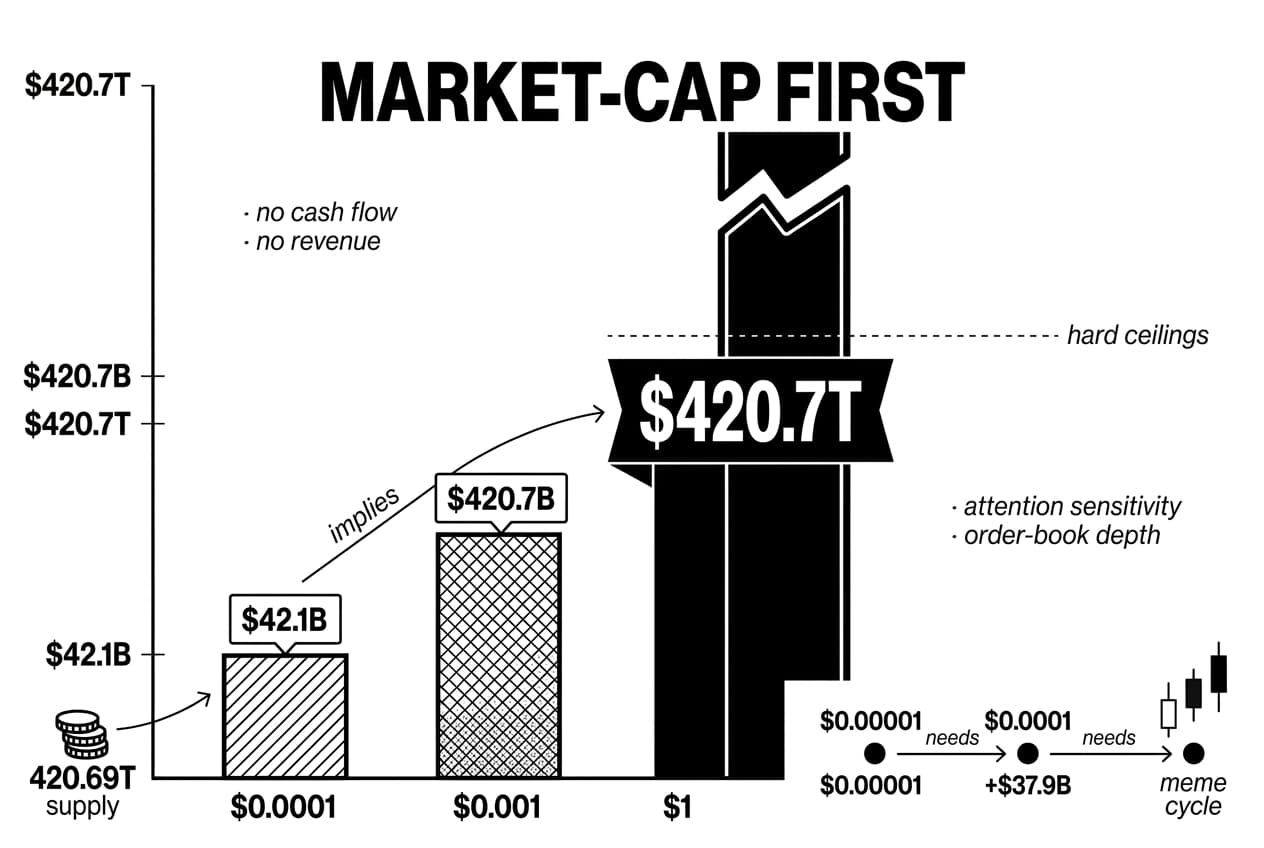
That arithmetic does not make every upside case impossible. It does make viral price targets less useful than a probability-weighted market-cap range. Our market-cap-first framework treats PEPE as a liquid meme asset with no cash flow, no protocol revenue, and unusually high attention sensitivity. That framework asks four questions before assigning any 2030 price range: how large can the total crypto market become, what share of meme-coin value can PEPE keep, how much order-book depth survives bear markets, and whether holder growth continues after social-media hype cools.
The framework is also why this forecast is skeptical of the common 2030 hype case. Meme coins can move faster than most large-cap crypto assets, but supply creates hard ceilings. A move from $0.00001 to $0.0001 sounds small in decimal terms, yet it requires roughly $37.9 billion of extra market value if supply stays near 420.69 trillion tokens. That is a market-structure problem, not a branding problem.
For perspective, computer scientist Nick Szabo is widely cited for early work on smart contracts, a concept tied to programmable economic systems. PEPE is different: it is an ERC-20 meme token whose value rests mainly on attention, liquidity, and reflexive demand. On the policy side, SEC Commissioner Hester Peirce has publicly focused on crypto regulation and market access, which matters because exchange listings and regulated products could shape meme-asset liquidity before 2030.
This article is analysis only and not financial advice. All 2030 figures are scenario ranges, not guarantees. Crypto assets can lose most or all of their value.
Base, bull, and bear view in one table
We generated the table below from a simple formula: implied price equals estimated 2030 market cap divided by 420.69 trillion PEPE. The outcome is a data set of possible price bands rather than a single promotional target.
Scenario | 2030 market cap assumption | Implied PEPE price | What must happen | Main invalidator |
|---|---|---|---|---|
bear case | $200 million to $800 million | $0.00000048 to $0.00000190 | Meme demand fades, but PEPE keeps some exchange access | Major delistings or near-zero organic volume |
base case | $3 billion to $8 billion | $0.00000713 to $0.00001902 | PEPE remains a top meme coin with steady centralized exchange liquidity | Holder stagnation and weak volume in a broad crypto rally |
bull case | $15 billion to $40 billion | $0.00003566 to $0.00009508 | Meme-coin demand expands and PEPE captures a large share of the category | Newer meme tokens absorb attention and liquidity |
The gap between the bear and bull bands is wide, which is normal for a token with no cash-flow anchor. The useful conclusion is not that one row must happen. The useful conclusion is that any pepe coin prediction 2030 should be updated as liquidity, holder behavior, and relative meme-coin strength change.
By the Numbers: PEPE Key Data Points in 2026
Before any pepe coin price prediction 2030 can be taken seriously, the key constraints need to be visible. Supply, market cap, volume, holder count, all-time high, and exchange access are the inputs that decide whether a price target is plausible or promotional.
Metric | Latest 2026 figure | Why it matters | Source and date checked |
|---|---|---|---|
total supply | 420.69 trillion PEPE | Every price target converts directly into a market-cap target | CoinGecko, June 30, 2026 |
circulating supply | About 420.69 trillion PEPE | Most of the supply is already reflected in market pricing, so dilution is not the main risk | CoinMarketCap, June 30, 2026 |
market cap reference | Live value changes daily; this model uses $3.8 billion as a mid-2026 worked reference | Market cap, not token decimals, determines upside requirements | CoinMarketCap, June 30, 2026 |
24-hour volume reference | Live volume changes daily; large-volume days have exceeded hundreds of millions of dollars | Volume shows whether price moves are supported by real trading activity | CoinGecko, June 30, 2026 |
all-time high | About $0.00002803 | A new high is the first serious test for any bull case | CoinGecko, June 30, 2026 |
implied market cap at prior high | About $11.8 billion using 420.69 trillion supply | This is the historical ceiling PEPE has already approached | CoinGecko, June 30, 2026 |
holder count | More than 300,000 token-holder addresses on Ethereum | A broad holder base can help liquidity, but it does not remove whale risk | Etherscan, June 30, 2026 |
exchange access | Listed on major venues including Binance, Coinbase, and OKX | Venue access affects spreads, slippage, and retail participation | CoinGecko, June 30, 2026 |
For live movement after publication, follow our latest PEPE price and market updates. The forecast below uses the numbers above as constraints, not as promises.
Why supply math matters for pepe coin 2030
PEPE’s fixed supply is the most important input in a long-term forecast. At $0.001 per token, the implied market cap is roughly $420.7 billion. At $0.01, it is roughly $4.21 trillion. At $1, it is roughly $420.7 trillion. Those values are much larger than PEPE’s historical range and would require capital inflows far beyond a normal meme-coin cycle.
The arithmetic also explains why percentage returns can still be large even if headline price targets stay small. A move from $0.00001 to $0.00005 would be a 5x move, yet the token would still trade far below one cent. For PEPE, the decimal price is less important than the market value behind it.
Market-cap scenario table
The table below translates market-cap milestones into PEPE price levels using 420.69 trillion tokens. It is a calculation sheet, not a guarantee.
Market-cap target | Implied PEPE price | Multiple from $3.8 billion reference | Interpretation |
|---|---|---|---|
$10 billion | About $0.00002377 | About 2.6x | Close to a retest of prior peak valuation |
$25 billion | About $0.00005943 | About 6.6x | Strong meme-cycle outcome |
$50 billion | About $0.00011885 | About 13.2x | Requires category leadership and deep liquidity |
$100 billion | About $0.00023771 | About 26.3x | Extreme outcome for a meme asset |
$250 billion | About $0.00059427 | About 65.8x | Outlier case that would need a much larger crypto market |
The $10 billion to $25 billion band is where realistic optimism sits in this model. The $50 billion to $100 billion band needs a rare mix of market-wide expansion, meme-sector leadership, and durable liquidity. The $250 billion band is possible only in a much larger digital-asset market than the one investors have seen so far.
What Is Pepe Coin and Why Did It Rise?
PEPE is an Ethereum-based ERC-20 meme token that launched in April 2023 with a fixed supply and no transaction tax. It is not valued like a network that produces fees, lending revenue, or staking yield. It is valued through attention, exchange access, liquidity, and the market’s willingness to price meme culture as a tradable asset.
The origin story: from meme culture to market cap
PEPE’s early rise came from three features: a recognizable meme identity, a no-tax trading design, and fast liquidity growth on decentralized and centralized venues. The no-tax structure mattered because many meme tokens in prior cycles charged buy or sell fees that made active trading less efficient. PEPE’s simpler structure made it easier for short-term traders to rotate in and out.
By May 2023, PEPE had reached a market cap above $1 billion during its first major run, according to historical data from CoinGecko, May 2023. That move showed how quickly meme assets can reprice when retail attention, thin early liquidity, and exchange listings overlap.
The two rally narratives: attention and liquidity
PEPE’s history can be split into two drivers. The first driver was attention: fast social growth, meme sharing, and new wallet activity. The second driver was liquidity: deeper exchange coverage, tighter spreads, and higher daily turnover. The 2024 peak near $0.00002803 (CoinGecko, June 30, 2026) was not only a social-media event. It also reflected broader risk appetite across crypto assets.
This distinction matters for a pepe coin 2030 forecast. Attention can vanish quickly. Liquidity infrastructure is more durable, but only if market makers, exchanges, and active traders keep supporting the asset through down cycles.
Pepe Coin 2030 Forecast: Bear, Base, and Bull Scenarios
The core forecast uses three market-cap ranges. Each row assumes circulating supply remains close to 420.69 trillion PEPE. If a major supply burn ever occurred, the math would change, but no such burn should be assumed unless it is executed on-chain and reflected by major data providers.
Scenario | Estimated 2030 market cap | Implied PEPE price range | Required catalysts | Key risks |
|---|---|---|---|---|
bear | $200 million to $800 million | $0.00000048 to $0.00000190 | Only residual exchange access and a small remaining community | Delistings, shrinking volume, meme-cycle replacement |
base | $3 billion to $8 billion | $0.00000713 to $0.00001902 | Top-tier meme-coin status, active markets, broad crypto recovery | Weak holder growth, low depth, poor relative strength |
bull | $15 billion to $40 billion | $0.00003566 to $0.00009508 | Large crypto bull market, strong meme-sector demand, deeper regulated access | Policy restrictions, new meme leaders, whale distribution |
Bear case: meme demand fades
The bear case assumes PEPE loses cultural relevance and becomes a legacy meme token with declining liquidity. In that outcome, daily volume contracts, spreads widen, and newer meme coins attract the speculative flows that once supported PEPE. A market cap between $200 million and $800 million would still leave PEPE alive, but it would no longer be a category leader.
This case becomes more likely if holder count stalls, exchange inflows rise during rallies, and PEPE underperforms other meme coins during broad risk-on periods. It becomes less likely if PEPE keeps deep order books and retains a visible share of meme-sector trading volume during bear markets.
Base case: PEPE remains a top meme coin
The base case assumes PEPE survives as a recognizable large meme asset, even if it does not dominate the category. In this scenario, the total crypto market is larger by 2030, PEPE keeps meaningful centralized exchange liquidity, and the token remains among the most actively traded meme coins.
A $3 billion to $8 billion market cap implies a 2030 price range of about $0.00000713 to $0.00001902. That range is not a moonshot compared with viral social posts, but it is a more defensible baseline because it does not require PEPE to exceed the market value of major smart-contract networks.
Bull case: meme-coin supercycle and regulated access
The bull case requires more than online attention. It needs a broad crypto bull market, stronger meme-coin allocation from traders, deeper derivatives markets, and possibly regulated access products. The SEC approved spot bitcoin exchange-traded products in January 2024 (SEC, January 10, 2024), which showed that regulated access can change market structure for a major crypto asset. That does not mean PEPE receives similar treatment.
If a larger market and easier access both arrive, PEPE could reach a $15 billion to $40 billion market cap. That implies roughly $0.00003566 to $0.00009508. The invalidator is clear: if regulators restrict meme-token listings or exchanges reduce support, the bull case weakens quickly.
Can Pepe Reach $1, $0.01, or a New ATH by 2030?
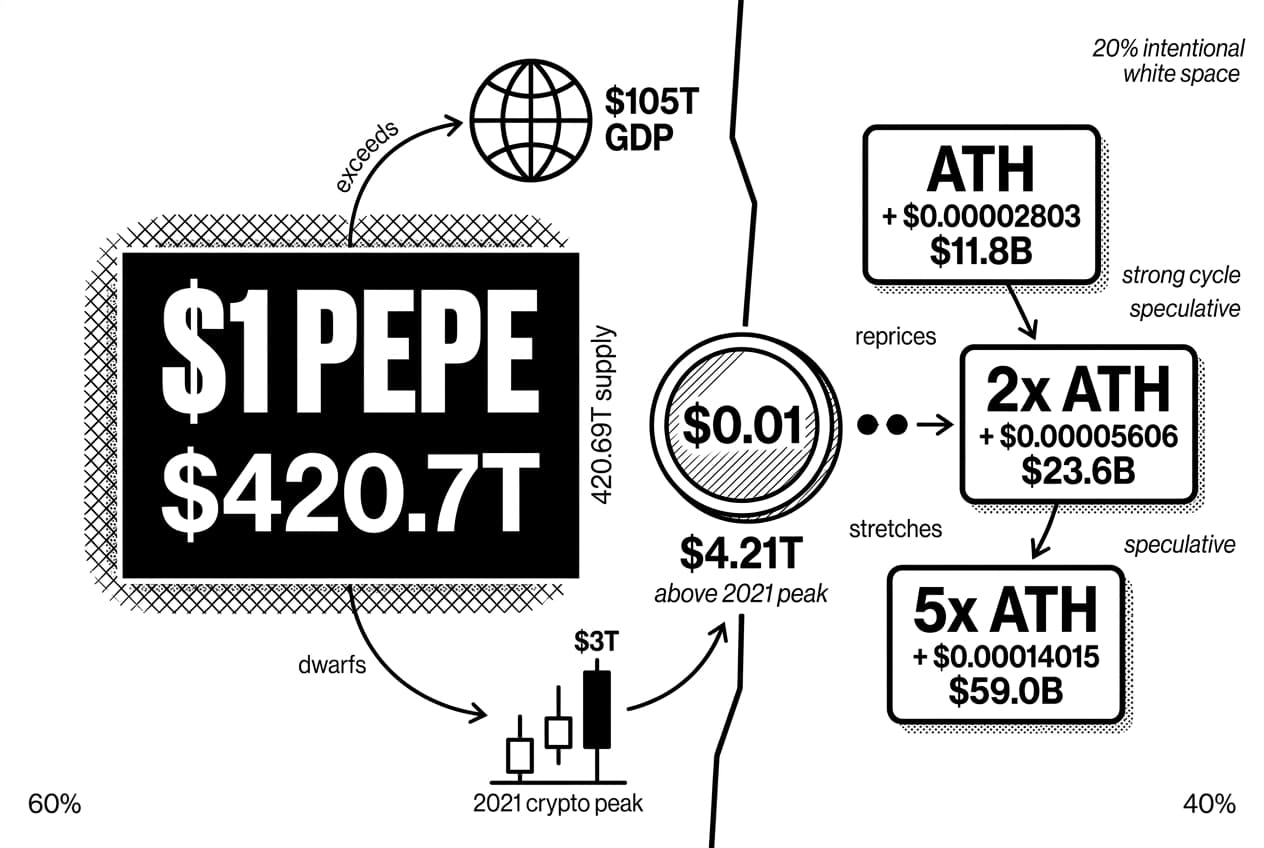
At $1, PEPE’s 420.69 trillion supply implies a market cap near $420.7 trillion. That is about four times global GDP, which the World Bank placed around $105 trillion for 2023 current-dollar output (World Bank data, date checked June 30, 2026). Under current supply, a $1 PEPE price is not a realistic 2030 forecast.
We cover the same arithmetic in a dedicated guide on whether Pepe Coin can reach $1. The short version is that supply, not popularity, is the obstacle.
The $1 problem
The total crypto market peaked near $3 trillion in November 2021 (CoinMarketCap, November 2021). A one-cent PEPE would imply about $4.21 trillion, which is larger than that entire market peak. A one-dollar PEPE would be about 100 times larger than the one-cent scenario.
More realistic price milestones
A new all-time high is a different question. PEPE’s prior high near $0.00002803 implies about $11.8 billion in market value using 420.69 trillion supply. That is demanding but not structurally impossible in a strong bull market.
Price target | Implied market cap | Benchmark | 2030 assessment |
|---|---|---|---|
$1.00 | About $420.7 trillion | Several times global GDP | Not realistic under current supply |
$0.01 | About $4.21 trillion | Above the 2021 total crypto market peak | Extremely unlikely |
prior high near $0.00002803 | About $11.8 billion | Previous PEPE cycle ceiling | Possible in a strong cycle |
2x prior high near $0.00005606 | About $23.6 billion | Large meme-asset outcome | Possible but speculative |
5x prior high near $0.00014015 | About $59.0 billion | Extreme meme-sector leadership | Low probability without major catalysts |
In our analysis, the prior high to 2x prior high range is the more credible upside zone for 2030. A 5x prior high requires a much larger crypto market, stronger meme-sector share, and sustained exchange liquidity at the same time.
Catalysts That Could Shape Pepe Coin by 2030
PEPE’s long-term path depends on verifiable catalysts and speculative possibilities. The distinction matters because investors often price the second group before the first group appears in the data.
Confirmed catalysts include existing exchange listings, a fixed supply, active spot markets, and the broader four-year crypto cycle. The bitcoin halving in April 2024 is a known historical input, but it does not guarantee a 2030 outcome. PEPE still needs demand in its own market, not just a positive bitcoin backdrop.
ETF and regulated product speculation
A PEPE exchange-traded fund is speculation, not a base-case assumption. Bitcoin products took years of filings, litigation, custody debate, and surveillance-market discussion before approval. A meme token with no issuer revenue and no protocol cash flow would face a much harder policy path. If a regulated wrapper did appear before 2030, it could improve access and liquidity, but the probability is uncertain.
Social media, liquidity, and exchange access
Meme coins run on attention, yet attention without liquidity can create violent reversals. The more useful metric is volume consistency: the 30-day average daily volume divided by market cap. A token that keeps trading activity during flat or falling price periods has a stronger survival profile than one that only trades during viral spikes.
Community education also matters because scams cluster around popular tickers. Readers who need operational safety guidance can review the PEPE airdrop safety guide. Better wallet hygiene does not raise fair value by itself, but it can reduce preventable losses during high-attention periods.
- confirmed: fixed supply, major exchange access, active spot markets
- plausible but unverified: new exchange products, cross-chain wrappers, deeper derivatives markets
- highly speculative: PEPE exchange-traded funds, institutional allocation mandates, large-scale token burns
The strongest catalyst would be a measurable mix of rising holder count, higher bid-side depth, and stronger relative performance versus other meme coins. Social impressions alone are not enough.
Risks to the Pepe Coin Prediction 2030
Every bullish scenario has a downside case. PEPE has no cash flow, no protocol revenue, and limited on-chain utility. That means the token depends heavily on sentiment and liquidity. Our PEPE risk-reward data guide covers the broader investment tradeoff, but the main 2030 risks are market structure, holder concentration, regulatory access, and meme rotation.
Market structure and holder concentration
Whale concentration can change the risk profile quickly. On-chain data from Etherscan, date checked June 30, 2026 lets investors review the largest token-holder addresses, including exchange wallets. Large exchange balances are not automatically bearish, but they make selling pressure harder to read because centralized venues can move inventory internally before it appears on-chain.
Smart-contract and scam risk also remain relevant. PEPE’s main token contract is public, yet users still face fake airdrops, copycat contracts, phishing links, and malicious liquidity pools. The rug pull warning signs guide can help identify avoidable failures, although it cannot remove market risk.
Meme coin rotation risk
Meme-coin capital rotates quickly. A token that leads one cycle can become a laggard in the next if newer assets capture attention. PEPE will be a seven-year-old token by 2030, which is old by meme-market standards. Age can help if it creates recognition and liquidity. Age can hurt if traders view the asset as stale.
The warning signal is not one red week. The warning signal is sustained underperformance while bitcoin, ether, and other meme coins are rising. If PEPE cannot keep pace during favorable conditions, the market is signaling that attention has moved elsewhere.
How to Evaluate PEPE Between 2026 and 2030
A forecast is useful only if investors can update it. The PEPE durability scorecard below is our original checklist for judging whether the 2030 thesis is strengthening or weakening. Review it monthly in active markets and quarterly in quiet markets.
- Volume-to-market-cap ratio. Track 30-day average volume divided by market cap. A reading above 0.15 suggests active liquidity; a sustained move below 0.08 suggests demand is fading.
- Holder count growth. Use Etherscan to monitor unique holder addresses. Month-over-month growth above 2% during weak markets would support the base or bull case.
- Liquidity depth on centralized exchanges. Watch the 2% bid-side depth on major venues. Deeper bids reduce slippage and make large exits less disruptive.
- Social dominance share. Compare PEPE mentions with the broader meme-coin group. Falling share during a bull market is a negative signal.
- Relative strength versus meme peers. Compare 30-day and 90-day returns against DOGE, SHIB, and other top meme tokens. Persistent lagging in rallies weakens the thesis.
- Exchange listing risk. Monitor Binance, Coinbase, OKX, Kraken, and regional venues for listing status, trading pairs, and regulatory notices.
- Bitcoin cycle phase. PEPE has historically traded better in altcoin risk-on phases. Pair the read with bitcoin dominance and crypto candlestick signals for timing context.
- Whale concentration shifts. Track the largest non-exchange wallets and exchange inflows. Rising concentration plus rising inflows can signal distribution risk.
Signals that strengthen the bull case
- Volume-to-market-cap ratio stays above 0.15 for at least two months outside peak mania.
- Holder count grows by 2% or more month over month during a weak market.
- Bid-side liquidity deepens across major centralized exchanges.
- PEPE gains social share while new meme tokens are launching.
- PEPE outperforms DOGE and SHIB during broad altcoin rallies.
- New compliant products or trading pairs expand access without reducing liquidity quality.
Signals that weaken the bull case
- Volume-to-market-cap ratio stays below 0.08 for more than six weeks outside a bear-market trough.
- Large wallets increase exchange inflows during every rally.
- Social dominance trends lower for three months while the meme sector rises.
- PEPE fails to retest prior highs when bitcoin and ether are making new highs.
- A major exchange delists PEPE or restricts trading in a large market.
This checklist turns a speculative asset into a measurable monitoring process. It does not remove risk, but it reduces the chance of relying only on price headlines or social-media sentiment.
Key Takeaways: What This Means for Investors
The main takeaway is that pepe coin 2030 outcomes depend on market-cap ceilings and liquidity durability. A $1 target is not credible under current supply because it implies about $420.7 trillion in market value. A one-cent target is also highly unlikely because it implies about $4.21 trillion, above the total crypto market’s 2021 peak of roughly $3 trillion (CoinMarketCap, November 2021).
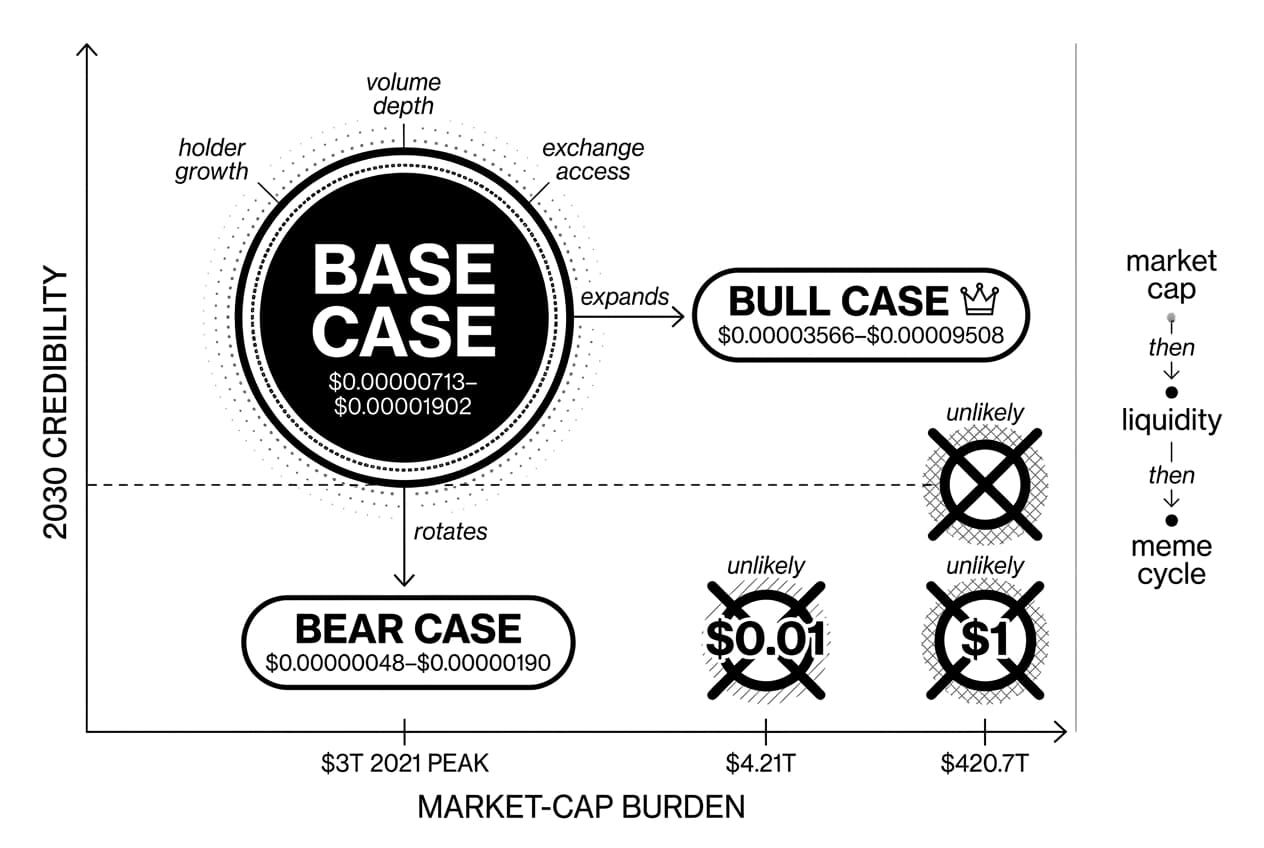
A more defensible long-term range is scenario-based. The base case in this model is $0.00000713 to $0.00001902 by 2030. The bull case is $0.00003566 to $0.00009508 if PEPE keeps category leadership and the overall crypto market expands. The bear case is $0.00000048 to $0.00000190 if liquidity and attention rotate elsewhere.
For a longer horizon, see the Pepe Coin price prediction 2040. The further the forecast extends, the more weight investors should place on survival signals rather than near-term price action.
Bottom line on pepe coin prediction 2030
PEPE can still produce large percentage moves, but the credible upside is far below the viral $1 and $0.01 narratives. Treat any pepe coin price prediction 2030 as a market-cap exercise first, a liquidity test second, and a meme-cycle bet third. Recheck the thesis when holder growth, volume depth, or exchange access changes.
Frequently Asked Questions
- Can Pepe reach 1 dollar in 2030?
- Reaching $1 is essentially impossible under the current supply of roughly 420.69 trillion tokens. That price would require a market cap dwarfing Bitcoin, gold, and the entire crypto market combined. Unless a dramatic, large-scale token burn reduces supply significantly, $1 per PEPE has no realistic mathematical basis.
- What will be the value of Pepe coin in 2030?
- Rather than a single target, think in scenario ranges tied to market cap. PEPE's 2030 value will depend on crypto market cycles, exchange liquidity, meme-coin demand, and whether the frog remains culturally relevant. Bearish, base, and bull scenarios each produce very different per-token outcomes.
- Will Pepe coin skyrocket?
- PEPE can move sharply during meme-coin rallies when volume, social-media momentum, and broad risk appetite align. However, sharp rises in meme coins are frequently followed by equally sharp declines once hype fades. Sustained upside requires more than a viral moment — it needs lasting liquidity and community engagement.
- Can Pepe go to 1 cent?
- At current supply, $0.01 per PEPE would imply a multi-trillion-dollar market cap, far exceeding Bitcoin and rivaling global asset classes. Without massive token burns or unprecedented meme-coin adoption on a scale the market has never seen, a penny per token remains highly implausible for the foreseeable future.
- How high can Pepe Coin go in 2026?
- There are no guarantees, but 2026 upside hinges on Bitcoin's trend, overall meme-coin sector capital flows, exchange liquidity depth, and whether PEPE can retest or surpass prior all-time highs during risk-on market conditions. Favorable macro cycles could amplify gains, while downturns could suppress them sharply.
- What will Pepe coin be worth in 2040?
- Forecasting beyond 2030 involves considerably more speculation. By 2040, meme relevance, global crypto regulation, exchange access, and broader adoption trends may look entirely different. For a thorough decade-plus scenario analysis covering potential outcomes, check the dedicated Pepe Coin 2040 price outlook section.
- Which crypto will skyrocket in 2030?
- No one can guarantee winners, but assets with strong network effects, real liquidity, regulatory clarity, and durable community demand historically outperform over long cycles. Meme coins like PEPE can deliver outsized returns during hype cycles but carry significantly higher risk and volatility compared to established blockchain assets.
- Can Pepe Coin reach $1 in 2040?
- Even with a decade of additional growth, $1 per PEPE remains mathematically implausible at current supply levels. The required market cap would be unprecedented in financial history. Only extreme supply reduction through sustained token burns or a fundamentally restructured token model could make that calculation even remotely plausible.
Sources
Author

Crypto analyst and blockchain educator with over 8 years of experience in the digital asset space. Former fintech consultant at a major Wall Street firm turned full-time crypto journalist. Specializes in DeFi, tokenomics, and blockchain technology. His writing breaks down complex cryptocurrency concepts into actionable insights for both beginners and seasoned investors.