Pepe Coin Price Prediction 2040: Data-Driven Decade Outlook

Key Finding: PEPE's 2040 Outlook Depends on Market Cap, Not Hype
Any serious pepe coin price prediction 2040 model has to start with market capitalization, not a single viral price target. PEPE has about 420.69 trillion tokens in circulation, according to CoinGecko, September 2026. At that supply, $0.0001 implies about $42.1 billion in value, while $0.01 implies about $4.21 trillion. The market-cap requirement is the forecast.
The contrarian point is simple: long tables showing annual minimum, average and maximum PEPE prices create false precision. A better model asks whether future liquidity, exchange depth, holder concentration and meme-coin demand can support a specific market cap. As a reference point, PEPE's model price of $0.0000085 implies roughly $3.58 billion in market value when multiplied by 420.69 trillion supply, using the same supply base reported by CoinGecko, September 2026.
The 2040 thesis in one paragraph
This article uses our Market-Cap First Scenario Stack: first lock the supply assumption, then assign a realistic 2040 market-cap band, then calculate implied price, then test that band against liquidity, concentration and category demand. In the bear case, PEPE fades toward a low-liquidity legacy meme coin. In the base case, it remains a top meme asset through several crypto cycles. In the bull case, meme coins become a persistent speculative category and PEPE captures enough demand to justify a high double-digit or low triple-digit billion-dollar valuation. None of these scenarios is investment advice.
By the Numbers: PEPE Supply, Market Cap and 2040 Price Math
The key data point is supply. PEPE's circulating supply is reported near 420,690,000,000,000 tokens on CoinGecko, September 2026, and the Ethereum token contract can be checked on Etherscan, September 2026. For live changes in price and volume, check the latest PEPE price and market updates.
Metric | Value used in this model | Source and date |
|---|---|---|
circulating supply | 420.69 trillion PEPE | CoinGecko, September 2026 |
maximum token supply | 420.69 trillion PEPE | Etherscan, September 2026 |
reference price | $0.0000085 | Model input based on market data review, September 2026 |
reference market value | about $3.58 billion | Calculated from supply and reference price, September 2026 |
all-time high reference | about $0.00002825 in May 2024 | CoinGecko, May 2024 |
contract network | Ethereum ERC-20 token | Etherscan, September 2026 |
Market-cap calculator for PEPE price targets
The formula is price multiplied by circulating supply equals market cap. Using 420.69 trillion PEPE, the implied valuations below are arithmetic outputs, not predictions.
PEPE price level | Implied market cap | What the level would require |
|---|---|---|
$0.00001 | about $4.21 billion | PEPE remains a liquid large meme coin |
$0.0001 | about $42.07 billion | Top-tier meme status plus strong cycle liquidity |
$0.001 | about $420.69 billion | A valuation near mega-cap crypto territory |
$0.01 | about $4.21 trillion | A market value above Bitcoin's roughly $2 trillion zone seen during the 2025 cycle, per CoinGecko, January 2025 |
ROI scenarios from a 2026 reference price
If the entry reference is $0.0000085, a move to $0.00001 would be about +18%, a move to $0.0001 would be about +1,076%, and a move to $0.001 would be about +11,665%. These figures are pure price arithmetic as of September 2026. They do not include slippage, taxes, exchange fees, failed exits or the risk that liquidity disappears during a drawdown.
PEPE Overview and Historical Context
PEPE launched in April 2023 as an Ethereum meme token with no formal utility, no disclosed founding team and no cash-flow model. It was built around the internet meme character rather than protocol revenue. That matters for a 2040 forecast because the token's value is driven mainly by attention, liquidity and distribution, not by earnings or fees.
How PEPE became a major meme coin
The token moved from niche internet asset to large-cap meme coin within weeks. CoinGecko data shows PEPE traded into the billion-dollar market-cap range in 2023, with later cycle highs in 2024 as broader crypto risk appetite returned (CoinGecko, 2023 and 2024). The pattern was not a product-market-fit story. It was a reflexive cycle of social attention, exchange listings and liquidity.
What past meme-coin cycles teach us
Meme coins can rise quickly and fall faster. DOGE and SHIB both showed that category leaders can survive deep drawdowns, but they also showed that peak valuations are hard to sustain once liquidity contracts. Lyn Alden, founder of Lyn Alden Investment Strategy, frequently analyzes risk assets through global liquidity and cash-flow quality. That lens is useful here: PEPE has no cash flows, so liquidity conditions and narrative demand carry most of the valuation burden.
How to Read and Predict PEPE Price Movements
Short-term PEPE analysis can use charts and on-chain data. A 2040 model cannot rely on weekly indicators alone. Use the signals below for cycle timing, then use market-cap math for decade-level scenarios.
Technical overview: SMA, EMA, RSI and MACD
The eight signals worth tracking before making any PEPE forecast, short or long, are:
- Price trend versus moving averages: Compare PEPE with the 50-day and 200-day simple moving averages to judge whether momentum is expanding or fading.
- Trading volume: A rally with rising volume is healthier than a thin move. PEPE's May 2024 all-time high of about $0.00002825 came during heavy turnover, per CoinGecko, May 2024.
- RSI: Readings above 70 often mark overheated meme-coin conditions, while readings below 30 can show exhaustion after forced selling.
- MACD: Weekly crossovers can help identify trend shifts. Pair this with bullish candle patterns for crypto momentum before treating a breakout as durable.
- Exchange flows: Large deposits to centralized exchanges can signal potential selling. Persistent withdrawals can reduce near-term sell-side supply.
- Whale concentration: Use Etherscan, September 2026 to watch top-wallet share and large transfers.
- Holder growth: Rising holder count during a rally suggests broader participation. Flat holder count during a rally suggests a narrower trade.
- BTC market direction: PEPE usually trades as high beta crypto risk. If Bitcoin weakens, meme-coin drawdowns often deepen.
Technical signals help with entries, exits and risk control. They do not create a reliable 14-year price forecast. The long-range question is whether PEPE can remain liquid and culturally relevant through several Bitcoin cycles.
On-chain and social signals
On-chain data matters because PEPE ownership can be concentrated. Track large-wallet transfers, exchange deposits, decentralized-exchange liquidity and holder growth. Social data also matters, but it should be paired with wallet data. A spike in posts without new holders is often existing owners amplifying a trade rather than new demand entering the market.
Uniswap depth is especially relevant because PEPE trades on Ethereum. Hayden Adams, founder of Uniswap Labs, helped build the automated market-maker venue that made token liquidity easier to create on-chain. For PEPE, deeper pools can reduce slippage, but they cannot remove the core valuation risk. For community-level sentiment tracking, see the PEPE community signals and Reddit sentiment guide.
2026 to 2033 Bridge: The Path That Shapes the 2040 Forecast
PEPE's 2040 outcome will be shaped well before 2040. The 2026 to 2033 period is a stress test for liquidity, listings and cultural staying power.
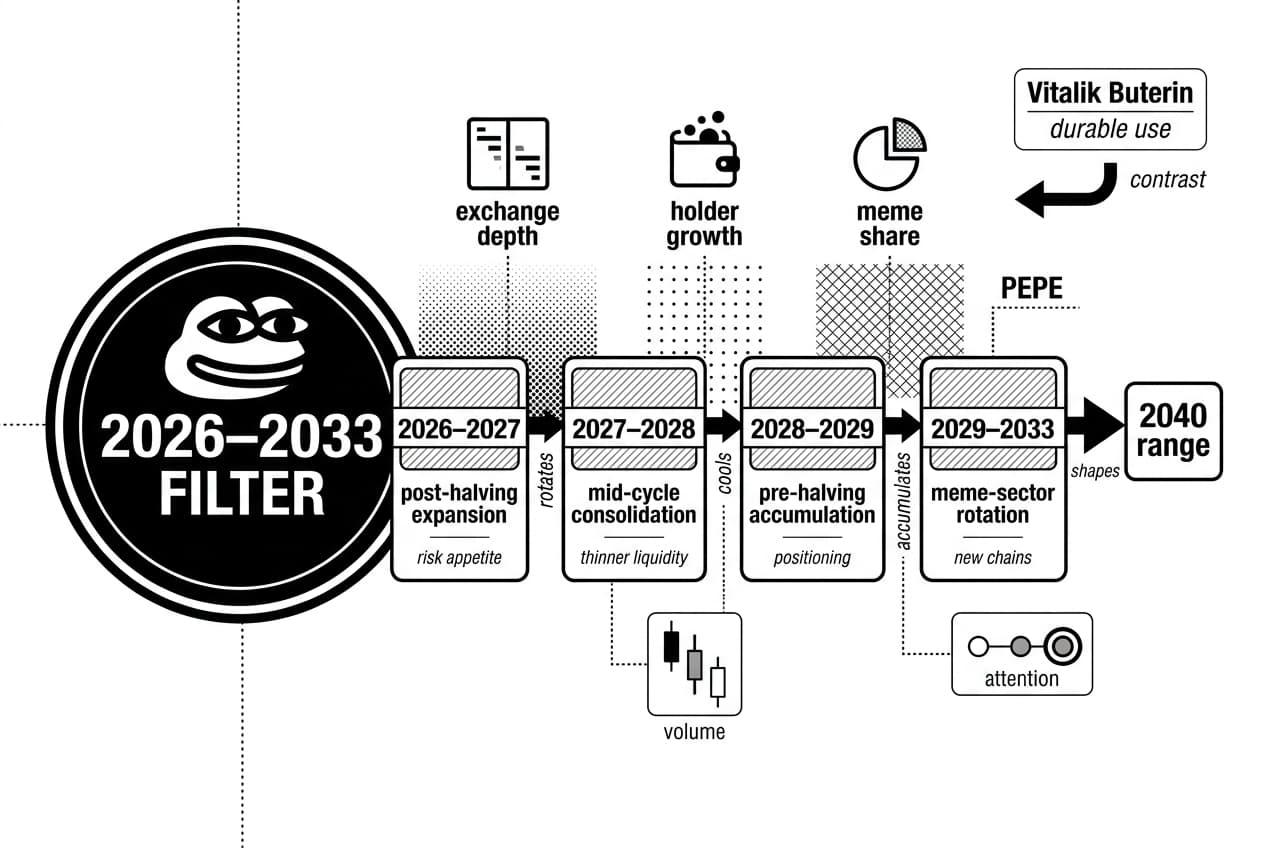
Cycle-based forecast framework
The Market-Cap First Scenario Stack treats each cycle as a filter. If PEPE keeps deep exchange access, broad holder growth and strong meme-sector share, its upper market-cap bands become more plausible. If one of those pillars breaks, the 2040 range moves lower.
Phase | Years | Main driver | PEPE implication |
|---|---|---|---|
post-halving expansion | 2026 to 2027 | Risk appetite after the April 2024 Bitcoin halving | If Bitcoin remains strong, meme coins can attract speculative rotation |
mid-cycle consolidation | 2027 to 2028 | Profit taking and thinner liquidity | PEPE must defend exchange volume and holder activity |
pre-halving accumulation | 2028 to 2029 | Positioning before the next Bitcoin halving | Surviving meme leaders may regain attention if broader crypto liquidity expands |
meme-sector rotation test | 2029 to 2033 | New themes, new chains and new speculative assets | PEPE must avoid becoming a low-volume legacy token |
Vitalik Buterin, co-founder of Ethereum, has repeatedly argued in public Ethereum materials for applications with durable use and credible decentralization. PEPE sits at the opposite end of the crypto spectrum: it is culturally driven and speculative. That contrast is useful because it reminds investors that PEPE's 2040 value depends on attention and liquidity, not protocol cash flows.
Pepe Coin Price Prediction 2040: Bear, Base and Bull Scenarios
The table below is the core Pepe Coin price prediction 2040 model. It uses the supply base cited above and converts market-cap bands into implied prices. These are scenario boundaries, not guaranteed targets.
Scenario | Assumed 2040 market cap | Implied PEPE price | Required conditions | Key risks |
|---|---|---|---|---|
Bear | $500 million to $2 billion | about $0.0000012 to $0.0000048 | PEPE survives but loses most meme-sector attention | Delistings, weak liquidity, whale selling and community decay |
Base | $10 billion to $40 billion | about $0.000024 to $0.000095 | PEPE remains a top meme coin across two or more cycles | Lower crypto growth, regulation and repeated 80% plus drawdowns |
Bull | $100 billion to $250 billion | about $0.000238 to $0.000594 | Meme coins become a lasting crypto category with deep exchange liquidity | Concentration risk, category rotation and a valuation ceiling below one cent |
Bear case: attention fades and liquidity rotates away
The bear case does not require PEPE to disappear. It only requires that new speculative themes capture retail attention. At a $500 million to $2 billion market value, PEPE would still trade, but the implied price would be far below one tenth of a cent. The key warning signs would be falling volume, fewer active holders and shrinking exchange support.
Base case: PEPE survives as a major meme-coin index asset
The base case assumes PEPE remains one of the recognizable meme assets. A $10 billion to $40 billion valuation by 2040 is demanding but not detached from prior cycle behavior, since PEPE already reached a multibillion-dollar valuation during 2024, according to CoinGecko, May 2024. The implied price remains below $0.0001 because supply is so large.
Bull case: meme coins become a durable crypto sector
The bull case requires more than another viral rally. It requires a much larger crypto market, sustained meme-sector share and enough exchange depth for large buyers and sellers to transact without breaking the market. A $100 billion to $250 billion PEPE value would be a major achievement, but it still implies a sub-cent token price. The supply math remains the ceiling.
Can PEPE Reach 1 Cent by 2040?
PEPE reaching 1 cent by 2040 is mathematically possible only if market value or supply changes radically. The formula is simple: market cap equals token price multiplied by circulating supply. With about 420.69 trillion PEPE tokens, a $0.01 price requires roughly $4.21 trillion in market value.
Why 1 cent is a market-cap question
The one-cent target is not a sentiment question. It is a balance-sheet question. A $4.21 trillion PEPE valuation would exceed the roughly $2 trillion Bitcoin market-cap zone seen during the 2025 cycle, based on CoinGecko, January 2025. It would also require PEPE alone to become larger than many national equity markets.
For a broader look at extreme per-token targets, see why a $1 PEPE price is mathematically unrealistic. Unless PEPE's supply is reduced on a massive scale, a one-cent 2040 target remains outside our bear, base and bull ranges.
Catalysts, Risks and Signals to Track Through 2040
Investors should track the variables that could push PEPE from one scenario band to another. Price alone is a lagging indicator.
Bullish catalysts
- Exchange depth: More order-book depth on major venues would reduce slippage and make larger positions easier to trade.
- Bitcoin cycle alignment: Meme coins usually perform best when Bitcoin strength pulls speculative capital into higher beta assets.
- Meme-sector share: If meme coins keep a larger share of total crypto value, PEPE can benefit even without new utility.
- Stablecoin liquidity: Stablecoin market value was above $150 billion during 2024 and continued to act as crypto trading liquidity, per DefiLlama, December 2024.
- Holder growth: New wallets matter more than social posting alone because they show fresh capital entering the asset.
- Community integrations: Payments, games or NFT tie-ins can renew attention, but they must show usage rather than announcements only.
Major risks
- Concentration risk: Large wallets can move the market if they sell into thin order books.
- No cash flows: PEPE has no revenue, no protocol fees and no dividend stream.
- Social attention decay: The meme that drives demand may lose cultural relevance long before 2040.
- Regulatory pressure: Tighter rules could reduce exchange access or marketing channels.
- Fake airdrops and scams: Brand impersonation damages trust. See Fake PEPE airdrop risks before interacting with any claim page.
- Liquidity shocks: A broad crypto credit event can drain order books within hours.
- Volatility: Meme assets can fall 80% or more from cycle highs, even when the long-term community survives.
For a structured view of current upside and downside, the PEPE risk-reward analysis for 2026 investors breaks down entry-point risk in more detail.
Frequently Asked Questions
- Will Pepe Coin reach 1 cent in 2040?
- Reaching $0.01 would push PEPE's market cap into multi-trillion-dollar territory given its current supply, making this an aggressive bull case rather than a realistic base forecast. Achieving it would require massive token burns, explosive crypto sector growth, and sustained mainstream adoption well beyond anything seen today.
- What will Pepe be worth in 2050?
- No single price target for 2050 is reliable. PEPE's value by then depends on supply changes, meme-coin cultural relevance, exchange liquidity, overall crypto market size, and the regulatory landscape. Working with scenario bands and revisiting your assumptions regularly is far more practical than trusting any fixed long-range prediction.
- How high can Pepe Coin go in 2026?
- The 2026 ceiling largely depends on Bitcoin's trend, speculative volume, RSI and MACD signals, exchange liquidity, and meme-sector rotation cycles. A renewed wave of speculative demand could push prices sharply higher, but meme coins historically correct just as fast once momentum fades, so downside risk remains significant.
- Is Pepe a good investment?
- PEPE is a high-risk, highly volatile speculative token with no traditional cash flows or underlying revenue. It may suit investors seeking targeted meme-coin exposure, but severe drawdowns are common. Careful position sizing and solid risk management are essential. Always conduct independent research before making any financial decisions.
Sources
Author

Crypto analyst and blockchain educator with over 8 years of experience in the digital asset space. Former fintech consultant at a major Wall Street firm turned full-time crypto journalist. Specializes in DeFi, tokenomics, and blockchain technology. His writing breaks down complex cryptocurrency concepts into actionable insights for both beginners and seasoned investors.