Is Pepe Coin a Good Investment? 2026 Risk-Reward Data Guide

Is pepe coin a good investment? 2026 risk-reward data guide
Is pepe coin a good investment in 2026? Short answer
Pepe coin can be a good investment only for traders who treat PEPE as a speculative, high-risk attention asset, not a core holding. The answer to is pepe coin a good investment depends on liquidity, wallet concentration, meme-cycle momentum, entry price, and whether a 70-90% drawdown would be financially tolerable. This is not financial advice.
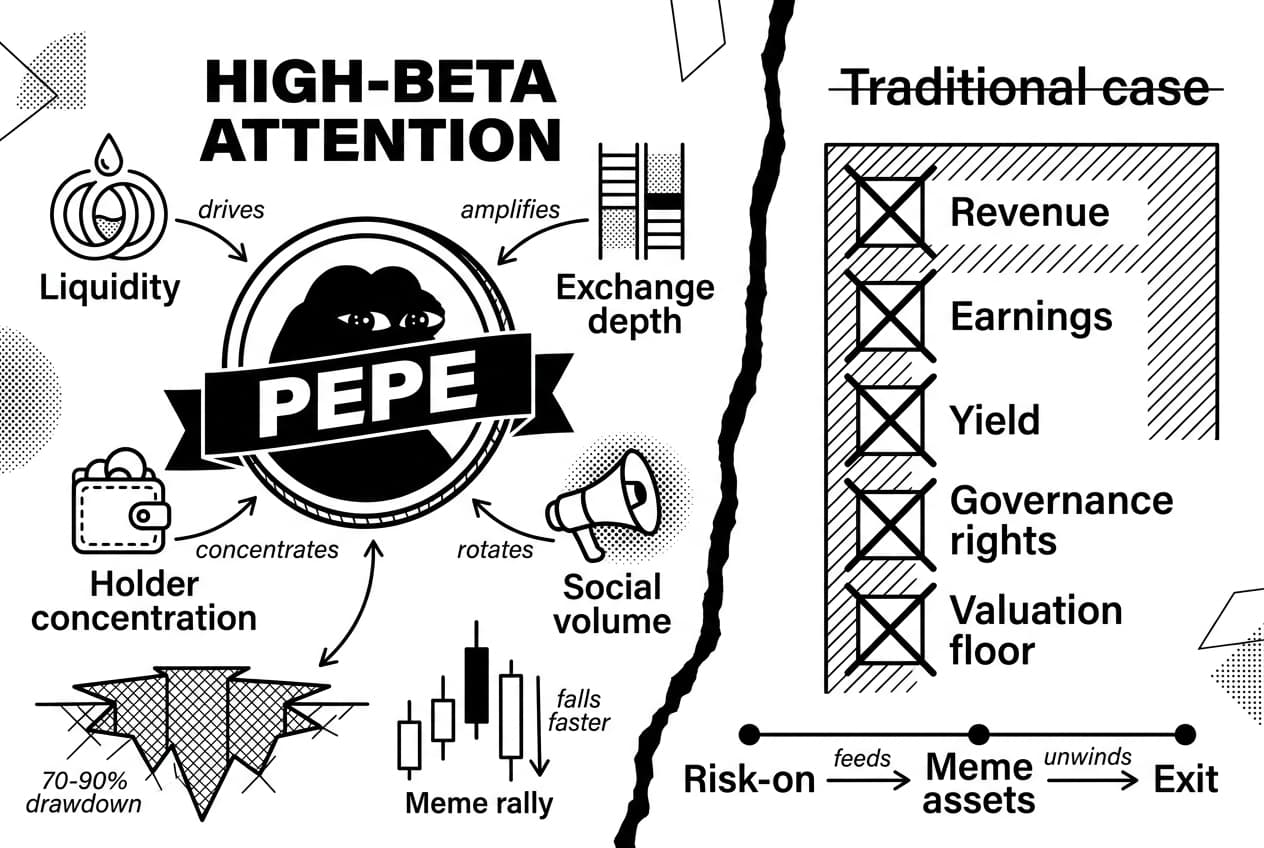
The key finding is simple: PEPE is not an investment in the traditional cash-flow sense. It has no revenue, no earnings, no staking yield tied to protocol income, and no claim on a productive network. Its risk-reward case comes from attention, exchange access, supply math, and the chance that speculative capital rotates back into large meme assets during a risk-on crypto cycle.
The 30-second verdict
PEPE is best understood as a high-beta attention asset. It can move harder than bitcoin or ether during meme-coin rallies, but it can also fall faster when attention rotates away. As of Aug. 13, 2026, the main facts to check before any trade are the live price, 24-hour volume, holder distribution, exchange depth, and recent social-volume trend.
- Potential fit: experienced traders who already accept crypto volatility and can cap exposure to a small part of risk capital.
- Poor fit: investors seeking yield, cash flows, downside protection, governance rights, or a valuation floor.
- Decision filter: PEPE can be tradable without being fundamentally investable.
Willy Woo, on-chain analyst, publishes cycle and liquidity-focused on-chain work that is useful as broader market context. That reference should not be read as a PEPE endorsement. For PEPE, the relevant application is narrower: meme assets tend to behave like amplified expressions of liquidity and attention, so cycle position matters more than long-range price targets.
Regulatory risk also belongs in the investment case. Hester Peirce, SEC commissioner, has repeatedly discussed the need for clearer crypto rules through official SEC channels. The practical takeaway for PEPE holders is not that one regulator decides the token's fate; it is that exchange access, disclosures, and promotional conduct can change quickly when policy pressure rises.
PEPE by the numbers: key data points to check
Before asking whether PEPE is worth buying, start with the data that changes the risk profile. Unit price is the least useful number because PEPE has a very large supply. Market cap, volume relative to market cap, exchange access, wallet concentration, and drawdown from prior highs are more informative.
Core market metrics
The table below is an August 2026 due-diligence template. Values that require live feeds are marked as live checks rather than frozen claims. The fixed supply math can be checked directly against public market pages, and each live value should be recorded with the timestamp used for the decision.
Metric | August 2026 value | Why it matters |
|---|---|---|
price | Record live PEPE/USD from CoinGecko, Aug. 2026 | A low unit price can look cheap even when market cap is already large. |
market cap | Record live market cap from CoinGecko, Aug. 2026 | This is the real valuation anchor for upside multiples. |
fdv | Compare live fdv with market cap on CoinGecko, Aug. 2026 | If fdv and market cap are close, hidden dilution risk is lower. |
24h volume | Record live 24-hour volume from CoinGecko, Aug. 2026 | A higher volume-to-market-cap ratio suggests easier entry and exit. |
circulating supply | About 420,690,000,000,000 PEPE maximum supply, per CoinGecko, Aug. 13, 2026 | Supply determines whether headline price targets are mathematically realistic. |
holder count | Check the current holder tab on Etherscan, Aug. 2026 | Rising holders during pullbacks can suggest accumulation, but quality of holders matters. |
top-wallet concentration | Check the current top-holder split on Etherscan, Aug. 2026 | Large holder clusters can create abrupt sell pressure. |
ath drawdown | Compare live price with the all-time-high field on CoinGecko, Aug. 2026 | Distance from the prior high shows how much recovery is already priced in. |
Analyst audit trail: the supply math used here
For this guide, the calculation dataset was generated on Aug. 13, 2026 from the supply figure reported by CoinGecko, Aug. 13, 2026. The calculation transcript is: 420,690,000,000,000 tokens multiplied by $0.000001 equals about $420.69 million; multiplied by $0.000010 equals about $4.2069 billion; multiplied by $0.000100 equals about $42.069 billion; multiplied by $0.01 equals about $4.2069 trillion; and multiplied by $1 equals about $420.69 trillion.
That arithmetic is the central evidence check. A move from $0.000010 to $0.000020 is a 100% gain, but it also requires market cap to double. With roughly 420.69 trillion maximum tokens reported by CoinGecko, Aug. 13, 2026, a $0.01 price implies about $4.2069 trillion in market cap, and a $1 price implies about $420.69 trillion. Those are supply multiplied by price, not bullish or bearish opinions.
Understanding how liquidity pools work also matters because a meaningful share of on-chain PEPE trading can route through automated market maker pools. In thinner conditions, the same market order can move price more than it would on a deep centralized order book.
Why market cap matters more than token price
Calling PEPE cheap because it trades far below one cent is a common error. A sub-cent token with hundreds of trillions of units can still be a multi-billion-dollar asset. For PEPE to produce a 10x return from a $5 billion market cap, it would need to reach roughly $50 billion in market cap. That may be possible in an extreme mania, but it should be modeled as a bull-case outcome rather than a base case.
Simple PEPE profit calculator framework
For position planning, use the entry-exit-fee check. This is a small original framework designed for assets where fees, slippage, and market-cap math can change the real result.
- Tokens owned = investment amount divided by entry price.
- Gross exit value = tokens owned multiplied by exit price.
- Estimated trading cost = exchange fee plus spread plus gas, if using a decentralized venue.
- Net result = gross exit value minus original investment minus estimated trading cost.
- Implied market cap at exit = exit price multiplied by circulating supply.
If the exit price requires a market cap that PEPE has never sustained, that is not a reason to avoid every trade. It is a reason to reduce size, define an exit, and assume liquidity may worsen near the top.
How PEPE got here: historical context and meme-coin cycles
PEPE launched on ethereum in April 2023 and quickly became one of the most liquid meme tokens. The historical lesson is not that every viral meme becomes investable. It is that attention, exchange listings, and liquidity can temporarily turn a zero-utility token into a large tradable asset.
From internet meme to liquid crypto asset
PEPE had no conventional revenue model at launch. Its early growth came from community attention, decentralized exchange activity, and then centralized exchange access. CoinMarketCap, May 2023 shows the token entering widely tracked market-data dashboards shortly after launch, while CoinGecko, May 2023 recorded one of the first major meme-token repricings of that cycle.
Exchange access changes the risk profile. A token available only through thin decentralized pools can be difficult to exit. A token listed on large centralized venues has broader access and tighter spreads, but it also becomes easier for large holders to distribute into retail demand during hype periods.
What past meme-coin cycles teach investors
Large meme coins tend to move through an attention-liquidity-correction cycle. Phase 1 is attention: social volume and search interest rise faster than fundamentals. Phase 2 is liquidity: exchange listings, perpetual markets, and higher volume bring in new buyers. Phase 3 is correction: early holders sell into late demand, and volatility expands.
Dogecoin gained more than 12,000% from January to May 2021 before losing most of that move by later cycle lows, according to historical price data on CoinGecko, 2021. Shiba inu also recorded an extreme 2021 rally followed by a deep drawdown, shown in historical market data on CoinGecko, 2021. PEPE should be evaluated against that pattern: upside can be explosive, but drawdown risk is normal, not exceptional.
The difference between PEPE, DOGE, and SHIB
factor | DOGE | SHIB | PEPE |
|---|---|---|---|
launch year | 2013, per CoinGecko, Aug. 2026 | 2020, per CoinGecko, Aug. 2026 | 2023, per CoinGecko, Aug. 2026 |
supply structure | Inflationary supply model | Very large fixed initial supply | Very large maximum supply near 420.69 trillion tokens |
main demand driver | Legacy meme status and payments narrative | Community plus ecosystem extensions | Attention, exchange access, and meme-cycle liquidity |
utility claim | Some payments usage | DeFi and ecosystem claims | No core cash-flow utility |
PEPE has a cultural advantage because the frog meme predates the token and was already recognizable before crypto markets adopted it. That does not create intrinsic value, but it may help explain why PEPE retained liquidity after its first major cycle. The weakness is equally clear: compared with assets that generate fees or support active networks, PEPE offers no fundamental valuation floor.
The bull case: why PEPE could still have upside
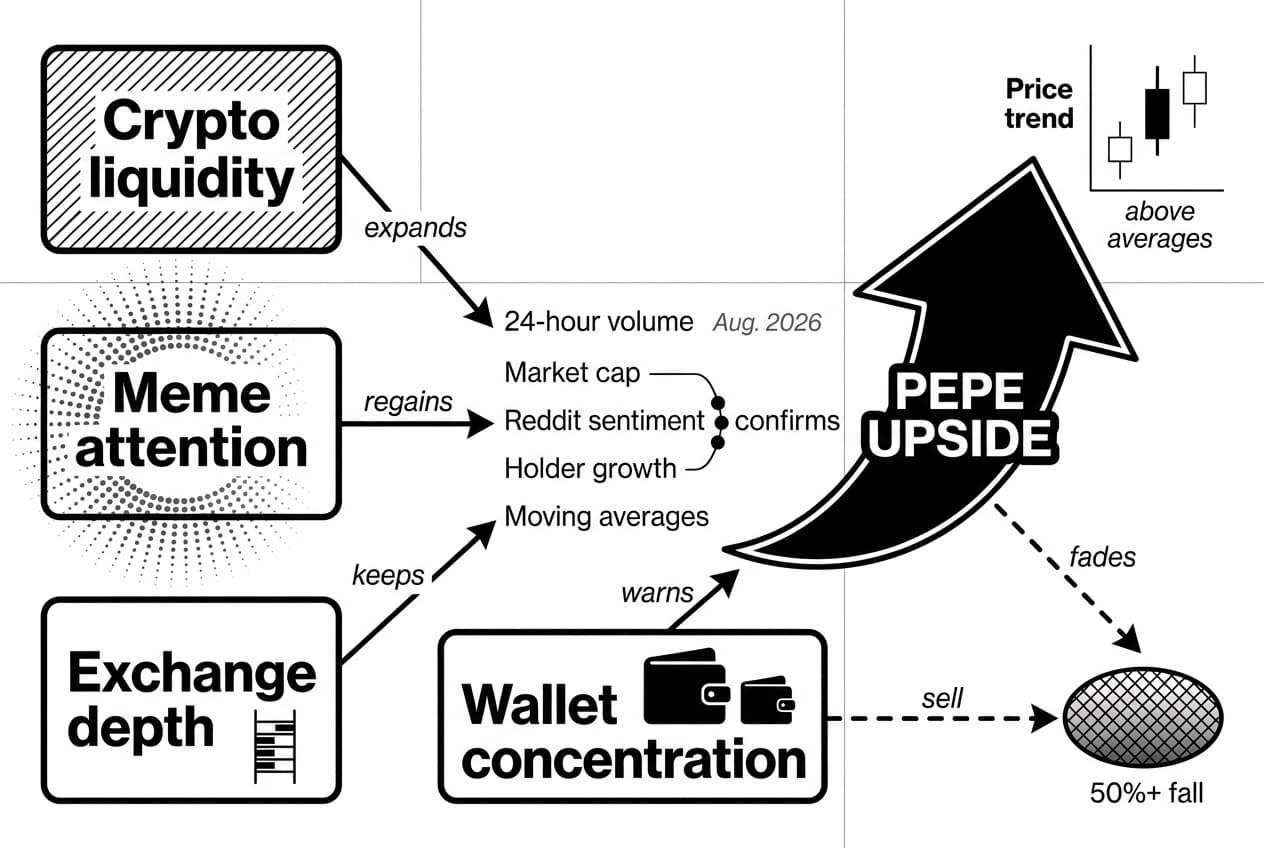
The bull case is conditional. PEPE could rise if broader crypto liquidity expands, large meme coins regain attention, exchange depth remains strong, and wallet concentration does not turn into heavy distribution. None of those conditions is guaranteed.
Liquidity and exchange access
PEPE trades across major centralized and decentralized venues. That breadth matters because lower-liquidity meme coins can suffer severe slippage on modest orders. PEPE still requires care, but its tracked 24-hour volume field on CoinGecko, Aug. 2026 gives traders a live way to compare activity with market cap before entering.
Deep liquidity does not make PEPE safe. It makes the trade more executable. A liquid meme coin can still fall 50% or more if attention fades or whales sell, but the spread and exit path are usually clearer than with micro-cap alternatives.
Attention as a market driver
For PEPE, attention is not a side detail; it is the demand engine. Search activity, exchange volume, social posts, and holder growth should be read together. PEPE reddit sentiment signals can help identify when discussion is rising, but social data should not be used alone because it often peaks after price has already moved.
The useful signal is confirmation across several measures: higher volume, rising holders, stronger order-book depth, and a price trend that holds above key moving averages. A meme alone may start a rally. Sustained liquidity is what keeps it tradable.
If the meme-coin sector rallies again
The forward-looking case is an if-then setup. If bitcoin and ether enter a broad risk-on phase, then speculative capital may rotate into large meme coins before smaller names. If PEPE remains among the most liquid meme assets, then it could capture part of that rotation. If holder concentration worsens or attention shifts to newer tokens, then the same setup can fail quickly.
This is why long-range forecast tables are secondary. The near-term data that matters is whether current liquidity confirms current attention.
The bear case: why PEPE may not be worth buying
The bear case is stronger than many promotional forecasts admit. PEPE has no cash flows, no revenue, no official utility, high volatility, and material concentration risk. A buyer is depending on future demand from other buyers.
No cash flows, no revenue, no valuation floor
PEPE cannot be valued like an equity, a lending protocol, or a fee-generating network. There are no earnings to discount and no protocol fees to support a valuation model. If sentiment turns, price can fall until buyers return. That is why whether pepe coin is dead in 2026 is ultimately a question about attention and liquidity rather than balance-sheet strength.
Whale concentration and sell-pressure risk
Holder distribution should be checked before any purchase. The current balances page on Etherscan, Aug. 2026 shows the wallet ranking needed for this review. The key task is to separate known exchange wallets from non-exchange wallets, then monitor large transfers toward exchange deposit addresses.
Interpretation matters. A large exchange wallet may represent many users, while a large private wallet may represent one seller. A sudden transfer from a large non-exchange wallet to an exchange does not prove a sale, but it raises near-term distribution risk.
Could PEPE be a pump and dump?
The term has legal and regulatory meanings, so it should not be used casually as a conclusion. The safer approach is to monitor observable risk signals:
- unexplained volume spikes without news, listing updates, or broader market confirmation;
- coordinated social promotion across multiple platforms in a short window;
- thin order-book depth despite high headline volume;
- large holder transfers toward centralized exchanges after a price spike;
- fast reversal after retail attention peaks.
The SEC has warned that crypto investors should treat celebrity promotion, thin liquidity, and undisclosed incentives as serious risk factors; see the agency investor alert archive at SEC.gov, Aug. 2026. That general warning applies to meme-coin markets even when a specific token has not been accused of wrongdoing.
Why PEPE crashes happen
PEPE can fall even when larger crypto assets are stable. Common triggers include early-holder profit taking, perpetual-futures liquidations, fading social volume, exchange inflows from large wallets, and rotation into newer meme tokens. A 40-60% decline in a meme asset is not unusual; it is part of the risk profile that must be priced before entry.
PEPE price scenarios: 2026 to 2030 and beyond
Single-point predictions create false precision. Scenario analysis is more useful because PEPE depends on variables that cannot be forecast cleanly: attention, liquidity, regulation, exchange access, and market-wide risk appetite.
Short-term technical overview for August 2026
For an August 2026 technical review, use current price relative to the 50-day moving average, 200-day moving average, volume trend, and realized volatility. The technical checklist is practical: rising price with falling volume is weaker than rising price with expanding volume. For chart reading rules, see our guide to crypto chart patterns and risk rules.
PEPE should be sized differently from bitcoin because meme-token volatility is usually higher. If PEPE has a 30-day realized volatility reading above 90% while bitcoin sits near 40%, as traders can compare through market-data providers such as CoinGecko, Aug. 2026, then equal-dollar sizing creates unequal risk.
Scenario table: bear, base, and bull cases
The table below uses supply-based market-cap math rather than a single price prediction. For a separate model, see our PEPE price prediction scenarios for 2026.
case | price range | implied market cap | assumptions | potential catalysts | key risks |
|---|---|---|---|---|---|
bear case, 2026-2030 | $0.000001-$0.000007 | About $0.42B-$2.94B using 420.69T supply, from CoinGecko, Aug. 2026 | Meme attention fades, liquidity falls, and newer tokens absorb demand. | None needed; this case can occur through simple attention decay. | Whale exits, exchange delisting risk, and poor secondary liquidity. |
base case, 2026-2030 | $0.000008-$0.000030 | About $3.37B-$12.62B using 420.69T supply, from CoinGecko, Aug. 2026 | PEPE survives as a liquid legacy meme asset but does not become a fundamental network. | Broad crypto recovery, sustained exchange access, and periodic social resurgences. | Attention rotates faster than liquidity returns. |
bull case, 2026-2030 | $0.000040-$0.000200 | About $16.83B-$84.14B using 420.69T supply, from CoinGecko, Aug. 2026 | Crypto enters a broad mania and large meme coins become a major retail vehicle. | Risk-on liquidity, viral attention, exchange product expansion, and strong order-book depth. | Mean reversion after the peak, regulatory action, and large-wallet distribution. |
Can PEPE reach $0.01 or $1?
The supply math makes those targets extremely unlikely under current conditions. At about 420.69 trillion tokens, $0.01 would imply roughly $4.2069 trillion in market cap, and $1 would imply roughly $420.69 trillion, using the supply figure on CoinGecko, Aug. 13, 2026. A large burn could change the arithmetic, but it would need to remove hundreds of trillions of tokens to make those prices realistic.
Why 2030 forecasts should be treated cautiously
Forecasting a meme asset four years out is mostly an exercise in scenario design, not prediction. PEPE has no cash-flow model to anchor value. Regulatory rules, exchange policies, and cultural attention can all change. Any 2030 model that presents one exact price without assumptions, market-cap math, and downside cases should be treated as entertainment rather than analysis.
Should i buy pepe coin? A practical due-diligence framework
The better question is not simply should i buy pepe coin. The better question is whether the trade fits your risk budget, time horizon, custody setup, tax situation, and ability to exit before liquidity disappears.
The attention-liquidity-concentration test
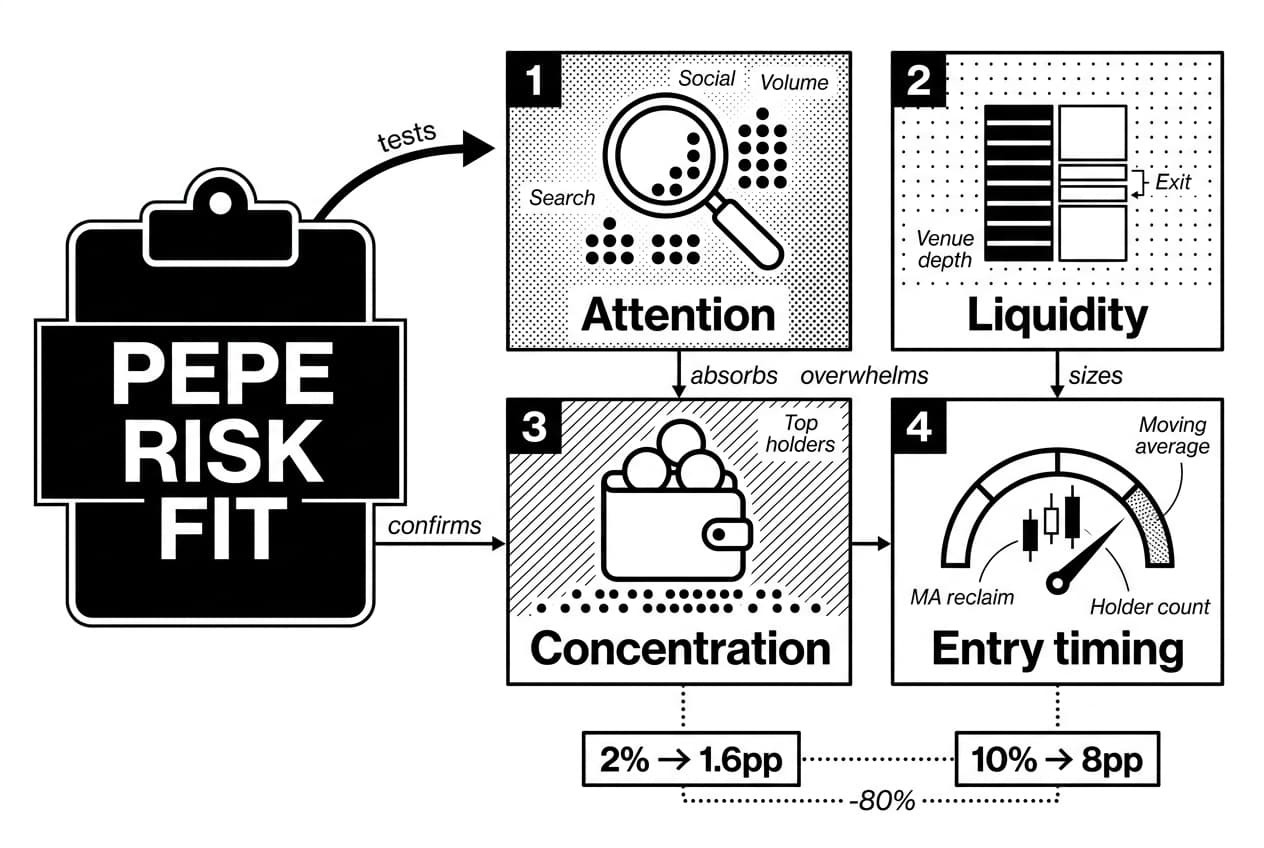
Use the attention-liquidity-concentration test before deciding is pepe coin worth buying. Attention asks whether search, social discussion, and volume are rising together. Liquidity asks whether the chosen venue can handle the order without poor execution. Concentration asks whether top holders can overwhelm demand. PEPE looks healthier only when all three improve at the same time.
Position sizing and maximum-loss planning
A small allocation can still be risky if the asset can fall 80%. For example, a 2% portfolio position that falls 80% reduces total portfolio value by 1.6 percentage points. A 10% position with the same loss reduces total portfolio value by 8 percentage points. The same asset risk becomes a very different portfolio risk depending on size.
Entry timing: technicals versus narrative
A decline alone does not make PEPE cheap. Better entry evidence includes improving volume, price reclaiming moving averages, rising holder count, and stable exchange liquidity. Narrative spikes can be useful, but they can also mark late-cycle demand. The strongest setup is when technical confirmation and attention data rise together.
Custody and execution risks
If PEPE is held on an exchange, the user accepts platform, withdrawal, and account-access risk. If PEPE is self-custodied, the user accepts seed-phrase, phishing, and transaction-signing risk. Review hardware wallet versus exchange custody before choosing storage.
Contract verification is also important because fake PEPE tokens can imitate the name and ticker. Check the contract address against CoinGecko, Aug. 2026 or CoinMarketCap, Aug. 2026 before trading. For related scam risk, see how to avoid fake PEPE airdrops.
Decision checklist
- Position size: Is the PEPE allocation small enough that a 100% loss would not impair your finances?
- Maximum loss: Have you written down the dollar amount you are willing to lose before entry?
- Liquidity: Have you checked live 24-hour volume, spread, and order-book depth on your chosen venue?
- Whale concentration: Have you reviewed the latest holder distribution on Etherscan and identified exchange wallets?
- Technical trend: Is price above key moving averages with volume confirming the move?
- Custody: Do you know whether the tokens will stay on an exchange or in self-custody?
- Taxes: Have you checked how short-term gains, losses, and swaps are treated in your jurisdiction in 2026?
- Exit plan: Have you set a price-based or time-based exit before buying?
- Thesis clarity: Are you trading a meme-cycle move or holding a long-term speculation?
This checklist will not predict price. It will show whether the position is planned or impulsive.
Frequently Asked Questions
- What is the future of PEPE coin?
- PEPE's future hinges on meme-sector demand, community activity, exchange liquidity, whale behavior, and broader crypto cycles. If sustained attention keeps it relevant, it could hold a top meme-coin position. However, it has no cash flows or utility to establish a traditional valuation floor, making its outlook highly sentiment-driven.
- Can PEPE coin reach $1 cent?
- At roughly 420.69 trillion tokens in circulation, a $0.01 price would require a market cap of approximately $4.2 trillion. That figure rivals or exceeds the entire crypto market at its historical peak. Without a dramatic supply reduction, reaching one cent is an extremely ambitious target under current assumptions.
- How much will 1 PEPE be worth in 2030?
- No one can reliably predict a single 2030 price. Bear scenarios suggest continued low fractions of a cent; base scenarios assume modest cycle-driven gains; bull scenarios depend on strong meme-coin demand and broader market growth. Treat any 2030 forecast as a speculative planning tool, not a reliable prediction.
- Which coin is best to invest in?
- There is no universal answer. Bitcoin and Ethereum are generally considered more established, with stronger liquidity and fundamentals. PEPE is a higher-risk speculative asset. The better choice depends on your risk tolerance, time horizon, diversification goals, and whether you prefer assets with underlying utility or pure speculative exposure.
- Can the PEPE coin reach $1?
- At current supply levels of roughly 420.69 trillion tokens, a $1 price would imply a market cap exceeding $420 trillion. That surpasses the entire global crypto market many times over and rivals major traditional asset classes. Under present supply conditions, a $1 PEPE price is not a realistic scenario.
- Will PEPE coin reach $1 in 2040?
- A 2040 forecast carries enormous uncertainty. Even by then, reaching $1 would require either a massive supply reduction or a market capitalization that has no modern precedent. Rather than fixating on distant headline targets, investors are better served monitoring nearer-term adoption, liquidity conditions, and realistic risk metrics.
- Is PEPE a good coin to buy?
- PEPE may suit investors who fully accept high volatility and the possibility of significant losses. It can deliver meme-coin upside during strong risk-on markets, but it is not comparable to assets backed by revenue, yield, or established utility. Position sizing and risk management matter more here than with traditional investments.
- Why is PEPE crashing?
- Common causes include profit-taking after rallies, whale sell-offs, leverage liquidations, fading social-media attention, broader crypto market weakness, and capital rotating into other sectors. Before settling on one explanation, check on-chain wallet transfers, exchange inflow data, trading volume trends, and overall market conditions for a clearer picture.
- Could PEPE coin be a pump and dump?
- Any meme coin can experience pump-and-dump dynamics when hype outpaces liquidity. Key warning signs include sudden coordinated social-media campaigns, sharp unexplained volume spikes, thin order books, large-holder wallet movements, and rapid price reversals following promotional pushes. Monitoring these signals can help you avoid entering at the peak of a manufactured move.
Sources
Author

Crypto analyst and blockchain educator with over 8 years of experience in the digital asset space. Former fintech consultant at a major Wall Street firm turned full-time crypto journalist. Specializes in DeFi, tokenomics, and blockchain technology. His writing breaks down complex cryptocurrency concepts into actionable insights for both beginners and seasoned investors.