Can Pepe Coin Reach $1? Realistic 2026 Math & Scenarios

Can PEPE coin reach $1? The short answer
Can pepe coin reach $1? Under the current supply structure, the realistic answer is no. With about 420.69 trillion PEPE tokens outstanding, a $1 price would imply a market value near $420.69 trillion, far beyond global crypto liquidity and larger than the annual output of the world economy.
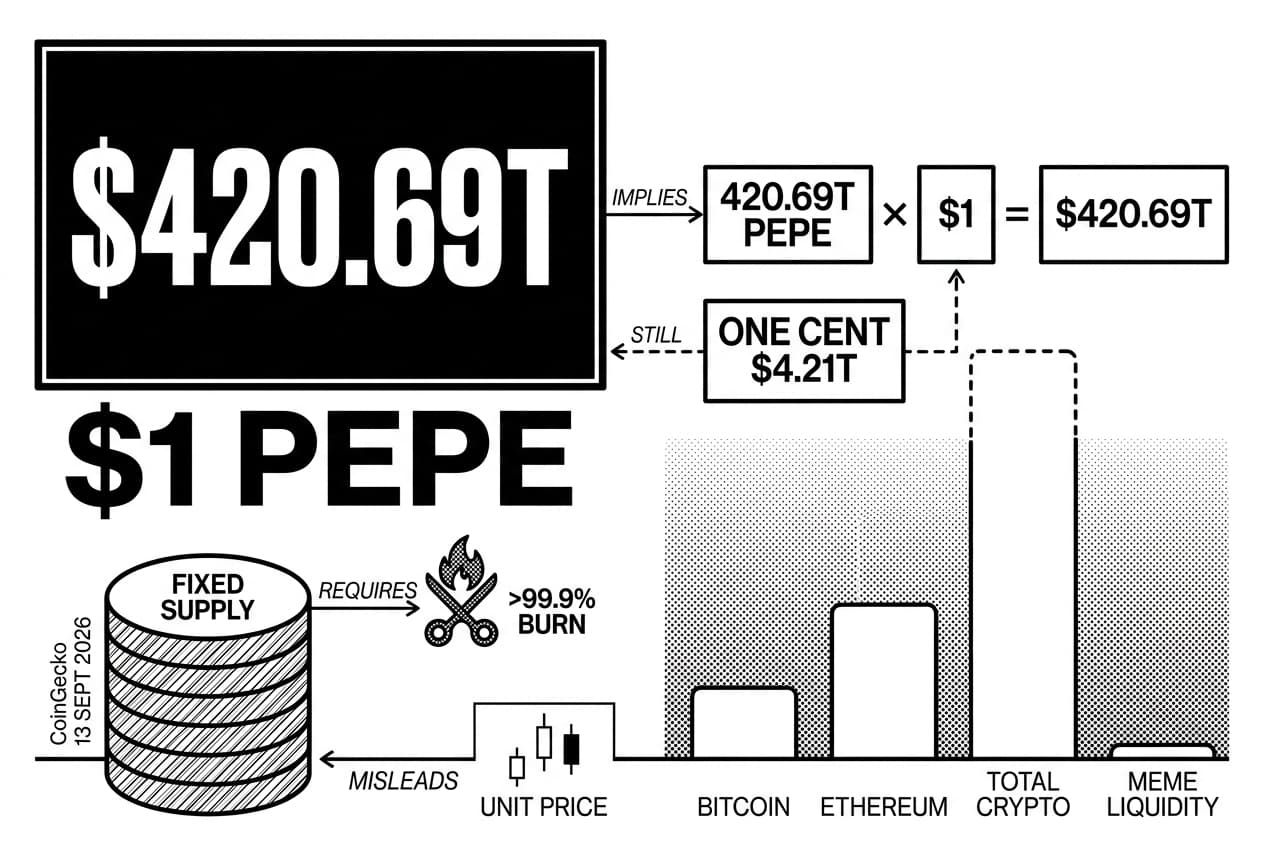
The better question is not whether PEPE can print a larger unit price, but what market capitalization, liquidity, and supply changes would be required at each target. This analysis uses a simple stress test: circulating supply multiplied by target price, then compared with Bitcoin, Ethereum, the total crypto market, meme-coin history, and likely order-book depth as of 13 September 2026.
The direct answer for 2026 investors
PEPE reaching $1 is not realistic unless the circulating supply is reduced by more than 99.9% and the remaining token attracts demand on a scale no meme coin has ever sustained. The fixed supply is the constraint. PEPE’s listed supply is about 420,690,000,000,000 tokens according to CoinGecko, checked 13 September 2026. At that supply, even one cent would imply about $4.21 trillion in market value.
Why unit price misleads meme-coin buyers
A token priced at $0.00001 can look cheap because the number is small. That comparison is incomplete. A low unit price can still represent a large valuation when the supply runs into hundreds of trillions. Lyn Alden, Founder of Lyn Alden Investment Strategy, has often emphasized that monetary assets must be judged against supply and the total pool of capital willing to hold them. That principle is directly relevant to PEPE.
Our contrarian view is that $1 is a distraction. Even the question can pepe coin reach 1 cent is already a multi-trillion-dollar market-cap discussion unless supply falls sharply. Realistic upside depends more on exchange depth, whale concentration, meme-sector volume, Bitcoin liquidity cycles, and whether PEPE can keep attention during the next retail risk-on phase. For current token-level updates, see our latest PEPE price and market updates.
By the numbers: PEPE supply, market cap, and price targets
This section is the data core of the article. We generated the table below by applying one formula to PEPE’s circulating supply: target price multiplied by circulating supply equals implied market capitalization. The result is not a price prediction. It is a viability screen.
Key PEPE metrics and calculation inputs
- Circulating supply input: about 420.69 trillion PEPE tokens, based on CoinGecko, checked 13 September 2026.
- All-time high reference: PEPE’s listed all-time high was around $0.000028, based on CoinGecko, checked 13 September 2026.
- Total crypto benchmark: the total crypto market has traded in the low-trillion-dollar range during recent cycle peaks, with historical market-cap charts tracked by CoinMarketCap, checked 13 September 2026.
- Global economy benchmark: world output was estimated around $110 trillion for 2025 in worldbank.org global economic prospects data, January 2026.
Implied market cap at $1, 50 cents, and 1 cent
PEPE price target | Implied market cap | Required gain from $0.000028 ATH | Realism rating |
|---|---|---|---|
$0.0001 | About $42.07 billion | About 3.6x | Very difficult, but cycle-plausible in a mania |
$0.001 | About $420.69 billion | About 35.7x | Extremely unlikely without sector-wide excess |
$0.01 | About $4.21 trillion | About 357x | Implausible without huge burns and a much larger crypto market |
$0.50 | About $210.35 trillion | About 17,857x | Not realistic at current supply |
$1.00 | About $420.69 trillion | About 35,714x | Not realistic at current supply |
The only row that deserves serious bull-cycle modeling is $0.0001. A $42 billion valuation would still be large for a meme coin, but it is at least comparable with historical peak valuations reached by the largest meme assets. By contrast, $0.01, $0.50, and $1 require market values that exceed the available capital base of the crypto market by wide margins.
What is PEPE coin and how did it get here?
PEPE is an ERC-20 meme coin on Ethereum. It does not secure a base-layer network, pay protocol fees to holders, or provide equity-style claims on cash flow. Its value is mainly a function of attention, exchange access, liquidity, holder behavior, and speculative demand.
PEPE’s origin as an ERC-20 meme coin
PEPE launched in April 2023 with a fixed token supply and a no-roadmap meme identity. That structure is important. Because there is no traditional cash-flow model, PEPE cannot be valued like a company, a lending protocol, or a layer-1 blockchain. Investors should also treat anonymous meme-coin launches as high-risk by default and review crypto scam and rug pull warning signs before allocating capital to any similar token.
Historical price trends and all-time high context
PEPE’s history has been marked by sharp rallies and deep reversals. The token’s all-time high near $0.000028, shown by CoinGecko, checked 13 September 2026, briefly placed it among the largest meme coins by market value. That history matters because the next major target, $0.0001, would already require a move of roughly 3.6x from that high. A repeat of early launch percentage gains is harder after a token already has a multibillion-dollar valuation.
How PEPE compares with DOGE and SHIB
Metric | DOGE | SHIB | PEPE |
|---|---|---|---|
Supply profile | Inflationary, lower unit count | Very high supply | Very high fixed supply |
Peak market-cap reference | About $88 billion in May 2021, per CoinMarketCap, checked 13 September 2026 | Tens of billions during 2021 peak cycle | Low tens of billions near peak trading periods |
Core driver | Long-standing meme liquidity | Community scale and exchange access | Internet meme attention and high-beta trading |
DOGE and SHIB show that meme coins can reach large valuations during retail cycles. They do not prove that PEPE can reach $1. DOGE’s roughly $88 billion peak is still less than one-quarter of the $420.69 billion implied by PEPE at $0.001 and about 0.02% of the value implied by PEPE at $1.
The mathematical reality: why $1 and 50 cents are extreme targets
The PEPE target viability matrix is our original framework for this analysis. It grades each price target across four gates: supply math, benchmark comparison, liquidity feasibility, and burn dependency. A target fails if it requires a market value that cannot be supported by historical crypto liquidity or a burn schedule with no credible path.
Here is the calculation process:
- Find circulating supply: use about 420.69 trillion PEPE tokens from CoinGecko, checked 13 September 2026.
- Multiply by target price: $0.01 multiplied by 420.69 trillion equals about $4.21 trillion.
- Compare with BTC, ETH, and total crypto value: total crypto market-cap history is tracked by CoinMarketCap, checked 13 September 2026.
- Assess liquidity feasibility: ask whether exchanges and decentralized pools could absorb real selling pressure at that valuation.
What PEPE would be worth at $1
At $1 per token, PEPE would be worth about $420.69 trillion. That figure is nearly four times the roughly $110 trillion world output estimate for 2025 cited by worldbank.org, January 2026. A single meme coin sustaining that valuation is not a realistic market scenario. The only theoretical path would be a supply collapse so large that the current PEPE token base would no longer resemble today’s asset.
Will pepe coin reach 50 cents?
Will pepe coin reach 50 cents? Under current supply, the answer is also no in any normal market scenario. At $0.50, PEPE would imply about $210.35 trillion in market value. That is still far above world annual output and far beyond the size of the full crypto market. A 50-cent target is not meaningfully more realistic than $1 because both depend on supply destruction at a scale the project has not shown.
Can pepe coin reach 1 cent?
Can pepe coin reach 1 cent? It is less impossible than $1, but still extremely difficult. At $0.01, PEPE would imply about $4.21 trillion. That would require PEPE alone to rival or exceed full-cycle crypto-market valuations. Without major burns, a far larger crypto market, and deep order books, the 1-cent math does not close.
Target | Market-cap result | Main blocking factor | Viability score |
|---|---|---|---|
$1.00 | About $420.69 trillion | Global capital base | Fails all four gates |
$0.50 | About $210.35 trillion | Global capital base | Fails all four gates |
$0.01 | About $4.21 trillion | Supply and liquidity | Fails under current supply |
$0.001 | About $420.69 billion | Meme-sector scale | Possible only in an extreme mania |
Lyn Alden, Founder of Lyn Alden Investment Strategy, has written extensively about liquidity, monetary supply, and capital flows. Applied to PEPE, the lesson is simple: unit price does not matter until supply and the available buyer base are measured together.
Realistic PEPE price scenarios for 2026 to 2030
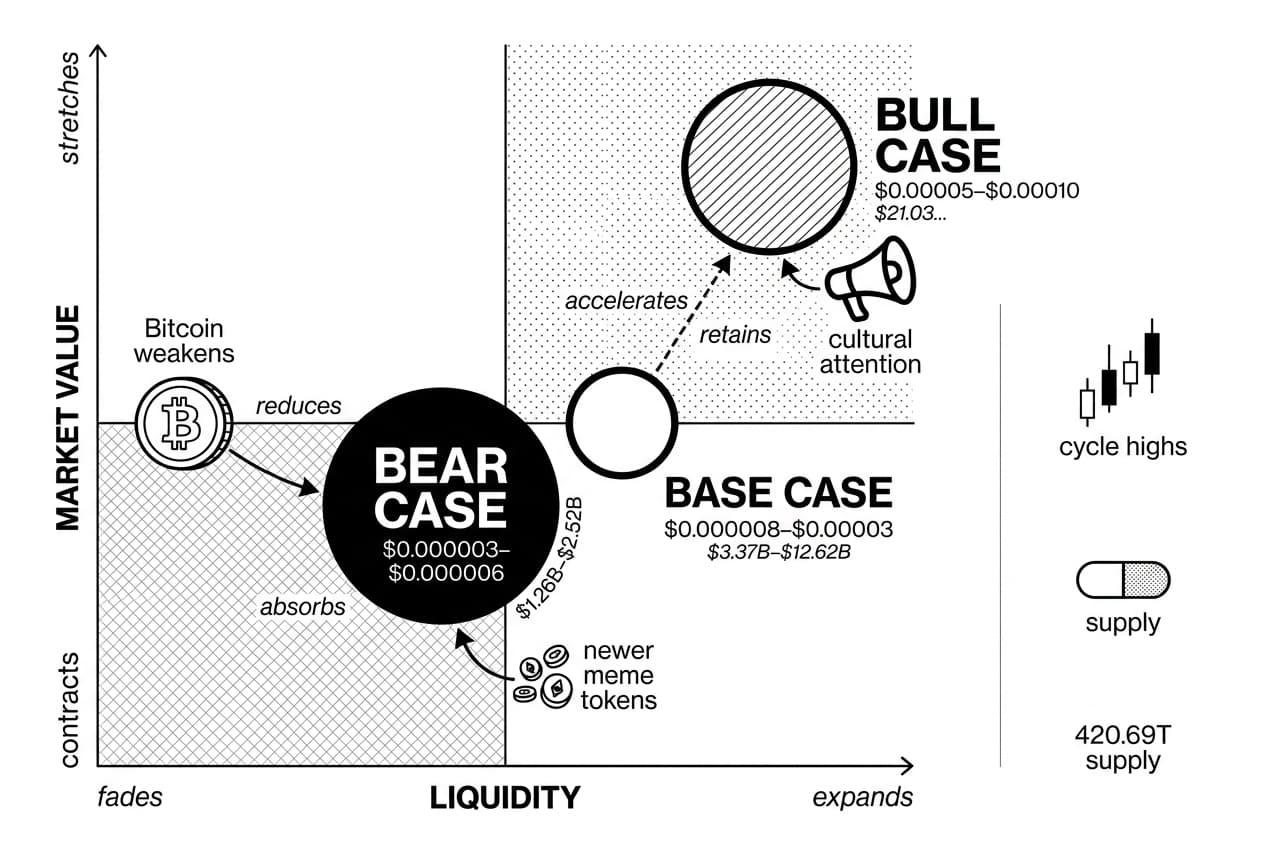
Forecast sites can be useful sentiment gauges, but they often hide the assumptions behind their models. A better method is to use scenarios. The PEPE target viability matrix below separates downside survival, cycle continuation, and mania conditions while keeping each range tied to implied market value.
Bear case: liquidity fades and meme demand rotates
If Bitcoin weakens, retail risk appetite falls, and newer meme tokens absorb attention, PEPE could retrace sharply. Meme coins often fall faster than major assets because their holders are less anchored by cash flows or network use. In this scenario, PEPE might trade near $0.000003 to $0.000006, implying roughly $1.26 billion to $2.52 billion in market value using the 420.69 trillion supply base. This is not a prediction. It is a downside range if liquidity contracts.
Base case: a top meme coin, not a dollar asset
The base case assumes PEPE remains a liquid top-tier meme coin but does not escape market-cap gravity. A $0.000008 to $0.00003 range implies about $3.37 billion to $12.62 billion in market value. That would keep PEPE relevant while still leaving it far from $0.01, $0.50, or $1. For a more detailed cycle model, see our PEPE price prediction 2026 analysis.
Bull case: new cycle highs without impossible valuations
A strong bull case could push PEPE into the $0.00005 to $0.00010 area if total crypto liquidity expands, meme-coin volume accelerates, and PEPE retains cultural attention. That range implies about $21.03 billion to $42.07 billion in market value. Raoul Pal, CEO and co-founder of Real Vision, has often described crypto as highly sensitive to global liquidity cycles. That framework helps explain why meme coins can surge late in bull markets, but it does not justify $1 math.
Scenario | Price range | Implied market cap | Trigger to watch |
|---|---|---|---|
Downside survival | $0.000003 to $0.000006 | About $1.26B to $2.52B | Risk-off market and meme rotation |
Base continuation | $0.000008 to $0.00003 | About $3.37B to $12.62B | PEPE keeps major exchange liquidity |
Cycle high | $0.00005 to $0.00010 | About $21.03B to $42.07B | Retail mania and broad crypto expansion |
Extreme mania | $0.001 or higher | About $420.69B or higher | Historically abnormal meme-coin valuation |
What would need to happen for PEPE to reach 1 cent?
PEPE could approach 1 cent only if supply burns remove most circulating tokens, total crypto market value expands far beyond prior cycle norms, exchange and pool liquidity deepen enough to absorb large exits, and sustained demand keeps the meme premium alive for more than one speculative burst.
That combination is possible in theory, but each condition is hard. All of them occurring together would be historically unusual for a no-cash-flow meme token.
Supply burns: how much would actually matter?
At the current supply, $0.01 requires about $4.21 trillion in market value. A 50% burn would still leave about 210.35 trillion tokens and require about $2.10 trillion at one cent. A 90% burn would leave about 42.07 trillion tokens and still require about $420.69 billion. To bring one cent into a more plausible range, supply would likely need to fall by 95% or more. Small burns can move sentiment, but they do not fix the arithmetic.
Burn announcements often create short-lived excitement. Investors tracking PEPE community signals and Reddit risks should separate social engagement from actual supply reduction. A burn matters only if it is verifiable, large relative to total supply, and not offset by weaker demand.
Liquidity and market-depth requirements
A quoted price is useful only if real buyers and sellers can trade size near that price. For PEPE to sustain $0.01, major centralized exchanges would need deep order books, and decentralized pools would need enough liquidity to avoid severe slippage on medium-sized trades. To understand how crypto liquidity pools work is to understand why thin pools can create dramatic candles that reverse quickly.
Whale concentration is another constraint. If a small group of large holders controls a meaningful share of supply, rallies become fragile. Rising exchange inflows from large wallets often signal potential selling pressure. A healthier setup would show growing holder count, lower top-wallet concentration, and higher spot volume that is not driven by wash trading or short-term tap.
Utility versus meme premium
PEPE does not need utility to rally. DOGE and SHIB already proved that attention alone can support large valuations during risk-on periods. The harder task is holding those valuations after attention fades. Utility, integrations, staking, or payments can help liquidity persist between hype cycles, but they do not erase the supply problem. PEPE’s best realistic case is still a high-beta meme asset, not a cash-flow instrument.
The one-cent test: if supply is not reduced at scale, total crypto liquidity does not expand, and order-book depth does not improve, then a one-cent PEPE target remains a headline number rather than a durable valuation case.
How to analyze PEPE price movements in 2026
Price targets are useful only when paired with market signals. PEPE traders should watch liquidity, volume, Bitcoin direction, and holder behavior before treating any breakout as durable.
Key price levels, moving averages, and oscillators
The 50-day and 200-day simple moving averages remain useful trend markers. A sustained close above the 200-day average can indicate improving momentum, while a failed reclaim often signals weak demand. RSI above 70 can warn of overheated trading, and RSI below 30 can mark oversold conditions. MACD, rate of change, and CCI are secondary tools. Volume is the filter: a breakout on falling volume is weaker than a breakout supported by rising spot volume.
Correlation with Bitcoin and meme-coin cycles
PEPE usually trades as a high-beta expression of broader crypto risk appetite. When Bitcoin liquidity improves, traders often rotate into larger altcoins first and meme coins later. When Bitcoin sells off, PEPE can fall faster because many holders are momentum-driven. Meme-sector breadth also matters. If DOGE, SHIB, and other large meme tokens rise together, PEPE breakouts are more credible than isolated pumps.
Candlestick and on-chain signals to watch
Reversal candlestick patterns can help identify exhaustion, but they are more useful when confirmed by on-chain data. Watch exchange inflows, large-wallet transfers, holder-count changes, and decentralized-pool depth. Falling exchange inflows during a pullback can suggest sellers are running out of supply. Rising exchange inflows during a rally can warn that whales are preparing to sell into strength.
Key takeaways: what this means for PEPE investors
The market-cap hierarchy is clear. PEPE can still produce tradable volatility without reaching $1, 50 cents, or one cent. Investors should judge the asset by supply, liquidity, and cycle conditions rather than by a psychologically appealing unit price.
Final verdict on $1, 50 cents, and 1 cent
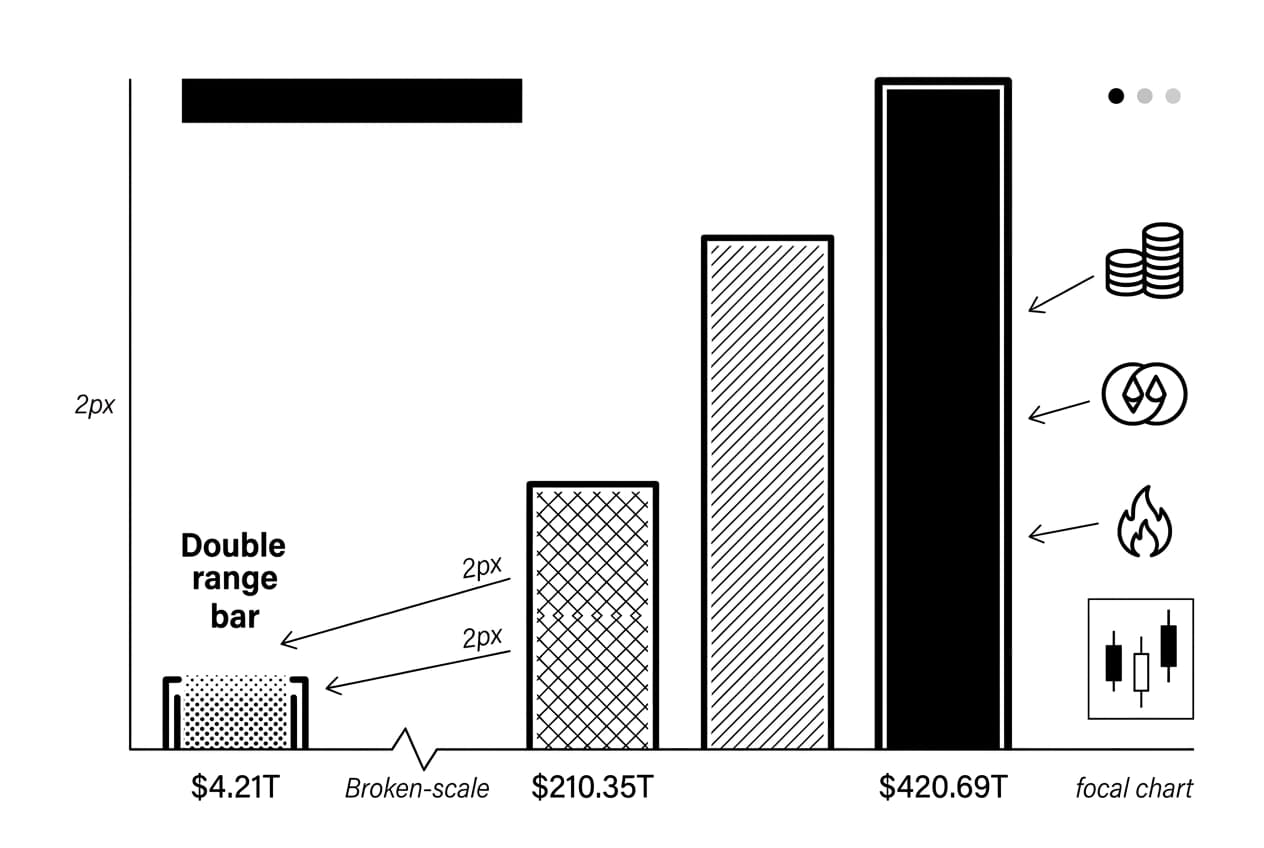
A $1 PEPE price implies about $420.69 trillion in value. A 50-cent price implies about $210.35 trillion. A one-cent price implies about $4.21 trillion. Those figures come from the same supply input listed by CoinGecko, checked 13 September 2026. Based on that math, PEPE is better understood as a volatile trading asset than a long-term compounder. For risk framing, see our PEPE investment risk-reward analysis.
- $1 target: Not realistic at the current supply because it implies about $420.69 trillion in market value.
- 50 cents target: Also not realistic because the implied value remains above $210 trillion.
- 1 cent target: Possible only in theory, requiring massive burns, much larger crypto liquidity, and sustained demand.
- Most realistic bull target area: $0.00005 to $0.00010 would already imply about $21.03 billion to $42.07 billion.
- Metrics to monitor: circulating supply, burn size, top-wallet concentration, spot volume, order-book depth, Bitcoin trend, and meme-sector breadth.
Frequently Asked Questions
- How high can Pepe realistically go?
- Rather than a single price target, realistic upside is best understood through market-cap ranges. PEPE's ceiling depends on circulating supply, overall crypto market conditions, meme-coin liquidity cycles, new exchange listings, and whether it can revisit or surpass valuations from previous bull cycles. Historically, top meme coins have reached $10–$20 billion market caps at peak.
- Will Pepe coin reach $1?
- Reaching $1 is not realistic under current supply conditions. With hundreds of trillions of PEPE tokens in circulation, a $1 price would imply a market capitalization that dwarfs the entire crypto market today. Only a massive, sustained supply reduction combined with unprecedented global demand could ever make that math work.
- Will Pepe coin reach 50 cents?
- Fifty cents is still an extreme target — roughly half the market cap implied by a $1 scenario — which itself is already considered impossible under current conditions. Reaching $0.50 would require dramatic supply burns and meme-coin demand expanding far beyond anything seen in prior crypto cycles, making it highly unlikely in any foreseeable timeframe.
- Can Pepe coin reach 1 cent?
- One cent is less extreme than $1 but still requires an enormous market capitalization given PEPE's current supply. Getting there would need meaningful token burns to reduce supply, deep and sustained liquidity, a strong broader crypto bull market, and PEPE maintaining cultural relevance long enough to attract serious institutional and retail capital.
- How much will 1 Pepe be worth in 2030?
- No one can reliably forecast a 2030 price. In a bear case, PEPE could fade into irrelevance. A base case suggests modest growth tied to broader crypto adoption. A bull case could see new all-time highs if meme coins remain culturally dominant. Treat estimates from sites like DigitalCoinPrice or PricePrediction as speculative models, not reliable forecasts.
- What is the Pepe coin price prediction for 2026?
- A 2026 outlook hinges on Bitcoin's trend, PEPE's trading volume, social momentum, and how close it gets to prior all-time highs. If a macro bull cycle peaks around 2025–2026, PEPE could overshoot expectations. However, meme coins are narrative-driven and can collapse just as fast, so both upside and downside scenarios deserve equal attention.
- Which meme coin can reach $1?
- Whether any meme coin reaches $1 is largely a supply question. Low-supply tokens have a much easier mathematical path to $1 than high-supply tokens like PEPE or SHIB. That said, a $1 price tag on its own says nothing about actual value or market cap — a low-price token with massive supply can be worth far more in total.
- How many Pepe coins do I need to be a millionaire?
- The formula is straightforward: $1,000,000 ÷ future PEPE price = coins needed. At $0.0001 you would need 10 billion PEPE; at $0.001, one billion; at $0.01, one hundred million. These are illustrative scenarios only — not predictions — and reaching any of those price levels carries significant uncertainty and risk.
Sources
Author

Crypto analyst and blockchain educator with over 8 years of experience in the digital asset space. Former fintech consultant at a major Wall Street firm turned full-time crypto journalist. Specializes in DeFi, tokenomics, and blockchain technology. His writing breaks down complex cryptocurrency concepts into actionable insights for both beginners and seasoned investors.