Monero Traceable? Government Chain Analysis of XMR 2026

Monero traceable? government chain analysis of XMR in 2026
key finding: is Monero traceable by governments in 2026?
Monero is not traceable in the same way as Bitcoin. To trace Monero, investigators usually need off-chain evidence such as exchange records, seized devices, network metadata, marketplace logs, or user mistakes. The protocol hides sender, receiver, and amount by default, so public-chain analysis alone remains a weak attribution method in 2026.
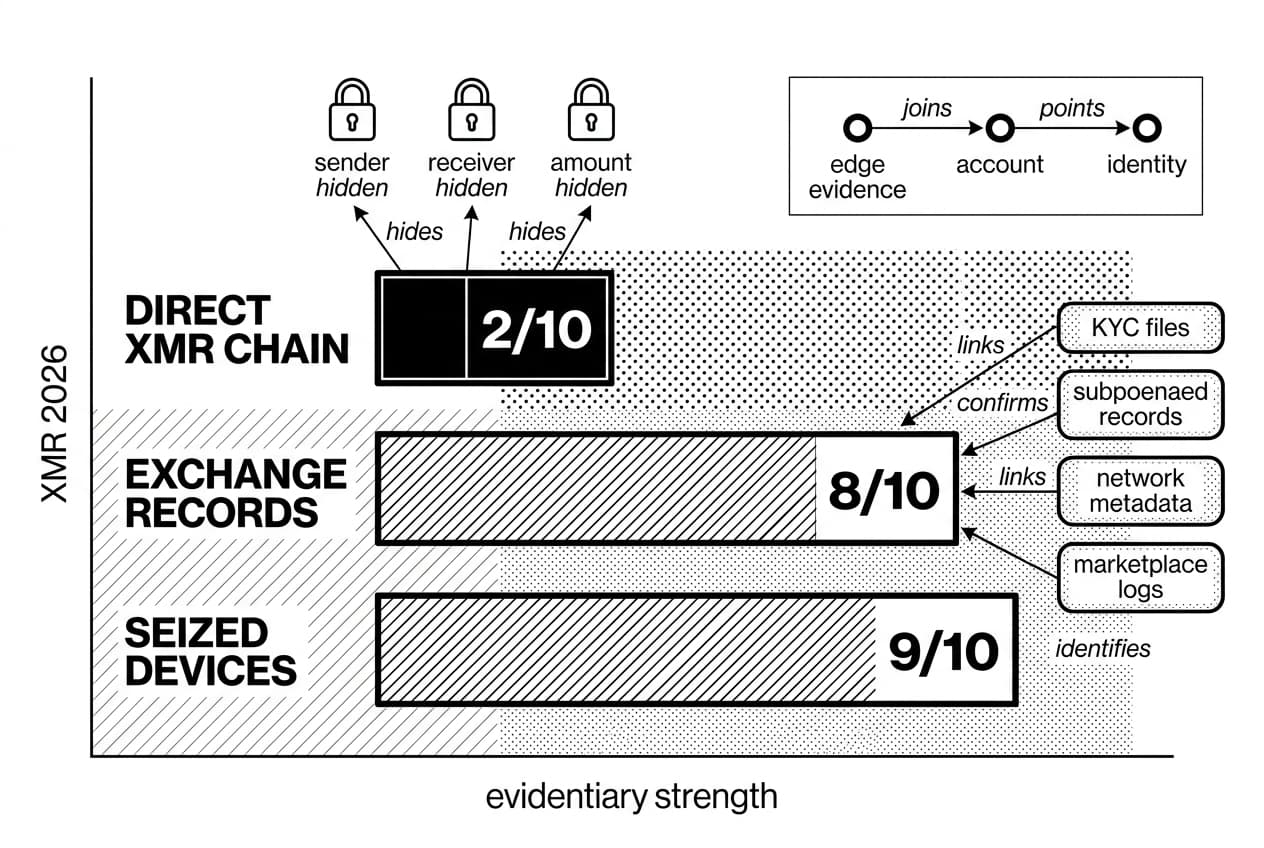
The useful answer is not yes or no. It is a confidence question. Monero can be investigated, but the strongest evidence usually comes from the edges around the transaction rather than the ledger itself. That distinction matters for compliance teams, investors, and users because it separates protocol-level traceability from real-world identity attribution.
Our 2026 chain-vs-edge attribution scorecard rates direct Monero chain tracing at 2 out of 10 for evidentiary strength, but rates exchange records and seized devices at 8 to 9 out of 10 when those records exist. The scorecard is an editorial framework, not a claim that any single agency has a universal XMR tracing tool.
The privacy education of Andreas Antonopoulos is useful here because it separates ledger design from user security. The broader crypto privacy debate involving Vitalik Buterin also shows why privacy systems must be judged by both cryptography and the surrounding application layer.
short answer for readers
Monero hides sender, receiver, and amount by default. Governments can still identify users through exchange know-your-customer files, subpoenaed account records, device forensics, internet metadata, timing analysis, undercover buys, and careless reuse of identities. The chain is hard to read. The endpoints are much easier to attack.
what counts as tracing?
Tracing can mean several different things, and each has a different confidence level:
- transaction tracing: following a payment from sender to receiver using only public ledger data.
- wallet clustering: grouping outputs as belonging to one entity, which is far harder on Monero than on transparent ledgers.
- identity attribution: linking a transaction or wallet to a real person through records outside the chain.
- network surveillance: trying to observe the node or internet address that first broadcasts a transaction.
- case-building: combining exchange records, seized devices, messages, marketplace logs, and timing evidence.
The government interest is documented. In 2020, the U.S. tax agency sought tools for privacy-coin tracing with a bounty reported at $625,000, source, Sept. 2020. That number proves demand for tooling. It does not prove reliable protocol-level tracing at scale.
by the numbers: Monero privacy and investigation data points
The table below is our chain-vs-edge attribution scorecard for 2026. It scores what an investigator can learn from each signal, not whether a person has committed an offense. Scores reflect public documentation, protocol design, and the practical limits of the evidence type.
signal | what it can show | confidence level | main limitation |
|---|---|---|---|
on-chain heuristics | possible narrowing of input candidates, especially under abnormal output-flooding conditions | low, 2/10 | sender, receiver, and amount are hidden by default |
KYC records | fiat account owner, deposit or withdrawal time, bank link, login history | high, 8/10 | works only when the user touched a regulated platform |
device forensics | wallet files, seed phrases, view keys, messages, screenshots, browser history | very high, 9/10 | requires lawful access, cooperation, malware, or seizure |
IP metadata | possible node connection or transaction-broadcast timing | medium, 5/10 | privacy networks, local nodes, and relay design reduce confidence |
timing analysis | correlation between an outside event and a transaction window | medium, 5/10 | usually needs another identity clue first |
seized view keys | incoming transaction history for a specific wallet | high, 8/10 | incoming visibility is not the same as full spend attribution |
core numeric reference points
- ring size: Monero increased the mandatory ring size to 16 with its 2022 network upgrade (getmonero.org, Aug. 2022).
- amount privacy: confidential transactions became mandatory for Monero in January 2017 (getmonero.org, Jan. 2017).
- agency demand: the 2020 privacy-coin tracing solicitation was reported at $625,000 (source, Sept. 2020).
- exchange pressure: Binance announced that XMR would be delisted on February 20, 2024 (source, Feb. 2024).
- tax treatment: U.S. virtual-currency tax guidance was issued in notice 2014-21 (IRS, Mar. 2014).
- EU timing: the main EU crypto-asset rulebook applied from 30 December 2024 (ESMA, Dec. 2024).
The data points point in one direction: Monero is hardest to read at the protocol layer and easiest to investigate when a user interacts with regulated firms, exposed devices, or identifiable network infrastructure.
how Monero works: privacy by design, not optional mixing
Monero differs from Bitcoin and Ethereum because privacy is not an optional add-on. Every normal transaction participates in the same privacy system. That makes the anonymity set broader than opt-in privacy tools, where users often stand out simply by choosing the private route. For background on the distinction, see the difference between anonymity and pseudonymity.
Monero uses three core privacy mechanisms:
- stealth addresses: each payment creates a one-time recipient address, so observers cannot link multiple incoming payments to one public wallet address.
- ring signatures: the real input is placed among decoy inputs, so an outside observer sees several plausible spenders instead of one confirmed sender.
- RingCT: transaction amounts are hidden with cryptographic commitments, removing the value trail that transparent-chain tracing tools often depend on.
stealth addresses hide the receiver
When XMR is sent, the protocol derives a one-time public key for the recipient. That key appears on-chain once. Without the recipient view key, a public observer cannot scan the ledger and group all payments to that person. This is why simple address clustering, common on transparent blockchains, does not transfer cleanly to Monero.
ring signatures obscure the sender
Ring signatures place the true spending input among decoys. The current 16-member ring design means the public chain shows a set of plausible inputs rather than a single confirmed spend. Older Monero research found weaknesses when ring sizes were smaller and decoy selection was less mature. Those historical findings matter, but they should not be treated as proof that the current protocol is broken.
RingCT hides the amount
RingCT removes visible transaction amounts. On transparent ledgers, analysts can often follow distinctive values across hops. On Monero, that value-matching signal is absent. Hidden amounts do not guarantee perfect anonymity, but they remove one of the strongest signals used in ordinary blockchain surveillance.
can chain analysis trace Monero transactions?
Chain analysis can still inspect the Monero blockchain, but the observable data is limited. Analysts can see block times, transaction structure, key images used to prevent double-spending, and opaque output commitments. They cannot directly see sender identity, recipient address, or amount. For a broader explanation of the surveillance method on transparent chains, see how blockchain surveillance works.
what chain analysis can see
The ledger gives analysts structure without attribution. A node can verify that transactions are valid, that no output is double-spent, and that consensus rules are followed. It cannot reveal the owner of a one-time address or the true input inside a ring. That makes Monero data useful for network statistics and anomaly detection, but weak for direct person-level attribution.
heuristics are triage, not decryption
Investigators can still apply statistical methods. They can examine decoy age, transaction timing, abnormal output creation, known exchange deposit windows, and repeated user behavior. These methods can raise or lower suspicion, but they do not decrypt the transaction. In a legal setting, a probability score usually needs support from records, devices, messages, or witnesses.
the flooding-attack debate
Flooding attacks try to create many outputs so that attacker-controlled outputs appear more often as decoys in other users rings. If successful, this can reduce statistical uncertainty for some rings. It is not the same as breaking Monero encryption. The practical cost, the need for sustained activity, and the existence of protocol countermeasures make it better understood as an anonymity-set pressure test than as universal traceability.
Our interpretation is narrow: flooding research shows that Monero privacy can be degraded under certain conditions. It does not show that governments can reliably trace Monero at scale using public-chain data alone.
how governments actually trace Monero users
The most reliable investigative paths target people, accounts, devices, and services around the transaction. In documented crypto cases, the strongest evidence usually comes from records outside the chain.
- exchange subpoenas: regulated platforms can provide account identity, deposit and withdrawal times, linked banks, device fingerprints, and login records.
- endpoint forensics: seized phones, laptops, cloud backups, wallet files, seed phrases, and view keys can directly connect a person to XMR activity.
- network metadata: remote nodes, clearnet connections, internet-provider logs, or timing correlations can narrow suspects when paired with other evidence.
- undercover operations: agents can create direct transaction records by posing as buyers, vendors, or counterparties.
- marketplace records: seized servers may contain usernames, orders, shipping records, support messages, and payment timing.
- user mistakes: reused handles, public screenshots, copied wallet data, browser history, and chat logs can defeat strong protocol privacy.
KYC exchanges and fiat ramps
Converting between XMR and fiat often creates the clearest record. A regulated account can reveal identity, time of access, withdrawal history, bank connections, and device information. This is also where custody matters. A custodial platform can be compelled to produce records in a way a self-custody wallet cannot. For that distinction, see custodial vs non-custodial wallet rules.
device, wallet, and endpoint forensics
A seized unlocked wallet can be more valuable than months of statistical chain work. View keys can reveal incoming payments. Seed phrases can control funds. Notes apps, password managers, screenshots, clipboard history, and marketplace messages can provide context that the blockchain hides. Endpoint evidence is high confidence because it is tied to a person and a device.
network metadata and user behavior
Monero reduces network-level leakage, but it does not make bad operational security harmless. A user who connects to a remote node over the open internet, logs into a marketplace from the same device, and reuses a public handle creates a trail outside the ledger. This is the layer where the educational warning from Andreas Antonopoulos is most relevant: privacy tools fail when the user environment leaks identity.
historical context: why Monero became a surveillance target
Monero became a target because it addressed a real weakness in Bitcoin privacy. Bitcoin is pseudonymous, not anonymous. Its transaction graph is public forever, and exchange identity records can turn clusters of addresses into real-world profiles. Monero was designed as a response to that structural transparency.
from Bitcoin transparency to privacy coins
Monero launched in 2014 with privacy as a default design goal. Its later RingCT activation in 2017 added amount hiding and made the visible ledger much less useful to transaction-graph analysis. That shift is the main reason XMR is treated differently from transparent assets by surveillance firms and compliance teams.
darknet use, delistings, and compliance risk
Monero also gained adoption in illicit markets because its privacy properties reduced the usefulness of public-chain tracing. That adoption increased law-enforcement attention and made exchanges weigh whether XMR could fit their anti-money-laundering controls. The result was not a universal legal ban. It was a steady reduction in large regulated trading venues willing to support XMR.
Exchange delistings change the risk model. They reduce convenient fiat access and may widen spreads, but they can also push activity toward peer-to-peer venues where formal record collection is harder. For investors, this creates a liquidity risk rather than a simple privacy failure.
is Monero legal, and why do some platforms ban it?
Owning Monero is not broadly illegal in the U.S. as of July 2026, but legality and platform support are separate questions. Regulated businesses may refuse XMR because they cannot easily verify source of funds, screen counterparties, or attach required metadata to transfers. If your exposure depends on a legal interpretation, see when to hire a crypto lawyer for guidance on choosing jurisdiction-specific counsel.
U.S., EU, and exchange policy
In the U.S., registered money transmitters must run anti-money-laundering programs and comply with sanctions controls. Monero makes some of those checks technically difficult because addresses and amounts are hidden. In the EU, the post-2024 crypto-asset rule set increased pressure on platforms to maintain compliance records. For many platforms, delisting XMR is a business-risk decision, not a declaration that users are criminals.
tax and reporting implications
Protocol privacy does not remove tax duties. The U.S. tax agency treats virtual currency as property under notice 2014-21, which means disposals can create reportable gains or losses. If the chain does not show the record, the taxpayer still needs private records. For practical recordkeeping context, see our crypto tax reporting help guide.
will Monero ever become traceable? future scenarios
The future depends on two separate tracks: protocol privacy and edge attribution. Monero may become harder to analyze on-chain while users become easier to identify through regulated services. Those outcomes can happen at the same time.
privacy-resilience scenario
If full-chain membership proof research reaches production quality, Monero could reduce the importance of small-ring decoy analysis. In that scenario, chain-only tracing becomes even less useful because the anonymity set expands beyond the current ring structure. Pair that with better wallet defaults and safer remote-node use, and the protocol-level attack surface would likely shrink.
edge-attribution scenario
If exchanges, brokers, payment processors, and hosted wallet services face stricter reporting duties, governments may not need to break the protocol. They can move pressure to fiat ramps and custodians. That scenario makes XMR less accessible on regulated platforms while preserving the protocol privacy that made it difficult to monitor in the first place.
base case for 2026
The base case is mixed. Direct chain tracing of well-formed Monero transactions remains unreliable, but user attribution through surrounding evidence remains realistic. If a user touches a compliant exchange, stores keys poorly, exposes an internet address, or reuses an identity, Monero privacy cannot repair those leaks afterward. If protocol upgrades ship cleanly, chain heuristics may weaken further, but compliance pressure at the edges will likely increase.
key takeaways: what this means for investors and users
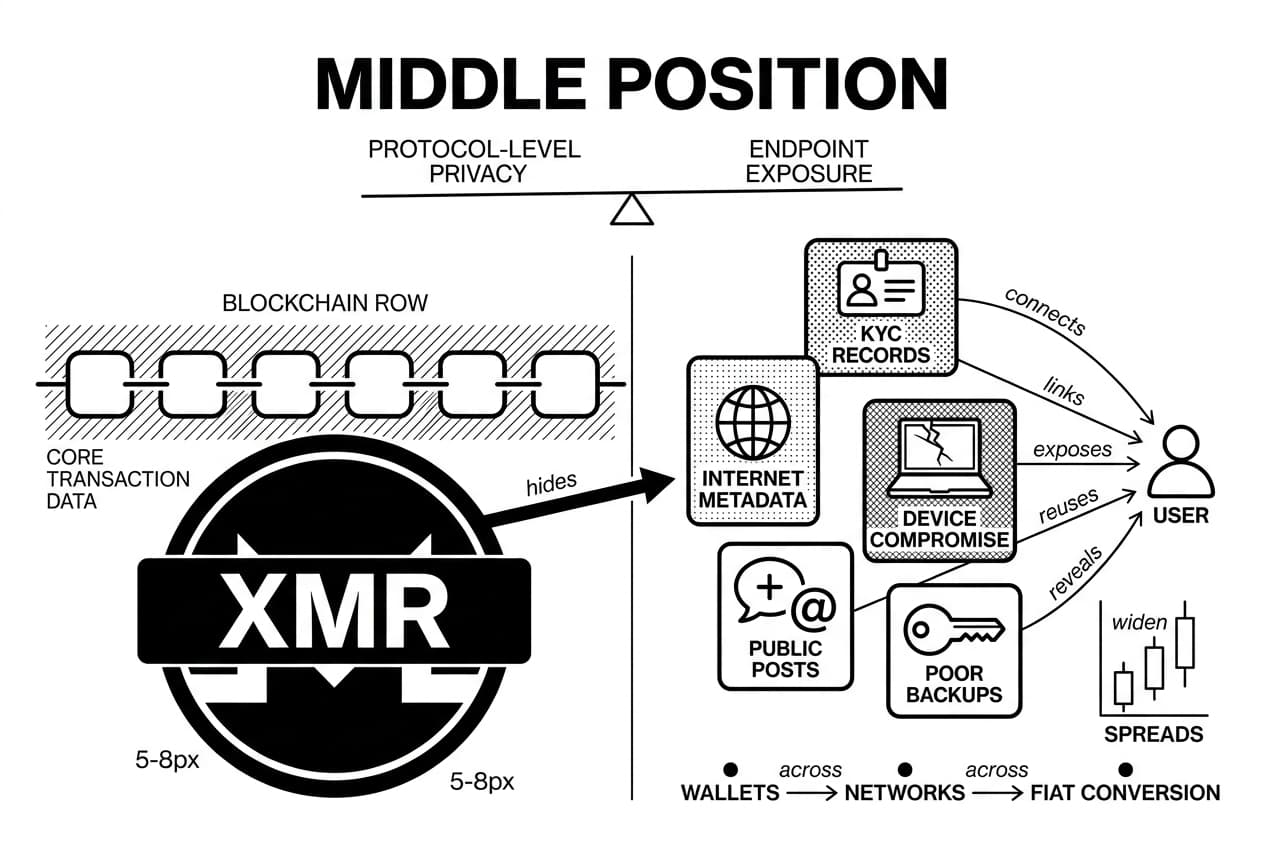
The evidence supports a middle position. Monero is not transparently traceable like Bitcoin, but it is not a cloak that erases all investigative risk. The chain hides the core transaction data. The surrounding systems often do not.
investor lens
For investors, XMR has a distinct risk profile. Privacy demand supports the asset thesis, while exchange delistings and compliance pressure can reduce liquidity and access. If regulated venues continue to remove XMR, spreads may widen and fiat conversion may become harder. If privacy demand rises during periods of surveillance concern, that same friction can reinforce Monero use among users who value censorship resistance.
user lens
For users, the main lesson is operational. Monero protects the ledger, not the entire life of the user. KYC records, internet metadata, device compromise, public posts, reused handles, and poor backups can all connect XMR activity to a person. Practical privacy requires consistent behavior across wallets, networks, devices, and fiat conversion points.
final verdict
Governments generally cannot trace Monero the way they trace transparent blockchains, but they can trace Monero users through surrounding evidence. Protocol-level privacy is real. So is endpoint exposure. Treating Monero as either perfectly anonymous or already broken misses the actual risk model.
Frequently Asked Questions
- Are Monero transactions traceable?
- Monero transactions are not normally traceable through standard blockchain analysis because sender identity, recipient address, and amounts are all hidden by default. That said, investigators can still link activity to real people using KYC exchange records, seized wallets, device forensics, IP logs, timing data, or operational mistakes made by the user.
- Is Monero completely anonymous?
- Monero offers strong on-chain privacy by default, but "complete anonymity" is an overstatement. Privacy can break down at endpoints through malware, screenshots, reused identities, exchange records, or poor wallet practices. The protocol protects the ledger well, but real-world anonymity depends heavily on user behavior outside the blockchain.
- Can the IRS track Monero?
- The IRS cannot reliably follow XMR on-chain the way it can with Bitcoin, but it has other tools — exchange subpoenas, bank records, tax form cross-referencing, and analytics around fiat entry and exit points. Importantly, using Monero does not eliminate tax-reporting obligations, and the IRS has actively funded research into privacy-coin tracing.
- How is XMR untraceable?
- Three built-in mechanisms work together: stealth addresses generate one-time addresses that hide recipients, ring signatures blend the true spender among decoy inputs, and RingCT conceals transaction amounts. All three are enabled by default for every Monero transaction, making its ledger far less readable than Bitcoin or Ethereum.
- Is it possible to trace Monero?
- Tracing a Monero transaction on-chain from sender to receiver is extremely difficult and, at best, probabilistic. However, tracing the user behind those transactions is more feasible through off-chain evidence — KYC exchange withdrawals, marketplace records, network metadata, timing correlations, or data recovered from seized devices.
- Is Monero illegal in the USA?
- As of 2026, Monero is not broadly illegal in the United States. Owning or transacting with XMR is generally lawful, but using it for illegal activity remains a crime. Regulated exchanges may delist or restrict it for compliance reasons. Users should verify current legal and tax obligations in their jurisdiction.
- Will Monero ever be traceable?
- A serious cryptographic flaw or implementation weakness could make Monero more vulnerable, but active development consistently aims to strengthen its privacy model. Even if the protocol remains robust, individual users can still be traced through exchanges, operational mistakes, or endpoint exposure — the chain and the user are separate problems.
- Why is Monero being banned or delisted?
- Most delistings stem from regulatory compliance concerns rather than Monero ownership being outright illegal. Its privacy features make AML monitoring, sanctions screening, and transaction-source verification difficult for regulated exchanges. Platforms facing strict compliance requirements often find it easier to remove XMR than to meet those obligations while supporting it.
Sources
Author

Crypto analyst and blockchain educator with over 8 years of experience in the digital asset space. Former fintech consultant at a major Wall Street firm turned full-time crypto journalist. Specializes in DeFi, tokenomics, and blockchain technology. His writing breaks down complex cryptocurrency concepts into actionable insights for both beginners and seasoned investors.