Crypto Mixer Legal Status: Privacy Tools and Law in 2026

Crypto Mixer Legal Status in 2026: The Short Answer
A crypto mixer is not automatically illegal, but crypto mixer legal status depends on sanctions exposure, AML rules, custody, fees, intent, and jurisdiction. In 2026, users face the highest risk when funds touch sanctioned addresses, criminal proceeds, unlicensed operators, or exchanges that apply strict compliance screening.
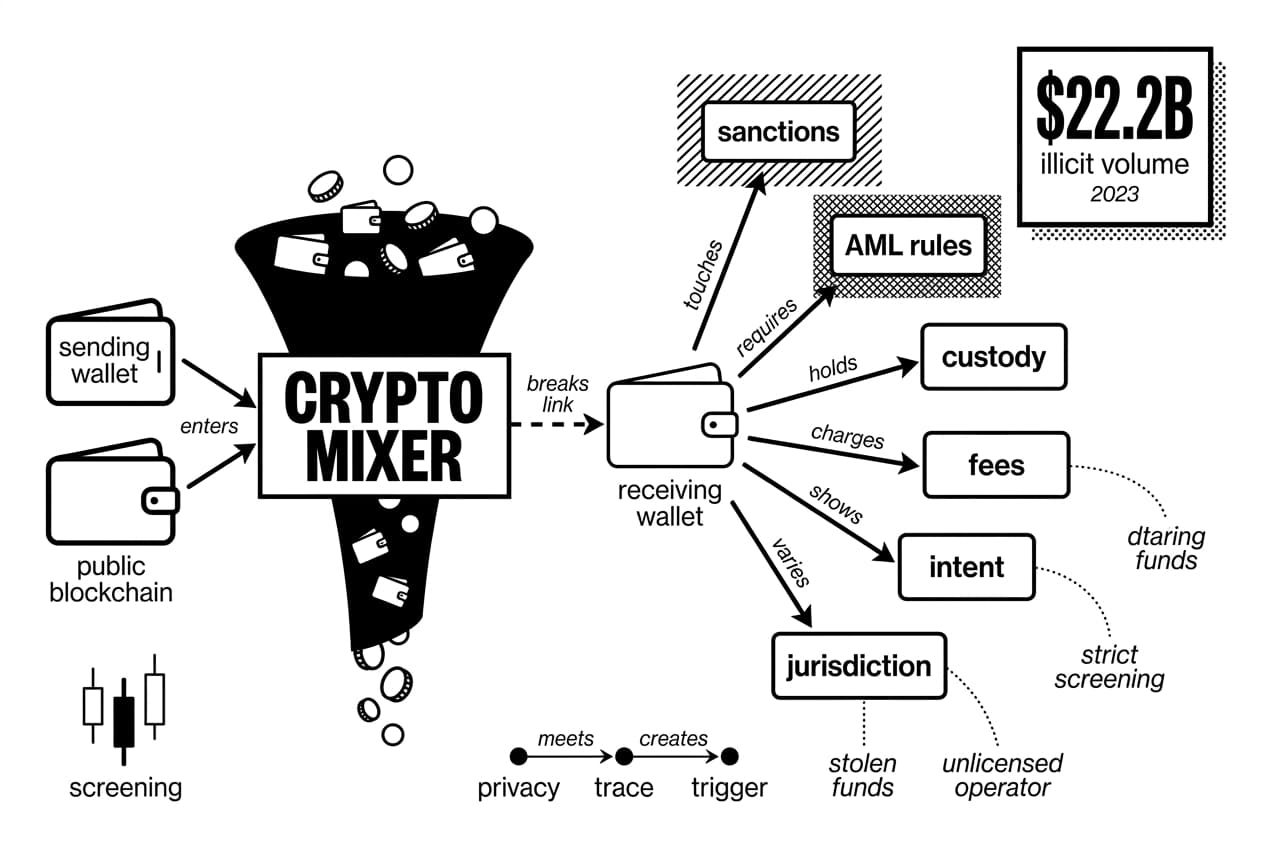
Plain-English definition: a crypto mixer is a privacy tool that tries to break the visible link between a sending wallet and a receiving wallet on a public blockchain.
This article is educational information only and is not legal advice. If you face a specific legal situation involving a mixer, consult a qualified attorney in your jurisdiction.
Why It Matters
A public blockchain resembles a read-only shared spreadsheet: wallet addresses, amounts, and transaction times can be viewed by anyone. That transparency helps audits and investigations, but it can also expose salary payments, donations, business vendors, and personal savings. The legal problem is not privacy by itself. The problem starts when privacy tools intersect with sanctions, anti-money laundering controls, tax records, stolen funds, or unlicensed money transmission.
As of September 2026, the practical question is no longer simply whether a person can use a privacy tool. The better question is whether the tool creates a traceable legal trigger. Chainalysis reported $22.2 billion in illicit crypto transaction volume in 2023 (Chainalysis, February 2024). That figure does not mean most crypto activity is illicit. It does explain why exchanges, custodians, and investigators screen for mixer exposure so aggressively.
This is where crypto privacy vs regulation becomes practical for ordinary users. A deposit can be delayed or rejected because coins previously touched a known mixer, even when the user did not commit a crime. Understanding the triggers is more useful than asking whether all mixers are good or bad.
The 2026 C-SIFT Test for Mixer Legality
Use this original C-SIFT test as a quick risk screen before you rely on any privacy tool. It is not a legal opinion, but it maps the issues regulators usually care about.
- Custody: does an operator take control of customer funds?
- Sanctions: has the service, wallet, or counterparty appeared on a sanctions list?
- Intent: is the user hiding legitimate privacy information or trying to conceal crime?
- Fees: does someone charge for transmitting value for others?
- Taxes: can the user still prove basis, ownership, dates, and gains or losses?
This framework reflects the contrarian point of this guide: mixer legality depends less on mixing as a technical act and more on sanctions exposure, custody, business model, source of funds, and evidence of intent.
What Is a Crypto Mixer or Bitcoin Tumbler?
A crypto mixer, also called a Bitcoin mixer, Bitcoin tumbler, or tumbler, is a service or protocol that pools cryptocurrency from multiple users and returns equivalent value to new addresses. The goal is to make it harder to match each deposit with each withdrawal.
For example, a user sends 0.5 BTC into a mixing service. Several other users send their own amounts. After a delay, the first user receives roughly 0.5 BTC minus a service fee at a fresh address. Some older centralized services charged fees around 1% to 3%, though fee structures vary and should be verified before any transaction. The point is not to create new value. The point is to obscure the path between the old address and the new one.
Background: Why Mixers Appeared
Bitcoin and many other blockchains are pseudonymous, not anonymous. Pseudonymous means a wallet address stands in for a name. Anonymous would mean the transaction cannot be linked back to a person. In practice, wallet patterns, exchange withdrawals, timing, IP data, and repeated address use can connect public addresses to real identities.
Early bitcoin users often underestimated that traceability. As analytics methods improved, privacy-focused users started looking for ways to separate personal identity from public wallet history. Centralized tumblers, collaborative transaction tools, and later smart contract privacy systems grew out of that demand.
Pseudonymous Does Not Mean Anonymous
Once a regulated exchange knows your identity, any withdrawal from that exchange can anchor a wallet to you. From there, later transfers may reveal related wallets, spending habits, counterparties, and holdings. The public writing of Balaji Srinivasan, author and investor, often emphasizes that public crypto ledgers expose more transaction detail than many users expect. Lyn Alden, founder of Lyn Alden Investment Strategy, has also written widely about bitcoin as an auditable monetary network, which is useful for transparency but not the same as personal financial secrecy.
- Mixers try to break transaction links between old and new wallet addresses.
- Wallets are public identifiers, not proof of anonymity.
- Exchange records can identify users because know-your-customer checks connect names to withdrawals.
- The technology is not automatically illegal, but the source of funds and the service model matter.
How Crypto Mixers Work: Centralized, CoinJoin, P2P, and Pools
A crypto mixer takes funds from one address, runs them through a pooling or coordination process, and sends equivalent value to a different address. The key legal question is who controls the funds during that process.
Here is the basic process:
- Deposit funds: You send crypto to a service address, a smart contract, or a coordinated transaction round.
- Pool or coordinate transactions: The tool combines or coordinates multiple users so individual inputs are harder to match with outputs.
- Wait through a delay: A time gap reduces simple timing matches between deposit and withdrawal.
- Pay a fee: The tool or coordinator may charge a service fee, mining fee, or network transaction fee.
- Withdraw to a new address: You receive equivalent value at a fresh wallet address that is not directly linked on-chain to the deposit.
- Keep records: You save dates, amounts, transaction hashes, and source-of-funds documents for tax and compliance questions.
Centralized Mixers
A centralized mixer takes custody of customer coins, pools them, and later sends coins back to designated addresses. Custody is the key word. If a business accepts and transmits value for others, it may be treated as a money services business under U.S. rules. FinCEN stated in 2019 guidance (FinCEN, May 2019) that businesses accepting and transmitting convertible virtual currency can have money transmission obligations depending on the facts.
CoinJoin and Collaborative Transactions
CoinJoin is a collaborative transaction method. Multiple users combine inputs and outputs into one transaction, so observers cannot easily tell which input funded which output. It is often non-custodial, meaning no single operator holds customer funds. That can reduce some legal risk compared with a hosted mixer, but it does not guarantee exchange acceptance or remove tax duties.
Smart Contract Mixers and Privacy Pools
Some privacy tools use smart contracts, which are blockchain programs that execute according to code. The best-known sanctioned example was the tornado.cash protocol, which the U.S. Treasury addressed in August 2022 (U.S. Treasury, August 2022). That action matters because it showed that even code-based systems can create sanctions exposure when listed addresses are involved.
Newer privacy pool designs try to solve a different problem: how can a user prove funds are not from a tainted set without revealing a full wallet history? In our 2026 trigger map, that design direction scores better than older hosted mixers because it can support selective disclosure. For more detail, see our privacy pool compliance guide.
Mixer Legality: What Laws Actually Target
No single rule says all crypto mixers are illegal. Laws usually target specific conduct: sanctions violations, money laundering, unlicensed money transmission, handling stolen property, and false tax reporting. That is why mixer legality is fact-dependent. The same privacy technique can look different when used by a journalist protecting donors, an exchange serving customers, or a criminal moving hacked funds.
The table below is the article's 2026 Mixer Legality Trigger Map, built from public enforcement materials and compliance rules cited in this guide.
Legal issue | What it means | Who is most affected | Practical risk |
|---|---|---|---|
Sanctions | Transacting with a blocked address, service, person, or entity | U.S. persons, U.S. businesses, global platforms with U.S. exposure | Civil penalties, criminal referral, frozen funds |
AML/CFT | Anti-money laundering and counter-terrorist-financing controls require monitoring and reporting | Exchanges, brokers, custodians, payment firms | Account reviews, suspicious activity reports, rejected deposits |
Money transmitter rules | A business accepts and transmits value for others without required registration or licenses | Hosted mixer operators and fee-charging services | FinCEN action, state enforcement, prosecution |
Stolen funds | Funds come from hacks, ransomware, fraud, or darknet market activity | Users with knowledge, operators, exchanges receiving deposits | Money laundering allegations and asset seizure |
Taxes | Users fail to report taxable events or cannot prove cost basis | Any user who sells, swaps, earns, or spends crypto | Audits, penalties, back taxes, source-of-funds questions |
Sanctions and OFAC Exposure
OFAC is the U.S. sanctions office. It maintains lists of blocked parties and, in some cases, crypto addresses that U.S. persons generally may not deal with. In August 2022 (U.S. Treasury, August 2022), it designated addresses tied to the tornado.cash protocol. That was a turning point because the sanctioned items included smart contract addresses, not only a traditional company.
Civil sanctions can operate on a strict-liability basis. In plain English, a person may face exposure even if they did not intend to violate sanctions. Lack of knowledge can matter for penalty analysis, but it is not a reliable shield.
AML and CFT Rules
AML means anti-money laundering. CFT means countering the financing of terrorism. Regulated financial firms must monitor transactions, review suspicious activity, and sometimes report it to authorities. When coins arrive from a mixer, compliance software may score them as higher risk because mixers have appeared in ransomware, hacking, and darknet market cases.
For everyday users, the most common consequence is not arrest. It is friction: delayed deposits, requests for documents, closed accounts, or rejected transfers. The exchange is often protecting its own license and banking access.
Money Transmitter Licensing
Operating a hosted mixer is far riskier than using a non-custodial privacy feature. If a service takes custody, charges fees, and transmits funds for customers, it may need federal registration and state licenses. The Helix operator sentence of 3 years in prison (U.S. DOJ, November 2021 sentencing release updated by DOJ materials) shows how unlicensed money transmission and laundering facts can combine in a criminal case.
For a deeper licensing explanation, see our money transmitter license rules for crypto. The short version is simple: building and charging for a mixer creates a different legal profile than seeking privacy as an individual user.
Tax and Recordkeeping Risk
Mixing does not erase tax obligations. If you sell, swap, spend, earn, or convert crypto, you may need to report gains, losses, or income. The IRS has required a digital-asset question on individual returns since the 2019 tax year (IRS, 2019), and broker reporting expands with Form 1099-DA for the 2025 tax year (IRS, 2025 guidance page).
Good records should include acquisition date, cost basis, transaction hash, wallet address, fair market value, and the reason for each transfer. If an exchange asks for source-of-funds proof, those records can be the difference between a routine review and a frozen account.
Can Crypto Mixers Be Traced?
Mixers can be traced in some cases through transaction graph analysis, timing patterns, matching deposit and withdrawal amounts, KYC exchange records, IP data, subpoenas, and other off-chain evidence. A mixer may weaken a simple trail, but it does not make funds invisible, especially when liquidity is low or users make repeated mistakes.
How Blockchain Analytics Works
Blockchain analytics means studying public ledger data to identify address clusters, transaction flows, and risk patterns. A cluster is a group of addresses that likely belong to the same person or entity. KYT, or know-your-transaction monitoring, screens wallets and transfers for sanctions, darknet, fraud, and mixer exposure. Our reviews of crypto compliance analytics platforms and blockchain analytics and KYT tools explain how those systems are used by exchanges and compliance teams.
Public enforcement actions show the limits of assuming crypto is untraceable. In 2022, the Department of Justice said it seized about $3.36 billion in bitcoin linked to the 2016 Bitfinex hack (U.S. DOJ, November 2022). That case was not simply about a mixer, but it is strong evidence that long-running public-chain investigations can connect old transactions to real-world evidence.
Why User Mistakes Break Privacy
Most privacy failures come from behavior. Withdrawing exactly 1.337 ETH after depositing exactly 1.337 ETH creates an obvious amount match. Reusing an address collapses the privacy set. Moving funds immediately after mixing creates a timing clue. Depositing to a KYC exchange can connect the whole trail to a legal name. Privacy tools reduce some signals, but they do not fix careless operational security.
Legitimate Privacy Uses, Red Flags, and Common Misconceptions
Wanting financial privacy is not the same as doing something wrong. A contractor may not want every client to see total income. A donor may want to support a sensitive cause without harassment. A business may want to keep supplier payments away from competitors. Those are legitimate privacy interests.
Privacy Is Not the Same as Illegality
The legal analysis changes when the funds themselves are problematic. If coins come from a hack, ransomware payment, fraud, sanctioned party, or unreported income, a privacy tool does not make them lawful. It may instead become evidence that the user tried to conceal the source.
One common misconception is that mixing makes coins "clean." It does not. Chainalysis reported that illicit services received $24.2 billion in cryptocurrency value in 2023 after later revisions (Chainalysis, February 2024). Mixing may change how a transaction trail appears. It does not change ownership history or legal status.
Different privacy designs also carry different risk profiles. Protocol-level privacy is not the same as sending funds through a third-party hosted tumbler. For comparison, see our guide on whether Monero is traceable.
Why Exchanges May Still Flag Mixed Funds
A regulated exchange does not need to prove a crime before it reviews a deposit. Its compliance system may flag mixer exposure because past cases connect mixers with illicit flows. The result can be a request for documents, a temporary hold, or a refusal to credit funds.
- Legitimate privacy reasons: salary privacy, donor safety, treasury confidentiality, and protection from doxxing.
- High-risk facts: hacked funds, ransomware proceeds, darknet market payments, sanctioned addresses, or false tax reporting.
- Common mistake: assuming a legal privacy motive guarantees exchange acceptance.
- Best evidence: clean source-of-funds records, exchange withdrawal receipts, invoices, payroll records, and tax files.
Safer Privacy Options and a Practical User Checklist
Good privacy does not always require a mixer. Many users reduce exposure with basic wallet hygiene: separate addresses for separate activities, careful self-custody, hardware wallets for long-term holdings, and clear records. Our guide to custodial vs non-custodial crypto wallets explains that custody choice in plain English.
Some Ethereum privacy solutions now focus on selective disclosure, view keys, or proofs that support audits without broadcasting every detail publicly. That design goal is more likely to fit future compliance expectations than black-box hosted mixing.
The IRS digital-asset page reminds taxpayers that crypto activity can create reporting duties even when no bank is involved (IRS digital assets page, 2024 update). A simple spreadsheet with dates, amounts, transaction hashes, wallet addresses, and notes is often enough for personal organization, though complex activity may require a tax professional.
Before You Use Any Privacy Tool
Run this checklist before using any mixer, tumbler, privacy wallet, or smart contract privacy tool.
- Check sanctions status: search the OFAC SDN list for the service, domain, and known addresses.
- Identify custody: ask whether an operator can hold, freeze, redirect, or lose your funds.
- Verify source of funds: do not send stolen, hacked, sanctioned, or unreported funds through any privacy tool.
- Document taxes: record cost basis, date, fair market value, fees, and transaction hashes.
- Plan the exit: check whether your exchange accepts deposits with privacy-tool history.
- Ask local counsel for high-value transfers: mixer legality varies by country and facts.
In our C-SIFT framework, users usually get into trouble when they skip sanctions checks, ignore custody, or assume privacy intent cures all other facts. It does not. A five-minute review can prevent weeks of account freezes or worse.
Key Takeaways
- A crypto mixer is not automatically illegal. Risk comes from sanctions, custody, fees, source of funds, intent, and jurisdiction.
- Operators face higher risk than ordinary users. Taking custody and charging to transmit value can trigger money transmitter and AML duties.
- Mixing does not clean funds. Stolen, sanctioned, or unreported assets remain legally risky after any privacy step.
- Tracing is still possible. Graph analysis, timing, KYC records, subpoenas, and user mistakes can reconnect transactions.
- Records are protection. Keep source-of-funds and tax documents before using any privacy tool.
Frequently Asked Questions
- Can crypto mixers be traced?
- Sometimes, yes. Mixers obscure transaction links but do not guarantee anonymity. Investigators can exploit timing patterns, repeated transaction amounts, address reuse, low liquidity, and blockchain analytics tools. Exchange records and user mistakes also expose connections. How traceable a mixer is depends heavily on its design and the evidence available.
- Can the IRS see your crypto wallet?
- The IRS can view public blockchain activity and often connects wallets to individuals through KYC exchanges, tax forms, subpoenas, and blockchain analytics firms. Using a mixer does not erase your tax reporting obligations. Failing to report taxable crypto activity remains a legal risk regardless of the privacy tools you use.
- Can the FBI track crypto?
- Yes, frequently. The FBI and partner agencies use blockchain analytics platforms, exchange data, court warrants, and international law enforcement cooperation to follow cryptocurrency flows on public blockchains. Privacy tools can complicate investigations and slow them down, but they have not proven to make tracing reliably impossible in serious criminal cases.
- What is a crypto mixer?
- A crypto mixer is a tool or service designed to break the visible on-chain link between a sending wallet and a receiving wallet. Think of it like pooling funds from many users so deposits cannot be cleanly matched to withdrawals. Mixers may be centralized services, collaborative protocols, or smart contract-based systems.
- What is a bitcoin mixer?
- A Bitcoin mixer, sometimes called a Bitcoin tumbler, is a privacy tool built specifically for BTC transactions. It pools or coordinates coins from multiple users so outside observers find it harder to match a deposit to a specific withdrawal. Most services charge a fee and return equivalent amounts to designated addresses.
- What is a tumbler mixer for cryptocurrency?
- A tumbler is simply another name for a mixer. It tries to shuffle transaction trails, similar to tossing identical bills into a shared box and withdrawing different bills later. Whether using one is legal depends on your jurisdiction, the sanctions status of the service, the origin of funds, and how the tool operates.
- Which crypto mixer is the best?
- Recommending a specific mixer is not appropriate here. Rather than choosing based on secrecy claims alone, evaluate legality in your jurisdiction, sanctions exposure, custody arrangements, transparency, security practices, and compliance risk. Many users find that privacy-focused wallets or coins meet their legitimate needs without the legal complications mixers often carry.
Sources
Author

Crypto analyst and blockchain educator with over 8 years of experience in the digital asset space. Former fintech consultant at a major Wall Street firm turned full-time crypto journalist. Specializes in DeFi, tokenomics, and blockchain technology. His writing breaks down complex cryptocurrency concepts into actionable insights for both beginners and seasoned investors.