FHE Blockchain Guide: How Encrypted Smart Contracts Work

FHE Blockchain Guide: How Encrypted Smart Contracts Work
What Is FHE Blockchain?
An FHE blockchain is a blockchain that uses fully homomorphic encryption so smart contracts can process encrypted data without reading the raw values. In plain English, it lets encrypted smart contracts update balances, votes, bids, or scores while the private numbers stay hidden.
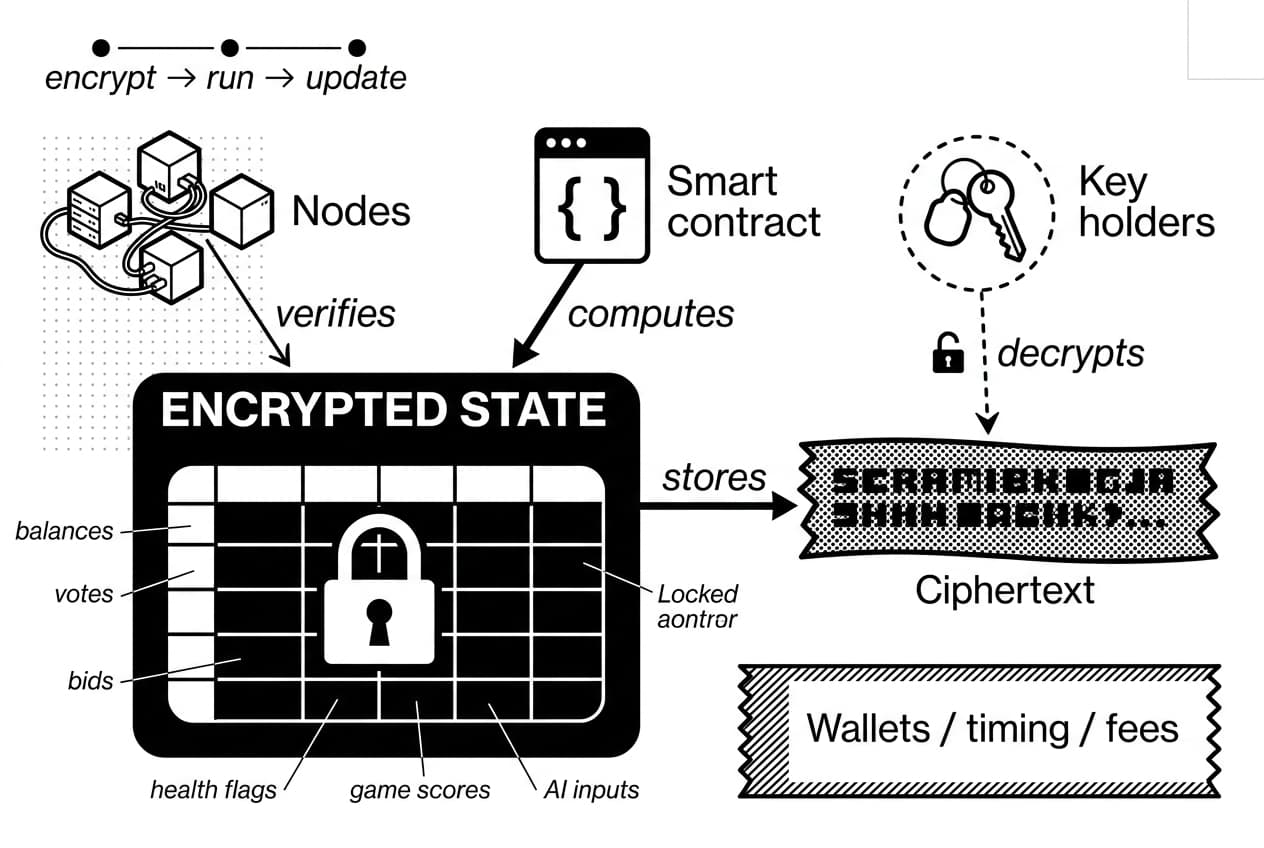
Why it matters: ordinary smart contracts are useful because anyone can verify them, but that same openness exposes user balances, trading strategies, votes, business terms, and sensitive AI inputs. FHE tries to keep the verification benefits of blockchains while adding privacy for the contract state that applications actually need to protect.
Plain-English Definition
Fully homomorphic encryption, shortened to FHE, is encryption that allows computation on scrambled data. A blockchain is a shared ledger copied across many computers, called nodes. A smart contract is code stored on that ledger that runs when set conditions are met. The data a contract stores between transactions is its state, such as balances, votes, bids, health flags, or game scores. With FHE, that state is stored as ciphertext, which means encrypted data that looks meaningless without a decryption key.
A useful analogy is a shared spreadsheet with locked cells: everyone can verify that formulas were run and that the sheet history was not changed, but only approved key holders can read the hidden cell values. FHE brings that idea to smart contract state, with the important caveat that wallet addresses, timing, fees, and some outputs may still be visible.
Public blockchains are transparent by design. Ethereum has recorded more than 2.6 billion cumulative transactions since launch (Etherscan transaction chart, accessed March 2026), and each transaction leaves a permanent public trail. That auditability is useful, but it blocks applications that need private loan data, sealed auction bids, confidential supply-chain terms, or hidden inputs for AI agents.
Why It Matters in 2026
Several 2026 pressures explain the interest in FHE blockchain systems. Private DeFi teams want to hide order sizes and liquidation thresholds. Enterprises want audit trails without exposing customer data or negotiated prices. AI agents need to process user inputs without broadcasting those inputs to every node. Regulated institutions want selective disclosure rather than full public exposure.
Vitalik Buterin, co-founder at the Ethereum Foundation, has repeatedly framed privacy as one of the major missing pieces for everyday blockchain use. Nick Szabo, the computer scientist associated with the smart-contracts concept, described smart contracts as digital rules that enforce agreements. FHE matters because many real agreements require both rule enforcement and confidentiality.
The common claim is that FHE makes smart contracts fully private. That is too broad. FHE protects values and computations inside encrypted state, but blockchains still reveal transaction timing, wallet interactions, gas usage, contract addresses, and output patterns. Privacy depends on encryption, key management, metadata discipline, and careful output design.
- Private DeFi: hide balances, bids, loan health, or trade sizes from competing traders.
- Enterprise workflows: verify business rules without posting raw commercial data to a public ledger.
- On-chain AI: process sensitive prompts or user records while keeping raw inputs encrypted.
- Games and voting: keep moves, scores, and choices hidden until a rule says they should be revealed.
- Selective compliance: disclose only what auditors or regulators need, not every user detail by default.
Why Smart Contract State Is Usually Public
A blockchain is built so independent computers can verify the same transaction history. To do that, each validator needs enough information to check whether a transaction follows the rules. On most public chains, that requirement makes balances, contract calls, storage values, and event logs readable to anyone.
Smart contract state is the contract’s memory. It can include token balances, loan positions, order books, game scores, governance votes, and access-control roles. If Alice deposits 1 ETH into a public lending contract, observers can see her wallet address, the amount, the contract she used, and future borrowing or repayment activity tied to that address.
The Transparency Trade-Off
Transparency gives public blockchains their audit value. Anyone can inspect contract code, verify token balances, and check whether rules were followed. That is why public chains can operate without a central company updating a private database behind closed doors.
The drawback is exposure. A business cannot safely post confidential pricing terms, customer records, or supplier identities to a public state table. A trader may lose money when bots read pending transactions and reorder trades. A voter may not participate if every choice is publicly tied to a wallet. FHE blockchain designs target this state-visibility problem.
What Data Can Observers See?
When a public transaction is submitted, observers can usually read or infer:
- Sender and recipient addresses: pseudonymous wallet identifiers tied to on-chain history.
- Contract address: the application or protocol being called.
- Function call and input data: how Solidity encodes contract calls often makes arguments and function selectors decodable.
- Public storage variables: balances, counters, positions, mappings, and flags.
- Token transfers: ERC-20 token movements and NFT transfers between wallets.
- Timestamps and block numbers: when each action entered the chain.
- Gas fees paid: fee levels that can hint at urgency or transaction complexity.
- Event logs: structured messages that contracts emit for wallets, indexers, and dashboards.
Ethereum recorded more than 1.2 million transactions on several days in March 2024 (Etherscan transaction chart, March 2024). At that scale, public state is not a small privacy footnote. It is the default data environment that encrypted smart contracts are trying to change.
Background: From Public Ledgers to Programmable Privacy
Blockchain privacy did not begin with FHE. It developed through payment privacy, proof systems, secure hardware, and multi-party computation. Each tool hides a different part of the activity, and each leaves different traces behind.
History: Privacy Tools Before FHE
Bitcoin launched in 2009 as a public payment ledger. Later systems added stronger privacy features for transfers, proofs, and off-chain computation. The main approaches are easier to compare when separated by what they hide and what they leave visible.
Tool | What it hides | What it does not hide | Main limit |
|---|---|---|---|
Mixers | Transaction origin across a pool of deposits and withdrawals | Amounts, timing clues, and most smart contract logic | High regulatory pressure and no general encrypted computation |
Privacy coins | Sender, receiver, or amount depending on the design | General smart contract state in many systems | Best suited to payments, not arbitrary applications |
Zero-knowledge proofs | Specific private inputs used to prove a statement | Proof validity and often the public logic being proven | Excellent for proving facts, less natural for ongoing hidden state |
Trusted execution environments | Data inside a secure hardware enclave | Metadata, enclave boundaries, and hardware trust assumptions | Depends on hardware security and manufacturer trust |
Multi-party computation | Individual inputs split across participants | The agreed final output | Requires coordination among computing parties |
You can compare those approaches in more Ethereum-specific detail in our guide to Ethereum privacy solutions. The key distinction is that most older tools either hide payments, prove facts, or protect data inside special infrastructure. FHE lets a program compute directly on encrypted values.
Why FHE Is Different
FHE allows a contract or coprocessor to add, multiply, compare, or update encrypted values while they remain encrypted. The result is also encrypted. Only an approved party or threshold group can decrypt the selected output.
A 2009 doctoral thesis on homomorphic encryption showed the first general construction for this kind of computation (CMU-hosted thesis PDF, 2009). What changed by 2026 is not the basic goal, but the surrounding infrastructure: faster libraries, better hardware, EVM-oriented tooling, rollups, and coprocessor networks that can connect encrypted computation to blockchain execution.
The important category shift is this: privacy coins mainly hide transfers, while FHE can support private state transitions. That covers auctions, lending checks, voting, games, enterprise workflows, and AI agents, not just payments.
How FHE Works in Blockchain Apps
At its core, FHE in blockchain means a smart contract can run calculations on data it cannot read. The lifecycle of encrypted smart contract state has five stages.
- Encrypt input: a user turns readable data into ciphertext on their own device before sending it on-chain.
- Submit ciphertext: the encrypted value is included in a transaction and sent to the contract.
- Compute on encrypted state: validators or an FHE coprocessor run approved operations on ciphertext.
- Update contract state: the new encrypted result is written back into storage and agreed by network consensus.
- Selectively decrypt output: only the user, committee, contract-approved party, or auditor with the right key path can read the chosen result.
Step 1: Users Encrypt Inputs
A public key is a key that anyone can use to encrypt data. A private key is the matching secret needed to decrypt. Before a transaction, Alice encrypts a sealed bid of 100 USDC and Bob encrypts a sealed bid of 120 USDC. The chain receives ciphertext, not the readable numbers.
The user still pays a gas fee, meaning a network processing fee for running computation and storing data. The transaction is still ordered into a block through a consensus mechanism, meaning the network rules that decide which transactions are valid and in what sequence.
Step 2: Contracts Compute on Ciphertext
The smart contract or FHE execution layer can update encrypted balances, compare encrypted bids, or calculate encrypted scores. In the auction example, the contract determines which encrypted bid is larger without exposing the amounts. It may output an encrypted flag that later resolves to "bidder B wins" without revealing all losing bids.
Performance remains the hard part. Benchmarks published by the Zama team reported that FHE operations in its fhEVM setting were often about 100 to 1,000 times more computationally expensive than comparable plaintext operations (Zama, 2024). That range is why developers must keep encrypted logic small and purposeful.
Step 3: Outputs Are Selectively Decrypted
Computation is not the end of privacy. Decryption policy decides who learns the answer and when. An auction may decrypt only the winner and the final price after the deadline. A lending protocol may reveal only whether a position is healthy. A game may reveal a hidden move only after the turn ends.
Even a valid output can leak information. If an auction reveals that Bob won by exactly 1 USDC, observers can infer the second-highest bid. If a lending contract reveals a detailed risk score, traders may infer a user’s collateral range. Good encrypted smart contracts reveal the minimum useful answer.
The minimum-reveal framework
For this guide, we use a practical minimum-reveal framework to evaluate encrypted state. Ask five questions before adding FHE: what enters encrypted, what remains encrypted during computation, who can compute on it, who can decrypt, and what metadata remains public. If a design cannot answer those questions, its privacy claim is unfinished.
Lifecycle question | Good answer | Warning sign |
|---|---|---|
What gets encrypted? | Inputs and state variables tied to user risk | Only a cosmetic field is encrypted |
Who computes? | Auditable contract logic or a documented coprocessor | A private server performs hidden steps |
When is data decrypted? | After a clear rule or threshold approval | Admins can decrypt whenever they choose |
What remains visible? | Metadata is documented and reduced where possible | The project claims total privacy with no metadata discussion |
Architecture Patterns for Encrypted Smart Contracts
After choosing FHE, teams still need to decide where encrypted computation runs, how keys are managed, and how FHE interacts with other privacy tools.
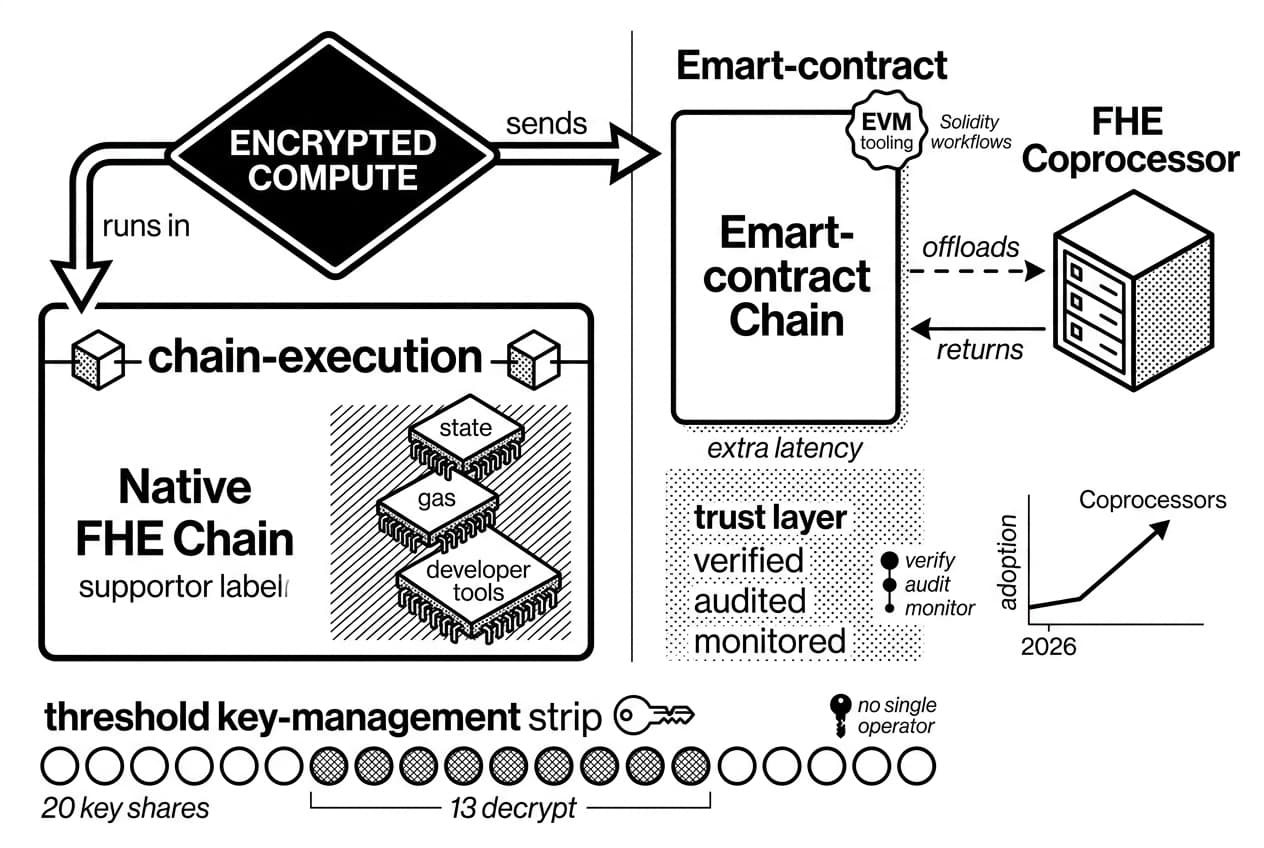
Native FHE Chains vs FHE Coprocessors
A native FHE chain builds encrypted computation into the chain’s execution environment. The benefit is tight integration across state, gas accounting, and developer tools. The trade-off is that developers work within that network’s rules and maturity level.
An FHE coprocessor keeps ordinary smart contract logic on an existing chain while sending expensive encrypted computation to a specialized network. The main benefit is compatibility with current EVM tooling. The trade-off is extra latency and another trust layer that must be verified, audited, and monitored.
In our editorial review, coprocessors may see faster adoption in 2026 because they fit existing Solidity workflows. Native encrypted execution may offer cleaner long-term design, but it asks developers, auditors, and users to move into newer ecosystems.
Threshold Decryption and Key Management
Threshold decryption splits a decryption key into shares held by multiple parties. For example, a protocol might distribute 20 key shares and require 13 shares to decrypt a result. That example is not a universal standard; it simply shows the model. No single operator should be able to open all private state alone.
Key design is a governance issue as much as a cryptography issue. Users need to know whether keys sit with individuals, validators, a foundation, a regulated custodian, or a mixed committee. If a project cannot explain who can decrypt and under what rule, its encrypted smart contracts carry hidden centralization risk.
FHE, ZK Proofs, and Interoperability
FHE and zero-knowledge proofs, often called ZK proofs, solve different problems. FHE computes on hidden data. ZK proofs verify that a statement or computation is valid without revealing the private input. Together, they can support private computation with public proof of correctness.
Sergey Nazarov, co-founder at Chainlink Labs, has argued that decentralized oracle networks reduce single points of failure for data delivery. That principle also matters for encrypted computation. Bridges, oracles, and modular rollups need ways to move encrypted data between systems while proving that the data was handled correctly.
Approach | What it hides | What remains visible | Strengths | Trade-offs |
|---|---|---|---|---|
Public smart contracts | Nothing by default | Inputs, outputs, state, addresses, timing, and fees | Easy auditability and broad tooling | No privacy for sensitive state |
FHE smart contracts | Selected inputs, computations, and stored state | Contract use, transaction graph, timing, gas, and approved outputs | Computation on encrypted values | High cost, newer tooling, and hard key management |
ZK privacy | Private inputs behind a proof | Proof validity, public signals, and often the contract logic | Efficient verification and mature production use | Less natural for ongoing encrypted state updates |
MPC | Individual inputs across computing parties | Final output and communication patterns | No single party sees the whole secret | Coordination cost and online-party assumptions |
TEEs | Data inside secure hardware | Metadata, enclave boundaries, and hardware vendor trust | Fast execution and familiar deployment model | Side-channel risk and hardware dependence |
No approach wins every category. Real applications may combine FHE for hidden state, ZK proofs for verification, MPC for key operations, and public contracts for transparent settlement.
What Encrypted Smart Contracts Can Enable
Encrypted smart contracts matter when an application needs rules to run publicly while sensitive state stays private. The strongest use cases are those where revealing the input changes user behavior or creates an attack opportunity.
Private DeFi and Hidden Trading Data
Today, many DeFi positions expose collateral size, liquidation thresholds, order amounts, and wallet behavior. Bots can read that data and act before users do. With FHE blockchain infrastructure, a lending contract could store collateral as ciphertext and compute whether a loan is healthy without showing the collateral amount.
This directly relates to front-running prevention for smart contracts. Chainalysis estimated that sandwich attacks extracted more than $1.4 billion from Ethereum users from 2021 through 2024 (Chainalysis, 2024). FHE does not remove all MEV, short for maximal extractable value, but it can reduce the value leaked through public state.
Private Voting, Games, and Auctions
Voting is a clear fit. Each voter submits an encrypted choice. The contract adds the encrypted votes. Only the final tally is decrypted after voting closes. Individual choices never need to appear in public storage.
Sealed-bid auctions work similarly. Bidders submit encrypted bids, the contract computes the maximum, and the auction reveals only the winning result required by the rules. On-chain games can keep cards, moves, maps, or strategy choices encrypted until a game condition requires disclosure.
Enterprise and AI Use Cases
Enterprises often need shared rules but private inputs. A supply-chain contract might check whether a shipment meets a compliance threshold without revealing negotiated prices or supplier identities. A credit workflow might verify an encrypted score range without publishing the underlying financial file.
For on-chain AI inference, FHE can help an agent receive encrypted user inputs, run an approved computation, and return an encrypted output. This is useful for health-adjacent data, financial profiles, or business documents. It does not solve every AI privacy issue, but it reduces the need to expose raw inputs to nodes.
The pattern across use cases is consistent: encrypt the sensitive input, compute only what the application needs, and reveal the smallest useful output. That is the practical promise of encrypted smart contracts.
Security, Trust, and Compliance Questions
FHE protects data during computation, but trust in an application still depends on code quality, key control, data sources, governance, and legal design.
Can FHE Blockchains Be Trusted?
The math can be sound while the application remains risky. A bug in contract logic can still lose funds. Poor access control can let an admin trigger decryption too early. A compromised oracle can feed false encrypted inputs. A weak wallet can leak a user’s private key before FHE ever helps.
Smart contract access control is especially important for encrypted systems because permissions may define who can update parameters, request decryption, pause a contract, or rotate keys. Blockchain oracle architecture also matters because private computation on bad data still produces bad results.
Andreas Antonopoulos, author and educator, has often taught that crypto security claims should be examined through key custody and threat models. The same standard applies here. Do not ask only whether data is encrypted. Ask who can decrypt it, who can be coerced, and what happens if a key holder fails.
Privacy Does Not Mean No Rules
Regulators treat personal privacy, business confidentiality, and hidden illicit flows differently. FHE can support legitimate confidentiality, but financial applications may still need audit paths, sanctions controls, and selective disclosure.
Vitalik Buterin, co-founder at the Ethereum Foundation, has written about compliant privacy designs that let users prove facts about funds without exposing a full transaction history. Related designs for FHE systems may include view keys, auditor-only reports, threshold disclosure, or court-order workflows.
The U.S. Treasury sanctioned a major crypto mixer on August 8, 2022 (U.S. Treasury, 2022). That action showed the risk for privacy tools that offer no compliance path. FHE projects that plan selective disclosure early are easier to defend than systems that add controls only after pressure arrives.
Limits and Trade-Offs of FHE Blockchain in 2026
FHE is powerful, but it is not magic. In 2026, developers should treat it as a privacy layer with clear cost, latency, and governance trade-offs.
- Performance: encrypted computation remains far slower than ordinary arithmetic.
- Gas cost: heavier computation means higher fees or a need for off-chain coprocessors.
- Metadata leakage: addresses, timing, gas, contract calls, and some outputs remain visible.
- Key management: decryption rules and key-holder incentives are hard to design.
- Composability: mixing encrypted and public contracts can leak state through outputs.
- Audits: auditors need both smart contract and applied cryptography expertise.
- Compliance: legal access demands may conflict with strong privacy promises.
Performance and Gas Costs
Ordinary arithmetic is cheap for a blockchain virtual machine. FHE arithmetic carries encrypted structure through each operation, so even simple comparisons can become expensive. The 100 to 1,000 times overhead range reported in 2024 Zama benchmarks explains why many teams avoid fully encrypted logic unless privacy is central to the product.
Higher computation can mean higher gas fees, longer execution time, or reliance on a coprocessor. Hardware acceleration may help, but a 2026 design should still budget carefully. A private transfer, encrypted auction, or hidden loan check should be benchmarked under real load before launch.
Metadata Leakage
Encrypting state does not hide the whole transaction graph. Your wallet address, the application you call, the time of the call, the gas paid, and the fact that a result was produced may remain public. Observers can infer patterns from those clues.
For a deeper look at that risk, read our explainer on how blockchain surveillance works. The short version is that encryption protects contents, not necessarily context. FHE projects that ignore metadata are overstating their privacy.
Developer Experience
Developer tooling is improving, but writing encrypted smart contracts is still harder than writing ordinary Solidity. Teams must understand ciphertext types, allowed operations, gas or coprocessor cost, output leakage, and key workflows. Standard test suites may not catch privacy failures because a contract can be functionally correct while revealing too much.
Audits are also harder. A review must cover contract bugs, cryptographic assumptions, decryption policy, oracle inputs, upgrade permissions, and user experience. In 2026, the best teams keep FHE logic narrow, documented, and tested against a clear threat model.
How to Evaluate an FHE Blockchain Project
Not every project that claims encrypted smart contracts provides meaningful private state. Some encrypt only transaction amounts. Some rely mainly on hardware enclaves. Some have testnet demos but no production security history. Use a direct checklist before building, integrating, or investing.
Quick Evaluation Checklist
- What is encrypted? Confirm whether inputs, outputs, stored state, or only a few fields are protected.
- Who controls decryption? Identify whether keys belong to users, a committee, a company, validators, or a custodian.
- Is it live or experimental? As of March 2026, verify mainnet status, audits, and user activity independently.
- Who can trigger reveal? Check whether decryption needs user consent, threshold approval, a protocol rule, or admin action.
- What audits exist? Look for independent reviews covering both contract logic and cryptographic implementation.
- What are the real costs? Ask for benchmark numbers under realistic load, not only best-case demos.
- Does it address metadata? A project promising total privacy without discussing addresses, timing, and access patterns is not being precise.
- Does it use reviewed cryptography? Prefer established schemes and open implementations over proprietary black boxes.
The biggest red flag is a "full privacy" claim with no clear decryption policy. The strongest FHE blockchain teams explain their threat model, publish limits, document key control, and show what remains visible.
Key Takeaways
- FHE blockchain systems let contracts compute on encrypted state, which can protect bids, votes, balances, scores, and sensitive AI inputs while rules still execute on-chain.
- Encrypted smart contracts do not make everything anonymous. Addresses, timing, gas patterns, contract calls, and selected outputs can still leak information.
- The minimum-reveal framework is the practical test: define what enters encrypted, what stays encrypted, who computes, who decrypts, and what metadata remains public.
- Performance is still the 2026 constraint. FHE operations can be far more expensive than plaintext computation, so teams should encrypt only the state that needs privacy.
- Key management decides trust. Threshold decryption, access control, audit paths, and governance rules matter as much as the encryption scheme itself.
Frequently Asked Questions
- What exactly is the blockchain?
- A blockchain is a shared digital ledger stored across many computers rather than one central company's servers. Data is grouped into blocks, linked in sequence, and validated by network rules. Most blockchains are fully public, meaning anyone can read them — which is precisely why FHE blockchain privacy solutions have become so important.
- Can blockchain be trusted?
- Blockchains offer specific, reliable guarantees — transaction ordering, tamper resistance, and rule enforcement — when the network is genuinely decentralized and the code is sound. However, users still depend on wallets, smart contracts, bridges, and key management being secure. Trust is narrow and technical, not blanket or unconditional.
- What are examples of smart contracts?
- Common examples include lending contracts that lock collateral, token swap contracts, NFT auctions, DAO voting systems, and on-chain games. With encrypted smart contracts, sensitive state — such as sealed bids, private votes, hidden balances, or concealed game moves — could be processed without ever being exposed publicly on-chain.
- What are the downsides of smart contracts?
- Smart contracts carry real risks: coding bugs, exploits, irreversible transactions, high gas fees, weak access control, fully public data, and reliance on external oracles. FHE can address some privacy-related exposures, but it does not automatically fix poorly written code, flawed economics, or unsafe behavior by users or developers.
- What is the best crypto for smart contracts?
- There is no single best answer, and nothing here is investment advice. The right platform depends on security, liquidity, developer tooling, transaction fees, and your application's specific needs. For FHE blockchain use cases specifically, check whether encrypted computation is live on mainnet, independently audited, and actually usable by developers today.
- Is XRP a smart contract?
- No. XRP is a cryptocurrency native to the XRP Ledger — it is a digital asset, not a smart contract. A smart contract is executable code that enforces rules automatically on a blockchain. Some ledgers do support programmable features, but the currency itself and the contract layer are distinct concepts.
- How does blockchain make you money?
- People may earn — or lose — money through investing, staking, building applications, providing liquidity, trading, or offering blockchain-based services. Blockchain does not guarantee profit. Technologies like FHE are infrastructure tools designed to improve privacy and security, not financial instruments or income-generating mechanisms on their own.
Sources
Author

Crypto analyst and blockchain educator with over 8 years of experience in the digital asset space. Former fintech consultant at a major Wall Street firm turned full-time crypto journalist. Specializes in DeFi, tokenomics, and blockchain technology. His writing breaks down complex cryptocurrency concepts into actionable insights for both beginners and seasoned investors.