Privacy Pools: Vitalik's Compliant Crypto Privacy Guide
Privacy pools: Vitalik's compliant crypto privacy guide
What are privacy pools?
Privacy pools are crypto transaction systems that use zero-knowledge proofs, hide transaction links between deposit and withdrawal wallets, and let users prove funds are not tied to known illicit activity without revealing their full wallet history or identity.
Why it matters
Think of a blockchain like a shared Google Doc that nobody can edit after saving: everyone can read the record, but nobody can erase past entries. That transparency helps auditors, exchanges, and users verify activity. It also means a salary payment, donation, or medical bill paid on-chain can expose more of your financial life than you intended.
Privacy pools try to create a middle path. They do not make a blockchain secret. They do not promise legal immunity. Their goal is narrower: separate the public link between your old wallet and your new wallet while letting you prove your funds are outside a risky group.
The idea is closely tied to the privacy pools Vitalik proposal: a September 2023 research paper on blockchain privacy and regulatory compliance (SSRN, 2023) that described how users could voluntarily prove their deposits belong to acceptable association sets. An association set is the group of deposits a withdrawal is willing to be grouped with for privacy and compliance purposes.
Our view is more cautious than the common sales pitch. Privacy pools only work well if association sets are broad, transparent, and recognized by the relevant compliance audience. A small or biased set can weaken privacy without giving users meaningful regulatory comfort.
- Blockchain: a public record of transactions on a network such as ethereum or bitcoin.
- Wallet: software or hardware that holds private keys and lets a user send crypto.
- Gas fee: the network fee paid to process a blockchain transaction.
- Zero-knowledge proof: a cryptographic method that proves a statement is true without revealing the private data behind it.
- Association set: the group of deposits used to prove a withdrawal is not connected to excluded funds.
Background: from the sanctioned mixer to the privacy pools Vitalik proposal
Public blockchains created the original privacy problem. If someone links your wallet to your real identity through an exchange withdrawal, a public donation, or a leaked address book, they can inspect your past and future transactions. That is how blockchain surveillance works in practice.
History: why older mixers drew enforcement pressure
Older crypto mixers pooled funds from many users and returned equivalent funds later. They helped break visible on-chain links, but most did not distinguish ordinary users from hacked or sanctioned funds. The U.S. Treasury sanctioned the tornado cash mixer on August 8, 2022, stating that more than $7 billion had been laundered through it since 2019 and citing over $455 million tied to a state-linked hacking group (U.S. Treasury, 2022).
That action changed the privacy debate. It showed that regulators were not only worried about anonymity; they were worried about unfiltered anonymity. Users still needed privacy for normal activity, but tools that mixed everyone together created hard compliance questions for exchanges, developers, and front-end operators.
What the 2023 proposal added
The 2023 privacy pools paper reframed the question. Instead of asking whether users should have privacy or compliance, it asked whether users could prove a limited compliance fact while keeping the rest of their transaction history private. The key was voluntary separation: a user could prove their deposit is part of a selected clean group, without revealing which deposit is theirs.
This sits inside a longer cryptography tradition. Adam Back, co-founder and CEO of Blockstream, is one of the public figures associated with applied cryptographic money systems. Nick Szabo, the computer scientist credited with originating the smart-contracts concept, is another useful historical reference point for why programmable rules matter in crypto. Privacy pools combine both themes: cryptographic proof and smart-contract enforcement.
How privacy pools work step by step
A privacy pool is a smart contract, meaning code stored on a blockchain that executes according to preset rules. It accepts deposits, stores commitments to those deposits, and later releases withdrawals when a valid proof is supplied.
Deposit into a pool
A user sends a fixed amount, for example 1 ETH, to the privacy pool contract. The deposit is public: anyone can see that 1 ETH entered the contract. What matters is that many deposits of the same amount can later form an anonymity set, which is the crowd your withdrawal hides within.Create a private note
The wallet creates a private note, sometimes called a secret. This note proves control over one deposit later. It should be treated like a seed phrase: if the note is lost, the user may lose the ability to withdraw. If the note is leaked, someone else may be able to steal the withdrawal.Generate a zero-knowledge proof
When withdrawing, the user generates a zero-knowledge proof. The proof tells the contract: “I own a valid deposit in this pool, and I have not already spent it.” It does not reveal which deposit belongs to the user. The mathematical basis for zero-knowledge proofs dates to a 1985 paper on the knowledge complexity of interactive proof systems (MIT, 1985).Withdraw from an approved association set
The user also proves that their deposit belongs to an approved association set or is excluded from a risky set. For example, the proof may show that the deposit is not among addresses flagged by a sanctions list. The contract releases funds to a new wallet while keeping the original deposit link hidden.
This four-step flow is the practical difference between privacy pools and older mixers. The zero-knowledge proof protects the wallet link. The association set supplies a narrow compliance signal. Neither one proves that a user is legally safe in every jurisdiction.
What makes privacy pools compliant?
“Compliant” does not mean a regulator has approved every privacy pool. It means the design gives users a way to prove a limited fact about fund origin. That distinction matters. A court, exchange, bank, or regulator may still decide that the proof is not enough under local rules.
Inclusion proofs and exclusion proofs
An inclusion proof shows that a deposit belongs to an approved group, such as deposits that came from screened wallets. An exclusion proof shows that a deposit is not in a risky group, such as a list of known hack proceeds or sanctioned addresses. Exclusion proofs usually reveal less because the user does not need to identify a trusted source, only absence from a named risk set.
The September 2023 privacy pools paper (SSRN, 2023) describes this as voluntary separation. Honest users can separate themselves from tainted funds without publishing their entire transaction graph.
Where compliance still gets difficult
Three hard problems remain. First is curation: who decides which addresses are risky? A private list provider, a protocol committee, or a public governance process can each make mistakes. Second is recognition: a mathematically valid proof may not satisfy anti-money-laundering rules in every country. Crypto privacy and regulation remain unsettled across major jurisdictions as of August 10, 2026.
Third is operator risk. A smart contract may be non-custodial, but a website, relayer, or hosted interface can still face licensing questions. Depending on the country, running access points around a privacy pool may trigger crypto money transmitter compliance duties.
- Compliance by design: the protocol can produce limited proofs about fund origin.
- Not a legal safe harbor: proof generation does not equal regulatory approval.
- List quality matters: weak or opaque association sets can damage both privacy and compliance value.
- Operators and users face different risks: a front end may have duties that a passive user does not.
Privacy pools vs. mixers, privacy coins, and liquidity pools
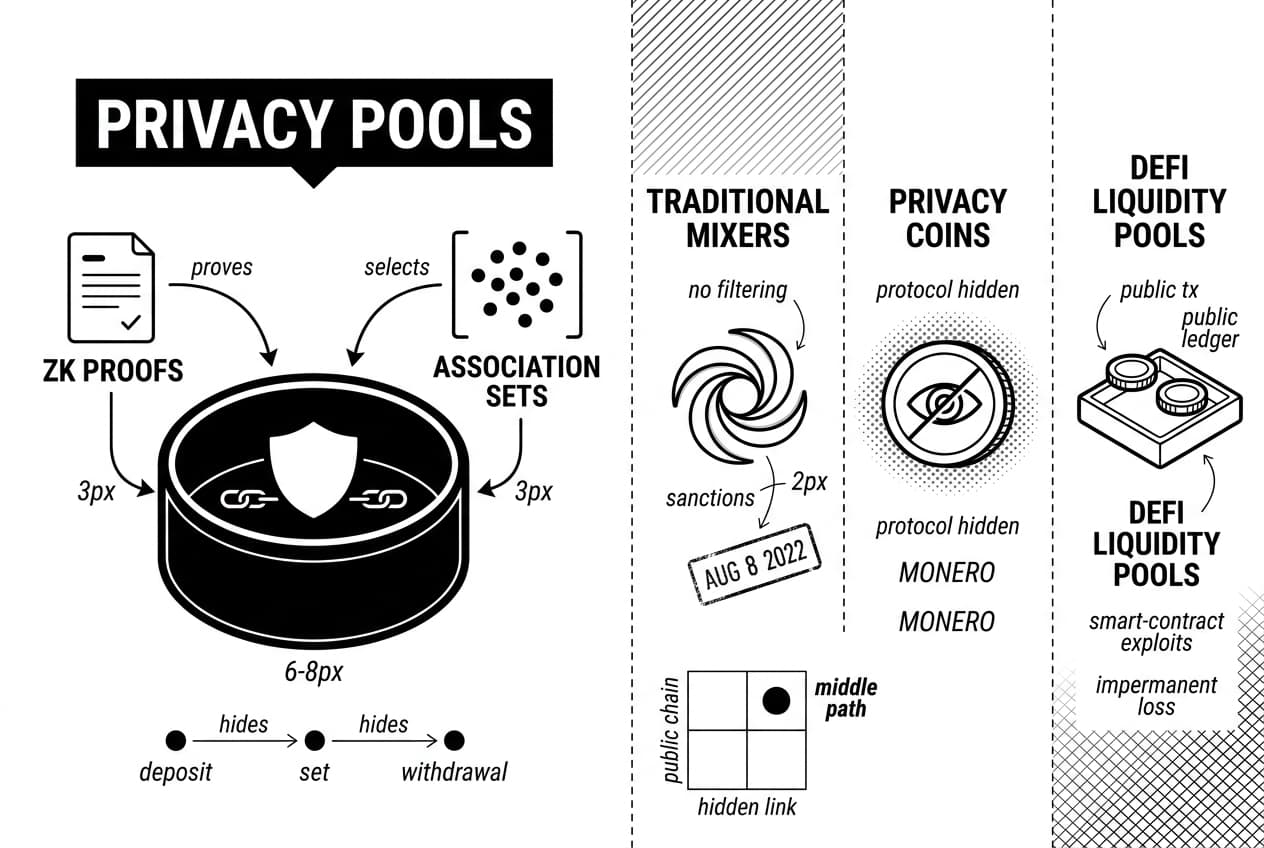
The word “pool” appears in several crypto products. The table below separates privacy pools from three commonly confused tools.
Tool type | Main purpose | How privacy works | Compliance features | Key risk |
|---|---|---|---|---|
Privacy pools | Hide the link between deposit and withdrawal wallets on a public chain | Zero-knowledge proofs plus selected association sets | User can prove absence from known risky sets | Small or biased association sets can weaken privacy |
Traditional crypto mixers | Break transaction trails by mixing funds broadly | Funds from many users are pooled without strong filtering | Usually none by design | Sanctions and enforcement risk, as shown by the August 8, 2022 U.S. Treasury action |
Privacy coins | Make privacy part of the base asset or network | Sender, receiver, or amount can be hidden at protocol level | Limited selective proof options in many systems | Exchange delistings and chain-analysis pressure; see Monero and privacy coin traceability |
DeFi liquidity pools | Supply assets for trading, lending, or borrowing | No privacy function; transactions remain public | Depends on the platform | Smart-contract exploits, bad pricing, and impermanent loss |
Privacy pools vs. traditional mixers
A traditional mixer hides links by putting many users in the same pool and returning funds later. That can improve privacy, but it does not tell an observer whether a particular withdrawal avoided illicit sources. Privacy pools add a proof layer so a user can show membership in a cleaner set without revealing the exact deposit.
Privacy pools vs. privacy coins
Privacy coins make confidentiality a feature of the network itself. Privacy pools are applications on otherwise transparent chains. That makes them more flexible for users who want selective disclosure, but it also means privacy depends on contract design, pool size, wallet hygiene, and association-set rules. For a deeper comparison, see Monero and privacy coin traceability.
Privacy pools vs. DeFi liquidity pools
A liquidity pool is different. It holds token reserves so decentralized exchanges can process swaps without a traditional order book. If you have swapped ETH for USDC on a decentralized exchange, you used liquidity, not privacy. For that separate topic, read how DeFi liquidity pools work.
2026 protocol information and key metrics to check
Privacy pool metrics move quickly, so a fixed number in an article can become stale. As of August 10, 2026, the safer approach is to verify live sources before depositing. The table below gives a field checklist, the source to use, and the reason each metric affects privacy or risk.
Metric | 2026 field to verify | Source of data | Why it matters |
|---|---|---|---|
TVL by chain | Current dollar value locked on each supported network | DefiLlama live protocol data, checked August 10, 2026, plus the protocol’s official dashboard | Higher value can indicate more deposits and a larger anonymity set; compare with DeFi protocols by TVL |
Supported networks | Whether ethereum mainnet, layer-2 networks, or testnets are active | Official privacy pools site, checked August 10, 2026 and verified contract addresses | A chain shown in discussion is not the same as a live, safe deployment |
Active pools | Number of deposit pools with recent deposits and withdrawals | Block explorers such as Etherscan, checked August 10, 2026 | Dormant pools provide weak privacy because few users are available to blend with |
Fees | Gas cost, relayer fee, and any protocol fee | Etherscan gas data, checked August 10, 2026 and official fee documentation | Fees can make small withdrawals uneconomic and may reveal timing patterns |
Audits | Published security reviews, dates, unresolved high-severity findings, and bug-bounty status | Official repository, audit PDFs, and release notes | Unaudited proof circuits or contracts can lose funds or break privacy |
Source of data | Whether metrics come from contracts, indexers, dashboards, or team claims | Cross-check official docs, block explorers, and third-party dashboards | Marketing dashboards can lag or omit inactive contracts |
Our six-source verification method
Use this original six-source verification method before trusting any privacy pool claim:
- Official site: confirm the product is live and not only announced.
- Official contract addresses: copy addresses only from official documentation.
- Block explorer: check recent deposit and withdrawal timestamps.
- Third-party TVL page: compare live value locked with the protocol’s own numbers.
- Code repository: review recent commits, tagged releases, and issue activity.
- Audit reports: read the date, scope, and unresolved findings.
This is information gain that a brochure will not give you: a privacy pool with a polished interface but no recent withdrawals, no audit, and no verified contract address should be treated as high risk.
Benefits, limits, and risks of privacy pools
Privacy pools can help normal users regain a boundary between public payment activity and private financial life. They can also create new risks if users misunderstand what is being proved.
Benefits for ordinary users
- Salary separation: a worker paid in crypto can move funds to a fresh wallet without showing an employer every later payment.
- Donation privacy: a donor can support a legal cause without publishing a full wallet history.
- Business confidentiality: a small company can reduce the chance that competitors map every contractor or vendor.
- Selective compliance signal: a user can show that funds are outside a risky set without disclosing all counterparties.
Limits builders and users must respect
Risk | Why it matters | Better design or behavior |
|---|---|---|
Small anonymity set | If few users deposit the same amount, observers can guess links more easily | Check recent pool activity before using it |
Weak association-set curation | Bad lists can include tainted funds or exclude legitimate users | Publish list methods, update logs, and dispute paths |
Smart-contract bugs | A contract flaw can lock or drain funds | Require independent audits and public fixes |
Proof-circuit bugs | A flawed circuit can break privacy even when the contract works | Review audit scope and test vectors |
Address reuse | Withdrawing to a wallet tied to your identity can undo privacy | Use fresh wallets and understand self-custody wallet rules |
Legal overclaiming | A proof does not guarantee acceptance by a regulator, bank, or exchange | Avoid services that promise legal certainty without jurisdiction-specific counsel |
We call the core tradeoff the privacy-assurance triangle. A pool must balance three pressures: anonymity set size, association-set quality, and user access. If rules are too strict, fewer users join and privacy shrinks. If rules are too loose, compliance value falls. If access is too easy, screening may become weak.
Privacy pools are not a substitute for legal advice. They are a technical way to prove limited facts about funds. Whether that proof is enough depends on the law, the exchange, the counterparty, and the quality of the association set.
How to evaluate a privacy pool before using or integrating it
Before you deposit funds or integrate a privacy pool into an app, slow down and test the claims. The checklist below is designed for smart beginners and product teams.
User checklist
- Is the contract address official? Verify it from the protocol’s own documentation and a block explorer.
- Is the code public? No public code means outsiders cannot review what the system does.
- Is there a recent audit? Look for a dated report and confirm high-severity issues were fixed.
- How large is the pool? More same-sized deposits usually means better privacy.
- How is the association set built? The protocol should explain which deposits are included, excluded, and why.
- What fees apply? Check gas, relayer, and protocol costs before moving small amounts.
- Does the site promise legal safety? Treat absolute legal claims as a warning sign.
Builder checklist
- Legal review: obtain jurisdiction-specific advice before offering the tool to users.
- Association-set monitoring: confirm that your app can detect updates, removals, and disputes.
- Plain-language user flow: explain what the proof shows and what it does not show.
- Incident plan: document what happens if a bug, bad list update, or sanctions issue appears.
- Data minimization: avoid collecting user data that would defeat the privacy goal.
- Exit support: give users clear instructions for withdrawing or avoiding unsafe pools.
Apply the three-layer transparency test: code transparency, process transparency, and legal transparency. Code transparency asks whether the contracts and circuits are public. Process transparency asks whether association-set rules are visible. Legal transparency asks whether claims are carefully limited instead of marketed as guaranteed protection.
Frequently Asked Questions
- What are privacy pools?
- Privacy pools are smart contract systems that allow users to conduct crypto transactions with greater confidentiality while still proving their funds are not linked to known illicit sources. They use zero-knowledge proofs and curated association sets to demonstrate clean fund origins, but they do not eliminate your legal or regulatory obligations.
- Are privacy coins illegal in the US?
- Privacy coins are not automatically illegal in the United States, but they exist in a complex regulatory environment. Users, businesses, and exchanges may still face anti-money-laundering rules, sanctions compliance requirements, and tax reporting obligations. Availability varies by platform and jurisdiction, so check the rules that apply to your specific situation.
- What is a privacy cash pool?
- A privacy cash pool is a type of crypto pool designed to make digital payments behave more like physical cash by reducing the visible on-chain link between a deposit and a withdrawal. Privacy pools improve on basic mixing by adding compliance features through cryptographic proofs or carefully curated association sets that vouch for fund legitimacy.
- Is XRP a privacy coin?
- No, XRP is not considered a privacy coin. The XRP Ledger is a public blockchain where transactions are visible and traceable, and privacy is not a core design goal of the network. This stands in clear contrast to privacy-focused systems like Monero or emerging compliant privacy applications like Vitalik Buterin's privacy pools proposal.
Author

Crypto analyst and blockchain educator with over 8 years of experience in the digital asset space. Former fintech consultant at a major Wall Street firm turned full-time crypto journalist. Specializes in DeFi, tokenomics, and blockchain technology. His writing breaks down complex cryptocurrency concepts into actionable insights for both beginners and seasoned investors.