Ethereum Privacy: Anonymous Transactions Solutions in 2026
Ethereum Privacy: Anonymous Transactions Solutions in 2026
What Is Ethereum Privacy?
Ethereum privacy is the practice of keeping your wallet identity, token balances, transaction history, and app activity from being easily connected to your legal name, employer, home address, or habits while still using Ethereum's public network in 2026 by default.
Why it matters for everyday users
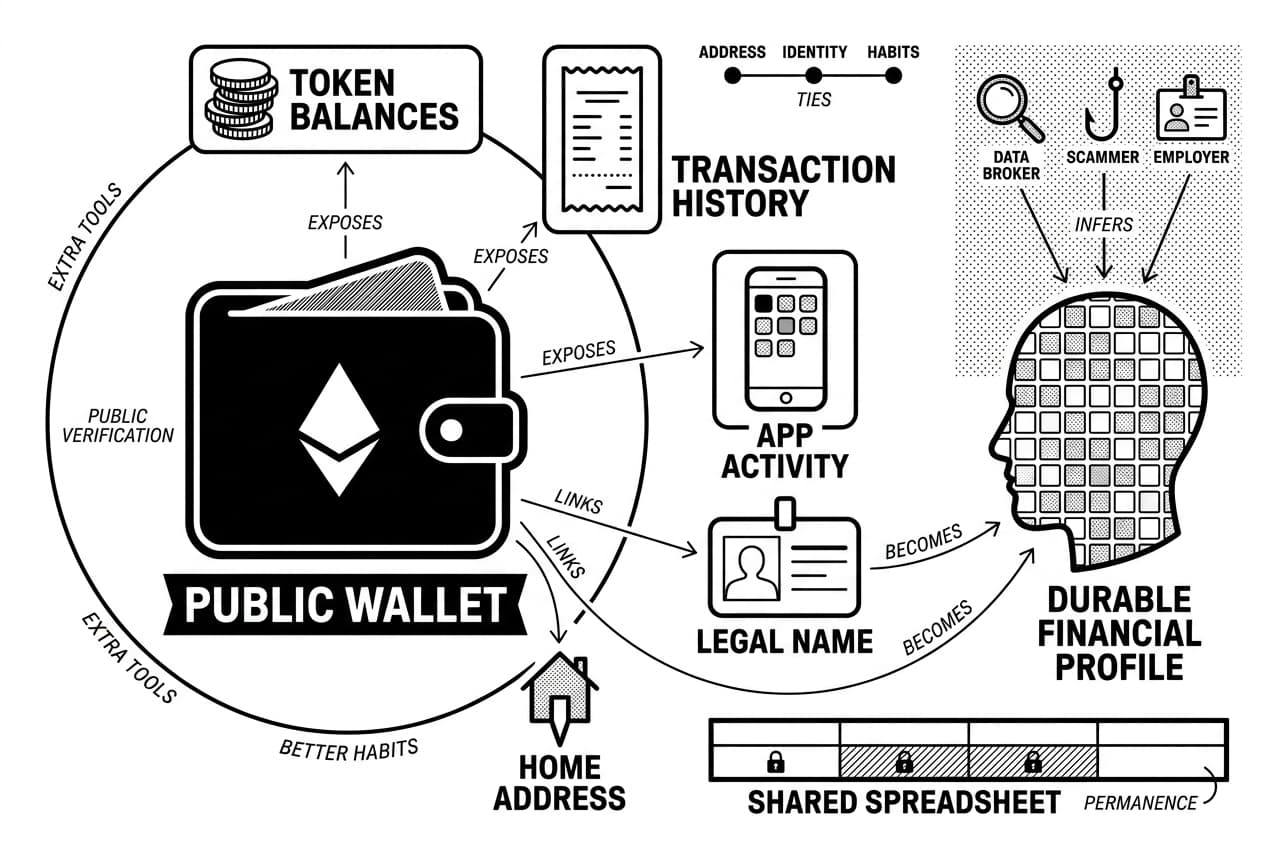
Why it matters: Ethereum can make payments, donations, savings, and app use visible to strangers. If one address is tied to you, a data broker, scammer, employer, landlord, or competitor may infer your income, beliefs, health spending, business flows, and risk tolerance without asking permission.
A blockchain is like a shared spreadsheet that nobody can edit after saving: every entry is useful for auditability, but the same permanence can expose private behavior. Ethereum was built for public verification, not bank-style confidentiality. That means private transactions ethereum users want in 2026 usually require extra tools and better habits rather than a single built-in switch.
The common debate frames ethereum privacy as anonymous users versus regulators. A better frame is consumer data protection. Public wallet histories can reveal salaries, donations, medical payments, grant funding, trading losses, and purchasing patterns even when no crime exists. A wallet address is not your legal name, but once it is linked to you, it becomes a durable financial profile.
Background: why Ethereum was built transparently
Ethereum launched as a public network so anyone could verify balances, contract code, and transaction results without trusting a company. The Ethereum mainnet went live on July 30, 2015 (Ethereum Foundation history, accessed Aug. 20, 2026). A wallet is software or hardware that controls cryptographic keys. An address is the public string others use to send assets to that wallet. A smart contract is code stored on-chain that runs when its conditions are met. A gas fee is the ETH payment used to process a transaction.
Vitalik Buterin, co-founder at the Ethereum Foundation, has repeatedly argued for systems where users can prove facts without exposing unnecessary personal data. That principle explains why ethereum privacy work now focuses on selective disclosure, zero-knowledge proofs, stealth addresses, and safer wallet practices rather than hiding the entire chain from everyone.
Our 2026 privacy stack scorecard
To make the tradeoffs easier to compare, we scored six privacy approaches against five leakage surfaces: identity link, balance visibility, transaction graph, app activity, and compliance proof. The score is an editorial assessment as of Aug. 20, 2026, where 5 means broad protection and 1 means narrow protection.
Approach | Privacy score | Best protected surface | Weakest surface |
|---|---|---|---|
Zero-knowledge proofs | 5/5 | Transaction details | Usability and app support |
Privacy pools | 4/5 | Deposit-withdrawal link | Small pool sizes |
Stealth addresses | 3/5 | Recipient linkability | Sender metadata |
Layer 2 privacy apps | 3/5 | Mainnet visibility | Bridge and sequencer data |
Wallet hygiene | 3/5 | Identity separation | User mistakes |
Mixing tools | 2/5 | Direct transaction links | Legal and timing risk |
- Ethereum privacy protects wallet identity, balances, transaction history, and app activity from easy real-world linking.
- Ethereum is transparent by design, which helps audits but also enables financial surveillance.
- Privacy is a stack of tools and habits, not one magic product.
- The safest goal for most users is reducing linkability while staying able to meet tax and legal duties.
Is Ethereum Public or Private by Default?
Ethereum is public by default. Every standard transfer, token swap, contract call, wallet balance, and timestamp is visible to anyone with an internet connection. No account is needed to inspect the ledger, and no central company decides who can read it.
Pseudonymous does not mean anonymous
Anonymous means no identity is attached. Pseudonymous means an activity is tied to a substitute identifier, such as an Ethereum address. Ethereum addresses are pseudonymous because they look like long strings of letters and numbers, but that protection weakens once the address touches an identity-checked exchange, a public profile, or a known app account.
For example, if a user buys ETH on a regulated exchange and withdraws 1.3 ETH to a self-custody wallet, the exchange may hold identity records linking that withdrawal to the user. If that wallet later donates, trades, lends, or buys NFTs, the activity may be associated with the same person even though the legal name is not printed on-chain.
Andreas Antonopoulos, author and educator, has long taught that public blockchains should be treated as pseudonymous rather than anonymous. Address reuse, repeated timing patterns, and exchange records often create enough clues for analytics tools to connect a wallet cluster to a person or organization.
What a block explorer reveals
A block explorer is a search engine for blockchain data. Paste an address or transaction hash into Etherscan, and you can see:
- Sender address: the wallet that initiated the transaction.
- Recipient address: the destination for funds or contract data.
- Amount transferred: ETH, stablecoins, NFTs, or other tokens.
- Gas fee: the network processing cost paid in ETH.
- Timestamp: the date and time the transaction was included.
- Contract interaction: the app or code the wallet used.
- Wallet history: earlier transfers connected to the same address.
Etherscan's public chart shows Ethereum processed more than 1,000,000 transactions per day on many days in 2025 (Etherscan chart, accessed Aug. 20, 2026). That public data is useful for audits, but it also gives analytics firms, advertisers, and scammers a searchable map of user behavior.
Can Ethereum Transactions and Wallets Be Traced?
Yes, Ethereum transactions can usually be traced because every transfer, swap, and smart contract action is written to a public ledger that analytics tools can map. The search phrase private transactions ethereum points to tools that reduce tracing, but standard Ethereum activity is visible first.
How blockchain surveillance works
Blockchain surveillance starts with transaction graph analysis. A transaction graph is a map of addresses and the transfers between them. Analytics systems look for clusters of addresses that behave as if they belong to the same user. Clues include shared funding sources, repeated destination addresses, gas payments from the same wallet, and similar timing.
Funding data shows how large the surveillance market has become. Chainalysis raised $170 million in May 2022 (Forbes, May 11, 2022), a sign that investors saw strong demand for on-chain intelligence. These tools are used by exchanges, law enforcement, compliance teams, and private companies.
Common tracing signals include:
- Exchange withdrawals: funds leaving an identity-checked exchange may be tied to the account holder.
- Timing correlation: a withdrawal and later deposit of the same unusual amount can create a strong link.
- Token approvals: permissions granted to apps reveal which services a wallet has used.
- Public naming: sharing an address on a profile connects the wallet to a real identity.
- Bridge activity: moving assets between Ethereum and another network can expose both sides of the path.
You can read a deeper breakdown of these methods in our guide on how blockchain surveillance works.
Worked trace: how one transfer exposes a history
Consider a simple four-step trace. A user withdraws 2 ETH from an identity-checked exchange to Wallet A. Wallet A swaps tokens on a decentralized exchange, then sends 0.5 ETH to Wallet B. Wallet B later buys an NFT. No legal name appears on-chain, but the chain of custody is easy to follow.
Step | Action | What an analyst can infer |
|---|---|---|
1 | Exchange withdrawal to Wallet A | Wallet A may be linked to exchange identity records. |
2 | Wallet A swaps tokens | The trade history can be tied to Wallet A. |
3 | Wallet A sends 0.5 ETH to Wallet B | Wallet B may be treated as a related address. |
4 | Wallet B buys an NFT | The NFT purchase may be linked back to the original withdrawal. |
This example is why ethereum privacy tools focus on breaking linkability. They do not erase the public ledger. They make it harder to connect addresses, amounts, timing, and identities into one profile.
Why the 'Nothing to Hide' Argument Misses the Point
Privacy is not about guilt. It is about control over who can see your life and what they can do with that information.
When financial data becomes personal data
An Ethereum wallet can reveal more than balances. It may show income patterns, donations, trading losses, business partners, DAO votes, gaming activity, health-related payments, and political spending. If a wallet address is connected to a person once, older and future activity can be reviewed again later.
The danger is not limited to government attention. Data brokers can build profiles. Scammers can target high-balance wallets. Employers or counterparties may make judgments from financial clues. Retailers can test individualized pricing based on perceived wealth or urgency. A public wallet history gives other people power over information you may never have meant to disclose.
Andreas Antonopoulos, author and educator, often explains financial privacy as a safety feature rather than a secrecy feature. People do not want transparent bank envelopes for ordinary mail. The same idea applies on-chain: most legitimate users still need boundaries.
Privacy as consumer protection
The question is not, "What are you hiding?" The better question is, "Who gets to build a permanent profile from your financial behavior?" Ethereum privacy protects ordinary choices: supporting a cause, paying a contractor, saving assets, testing an app, or separating business funds from personal funds.
- Wallet data can reveal beliefs and relationships: payments and app use often expose more than account balances.
- Public data can be reused forever: future tools may extract patterns that are not obvious today.
- Privacy reduces targeting: hiding linkable patterns can lower phishing, harassment, and pricing risk.
- Legitimate users need privacy too: safety, dignity, and negotiation power all depend on data boundaries.
Main Ethereum Privacy Solutions in 2026
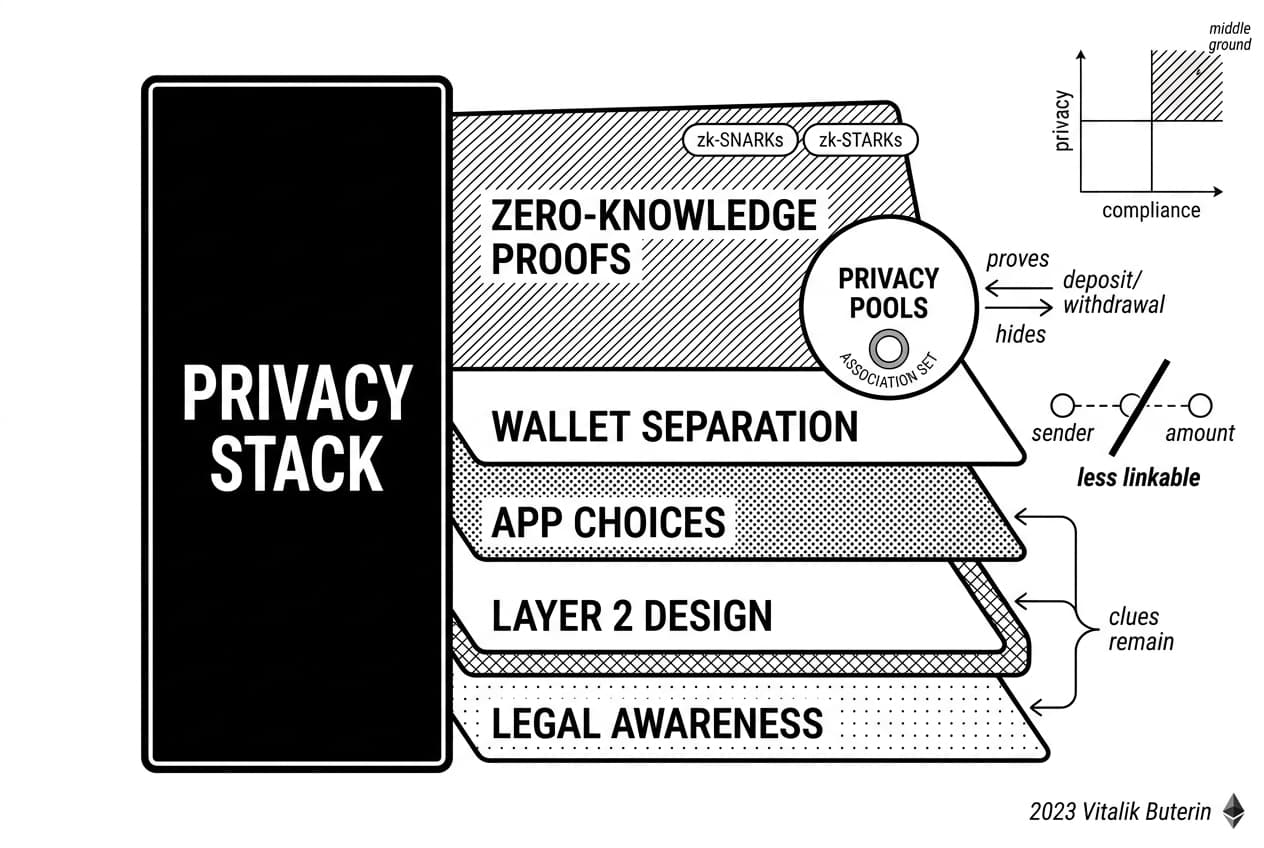
No single tool creates complete privacy on Ethereum. The practical approach is a stack: cryptography, wallet separation, app choices, Layer 2 design, and legal awareness working together. Each solution hides a different part of the transaction trail and leaves other clues exposed.
Zero-knowledge proofs
A zero-knowledge proof is a cryptographic method for proving a statement is true without revealing the underlying data. In payments, that may mean proving a transaction is valid without revealing the sender, receiver, or amount to the public. Two common proof families are zk-SNARKs, which are short proofs, and zk-STARKs, which avoid a trusted setup but can be larger.
Zero-knowledge systems are central to ethereum privacy because they preserve verifiability. The network or app can check that rules were followed without seeing every private detail. The tradeoff is complexity: users depend on wallet support, audited contracts, and careful app design.
Privacy pools and association sets
Vitalik Buterin, co-founder at the Ethereum Foundation, helped popularize privacy pools as a middle-ground design in 2023. The core idea is an association set: a user proves a withdrawal belongs to a set of acceptable deposits without revealing which deposit is theirs. That can reduce linkability while still allowing proofs that funds are not connected to known sanctioned deposits.
This approach matters because it treats privacy and compliance as design constraints rather than enemies. It also has limits. If a pool is small, the anonymity set is small. If exchanges or regulators reject the proof format, users may still face friction. You can read more in our guide to Privacy Pools.
Stealth addresses
A stealth address lets a recipient publish one reusable identifier while each payment goes to a fresh one-time address. Outside observers may see separate destination addresses instead of one public wallet collecting every payment. That helps creators, contractors, donors, and merchants who receive repeated transfers.
The Ethereum stealth address standard EIP-5564 lists a created date of Aug. 13, 2022 (Ethereum EIPs, accessed Aug. 20, 2026). Adoption depends on wallets because users need software that can scan for incoming payments and manage the extra keys safely.
Mixers and their limits
Mixing tools try to break the direct link between input and output addresses by pooling activity. The legal risk is significant. The U.S. Treasury sanctioned a major Ethereum mixing protocol on Aug. 8, 2022 (U.S. Treasury, Aug. 8, 2022). Users should treat sanctioned or poorly understood tools as high-risk, even when their own purpose is legitimate.
Solution comparison table
Solution | What it hides | What it does not hide | Best for | Main risk |
|---|---|---|---|---|
Zero-knowledge proofs | Transaction details such as sender, receiver, or amount when the app supports it. | The fact that an app was used, plus some fee and timing metadata. | Confidential transfers and private app logic. | Complex contracts, weak implementation, or poor wallet support. |
Privacy Pools | The direct link between a specific deposit and withdrawal. | Total pool activity, entry and exit timing, and pool size. | Users who want privacy with a compliance proof path. | Small association sets and uncertain exchange acceptance. |
Stealth addresses | The link between repeated payments to the same recipient. | Sender activity, amounts, and timing. | Receiving payments privately over time. | Limited wallet support and key management mistakes. |
Mixers | The direct path between input and output addresses. | Timing, amounts, app use, and off-chain identity records. | Historically, breaking simple on-chain links. | Sanctions, exchange freezes, and legal exposure. |
Layer 2 privacy apps | Some details from Ethereum mainnet observers. | Bridge deposits, withdrawals, and activity visible inside the Layer 2. | Lower-fee private transaction flows. | Sequencer visibility and bridge linkability. |
Wallet hygiene | Links between different parts of your financial life. | Activity on each individual address. | Beginners reducing avoidable exposure. | Accidental cross-use between wallets. |
Layer 2, Enterprise, and App-Level Privacy
Ethereum privacy is shaped by the full stack: the base chain, Layer 2 networks, wallets, bridges, apps, and business systems. Moving away from mainnet can lower fees or change who sees data, but it does not automatically make activity private.
Do Layer 2 networks make Ethereum private?
A Layer 2 is a network built on top of Ethereum that processes activity more cheaply and then posts data or proofs back to Ethereum. Optimistic rollups assume transactions are valid unless challenged. Zero-knowledge rollups use proofs to show batches are valid.
These systems mainly solve scale and cost. They do not guarantee private transactions ethereum users might expect. Bridge deposits, withdrawals, public addresses, and app activity can still be mapped. Some privacy-focused Layer 2 apps add encryption or zero-knowledge features, but those are separate design choices.
Gas abstraction can help with one narrow leak. For example, gasless transactions and meta-transactions may let another account pay the fee, which can reduce the visible link between a user and a gas source. It does not hide the full transaction path by itself.
Enterprise and app-level privacy
Businesses often need auditability without publishing sensitive records to the open internet. A hospital, payroll provider, or supply-chain group may use permissioned Ethereum-compatible systems where only approved parties can read or write data. At the app level, selective disclosure can prove a fact, such as eligibility or shipment status, without exposing the raw record.
The same principle applies to consumer apps. A decentralized exchange could prove a trade followed its rules without showing every user detail. Uniswap processed more than $2 trillion in cumulative protocol volume by April 2024 (Uniswap Labs, April 2024), according to materials from the protocol's official site. At that scale, privacy choices made by apps affect many users, not just a small privacy-focused niche. Hayden Adams, founder at Uniswap Labs, is one of the public builders whose work shows how app design can shape user exposure across decentralized finance.
The bottom line: enterprises can create controlled networks, while public users need wallets and apps that minimize data leakage. Both groups benefit from the same idea: reveal only what is needed for the task.
How to Improve Ethereum Privacy Safely
Good privacy on Ethereum comes from small decisions repeated consistently. None of the steps below guarantee anonymity. They reduce unnecessary linkability, lower the value of your wallet history to data brokers, and help you avoid tools that may create legal or security problems.
Beginner privacy hygiene checklist
- Use separate wallets for savings, app testing, public profiles, and business activity so one exposed address does not reveal everything.
- Avoid address reuse when your wallet supports fresh receiving addresses, because repeated use makes transaction clustering easier.
- Review token approvals monthly and revoke permissions for apps you no longer trust or use.
- Do not post private wallets on social media, resumes, grant pages, or public forums.
- Treat human-readable names as public labels, not privacy tools, because they connect activity to an identity.
- Use a hardware wallet for significant holdings and read our hardware wallet vs exchange guide before storing large balances.
- Choose wallet software with clear privacy settings, and compare options in our DeFi wallet comparison.
- Assume withdrawals from identity-checked exchanges are linkable to you, even if the later wallet address looks anonymous.
- Check local rules before using mixers, shielding tools, or privacy protocols that exchanges may flag.
What privacy tools cannot protect against
On-chain privacy does not fix every risk. If malware steals your seed phrase, an attacker can move funds regardless of how private earlier transactions were. If a website fingerprints your browser, it may identify you without reading the blockchain. If you publicly announce a wallet, no cryptographic tool can make that announcement disappear.
- Seed phrase leaks: a recovery phrase gives full control over a wallet.
- Phishing: fake sites can trick users into signing harmful transactions.
- Browser tracking: websites can link visits through device and browser signals.
- Exchange records: identity-checked purchases create off-chain records.
- Timing patterns: matching deposits and withdrawals can weaken privacy tools.
- Public disclosure: posting an address can connect your name to old and future activity.
The weakest link is often behavior, not cryptography. Better tools help, but careful habits decide whether those tools protect the right information.
Ethereum Privacy vs Regulation in 2026
Ethereum privacy and regulation are not simple opposites. Users need protection from surveillance and profiling, while regulators focus on sanctions, tax reporting, fraud, and money laundering. The most useful designs try to limit public exposure while keeping a path for lawful proof when needed.
The compliance tradeoff
Total transparency exposes ordinary users. Total opacity can make lawful audits harder. The middle ground includes selective disclosure, view keys, audit proofs, and privacy pools. A view key is a read-only key that lets a chosen party inspect certain transaction details. An audit proof is a cryptographic proof that a rule was followed without showing every underlying record.
The U.S. Treasury action against a major mixing protocol on Aug. 8, 2022 (U.S. Treasury, Aug. 8, 2022) changed how exchanges, wallet providers, and developers assess privacy tools. That decision remains a reference point in the broader crypto privacy vs regulation debate.
What users should know before using privacy tools
- Know your local rules: privacy tools may be allowed in one country and restricted in another.
- Keep tax records: shielding funds does not erase taxable events.
- Check exchange policies: some exchanges freeze or reject funds that touched flagged protocols.
- Review sanctions lists: interacting with a blacklisted address can create legal exposure.
- Prefer proof-friendly tools: systems with selective disclosure are usually safer than tools that offer no audit path.
Practical rule: if a privacy tool gives you no way to prove lawful source of funds to a trusted party when required, it may create compliance problems even when your own activity is legitimate.
Key Takeaways
- Ethereum is public by default. Standard transactions, balances, timestamps, and contract interactions are visible through block explorers.
- Ethereum privacy is consumer data protection. Wallet histories can reveal income, donations, health spending, relationships, and business activity.
- Privacy tools reduce linkability. Zero-knowledge proofs, privacy pools, stealth addresses, Layer 2 apps, and wallet hygiene each protect different surfaces.
- Good privacy is a stack. Safer habits, app choices, cryptography, and legal awareness work together.
- Compliance still matters. Prefer tools that support selective disclosure or audit proofs when you may need to show lawful activity.
Frequently Asked Questions
- Is Ethereum public or private?
- Ethereum is fully public by default. Anyone can inspect transactions, balances, smart contract interactions, and timestamps using block explorers like Etherscan. Wallet addresses are pseudonymous — not directly tied to names — but they offer no true anonymity. Privacy tools can reduce visibility, though Ethereum provides none natively.
- Can Ethereum wallets be traced?
- Yes, Ethereum wallets can often be traced. Transaction history, exchange records, ENS names, NFT holdings, social media posts, and repeated spending patterns can all connect an address to a real person or organization. A wallet address is not automatically a legal identity, but blockchain analytics firms are skilled at making those connections.
- Can Ethereum transactions be traced?
- Standard Ethereum transactions are fully traceable. The sender, recipient, amount, token type, gas fee, and timestamp are all permanently recorded on-chain. Tracing becomes straightforward when wallets interact with known exchanges or identified addresses. Privacy tools make tracing harder, but no current solution makes Ethereum transactions completely untraceable.
- How is privacy maintained in Ethereum?
- Privacy on Ethereum comes from layering multiple approaches: avoiding address reuse, using zero-knowledge proofs, stealth addresses, Privacy Pools, and app-level encryption. Selective disclosure lets users share only what is necessary. Because Ethereum has no built-in privacy, maintaining it depends heavily on both user behavior and purpose-built cryptographic tools.
- What are the top 5 privacy crypto coins?
- Widely referenced privacy-focused cryptocurrencies include Monero, Zcash, Dash, Decred, and Secret Network. Unlike these projects, Ethereum is not private by default. Privacy on Ethereum is achieved through protocols, smart contracts, Layer 2 solutions, and careful wallet practices — it is a behavior and tooling problem, not a built-in feature.
- Can I transfer Ethereum to my bank account?
- ETH cannot be sent directly to a bank account like a wire transfer. You typically sell ETH on a regulated exchange or through a broker, then withdraw the resulting fiat currency to your bank. This process almost always requires identity verification and creates a clear off-chain record linking your wallet activity to your identity.
Sources
Author

Crypto analyst and blockchain educator with over 8 years of experience in the digital asset space. Former fintech consultant at a major Wall Street firm turned full-time crypto journalist. Specializes in DeFi, tokenomics, and blockchain technology. His writing breaks down complex cryptocurrency concepts into actionable insights for both beginners and seasoned investors.