Crypto Mixer Explained: How Bitcoin Tumblers Work in 2026
Crypto Mixer Explained: How Bitcoin Tumblers Work in 2026
What Is a Crypto Mixer?
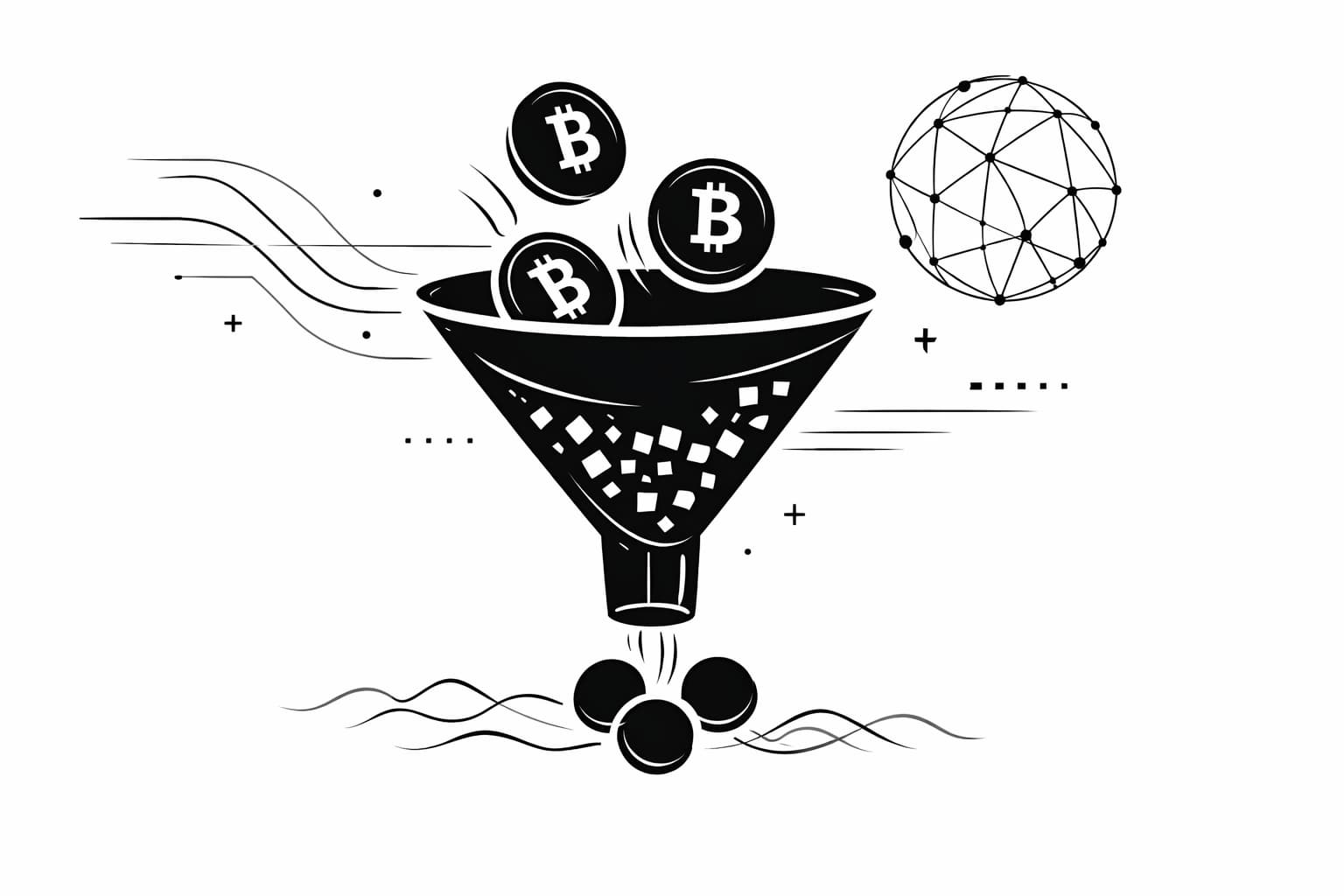
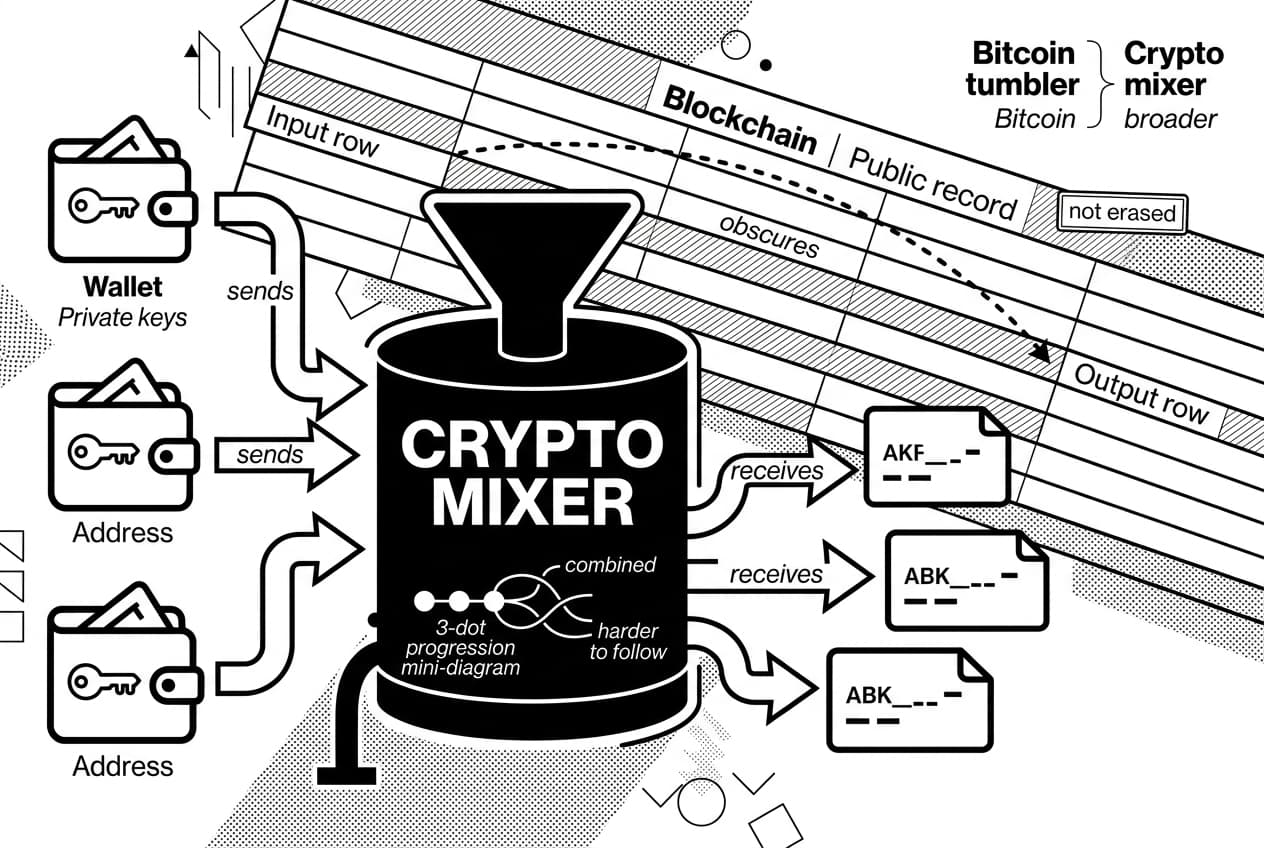
A crypto mixer is a service or protocol that tries to break the public link between coins sent from one wallet and coins received later; a bitcoin tumbler is the older Bitcoin-specific name for the same idea, where many users' transactions are combined to make ownership harder to follow.
Why it matters: public blockchains let anyone inspect transaction history. That can help expose hacks and scams, but it can also reveal salaries, donations, vendor payments, and business cash flows once a wallet address is tied to a real identity. A mixer is best understood as a probabilistic privacy tool, not a delete button for the blockchain.
Before going further, define the basics. A wallet is software or hardware that stores private keys and lets you send or receive crypto. A blockchain is a public record of transactions shared across many computers. An address is a string of letters and numbers that receives funds. A transaction is a recorded movement of coins from one address to another.
A blockchain works like a shared spreadsheet that nobody can quietly edit after a row is saved. A mixer does not erase rows from that spreadsheet. It tries to make it harder to match an input row to an output row, while the record itself remains public.
Crypto Mixer vs. Bitcoin Tumbler
The term bitcoin tumbler comes from early Bitcoin privacy services. It usually refers to tools built for the Bitcoin network. Crypto mixer is broader: it can include Bitcoin tools, coinjoin-style coordination, smart-contract systems on Ethereum-like chains, and newer compliance-aware privacy designs. The goal is similar, but the custody model, tracing risk, and legal exposure can differ sharply.
Our 2026 MIXER Risk Lens
As of January 2026, this guide uses a simple original framework called the MIXER risk lens to evaluate any privacy tool:
- M, money custody: who can hold, freeze, steal, or redirect the funds?
- I, identity links: what exchange, device, IP, tax, or account records connect a wallet to a person?
- X, external signals: what timing, amount, address, or sanctions signals can analytics tools score?
- E, enforcement exposure: does the tool touch sanctioned addresses, money-transmission rules, or AML obligations?
- R, recordkeeping: can the user document source of funds, cost basis, and lawful purpose if questioned?
This lens avoids two common mistakes. A crypto mixer does not provide guaranteed anonymity, and mixer contact does not automatically prove criminal intent. It changes probabilities and risk signals.
Why Crypto Mixers Matter
Most people are used to bank accounts being private by default. Bitcoin and similar public blockchains work differently. Anyone with an internet connection can inspect address balances, transaction amounts, and transaction timing.
Transparency Helps and Exposes
Transparency has real benefits. Donors can verify that a public wallet received funds. Researchers can trace stolen crypto after an exploit. Users can confirm settlement without trusting a bank. Bitcoin surpassed 1 billion confirmed transactions in May 2024 (Blockchain.com chart, May 2024), and those transactions remain publicly readable.
The discomfort begins when an address links to a person. That can happen through a know-your-customer exchange account, a public donation page, a payroll payment, a court filing, or a merchant invoice. Once the link exists, a stranger may be able to inspect past and future activity connected to that wallet cluster.
Privacy Is Not the Same as Concealment of Crime
Ordinary privacy needs are easy to understand. A freelancer may not want every client to see every other client payment. A nonprofit donor may want a donation kept private. A business may not want competitors tracking supplier payments. Those are not the same as hiding ransomware proceeds, sanctions evasion, fraud, or stolen funds.
Lyn Alden, founder of Lyn Alden Investment Strategy, is useful context here because her public research often treats Bitcoin as an auditable settlement network rather than private digital cash. That framing matters: Bitcoin privacy tools are working on top of a transparent base, not replacing it.
A crypto privacy vs regulation framework helps separate legitimate personal privacy from conduct designed to defeat anti-money-laundering controls. The line is not always simple, but intent, source of funds, jurisdiction, and recordkeeping all matter.
- Transparent ledgers help auditing and recovery, but they can expose personal financial behavior.
- Legitimate privacy needs include salary confidentiality, business payment privacy, and protected donations.
- Illegal concealment includes sanctions evasion, ransomware payments, fraud proceeds, and laundering stolen funds.
- The practical trade-off is that the same privacy feature can help lawful users and attract bad actors.
A Short History of Bitcoin Tumblers
Bitcoin mixing is not new. Early custodial services appeared around 2011, and the category has moved through several generations: trusted operators, collaborative transactions, smart contracts, and newer compliance-aware privacy research.
Background: Custodial Services Came First
The first bitcoin tumblers were custodial. A user sent coins to an operator and trusted that operator to send different coins back. The privacy promise depended on the operator not stealing funds, not keeping useful logs, and not being seized. The bitcoin fog service is a documented example: prosecutors said it processed about $335 million over more than a decade (DOJ, Apr. 28, 2021).
That custody risk pushed developers toward non-custodial designs. Coinjoin-style transactions let multiple users coordinate a single transaction with many inputs and outputs, so ownership links become less obvious. Later, smart contracts attempted to remove the human operator by replacing it with code.
Why Enforcement Changed the Market
Regulatory pressure grew between 2022 and 2024. OFAC sanctioned blender.io in May 2022 and then sanctioned the tornado cash tool in August 2022 (OFAC, Aug. 8, 2022). That sequence appears in the broader key crypto regulation milestones that shaped how exchanges screen deposits today.
The practical result is important for ordinary users. Even if using a particular tool is not illegal in a user's country, coins with mixer exposure may be harder to deposit at a regulated exchange. Compliance systems often treat mixer links as a risk signal that requires review.
How a Bitcoin Tumbler Works Step by Step
A bitcoin tumbler takes coins in, combines or coordinates them with other users' funds, and sends different coins out to addresses the user controls. The goal is to weaken the visible link between the original sending wallet and the later receiving wallet.
- Deposit: A user sends bitcoin, for example 0.5 BTC, to a mixer address or into a coordinated transaction round.
- Pooling: The service or protocol groups that deposit with other users' funds, increasing the set of possible ownership links.
- Timing and amount changes: Outputs may be split, delayed, or standardized so simple one-to-one matching becomes harder.
- Withdrawal to new addresses: The user receives coins at fresh addresses that do not show the same direct history as the deposit address.
- Post-mix risk signals: The chain still records mixer interaction, and exchanges or investigators may flag timing, amounts, address clusters, or sanctioned-service exposure.
Step 1: Coins Enter a Pool
A pool is a group of funds that may be linked to many participants rather than one sender. Pool size matters. A small pool with only a few deposits offers weak privacy because there are fewer possible matches. A larger pool can create more uncertainty, but it still cannot remove the original public transaction.
Step 2: Timing and Amounts Change
If a user deposits 0.5 BTC and receives exactly 0.5 BTC seconds later, the link is obvious. Mixers try to avoid that by delaying withdrawals, splitting outputs, or using standardized output sizes. Those methods create uncertainty, but they can also create recognizable fingerprints that analytics systems learn to score.
Step 3: Outputs Go to Fresh Addresses
Fresh addresses reduce address-reuse risk. Address reuse means using the same receiving address more than once, which makes wallet clustering easier. A fresh address helps only if the user does not later recombine funds, send them to a known exchange account, or reveal ownership in another way.
Why Mixing Is Not Magic Anonymity
A mixer shifts probabilities; it does not rewrite the ledger. Analytics firms use timing analysis, amount matching, address clustering, and off-chain records to estimate links. Chainalysis raised $170 million in a series F round (Reuters, May 24, 2022), which shows the scale of the market for blockchain investigation and compliance tooling.
Adam Back, co-founder and CEO of Blockstream, provides useful technical context because Blockstream's public work focuses on Bitcoin infrastructure and privacy-adjacent cryptography. The key point for beginners is simple: Bitcoin's base layer is transparent, so privacy tools operate as overlays with limits.
Types of Crypto Mixers
Not all crypto mixers work the same way. The most important differences are who controls funds, how privacy is attempted, what breaks the model, and how regulated platforms are likely to treat the result.
Centralized Custodial Mixers
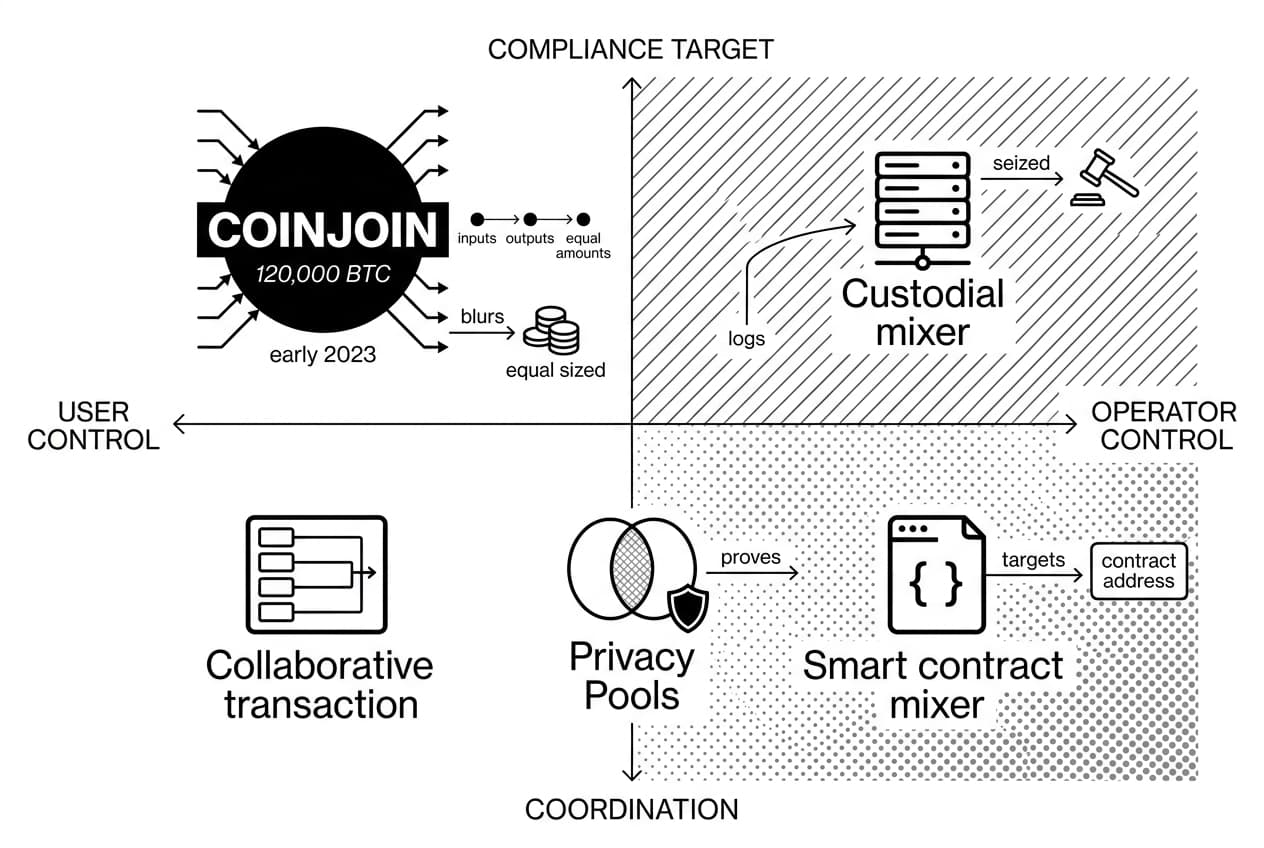
In a custodial mixer, an operator temporarily controls the user's funds. That creates a direct trust problem. The operator can steal deposits, keep logs, be hacked, or be compelled to disclose records. Custodial designs are usually the easiest for law enforcement to seize because there is an identifiable service, server, or operator.
Coinjoin and Collaborative Transactions
Coinjoin is a coordination method. Multiple users create a single transaction containing several inputs and several outputs, often using equal output amounts to make ownership harder to map. It is not a separate blockchain. It is a way of constructing a transaction so the simple input-to-output trail becomes less direct. Public stats for one wallet coordinator showed more than 120,000 BTC in mixed volume by early 2023 (Wasabi Wallet stats, accessed Apr. 2023).
Smart Contract Mixers
A smart contract is code that runs on a blockchain. In a smart-contract mixer, a user deposits a fixed amount and receives a secret note or proof. Later, the user can withdraw the same fixed amount from another address by proving a valid deposit occurred, without revealing which deposit it was. The weakness is that the contract address itself can become a compliance target.
Privacy Pools and Compliance-Aware Designs
Newer privacy-pool designs ask a harder question: can a user prove funds are not linked to a known illicit set without exposing every transaction? These systems use zero-knowledge proofs, which are cryptographic methods for proving a statement without revealing all underlying data. For a deeper look, see our guide to privacy pools and compliant crypto privacy.
Mixer type | Who controls funds | How privacy is attempted | Main weakness | Typical compliance risk |
|---|---|---|---|---|
Centralized custodial | Service operator | Deposits are pooled and different coins are returned | The operator can steal funds, keep logs, or be seized | Very high |
Coinjoin coordinator | User keeps custody during coordination | Many inputs and outputs appear in one transaction | Equal-output patterns and coordinator pressure | High |
Smart contract mixer | Blockchain code | Deposit proofs allow later withdrawal from another address | The contract address can be sanctioned or blocked | Very high when sanctioned addresses are involved |
Privacy pool | User or protocol design, depending on implementation | Zero-knowledge proofs can exclude known illicit sets | Experimental design and proof-set quality | Unresolved, potentially lower if accepted by regulators |
Can Crypto Mixers Be Traced?
Crypto mixers can sometimes be traced or risk-scored, but results depend on design, liquidity, user behavior, and off-chain records. Investigators often work with probabilities rather than certainty, yet those probabilities may be enough for an exchange freeze, tax inquiry, or law-enforcement lead.
How Blockchain Investigators Analyze Mixer Activity
Address clustering groups addresses that appear to be controlled by the same wallet. Timing analysis compares when coins enter a mixer and when similar values leave. Amount matching looks for distinctive values that remain recognizable after fees or splits. Exposure scoring estimates how closely funds are linked to risky services.
Off-chain evidence often completes the picture. If funds later move to a regulated exchange, that exchange may hold identity records. A subpoena, tax filing, sanctions list, device log, or account login can connect an address to a person even if the on-chain path is uncertain.
Why User Mistakes Matter
Most privacy failures are behavioral. Reusing addresses, withdrawing soon after depositing, sending unusual amounts, recombining outputs, or cashing out through a known exchange account can defeat the benefit of mixing. The cryptography may still work, while the user's later actions reveal the trail.
What Compliance Teams Look For
Compliance teams use transaction-screening systems sometimes called KYT, meaning know-your-transaction monitoring. These tools score wallet addresses based on links to sanctioned entities, darknet markets, hacks, scams, and mixers. Indirect exposure can matter too, meaning funds may be flagged even when the mixer was two or three hops away. See our guide to how wallet screening checks mixer exposure for a deeper explanation.
- Tracing is probabilistic: investigators assign likelihoods until off-chain records confirm identity.
- User behavior matters: address reuse, timing, amount patterns, and exchange withdrawals often break privacy.
- Screening can be indirect: funds do not need to come straight from a mixer to trigger review.
- Records remain public: a mixer may blur links, but it does not remove transactions from the chain.
Legal, Tax, and Safety Risks in 2026
Using a crypto mixer is not automatically a crime everywhere, but it can create serious legal, tax, and account-access problems. The answer depends on the user's location, the tool used, the source of funds, and whether sanctioned addresses or money-transmission rules are involved. This article is educational and is not legal advice.
Is Using a Crypto Mixer Illegal?
It depends on jurisdiction. In the United States, interacting with a sanctioned service can be prohibited regardless of a user's intent. Other countries may treat mixers differently. For a full breakdown, read our guide to crypto mixer legal status in 2026. Anyone considering a mixer should speak with a licensed attorney in their own country first.
Businesses face extra duties. A service that moves funds for others may need registration, AML controls, reporting systems, and sanctions screening. Our money transmitter license rules for crypto businesses guide explains why operating a mixer can create a different legal risk profile from merely reading about one.
Can Tax Agencies See Your Crypto Wallet?
Public wallet activity is visible, but a wallet is not automatically a legal name. Agencies connect wallets to people through exchange records, tax forms, subpoenas, analytics vendors, device data, and transaction patterns. In the U.S., brokers began preparing for digital-asset reporting under final broker-reporting rules announced by the IRS in June 2024 (IRS, June 28, 2024).
Mixing does not remove cost basis, gains, losses, or reporting duties. If a user sells bitcoin, trades it, spends it, or otherwise disposes of it, tax rules may still apply. Poor records can make a later audit harder, not easier.
Common User Risks
The safety risks are practical as well as legal. Some mixer websites are scams. Some are phishing clones. Custodial services can disappear with deposits. Even after a successful mix, a regulated exchange may freeze an incoming deposit and ask for source-of-funds records that the user can no longer explain clearly.
Before sending funds to any privacy tool, review common crypto scam red flags. If a site promises guaranteed anonymity, no risk, or instant clean coins, treat that as a warning sign.
- Sanctions risk: specific addresses or services can be off-limits for some users.
- Tax risk: reporting duties can remain even after mixing.
- Account risk: exchanges may freeze or reject funds with mixer exposure.
- Theft risk: custodial mixers can steal deposits or vanish.
- Evidence risk: poor records make lawful source-of-funds explanations harder.
Common Misconceptions and Better Privacy Alternatives
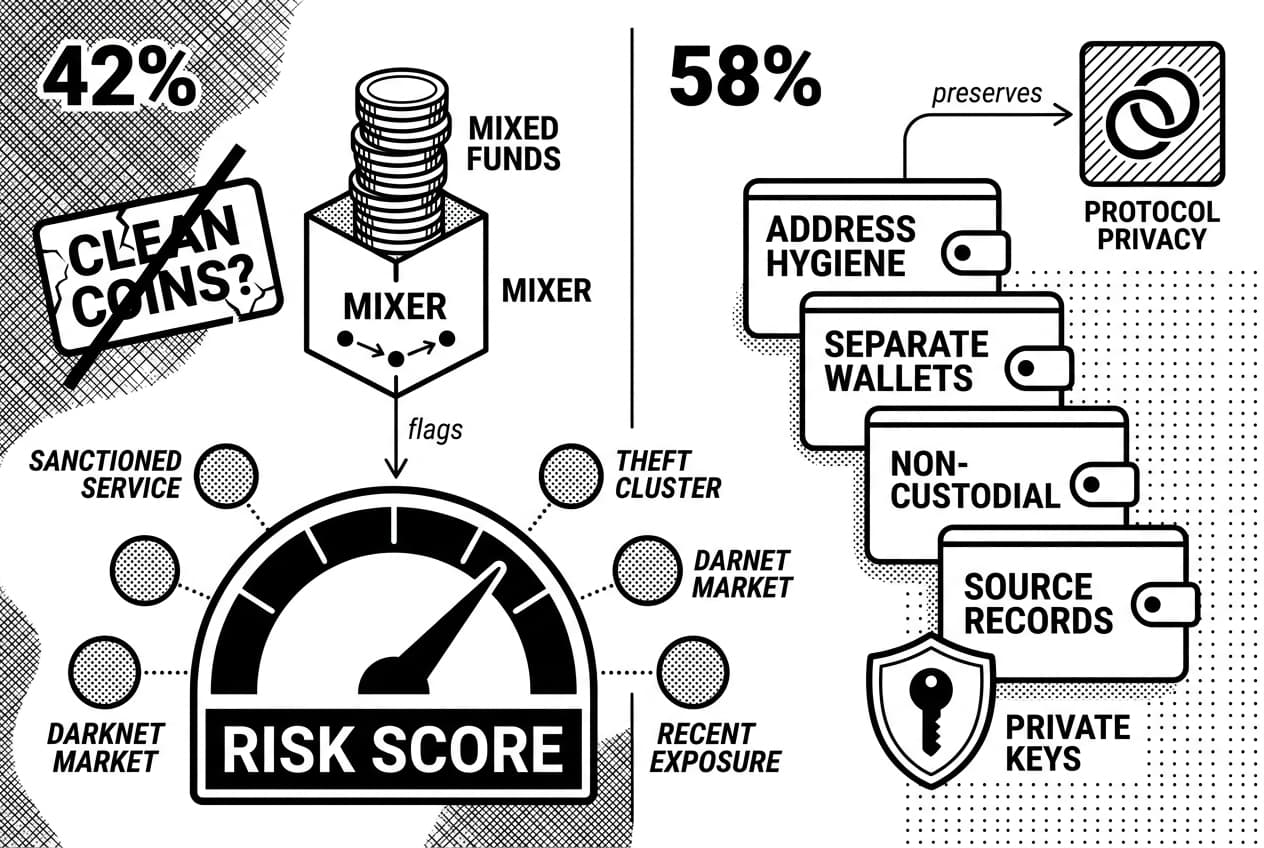
A crypto mixer does not turn risky coins into clean coins. It changes the visible transaction graph, and regulated platforms may still treat the result as higher risk.
Misconception: Mixed Coins Are Clean Coins
Compliance teams do not need perfect proof of wrongdoing to flag a deposit. If a wallet has recent exposure to a known mixer, sanctioned service, theft cluster, or darknet market, the deposit can trigger review. That review can happen even when the current holder did not commit the original wrongdoing.
The better mental model is risk scoring. Mixed funds may become harder to trace in a narrow technical sense while becoming more suspicious in a compliance sense. That is the central trade-off many beginners miss.
Privacy Practices That Do Not Start with a Mixer
For many everyday users, safer privacy starts with wallet hygiene rather than a tumbler:
- Do not reuse addresses. Reuse makes wallet clustering easier.
- Separate public and private wallets. Keep employer, client, donation, and personal spending flows apart.
- Use reputable non-custodial wallets. Non-custodial means the user controls the private keys.
- Keep source-of-funds records. Exchange statements, receipts, and transaction notes can help if a platform asks questions.
- Study protocol-level privacy tools. Some designs aim to protect users while preserving compliance proofs. Our guide to Ethereum privacy tools in 2026 covers several approaches.
The privacy goal should be proportionate. If the concern is not exposing a salary wallet to a merchant, address hygiene may solve more problems with fewer legal side effects than a mixer. If the concern involves sanctioned funds, stolen assets, or tax avoidance, a mixer does not make the activity lawful.
Frequently Asked Questions
- What is the best crypto mixer?
- There is no single "best" mixer — the right choice depends on your privacy goals, jurisdiction, legal exposure, fees, and custody risk. Many mixer services are outright scams or exit frauds. More importantly, using a mixer carries serious compliance consequences, so consult a legal professional before interacting with any such service.
- Can crypto mixers be traced?
- Yes, sometimes. Blockchain analytics firms use probability-based clustering, timing patterns, amount matching, address reuse, and sanctions databases to flag or link mixed funds. Perfect certainty is rare, but common user mistakes — like cashing out on a KYC exchange — often expose the trail without needing to fully "break" the mix.
- Can the IRS see your crypto wallet?
- Public blockchain wallets are visible to anyone. Connecting a wallet to a real identity typically requires additional clues: exchange KYC records, tax filings, subpoenas, device data, or transaction patterns. Selling or transferring crypto may independently trigger tax reporting obligations regardless of whether your wallet is personally identified.
- How does a Bitcoin mixer work?
- At a basic level, a tumbler accepts a deposit, pools it with other funds, charges a fee, and sends different coins to a new address after time delays. In practice, this creates serious legal, tax, theft, and exchange-freeze risks. Safer, legally sound privacy practices exist — seek qualified legal advice before considering any mixing service.
- Why is crypto tumbling today?
- The word "tumbling" has two meanings here. If you mean prices dropping, look to market liquidity, macroeconomic news, and sentiment shifts. If you mean mixing activity increasing, that often follows major hacks, heightened privacy concerns, or regulatory announcements that push users toward obfuscation tools — though doing so carries significant legal risk.
- Does the IRS know if you sell Bitcoin?
- Potentially yes. The IRS receives data from centralized exchanges via tax forms, subpoenas, and reporting requirements. Blockchain analytics and self-reporting add further exposure. Selling Bitcoin triggers capital gains or losses that must be reported. Using a mixer does not eliminate your tax obligations or reliably shield activity from tax authorities.
Sources
Author

Crypto analyst and blockchain educator with over 8 years of experience in the digital asset space. Former fintech consultant at a major Wall Street firm turned full-time crypto journalist. Specializes in DeFi, tokenomics, and blockchain technology. His writing breaks down complex cryptocurrency concepts into actionable insights for both beginners and seasoned investors.