Buy Privacy Coins: Exchanges, Monero & Safe Methods 2026
Buy privacy coins: exchanges, Monero and safe methods in 2026
What you’ll accomplish in this guide
This guide shows you how to buy privacy coins in 2026, where to buy Monero, how to compare exchanges with peer-to-peer routes and atomic swaps, and how to move your coins into self-custody. You can follow it even if this is your first privacy-focused crypto purchase.
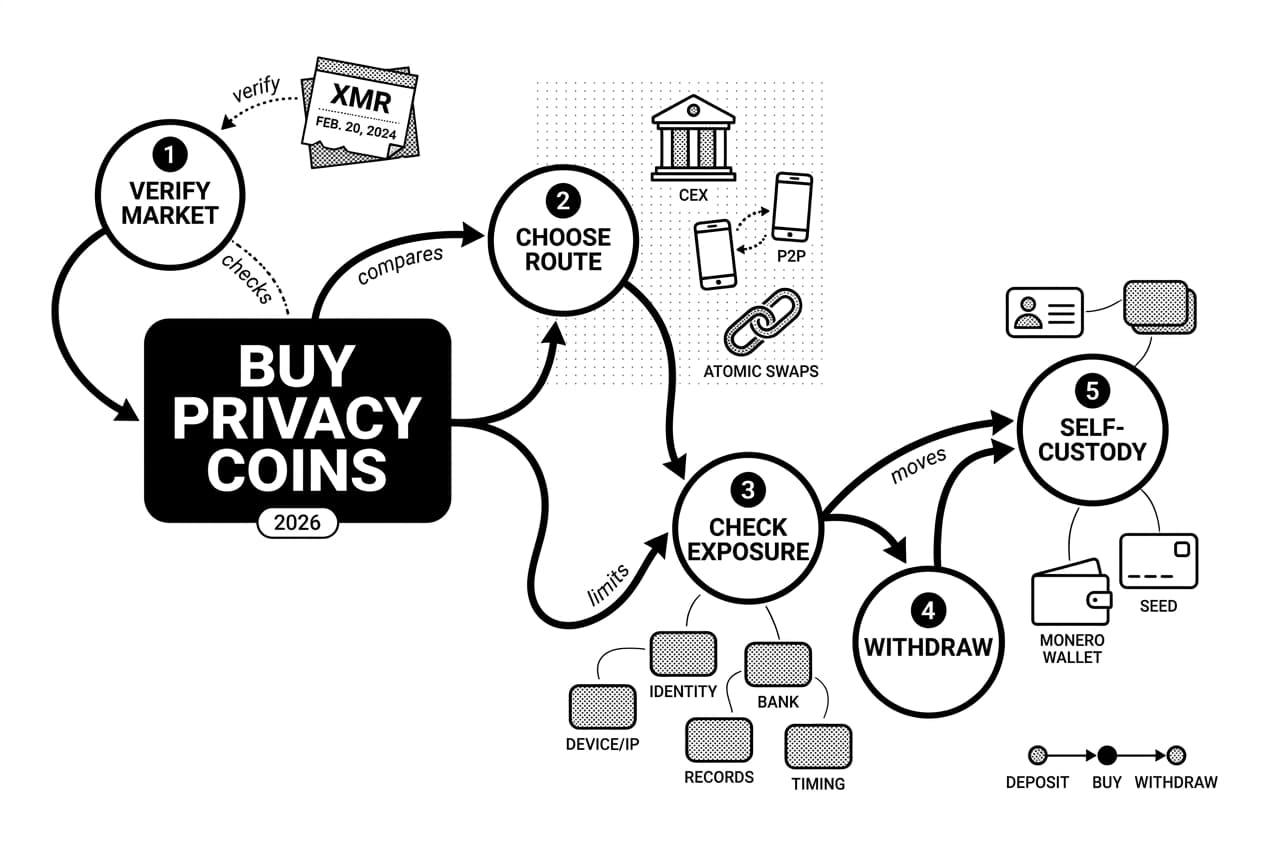
The practical problem is access. Privacy coins are not hard to understand, but they are harder to buy through mainstream venues. Binance said it would delist XMR on Feb. 20, 2024 (Binance, February 2024), and similar listing changes are why you should verify every market before you deposit funds.
Use the on-ramp exposure framework while you read: identity, funding rail, device and IP data, exchange records, and withdrawal pattern. The coin may hide on-chain details after withdrawal, but your fiat entry point can still connect your name, bank account, device, and timing to the purchase.
Who this guide is for
This guide is for you if you want legitimate financial privacy, better control over personal spending data, or a clearer understanding of privacy-focused assets. It is not a guide for tax evasion, sanctions avoidance, fraud, or hiding unlawful activity.
Andreas Antonopoulos, author and educator, has consistently framed financial privacy as a normal user need rather than suspicious behavior. That view shapes this guide: privacy is valid, but your legal and tax duties still apply.
Quick safety note before you start
Privacy tools do not make illegal activity legal. A Monero wallet does not remove tax duties, and a peer-to-peer trade does not remove local reporting rules. Check the rules where you live before you buy.
If you are unsure, search your country name with Monero legal 2026, read the exchange’s restricted-region page, or ask a qualified local tax professional. Do that before sending money, not after.
What you’ll need before you buy privacy coins
Set up the basics before you spend money. Privacy coins are manageable for beginners, but skipping wallet setup or fee checks can leave your coins stuck on an exchange.
Prerequisites checklist:
- Verified account: complete identity checks first if you will use a fiat exchange.
- Funding method: prepare a bank transfer, debit card, stablecoin, or existing crypto balance.
- Compatible wallet: choose a wallet that supports XMR, ZEC, DASH, or your target coin natively.
- 2FA app: use an authenticator app or hardware security key, not SMS if you can avoid it.
- Secure backup: write your seed phrase on paper or metal and store it offline.
- Local-law check: confirm whether privacy coins can be bought, held, and transferred where you live.
- Fee review: compare trading fees, withdrawal fees, spreads, and network fees before placing an order.
Required accounts, wallets, and security tools
At minimum, you need an exchange or peer-to-peer account, a strong password manager, and a secure email address used only for crypto. For XMR, the official wallet from GetMonero is the safest starting point because it tracks protocol changes directly.
Self-custody matters more for privacy coins than for most assets. Leaving coins on an exchange means the platform can see your balance, hold your withdrawal, or freeze your account under its policy.
Pro tip: Create your wallet before you buy. Copy your receiving address from the wallet itself, then keep the wallet open while you test the first withdrawal.
Fees, timeframes, and checks to expect
Card purchases often settle within minutes but may cost 2% to 4%. Bank transfers are often cheaper, sometimes under 1%, but ACH or SEPA deposits can take 1 to 5 business days depending on the platform and country.
Withdrawal fees vary by exchange and network. Check the live withdrawal page before you trade. A cheap purchase can become expensive if the exchange has a high flat withdrawal fee or a large minimum withdrawal amount.
For compliance context, FATF’s 2023 update kept pressure on virtual asset service providers to apply sender and recipient information-sharing rules (FATF, 2023). That pressure is one reason privacy-coin support changes quickly.
Step 1: Choose the privacy coin that fits your goal
Before you buy, decide what problem you want the coin to solve. Some coins hide transaction details by default. Others offer optional privacy, which means user behavior matters much more.
Monero, zcash, dash, and other options
Here is a beginner-focused comparison of the main choices:
Coin | Ticker | Privacy model | Exchange availability | User complexity |
|---|---|---|---|---|
Monero | XMR | On by default with stealth addresses, ring signatures, and hidden amounts | Limited because many regulated exchanges have delisted it | Low to medium |
Zcash | ZEC | Optional shielded addresses | Better than XMR on many mainstream venues | Medium |
Dash | DASH | Optional mixing through its privacy feature | Available on more venues than XMR | Low |
PIVX | PIVX | Optional shielded transactions | Limited | Medium |
Smaller privacy assets | varies | Often ring signatures, zero-knowledge proofs, or network privacy | Thin markets and more delisting risk | Medium to high |
Monero is the most practical default if your goal is strong on-chain privacy because privacy is always active. Zcash can be easier to find, but you must use shielded addresses for its privacy tools to matter. Dash is easier for beginners, but its privacy model is less strict than Monero’s.
Smaller privacy assets can be interesting, but thin order books create wider spreads and more slippage. If you are new, start with XMR or ZEC before exploring niche markets. If you would rather stay in a more exchange-friendly ecosystem, compare Ethereum privacy solutions as well.
Erik Voorhees, founder of ShapeShift, has been a public advocate for non-custodial crypto tools. That perspective is relevant here because the harder privacy coins become to access through large exchanges, the more important it is to understand self-custody and direct exchange methods.
Privacy technology in plain english
You do not need to master cryptography to buy safely. You only need to know what each feature does and what it does not protect.
- Stealth addresses: the wallet creates a one-time destination for each payment, which reduces address linking.
- Ring signatures: a transaction is grouped with decoys, making it difficult to prove which input was spent.
- Hidden amounts: outside observers cannot see the amount sent on Monero.
- Shielded addresses: Zcash privacy addresses encrypt transaction details, but users must choose them.
- Zero-knowledge proofs: one party can prove a statement is true without showing the private data behind it.
The key buying lesson is simple: stronger privacy often means less exchange access. That tradeoff should shape where you buy, how much you buy, and how carefully you store records.
Step 2: Find where to buy Monero and other privacy coins
After you choose a coin, confirm where it is actually available in your region. This is where many beginners get stuck. A market page may show XMR globally while your local account cannot trade or withdraw it.
Kraken restricted Monero access for some customers in 2024 (Kraken, 2024). Treat that as a warning pattern: listings change, and old guides can be wrong within months.
Use a centralized exchange when available
A centralized exchange is usually the easiest place to start. You get fiat funding, a familiar order screen, visible liquidity, and support if a deposit is delayed.
The tradeoff is identity exposure. The platform may keep your ID, bank records, IP logs, order history, and withdrawal history. Brian Armstrong, co-founder and CEO of Coinbase, runs one of the best-known regulated exchanges, and Coinbase’s compliance-first model shows why mainstream venues collect extensive user information before allowing fiat crypto purchases.
Use market aggregators to check live markets
You cannot buy directly on CoinGecko or CoinMarketCap. Use them as research tools. Search XMR, ZEC, or DASH, open the markets tab, and compare active pairs, exchange names, and 24-hour volume.
After you find a possible venue, go to the exchange directly. Confirm the pair is open in your country, deposits are enabled, and withdrawals are enabled. Do not fund the account until all three are true.
Consider peer-to-peer or atomic swaps only if you understand the tradeoffs
When large exchanges do not support Monero, peer-to-peer markets and atomic swaps become practical alternatives. Peer-to-peer markets match buyers and sellers, often with escrow. Atomic swaps let you exchange one coin for another without a central custodian.
These routes can work, but they are less forgiving. Spreads can be 2% to 5% above spot, liquidity is lower, and counterparty risk still exists even when escrow is present. Use them only if you understand the process and your local rules.
Method | Best for | KYC required | Typical speed | Main fees | Privacy tradeoff | Beginner risk |
|---|---|---|---|---|---|---|
Centralized exchange | Fiat on-ramp and simple purchase flow | Yes | Minutes after funding clears | Often 0.1% to 0.5% trading fee, plus spread and withdrawal fee | Exchange keeps identity and transaction records | Low |
Crypto-only exchange | Coin-to-coin swaps after you already own crypto | Sometimes | Minutes | Often 0.1% to 0.25% trading fee, plus withdrawal fee | Less bank data, but wallet, device, and IP data may still be logged | Low to medium |
Peer-to-peer marketplace | Regions where large exchanges do not list XMR | Varies by platform | 30 minutes to 24 hours | Commonly 1% to 5% spread above spot | Seller may see your payment method and timing | Medium |
Atomic swap | Non-custodial swaps from another crypto into XMR | No | Minutes to hours | Network fees and possible spread | No central exchange record, but source-chain history still matters | High |
DEX or wrapped exposure | DeFi users who want price exposure | No | Seconds to minutes | 0.3% or more liquidity-provider fee, plus gas | Wrapped tokens are not the native privacy coin | Medium to high |
Pick the method that matches your comfort level. If you are a beginner and a regulated exchange is available, start there, then withdraw to your own wallet.
Step 3: Verify your account, fund it, and place the order
Once you choose a venue, slow down and follow the order screen carefully. Most losses at this stage come from rushing, using the wrong ticker, or missing a withdrawal restriction.
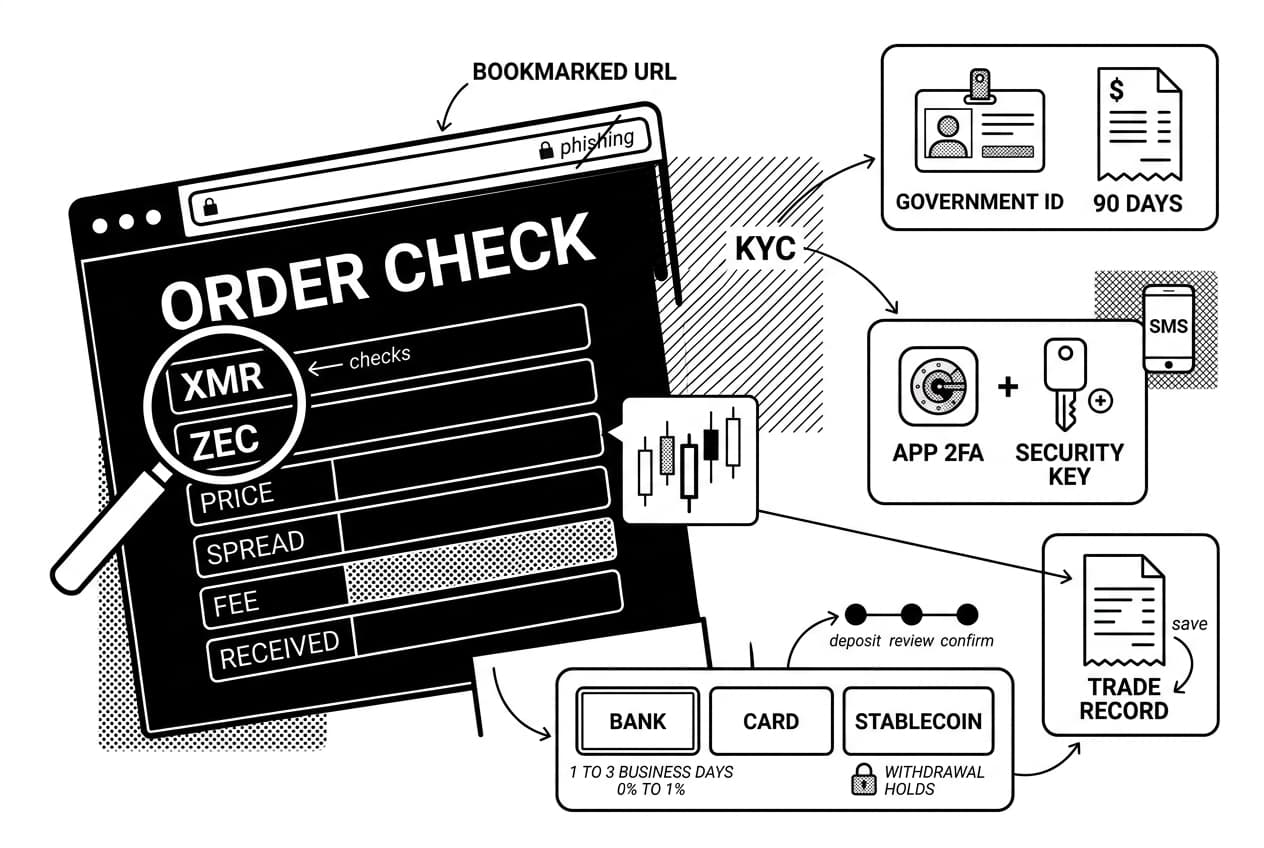
- Sign in to your exchange account from a bookmarked URL.
- Enable two-factor authentication before depositing funds.
- Deposit money by bank transfer, debit card, stablecoin, or crypto.
- Search the ticker, such as XMR for Monero or ZEC for Zcash.
- Open the buy or trade ticket.
- Review price, spread, fee, and estimated amount received.
- Select buy or confirm only after checking the details.
- Save the receipt or download the trade record.
Complete KYC and enable 2FA
Fiat exchanges usually ask for a government ID, proof of address, and sometimes a source-of-funds statement for larger purchases. Proof of address is often a bank statement or utility bill dated within 90 days.
Before uploading documents, check the URL in your browser. Phishing pages copy exchange login screens and then steal IDs. Our guide on how to avoid crypto phishing attacks shows the common red flags.
Use an authenticator app or a hardware security key. SMS-based codes are better than no 2FA, but phone-number hijacking makes them weaker than app-based codes.
Choose a funding method
Your funding choice affects cost, speed, and privacy. Bank transfers are cheaper but slower. Cards are fast but expensive and create a clear bank-card trail.
Method | Typical speed | Typical fee | Watch out for |
|---|---|---|---|
Bank transfer | 1 to 3 business days | 0% to 1% | Withdrawal holds while funds clear |
Debit card | Often instant | 1.5% to 3.99% | Some banks block crypto purchases |
Credit card | Often instant | 3% to 5%, plus possible cash-advance fee | Interest may start immediately |
Stablecoin deposit | Minutes after confirmations | Network fee only | Wrong-chain deposits can be lost |
Crypto deposit | Minutes to about 1 hour | Network fee only | Market price can move before you trade |
Preview the trade before confirming
The preview screen is your last safe checkpoint. Check the ticker, amount, fee, spread, and withdrawal status before you confirm.
- Ticker: verify XMR, ZEC, or the exact coin you intended to buy.
- Slippage: for thin order books, a 0.5% to 1% setting may be reasonable.
- Network: confirm the withdrawal network matches your wallet.
- Total cost: include spread, trading fee, withdrawal fee, and network fee.
- Minimum withdrawal: do not buy less than the amount you can withdraw.
- Withdrawal status: make sure withdrawals are open before buying.
Warning: Do not assume buying and withdrawing are both available. Some venues allow trading while withdrawals are paused. Check the asset’s withdrawal page first.
After the order fills, save the receipt. Record date, asset, amount, price, fee, exchange, and transaction ID for tax records.
Step 4: Withdraw to a wallet and store your coins safely
After your order fills, the coins usually sit in the exchange account. That is not the final step. Withdraw to a wallet you control so you hold the private keys.
Pick a wallet that supports your coin
Wallet support is coin-specific. For Monero, use the official wallet from GetMonero when possible. For Zcash, choose a wallet that supports shielded addresses if privacy is your goal.
For long-term storage, consider a hardware wallet if your chosen coin is supported. Read our guide on how to use a hardware wallet safely before moving a large balance.
Send a test transaction first
Crypto withdrawals are usually irreversible. Send the minimum test amount first, wait for it to arrive, and only then send the rest.
Before you click the withdraw button, check these details:
- Address: compare the first and last six characters with your wallet screen.
- Payment ID or memo: add it only if the exchange or wallet requires it.
- Network: choose the native coin network, not a wrapped-token network.
- Minimum: confirm the withdrawal amount is above the exchange minimum.
Once the test arrives, repeat the withdrawal using the same verified address. If your wallet has a send or receive history tab, confirm the incoming transaction appears there before closing the app.
Step 5: Use privacy coins without common privacy mistakes
Getting coins into self-custody is a strong start. Still, privacy coins protect blockchain data better than they protect careless behavior around the purchase.
Avoid address and timing leaks
With Monero, stealth addresses reduce address reuse risk automatically. With optional-privacy coins, reusing a transparent address can expose patterns that anyone can follow.
Timing matters too. If you buy on a KYC exchange and withdraw minutes later, the exchange record still connects your identity to the withdrawal. Waiting, batching carefully, and avoiding round trips back to the same exchange can reduce simple timing links.
Protect yourself from scams
Privacy coin users attract scammers because transfers are hard to reverse. Chainalysis reported $9.9 billion in crypto scam revenue for 2024 (Chainalysis, 2025), so treat unsolicited sellers and fake wallet links as serious risks.
Watch for fake wallet apps, cloned exchange URLs, chat-room sellers offering cheap XMR, and escrow impostors. No legitimate wallet, exchange, or seller will ever ask for your seed phrase.
Review our guide to common crypto scam red flags before using any peer-to-peer platform.
Warning: Download wallets only from the official project site. Verify checksums when the project publishes them. Fake installers can drain a wallet within minutes.
Legal, tax, and exchange risks to know in 2026
Before you buy privacy coins, spend five minutes on compliance risk. The gap between legally holding a coin and being able to buy it through a regulated exchange is getting wider.
Is Monero illegal in the USA?
Owning or buying Monero is not broadly illegal in the US as of 2026. No federal law bans holding XMR. Regulated exchanges may limit access, and you still owe tax reporting, sanctions compliance, and accurate records for every trade, sale, swap, or payment.
The IRS treats digital assets as property for federal tax purposes (IRS, 2026). A sale, swap, or payment can create a taxable event even if the coin has privacy features.
Rules are also tightening outside the US. EU lawmakers adopted a new anti-money-laundering package in 2024, with major parts applying through 2027 (EU Parliament, 2024). If you are in Europe, exchange options may narrow further.
Why exchanges delist privacy coins
Exchanges usually delist privacy coins because monitoring and reporting are harder, not because privacy itself is illegal. Three pressure points explain most decisions.
- AML monitoring: regulated venues must detect suspicious activity, and private transaction data makes that harder.
- Travel rule duties: exchanges may need to transmit sender and recipient details above certain thresholds.
- Sanctions screening: transparent-chain screening is easier than screening hidden-address systems. Learn how wallet screening works before assuming all coins face the same review.
The practical lesson is simple: any list of exchanges can go stale. Check the exchange’s asset page and withdrawal page on the same day you plan to trade.
If you want a broader legal map, read our guide to the legal status of crypto privacy tools. You can also compare compliant crypto privacy models if you want privacy designs that try to preserve user protection while answering regulator concerns.
Summary and next steps
You now have the full purchase path: choose a coin, find a live venue, fund the account, place the order, withdraw to self-custody, and avoid behavior that weakens privacy.
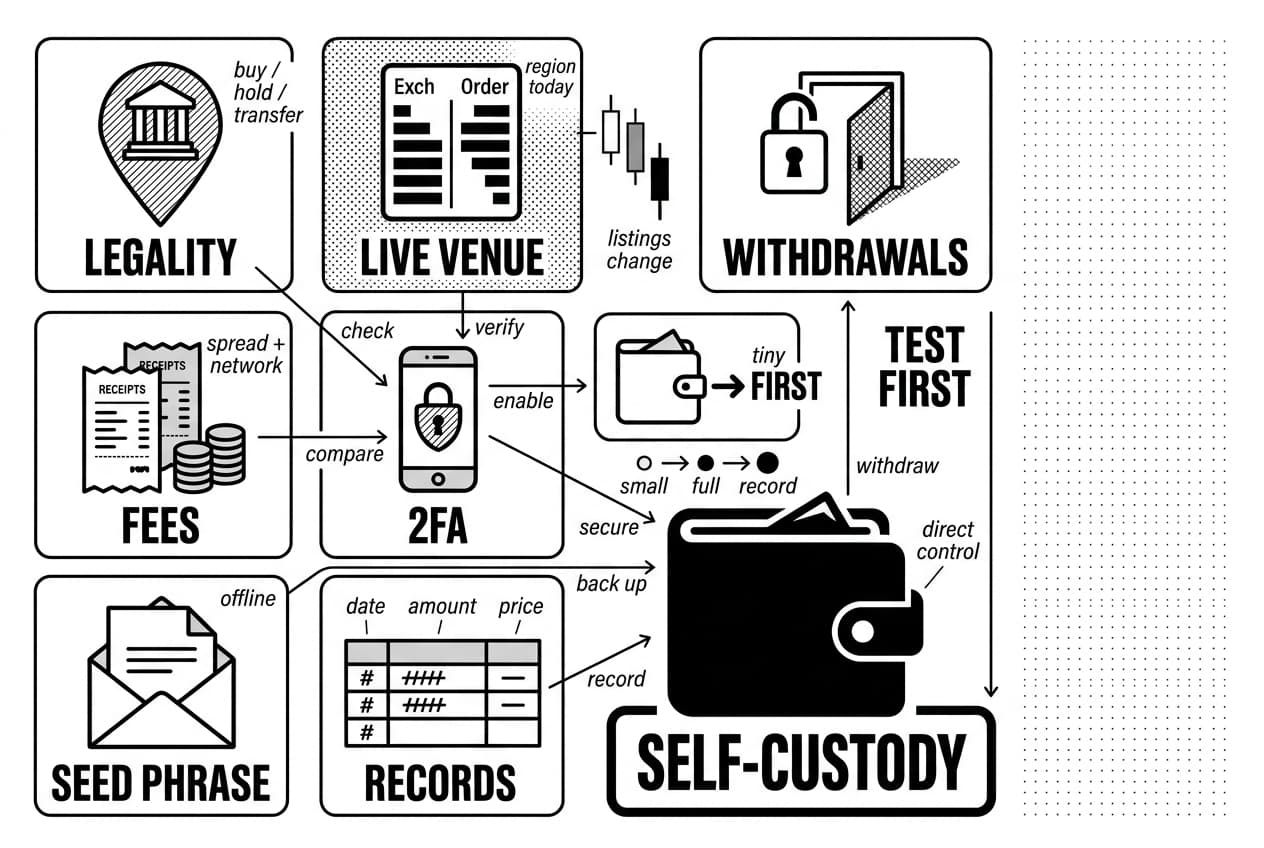
Beginner checklist: before you buy
- Confirm legality: check whether you can buy, hold, and transfer privacy coins where you live.
- Confirm the listing: verify the coin is tradable in your account region today.
- Confirm withdrawals: make sure withdrawals are enabled before placing the order.
- Compare fees: add trading fee, spread, withdrawal fee, and network fee.
- Secure your account: turn on app-based 2FA before depositing funds.
- Test first: withdraw a small amount before moving the full balance.
- Back up the wallet: store the seed phrase offline and never photograph it.
Keep a record of each purchase: date, amount, price, fees, platform, and transaction ID. Recheck exchange access before every trade because privacy coin listings can change faster than listings for larger assets.
As Andreas Antonopoulos, author and educator, often teaches, the point of self-custody is direct control. With privacy coins, that control is not a bonus step. It is part of using the asset safely.
Frequently Asked Questions
- What is a crypto privacy coin?
- A privacy coin is a cryptocurrency built to limit exposure of transaction details — including sender, receiver, amount, or address history. Monero and Zcash are well-known examples. Privacy strength varies significantly depending on the underlying protocol and how carefully the user actually handles their transactions.
- Can I buy on CoinGecko?
- CoinGecko is a data aggregator, not a trading platform. It shows live prices, trading pairs, exchange names, volume, and direct links to markets. Use it to find where a coin is listed, then complete your purchase through the actual exchange — provided that exchange operates in your region.
- Can buying crypto be traced?
- Yes, in most cases. Regulated exchanges collect KYC data, log IP addresses, and record bank transfers and withdrawal history. Privacy coins can obscure on-chain details after you withdraw, but they cannot erase the records held by the exchange where you originally made the purchase.
- Why are privacy coins rising?
- Several factors drive interest: growing demand for financial privacy, concern over government surveillance, expansion of blockchain analytics firms, and speculation tied to exchange delistings or perceived scarcity. That said, rising interest does not guarantee price appreciation or sufficient liquidity when you actually need to buy or sell.
- Is Monero illegal in the USA?
- As of 2026, simply owning Monero is not broadly illegal in the United States. Using it to facilitate unlawful activity is a separate matter and remains illegal. Standard obligations still apply — including tax reporting on gains, sanctions compliance, and any exchange-specific rules that govern your account.
- Can you buy Monero in the US?
- Access varies by exchange, state regulations, and individual platform policies. Not every platform that once listed XMR still does. Before funding an account, confirm that deposits, XMR trading pairs, and withdrawals are all currently available to users in your specific state or region.
- Where can I buy Monero coin?
- Monero is available through exchanges that still list XMR, crypto-only trading platforms, peer-to-peer markets, and atomic swap tools, depending on where you live. Always verify current listings directly on the platform and avoid purchasing from unofficial sellers who lack a proper escrow or dispute resolution process.
- Where can I buy Monero cryptocurrency?
- Start by checking a market aggregator to identify reputable venues listing XMR. Confirm regional availability, compare fees and liquidity, and enable two-factor authentication before funding your account. After purchasing, send a small test transaction first, then withdraw your full balance to a compatible, self-custody Monero wallet.
Sources
Author

Crypto analyst and blockchain educator with over 8 years of experience in the digital asset space. Former fintech consultant at a major Wall Street firm turned full-time crypto journalist. Specializes in DeFi, tokenomics, and blockchain technology. His writing breaks down complex cryptocurrency concepts into actionable insights for both beginners and seasoned investors.