How to Swap Bitcoin to Ethereum: Simple Beginner Guide 2026
How to swap bitcoin to ethereum: simple beginner guide 2026
This guide shows you how to move from BTC to ETH without treating the swap as just a price lookup. You will compare custody, fees, network compatibility, and tax records before you press confirm, so your first BTC-to-ETH swap is safer and easier to review later.
Quick answer: how to swap bitcoin to ethereum safely
Here is how to swap bitcoin to ethereum safely: use a regulated exchange or trusted wallet swap flow, sell BTC for ETH, then send ETH only to an Ethereum-compatible address. Never paste a BTC deposit into an ETH withdrawal field or send BTC directly to an 0x address; wrong-network transfers can be permanent.
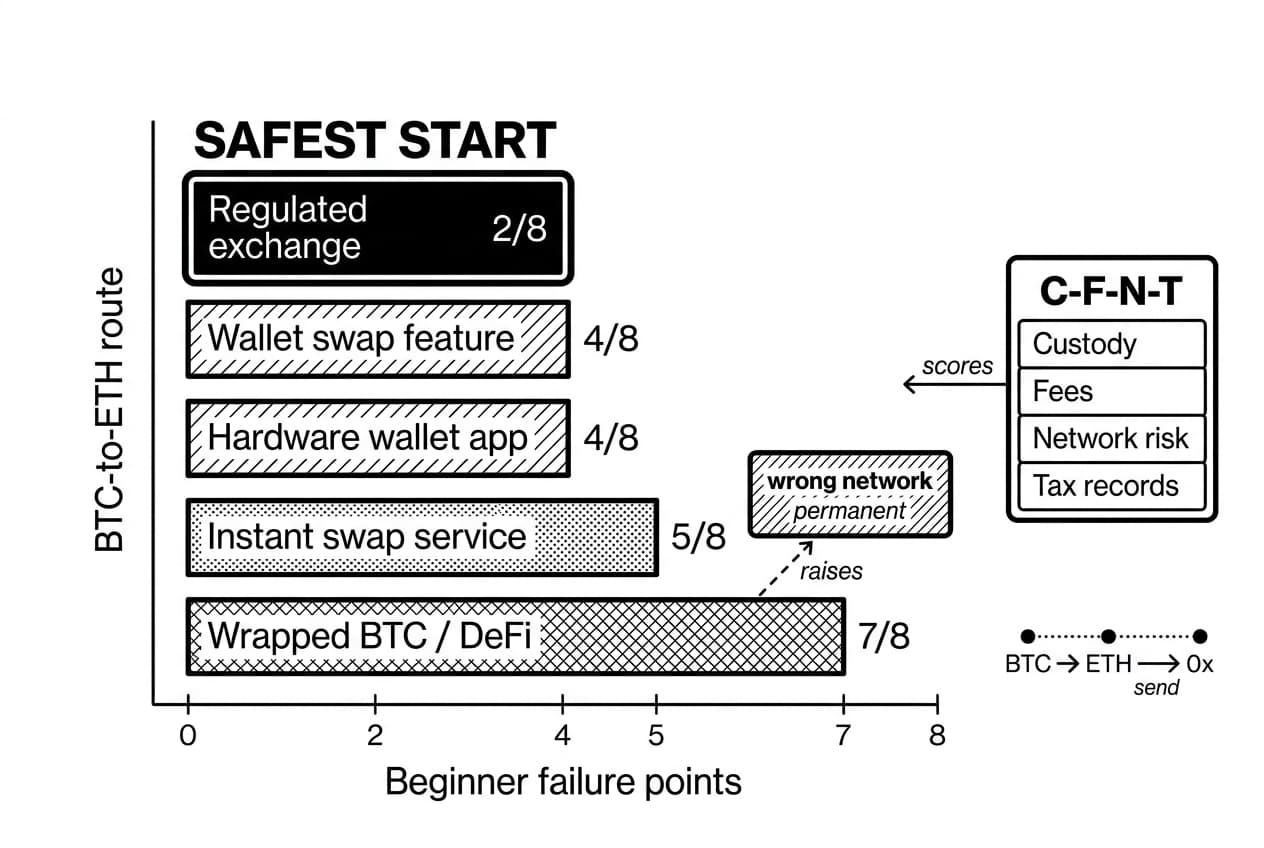
The safest beginner route in 2026 is usually a regulated exchange such as Coinbase or Gemini, especially if you are still learning how addresses, confirmations, and withdrawals work. A wallet swap can also work, but you must read the provider, spread, destination address, and network fields before approving anything.
Use the C-F-N-T check before you swap
For this guide, as of July 22, 2026, we scored five BTC-to-ETH routes with an original C-F-N-T framework: custody, fees, network risk, and tax record quality. A lower score means fewer beginner failure points, not a guarantee of profit or safety.
Route | Beginner failure points scored | Best use |
|---|---|---|
Regulated exchange | 2 of 8 | First BTC-to-ETH swap with support and clear records |
Wallet swap feature | 4 of 8 | Small self-custody swaps when you already understand wallets |
Hardware wallet app | 4 of 8 | Security-focused users who verify provider details |
Instant swap service | 5 of 8 | Speed, if you accept more provider and quote risk |
Wrapped BTC or DeFi route | 7 of 8 | Advanced users who need BTC exposure inside Ethereum apps |
Erik Voorhees, founder of ShapeShift, is a useful reference point for the self-custody side of this decision because ShapeShift has long focused on user-controlled swaps. For a beginner, though, self-custody should not mean rushing past address checks or tax records.
What you’ll need before you swap BTC to ETH
Before you open a trade screen, make sure you have the basics ready. Most errors happen when people create a wallet, copy an address, and approve a swap while under time pressure.
- A BTC balance in an exchange account or a wallet you control.
- A verified exchange account if you plan to use a regulated platform.
- An Ethereum-compatible wallet address if you plan to withdraw ETH after the trade.
- Two-factor authentication on any account that will hold funds.
- A small fee buffer for trading fees, BTC network fees, ETH withdrawal fees, and later gas costs.
- A record-keeping plan for the date, BTC amount, ETH amount, USD value, and fees.
BTC and ETH live on different blockchains. Your BTC address and your ETH address are not interchangeable. If you are unsure what ETH is and how gas fees work, review that first so the withdrawal screen makes sense.
Prerequisites: wallet, ID, and account safety
If you use an exchange, finish identity verification before depositing BTC. Add a strong password and an authenticator app. Do not rely on email alone for account recovery because email accounts are common attack targets.
For the regulated-exchange model, Brian Armstrong, co-founder and CEO of Coinbase, is a relevant public operator to cite because Coinbase is built around verified accounts, listed trading pairs, and exportable transaction histories. That convenience reduces some beginner risk, but it also means the platform holds your assets during the swap.
If you use self-custody, your seed phrase is the key to your funds. Write it offline, store it away from your phone and computer, and never type it into a website that asks for it. If you are still choosing between account custody and private-key custody, read custodial vs non-custodial wallets before moving funds.
Pro tip: Prepare your ETH wallet before the swap. Copy the receiving address, paste it into a notes file for checking, and compare the first four and last four characters before you withdraw. If your wallet app has a blue Receive button in the top right, use that screen to copy the address instead of typing it by hand.
Bitcoin blocks target about 10 minutes per block in the protocol design (Bitcoin white paper, October 2008). Ethereum blocks are produced roughly every 12 seconds under proof of stake (ethereum.org, accessed July 22, 2026). These timings explain why your BTC deposit often takes longer than your ETH withdrawal.
Choose the best swap method for your situation
The best method depends on your comfort with custody and your tolerance for extra steps. A cheap-looking quote is not always cheaper after spread, network fees, withdrawal fees, and tax tracking are included.
Compare exchange, wallet, hardware app, instant service, and wrapped BTC routes
Method | Best for | Custody | KYC | Fee sources | Speed | Beginner risk |
|---|---|---|---|---|---|---|
Centralized exchange | First-time swappers who want clear screens and support | Platform holds funds during the trade | Yes | Trading fee, spread, withdrawal fee | Minutes after BTC deposit clears | Low, but platform risk remains |
Wallet swap | Users who already understand self-custody | You hold keys, provider handles route | Sometimes | Provider fee, spread, network fees | Minutes to an hour | Medium |
Hardware wallet app | Security-focused users using a signing device | You approve from your device | Provider-dependent | Provider spread, service fee, network fees | Minutes to an hour | Low to medium |
Instant swap service | Small swaps when speed matters more than records | Temporary provider custody during execution | Sometimes | Spread, service fee, network fees | Often under 30 minutes after deposit | Medium |
Wrapped BTC or DeFi route | Advanced users who need BTC exposure inside Ethereum apps | You manage the wallet, contracts handle execution | No for most protocols | Bridge cost, liquidity pool fee, gas, slippage | Variable | High |
Most beginners should start with a centralized exchange for the first swap. You give up custody during the trade, but you gain clearer confirmations, exportable records, and fewer wrong-network choices. For the tradeoff, see hardware wallet vs exchange custody.
If you prefer a wallet route, check the official fee page before you approve. MetaMask says its swap feature includes a 0.875% service fee on swaps (MetaMask support, accessed July 22, 2026). That fee can be reasonable for convenience, but it is not the same as a zero-cost trade.
Warning: wrapped BTC is not the same as native BTC
Wrapped BTC is a token on Ethereum that tracks bitcoin value through a custodian or bridge design. It is useful in DeFi, but it is not native BTC. You add smart-contract risk, custodian risk, and extra tax record complexity.
For Ethereum design context, Vitalik Buterin, co-founder of the Ethereum Foundation, is the approved expert to cite here because Ethereum exists to run programmable applications, not to host native BTC directly. If your goal is simply to hold ETH and pay gas, a direct BTC-to-ETH swap is simpler than wrapping.
Step 1: compare the BTC/ETH rate, fees, and slippage
Before confirming, read the full quote screen. The headline exchange rate is only one part of the cost. You care about the ETH that will actually arrive after spread, service fees, network fees, and slippage.
What to check before confirming a BTC to ETH quote
- Live rate: Compare the quoted BTC/ETH rate with a public market page at the same moment.
- Estimated ETH received: This is the number that matters most.
- Spread: Check whether the provider rate is worse than the mid-market rate.
- Platform fee: Look for a percentage fee or flat fee.
- Network fee: BTC fees apply when sending BTC; ETH gas applies when moving ETH.
- Withdrawal fee: Some exchanges charge a separate fee to send ETH to your wallet.
- Quote expiry: Many quotes refresh quickly, so do not approve an expired number.
- Minimum received: This is your slippage safety floor.
Use public price pages only as a reference, not as a promise. If two providers show very different ETH received for the same BTC amount, the worse quote may be hiding its cost in the spread.
Read the preview screen before you approve
On an exchange, click Preview, Review, or Review order before confirming. On a wallet app, read the provider name, minimum received, destination address, and expiry timer. If your app shows a blue Confirm button in the lower right, pause on that screen until every field matches your plan.
Transparent routing matters. Hayden Adams, founder of Uniswap Labs, is relevant here because decentralized swap interfaces made minimum received, liquidity source, and slippage settings visible to ordinary users. You should expect the same plain disclosure from any BTC-to-ETH provider.
Pro tip: Test a new provider with a small amount first, such as $10 to $20 of BTC (Consumer Financial Protection Bureau, accessed July 22, 2026). The dollar amount is not magic; the point is to confirm the route and address before risking your full balance.
Step 2: open your exchange or wallet swap screen
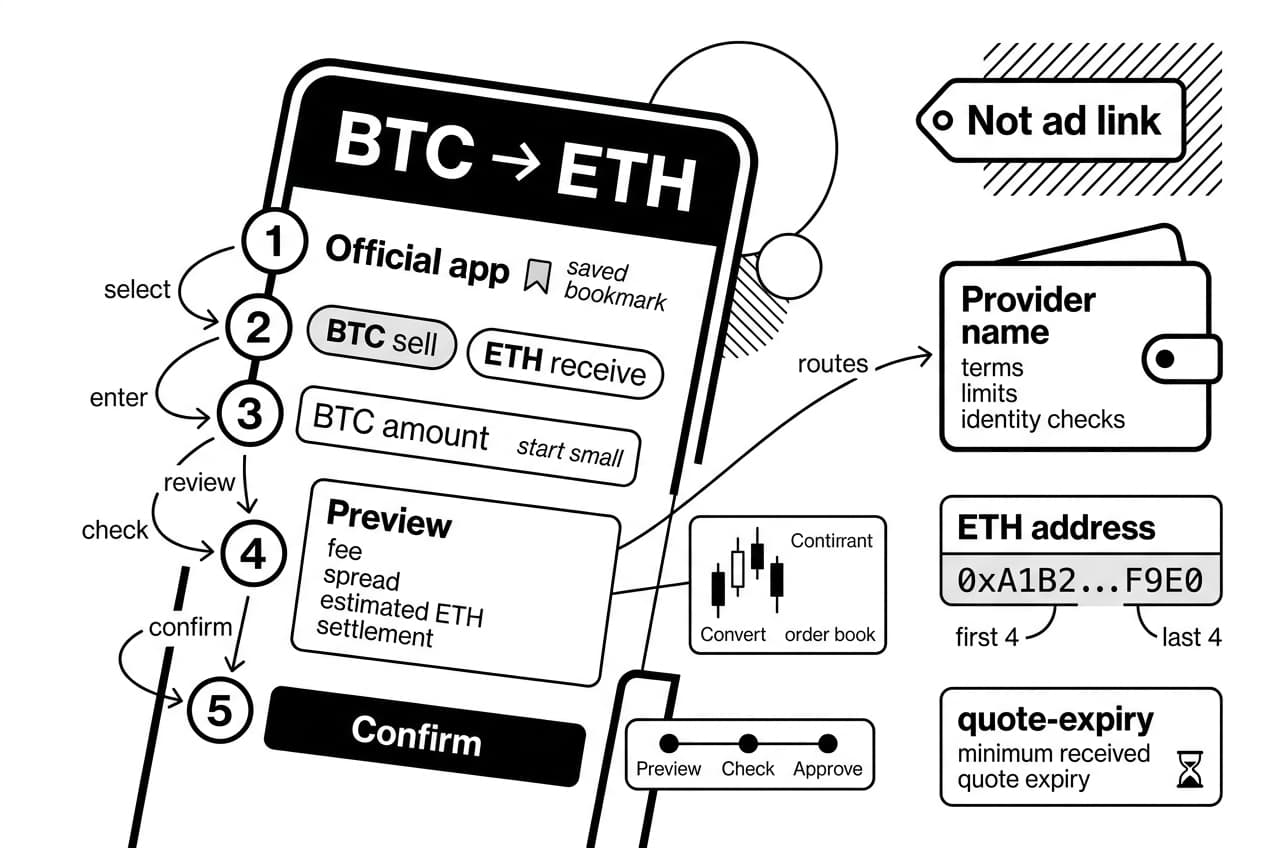
Now open the platform you chose. The screens differ, but the logic is the same: select BTC as the asset you are selling, select ETH as the asset you want, enter the amount, review the quote, and confirm only after checking the address and fees.
On a centralized exchange
- Log in from a saved bookmark or the official mobile app, not from an ad link.
- Open the Trade, Convert, or Advanced trade screen.
- Select BTC as the source asset and ETH as the asset to receive.
- Enter the BTC amount. Start small if this is your first swap.
- Click Preview or Review order.
- Check the fee, spread, estimated ETH, and settlement details.
- Click the final Confirm button only if the numbers still match your plan.
Warning: If the exchange offers both a simple convert screen and an advanced order book, compare them. The simple screen may be easier, while the order book may offer better control over price and fees.
In a self-custody wallet or hardware wallet app
Wallet tools usually route your order through a third-party provider. That provider may have its own terms, fees, limits, and identity checks. The wallet interface is not the same as the swap counterparty.
- Open the wallet swap area and choose BTC to ETH.
- Confirm the provider name shown on the quote screen.
- Check whether identity verification may be requested before completion.
- Paste your ETH receiving address and compare the first four and last four characters.
- Read the minimum received and quote expiry fields.
- Approve the swap from your wallet or device only after all fields are correct.
If you store assets on a signing device, use the official app from the manufacturer and confirm the transaction details on the device screen. For setup help, use how to set up a Ledger wallet. If you are comparing device options, see this hardware wallet model comparison.
Step 3: send BTC and wait for confirmation
After you confirm the quote, the provider or exchange may show a BTC deposit address. Copy it exactly. Paste it into your sending wallet, enter the same BTC amount, and click the blue Send button if that is how your wallet labels the final action.
Check the network before sending
Use the native Bitcoin network unless the platform gives a clear, supported alternative. A valid BTC address commonly starts with 1, 3, or bc1. If the address starts with 0x, stop because that is an Ethereum-style address.
Most platforms wait for confirmations before crediting your deposit. Many services require 1 to 3 BTC confirmations before a swap proceeds (Coinbase help, accessed July 22, 2026). Since bitcoin targets about 10 minutes per block, a normal wait can be 10 to 30 minutes, and congestion can take longer.
Warning: wrong-network transfers can be permanent. Sending BTC to an ETH address, or ETH to a BTC address, can lead to unrecoverable loss. Support teams often cannot reverse a confirmed blockchain transaction. Read the address aloud in chunks before you send.
After broadcasting, save the transaction ID. If your wallet lets you add a note, label it BTC-to-ETH swap with the platform name and date. That small note helps when you export records later.
Step 4: verify, withdraw, and secure your ETH
The swap is not finished when the progress bar reaches 100 percent. You still need to confirm the ETH arrived on the right network and decide where to store it.
Confirm ETH arrived on the right network
Open your exchange account or wallet and check the ETH balance directly. Copy the transaction hash and paste it into Etherscan. Confirm the receiving address, amount, and network are correct.
Ethereum completed its shift to proof of stake on September 15, 2022 (ethereum.org, September 2022). Since then, ETH transfers often appear quickly, but wallet displays can still lag. If your balance is missing, check the block explorer before assuming the funds failed.
Warning: Make sure you are viewing Ethereum mainnet, not a test network or a different chain. ETH on the wrong chain may not appear in your wallet until you add that network, and some mistaken withdrawals cannot be recovered.
Secure ETH in self-custody when appropriate
If you swapped on an exchange and plan to hold ETH, consider withdrawing to a wallet you control. For small active trading balances, leaving funds on an exchange may be convenient. For larger long-term balances, private-key control reduces platform account risk.
Erik Voorhees, founder of ShapeShift, is often cited for the self-custody principle that owning crypto means controlling the keys. That principle is powerful, but it comes with responsibility: if you lose the seed phrase, there is no password reset.
For the cheapest ETH acquisition routes after your first swap, compare fees with cheapest ways to get Ethereum. For storage, use an offline seed backup and keep screenshots away from cloud storage.
Costs, timing, taxes, and mistakes to avoid
A BTC-to-ETH swap can create four costs: trade fee, spread, network fee, and tax impact. Your goal is not to find a fake zero-fee button. Your goal is to know the full cost before you approve.
Typical fee categories to check
- Trading fee: Charged by the exchange or provider for executing the swap.
- Spread: The hidden gap between the market price and your quoted price.
- BTC network fee: Paid when you send BTC to the provider or exchange.
- ETH gas: Paid when ETH moves on Ethereum.
- Withdrawal fee: Charged by some platforms when you move ETH out.
- Card or bank fee: Applies only if you buy crypto before swapping.
Gas changes with demand, so check a live gas tool before withdrawing. You can use Etherscan gas tracker for a current view. If gas is high and your swap is not urgent, waiting may reduce the final cost.
Tax implications
In many jurisdictions, swapping BTC for ETH is treated as selling BTC and buying ETH. The IRS stated that virtual currency is treated as property in Notice 2014-21 (IRS, March 25, 2014). Later IRS virtual currency FAQs also discuss gains and losses on crypto transactions (IRS, accessed July 22, 2026).
Save the date, BTC amount, ETH amount, USD value, fees, platform, and transaction IDs. If you bought BTC in several batches, cost basis can get messy. A crypto tax accountant can help you avoid guessing.
Common beginner mistakes
- Chasing a headline rate: Compare estimated ETH received, not just the BTC/ETH quote.
- Ignoring the spread: A "0% fee" swap can still be expensive if the provider widens the rate.
- Sending to the wrong network: BTC does not go to an 0x address.
- Skipping two-factor authentication: Add it before depositing funds.
- Approving an expired quote: Refresh and review again if the timer runs out.
- Forgetting records: Export CSV files and save transaction hashes the same day.
- Leaving too much on an exchange: Move long-term ETH to a wallet if you are ready for self-custody.
Can bitcoin be used on Ethereum instead of swapped?
Native BTC cannot run inside Ethereum contracts. The two networks have different assets, address formats, and consensus systems. You can, however, use tokenized BTC on Ethereum if you accept the extra risks.
Wrapped BTC represents bitcoin exposure as an Ethereum token. That can be useful in lending apps, liquidity pools, or other DeFi tools. It does not let you pay Ethereum gas, and it is not the same as holding native BTC.
Wrapped BTC vs selling BTC for ETH
Goal | Better route | Why |
|---|---|---|
Keep bitcoin price exposure while using DeFi | Use wrapped BTC | You keep BTC-like exposure inside Ethereum apps. |
Pay Ethereum gas fees | Swap BTC for ETH | Only ETH pays gas on Ethereum mainnet. |
Buy NFTs or stake ETH | Swap BTC for ETH | Those actions generally require native ETH. |
Provide liquidity in a BTC/ETH pool | Use wrapped BTC plus ETH | The pool needs Ethereum-based tokens. |
The simple rule is this: use wrapped BTC if you want BTC-like exposure inside Ethereum apps, and swap to ETH if you need ETH itself. For DeFi examples, see DeFi apps for swaps and earning.
Wrapping can still create tax and counterparty questions. Treat it as an advanced route, not a shortcut for a first BTC-to-ETH swap.
Frequently Asked Questions
- What are the benefits of converting BTC to ETH?
- Converting BTC to ETH gives you access to the Ethereum ecosystem — including DeFi protocols, NFT platforms, staking, and smart contract applications. ETH is also required to pay gas fees on Ethereum. Keep in mind this shifts your market exposure from Bitcoin to Ethereum, which comes with its own opportunities and risks.
- Is it better to trade BTC or ETH?
- This depends entirely on your goals and risk tolerance. BTC is widely seen as a digital store of value with deep liquidity, while ETH is closely tied to Ethereum network activity, gas demand, DeFi growth, and staking yield. Both have different market cycles and use cases, so the right choice varies by individual.
- Can Bitcoin be used on Ethereum?
- Native BTC cannot run directly on the Ethereum network. To use Bitcoin-like exposure in Ethereum apps, you need wrapped tokens such as WBTC, which represent BTC through custodians or bridges. These introduce additional risks including smart contract vulnerabilities and counterparty trust. For paying Ethereum gas fees, you still need actual ETH.
- Is converting BTC to ETH taxable?
- In many countries, swapping one cryptocurrency for another is treated as a taxable disposal, potentially triggering capital gains or losses. A BTC-to-ETH conversion is typically no exception. Tax rules differ significantly by jurisdiction, so keep detailed records of the transaction date, values, cost basis, and fees — and consult a qualified tax professional.
Sources
Author

Crypto analyst and blockchain educator with over 8 years of experience in the digital asset space. Former fintech consultant at a major Wall Street firm turned full-time crypto journalist. Specializes in DeFi, tokenomics, and blockchain technology. His writing breaks down complex cryptocurrency concepts into actionable insights for both beginners and seasoned investors.