How to Mine Ethereum Classic: Complete ETC Mining Guide
How to mine Ethereum Classic: complete ETC mining guide
This guide shows you how to mine Ethereum Classic in 2026 without confusing it with Ethereum after the merge. You will set up a wallet, check your power cost, choose software, join a pool, start the miner, and decide whether the numbers justify buying or running hardware.
What you’ll accomplish in this Ethereum Classic mining guide
By the end, you will have a repeatable setup checklist, a safe payout address, a pool configuration, and a breakeven method you can reuse before every hardware purchase. The main lesson is simple: miner software matters, but electricity price and hardware depreciation usually decide whether ETC mining pays.
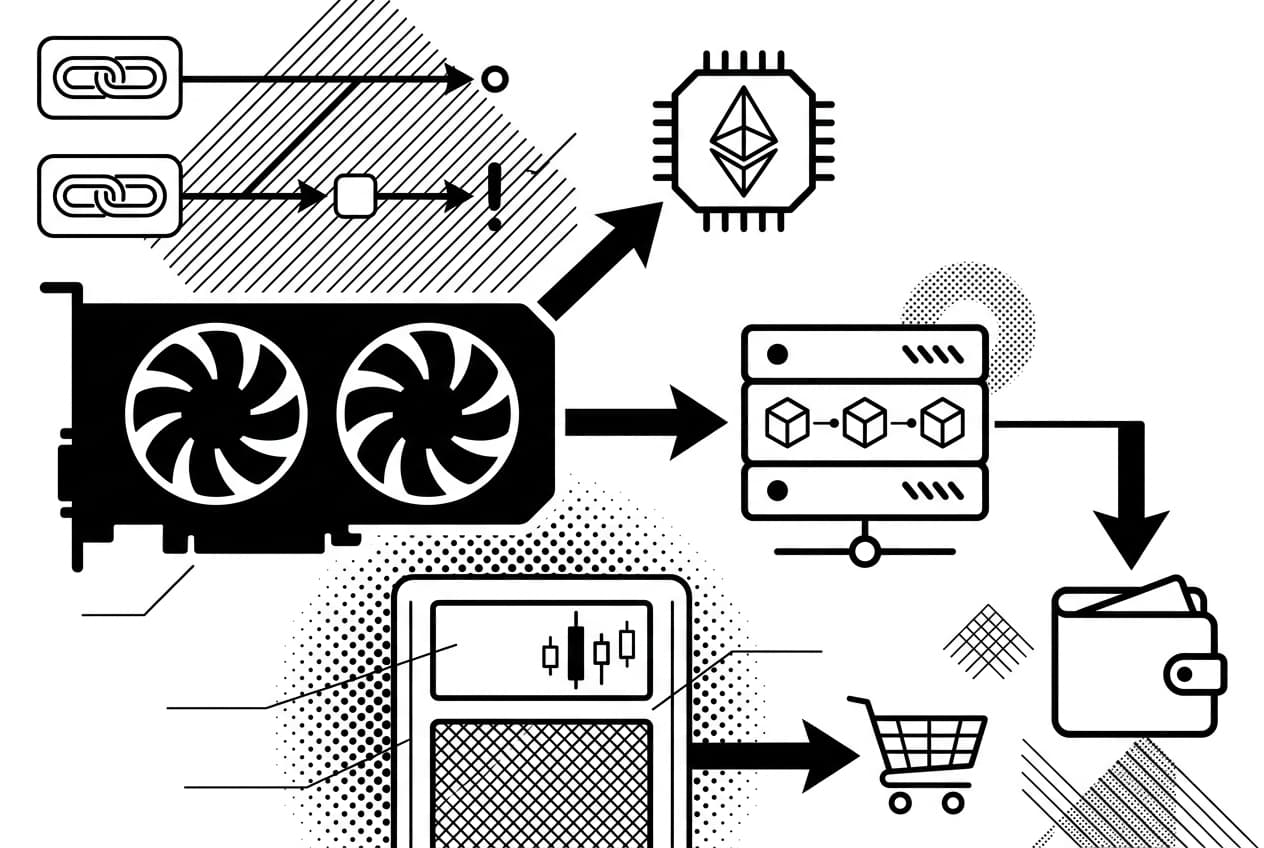
Ethereum and Ethereum Classic are separate networks. Ethereum moved from proof of work to proof of stake on 15 September 2022 (ethereum.org merge page, 2022), so ETH cannot be mined anymore. Ethereum Classic kept proof of work, which is why GPUs can still mine ETC.
For historical context, Vitalik Buterin, co-founder at the Ethereum Foundation, is tied to Ethereum’s post-merge network, while Gavin Wood, co-founder of Ethereum and founder of Polkadot, is part of the early Ethereum lineage. That history matters because old Ethereum mining guides often appear in search results, but they no longer apply to ETH.
If the breakeven math says mining is not worth it for you, you can still learn how to buy Ethereum Classic instead of spending money on GPUs.
Why Ethereum Classic is still mineable in 2026
Ethereum Classic exists because of the 2016 DAO split. The Ethereum Classic site documents the chain’s choice to continue the original proof-of-work chain after the rollback debate (ethereumclassic.org history, 2016).
ETC uses Etchash, a proof-of-work algorithm related to Ethash. Your GPU performs hashing work, submits valid shares to a pool, and receives ETC when the pool pays out. ETH, by contrast, uses validators and staked capital rather than GPU work.
Our contrarian view for 2026: do not treat ETC mining as passive income until you run a power-cost and depreciation check. A rig that works at $0.06 per kWh can lose money at $0.18 per kWh even if the hashrate is identical.
What you’ll need before you mine Ethereum Classic
Before you install anything, collect every required item. Most first-time losses come from skipped basics, such as using the wrong chain address, choosing the wrong pool port, or running a card without enough cooling.
To mine Ethereum Classic, you need:
- An ETC wallet address: self-custody is preferred, because this is where pool rewards arrive.
- GPU hardware: a desktop GPU with at least 4 GB of VRAM, because the Etchash DAG is about 3.0 GB as of the etcwiki Etchash page (etcwiki, 2024).
- Mining software: examples include lolMiner, TeamRedMiner, T-Rex, or GMiner.
- A mining pool: solo mining is too unpredictable for most home miners.
- Your electricity rate: use the cents-per-kWh line from your utility bill.
- A stable internet connection: wired Ethernet is better than wifi for avoiding stale shares.
- Cooling: keep the room near or below 27°C and give each GPU open airflow.
Warning: Do not mine ETC on a laptop, integrated graphics, or an office PC. Sustained mining heat can damage hardware, and the electricity cost will usually exceed the payout.
Ethereum Classic mining hardware requirements
For beginners, 6 GB and 8 GB GPUs are the practical starting point in 2026. Cards with less than 4 GB of VRAM are not suitable for Etchash. Used cards can work, but only if the price leaves room for depreciation and possible fan replacement.
The table below gives planning ranges, not guaranteed output. Use it for a first estimate, then verify your exact card model with live benchmarks and your wall-meter readings.
GPU | VRAM | Planning hashrate | Typical tuned draw | Notes |
|---|---|---|---|---|
AMD RX 6600 XT | 8 GB | about 32 MH/s | about 70 to 90 W | Efficient starter card |
AMD RX 580 8 GB | 8 GB | about 30 MH/s | about 120 to 150 W | Cheap used, less efficient |
Nvidia RTX 3060 | 12 GB | about 26 MH/s | about 100 to 130 W | Easy to configure |
Nvidia GTX 1080 Ti | 11 GB | about 36 MH/s | about 170 to 210 W | High draw, check power cost |
AMD RX 7600 | 8 GB | about 34 MH/s | about 90 to 120 W | Good efficiency if priced well |
These ranges are based on public GPU mining benchmark listings (hashrate.no GPU benchmark database, 2025). Your real number can differ because of memory brand, driver version, room temperature, power limit, and miner settings.
Your power supply should be rated at least 20% above the measured wall draw of the full system. If your rig pulls 500 W at the wall, use a quality PSU rated for at least 600 W. Cheap power supplies are a bad place to save money.
Ethereum Classic wallet requirements
You need a working ETC wallet before you edit a miner config file. The pool reads this address to credit your rewards, and a wrong address can make payouts unrecoverable.
For testing, a software wallet that supports Ethereum Classic can work. For meaningful balances, move payouts to a hardware wallet. Our Ledger vs Trezor hardware wallet comparison explains the tradeoffs, and our hardware wallet vs exchange storage guide explains why miners should avoid leaving balances on exchanges.
Never use an exchange deposit address unless the exchange clearly supports ETC mining payouts. Exchanges can change deposit instructions, pause ETC deposits, or reject pool-style payments.
Step 1: check whether ETC mining is profitable for you
Start with the numbers before you buy hardware. This is the most important step in learning how to mine Ethereum Classic because a correct setup can still lose money if power is too expensive.
Use a mining calculator such as minerstat ETC calculator or WhatToMine, then verify every input yourself. ETC block rewards reduce every 5,000,000 blocks, and the Spiral era reward is 2.56 ETC per block (ethereumclassic.org Spiral upgrade note, 2024).
Input | What it means | Where to find it |
|---|---|---|
Hashrate | Your GPU speed in MH/s | Miner console, pool dashboard, or benchmark database |
Power draw | Total watts at the wall | Plug-in watt meter or smart plug |
Electricity price | Your cost per kWh | Utility bill; compare with the 13 cents per kWh U.S. residential reference from EIA electricity monthly, 2025 |
Pool fee | Pool cut before payout | Pool fee page; 2Miners lists 1% for ETC pool mining (2miners ETC pool page, April 2026) |
Miner fee | Developer fee inside the miner | Official miner release notes |
ETC price | Market price used for revenue | CoinGecko ETC page, live 2026 |
Network difficulty | How much mining competition exists now | 2miners ETC network stats, live 2026 |
Calculate revenue, power cost, and breakeven
Use this formula before spending money:
Daily profit = ETC revenue minus electricity cost minus pool fee minus miner fee minus hardware depreciation.
Hardware depreciation is easy to ignore and expensive to miss. If a GPU costs $400 and you expect two years of mining life, depreciation is about $0.55 per day before power cost. That number belongs in your calculation.
Use the rate-first breakeven framework: first check electricity cost, then hardware depreciation, then hashrate, then fees. Software choice comes last because a 1% miner fee rarely matters as much as a high power bill.
Worked worksheet: a 32 MH/s GPU at 120 W uses 2.88 kWh per day. At $0.13 per kWh, the power cost is about $0.37 per day before fees (EIA electricity monthly, 2025). Add the $0.55 daily depreciation example above, and your setup needs more than $0.92 per day in gross revenue just to break even.
If your local rate is high, compare ETC mining with alternative ways to earn with GPU power before you buy more cards.
Warning: hashrate alone does not mean profit
Two GPUs can show similar hashrate and deliver very different results. A card at 32 MH/s and 120 W can beat a card at 33 MH/s and 220 W after electricity, even though the second card looks faster in a miner console.
Track MH per watt. If rejected shares are low and the card is stable, the more efficient card is usually the better mining card.
Step 2: choose and secure an Ethereum Classic wallet
Before your miner earns a payout, you need a safe place to receive ETC. This step prevents two common mistakes: sending ETC to the wrong chain and letting pool rewards accumulate at a risky address.
Create or open a wallet that explicitly supports Ethereum Classic. Select Ethereum Classic, not Ethereum, before copying the address. ETC addresses often start with 0x, which can look like an Ethereum address, so the network label matters.
Write your seed phrase offline the moment you create the wallet. Store it away from your rig. Heat, dust, failed drives, and accidental reformats are boring causes of permanent coin loss.
Copy your ETC wallet address correctly
- Open your wallet app.
- Select Ethereum Classic from the asset list.
- Click or tap Receive.
- Copy the full address.
- Paste it into a plain text file named etc-wallet-address.
- Compare the first four and last four characters with the wallet display.
- Never retype the address by hand.
Keep that text file open while you configure the miner. Copying once from a verified file is safer than switching windows and guessing under pressure.
Pro tip: send a small test payout first
Set the pool payout threshold to the lowest practical level for your pool. For example, 2Miners lists a 0.01 ETC minimum payout on its ETC pool page (2miners, April 2026). Wait for the first small payout before raising the threshold.
After it arrives, confirm the transaction in your wallet history and compare the receiving address. This test proves the wallet, pool, and miner configuration all match.
Step 3: select Ethereum Classic mining software
Mining software runs Etchash on your GPU and sends shares to the pool. Pick software that supports your GPU, your operating system, and Etchash specifically.
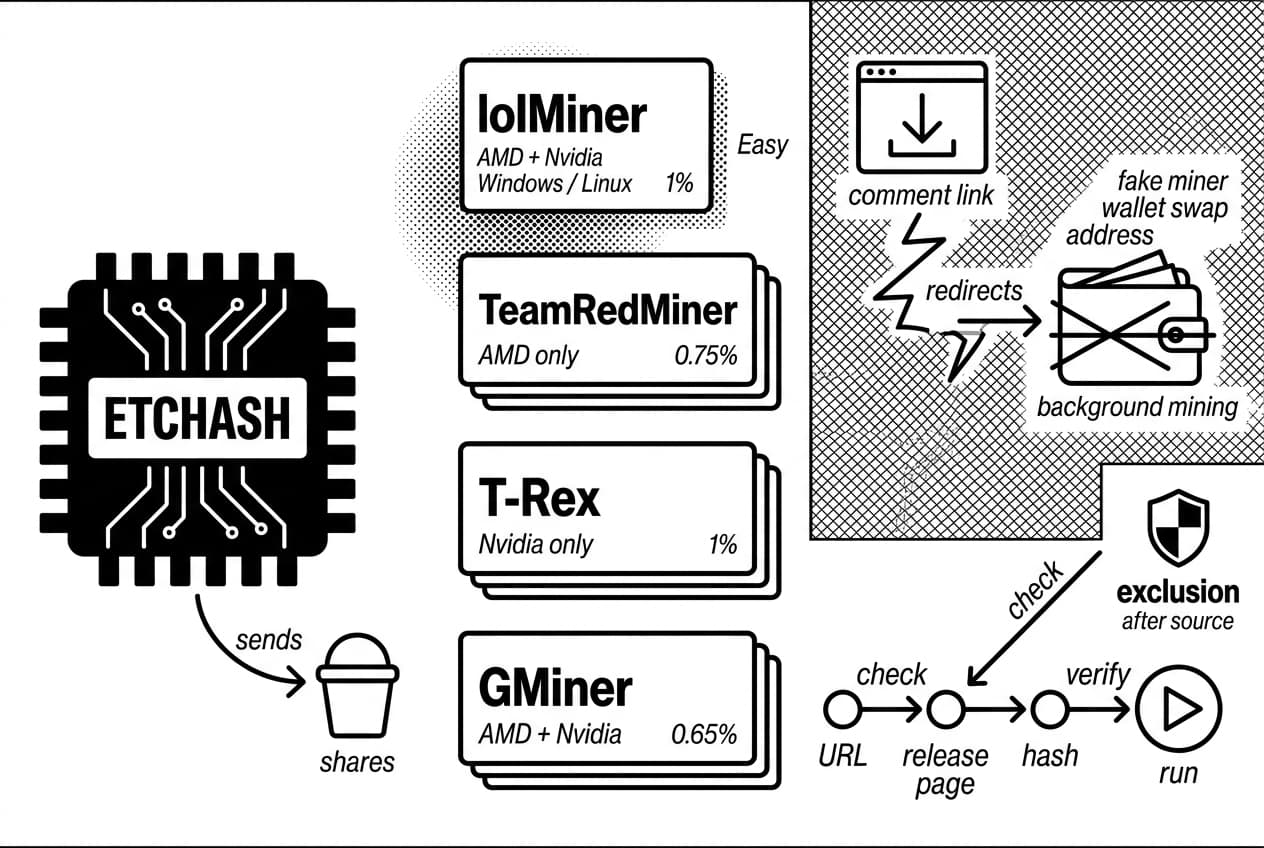
Best mining software for ETC in 2026
Miner | GPU support | Operating systems | Dev fee | Beginner fit |
|---|---|---|---|---|
lolMiner | AMD and Nvidia | Windows, Linux | 1% | Easy |
TeamRedMiner | AMD only | Windows, Linux | 0.75% | Medium |
T-Rex | Nvidia only | Windows, Linux | 1% | Easy |
GMiner | AMD and Nvidia | Windows, Linux | 0.65% | Medium |
For most beginners, lolMiner is a friendly first choice because the config files are readable and errors are easier to understand. If you run only AMD cards, TeamRedMiner can be efficient after tuning. If you run only Nvidia cards, T-Rex is a common choice.
Download only from the project’s official release source. For example, lolMiner publishes releases on its official repository (lolMiner release repository, 2026). Do not use download links from comments, chats, or ads.
Warning: avoid fake miner downloads
Fake miners can replace your wallet address, redirect shares, or install unwanted background mining. Before running a file, check the URL, read the release page, and verify the file hash if the developer publishes one.
Antivirus tools often flag miners because mining behavior resembles malware behavior. Add an exclusion only after you confirm the file source. Never disable security software globally just to make a miner run.
Step 4: join an Ethereum Classic mining pool
After your wallet and software are ready, choose where your hashrate goes. A pool gives you smaller, more regular payouts than solo mining.
A mining pool for Ethereum Classic combines miners’ hashrate and distributes rewards according to contributed shares. This makes payouts more predictable than solo mining because you receive a proportional share when the pool finds blocks, instead of waiting for your own small rig to find a block alone.
Pool mining vs solo mining
Solo mining means your hardware competes alone against the whole network. If you find a block, you receive the block reward, but a small home rig may wait an extremely long time.
Pool mining spreads that luck across many miners. For one to ten GPUs, pool mining is usually the practical choice because cash flow is steadier and troubleshooting is easier.
How to pick a pool server
Use the four-point pool check before connecting:
- Server location: choose the closest regional stratum server to reduce stale shares.
- Pool fee: compare the fee with expected uptime and payout method. Many ETC pools sit near 1%, while F2Pool lists a 3% PPS fee on its fee page (f2pool fee page, 2026).
- Payout method: PPLNS suits steady miners; PPS offers steadier per-share accounting but can cost more.
- Minimum payout: lower thresholds reduce how long your coins sit with the pool. Common thresholds range from 0.01 ETC to 1 ETC, depending on the pool.
Popular ETC-compatible pools include 2Miners, ETCMC pool, and F2Pool. Confirm ETC is active on the pool dashboard before copying the stratum address.
Pool | Typical fee | Payout method | Minimum payout | Server regions |
|---|---|---|---|---|
2Miners | 1% | PPLNS or SOLO | 0.01 ETC | U.S., Europe, Asia |
F2Pool | 3% | PPS | Check account page | Global |
ETCMC pool | Check pool page | PPLNS | Check pool page | Regional servers vary |
Copy the exact stratum URL and port from the pool page. A typical format looks like etc.2miners.com:1010, but you must use the address your chosen pool provides.
Step 5: configure and start your ETC miner
Now connect the pieces: miner software, pool URL, wallet address, and worker name. Slow down here. One wrong character can cost hours of troubleshooting or send rewards to the wrong place.
Follow this setup process:
- Download miner software.
- Unzip files into a dedicated folder.
- Edit the config or batch file in a plain text editor.
- Paste the pool URL.
- Paste your ETC wallet address.
- Add a worker name.
- Save the file.
- Run the miner.
- Confirm accepted shares.
Enter your pool URL, wallet address, and worker name
Your config line will look similar to this:
miner.exe --pool stratum+tcp://POOL_URL:PORT --wallet YOUR_ETC_ADDRESS --worker rig1 --pass x- Pool URL and port: copy from the pool setup page, including the port number.
- Wallet address: paste the ETC receiving address you verified in step 2.
- Worker name: use a short label such as
garage-rigorrx6600-1. - Password: many pools use
x, but check the pool instructions.
Save the file after editing. If the miner opens and instantly closes, reopen the file from a command prompt so you can read the error message instead of guessing.
Confirm shares are being accepted
Watch the console during the first two minutes. You want to see accepted shares, a stable hashrate, reasonable temperature, and no repeating connection errors.
- Accepted shares: the pool recorded valid work.
- Rejected shares: a few can happen at startup, but repeated rejections need attention.
- Stale shares: your share arrived too late, often because of latency.
- Temperature: keep core temperature below 80°C under load.
- Power draw: compare wall watts with your breakeven worksheet.
If rejected shares stay above 2%, roll back the memory overclock, confirm Etchash is selected, and switch to a closer pool server. Do not keep mining for days with a high reject rate.
Pro tip: name each rig clearly
Use names that identify the physical machine. rig1 is better than a blank name, but garage-3060ti is better when a card drops offline at night.
Keep worker names lowercase and avoid spaces. Some dashboards ignore names with symbols, which can make a working rig look invisible.
Step 6: monitor, optimize, and maintain your mining setup
Getting the miner online is only the start. Profit comes from watching efficiency, cooling, payouts, and rejected shares every week.
Check these metrics daily during the first two weeks:
- Hashrate: a sudden 20% to 30% drop often means a driver crash, throttling, or unstable settings.
- GPU temperature: keep core temperature below 80°C and memory junction temperature below 95°C.
- Fan speed: constant 85% fan speed means you need better airflow or a lower power limit.
- Wall power: measure with a plug-in meter, not only the software estimate.
- Rejected shares: keep this below 2% if possible.
- Payouts: confirm each payout appears in your ETC wallet after the threshold is reached.
Optimize for efficiency, not maximum hashrate
Chasing the highest hashrate often raises wattage faster than revenue. Instead, tune for watts per MH/s.
Use the plateau-then-cut framework:
- Set the power limit to 70% to 80% of the card’s rated draw.
- Raise memory clock in 50 MHz steps until hashrate stops improving or errors appear.
- Lower voltage gradually and test for 30 minutes at each setting.
- Back off one step from the first unstable setting.
Document every change in a small log: date, memory clock, power limit, wall watts, hashrate, rejected shares, and temperature. That generated dataset is your evidence when deciding whether a change actually helped.
Airflow matters as much as software tuning. Adding exhaust behind a GPU can reduce heat stress, and a cooler card is more likely to hold a stable hashrate through summer.
Common ETC mining errors and fixes
Error | Likely cause | Fix |
|---|---|---|
No payouts arrive | Wrong ETC wallet address | Compare every character and check the pool dashboard payout page. |
Miner will not connect | Wrong pool port or SSL mismatch | Use the exact port listed by the pool for your miner. |
Miner closes on launch | Antivirus quarantine or bad config syntax | Open from a command prompt and read the error line. |
Rejected shares above 2% | Unstable overclock or high latency | Reduce memory clock by 50 MHz and choose a closer server. |
GPU throttles | Heat or power limit problem | Improve airflow, lower power, and clean dust from fans. |
Zero hashrate | Wrong algorithm | Select Etchash for ETC, not Ethash for old ETH mining guides. |
Track taxes, records, and payouts
Mined crypto may be taxable income when received, depending on where you live. The IRS has treated mined virtual currency as income since Notice 2014-21 (IRS virtual currency guidance, 2014).
Keep a spreadsheet with payout date, ETC amount, USD value, pool, wallet address, electricity bill, and hardware receipts. If your operation grows beyond a hobby, speak with a crypto tax accountant before year-end.
Recheck profitability at least weekly. ETC price, difficulty, and power rates move, so a profitable January setup can become unprofitable later without any hardware change.
Summary and next steps
You now know the full ETC mining loop: check profitability, secure a wallet, pick software, join a pool, configure the miner, and monitor the setup. Repeat that sequence every time you change a GPU, pool, power plan, or payout address.
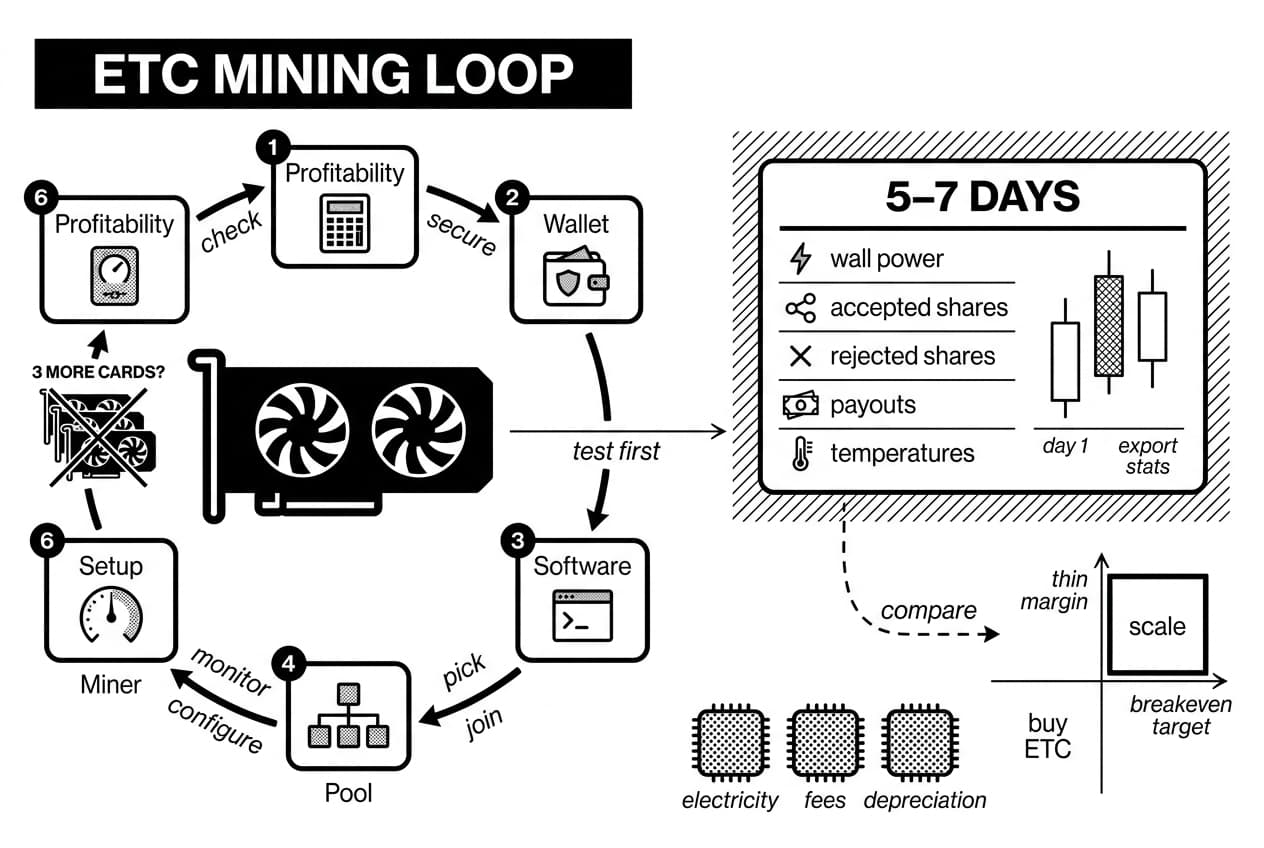
The safest next step is to run one GPU for five to seven days. Compare real wall power, accepted shares, rejected shares, payouts, and temperatures with your worksheet before scaling.
Before you scale your ETC mining rig
Do not buy three more cards just because the first day looks good. Run a short test period, export your pool stats, and check whether real power draw matches your estimate.
Only scale if your live results beat your breakeven target after electricity, fees, and depreciation. If the margin is thin, buying ETC directly may be less risky than expanding a mining rig.
Frequently Asked Questions
- Is ETH mining still profitable?
- Ethereum mining is no longer possible. Ethereum switched to proof-of-stake in 2022, permanently ending GPU mining on that network. If you want to mine a GPU-compatible chain, Ethereum Classic is the relevant option. ETC profitability depends on current ETC price, network difficulty, hardware efficiency, pool fees, and your electricity cost.
- Can I mine ETH for free?
- You cannot mine Ethereum at all anymore, and no legitimate mining is ever truly free. Hardware, electricity, cooling, and internet access all carry real costs. If a platform promises free ETH mining, treat it as a red flag — it is almost certainly a cloud-mining scam, a faucet with negligible payouts, or a misleading rewards scheme.
- Is Ethereum Classic worth holding?
- That depends entirely on your personal risk tolerance. ETC appeals to proof-of-work advocates and has a fixed monetary policy, but it also faces real risks including market volatility, past 51% attacks, limited adoption, and lower liquidity than major assets. Keep mining profitability decisions separate from long-term investment decisions — they involve different considerations.
- How much will Ethereum Classic be worth in 5 years?
- Nobody can reliably predict ETC's price five years out. Future value will be shaped by broader crypto market cycles, network usage, miner participation, exchange support, regulatory changes, and demand for proof-of-work assets. Rather than anchoring to a single target, consider multiple scenarios and remember that even well-researched forecasts frequently miss the mark.
Sources
Author

Crypto analyst and blockchain educator with over 8 years of experience in the digital asset space. Former fintech consultant at a major Wall Street firm turned full-time crypto journalist. Specializes in DeFi, tokenomics, and blockchain technology. His writing breaks down complex cryptocurrency concepts into actionable insights for both beginners and seasoned investors.