How to Cash Out Ethereum: Convert ETH to Fiat Safely in 2026
How to cash out Ethereum: convert ETH to fiat safely in 2026
This guide shows you how to convert Ethereum to cash without guessing which app, rail, or withdrawal route is safest. You will learn how to choose a method, verify your account, send ETH safely, sell it for fiat or stablecoins, withdraw the money, and keep the records you need for fees and taxes.
What cashing out Ethereum means in 2026
By the end, you will know how to convert ETH to USD, EUR, GBP, CHF, or another fiat currency and move that money to a bank account, debit card, ATM, or verified cash buyer. We compare the main routes by cost, speed, limits, KYC checks, custody risk, and settlement risk, rather than pushing one instant-sell product.
ETH to fiat vs. ETH to stablecoins
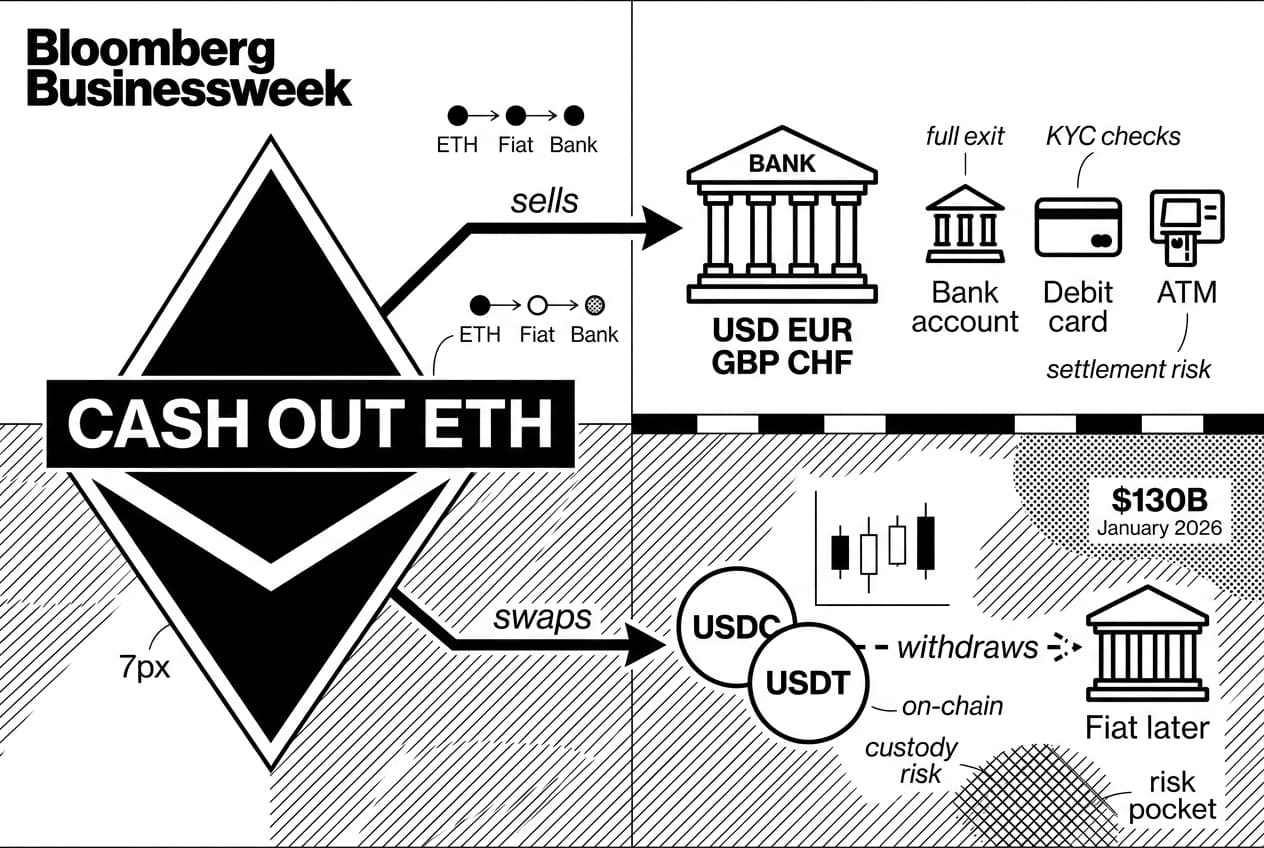
Cashing out does not always mean going straight from ETH to bank money. You have two broad choices.
- ETH to fiat: You sell ETH and receive USD, EUR, or another government currency in a bank account, on a card, or through a cash route. This is the full exit from crypto.
- ETH to stablecoins: You swap ETH for USDC or USDT, which aims to track a fiat price but stays on-chain or inside an exchange account. You may do this first to lock in a dollar value, then withdraw to fiat later.
Stablecoin settlement is now a normal part of off-ramp planning. DefiLlama tracked more than $130 billion in stablecoin market capitalisation in January 2026 (DefiLlama, January 2026). That matters because deep stablecoin liquidity can make it easier to pause between selling ETH and withdrawing fiat, although custody risk remains until money reaches your bank.
The common framing is that cashing out ETH is mainly about finding the fastest button. Our take is different: the best route is usually the lowest-risk settlement path. Card, P2P, and ATM speed often costs more in fees, lower limits, and compliance friction than a verified bank transfer.
Use the SAFE cash-out framework throughout this guide: Settlement route, Account verification, Fee stack, and Evidence trail. If a method is fast but weak on settlement or evidence, it is usually not the best first choice for a beginner.
What you will need before you sell ETH
Get your prerequisites ready before you start any transaction. Missing one item can leave fiat stuck inside an exchange account or ETH sitting in a pending blockchain transfer.
- ETH in a wallet or exchange account: Know exactly where your ETH sits before you start.
- A verified exchange or off-ramp account: Unverified accounts are usually limited or blocked from fiat withdrawals.
- Government ID and proof of address: Regulated off-ramps normally ask for identity documents before fiat payout.
- Bank or card details: Prepare your IBAN, ACH routing details, SWIFT or BIC details, or debit card number.
- A small ETH gas reserve: You need this only if your ETH is in a self-custody wallet and must be sent on-chain.
Warning: Three errors cause many failed withdrawals: sending ETH on a network the exchange does not support, pasting the wrong address, and using a bank account name that does not match your verified identity. Check all three before you click send.
Documents and account verification
Regulated exchanges must verify who you are before they let you convert crypto to fiat. This process is called know-your-customer verification, usually shortened to KYC. Most platforms ask for a passport or national ID, a selfie, and a proof-of-address document dated within the last three months.
Coinbase says ID verification can take 10 minutes to 48 hours depending on account and document review (Coinbase, 2024). Manual review can happen at the worst moment, such as when the ETH price is moving quickly. Complete verification before you plan to sell a meaningful amount.
Start KYC at least 48 to 72 hours before your target sell date if you are cashing out more than $5,000 worth of ETH. Larger withdrawals can trigger source-of-funds questions. To understand how account type affects this process, see our guide on custodial vs non-custodial wallets.
Wallet and gas requirements
If your ETH is already on a centralised exchange, you can usually sell without paying a separate on-chain gas fee. If you hold ETH in a self-custody wallet, such as MetaMask or a hardware wallet, you need ETH in that same wallet to pay the network fee for sending funds to the selling platform.
Gas costs move with network demand. In our January 2026 spot check of the Etherscan gas tracker (January 2026), a standard ETH transfer often priced between $0.50 and $4.00 during low-traffic periods, while congested periods could rise above $15. Check gas before sending, and avoid low-fee settings when the transfer matters.
Compare the main ways to convert Ethereum to cash
Choosing the route matters more than choosing the prettiest app. We built the seven-route 2026 ETH off-ramp scorecard below from public fee pages, exchange help pages, block explorer checks, and common settlement rails. It is designed to answer one beginner question: what is safest for this amount, this deadline, and this bank route?
method | best for | typical speed | cost level | KYC required | main risk |
|---|---|---|---|---|---|
centralised exchange plus bank transfer | beginners and regular sellers | 1 to 5 business days | low, often 0.1% to 1.5% | yes | account review or withdrawal delay |
instant card withdrawal | small urgent cash-outs | minutes to hours | medium to high, often 1.5% to 3.5% | yes | bank decline or low card limit |
P2P marketplace | users without a working bank off-ramp | hours to 1 day | variable, often 0% to 3% | varies by platform and amount | scam, chargeback, or payment reversal |
OTC desk | large amounts above $50,000 | 1 to 3 business days | low, often 0.1% to 0.5% | yes, often enhanced | source-of-funds review and counterparty checks |
crypto ATM | small cash-in-hand needs | minutes | very high, often 8% to 20% | varies by operator and limit | high fees, low limits, and physical safety |
payment processor | merchants accepting ETH | 1 to 3 business days | medium, often 0.5% to 2% | yes, business checks | settlement delay and conversion slippage |
stablecoin first, fiat later | users who want to lock a price before bank withdrawal | minutes for swap, then bank timing | low to medium | yes when fiat is withdrawn | exchange custody risk before final fiat payout |
Crypto ATM access is wide, but expensive. coinatmradar.com listed more than 38,000 crypto ATM locations globally in January 2026 (coinatmradar.com, January 2026), while Chainalysis found crypto ATM fees commonly reached double-digit percentages in its 2024 ATM risk review (Chainalysis, 2024). That fee gap can erase a large share of a small ETH sale.
Best for beginners: regulated exchanges
If you are selling ETH for the first time, a regulated exchange with bank withdrawals is usually the safest starting point. The interface guides you through the sell order, and fiat lands in a linked account. You will provide ID, but you also get account records and a support channel if a withdrawal is reviewed.
The tradeoff is time. Bank withdrawals often take one to five business days, and some platforms add a short hold after your first withdrawal. Plan around that window if you need the money by a specific date.
Best for speed: card withdrawals and instant off-ramps
Card-based cash-outs can move ETH proceeds to a debit card quickly. They are useful when the amount is small and the timing matters. The catch is that fees often run from 1.5% to 3.5%, and per-transaction limits may be only a few hundred to a few thousand dollars.
Read the word instant carefully. It may mean the quote executes instantly, not that your bank has cleared spendable funds. If your bank declines the incoming card credit, you may wait days for the money to return to the platform balance.
Best for large amounts: OTC and bank transfer routes
Selling more than $50,000 worth of ETH through a retail convert button can create spread cost and compliance review. An OTC desk can quote one price for the full block and settle by bank transfer. Expect source-of-funds documents, proof of wallet ownership, and sometimes a compliance call.
Staged withdrawals are worth considering. Splitting a large sale across several days or weeks can reduce operational risk and prevent one bad quote from deciding your entire exit price. If your business regularly receives ETH, review how merchants accept Ethereum payments through processors that can auto-convert to fiat.
Hayden Adams, founder of Uniswap Labs, has repeatedly focused public education around transparent on-chain exchange rates and user control. That principle applies even when you leave decentralised finance: compare the quote, spread, and settlement route before you approve a sale.
Use the 3-point cash-out fit test: how much are you selling, how fast do you need fiat, and how much documentation are you comfortable providing? Your answers should point to one row in the scorecard before you open a trading screen.
Step 1: choose your cash-out method
Before you send a single wei anywhere, choose the route that matches your amount, deadline, and bank access. The best method for a $200 urgent withdrawal is not the best method for a $50,000 planned sale.
Use a decision checklist before moving funds
Answer each question before you click deposit, sell, or withdraw.
- How much are you cashing out? Under $1,000 may justify a fast app. Over $10,000 usually favours a bank rail.
- Which currency must reach you? Confirm that your exchange supports USD, EUR, GBP, CHF, CAD, or your local fiat currency.
- Where should the money land? Bank account, debit card, payment app, and physical cash each require different rails.
- How fast do you need it? Coinbase describes standard bank cash-out timing as 1 to 3 business days for many bank routes (Coinbase learn article, 2024), while cards may be faster but cost more.
- Is ETH in a wallet or already on an exchange? Wallet-held ETH needs an on-chain transfer and gas before a centralised exchange can sell it.
- Do you have a verified bank account linked? No bank access pushes you toward P2P, ATM, or specialist off-ramp routes.
- Do you need a clean tax record? Choose a platform that exports CSV files and includes transaction IDs.
If you are still unsure, the cheapest default for most beginners is a regulated exchange with ACH, SEPA, or local bank transfer support. It gives you lower fees, clear records, and fewer personal safety issues than cash trades.
Step 2: prepare your exchange, wallet, or off-ramp account
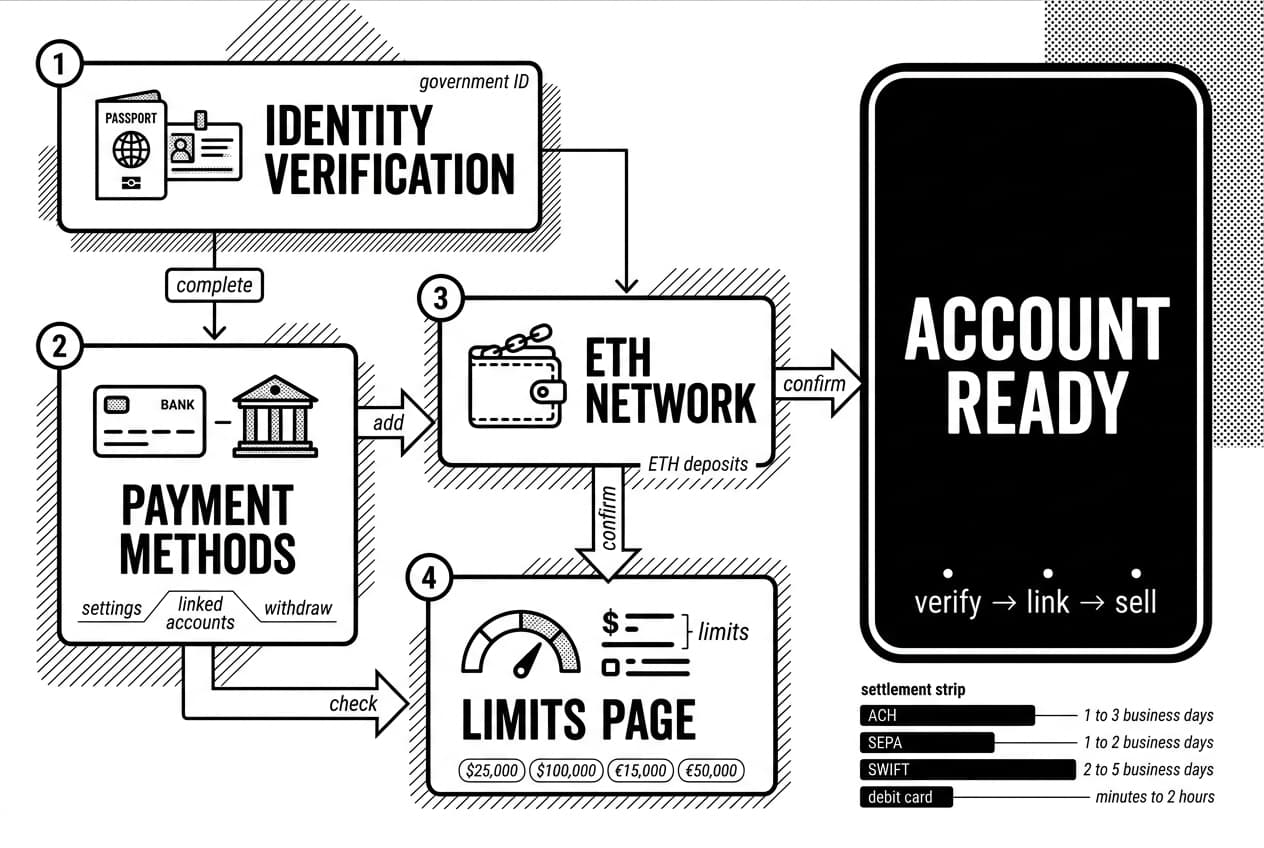
With your route chosen, prepare the account before moving ETH. This means finishing verification, linking fiat details, checking limits, and confirming that the platform supports ETH deposits on the network you plan to use.
Link your bank account or card first
Open the platform, complete identity verification, then go to the fiat or payment section before you sell. Look for labels such as settings, payment methods, linked accounts, or withdraw. Add your bank account or card, then confirm the account name matches your government ID exactly.
This order matters. If you sell ETH first and then try to add a bank account, your money can sit in a fiat balance while verification finishes. Coinbase states that new cash-out methods can be subject to security checks under its user agreement terms (Coinbase user agreement, 2024).
Check limits before selling
Before you click sell, find the platform limits page. It may sit under account, profile, or limits. Check the daily limit, monthly limit, minimum withdrawal, and whether a new bank account has a temporary hold.
withdrawal method | representative daily limit | representative monthly limit | typical settlement speed |
|---|---|---|---|
ACH bank transfer | $25,000 | $100,000 | 1 to 3 business days |
SEPA bank transfer | €15,000 | €50,000 | 1 to 2 business days |
SWIFT wire | varies by bank | no common standard cap | 2 to 5 business days |
debit card withdrawal | $2,500 to $10,000 | $25,000 | minutes to 2 hours |
crypto ATM cash-out | $900 to $10,000 | varies by operator | often immediate after confirmations |
These are representative ranges for planning as of January 2026, not promises from any provider. Your actual limits depend on verification tier, jurisdiction, account history, and current platform policy.
Step 3: send ETH safely to the selling platform
Now move ETH from your wallet to the platform where you will sell it. This is the step with the highest loss risk, so slow down and confirm the address and network before approving.
Warning: blockchain transfers are irreversible. If you send ETH to the wrong address or wrong network, an exchange support team usually cannot recover it. There is no undo button.
- Copy the deposit address from the official platform. Open the ETH deposit page and copy the address shown there.
- Send a small test transaction first. For transfers above about $500, send 0.001 ETH and wait for credit.
- Send the remaining ETH. After the test arrives, send the rest from your wallet.
Watch for address poisoning scams. Attackers may place lookalike addresses in your wallet history. Always copy from the official deposit page, not from old transaction history.
If you are moving funds from hardware wallet vs exchange custody, read the address on the hardware wallet screen before approving. The computer display is not enough if the device is asking you to sign something different.
Confirm the network and address
Most major exchanges accept ETH deposits on Ethereum mainnet, and some also support layer 2 networks. Do not assume. If the platform does not explicitly list the network you intend to use, choose Ethereum mainnet.
Before you click send, compare at least the first four and last four characters of the deposit address against the platform screen. Vitalik Buterin, co-founder of the Ethereum Foundation, has described Ethereum as a system where valid state transitions are final by design. For a beginner, that means address checking is not optional.
Wait for confirmations
After the transaction broadcasts, the exchange usually waits for network confirmations before crediting your ETH. Many platforms require roughly 12 to 64 confirmations, and Ethereum blocks target about 12 seconds each, according to Etherscan network data (January 2026). Normal deposits often credit in minutes, but congestion can extend the wait.
Paste your transaction hash into Etherscan to watch progress. If it stays pending for more than 20 minutes, check whether you selected a very low gas fee. Do not send the same ETH again unless your wallet explicitly shows the original transaction failed.
Step 4: sell ETH for fiat or a stablecoin
When the ETH appears in your exchange account, go to the trading, sell, or convert screen. Select ETH as the asset you are selling, then choose the target currency such as USD, EUR, GBP, CHF, or CAD. Review the quote before confirming.
Market order vs. limit order
A market order sells immediately at the best available price. It is fine for small amounts if the spread is reasonable. A limit order lets you set the minimum price you will accept, such as selling only if ETH is above $2,800, but it may not fill.
Coinbase explains the difference between market and limit orders in its limit order guide (Coinbase, 2024). Beginners often prefer instant convert screens, but those screens can hide more cost in the spread than a pro trading interface.
Check the spread before you confirm
The visible fee is not always the full cost. The spread is the gap between the mid-market ETH price and the rate you are quoted. On a $5,000 sale, a 0.5% spread costs $25 before any separate commission.
Compare the quoted rate against a neutral live market page such as CoinGecko ETH price data (January 2026). If the quote looks far below the live price, switch to a limit order, a pro interface, or a different off-ramp.
Once the rate, fee, and withdrawal path look acceptable, confirm the trade. Your balance changes from ETH to fiat, or to a stablecoin if you are parking value before withdrawal.
Pro tip: Stablecoin parking can reduce price-timing stress, but it is not the same as cashing out. Until fiat reaches your bank, card, or cash route, you still carry platform, issuer, and withdrawal risk.
Step 5: withdraw the money to your bank, card, or cash route
You have sold ETH, and the fiat balance is inside the platform. Now choose the payout rail. This final route decides when you can spend the money and what extra fee you pay.
Here is the ETH-to-fiat process in five quick steps:
- Choose method: exchange, P2P, ATM, card, or off-ramp app.
- Verify account: complete KYC and link payout details.
- Deposit ETH: send ETH to the selling platform.
- Sell ETH: convert to fiat or stablecoin first.
- Withdraw fiat: send money to bank, card, or cash route.
Bank transfer withdrawals
Bank transfers are usually the most reliable route for anything above a few hundred dollars. ACH transfers often settle in 1 to 3 business days. SEPA transfers usually land in 1 to 2 business days, while supported instant SEPA routes may clear faster.
UK faster payments often arrive within 2 hours, and international SWIFT wires usually take 2 to 5 business days. A first withdrawal to a new bank account may face a 24 to 72 hour hold. That is a fraud control, not proof that the transaction failed.
For amounts above $1,000, bank transfer fees are often cheaper than card payouts. Some platforms charge $0 to $25 for local bank withdrawals, while wires can cost more once correspondent banks add charges. Check the 2026 fee schedule on your chosen platform before confirming.
UK-based users can also read our guide on how to buy Ethereum in the UK to understand how similar local bank rails work when funds move in the opposite direction.
Card withdrawals and instant cash-outs
Debit card withdrawals can land within minutes to a few hours. That speed is helpful for small urgent withdrawals. In exchange, you may pay 1.5% to 3.5% and face tighter daily limits than bank transfers.
Your card issuer can still decline the payout. If that happens, call the bank before trying again. Repeated failed attempts can trigger a temporary lock on the card or platform account.
P2P and ATM cash withdrawals
P2P platforms let you sell ETH directly to another person for cash, bank transfer, or a payment app. Crypto ATMs may dispense cash after you send ETH and the machine receives confirmations. These routes can help users without bank access, but they add scam and personal safety risks.
ATM fees are often among the highest cash-out costs. Chainalysis reported that crypto ATM fees can be far higher than exchange fees in its 2024 crypto ATM crime and risk analysis (Chainalysis, 2024). Use an ATM only when access or speed is more important than price.
If you use a P2P cash trade, meet in a public place, bring another person, and keep the amount modest. Never release ETH until the payment has fully cleared in your own account or the cash has been counted and verified.
withdrawal rail | typical speed | typical fee range | best for | main risk |
|---|---|---|---|---|
ACH bank transfer | 1 to 3 business days | $0 to $10 flat on many platforms | larger local withdrawals | new-account holds |
SEPA bank transfer | 1 to 2 business days, faster if instant is supported | €0 to €5 flat on many platforms | euro withdrawals | IBAN name mismatch |
UK faster payments | often under 2 hours | £0 to £5 on many platforms | UK users needing local settlement | bank-side decline |
SWIFT wire | 2 to 5 business days | $15 to $50 or more | international or large sums | intermediary bank fees |
debit or credit card | minutes to hours | 1.5% to 3.5% | small urgent withdrawals | issuer decline and low limits |
crypto ATM | often immediate after confirmations | 8% to 20% | small cash needs | high fees and safety concerns |
P2P cash trade | immediate in person | negotiated | no-bank-account situations | scams, chargebacks, and physical risk |
Once fiat clears, you are done with the cash-out itself. Save the sale date, ETH amount, fiat amount, fees, and transaction hash before closing the tab.
Fees, timing, limits, taxes, and safety checks
Before the money lands, review the costs and evidence trail. A cash-out can include gas, trading fees, spreads, withdrawal fees, bank fees, tax reporting, and scam risk. The SAFE framework helps you check each one before you rush.
How fast is instant crypto to cash?
Instant in crypto off-ramp marketing usually means quote execution or payout initiation, not guaranteed bank settlement. ETH confirmations, platform compliance checks, card issuer review, and bank processing can still add 1 to 5 business days before cleared funds appear. Card payouts are often faster than wires, but not instant end to end.
The timing gap matters because your sell price is locked when you trade, not when the bank posts funds. If a provider promises a guaranteed rate across every step, read the terms before accepting.
Tax records you should keep
Selling ETH is a taxable disposal in many jurisdictions as of the current crypto regulation timeline. The gain or loss is usually the difference between your cost basis and sale price, minus eligible fees. Rules vary by country, so consult a qualified tax professional before filing.
For every ETH sale, keep at minimum:
- transaction date
- amount of ETH sold
- fiat value at the time of sale
- gas, trading, spread, and withdrawal fees
- transaction hash and exchange trade ID
- bank withdrawal confirmation
Pro tip: After each sale, take a screenshot of the confirmation screen and export a CSV from the exchange history page. Store both in a folder labelled by tax year. This evidence trail is easier to build now than months later.
Because how crypto tracking works has matured, wallet histories can often be reconstructed from public chain data. Poor recordkeeping is still your problem if a tax authority asks how a cash-out was calculated.
Red flags before you cash out
Scams rise when ETH prices move sharply. Stop the transaction if you see any of these patterns.
red flag | what it looks like | why it is dangerous |
|---|---|---|
guaranteed rate outside a reputable platform | a chat seller offers a rate better than every exchange | the quote may be fake, illegal, or impossible after delays |
send more ETH to release funds | a fake support agent says your withdrawal is locked until you pay | this is advance-fee fraud |
mismatched bank details | the payout account name differs from your verified identity | the withdrawal may bounce or signal account compromise |
fake support messages | someone contacts you first through chat or social media | real exchange support does not need your seed phrase |
pressure to use irreversible payment methods | a buyer insists on cash, gift cards, or unfamiliar wires | you have little recourse if the counterparty disappears |
If anything feels wrong, stop and contact the platform through its verified website. A slower withdrawal is better than losing the full balance.
Frequently Asked Questions
- Can I convert my Ethereum to cash?
- Yes. You can sell ETH through a crypto exchange, off-ramp app, P2P marketplace, OTC desk, payment processor, or crypto ATM, then withdraw fiat to a bank account, debit card, or pick up cash. Availability depends on your country, KYC verification status, and the platform's withdrawal limits.
- How do I withdraw my Ethereum?
- Withdrawing ETH and withdrawing cash are two different actions. To move ETH, send it from an exchange to an Ethereum wallet address. To get cash, sell your ETH first, then withdraw the resulting fiat balance via ACH, SEPA, SWIFT, Faster Payments, or a card payout, depending on your platform.
- How much is $100 ETH worth in dollars?
- $100 worth of ETH converts to roughly $100 before fees at the moment of sale. The actual ETH quantity fluctuates with the live ETH/USD price. Trading fees, spreads, and withdrawal charges will reduce the final amount of cash you receive, so always review the full cost breakdown before confirming.
- Where can I withdraw Ethereum?
- ETH can be sent to any compatible Ethereum wallet address, including self-custody wallets like MetaMask or exchange deposit addresses. If you mean withdrawing cash, options include bank-connected exchanges, card withdrawal providers, P2P platforms, OTC desks, and crypto ATMs that support ETH-to-cash conversions.
- How much is $500 dollars in Ethereum worth today?
- Divide $500 by the current ETH/USD market price to estimate how much ETH you would receive, then subtract any platform spread or trading fee. Avoid relying on fixed examples because ETH trades continuously and the quoted price changes by the second. Always check the live rate on your chosen platform.
- How do I turn my ETH into USD?
- The process is straightforward: deposit ETH into a USD-supported exchange or off-ramp, select Sell ETH, choose USD as the target currency, review the quoted price and fees, then confirm the sale. Once settled, withdraw your USD balance via ACH transfer, wire, debit card, or another method the platform supports.
- How much is $100 ETH worth in US dollars?
- If you hold $100 worth of ETH, its USD value shifts constantly with ETH's market price and may be slightly less after fees are applied. Check the live ETH/USD quote directly on your selling platform, since the final payout depends on the current spread, available liquidity, and exact timing of your sale.
Sources
Author

Crypto analyst and blockchain educator with over 8 years of experience in the digital asset space. Former fintech consultant at a major Wall Street firm turned full-time crypto journalist. Specializes in DeFi, tokenomics, and blockchain technology. His writing breaks down complex cryptocurrency concepts into actionable insights for both beginners and seasoned investors.