Polygon vs Ethereum: Layer 2 vs Layer 1 Comparison Guide
Polygon vs Ethereum: Quick Overview and Comparison Table
Polygon vs Ethereum is not a simple contest between two substitute chains. Ethereum is a Layer 1 blockchain that provides base settlement, validator consensus and the deepest liquidity layer in the EVM ecosystem. Polygon is a scaling ecosystem aligned with Ethereum, with Polygon PoS, Polygon zkEVM and AggLayer infrastructure designed to make transactions cheaper and faster for apps that cannot afford mainnet fees.
This comparison uses a May 2026 metrics snapshot and one consistent lens for both networks: security model, fees, finality, ecosystem depth, liquidity, developer experience and best-fit use cases. The contrarian point is important: Polygon is not cheaper because it is just a faster Ethereum. It is cheaper because it changes execution, liquidity and security assumptions. Those tradeoffs are often acceptable, but they are not invisible.
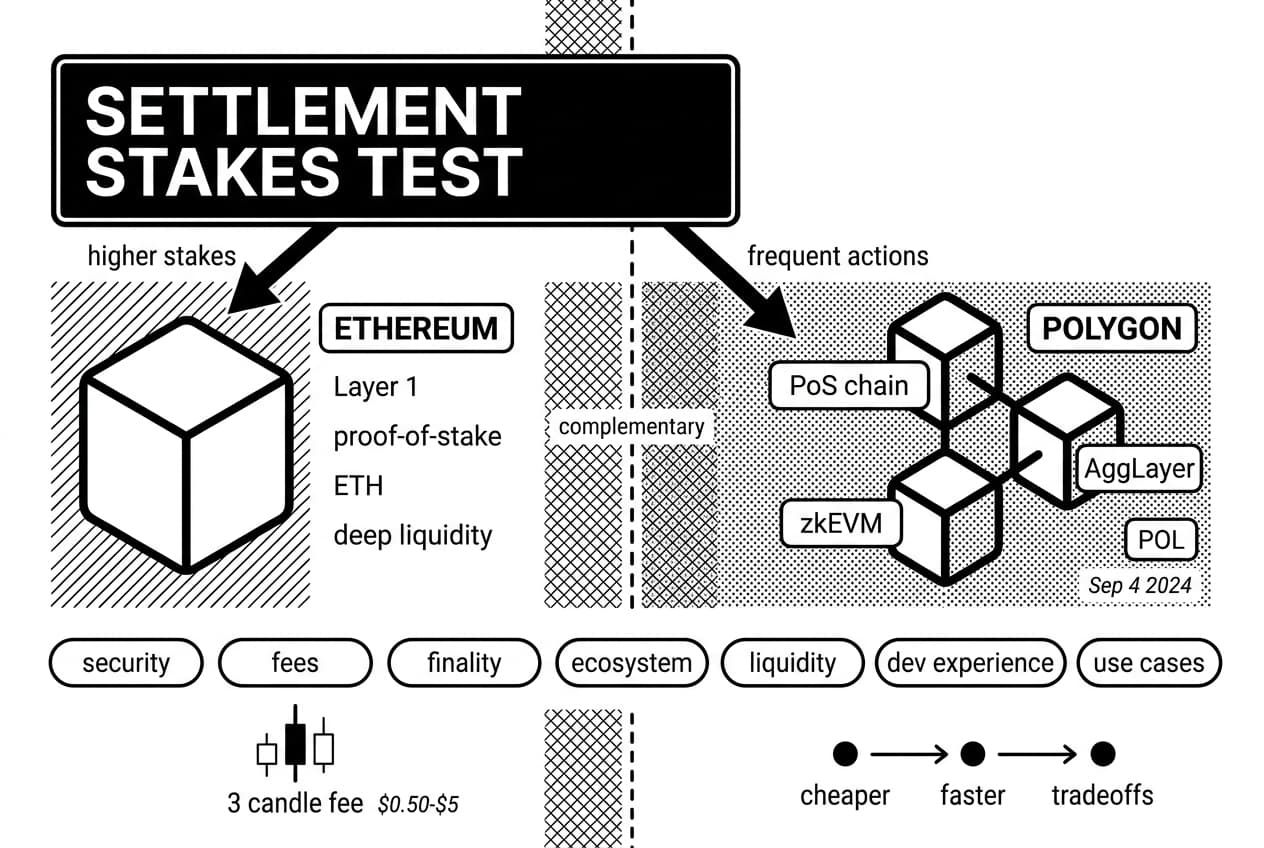
Method note: we use a named decision filter, the settlement stakes test. Ask what a finality failure, bridge failure or liquidity shortfall would cost in the specific use case. Higher settlement stakes point toward Ethereum mainnet. Lower settlement stakes, frequent user actions and small transaction values point toward Polygon.
At-a-glance comparison table
Metric | Ethereum | Polygon |
|---|---|---|
Type | Layer 1 proof-of-stake settlement chain | Ethereum scaling ecosystem with PoS chain, zkEVM and AggLayer |
Native token | ETH | POL, migrated from MATIC on September 4, 2024 (Polygon blog, September 2024) |
Typical simple transfer fee | Often about $0.50 to $5 in normal periods, higher during congestion (Etherscan gas tracker, May 2026) | Commonly below $0.01 on Polygon PoS (Polygonscan gas tracker, May 2026) |
Speed | Roughly 12-second slots and about 12 to 15 transactions per second on L1 (Etherscan charts, May 2026) | About 2-second PoS blocks, with throughput varying by chain and app design (Polygonscan charts, May 2026) |
Security model | Ethereum-native consensus with more than 1.1 million validators (beaconcha.in, May 2026) | Polygon PoS uses its own validator set; Polygon zkEVM posts validity proofs to Ethereum |
Validator set | 32 ETH required per validator (ethereum.org staking guide, May 2026) | Polygon PoS supports up to 105 active validators (Polygon validator docs, May 2026) |
Finality | Economic finality is typically about 12 to 15 minutes after proof-of-stake finalization | PoS gives fast soft confirmation, while harder settlement depends on checkpoints or rollup proof posting |
TVL | About $48.2 billion (DefiLlama Ethereum, May 2026) | About $1.1 billion on Polygon PoS (DefiLlama Polygon, May 2026) |
Dapps | Deepest base-layer markets across Uniswap, Aave, Curve and NFT provenance activity | Active consumer, gaming, NFT and payment apps, with EVM-compatible deployment |
Best use cases | High-value DeFi, treasury settlement, institutional collateral and scarce NFT provenance | Low-cost transfers, gaming actions, loyalty programs, small NFT mints and consumer dapps |
What Is Ethereum? Layer 1 Overview, Strengths and Weaknesses
Ethereum is a Layer 1 smart contract network. It orders transactions, executes smart contracts and provides the settlement layer that many wallets, exchanges, stablecoins, lending markets and rollups depend on. Since the Merge in September 2022 (ethereum.org, September 2022), Ethereum has used proof of stake rather than proof of work.
Ethereum’s value in this comparison is not raw speed. Its value is credible settlement. A transaction on Ethereum mainnet settles directly under Ethereum consensus, without requiring a bridge to another execution environment. That is why high-value DeFi, large liquidity pools and major collateral markets still concentrate on mainnet even when cheaper networks exist.
As of May 2026, Ethereum had more than 1.1 million validators visible on beaconcha.in, and each validator requires 32 ETH under the staking design described by ethereum.org. Those numbers matter because validator breadth is one of Ethereum’s strongest defenses against censorship and coordinated failure.
Ethereum Strengths
- Security and decentralization: Ethereum’s validator count is far larger than Polygon PoS. For settlement-heavy use cases, that breadth is the main reason to pay mainnet fees.
- Liquidity depth: Ethereum held about $48.2 billion in TVL in May 2026 (DefiLlama Ethereum, May 2026), compared with about $1.1 billion on Polygon PoS (DefiLlama Polygon, May 2026). That gap affects slippage, liquidation depth and market resilience.
- Developer mindshare: Solidity, EVM tooling, audit practices and wallet support are deepest on Ethereum. Rollups and EVM chains often inherit these standards from mainnet.
- Composability: Ethereum DeFi contracts can interact in the same settlement environment. That matters for lending, liquidations, derivatives and complex trades where bridged execution adds risk.
- Expert context: Hayden Adams, founder of Uniswap, represents one of the most important liquidity networks in the Ethereum ecosystem. Uniswap’s mainnet presence is a practical example of why liquidity concentration still matters.
Ethereum Weaknesses
- Fee volatility: Ethereum simple transfers may sit near a few dollars in calm periods, while contract interactions can become much more expensive during congestion (Etherscan gas tracker, May 2026).
- Limited base-layer throughput: Ethereum L1 is not designed to process consumer-scale activity directly. Its role is settlement first, with rollups and scaling layers handling more frequent actions.
- User friction: Gas estimation, failed transactions and fee spikes remain confusing for new users. Even experienced users may wait for cheaper gas before moving funds.
- Dependence on scaling layers: Ethereum’s roadmap accepts that mass-market activity will happen on L2s and app chains. That is logical, but it means mainnet alone is not the right venue for every retail transaction.
What Is Polygon? Layer 2 Scaling Overview, Strengths and Weaknesses
Polygon is best understood as an Ethereum-aligned scaling ecosystem rather than a single chain. Polygon PoS is a low-fee proof-of-stake chain with its own validator set. Polygon zkEVM is a zero-knowledge rollup design that posts proofs to Ethereum. AggLayer is intended to connect liquidity and state across Polygon-connected chains.
The POL upgrade changed the token layer. The migration from MATIC to POL went live on September 4, 2024 (Polygon blog, September 2024), positioning POL as the gas and staking asset for the wider Polygon ecosystem. For the polygon vs ethereum question, that matters because Polygon’s direction is no longer only about one cheaper PoS chain.
Polygon’s core advantage is user cost. A game, loyalty app or social dapp can ask users to sign many small transactions without making each action economically irrational. That is a different product profile from Ethereum mainnet, where the chain is better suited to fewer, higher-value actions.
Polygon Strengths
- Low transaction costs: Polygon PoS fees are commonly below $0.01 for basic transfers (Polygonscan gas tracker, May 2026). That makes small payments, rewards, NFT mints and game actions more practical.
- Fast user feedback: Polygon PoS block time is about 2 seconds (Polygonscan charts, May 2026), so apps can show confirmations quickly even if deeper settlement takes longer.
- EVM compatibility: Developers can port Solidity contracts and use familiar wallets, indexers and audit workflows. That lowers migration friction from Ethereum.
- High activity capacity: Polygon PoS has processed more than 4 billion transactions in cumulative history (Polygonscan, May 2026), showing sustained use for low-cost activity.
- Consumer fit: The network has attracted gaming, brand loyalty and NFT projects because users can interact repeatedly without paying mainnet-level fees.
Polygon Weaknesses
- Different security assumptions: Polygon PoS is not secured by Ethereum’s full validator set. Its active validator design is capped at 105 validators (Polygon validator docs, May 2026), far below Ethereum’s validator count.
- Bridge exposure: Moving assets between Ethereum and Polygon usually involves bridge contracts or cross-chain messaging. That adds a risk layer that native Ethereum settlement does not require.
- Liquidity fragmentation: Liquidity is spread across Polygon PoS, Polygon zkEVM and other connected environments. That can make large swaps less efficient than on Ethereum mainnet.
- Competitive pressure: Arbitrum, Optimism, Base and other EVM scaling networks compete for the same developers, wallets and liquidity.
- Expert context: Stani Kulechov, founder of Aave, is closely tied to cross-chain lending markets. Aave deployments show both the benefit and the complexity of running DeFi across multiple execution environments.
Key Differences Between Polygon and Ethereum
The main differences between Polygon and Ethereum are best seen when the same criteria are applied to both networks rather than treating one as a cheaper copy of the other.
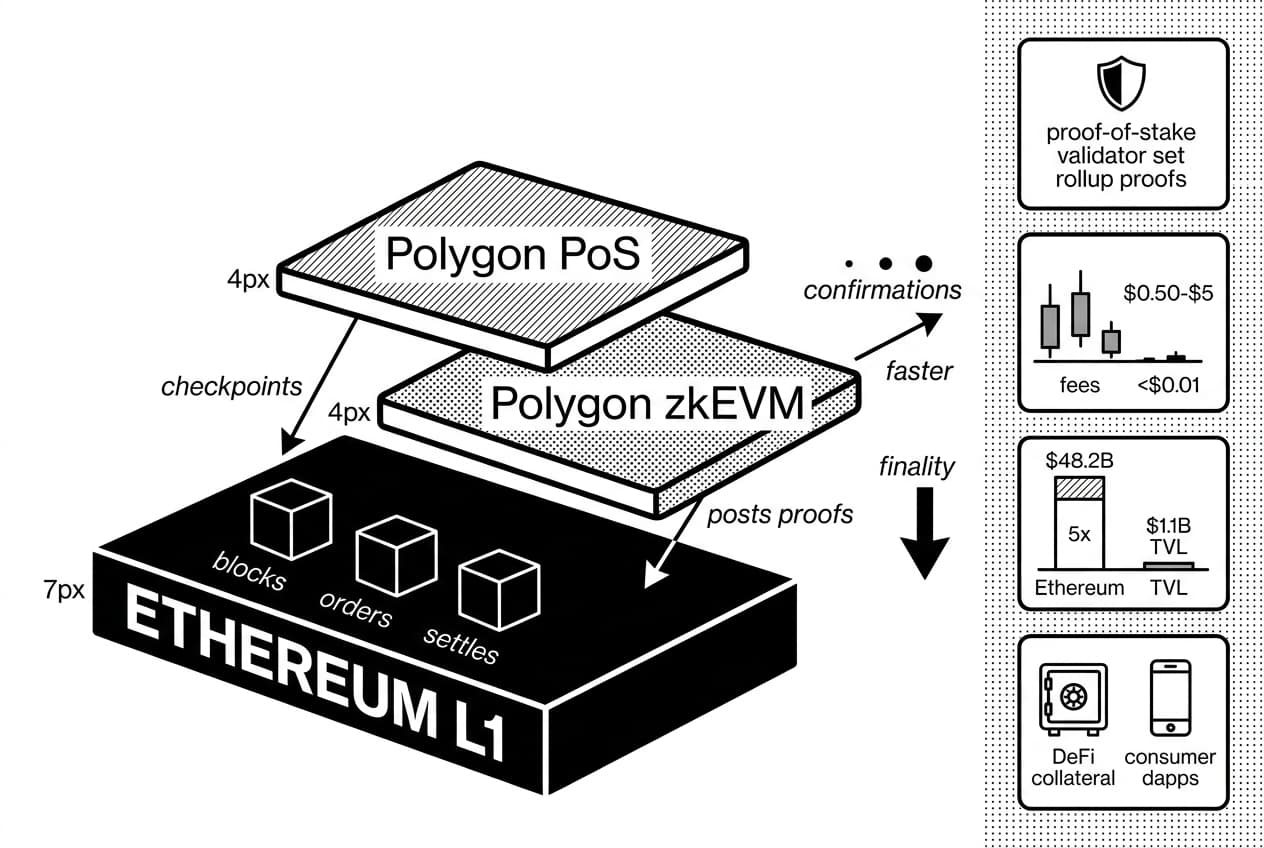
- The main differences between Polygon and Ethereum are security model: Ethereum settles directly through its own proof-of-stake consensus, while Polygon PoS uses its own validator set and Polygon zkEVM relies on rollup proofs posted to Ethereum.
- Fees: Ethereum mainnet transfers often cost about $0.50 to $5 in normal conditions (Etherscan gas tracker, May 2026), while Polygon PoS transfers often cost less than $0.01 (Polygonscan gas tracker, May 2026).
- Speed and finality: Polygon gives faster user-facing confirmations, while Ethereum gives stronger base-layer finality for high-value settlement.
- Liquidity: Ethereum’s roughly $48.2 billion in TVL was far above Polygon’s roughly $1.1 billion in May 2026 (DefiLlama Ethereum; DefiLlama Polygon).
- Best use case: Ethereum is better for large-value DeFi and collateral, while Polygon is better for frequent, low-value transactions and consumer dapps.
Layer 1 vs Layer 2 Architecture
Ethereum is the base chain. It produces blocks, orders transactions and settles value under one validator network. Polygon is a family of scaling environments connected to Ethereum to different degrees. Polygon PoS behaves more like an Ethereum-aligned sidechain with checkpoints, while Polygon zkEVM is closer to a rollup model because validity proofs are posted back to Ethereum.
This distinction is the core of the comparison. If an app only needs cheap execution and fast feedback, Polygon PoS may be enough. If an app needs Ethereum-derived settlement guarantees, a rollup design is more relevant. If an app needs the deepest liquidity and strongest settlement credibility, Ethereum mainnet remains the default.
Fees, Speed and Finality
Fee comparisons are useful only when paired with finality. A $0.01 transaction can be a better user experience than a $3 transaction, but not if the application is settling tens of millions of dollars and cannot accept bridge or validator-set risk. Ethereum’s 12-second slots and proof-of-stake finality are built for security. Polygon’s low fees and fast confirmations are built for usage frequency.
For a payment app handling thousands of small transfers, Polygon’s economics are stronger. For a protocol moving $50 million in collateral, Ethereum’s higher fee is easier to justify because the cost of a settlement failure is far larger than the gas bill. That is the settlement stakes test in practice.
Security and Decentralization Tradeoffs
Lower fees usually come from a tradeoff somewhere in the stack. Polygon PoS reduces costs by processing transactions outside Ethereum’s main validator set. Polygon zkEVM narrows that gap by posting proofs to Ethereum, but users still need to understand bridge design, sequencer assumptions and liquidity location.
Vitalik Buterin, co-founder at the Ethereum Foundation, is the clearest approved expert to cite on this point because Ethereum’s scaling roadmap centers on rollups using Ethereum for settlement. The practical takeaway is simple: rollups can extend Ethereum security, but not every low-fee chain inherits the same guarantees.
You can also see this security-versus-throughput tension in Ethereum compared with another major Layer 1.
Adoption, Ecosystem and Real-World Use Cases
Adoption data shows complementary roles. Ethereum remains the strongest venue for liquidity, collateral and high-value settlement. Polygon is stronger where applications need low fees, fast feedback and frequent user actions. The same wallet can use both networks for different jobs.
DeFi, Stablecoins and Liquidity
Ethereum remains the primary settlement layer for large-value DeFi. DefiLlama listed about $48.2 billion in Ethereum TVL in May 2026 (DefiLlama Ethereum, May 2026), while Polygon PoS held about $1.1 billion (DefiLlama Polygon, May 2026). That gap affects slippage on large trades, collateral depth and liquidation reliability.
Polygon still matters in DeFi, especially for smaller trades, wallet onboarding and low-cost portfolio actions. Protocols such as Uniswap and Aave support multiple networks, so users often choose the chain based on trade size. A $40 swap may make more sense on Polygon. A $5 million swap may require Ethereum’s deeper liquidity.
For developers thinking through how DeFi interoperability works across chains, the bridge and messaging layer is not a side detail. It is part of the risk model.
Metric | Ethereum | Polygon PoS |
|---|---|---|
TVL | About $48.2 billion (DefiLlama, May 2026) | About $1.1 billion (DefiLlama, May 2026) |
Stablecoin data source | Check current USDC and USDT supply on DefiLlama stablecoin data, May 2026 | Check current USDC and USDT supply on DefiLlama stablecoin data, May 2026 |
Typical best trade size | Larger trades where liquidity depth matters more than gas | Smaller trades where gas savings matter more than maximum depth |
Bridge need | No bridge needed for native mainnet assets | Bridge or cross-chain transfer often needed when moving from mainnet |
Primary risk to monitor | Gas spikes and smart contract risk | Bridge risk, validator-set risk and fragmented liquidity |
Gaming, NFTs and Payments
Polygon’s lower fees make it a natural fit for high-volume, low-value actions. Sending a small in-game item, minting a loyalty badge or claiming a reward can become uneconomic on Ethereum if fees exceed the value of the action. Polygon’s fee profile avoids that problem.
Nike, Starbucks and Reddit have all used Polygon for consumer-facing Web3 experiments, with coverage through public company announcements and crypto media. The common pattern is not that these brands required maximum settlement security. They needed low fees, familiar wallets and tolerable onboarding for mainstream users.
Teams building consumer Web3 apps in 2026 often start with Polygon or another EVM scaling network for the interactive layer, then reserve Ethereum mainnet for treasury, provenance or high-value settlement. Ethereum’s NFT market is still stronger for scarce, expensive assets where provenance and buyer confidence matter more than a few dollars of gas.
Market Data and Recent Developments in 2026
The data layer reinforces the same conclusion. Ethereum has the stronger settlement and liquidity base. Polygon has the better cost structure for frequent activity. Recent protocol upgrades have narrowed some gaps, but they have not erased the tradeoff.
Where the Numbers Stand
The Dencun upgrade went live on March 13, 2024 and introduced blob transactions through EIP-4844 (EIP-4844, March 2024). This reduced data costs for rollups and made Ethereum’s broader scaling roadmap more practical. It also raised the bar for every scaling network, including Polygon, because low fees became more common across the L2 market.
Ethereum mainnet processed about 1.1 million daily transactions in many recent periods visible on Etherscan charts, May 2026. Polygon PoS has recorded much higher daily transaction bursts, including multi-million transaction days visible on Polygonscan charts, May 2026. The difference reflects design goals rather than a simple measure of superiority.
The POL migration remains a key Polygon development. It started as the network moved beyond the MATIC brand and toward a token model meant to support the wider AggLayer plan. Readers should verify current circulating supply, staking participation and exchange support on publication day rather than relying on static token data.
For teams building data-heavy apps, dapp indexing patterns are relevant on both networks. Ethereum often has deeper historical coverage, while Polygon can generate more frequent low-value events that need efficient indexing.
Metrics to Verify Before Publishing
On-chain data moves quickly, so every static number should be checked on the publication date. Use the sources below for a final update before publishing.
- Market cap for ETH and POL: use CoinGecko or CoinMarketCap on the publication date.
- TVL: use DefiLlama Ethereum and DefiLlama Polygon for separate chain figures.
- Daily active addresses: use Etherscan and Polygonscan, noting that explorer definitions can differ.
- Average fee: use Etherscan gas tracker and Polygonscan gas tracker.
- Transactions per second: calculate from recent on-chain activity rather than theoretical maximums.
- Stablecoin supply: use the DefiLlama stablecoin dashboard for current chain-level supply.
- Bridge flows: use the DefiLlama bridge dashboard for recent inflows and outflows.
Which Should You Choose: Ethereum or Polygon?
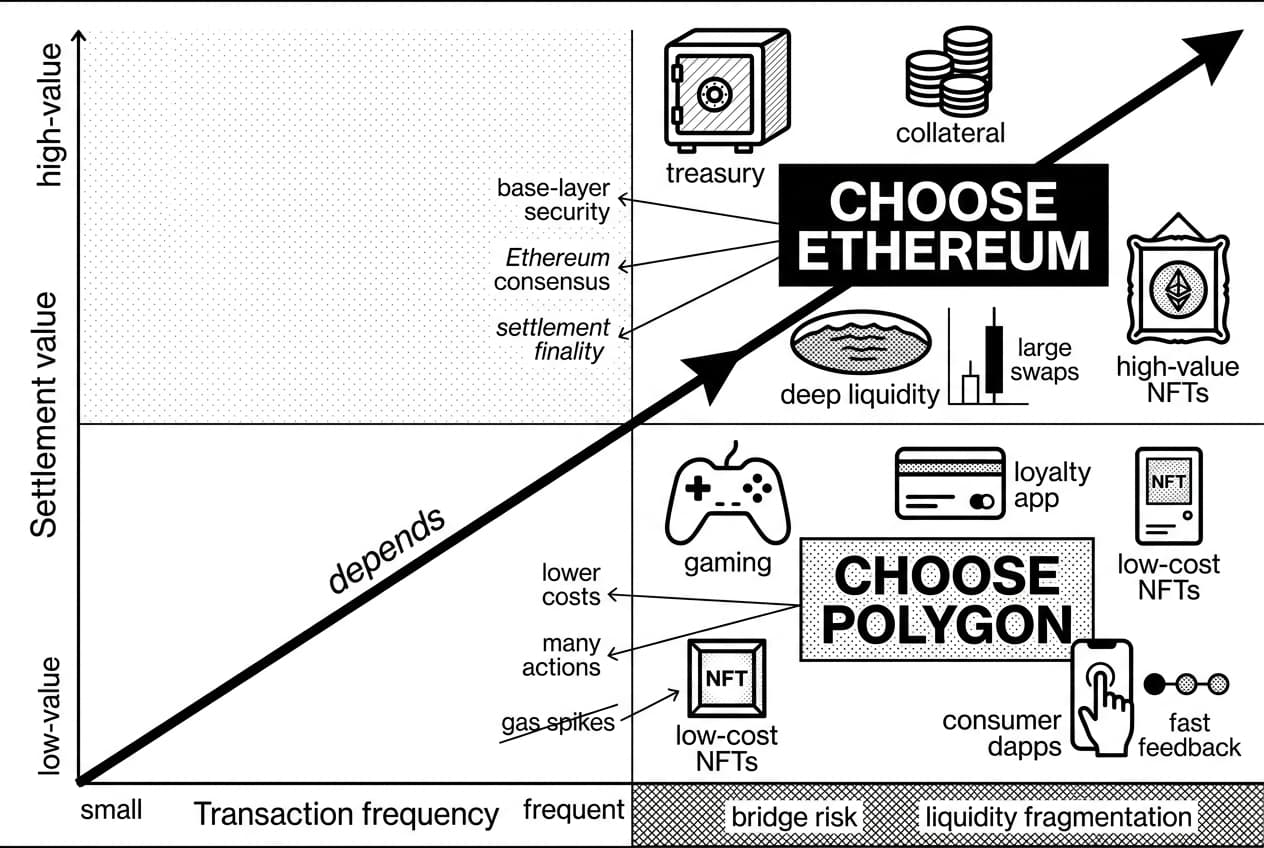
Ethereum is better for high-value settlement, deep liquidity, institutional collateral and blue-chip DeFi where base-layer security matters most. Polygon is better for low-cost, frequent transactions, gaming, loyalty programs, small NFT actions and consumer dapps where fees and fast user feedback matter more than mainnet finality.
Choose Ethereum if...
- You are settling large-value DeFi transactions where a few dollars in fees are small relative to trade size.
- You need the strongest available EVM settlement guarantees and direct exposure to Ethereum consensus.
- You are managing treasury, collateral or long-term custody on the base layer.
- You need the deepest liquidity for large swaps, liquidations or institutional DeFi operations.
- You are minting or buying high-value NFTs where provenance and buyer confidence matter more than transaction cost.
- You want to accept Ethereum payments with settlement finality on the base layer.
Choose Polygon if...
- You are making small or frequent transfers where Ethereum fees would damage the user experience.
- You are building a game, loyalty app or consumer dapp with many low-value actions.
- You want EVM compatibility but need lower transaction costs for testing or production use.
- You are onboarding new users who should not need to understand gas spikes before using the app.
- You are minting or transferring low-cost NFTs where volume matters more than maximum provenance.
- You can accept bridge, validator-set and liquidity-fragmentation risks in exchange for lower fees.
The most accurate 2026 framing is complementary infrastructure. Ethereum is the settlement and liquidity base. Polygon is an execution environment for low-cost activity. Many teams can use both: Ethereum for treasury and high-value settlement, Polygon for everyday interactions. The right answer depends on transaction value, risk tolerance and user frequency.
Frequently Asked Questions
- Which is better, Ethereum or Polygon?
- Neither is universally better — it depends on your needs. Ethereum excels in security, liquidity, and high-value settlement, making it the preferred choice for serious DeFi and institutional use. Polygon shines for low-cost transactions, gaming, NFTs, and frequent dapp interactions. In practice, Polygon complements Ethereum rather than replacing it.
- Does the Polygon coin have a future?
- Polygon's long-term outlook depends on continued developer adoption, POL token utility, and the growth of its scaling ecosystem. Key indicators to watch include total value locked, active users, transaction fees, and major partnerships. Competition from other Layer 2 networks and Ethereum's own roadmap evolution will also heavily influence its trajectory.
- Is Polygon better than Solana?
- They serve different purposes. Polygon is EVM-compatible and Ethereum-aligned, making it a natural fit for developers already in the Ethereum ecosystem. Solana is an independent, high-throughput Layer 1 built for speed on its own architecture. The right choice depends on your technical priorities, though this article focuses specifically on Polygon versus Ethereum.
- Is Polygon a good crypto to invest in?
- This is not financial advice. Polygon has potential positives — growing ecosystem adoption and clear low-fee use cases — but also meaningful risks, including token volatility, intense Layer 2 competition, bridge security concerns, and shifting demand for POL. Before committing capital, conduct thorough independent research and apply sound risk management principles.
Sources
Author

Crypto analyst and blockchain educator with over 8 years of experience in the digital asset space. Former fintech consultant at a major Wall Street firm turned full-time crypto journalist. Specializes in DeFi, tokenomics, and blockchain technology. His writing breaks down complex cryptocurrency concepts into actionable insights for both beginners and seasoned investors.