Ethereum vs BNB: Decentralization, Fees and Use Cases 2026
Ethereum vs BNB in 2026: What Are We Comparing?
This ethereum vs bnb comparison looks at Ethereum and BNB Chain as smart contract networks, not only ETH and BNB as tradable assets. The real 2026 tradeoff is about decentralization, fees, liquidity, validator design, user experience and the type of activity each chain serves best.
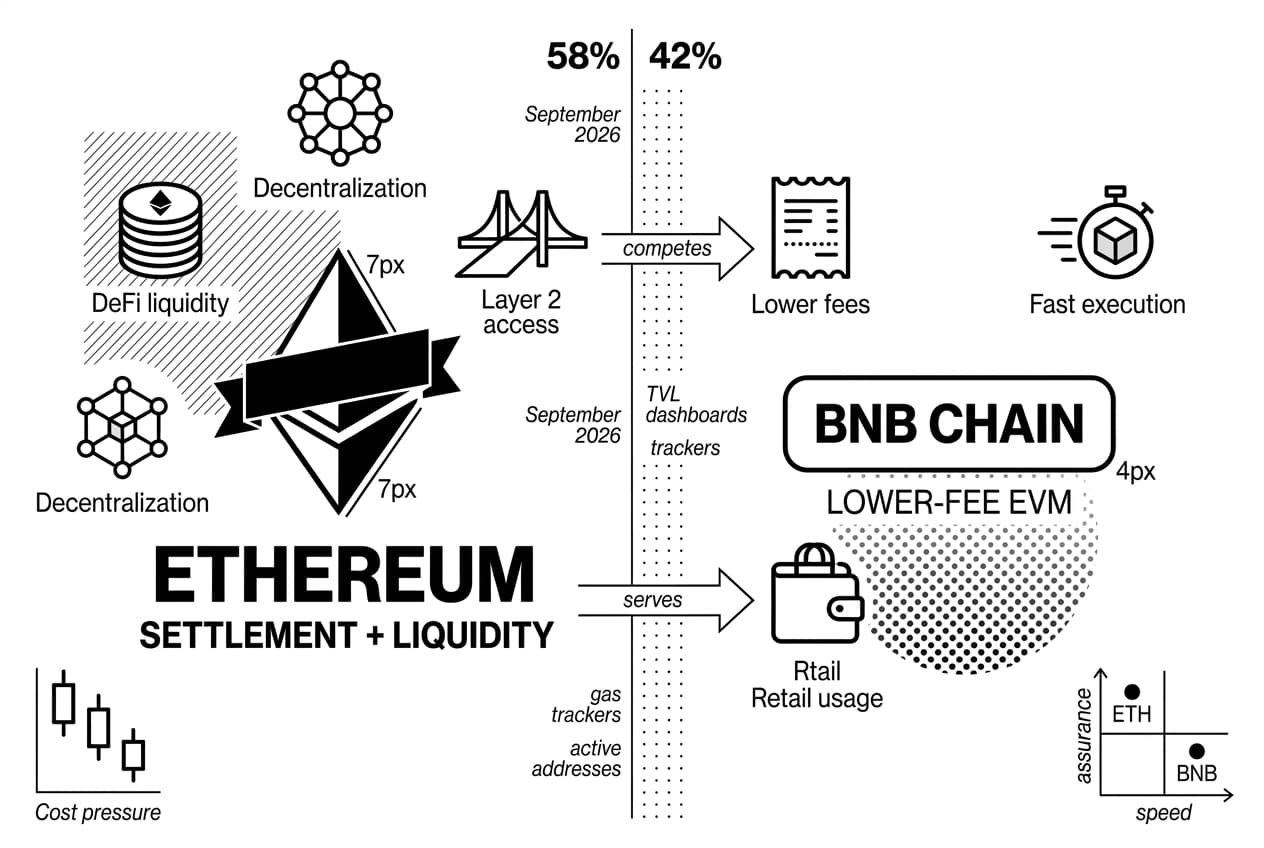
As of September 2026, the clearest pattern is that Ethereum remains the deeper settlement and liquidity layer, while BNB Chain remains a lower-fee EVM network with strong retail usage. Ethereum is increasingly accessed through layer 2 networks, so comparing only Ethereum mainnet against BNB Chain misses how users actually transact today.
Method note: the figures below combine date-stamped public dashboards, including DefiLlama chain TVL data, September 2026, Etherscan active address data, September 2026, BscScan active address data, September 2026, Etherscan gas tracker data, September 2026 and BscScan gas tracker data, September 2026. On-chain metrics move daily, so ranges should be read as decision inputs rather than permanent scores.
The short answer
Ethereum generally offers stronger decentralization, deeper DeFi liquidity and higher settlement assurances. BNB Chain generally offers lower fees, faster block times and easier retail execution. The simple story that Ethereum is expensive and BNB Chain is cheap is no longer enough, because Ethereum layer 2 networks now compete directly with BNB Chain on transaction cost.
Quick Comparison Table: Ethereum vs BNB Chain
The table gives a side-by-side snapshot for the main decision points: validator model, fees, speed, TVL, user activity and best-fit use cases.
Metric | Ethereum | BNB Chain |
|---|---|---|
Core role | Settlement, liquidity and security layer for DeFi, NFTs, stablecoins and layer 2 networks | Low-fee EVM execution chain for retail swaps, gaming, payments and exchange-linked activity |
Consensus model | Proof of stake after the Merge, with validator duties documented by ethereum.org, September 2026 | Proof of staked authority, described in BNB Chain documentation, September 2026 |
Validator model | More than 1 million active validators reported by Beaconcha.in, September 2026 | 21 active validators selected from a larger candidate set, per BNB Chain validator documentation, September 2026 |
Typical L1 transaction fee | About $0.50 to $4.00 in normal periods, with spikes during congestion, from Etherscan gas tracker, September 2026 | About $0.03 to $0.20 for common transfers and swaps, from BscScan gas tracker, September 2026 |
Ethereum layer 2 fee comparison | About $0.01 to $0.05 for many transfers on major rollups, per L2Fees.info, September 2026 | Not the same architecture; opBNB targets very low fees, with status and metrics listed by opBNB documentation, September 2026 |
Block time | About 12 seconds per slot, per ethereum.org block documentation, September 2026 | About 3 seconds, per BNB Chain documentation, September 2026 |
TVL | About $52.3B on Ethereum mainnet and more when major layer 2 networks are included, from DefiLlama, September 2026 | About $6.1B, from DefiLlama, September 2026 |
Daily active addresses | About 420,000 on mainnet, before adding rollup users, from Etherscan, September 2026 | About 1.1M on BNB Smart Chain, from BscScan, September 2026 |
Market cap reference | ETH market data is listed by CoinMarketCap, September 2026 | BNB market data is listed by CoinMarketCap, September 2026 |
Developer environment | Solidity, Foundry, Hardhat, Remix, Viem and mature audit tooling | Solidity-compatible EVM stack with similar tools and lower deployment costs |
Best use cases | High-value DeFi, settlement, long-term custody, institutional liquidity, layer 2 app deployment | Small transfers, active retail trading, gaming, consumer apps and low-cost EVM experimentation |
The comparison shows a split between value secured and activity processed. Ethereum holds substantially more DeFi value, while BNB Chain processes more low-cost retail interactions on its base chain. That difference matters more than a simple coin-price comparison.
Ethereum Overview: Settlement Layer, ETH and Ecosystem
Ethereum is the largest smart contract settlement layer by DeFi liquidity and developer mindshare. ETH pays for gas, secures the proof-of-stake validator set and functions as collateral across DeFi. The network’s base layer is intentionally conservative: it prioritizes settlement assurances, credible neutrality and open participation over cheap execution on every transaction.
Vitalik Buterin, co-founder of Ethereum, is one of the public figures most associated with Ethereum’s rollup-focused roadmap. In practice, that means Ethereum mainnet acts as the security and settlement base, while networks such as Arbitrum, Optimism and Base handle many lower-cost user transactions.
Ethereum strengths
- Decentralization: Ethereum’s validator set is broad, with more than 1 million active validators shown by Beaconcha.in, September 2026. That does not mean every validator is economically independent, but it still gives Ethereum a much wider consensus base than BNB Chain.
- Settlement security: Ethereum’s slower governance process, client diversity and high economic stake make unilateral changes difficult. That is valuable for large DeFi positions, treasuries and applications that need strong finality assumptions.
- DeFi depth: Ethereum and its layer 2 ecosystem hold the largest concentration of DeFi liquidity. If you want to accept Ethereum payments, that liquidity depth and settlement base are a major advantage.
- Developer maturity: Ethereum has the deepest smart contract tooling, security research and audit history in crypto. Builders get better documentation, more battle-tested libraries and a larger hiring pool.
- Institutional access: Spot ETH exchange-traded products began trading in the United States in 2024 after filings listed by the SEC, July 2024, which widened regulated access to ETH exposure.
Ethereum weaknesses
- Mainnet fee spikes: Ethereum L1 can still become expensive when demand rises. Small transfers and low-value swaps often make little sense on mainnet during congestion.
- Fragmented user experience: Liquidity is split across mainnet and multiple layer 2 networks. Users often need to manage bridges, chain switching and different gas balances.
- Layer 2 dependency: Low-cost Ethereum usage now depends on rollups and sequencers. That improves fees, but it also adds operational assumptions beyond the base layer.
- Slow governance: Ethereum’s open governance protects neutrality, but it can make upgrades slower than users and app teams prefer.
Ethereum is best understood as premium settlement plus low-cost access through layer 2 networks. The mainnet itself is not trying to be the cheapest execution venue for every retail action.
BNB Chain Overview: Low-Fee EVM Network and BNB Utility
BNB Chain is an EVM-compatible ecosystem built for faster and cheaper execution. BNB pays gas, supports staking and sits at the center of a broader exchange-linked ecosystem. For users already active around Binance products, BNB Chain often feels simpler than moving through multiple Ethereum rollups.
BNB Chain’s core appeal is practical accessibility. A user can make frequent swaps, claim gaming rewards or move small balances without worrying that a single transaction fee will exceed the value of the activity. That design is useful, even though it comes with a more concentrated validator structure.
BNB Chain strengths
- Low transaction fees: Common transactions often cost cents rather than dollars, with live fee data available from BscScan, September 2026. That is valuable for small transfers and retail DeFi.
- Fast execution: BNB Chain’s roughly 3-second block time, documented by BNB Chain documentation, September 2026, gives consumer apps a faster feel than Ethereum mainnet.
- EVM compatibility: Solidity teams can port contracts with fewer changes than they would need on a non-EVM chain. That lowers development and testing costs.
- Retail distribution: BNB Chain benefits from wallet familiarity, exchange-linked liquidity and a large base of cost-sensitive users.
- Useful for high-frequency actions: Gaming, social app interactions, small swaps and micro-payments fit BNB Chain’s fee profile well.
BNB Chain weaknesses
- Concentrated validator model: BNB Chain uses 21 active validators in each set, according to BNB Chain validator documentation, September 2026. That is much narrower than Ethereum’s validator base.
- Stronger governance trust assumptions: Faster coordination can be helpful during incidents, but it also means users rely more on a smaller set of actors.
- Exchange-linked risk: BNB’s utility and liquidity are closely tied to Binance-related activity. That can help adoption, but it also creates concentration risk.
- Bridge and infrastructure risk: The BNB Chain bridge exploit in October 2022 involved roughly $566M, reported by CoinDesk, October 2022. The response limited damage, but it also showed how much coordination power exists.
- Variable app quality: Low deployment costs attract experimentation, but they also attract short-lived forks and higher due diligence burden for users.
BNB Chain is not simply a weaker Ethereum. It is optimized for a different set of constraints: low fees, fast confirmation and retail reach, with greater reliance on a small validator group.
Key Differences: Decentralization, Security and Governance
The main difference between Ethereum and BNB Chain is that Ethereum prioritizes decentralization, settlement security and broad validator participation, while BNB Chain prioritizes lower fees, faster execution and easier retail access. Ethereum asks users to accept higher base-layer cost or use layer 2 networks; BNB Chain asks users to accept stronger validator and governance trust assumptions.
Validator and governance tradeoffs
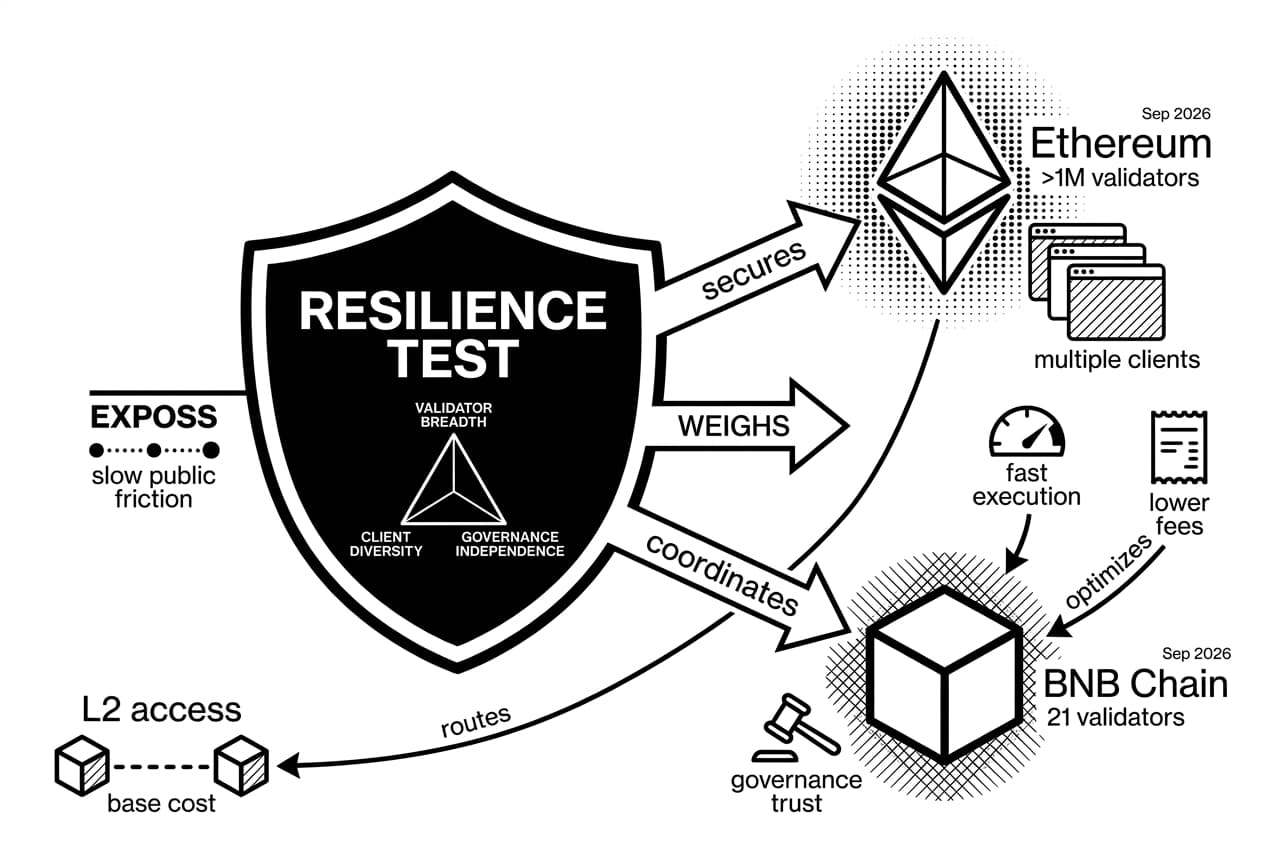
Ethereum’s decentralization advantage comes from the size and openness of its validator system. More than 1 million validators are tracked by Beaconcha.in, September 2026, and the network depends on multiple client teams. Governance is slow, public and often contentious, but that friction makes sudden capture harder.
BNB Chain’s validator design is smaller and more coordinated. The active validator set is 21, according to BNB Chain validator documentation, September 2026. That setup supports faster blocks and faster incident response, but it also reduces the number of parties that would need to coordinate for censorship, rollback pressure or policy changes.
The three-axis resilience test
For this comparison, the useful framework is the three-axis resilience test: validator breadth, client diversity and governance independence. Ethereum scores high on all three. BNB Chain scores better on speed and cost, but lower on validator breadth and governance independence. The right chain depends on which axis matters for the transaction.
Security versus performance
Security and performance are not free. Ethereum’s broad consensus makes changes slow, but it also makes the network harder to steer by a small group. BNB Chain’s smaller validator set makes it faster and cheaper, but the same coordination that helps during emergencies is the reason some users treat it as less trust-minimized.
A $30 game transaction and a $5M treasury rebalance should not be judged with the same rule. BNB Chain may be the better venue for the first. Ethereum mainnet, or an Ethereum layer 2 anchored to mainnet, is usually a better fit for the second.
Fees, Speed and User Experience: Mainnet vs Low-Cost Execution
Fee comparisons are often unfair because they compare BNB Chain with Ethereum mainnet only. In 2026, many Ethereum users interact through layer 2 networks, so the practical comparison has three columns.
Action | Ethereum mainnet | Ethereum layer 2 | BNB Chain |
|---|---|---|---|
Token transfer | $0.50 to $8.00, from Etherscan gas tracker, September 2026 | $0.01 to $0.10, from L2Fees.info, September 2026 | $0.03 to $0.20, from BScScan gas tracker, September 2026 |
DEX swap | $3.00 to $30.00 in normal-to-busy periods | $0.05 to $0.50 on many rollups | $0.10 to $0.40 in many periods |
NFT mint or game action | $5.00 to $60.00 when demand spikes | $0.05 to $1.00 depending on rollup and contract | $0.05 to $0.60 depending on contract |
Speed feel | About 12 seconds per slot, with stronger finality later | Often fast at the sequencer level, with settlement back to Ethereum | About 3 seconds per block |
The cost gap between Ethereum layer 2 networks and BNB Chain is now measured in cents for many actions. BNB Chain still feels simpler for users who want one low-fee base chain. Ethereum layer 2 networks give similar retail fees while retaining a connection to Ethereum settlement.
For wallet selection across both ecosystems, see our guide to the best DeFi wallets for Ethereum and BNB Chain.
When low fees matter most
Low fees matter most for frequent, low-value actions: small transfers, casual gaming, social app posts, retail swaps and testing. If a user is moving $20, a $10 fee destroys the use case. BNB Chain and Ethereum layer 2 networks both solve that problem better than Ethereum mainnet.
The major change came after proto-danksharding. EIP-4844 activated in March 2024, according to Ethereum EIP-4844 documentation, March 2024, reducing data costs for many rollups. That narrowed BNB Chain’s fee advantage against Ethereum’s low-cost execution paths.
When stronger settlement matters most
Higher settlement security matters for large DeFi positions, institutional custody, DAO treasuries and censorship-resistant applications. In those cases, the question is not only what the fee costs today. The question is who can interfere with the transaction, how finality is reached and how hard governance capture would be.
Vitalik Buterin, co-founder of Ethereum, is closely linked with the idea that credible neutrality at the base layer is central to Ethereum’s value. Whether a user needs that property depends on transaction size and risk tolerance.
Ecosystem Strength: TVL, Apps, Stablecoins and Liquidity
Fees tell only part of the story. Liquidity, stablecoin depth, app quality and user distribution often decide where a transaction should happen.
Metric | Ethereum and major layer 2 networks | BNB Chain |
|---|---|---|
DeFi TVL | About $68.4B across Ethereum mainnet and major rollups, from DefiLlama, September 2026 | About $6.1B, from DefiLlama, September 2026 |
Stablecoin depth | Deep USDT, USDC, DAI and other stablecoin markets across mainnet and rollups | Meaningful USDT, USDC and FDUSD activity, but less total depth than Ethereum |
DEX liquidity | Deep liquidity through large Ethereum-native exchanges and aggregators | Retail-heavy liquidity with strong activity on BNB-native exchanges |
App profile | Institutional DeFi, lending, liquid staking, derivatives, NFTs and rollup apps | Retail swaps, gaming, launch activity, payments and low-cost consumer apps |
30-day active address pattern | Broad activity when mainnet and major rollups are counted together | Strong base-chain activity shown by BscScan active address data, September 2026 |
DeFi and liquidity
Ethereum’s DeFi advantage is depth. More collateral, more stablecoins, more lending markets and more audited infrastructure sit on Ethereum or its rollups. Hayden Adams, founder of Uniswap Labs, is one of the public builders most closely linked with Ethereum DeFi and automated market maker design.
That depth makes Ethereum stronger for large trades and complex DeFi strategies. It also helps DeFi liquidity pools connect across lending, trading, staking and derivatives. BNB Chain has real liquidity, but it is narrower and more retail-driven.
For cross-chain interoperability, both ecosystems depend on bridges, messaging systems and wrapped assets. Those tools improve access, but they also add risk that does not exist when assets stay on one chain.
Retail apps, gaming and payments
BNB Chain is stronger for many retail use cases because it keeps base-chain costs low and user flows simple. Games, micro-payment apps and frequent swaps benefit from predictable cents-level fees. For users already holding BNB or using Binance-linked services, the path into BNB Chain can be direct.
Ethereum’s retail growth is now mostly an L2 story. Base, Arbitrum and other rollups give users low fees while connecting back to Ethereum settlement. The tradeoff is added complexity: bridges, sequencers and rollup-specific wallets can confuse new users.
Frequently Asked Questions
- Is BNB built on Ethereum?
- BNB originally launched as an ERC-20 token on Ethereum in 2017, but it later migrated to become the native gas and utility token of BNB Chain. Today, BNB Chain operates independently, though bridged or wrapped versions of BNB can still move between Ethereum and other networks.
- Is BNB still a good investment?
- That depends on factors you should research carefully: BNB Chain's transaction volume, Binance's broader ecosystem health, token burn mechanics, regulatory exposure, and validator centralization risks. Growing competition from Ethereum Layer 2s and other low-fee chains also puts pressure on BNB Chain's market position. Never invest more than you can afford to lose.
- Is it better to buy Ethereum or Bitcoin?
- Bitcoin and Ethereum serve fundamentally different purposes. Bitcoin is widely treated as digital scarcity and a monetary store of value, while Ethereum powers smart contracts, DeFi, and staking. Neither is universally "better" — the right choice depends on your investment goals, time horizon, and risk tolerance.
- Can BNB reach $10,000?
- At $10,000 per token, BNB's market cap would reach roughly $1.5 trillion based on current circulating supply — rivaling the largest companies on Earth. While mathematically possible in an extreme bull cycle, it would require massive adoption growth, favorable regulation, and sustained demand that far outpaces today's levels.
Sources
Author

Crypto analyst and blockchain educator with over 8 years of experience in the digital asset space. Former fintech consultant at a major Wall Street firm turned full-time crypto journalist. Specializes in DeFi, tokenomics, and blockchain technology. His writing breaks down complex cryptocurrency concepts into actionable insights for both beginners and seasoned investors.