Polkadot vs Ethereum: Smart Contracts or Interoperability?
Polkadot vs Ethereum: Smart Contracts or Interoperability?
Polkadot vs Ethereum in 2026: What Is Being Compared?
Polkadot vs Ethereum is not a simple winner-takes-all comparison in 2026. Ethereum is the larger smart contract settlement network with deeper liquidity, broad wallet support, and the strongest EVM developer base. Polkadot is a shared-security network built for app-specific chains that need native cross-chain coordination. The practical question is which architecture fits the job.
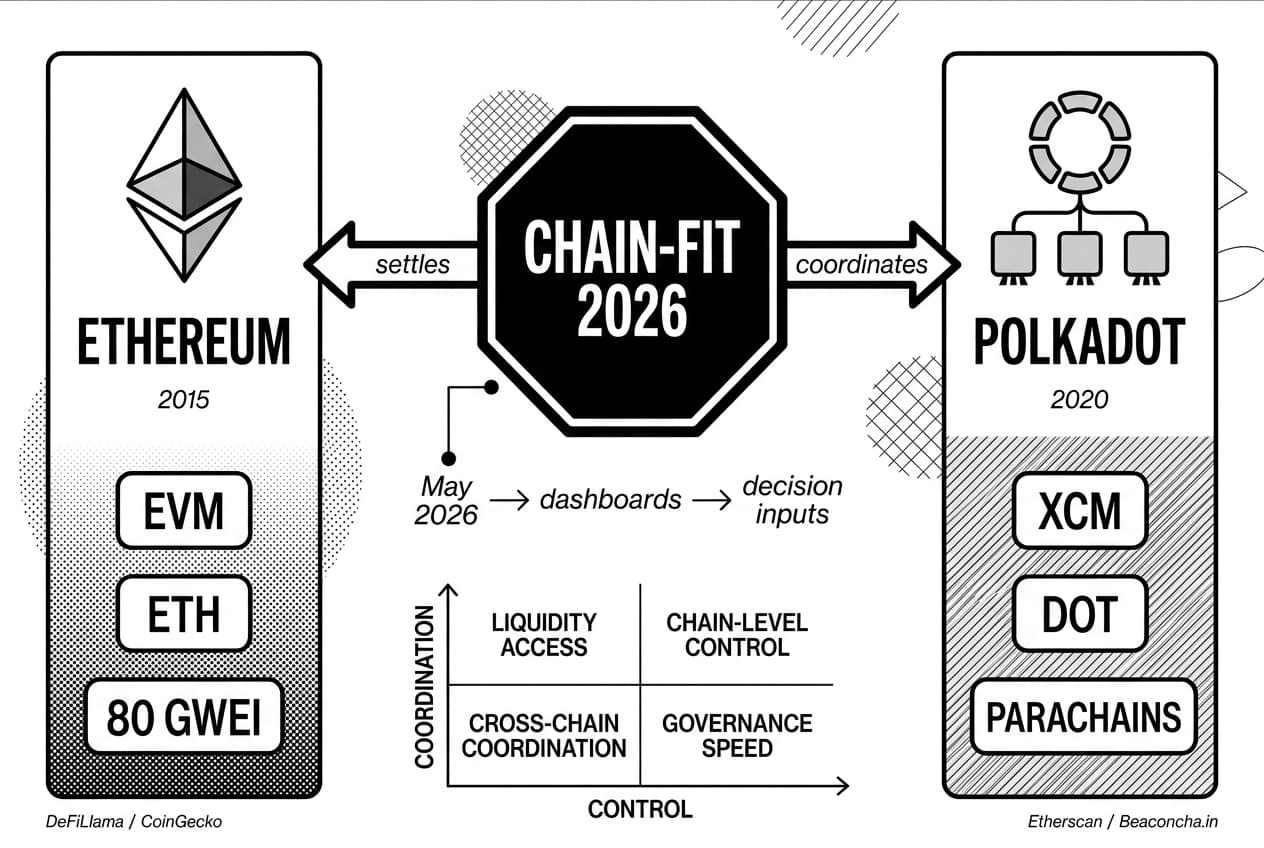
Method note: the figures below use a May 2026 public-data snapshot from source dashboards, including DeFiLlama, CoinGecko, Etherscan, Beaconcha.in, and Polkadot network data. Shifting crypto metrics move quickly, so treat the numbers as decision inputs, not fixed forecasts. This guide uses our Four-Lens Chain-Fit Framework: liquidity access, chain-level control, cross-chain coordination, and governance speed.
Quick comparison: Ethereum vs Polkadot in 2026
metric | Ethereum | Polkadot |
|---|---|---|
launch year | 2015 | 2020 |
native token | ETH | DOT |
purpose | general-purpose smart contract settlement | cross-chain coordination through shared security |
architecture | mainnet execution layer plus rollups | relay chain plus parachains |
consensus | proof of stake | nominated proof of stake |
smart contracts | EVM, Solidity, Vyper | Substrate runtimes, ink!, and EVM parachains |
interoperability | bridges, rollup messaging, shared sequencing projects | XCM, the native cross-consensus messaging format |
fees | mainnet gas can exceed 80 gwei in congested periods (Etherscan, March 2026) | fees vary by parachain and are typically low on Substrate-based chains (Subscan, May 2026) |
TVL | about $52.4B across mainnet and major L2s (DeFiLlama, May 2026) | about $380M across tracked Polkadot DeFi apps (DeFiLlama, May 2026) |
market cap | about $280B (CoinGecko, May 2026) | about $12B (CoinGecko, May 2026) |
staking | about 3% to 4% APR (Ethereum.org, May 2026) | about 12% to 15% APY before token-dilution effects (Polkadot.network, May 2026) |
best use case | liquidity-rich dapps, DeFi, NFTs, stablecoin settlement | custom app-chains, cross-chain protocols, specialized runtimes |
The common split says Polkadot is the interoperability chain while Ethereum is the smart contract chain. That is now too simple. Ethereum rollups are becoming their own coordination layer, while Polkadot parachains increasingly support EVM execution through networks such as Moonbeam. The better 2026 question is whether your use case needs liquidity first, control first, or native cross-chain coordination first.
Ethereum Overview: Smart Contract Settlement Layer
Ethereum sits at the center of DeFi, NFT markets, DAO tooling, stablecoin liquidity, and smart contract infrastructure. It has the largest pool of audited EVM code, the broadest wallet support, and the deepest liquidity base. In a polkadot vs ethereum decision, Ethereum usually wins when composability with existing contracts matters more than chain-level customization.
Ethereum strengths
Ethereum-connected networks held about $52.4B in total value locked in the May 2026 snapshot (DeFiLlama, May 2026). That liquidity compounds. New protocols can connect to established lending markets, DEX pools, stablecoins, oracle networks, and custody rails without asking users to move to a smaller ecosystem first.
The developer stack is another major advantage. Solidity, Vyper, Foundry, Hardhat, Remix, and block explorers such as Etherscan form a mature production path. Vitalik Buterin, co-founder of the Ethereum Foundation, has consistently supported Ethereum's rollup-centered scaling roadmap, where mainnet acts as the settlement and data-availability anchor while L2s absorb more execution. You can also see Ethereum compared with other smart contract networks for a broader look at fees and decentralization tradeoffs.
- Liquidity depth: DeFi capital, stablecoins, and lending markets are concentrated on Ethereum and its largest L2s.
- Developer availability: Solidity talent, auditors, public code examples, and testing tools are easier to find than equivalent Substrate resources.
- Network effects: Wallets, exchanges, analytics tools, custodians, and institutional services usually support Ethereum first.
- Composability: Contracts can plug into existing token standards, governance frameworks, DEXs, and lending markets.
Ethereum weaknesses
Ethereum mainnet still becomes expensive when demand spikes. Base fees moved above 80 gwei during high-demand periods in Q1 2026 (Etherscan, March 2026), which can make small transactions uneconomic. Rollups reduce fees, but they introduce their own fragmentation problem. Liquidity, users, and application state split across Arbitrum, Optimism, Base, zkSync, and other L2s.
Ethereum governance is also intentionally slow. That caution protects a high-value settlement layer, but it means protocol upgrades take long coordination cycles. The same conservatism that makes Ethereum credible for large DeFi positions can slow its response to UX and cross-rollup coordination issues.
criterion | Ethereum snapshot |
|---|---|
TVL | about $52.4B across mainnet and major L2s (DeFiLlama, May 2026) |
validator count | more than 1,000,000 active validators (Beaconcha.in, May 2026) |
gas stress point | above 80 gwei base fee in congested periods (Etherscan, March 2026) |
scaling model | optimistic and ZK rollups, supported by EIP-4844 blob data |
main tradeoff | deep liquidity and tooling, offset by cross-rollup fragmentation and mainnet fee spikes |
Polkadot Overview: Shared Security and Interoperability
Polkadot takes a different route. Instead of one general-purpose execution layer, it coordinates many specialized blockchains called parachains. Those parachains connect to a relay chain that provides shared security, finality, validator assignment, and cross-chain coordination. In a polkadot vs ethereum comparison, Polkadot usually wins when a team needs sovereign chain design without building an independent validator network.
Gavin Wood, founder of Polkadot and co-founder of Ethereum, designed Polkadot around the idea that specialized chains can share one security root while keeping their own runtime logic. The relay chain does not host general smart contracts. Its main job is coordination: finalizing parachain blocks, managing validators, handling disputes, and supporting XCM messages.
As of the May 2026 snapshot, Polkadot reported roughly 297 active validators securing the network (Polkadot.network, May 2026). That is far fewer than Ethereum's validator count, but Polkadot uses those validators differently. The validator set is assigned across parachains so new chains can inherit shared security from day one.
Polkadot strengths
- Native interoperability: XCM lets parachains transfer assets and instructions inside the Polkadot security model rather than through unrelated third-party bridges.
- Shared security: Parachains do not need to bootstrap their own validator markets, which can lower the security burden for early-stage app-chain teams.
- App-specific design: Substrate lets teams define custom runtimes, fee rules, block times, governance tracks, and transaction logic.
- On-chain governance: OpenGov allows token holders to propose and approve runtime changes without the same hard-fork process used by many chains.
- EVM access when needed: EVM-compatible parachains let Solidity teams deploy inside the Polkadot ecosystem while still using familiar tools.
Polkadot weaknesses
- Lower liquidity: Polkadot DeFi TVL was about $380M in the May 2026 snapshot (DeFiLlama, May 2026), far below Ethereum's liquidity base.
- Developer learning curve: Rust, Substrate, pallets, and parachain operations are harder for many teams than deploying a Solidity contract.
- User experience friction: Users still need to understand which parachain holds an asset, even when XCM handles the messaging layer.
- Token demand questions: DOT is used for staking, governance, and coretime-related network access, but its long-term demand depends on sustained parachain activity.
- Smaller tooling market: Wallets, indexers, auditors, and analytics providers cover Polkadot less broadly than they cover Ethereum.
Architectural Differences: Relay Chain vs Ethereum Execution
The two networks place complexity in different parts of the stack. Ethereum concentrates settlement and liquidity around one base layer, then scales execution outward through rollups. Polkadot distributes execution across app-specific chains, then ties them together through shared security and XCM. This is the central architecture tradeoff.
dimension | Ethereum | Polkadot |
|---|---|---|
core design | base execution layer plus rollup ecosystem | relay chain plus parachains |
finality | 12-second slots and later economic finality (Ethereum.org, May 2026) | about 6-second block timing on many relay-chain observations (Subscan, May 2026) |
validator set | more than 1,000,000 active validators (Beaconcha.in, May 2026) | about 297 active validators (Polkadot.network, May 2026) |
execution environment | EVM on mainnet and many L2s | Wasm through Substrate, plus EVM parachains |
upgrade path | client upgrades and social coordination around EIPs | forkless runtime upgrades through on-chain governance |
cross-chain messages | rollup bridges and external messaging protocols | XCM inside a shared-security network |
Security model and validators
Ethereum's validator count is a major security asset. With more than 1,000,000 active validators in the May 2026 snapshot (Beaconcha.in, May 2026), attacking mainnet requires a very large amount of staked ETH and coordination. Rollups inherit settlement from Ethereum, but each rollup also has its own proving, sequencing, upgrade, and bridge assumptions.
Polkadot's security model is smaller by validator count but more uniform across connected parachains. Validators are assigned to check parachain blocks, while nominators back validators with bonded DOT. For early-stage teams, that pooled security can be more practical than launching an independent chain and recruiting validators from scratch.
Execution environments: EVM, Wasm, and Substrate
Ethereum's EVM remains the default smart contract runtime. It is less flexible than a custom chain runtime, but it is familiar, heavily audited, and supported by an enormous tool market. That matters when the product depends on fast deployment, easy hiring, and integration with existing DeFi contracts.
Polkadot's native development path uses Wasm and Substrate. That gives teams more control over runtime logic, governance, storage, fees, and upgrade rules. Teams that need EVM compatibility can use EVM parachains, but the broader design still asks them to think at the chain level rather than only at the contract level.
Smart Contracts and Developer Experience
For builders, the daily question is not only which chain is more advanced. It is which environment lets the team ship safely with the talent, tools, liquidity, and risk budget it actually has. Ethereum provides the simpler contract deployment path. Polkadot provides more control when the product needs a custom chain.
criterion | Ethereum | Polkadot |
|---|---|---|
main languages | Solidity and Vyper | Rust, ink!, and Solidity on EVM parachains |
deployment unit | smart contract | runtime pallet, parachain, or Wasm contract |
tooling | Foundry, Hardhat, Remix, Etherscan, Tenderly | Substrate tools, Zombienet, Chopsticks, Polkadot.js |
wallet support | MetaMask, Ledger, Coinbase Wallet, many mobile wallets | Polkadot.js, Nova Wallet, Talisman, selected hardware-wallet paths |
indexing | The Graph, Alchemy, Infura, public RPC networks | SubQuery, Subsquid, parachain-specific indexers |
token standards | ERC-20, ERC-721, ERC-1155, ERC-4337 | asset pallets, parachain assets, XCM asset movement |
Building on Ethereum
Ethereum remains the default choice for DeFi protocols, NFT platforms, DAOs, token launches, and applications that need immediate access to stablecoin liquidity. The May 2026 snapshot shows about $52.4B in Ethereum mainnet and major L2 TVL (DeFiLlama, May 2026), which gives builders a large capital base from the first day of deployment.
The tooling path is also mature. Foundry's testing suite, Hardhat's plugin ecosystem, and audited contract libraries reduce setup time. For smart contracts and governance use cases, Ethereum's token and governance standards are familiar to users, auditors, exchanges, and custody providers.
Hayden Adams, founder of Uniswap Labs, is one example of the Ethereum application-layer network effect: major DeFi products started on Ethereum because liquidity and users were already there. That does not make Ethereum the best fit for every product, but it explains why EVM deployment remains the lowest-friction path for many teams.
The main drawback is limited chain-level control. If a project needs a custom fee market, unusual transaction ordering, protocol-native cross-chain instructions, or a specialized governance process, a contract on Ethereum may not be enough. The team may need a rollup, which adds infrastructure work.
Building on Polkadot
Polkadot is strongest when a team can clearly say: we need chain-level control. Substrate lets developers build custom runtimes, choose pallets, set governance rules, and design chain behavior around the application. That can be a better fit for identity networks, gaming chains, institutional settlement, custom marketplaces, and cross-chain protocols.
For DeFi interoperability, XCM gives Polkadot a native message layer. A lending parachain and a DEX parachain can coordinate through the network's own cross-chain format instead of relying only on an external bridge. That is the clearest design difference from Ethereum's L2 model.
The cost is operational complexity. Rust and Substrate are harder to staff than Solidity. Wallet support is narrower. Parachain and coretime planning require infrastructure judgment that a simple EVM contract deployment avoids. Polkadot is not the easier choice for a generic token launch, but it can be the more direct choice for products that need custom runtime logic.
Interoperability and Scalability Approaches
Both networks scale by using multiple execution environments, but they connect those environments differently. Ethereum scales through rollups that settle back to mainnet. Polkadot scales through parachains that share a relay-chain security root. The key question is whether cross-chain coordination is external infrastructure or part of the base system.
dimension | Polkadot | Ethereum |
|---|---|---|
message layer | XCM inside the protocol ecosystem | bridges, rollup messaging, and third-party standards |
security basis | shared relay-chain security for connected parachains | mainnet settlement plus rollup-specific proof systems |
data availability | availability cores and the JAM roadmap | EIP-4844 blobs live since March 2024 (Ethereum EIPs, March 2024) |
bridge risk | lower inside the Polkadot security perimeter, higher when leaving it | varies by bridge, rollup design, proof type, and upgrade control |
user experience | consistent message format, but parachain asset management can confuse users | strong wallets and apps, but liquidity is split across L2s |
Polkadot's XCM and parachain model
XCM, short for cross-consensus messaging, lets parachains send assets, instructions, and governance-related messages to each other. Because parachains share the relay-chain security model, cross-chain activity inside the ecosystem does not need the same external bridge assumptions that many independent chains require.
This is valuable for protocols that treat interoperability as a core product feature rather than an add-on. The limitation is adoption. A cross-chain system only works well when enough parachains, wallets, and apps support the message format in a user-friendly way.
Ethereum rollups, bridges, and data availability
Ethereum's rollup-centered roadmap has reduced costs for many users. EIP-4844, activated in March 2024, introduced blob transactions for cheaper L2 data posting (Ethereum EIPs, March 2024). That upgrade made Ethereum Layer 2 scaling more practical for frequent transactions.
The tradeoff is fragmented state and liquidity. Optimistic rollups can have delayed withdrawals. ZK rollups can prove faster, but they differ in maturity and cost. Shared sequencing and cross-rollup messaging projects aim to improve this, but the 2026 user experience still depends on which L2, bridge, and wallet a user chooses.
Bridge risk remains part of the comparison. Cross-chain bridge exploits tracked by DeFiLlama exceeded $2.5B in cumulative losses through 2023 (DeFiLlama hacks database, 2024). That does not mean every Ethereum bridge is unsafe, but it shows why Polkadot's native messaging design is not just a branding point.
Ecosystem, Tokenomics, and Market Data: ETH vs DOT
ETH and DOT serve different economic roles. ETH is gas, staking collateral, DeFi collateral, and the settlement asset for a large rollup economy. DOT is used for staking, governance, and network access inside Polkadot's app-chain model. The tokens should not be compared only by market cap, because their demand drivers differ.
metric | ETH | DOT |
|---|---|---|
market value | about $280B (CoinGecko, May 2026) | about $12B (CoinGecko, May 2026) |
circulating supply | about 120M ETH (CoinGecko, May 2026) | about 1.4B DOT (CoinGecko, May 2026) |
staking return | about 3% to 4% APR (Ethereum.org, May 2026) | about 12% to 15% APY before dilution effects (Polkadot.network, May 2026) |
DeFi TVL | about $52.4B across mainnet and major L2s (DeFiLlama, May 2026) | about $380M across tracked Polkadot DeFi apps (DeFiLlama, May 2026) |
fee mechanism | EIP-1559 burns part of the base fee | fee treatment depends on the chain and runtime configuration |
governance role | mostly off-chain social consensus and EIP coordination | on-chain OpenGov voting and delegation |
major projects | Uniswap, Aave, Lido, Arbitrum, Base | Acala, Moonbeam, Hydration, Bifrost, Astar |
ETH utility and value drivers
ETH pays gas on Ethereum mainnet and is also central to L2 settlement. Since EIP-1559 launched in August 2021, part of each base fee has been burned, linking token supply pressure to network activity (Ultrasound.money, May 2026). ETH also functions as major DeFi collateral because of its liquidity, listing depth, and long operating history.
For users looking to reduce DeFi gas costs, L2s such as Arbitrum and Base offer lower-cost ETH-denominated transactions than mainnet. The tradeoff is that ETH staking yield, around 3% to 4% APR in the May 2026 snapshot (Ethereum.org, May 2026), is lower than DOT's nominal staking yield.
DOT utility and value drivers
DOT supports staking, governance, and network access in Polkadot's app-chain economy. Holders can nominate validators, vote through OpenGov, and participate in decisions that affect runtime upgrades and treasury spending. This gives DOT a more direct governance role than ETH has at the protocol level.
DOT's nominal staking yield, about 12% to 15% APY in the May 2026 snapshot (Polkadot.network, May 2026), is attractive but must be judged against issuance and token demand. If parachain activity and application demand grow, DOT's utility improves. If activity stays limited, high nominal yield alone does not solve the demand question.
Key Differences Between Polkadot and Ethereum
The decision points below summarize the practical differences that matter most after comparing architecture, developer experience, interoperability, liquidity, governance, and token design.
- Architecture: Ethereum uses a base execution layer and rollups, while Polkadot uses a relay chain that secures many parachains.
- Smart contracts: Ethereum is the stronger default for Solidity and EVM contracts, while Polkadot is stronger when the team needs custom runtime logic.
- Interoperability: Polkadot uses XCM for native cross-chain messaging, while Ethereum relies on rollup bridges, third-party messaging, and emerging L2 standards.
- Liquidity: Ethereum held about $52.4B in tracked mainnet and L2 TVL (DeFiLlama, May 2026), while Polkadot tracked about $380M (DeFiLlama, May 2026).
- Fees: Ethereum mainnet fees can spike during congestion, while Polkadot parachain fees are set by each chain and tend to be lower for routine transfers.
- Governance: Ethereum changes through EIPs, client coordination, and social consensus, while Polkadot uses on-chain OpenGov for runtime and treasury decisions.
- Developer experience: Ethereum has the larger Solidity talent pool and audit market, while Polkadot gives Rust and Substrate teams more control over chain behavior.
- Risk profile: Ethereum concentrates economic activity but fragments across L2s, while Polkadot coordinates chains natively but has a smaller liquidity base.
The biggest practical distinction
Ethereum is stronger for liquidity-rich smart contract deployment. Polkadot is stronger for sovereign app-chain design with native cross-chain coordination. If the application depends on existing DeFi money markets, Ethereum has the edge. If the application needs custom runtime rules and shared security across chains, Polkadot is the more natural starting point.
Which Should You Choose: Polkadot or Ethereum?
Ethereum is better for liquidity-rich smart contract deployment, broad wallet support, stablecoin access, and fast EVM development. Polkadot is better for custom interoperable app-chain use cases that need shared security, native cross-chain messaging, and flexible governance. Choose by use case, not by assuming one architecture is universally superior.
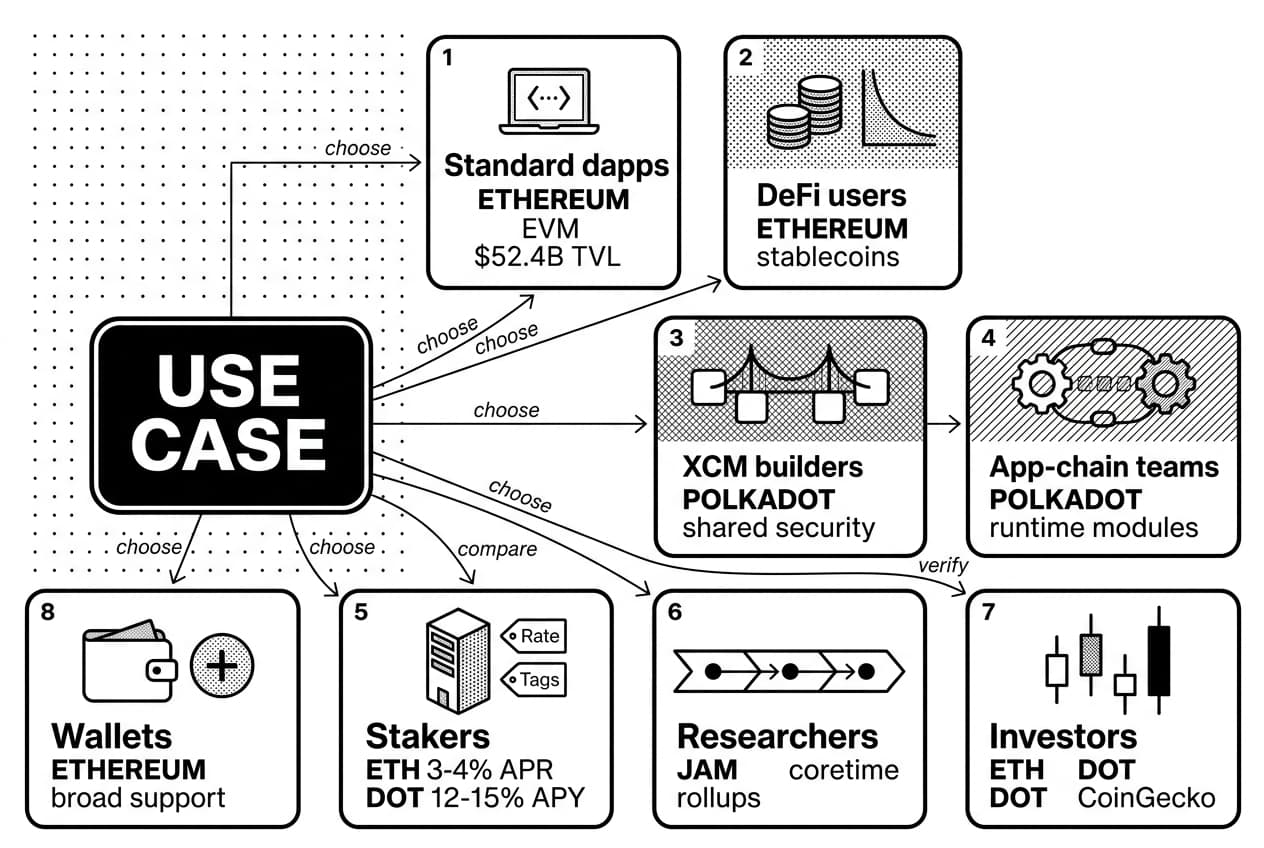
Best choice by user need
- Developers building standard dapps: Choose Ethereum. The EVM toolchain is mature, and the ecosystem held about $52.4B in tracked TVL in the May 2026 snapshot (DeFiLlama, May 2026).
- DeFi users: Choose Ethereum for deeper stablecoin liquidity, larger DEX markets, and broader lending integrations.
- Cross-chain builders: Choose Polkadot when native XCM messaging and shared relay-chain security are core to the product.
- App-chain teams: Choose Polkadot when custom block times, fee models, governance rules, or runtime modules matter more than immediate access to Ethereum liquidity.
- Stakers: Compare live rates before committing. ETH offered about 3% to 4% APR (Ethereum.org, May 2026), while DOT offered about 12% to 15% APY before dilution effects (Polkadot.network, May 2026).
- Long-term researchers: Study both. Ethereum's rollup roadmap and Polkadot's JAM and coretime roadmap remain active 2026 design fronts.
- Investors: Treat both as speculative assets. ETH is larger and more liquid, while DOT is a smaller-cap bet on app-chain interoperability. Verify live market data on CoinGecko before making any allocation.
Using the Four-Lens Chain-Fit Framework, Ethereum scores best on liquidity access and developer distribution. Polkadot scores best on chain-level control and native cross-chain coordination. Governance speed depends on what you value: Ethereum's slower process protects social legitimacy, while Polkadot's on-chain process can change the protocol faster.
Frequently Asked Questions
- Does Polkadot still have a future?
- Polkadot still has a credible future, particularly if demand grows for app-specific chains and native cross-chain communication via XCM. Its shared security model and active governance remain genuine strengths. That said, it faces real challenges around developer mindshare and liquidity compared to Ethereum's more established ecosystem.
- Is DOT a dead coin?
- Calling DOT dead oversimplifies the situation. The Polkadot network continues operating, with DOT actively used for staking, governance, and parachain bonding. However, weaker market performance and slower ecosystem growth compared to competitors can create that impression. Network activity and token price sentiment are two very different things.
- Is Polkadot a good crypto to invest in?
- That depends entirely on your risk tolerance. Polkadot may appeal to those who believe in interoperability infrastructure and app-chain architecture. However, DOT carries meaningful risks including adoption uncertainty, token supply dynamics, and stiff competition from Ethereum and its L2 ecosystem. Always compare key metrics before making any decision.
- What will Polkadot be worth in 5 years?
- No reliable fixed prediction exists for DOT's five-year value. Its price will depend on parachain activity, staking participation, governance direction, broader market cycles, and competition from Ethereum L2s and rival ecosystems. Regulatory shifts could also play a significant role. Scenario-based analysis tends to be more useful than point predictions.
Sources
Author

Crypto analyst and blockchain educator with over 8 years of experience in the digital asset space. Former fintech consultant at a major Wall Street firm turned full-time crypto journalist. Specializes in DeFi, tokenomics, and blockchain technology. His writing breaks down complex cryptocurrency concepts into actionable insights for both beginners and seasoned investors.