CBDC vs Crypto: Key Differences, Risks and Use Cases 2026
CBDC vs crypto: what is being compared?
CBDC vs crypto is not a simple comparison between two kinds of online money. A central bank digital currency, a public cryptocurrency, bitcoin and a stablecoin all move value digitally, but they rely on different issuers, trust models, privacy assumptions and legal rules. The practical question in 2026 is not which one is modern. It is which one fits a specific payment, savings or settlement need.
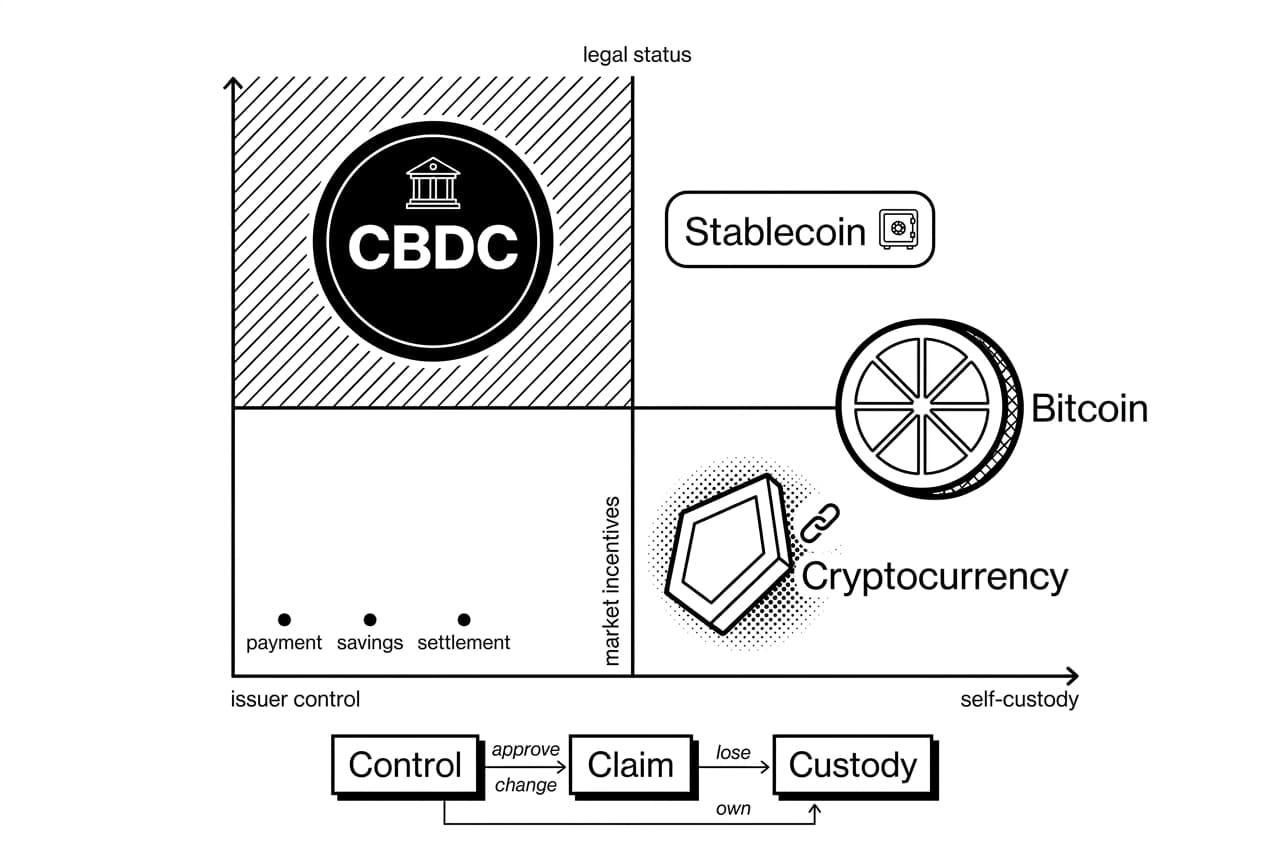
What is the difference between CBDC and crypto? A CBDC is digital fiat money issued by a central bank and governed by public monetary policy. Cryptocurrency is a blockchain-based asset governed by code, market incentives and network participants. In practical cbdc vs crypto terms, the tradeoff is state-backed stability and legal status versus permissionless access, self-custody and weaker issuer control.
This guide uses a dated comparison method, the Control, claim and custody framework. Control asks who can approve, block or change transactions. Claim asks what the holder legally owns. Custody asks who can recover, freeze or lose the funds. As of early 2026, those three questions explain most differences between a central bank digital currency vs crypto, bitcoin and stablecoins.
Quick definitions
- CBDC: A digital version of national fiat money issued by a central bank. It may be retail, for consumers and merchants, or wholesale, for banks and market infrastructure.
- Cryptocurrency: A digital asset recorded on a blockchain and secured by cryptography. Ethereum, litecoin and solana are examples, but they do not all serve the same purpose.
- Bitcoin: The best-known cryptocurrency and the clearest cbdc vs bitcoin contrast because its supply rules are fixed by protocol rather than set by a central bank.
- Stablecoin: A crypto token designed to track a fiat currency, usually the U.S. dollar. It is not a CBDC because the issuer is private, not a central bank.
Why the comparison matters in 2026
As of early 2026, more than 130 countries were in some stage of CBDC research, pilot or launch according to the cbdc tracker, early 2026. The same tracker listed 66 countries in advanced development, pilot or launch status at that time. That makes CBDCs a live policy issue, not a theoretical topic.
Jeremy Allaire, co-founder and CEO at Circle, has argued publicly that the architecture of digital money matters because issuer rights, freezing powers and settlement rails shape user risk. Lyn Alden, founder of lynalden.com, has argued publicly that bitcoin and CBDCs sit near opposite ends of the monetary control spectrum. Those views frame the core tradeoff: less volatility does not automatically mean less risk.
CBDC vs crypto comparison table
The table below applies the same criteria to CBDCs, broad crypto assets, bitcoin and stablecoins. It is designed for quick comparison, but the later sections explain the tradeoffs behind each row.
criteria | CBDC | crypto | bitcoin | stablecoins |
|---|---|---|---|---|
issuer | central bank | protocol, foundation or network | protocol and node consensus | private issuer |
claim | direct claim on sovereign money | claim on a network asset | scarce bearer asset | contractual claim on issuer reserves |
value stability | tracks national currency | usually volatile | volatile, fixed supply | targets fiat parity |
privacy | identity-based in most designs | pseudonymous on-chain | pseudonymous on-chain | pseudonymous on-chain, issuer-visible at redemption |
custody | state, bank or approved wallet | self-custody or custodian | self-custody or custodian | self-custody token, issuer reserve risk |
settlement | centralized finality | seconds to minutes by chain | about 10 minutes per block on the base layer | depends on host chain |
programmability | policy-controlled | open smart contracts | limited scripting | smart contracts on host chain |
main risk | surveillance, policy control, outage | volatility, scams, smart-contract bugs | price drawdowns, key loss | reserve, blacklist and issuer risk |
best use | domestic payments and public disbursement | open apps and DeFi | non-sovereign savings and censorship-resistant settlement | digital dollar payments and crypto market liquidity |
Under the Control, claim and custody framework, CBDCs score strongest on legal certainty and fiat stability. Bitcoin scores strongest on supply predictability and censorship resistance. Stablecoins score strongest where users need dollar pricing on public blockchains. Broad crypto assets score strongest where the goal is programmable finance rather than money-like stability.
Option scorecards
- CBDC overview: sovereign digital cash or reserves, depending on design. Strengths: legal status, fiat stability and fast domestic settlement. Weaknesses: state visibility, policy controls and centralized operational risk.
- Crypto overview: blockchain assets used for payments, applications, governance or collateral. Strengths: open access, smart contracts and global settlement. Weaknesses: volatility, scams, regulatory uncertainty and wallet complexity.
- Bitcoin overview: fixed-supply monetary network. Strengths: self-custody, scarcity and censorship resistance. Weaknesses: price volatility, limited base-layer throughput and irreversible key loss.
- Stablecoin overview: fiat-tracking token issued by a private company. Strengths: dollar pricing, fast transfers and DeFi compatibility. Weaknesses: reserve risk, blacklist controls and dependence on regulation.
What is a central bank digital currency?
A central bank digital currency is a digital liability of a central bank, denominated in the national unit of account. A digital dollar, digital euro or digital yuan would still be fiat money. The difference is form and infrastructure. Instead of paper cash or commercial bank deposits, the user holds value through a CBDC wallet or account built into a regulated payment system.
CBDC overview
Retail CBDCs target consumers and merchants. Wholesale CBDCs target banks, clearing systems and financial market settlement. Designs can be account-based, token-based or intermediated through banks and approved wallet providers. Some models include offline payments for resilience, while others prioritize identity controls and compliance screening.
The policy goal is usually narrower than crypto adoption. Central banks are not trying to create a speculative asset. They are trying to preserve public money in a world where cash use is falling, private payment apps are gaining share and dollar-backed stablecoins are moving value across borders.
CBDC strengths
- Fiat stability: a CBDC tracks the national currency one-to-one, so it avoids the market volatility that affects most crypto assets.
- Legal certainty: it can carry legal-tender status inside the issuing jurisdiction.
- Fast public settlement: the central bank can design rails for near-real-time domestic transfers without relying entirely on card networks.
- Public disbursement: tax refunds, welfare payments and emergency support can be sent directly to eligible wallets.
- Offline potential: card or device-based models can help during network outages if the design supports local transaction limits.
CBDC weaknesses
Caitlin Long, founder and CEO at custodiabank.com, has warned publicly that programmable government money can create surveillance and control risks. The concern is not that every CBDC must be abusive. The concern is that the same system that enables fast public payments can also enable account freezes, spending limits or detailed transaction monitoring.
- Privacy exposure: identity-based wallets create a transaction record that may be visible to the issuing authority or approved intermediaries.
- Policy control: programmable features can support useful rules, but they can also support spending restrictions or expiry dates.
- Bank funding effects: if consumers move deposits from banks into CBDC wallets, banks may lose a source of lending funds.
- Centralized outage risk: a national digital money platform becomes critical infrastructure and a valuable attack target.
What is cryptocurrency?
Cryptocurrency is a broad category of blockchain-based assets. Some tokens are designed for payments, some for smart-contract fees, some for governance and some for collateral. Unlike a CBDC, crypto is not issued as a liability of a central bank. It relies on network rules, cryptographic verification and market incentives.
Crypto overview: how the network works
Public blockchains replicate a ledger across many independent computers. Users control funds with private keys, and transactions are validated by miners or validators. Ethereum moved from proof of work to proof of stake in September 2022, according to ethereum.org, 2022. Bitcoin uses proof of work and adds a new block roughly every 10 minutes, according to bitcoin.org developer guide, accessed Aug. 19, 2026.
Self-custody is the core user difference. A person can hold crypto without a bank account, but that freedom moves responsibility to the user. Understanding why self-custody matters is important before holding meaningful value outside a custodian.
Crypto strengths
- Open access: a wallet address can receive value without bank approval, subject to local law and internet access.
- Self-custody: users can hold assets directly rather than relying on a bank, broker or payment company.
- Borderless settlement: transfers can move across countries without correspondent banking chains.
- Programmability: smart contracts allow lending, trading, collateral and escrow to run through code.
- Auditability: public ledgers make many transactions visible for independent verification.
Crypto weaknesses
- Volatility: most crypto assets are poor units of account because prices can move sharply in short periods.
- Irreversible loss: lost private keys or mistaken transfers often cannot be recovered.
- Scams and hacks: illicit crypto addresses received $3.8 billion from hacks in 2022, according to Chainalysis, 2023.
- Fee spikes: busy networks can make small payments expensive.
- Compliance pressure: exchanges, wallet providers and stablecoin issuers face rules that vary by country.
Key differences between CBDCs and cryptocurrencies
The key differences between CBDCs and crypto are the issuer, control model, privacy design, value stability, custody method, settlement process and legal status.
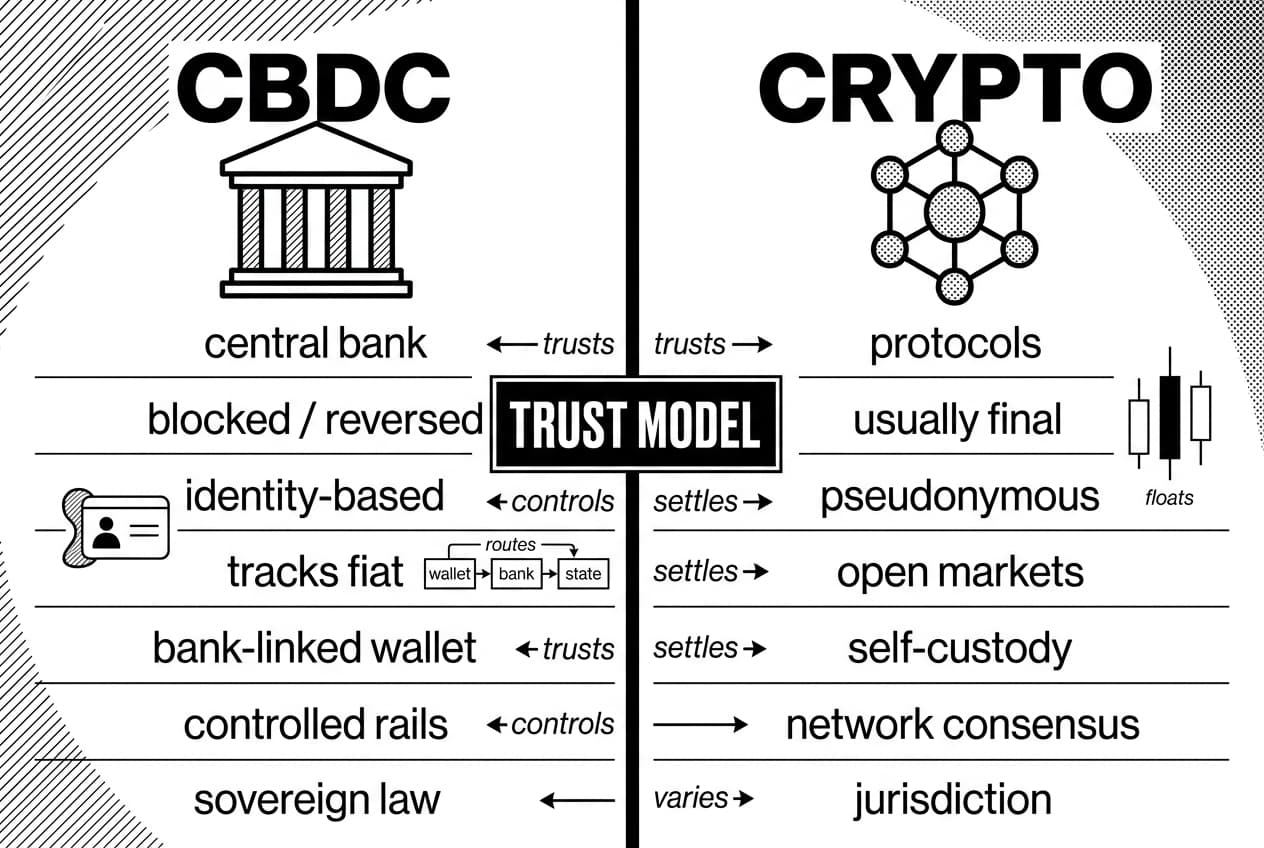
- Issuer: CBDCs are issued by central banks, while crypto assets are issued by protocols, networks or private projects.
- Control: CBDC transactions can be blocked or reversed by approved authorities, while confirmed crypto transactions are usually final.
- Privacy: CBDCs tend to be identity-based, while public blockchains are pseudonymous but traceable.
- Value stability: CBDCs track fiat currency, while bitcoin and most crypto assets float in open markets.
- Custody: CBDCs usually depend on official or bank-linked wallets, while crypto can be self-custodied.
- Settlement: CBDCs settle inside controlled rails, while crypto settles through distributed network consensus.
- Regulation: CBDCs are part of sovereign monetary law, while crypto rules vary widely by jurisdiction.
Issuer and trust model
CBDC trust flows from the state. The holder trusts the central bank, legal system and payment infrastructure. Crypto trust flows from software rules, validators or miners, wallet security and market liquidity. That difference is why central bank digital currency vs crypto comparisons should avoid vague labels such as safe or risky. The risks are different types.
Stability and monetary policy
A CBDC follows the policy of its issuing central bank. Supply can expand or contract with ordinary monetary policy. Bitcoin is different because its supply cap is 21 million coins, according to bitcoin.org white paper archive, accessed Aug. 19, 2026. Lyn Alden has argued publicly that fixed issuance makes bitcoin structurally different from state-issued digital money.
Privacy, surveillance and compliance
CBDCs are usually designed around identity, sanctions compliance and fraud controls. Public crypto networks expose transaction graphs, but not legal names by default. That does not make crypto fully private. Our guide to how blockchain surveillance works explains how addresses can be clustered and linked to exchanges or users. For the policy side, see our guide to crypto privacy and regulation tradeoffs.
Custody, control and reversibility
CBDC wallets can be recoverable through identity checks, which helps consumers who lose access. The same feature also allows freezes and limits. Crypto self-custody gives stronger user control, but it removes a recovery desk. Anyone comparing the two should review self-custody versus custodial wallets before choosing a storage method.
CBDC vs bitcoin: the sharpest contrast
CBDC vs bitcoin is the clearest version of the broader debate. A CBDC extends sovereign money into digital form. Bitcoin is a non-sovereign network with fixed issuance and no central operator. A CBDC is built for policy flexibility and domestic payment control, while bitcoin is built for rule predictability and resistance to unilateral change.
Supply and monetary policy
Bitcoin supply is capped at 21 million BTC, and the final subsidy is expected around 2140, according to bitcoin.org developer guide, accessed Aug. 19, 2026. A CBDC has no separate supply cap. It represents fiat money, so its supply depends on the central bank and the wider banking system.
Payments vs. store of value
CBDCs are better suited to everyday domestic payments because they can settle quickly in the national unit of account. Bitcoin is better suited to long-term non-sovereign exposure and larger settlement where censorship resistance matters more than instant retail finality. On the base layer, bitcoin prioritizes security and decentralization over card-like throughput.
Network governance
CBDC rules can be changed through legal and policy processes. Bitcoin rule changes require broad network consensus among users, developers, miners and node operators. Taproot activated in November 2021, according to bitcoin.org, 2021, after a long review process. Slow governance is a drawback for rapid policy response, but a strength for users who value predictable rules.
criterion | CBDC | bitcoin |
|---|---|---|
supply | fiat supply policy | 21 million cap |
main authority | central bank and law | network consensus |
best fit | payments and public settlement | store of value and censorship-resistant transfers |
main weakness | state control and privacy risk | volatility and key-management risk |
CBDCs, stablecoins and crypto: where they overlap
CBDCs and stablecoins can feel similar to users because both can represent fiat value digitally. The legal claim is different. A CBDC is sovereign money. A stablecoin is a private issuer liability backed by reserves or collateral. Crypto networks provide the settlement layer on which many stablecoins move.
CBDC vs stablecoin: a direct comparison
Stablecoins already compete with some CBDC use cases because they offer dollar-denominated value on public blockchains. The tradeoff is issuer risk. If reserves are weak, redemption can fail. If compliance rules require action, an issuer may freeze addresses. Jeremy Allaire has argued publicly through Circle that regulated stablecoins can extend dollar access on open networks, but that model still depends on private reserve management.
criterion | CBDC | stablecoin |
|---|---|---|
issuer | central bank | private company |
backing | sovereign money | cash, bills, deposits or collateral |
redemption | public monetary claim | contractual issuer claim |
blockchain access | usually closed or permissioned | public-chain compatible |
main risk | policy control | reserve and blacklist risk |
When stablecoins already compete with CBDCs
Stablecoins are already used for trading, remittances, treasury management and access to dollar value in high-inflation economies. Total stablecoin supply exceeded $230 billion in March 2026, according to DefiLlama, March 2026. Circle reported more than $12 trillion in USDC on-chain transaction volume in 2024 through Circle, 2025. Those numbers show why CBDCs are entering a market that already has active private rails.
When they could coexist
A realistic 2026 outcome is role separation. CBDCs can handle domestic public payments, tax collection and welfare disbursement. Regulated stablecoins can serve cross-border digital dollars, crypto trading pairs and DeFi collateral. Open crypto networks can host programmable applications that neither a retail CBDC nor a bank app is likely to support broadly.
Global CBDC adoption and the U.S. position in 2026
CBDC adoption is uneven. Some countries have live retail systems, some are running pilots and the U.S. has not launched a retail CBDC. Availability matters because a user cannot choose a CBDC that does not exist in their jurisdiction.
Countries testing or using CBDCs
Small economies were early retail CBDC movers, while larger jurisdictions have tended to run longer pilots. China expanded an e-CNY pilot across many cities, and the euro area continued digital euro preparation work after 2023. As of early 2026, the cbdc tracker still showed more than 130 countries researching, developing, piloting or launching CBDCs. That breadth does not prove deep consumer adoption. It proves policy interest.
Is the U.S. going to use a CBDC?
As of 2026, the U.S. has researched a possible digital dollar but has not launched one. The fed has stated that a retail CBDC would need clear legal support. FedNow, launched in July 2023 according to frbservices.org, 2023, is an instant bank payment rail, not a CBDC. Any U.S. retail CBDC would also interact with existing crypto money transmitter rules.
Why countries are considering CBDCs
- Cash decline: central banks want a public payment option if physical cash use keeps falling.
- Payment resilience: a public rail can add redundancy when private networks fail.
- Financial inclusion: low-cost wallets may reach users who do not have bank accounts.
- Stablecoin competition: dollar-pegged tokens create private alternatives to domestic money in some markets.
- Monetary sovereignty: governments do not want foreign stablecoins or foreign CBDCs to dominate local payments.
Which should you choose: CBDC, crypto, bitcoin or stablecoins?
No single option wins every category. The practical choice depends on whether the user needs legal certainty, privacy, self-custody, price stability, DeFi access or long-term non-sovereign exposure.
- Best for everyday domestic payments: CBDC, where available and legally supported, because it offers fiat stability and official settlement.
- Best for self-custody: bitcoin or another non-custodial crypto asset, if the user can manage private keys responsibly.
- Best for fiat stability on-chain: regulated stablecoins such as USDC or USDT, with reserve and issuer risk understood.
- Best for DeFi: native crypto assets and stablecoins used with the right wallet. Start with a DeFi wallet comparison before funding a wallet.
- Best for long-term non-sovereign exposure: bitcoin, because its monetary policy is protocol-defined rather than government-defined.
Choose a CBDC if...
You want official digital fiat, strong legal recognition and easy use inside domestic payment systems. A CBDC fits users who prioritize low volatility and recoverability over transaction privacy and censorship resistance.
Choose crypto or bitcoin if...
You want self-custody, open network access or an asset outside a central bank balance sheet. The tradeoff is higher volatility, key-management responsibility and less consumer protection if something goes wrong.
Choose stablecoins if...
You need dollar-denominated value on public blockchains for payments, remittances, trading or DeFi collateral. The tradeoff is dependence on issuer reserves, blacklist policies and local stablecoin regulation.
Decision checklist
- Privacy: do you need transaction-level privacy, or is regulated visibility acceptable?
- Custody: can you manage private keys, or do you need account recovery?
- Volatility: can you tolerate market drawdowns, or do you need fiat pricing?
- Payment route: are payments domestic, cross-border or on-chain?
- Legal status: is the option permitted and available where you live?
- Control risk: would a freeze, blacklist or blocked transfer create unacceptable risk?
Most users will not choose only one tool. A practical 2026 setup may combine a bank account or CBDC for local spending, stablecoins for cross-border digital dollars and bitcoin for long-term non-sovereign exposure. That mix treats these systems as different monetary technologies rather than interchangeable forms of digital money.
Frequently Asked Questions
- Is the US going to use CBDC?
- As of 2026, the U.S. has researched a digital dollar but has not launched a retail CBDC. Any Federal Reserve implementation would require legal authorization, careful policy design, strong privacy protections and broad political support — none of which have fully aligned yet.
- Which country has banned CBDC?
- Some lawmakers and jurisdictions have proposed restrictions on CBDCs, but formal national bans are uncommon and vary significantly by country and timing. CBDC policy shifts quickly, so it's worth checking current law rather than relying on older reports, since research-phase rules differ from retail deployment rules.
- Is XRP a CBDC currency?
- No, XRP is not a CBDC. It is a crypto asset issued by a private company, not sovereign money created by a central bank. While Ripple's technology appears in some institutional payment discussions, XRP itself operates independently of any government monetary authority.
- Why is the US against CBDC?
- The U.S. isn't uniformly opposed. Critics raise legitimate concerns about government surveillance, financial control, privacy erosion, bank disintermediation and federal overreach. Supporters argue CBDCs could modernize payments and strengthen monetary competitiveness. The debate reflects genuine policy disagreements rather than a single national position.
- Is CBDC coming to the US?
- A U.S. CBDC is possible but far from certain in 2026. There's a meaningful difference between ongoing research, wholesale settlement experiments and an actual retail digital dollar available to everyday consumers. The latter would require legislation, infrastructure and public trust that don't yet exist.
- Is CBDC good or bad?
- It largely depends on how a CBDC is designed. Well-built systems can improve payment efficiency, financial inclusion and settlement resilience. However, weak privacy safeguards, poor oversight or excessive centralization could create real risks around surveillance, censorship and cybersecurity. Design choices matter enormously.
- Are cryptocurrency and digital currency the same?
- Cryptocurrency is one type of digital currency, but the two terms aren't interchangeable. CBDCs, bank deposits, stablecoins and app-based balances are all digital currencies. Crypto specifically refers to blockchain-based assets that typically operate without a central issuing authority — a key structural difference.
- Will the U.S. dollar be replaced by digital currency?
- A digital dollar would represent the existing U.S. dollar in electronic form, not replace it with something new. It's also worth noting that most dollars already exist digitally — bank balances, card payments and payment apps all move digital dollar value every day.
Sources
Author

Crypto analyst and blockchain educator with over 8 years of experience in the digital asset space. Former fintech consultant at a major Wall Street firm turned full-time crypto journalist. Specializes in DeFi, tokenomics, and blockchain technology. His writing breaks down complex cryptocurrency concepts into actionable insights for both beginners and seasoned investors.