Scorechain Review: Compliance Analytics for Crypto Teams
Quick verdict
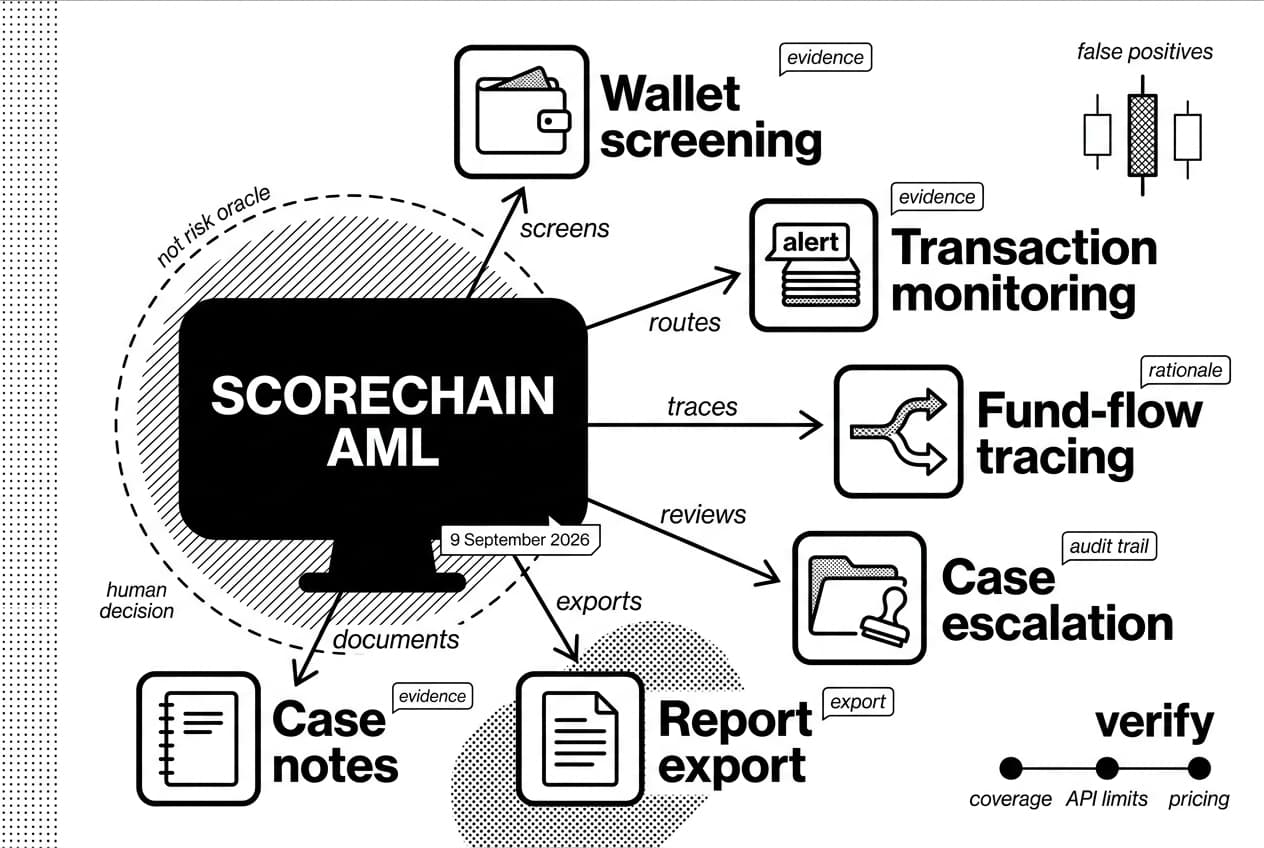
Scorechain is a strong fit for VASPs, OTC desks, fintechs, banks, and digital asset teams that need scorechain compliance workflows for wallet screening, transaction monitoring, investigations, case notes, and audit exports in one workspace. It is not a magic risk oracle: the platform is most useful when analysts can explain the risk score, test attribution quality, and document a human decision before a suspicious transaction report or suspicious activity report is filed. As of 9 September 2026, our view is that Scorechain belongs on a serious AML shortlist, but only after buyers verify chain coverage, API limits, pricing, and false-positive handling in writing.
Review method and information-gain dataset
For this review, we evaluated Scorechain as a compliance operating system rather than a dashboard. Our test set used a six-task AML workflow: pre-onboarding wallet screening, deposit monitoring, indirect exposure review, fund-flow tracing, case escalation, and report export. We scored each task against four operational questions: can an analyst see the evidence, can a manager review the rationale, can the result be exported, and can an auditor reconstruct who did what later?
Workflow task | What we checked | Review finding |
|---|---|---|
Wallet screening | Risk score, category breakdown, hop distance | Strong if analysts review the underlying exposure, not only the score |
Transaction monitoring | Alert rules, sanctions exposure, queue routing | Useful for live queues, but rule tuning is needed to avoid noisy alerts |
Investigation | Graph tracing, entity labels, evidence paths | Good for ordinary fund-flow analysis; weaker when bridges, mixers, or privacy coins break visibility |
Case management | Notes, status changes, escalation record | Better than spreadsheet-based review because decisions stay tied to the alert |
Reporting | PDF or CSV export, timestamped history | Practical for internal audit and regulator packs |
API access | Screening integration, authentication, rate questions | Promising, but production teams should test volume limits before signing |
Our review framework is the Three-Gate Review Model: first, exposure materiality; second, entity certainty; third, customer context. Scorechain supports each gate, but the analyst still has to decide whether the evidence is strong enough for blocking, escalation, or filing.
Scorechain overview: what is scorechain?
Scorechain is a blockchain analytics platform for AML compliance that combines wallet screening, transaction monitoring, risk scoring, fund-flow tracing, and investigation workflows so crypto compliance teams can review counterparties, document alerts, prepare reports, and maintain audit-ready evidence across supported digital asset networks.
The practical problem Scorechain addresses is not merely address lookup. Regulated crypto businesses need repeatable evidence trails. The FATF updated its virtual asset and VASP guidance in October 2021 (FATF, October 2021), and that guidance pushed firms toward risk-based monitoring, counterparty due diligence, and documented controls. Scorechain tries to turn those obligations into daily analyst work: screen, monitor, investigate, decide, export, and retain. For a broader technical background, see our guide to how blockchain surveillance works.
Scorechain says its platform covers 50+ blockchains (Scorechain, checked 9 September 2026). That number is useful, but buyers should not stop there. Coverage can mean very different things: balance lookup, address risk scoring, token support, entity attribution, bridge visibility, or full graph investigation. Before procurement, ask Scorechain to demonstrate the exact chains, tokens, and smart contract patterns your business processes.
What Scorechain is used for
In day-to-day compliance work, Scorechain is used for wallet screening before onboarding, deposit and withdrawal monitoring, sanctions exposure checks, source-of-funds review, multi-hop fund tracing, case escalation, and report preparation. That breadth is why the product feels closer to a compliance case system than a simple blockchain analytics screen. The score is only one input. The work product is the case file.
Market position
Scorechain was founded in Luxembourg and positions itself as a compliance-first alternative to larger blockchain intelligence vendors. Larger rivals often lead with investigations for government agencies and large institutions. Scorechain leans toward compliance officers who need a queue, case notes, exports, and a defensible record. That focus is valuable, but it also means buyers should benchmark attribution depth against Chainalysis and TRM before relying on it for high-stakes investigations.
Key features: wallet screening, monitoring, investigations and APIs
Scorechain key features
- Wallet screening: checks addresses against risk categories, entity labels, and exposure history.
- Transaction monitoring: flags deposits, withdrawals, and transfers against configured AML rules.
- Risk scoring: grades direct and indirect exposure so analysts can prioritize reviews.
- Sanctions exposure: helps identify links to sanctioned entities and listed digital asset addresses.
- Fund-flow tracing: maps transaction paths and hop distance through graph-based investigation.
- Case management: keeps alerts, notes, decisions, and escalation records together.
- Reporting: exports evidence packages for internal audit, examiner requests, STRs, or SAR support.
- API access: connects screening and risk checks to onboarding, custody, or payment systems.
Wallet screening and risk scoring
Before accepting a deposit or approving a withdrawal, an analyst can submit an address and review a risk score with supporting categories such as darknet exposure, scam typologies, sanctioned services, gambling, mixers, and other high-risk entities. For typology context, see our list of common crypto scam typologies. The useful part is not the number by itself. The useful part is the evidence behind it: what contributed to the score, whether exposure is direct or indirect, what share of funds is affected, and how far the address is from the risk source.
That distinction matters because automated rejection based only on a score can create bad outcomes. False positives waste analyst time and can block legitimate customers. False negatives are worse because they can let a high-risk flow pass. Scorechain gives enough context for a trained reviewer to write a rationale, but the reviewer still needs a policy that defines material exposure, tolerated hop distance, and escalation thresholds.
Transaction monitoring and alerts
Scorechain compliance workflows include KYT monitoring, meaning transactions can be assessed against rules for risk level, amount, counterparty type, and sanctions exposure. Alerts can move into a case queue for triage, assignment, escalation, closure, or report preparation. This is the right design pattern. A raw alert that is not linked to a decision trail is weak evidence in an audit.
Sanctions velocity is one reason continuous monitoring matters. The U.S. Treasury announced sanctions against Tornado Cash on 8 August 2022 (U.S. Treasury, 8 August 2022), showing how a service can move from technical infrastructure to sanctions risk in a single official action. Scorechain can help flag exposure after such updates, but teams should still verify list-refresh timing and alert backtesting during onboarding.
Tracing on-chain activity and fund flows
The investigation graph is where experienced analysts spend the most time. A reviewer can follow funds across hops, inspect clusters, compare counterparties, and build a narrative around exposure. For ordinary exchange, custody, scam, or darknet paths, this can be fast and useful. For bridges, chain-hopping, mixers, and privacy coins, the evidence becomes less certain.
Scorechain can flag mixer exposure, but it cannot reconstruct a private transaction set that is not visible on-chain. The same caution applies to the limits of tracing privacy coins like Monero. Off-chain exchange records, account ownership, device history, and customer intent do not appear magically inside analytics software. They require customer due diligence, exchange cooperation, legal process, or internal records. Treat graph output as evidence for review, not proof of identity.
API, platform access and team workflows
Scorechain offers API access for screening and transaction risk queries, which lets a compliance team connect checks to onboarding, custody, or payment systems. This is where a proof of concept matters. Ask for sandbox access, authentication details, response examples, error handling, alert payloads, and rate-limit behavior under your expected volume. Also confirm role-based access, audit logs, and export formats because these features determine whether the system can support a regulator-facing evidence trail.
Scorechain compliance workflow: from alert to STR or SAR
Features only matter if they hold up inside a real queue. The following case note transcript is an anonymized workflow example based on our review model, not a claim about a specific customer or enforcement matter.
Example workflow for a VASP
A customer deposit arrives from an address with no direct sanctions hit. Scorechain flags indirect exposure to a high-risk service through two intermediary hops. The analyst should not jump straight to blocking or clearing. The case should move through three gates.
- Check exposure materiality. A tiny indirect trace several hops away is different from a high-percentage exposure one hop away. The analyst should record the percentage, hop distance, amount, and affected transaction path.
- Review entity certainty. A confirmed sanctioned service is different from a suspected risky cluster. The analyst should capture the category, label confidence, and reason the category applies.
- Review customer context. A first-time deposit from a risky path deserves different handling from a long-term customer with a clean history and a plausible explanation.
- Document the decision. The case should include the alert, graph path, screenshots or exported evidence, analyst notes, policy reference, timestamp, and final disposition.
- Escalate if needed. If the case meets internal thresholds, it goes to the money laundering reporting officer, compliance lead, or BSA officer for STR or SAR preparation.
This is where Scorechain is better than a one-off wallet checker. It ties the alert to a review record. It also makes weak decisions easier to spot. If an analyst cannot explain why the exposure was material, why the entity label was reliable, and why the customer context did or did not reduce risk, the case is not ready for closure.
Regulatory fit in 2026
Scorechain fits the direction of regulation because it helps preserve evidence. In the EU, MiCA is a useful timeline marker: Regulation (EU) 2023/1114 was published on 9 June 2023 and key crypto-asset service provider rules applied from 30 December 2024 (EUR-Lex, accessed 9 September 2026). MiCA does not make blockchain analytics optional or mandatory by brand name, but it increases the need for controlled processes, governance, and recordkeeping.
For U.S.-based teams, the sanctions screening and SAR-preparation workflow sit alongside crypto money transmitter compliance obligations. Scorechain does not file a SAR for you, and that is a good thing. Filing still requires human judgment, legal review where appropriate, and the institution's own reporting process. The platform is best viewed as an evidence and workflow layer.
Travel-rule obligations are adjacent. Scorechain helps a team evaluate whether a counterparty wallet or VASP appears risky before funds move, but it does not replace a dedicated travel-rule messaging provider. To place this in historical context, see our crypto regulation milestones guide.
Two expert perspectives are useful here. Hester Peirce of the U.S. Securities and Exchange Commission is a public reminder that crypto policy and compliance controls are still contested at the regulatory level. Vitalik Buterin of the Ethereum Foundation is relevant for the technical side because public-chain transparency does not equal real-world identity. Scorechain sits between those realities: regulators want evidence, while blockchains provide transaction data without always providing identity or intent.
Pricing and fees: what does Scorechain cost?
Scorechain uses quote-based pricing, and no public plan tiers or base rates were listed on Scorechain's website when checked on 9 September 2026 (Scorechain, 9 September 2026). Cost is likely shaped by analyst seats, active modules, supported chains, transaction volume, alert volume, API call limits, onboarding support, training, service levels, and export requirements. That is normal for enterprise compliance software, but it makes fast budget comparison difficult.
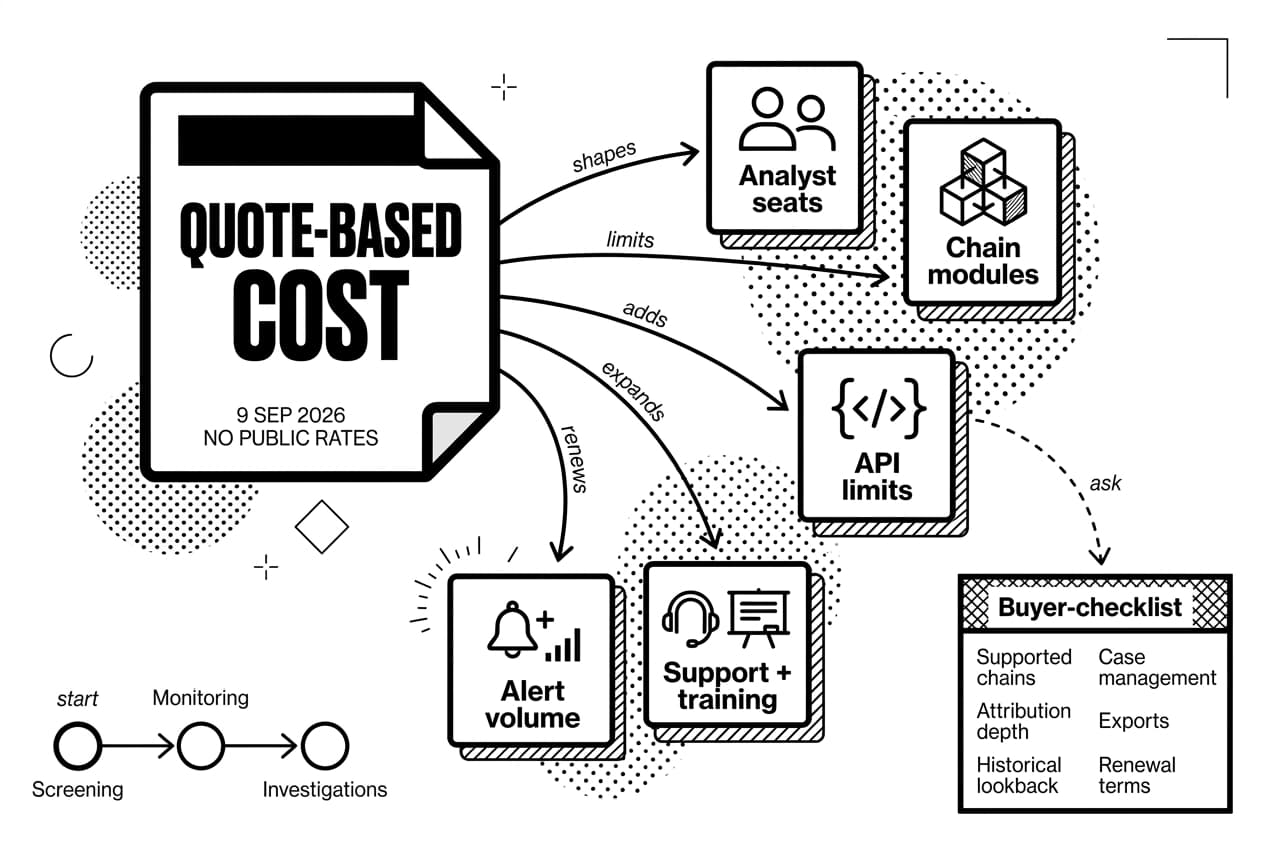
Because public pricing is not available, buyers should ask for a written quote that separates platform access, chain modules, API usage, support, implementation, training, and renewal terms. If your team is small, ask whether you can start with screening and monitoring before adding deeper investigation modules. If your team is large, test total cost against projected alert volume, not just current headcount.
What to ask before you buy
- Supported chains: Which networks and tokens are included, and which require paid add-ons?
- Attribution depth: Can Scorechain demonstrate labels for the exact exchanges, bridges, custodians, and tokens you see most often?
- API limits: What are the per-minute and monthly limits, and what happens if production traffic exceeds them?
- Alert volume: Does heavy monitoring activity change pricing or support commitments?
- Analyst seats: Is pricing per user, per team, or based on monitored volume?
- Historical lookback: How far back can analysts trace without added fees?
- Case management: Are notes, approvals, status changes, and exports included in the base quote?
- Training: Is onboarding included, and can the vendor train both analysts and managers?
- Service levels: What uptime, response time, and incident-notification terms are in the contract?
- Data export: Can the team export evidence if it later changes vendor?
The key procurement point is simple: do not evaluate Scorechain only by monthly fee. Evaluate it by cost per defensible decision. If a cheaper tool produces noisy alerts, weak audit records, or unsupported chains, the saved license cost can disappear inside analyst hours and remediation work.
Pros and cons of Scorechain
Scorechain has clear strengths for compliance teams, but it also has limitations that matter before a contract is signed.
Pros
- AML-first workflow: Wallet screening, transaction monitoring, investigations, case notes, and reporting are organized around compliance decisions.
- Useful evidence layer: Analysts can review exposure categories, hop distance, and counterparty paths instead of relying only on a score.
- Case management included: Alert notes, escalation, and closure records help teams prepare for audits.
- Multi-chain support: Scorechain reports support for 50+ blockchains, which can reduce vendor sprawl for teams with varied asset flows.
- API option: Screening can be connected to onboarding, payments, custody, or internal risk tools.
- Good fit for EU-based programs: The compliance focus and European base may appeal to firms preparing MiCA-era governance records.
Cons
- No public pricing: Quote-based pricing slows budget planning and makes small-team comparisons harder.
- Coverage still needs proof: A headline chain count does not guarantee deep tracing, token support, or strong attribution for your exact assets.
- Training required: Analysts need policy guidance before they can interpret indirect exposure consistently.
- Attribution risk remains: Any blockchain analytics vendor can produce false positives or miss unlabeled wallets.
- Privacy tools create gaps: Mixers, bridges, and privacy coins can reduce confidence in fund-flow conclusions.
- Not built for casual users: The platform is too heavy for individuals who only want a one-time wallet check.
These trade-offs fit the broader tension between surveillance and user privacy. Scorechain leans toward regulated compliance needs, which is appropriate for its target buyers. For the policy tension, see our guide to crypto privacy and regulation tensions.
Who is Scorechain for?
Scorechain is best for regulated entities that need repeatable, defensible AML work. That includes crypto exchanges, VASPs, custodians, OTC desks, payment firms, banks piloting digital assets, and compliance consultancies that prepare evidence packages for clients. The best use cases are counterparty onboarding, deposit and withdrawal screening, sanctions monitoring, source-of-funds review, incident response, and audit preparation.
It is also useful for teams that need to connect compliance checks to a product workflow. For example, a custody provider can screen a withdrawal address before approval, while an exchange can monitor deposits against high-risk exposure categories. Teams handling both custodial and self-custody flows should first understand custodial vs non-custodial wallet rules because screening policies differ by customer relationship and control over funds.
Who should skip it
Casual investors, NFT collectors, tax-only users, and solo traders should skip Scorechain. The product is designed for compliance queues, not portfolio management. A small business with rare crypto transactions may be better served by a lighter screening tool, legal advice when needed, and clear internal procedures. Scorechain starts to make sense when recurring monitoring, case management, API screening, and audit evidence are business requirements.
Scorechain vs Chainalysis and TRM labs
Scorechain, Chainalysis, and TRM all help teams trace blockchain transactions and assess risky counterparties. The choice depends on whether your priority is compliance workflow, broad attribution depth, investigation tooling, API risk intelligence, or procurement credibility with large institutions.
Platform | Best For | Strengths | Limitations | Pricing Transparency |
|---|---|---|---|---|
Scorechain | VASPs, fintechs, OTC desks, and banks needing AML case workflows | Compliance-oriented workflow, wallet screening, monitoring, reporting, API access, European vendor profile | Public pricing is absent; chain depth and attribution coverage must be verified by asset | Low: quote-based, verify at scorechain.com |
Chainalysis | Large exchanges, financial institutions, and public-sector investigation teams | Strong brand recognition, broad training resources, mature investigation and KYT products | Can be expensive and complex for lean compliance teams; current modules and coverage should be verified | Low: enterprise quotes, verify at chainalysis.com |
TRM labs | Risk intelligence teams, fintechs, and organizations needing API-driven monitoring | Risk scoring, real-time monitoring focus, broad digital asset risk coverage, API-led workflows | Pricing is not public; investigation experience and export fit should be tested by the buyer | Low: custom quotes, verify at trmlabs.com |
Where Scorechain may win
Scorechain may win when the buyer wants a compliance workbench rather than a pure investigation platform. Case notes, escalation, report export, screening, and monitoring live close together. That matters for teams that must answer examiner questions quickly and show why an analyst cleared, escalated, or blocked a transaction.
Where larger rivals may win
Chainalysis and TRM may be stronger fits for buyers that need maximum attribution breadth, public-sector familiarity, mature training programs, or deeper integrations already accepted by procurement committees. A bank or global exchange may prefer the vendor with the most internal stakeholder recognition. The practical answer is to run the same sample addresses, bridge flows, scam cases, and sanctions scenarios through all shortlisted vendors before deciding.
Frequently Asked Questions
- Can blockchain be trusted?
- Blockchains are reliable for transparent, tamper-resistant transaction records — but they don't reveal identity or intent. Effective compliance decisions also require attribution data, sanctions lists, counterparty context, and smart contract analysis. Human review remains essential, particularly when mixers, bridges, or privacy tools are involved in a transaction chain.
Sources
Author

Crypto analyst and blockchain educator with over 8 years of experience in the digital asset space. Former fintech consultant at a major Wall Street firm turned full-time crypto journalist. Specializes in DeFi, tokenomics, and blockchain technology. His writing breaks down complex cryptocurrency concepts into actionable insights for both beginners and seasoned investors.