Money Transmitter License Crypto: 2026 Compliance Guide

What is a money transmitter license for crypto?
A money transmitter license crypto businesses may need is state permission to receive and transmit digital value for customers, including bitcoin, ether, stablecoins, or dollars converted into crypto, when the business controls that value before sending it to another person, wallet, merchant, or account.
Why it matters: if your product touches customer funds, licensing can shape your launch states, banking access, investor diligence, compliance budget, and even your product design. If your product never controls customer value, the analysis may look very different. This article is educational, not legal advice, and you should confirm your own facts with qualified counsel.
Plain-English definition
A money transmitter is a business that accepts money or monetary value from one person and sends it to another person or place. In crypto, the hard question is whether the company ever controls the customer asset. A hosted exchange that holds private keys usually creates a licensing question. A software wallet where the user alone holds the private key may not.
Simple crypto example: a 0.5 BTC transfer
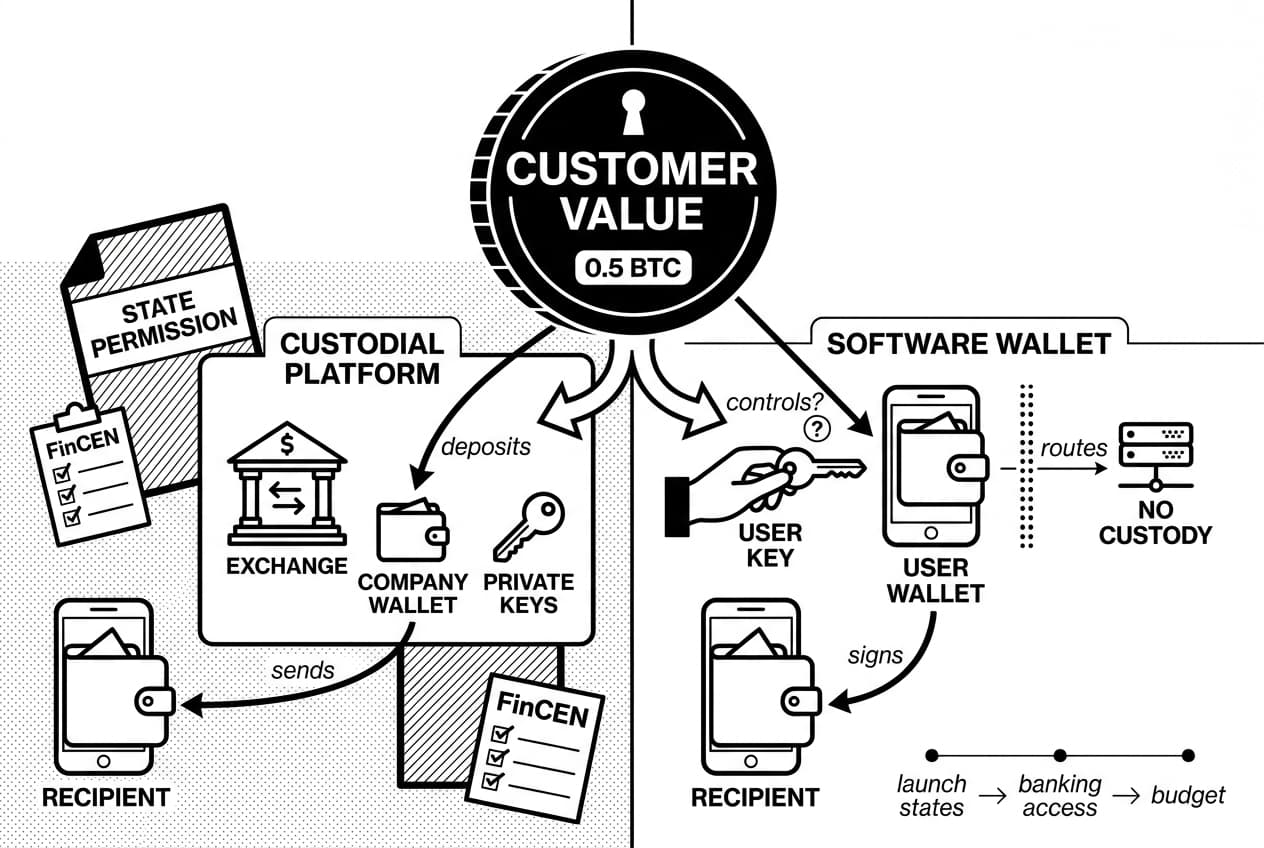
Consider a customer who wants to send 0.5 BTC to a recipient. Two product designs can produce the same blockchain result but very different regulatory facts.
- Custodial platform: the customer deposits bitcoin into an exchange wallet controlled by the company. The company later credits or sends value to the recipient. The company received, held, and transmitted customer value.
- Non-custodial software: the customer signs the transaction with a private key held only on the customer device. The software helps create the instruction, but it never controls the bitcoin.
This is the first fork in the road. A private key is the cryptographic password that lets someone move crypto. A wallet is software or hardware that stores or manages those keys. If the business holds the key or can otherwise move customer value, regulators are more likely to analyze it as a crypto money transmitter.
The Custody-Control Fork framework
Use this original framework before asking how many state applications you need:
- Asset received: does customer fiat, crypto, or stablecoin enter an address, account, smart contract, or bank account the company controls?
- Control exists: can the company, alone or with an admin key, move, freeze, redirect, or settle that value?
- Transmission occurs: does the company send value to another wallet, merchant, exchange, employee, or recipient?
- Customer instruction drives it: is the company moving value because a customer asked it to?
- State nexus exists: does the customer, recipient, company, or transaction touch a state with money transmission rules?
- Exemption review: does a specific state exemption apply, and can the company document why?
If the answer is yes on the control and transmission steps, the money transmitter license analysis usually comes before fee estimates, application checklists, or a 50-state plan.
The federal bureau known as FinCEN stated in March 2013 guidance and later May 2019 guidance that administrators and exchangers of convertible virtual currency can be money services businesses under federal rules. That federal status sits beside state licensing. It does not replace it.
Why it matters in 2026
As of January 2026, crypto founders still face a two-layer system: federal registration and anti-money-laundering duties on one layer, state money transmitter licensing on the other. The practical risk is not just a fine. A company that misreads custody can lose banking partners, fail investor diligence, pause customer onboarding, or need to redesign the product after launch.
If you are planning to start a crypto business with licensing in mind, the product team should map custody before the legal team prices applications. The contrarian point is simple: this is not only a paperwork problem. It is a product architecture problem.
Background: how money transmission rules reached crypto
Money transmission laws existed long before blockchains. States used them for money orders, wire transfer services, check cashers, and stored-value products. When crypto appeared, regulators did not start with a blank page. They asked whether a new asset was being used in an old pattern: one business receiving customer value and sending it elsewhere.
Think of a blockchain as a shared ledger that many computers verify together. That ledger can show that a transfer happened, but it does not answer the legal question by itself. Regulators still ask who controlled the value before the transfer, who gave the instruction, and whether the business was paid to move value for someone else.
How crypto money transmission works
Crypto money transmission usually has four steps. First, a customer delivers value. Second, a platform controls the value, even briefly. Third, the platform moves or converts it. Fourth, another person, merchant, wallet, or account receives value. The blockchain records part of that process, but the licensing analysis focuses on the business activity around it.
Custody and control are the key questions
Custody means holding someone else’s asset or holding the private key that can move it. Control is broader. A company may not hold a customer key directly, but if it can approve withdrawals, freeze balances, sweep funds, or trigger settlement, regulators may still ask whether it controls customer value.
The reason is consumer protection and financial crime risk. If a business can move customer money, customers can be harmed if the business fails, is hacked, or acts dishonestly. Bad actors can also use the business to disguise payments. That is why anti-money-laundering programs, customer identification, monitoring, and reporting are paired with money transmission rules.
Blockchain transaction vs regulated business activity
A direct self-custody payment, where a person signs with a key only they control, is usually different from a hosted platform transfer. In the hosted platform case, the company controls value at the middle step. That middle step is what turns a software feature into a possible licensing obligation.
Scenario | Who controls the value? | Likely licensing analysis |
|---|---|---|
Person sends BTC from a personal wallet | The wallet owner | Usually not money transmission by a business |
Exchange holds and transfers customer funds | The exchange | Usually requires MTL analysis |
Non-custodial swap interface | The user, subject to smart contract design | Fact-specific and still debated |
Crypto payroll processor sends employee wages | The processor during settlement | Very likely requires MTL analysis |
The unsettled row is important. Labels such as decentralized, wallet, protocol, or marketplace do not decide the answer. The legal review turns on function, control, and transaction flow.
Business models that usually need a crypto MTL
Not every crypto product triggers licensing. The following eight models commonly require a money transmitter license crypto review because they often receive, hold, convert, settle, or forward customer value.
- Exchanges: platforms where users deposit crypto or fiat and trade from hosted balances.
- Custodial wallets: services that hold private keys or hosted balances for users.
- Onramps: products that convert fiat into crypto or crypto into fiat.
- Payment processors: tools that receive customer value and settle merchants.
- Remittance apps: apps that move value across borders using crypto rails.
- Stablecoin wallets: hosted wallets that custody dollar-referenced tokens for users.
- OTC desks: desks that intermediate large bilateral crypto trades and settlement.
- Merchant settlement platforms: systems that collect customer funds and forward merchant proceeds.
Source-backed custody matrix for common models
The table below is a generated product-design dataset for founders. It combines the Custody-Control Fork with public regulatory materials available as of January 2026.
Product model | Custody signal | Design note | Public source |
|---|---|---|---|
Hosted exchange | High | User deposits assets into company-controlled accounts before trading or withdrawal. | FinCEN guidance, May 2019 |
Hosted stablecoin wallet | High | Company can move dollar-referenced tokens on customer instruction. | Conference of State Bank Supervisors model payments law, 2023 |
Fiat onramp | High | Company accepts fiat and delivers crypto or accepts crypto and delivers fiat. | FinCEN guidance, May 2019 |
Payment processor | High | Company receives customer funds before merchant settlement. | Conference of State Bank Supervisors, 2023 |
Pure blockchain explorer | Low | Product displays public-chain data and does not move funds. | FinCEN guidance, May 2019 |
Self-custody wallet software | Lower if no admin control | User holds the private key and signs transactions. | FinCEN guidance, May 2019 |
Centralized exchanges and custodial wallets
When a user deposits $500 worth of ETH into a hosted exchange, the platform often controls the keys or internal ledger. The user can see an account balance, but the company controls settlement mechanics. That is why exchanges and custodial wallets are typically near the center of state MTL review.
Payment processors, onramps, and remittance apps
Onramps accept one form of value and deliver another. Remittance apps receive value in one place and deliver value elsewhere. Crypto payment processors receive customer assets or fiat and settle a merchant. Each model raises the same question: did the company control value in transit? If you are building merchant acceptance flows, our guide on how to accept Ethereum payments explains product choices that can affect that footprint.
OTC desks and stablecoin services
OTC desks can raise MTL questions when they intermediate settlement instead of merely introducing two parties. Stablecoin services deserve special review because hosted dollar-token balances can resemble stored value from a regulator’s perspective. Brian Armstrong, co-founder and CEO of Coinbase, has repeatedly made stablecoin policy and U.S. crypto rules a public priority for Coinbase, which reflects how central this issue is for large custodial platforms.
Named expert views do not decide your legal status. They help show the market context. Your own product facts, customer states, and control points decide the licensing analysis.
Who usually does not need a money transmitter license?
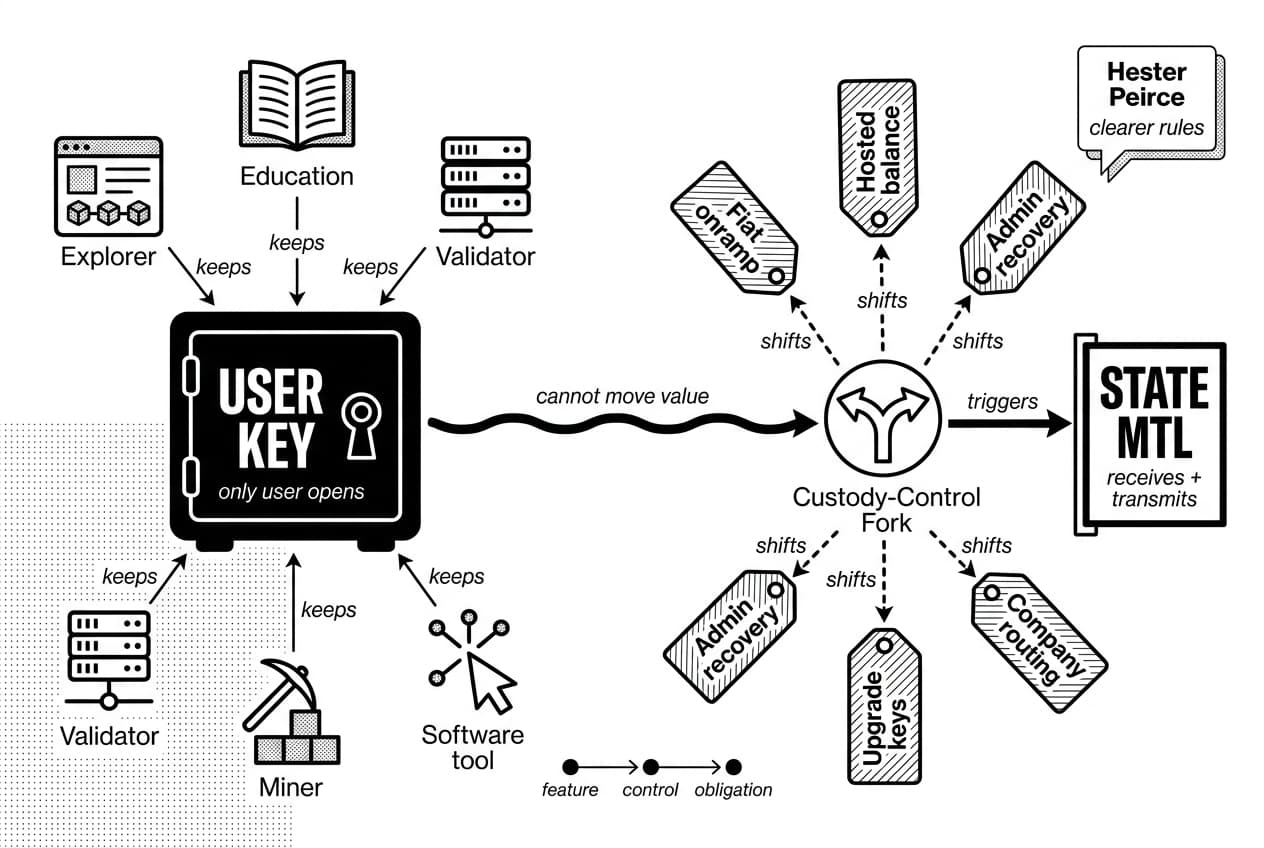
Businesses that never receive or control customer value are often outside the core money transmitter pattern. Common examples include blockchain explorers, educational publishers, some validator infrastructure providers, miners, and software tools that only help a user interact with a network while the user keeps full control.
Non-custodial wallets and software tools
A non-custodial wallet lets the user hold the private key. A practical analogy is a locked safe where only the user has the combination. The software maker may provide the safe design, but it cannot open the safe or move the contents. For a deeper comparison, see our guide to custodial vs non-custodial crypto wallets.
When the exception can disappear
The non-custodial answer can change when the product changes. Fiat onramps, hosted balances, admin recovery, company-controlled routing, merchant settlement, or upgrade keys can shift control toward the business. A founder should re-run the Custody-Control Fork whenever a new feature changes who can move customer value.
Hester Peirce, commissioner at the U.S. Securities and Exchange Commission, has often emphasized the need for clearer crypto rules. That policy debate matters, but it does not remove state MTL obligations for a product that currently receives and transmits customer value.
FinCEN MSB registration vs state money transmitter licenses
Federal registration and state licensing are different obligations. FinCEN handles federal money services business registration and anti-money-laundering rules. States decide whether a business needs permission to serve customers in that state as a money transmitter.
A company that qualifies as a federal money services business must generally register with FinCEN within 180 days after the business is established (eCFR, January 2026). That registration is not the same as a state MTL. State licenses are separate applications, with separate fees, bonds, exams, renewals, and regulator relationships.
Obligation | Regulator | What it covers |
|---|---|---|
FinCEN MSB registration | FinCEN | Federal registration for covered businesses that transmit money or monetary value, including many crypto money transmitters. |
State MTLs | State financial regulators | State permission to serve customers in a specific state when the product meets that state’s money transmission definition. |
AML/KYC program | FinCEN, with state review in many exams | Written controls for customer identity checks, transaction monitoring, sanctions screening, and suspicious activity reports. |
Ongoing reporting | FinCEN and state regulators | Federal reports, state renewals, periodic financial reports, examinations, and material-change notices. |
Federal AML rules
AML means anti-money laundering. KYC means know-your-customer checks. Together, they require a covered business to identify customers, monitor activity, screen against sanctions, and report suspicious activity. These duties can apply even before a state license is approved, depending on the business model and launch timing. The tension between privacy and identity checks is covered in our guide to crypto privacy and regulation tensions.
State-by-state licensing
State licensing is often the heavier operational lift. A company serving customers in 40 states may have up to 40 separate state licensing relationships, even though filings are often managed through the Nationwide Multistate Licensing System, January 2026. Each state can set its own bond amount, net worth rule, control-person review, renewal process, and examination style.
New York remains one of the best-known crypto-specific examples. A virtual currency license application carries a $5,000 fee (New York Department of Financial Services, January 2026). That fee is only the filing charge. Legal preparation, compliance staffing, policy work, audits, and ongoing examinations can cost far more.
Money transmitter license crypto requirements in 2026
Once a product appears to need an MTL, regulators usually want proof of financial stability, honest ownership, sound controls, and a working compliance program. They are not only reviewing forms. They are assessing whether the company can protect customer value and detect misuse.
Requirement category | Plain-English meaning | Why regulators require it |
|---|---|---|
Surety bond | A financial guarantee posted for the benefit of the state and consumers. | It creates a source of recovery if the business fails to meet obligations or harms customers. |
Net worth | Proof that the company has enough assets relative to liabilities. | It shows the company can absorb losses and operate safely. |
AML policy | A written anti-money-laundering program with named responsibilities and procedures. | It helps detect fraud, sanctions issues, terrorist financing, and other illegal finance. |
Cybersecurity | Policies for protecting systems, customer data, private keys, vendors, and incident response. | Crypto products can lose customer value quickly if controls fail. |
Ownership disclosures | Background and financial information for founders, officers, directors, and major owners. | Regulators check whether control persons are fit to handle customer funds. |
Financial statements | Reviewed or audited statements showing revenue, liabilities, assets, and cash position. | They let regulators assess solvency and business model risk. |
Florida shows how specific these numbers can get. A money services business application lists a $375 license application fee (Florida Office of Financial Regulation, 2024). Florida law also describes a bond structure starting at $50,000 and capped at $2,000,000 for certain money services businesses (Florida Statutes section 560.209, 2025).
If a token or product might also be a security, an MTL is only one layer of the analysis. See how securities law applies to crypto for that separate issue.
Typical application materials
Most state applications ask for a repeatable set of materials:
- Business plan: products, customers, states served, revenue model, and transaction flow.
- Flow-of-funds diagram: a step-by-step map showing where customer value enters, who controls it, and where it exits.
- Control-person disclosures: forms, fingerprints, background information, and ownership details for key people.
- AML/KYC policies: procedures for identity checks, monitoring, sanctions screening, escalation, and reports.
- Bank and custody information: where fiat and crypto are held and how customer funds are separated from operating funds.
- Cybersecurity policy: access controls, key management, vendor risk, backups, incident response, and testing.
- Financial statements: reviewed or audited statements, or opening balance sheets for new companies.
How hard is it to get approved?
Difficulty depends on product risk and state scope. A simple single-state payment product with experienced operators, adequate capital, and clear documents may move faster than a multi-state exchange with custody, stablecoins, complex smart contracts, and first-time controls. Examiners expect the team to explain how the program works, not only upload policies.
The five blockers we see most often in product reviews are unclear custody diagrams, weak capitalization, missing control-person information, policies copied from templates, and state plans that do not match the actual customer base.
How much does it cost?
There is no honest single price. Budget categories include state application fees, surety bond premiums, legal counsel, compliance consultants, staff time, audits, renewals, and examination responses. A focused state launch is usually easier to control than a national launch on day one. If you are deciding whether to build in-house or get help, read our guide on when to hire a crypto lawyer.
How to evaluate your licensing footprint
Before filing applications, prepare a product memo that answers the custody question in plain English. This memo should be written for lawyers, engineers, compliance staff, banking partners, and investors. If those groups cannot agree on who controls customer value, the licensing plan is not ready.
Five questions to ask before launch
- Do you ever receive customer crypto or fiat? If value enters a wallet, account, or contract you control, start MTL analysis.
- Who controls the private keys? Company-held keys are a strong custody signal.
- Do you convert between fiat and crypto? Onramps and offramps commonly trigger review under state money transmission rules.
- Which states are your customers in? Customer location can create state-by-state obligations.
- Do you settle merchant payments or transmit stablecoins? Both functions often involve receiving and forwarding value.
If any answer is yes, do not jump straight to applications. First document the transaction flow, then ask counsel whether licensing, an exemption, agency structure, partnership model, geofencing, or product redesign is the best path.
Frequently Asked Questions
- What is a money transmitter license?
- A money transmitter license is a state-issued authorization that allows a business to receive and transfer money or monetary value on behalf of others. For crypto companies, regulators often apply the same analysis when a business controls customer funds — including virtual currencies, stablecoins, or other digital assets.
- How hard is it to get a money transmitter license?
- Approval is genuinely challenging. Regulators scrutinize business owners, financial health, AML/KYC programs, cybersecurity controls, and how customer funds move through the platform. Complexity grows significantly when a company operates across multiple states, holds customer crypto directly, or submits incomplete compliance documentation.
- How much does it cost to get a money transmitter license?
- Total costs vary widely depending on how many states you target and your business model. Budget for state application fees, surety bonds, background checks, compliance audits, legal counsel, and ongoing reporting obligations. Companies expanding nationally often spend considerably more due to each state's unique requirements and renewal costs.
- How much does it cost to get a money transmitter license in Florida?
- Florida costs typically include state application fees, fingerprinting, background checks, a surety bond, legal preparation, and ongoing compliance expenses. Because fee schedules and bond amounts can change, check Florida's Office of Financial Regulation for current 2026 figures and confirm specifics with a licensed attorney before applying.
Sources
Author

Crypto analyst and blockchain educator with over 8 years of experience in the digital asset space. Former fintech consultant at a major Wall Street firm turned full-time crypto journalist. Specializes in DeFi, tokenomics, and blockchain technology. His writing breaks down complex cryptocurrency concepts into actionable insights for both beginners and seasoned investors.