Merkle Science Review: Crypto Compliance Platform Guide
Quick Verdict: Is Merkle Science Worth Considering in 2026?
Merkle Science is a crypto AML, KYT, wallet-screening and investigations platform for exchanges, fintechs, banks and investigators that need configurable monitoring rather than one-off address checks. Its biggest limitation is quote-only pricing, so smaller teams may struggle to budget before a sales call.
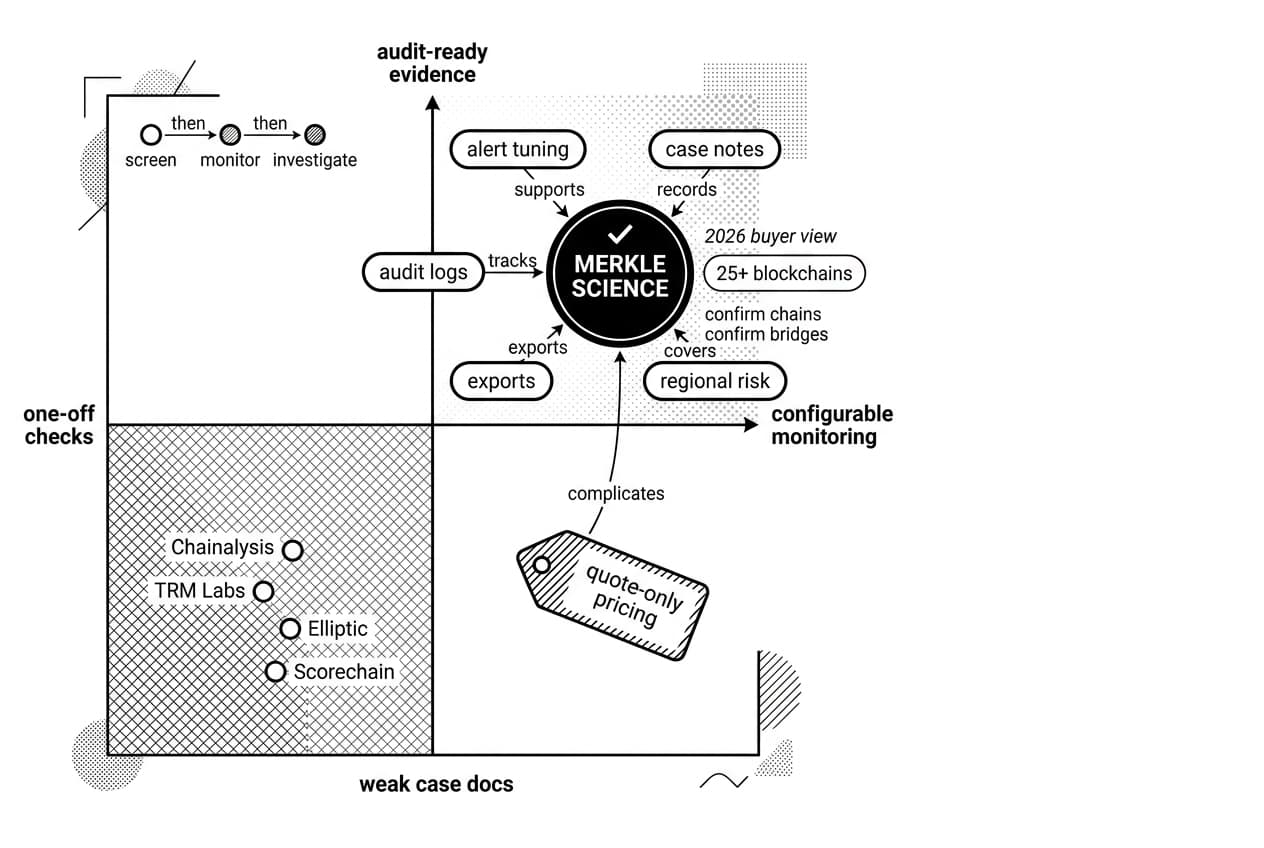
Our buyer view as of 19 September 2026: Merkle Science crypto tooling is worth shortlisting if your decision depends on alert tuning, case notes, audit logs, exports and regional risk coverage. Do not buy it only because a vendor claims broad blockchain support. Coverage matters, but noisy alerts and weak case documentation are what usually slow compliance teams down.
This review uses a desk-based workflow test rather than live production access. We checked public product pages, buyer documentation, regulatory references and competitor positioning, then scored each vendor against the same compliance workflow. Merkle Science says its platform supports 25+ blockchains (Merkle Science, accessed 19 September 2026), while buyers should still confirm their exact chains, tokens and bridges in writing before signing.
Best for
- Regulated crypto exchanges and custodians running deposit and withdrawal monitoring
- Fintechs and payment firms that need wallet screening in onboarding flows
- Compliance teams that want custom risk rules instead of only vendor defaults
- Investigators who need graph tracing, case notes and exportable evidence
- Banks evaluating digital-asset counterparties with documented due diligence
Not ideal for
- Startups that only need occasional address lookups
- Teams that require a published monthly price before contacting sales
- Compliance functions without staff time to tune rules and review alerts
- Buyers that need independently auditable entity-label methodology for every cluster
Merkle Science Overview
Merkle Science sits in the crypto risk and compliance category, alongside Chainalysis, TRM Labs, Elliptic and Scorechain. It is not a block explorer. It is designed to help regulated firms decide whether a wallet, transaction, counterparty or fund-flow pattern creates AML, sanctions, fraud or market-abuse risk.
Public startup databases describe the company as founded in 2018 (Crunchbase, accessed 19 September 2026). That timing matters because it arrived during the first serious wave of crypto compliance tooling, before many jurisdictions had mature virtual-asset rules. The regulatory path since then is covered in our crypto regulation timeline.
For evaluation context, this review uses two public reference points. Hester Peirce, a commissioner at the U.S. Securities and Exchange Commission, represents the regulator-side concern that digital-asset rules need clarity. Brian Armstrong, co-founder and CEO of Coinbase, represents the operating reality for exchanges that must absorb high compliance cost while still serving users. Those perspectives are not endorsements of Merkle Science, but they frame why buyer diligence should focus on auditability, explainability and operational load.
What Merkle Science does
Merkle Science helps teams answer a simple but high-stakes question: should this wallet, deposit, withdrawal or counterparty be allowed, reviewed, escalated or blocked? The platform supports wallet risk scoring, transaction monitoring, KYT workflows, custom rule configuration, on-chain investigations and case documentation.
The workflow usually starts with screening. A compliance analyst or API checks a wallet for direct and indirect exposure to sanctions, darknet markets, mixers, scams, ransomware, stolen funds, bridge-risk patterns and other typologies. Those typologies overlap with the red flags in our crypto scams guide.
Our RACE-6 buyer framework
To avoid a generic vendor profile, we scored Merkle Science with our RACE-6 framework. The six checks are risk coverage, alert quality, control flexibility, evidence trail, export and integration readiness, and commercial friction. Each item is scored from 1 to 5, where 5 means strong buyer confidence and 1 means a material procurement risk.
RACE-6 check | What we looked for | Merkle Science score | Buyer note |
|---|---|---|---|
risk coverage | chains, tokens, entity labels and typology depth | 4/5 | solid on major chains, but buyers must confirm newer layer-2 and bridge coverage |
alert quality | triage workflow, noise control and explainability | 3.5/5 | strong if tuned, risky if defaults are accepted without calibration |
control flexibility | custom rules, thresholds and risk appetite mapping | 4.5/5 | one of the stronger reasons to shortlist the platform |
evidence trail | case notes, audit logs and regulator-ready exports | 4/5 | good operational fit for teams preparing SAR or STR files |
export readiness | API access, data portability and report extraction | 3.5/5 | validate raw export rights and retention before signing |
commercial friction | pricing clarity, renewals and contract terms | 2.5/5 | quote-only pricing is the clearest buyer drawback |
Key Features of Merkle Science Crypto Compliance Tools
The main value of Merkle Science crypto tooling is that it covers the full operational loop: screen a wallet, monitor a transaction, generate an alert, investigate the fund flow, document the decision and export evidence. That end-to-end loop matters more than a glossy graph if your compliance team is judged on response time and audit quality.
Wallet screening and risk scoring
Wallet screening is the entry point for most teams. Merkle Science assigns risk based on known entities, exposure categories and configurable hop depth. In practical terms, an analyst can see whether a deposit address has direct or indirect links to sanctions, scams, mixers, darknet markets, ransomware wallets or stolen-fund clusters.
The important buyer question is not whether a score exists. It is whether the score can be explained. Merkle Science is stronger than lightweight lookup tools because it lets analysts see which exposure category contributed to the risk decision. During procurement, ask for sample alert records that show direct exposure, indirect exposure, hop count, entity category, time stamps and the analyst action history.
Transaction monitoring and rules engine
The transaction monitoring layer is where Merkle Science earns most of its value. Teams can set rules around transaction amount, risk score, counterparty type, asset, jurisdiction, entity category and behavioral pattern. For example, an exchange may tighten thresholds for mixer exposure while a payments firm may focus on sanctioned counterparties and repeated small transfers.
This flexibility is useful, but it creates work. Poorly tuned rules can overwhelm analysts with false positives. Strong buyers should ask Merkle Science to run a sample rules workshop using their own expected transaction mix, not a generic demo dataset. Ask how alerts are deduplicated, how rule changes are versioned, and whether historical alerts can be re-scored after policy changes.
Investigations and case management
For investigations, Merkle Science provides graph-based tracing, wallet clustering, notes, case files and exports. This is the difference between an analyst saying that funds look suspicious and a compliance officer producing a file that can survive internal audit or regulator review.
The platform is useful for tracing multi-hop flows across wallets and documenting why a case was escalated, closed or reported. It is less useful if your team needs highly polished law-enforcement forensics on day one. Chainalysis and TRM Labs remain the benchmark for deep public-sector investigation work, while Merkle Science is more attractive when custom rules and regional commercial fit matter as much as graph depth.
Real-time on-chain analytics and asset coverage
Merkle Science publicly describes support across 25+ blockchains (Merkle Science, accessed 19 September 2026). The platform covers major assets such as bitcoin, ether and major stablecoins, plus a range of token activity. Buyers should not treat that headline number as enough. Ask for a chain-by-chain appendix that lists mainnet support, token support, bridge attribution, NFT monitoring, historical lookback and expected launch dates for any missing networks.
The reason to be strict is simple. Chain coverage is uneven across vendors, and bridge-related activity can break weak monitoring setups. A tool may support a chain for basic transfers but not support the DeFi, token or cross-chain attribution your team actually needs.
Evidence log from this review
- Merkle Science publishes enterprise AML, KYT, transaction monitoring and investigations positioning on its official site (Merkle Science, accessed 19 September 2026).
- FATF updated its virtual-asset guidance in 2021 (FATF, 2021 guidance, accessed 19 September 2026), which reinforces why VASPs need documented risk-based controls.
- FinCEN issued convertible virtual currency guidance in 2019 (FinCEN, 2019 guidance, accessed 19 September 2026), so U.S.-touching firms should treat AML documentation as a procurement requirement, not a nice extra.
- Chainalysis reported that illicit addresses received $24.2 billion in crypto value during 2023 (Chainalysis, February 2024), which explains why alert quality and case handling are more important than simple address search.
Pricing, Fees, and Contract Considerations
Merkle Science does not publish a self-serve monthly price on its public website as of 19 September 2026 (Merkle Science, accessed 19 September 2026). That means the most accurate pricing statement is also the least satisfying one: pricing is quote-based and must be negotiated directly.
Do not invent a budget from peer anecdotes. Enterprise crypto compliance contracts typically vary by monitored address volume, API calls, alert volume, user seats, investigation modules, chain coverage, onboarding help, support tier and data-retention needs. A small VASP and a bank pilot may receive very different quotes even if both ask for wallet screening.
Is Merkle Science pricing public?
No public starting price, public per-seat rate or standard monthly plan was visible in our review. That hurts procurement speed because buyers cannot compare Merkle Science against Chainalysis, TRM Labs, Elliptic and Scorechain without a sales process. The upside is that quote-based pricing may allow scope negotiation if you are clear about chains, alert volume and API use.
Questions to ask Merkle Science before buying
- Annual minimums: What is the lowest annual commitment, and can the contract start with a limited pilot?
- API limits: How many screening calls are included per month, and what happens after the cap?
- Supported chains: Which blockchains, tokens, bridges and layer-2 networks are included in the quoted tier?
- Alert volume: Is there a monthly alert cap, and are archived alerts searchable after renewal?
- Onboarding: How many rule-tuning sessions, sandbox tests and analyst trainings are included?
- SLAs: What response times apply to platform outages, chain-indexing delays and urgent investigations?
- Data exports: Can you export raw alerts, case notes, wallet tags and audit logs if you leave?
- Renewals: Are price increases capped, and can you reduce scope if transaction volume falls?
For licensed firms, pricing cannot be separated from regulatory risk. FATF updated its virtual-asset guidance in 2021 (FATF, 2021 guidance, accessed 19 September 2026), and transaction-monitoring expectations have continued to rise. If you expect your alert volume to grow after licensing, negotiate expansion terms before signing.
Pros and Cons of Merkle Science
Pros
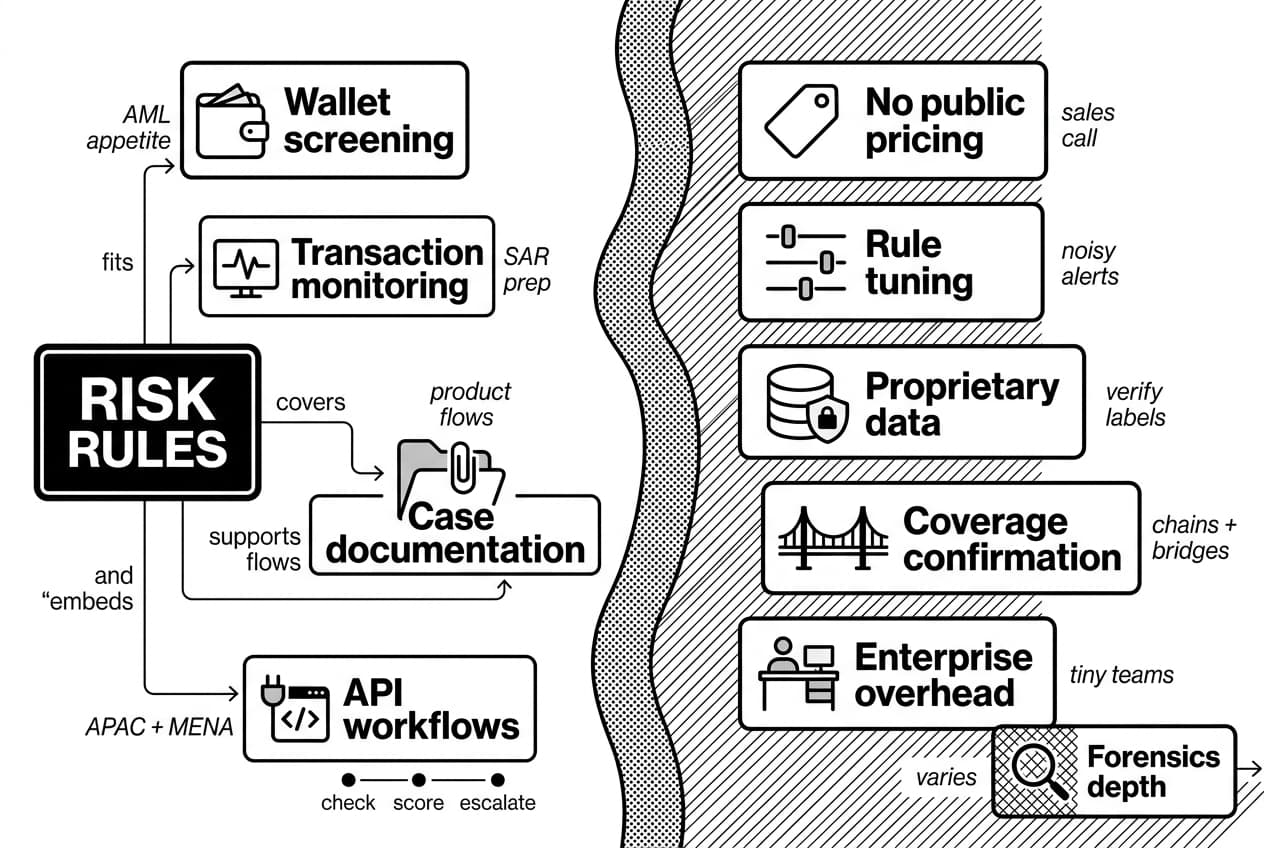
- Configurable risk rules: better fit for teams with their own AML risk appetite.
- Wallet screening plus monitoring: covers onboarding checks and live transaction review.
- Case documentation: useful for audit files, SAR preparation and internal escalation.
- API-driven workflows: suitable for exchanges and fintechs embedding checks into product flows.
- Regional fit: worth testing for APAC and MENA operating corridors.
- Practical scam typology coverage: useful for fraud, mixer and stolen-fund exposure review.
Cons
- No public pricing: buyers need a sales call before budget comparison.
- Rule tuning takes time: weak setup can create noisy alerts.
- Entity data is proprietary: buyers cannot independently verify every label.
- Coverage needs written confirmation: newer chains and bridges may vary by tier.
- Not built for tiny teams: occasional address checks do not justify enterprise overhead.
- Forensics depth varies: public-sector investigation teams may still prefer larger incumbents.
Merkle Science vs Chainalysis, TRM Labs, Elliptic, and Scorechain
No crypto compliance platform wins every category. Merkle Science is most competitive when a buyer wants configurable rules, a usable compliance workflow and regional coverage without defaulting to the largest vendor. Chainalysis and TRM Labs are stronger for large investigation programs. Elliptic is strong for institutional risk intelligence. Scorechain can be easier for smaller European compliance teams to budget.
Platform | Best for | Strengths | Limitations | Pricing transparency |
|---|---|---|---|---|
Merkle Science | exchanges, fintechs and banks needing custom AML rules | rule flexibility, wallet screening, KYT and case workflow | quote-only pricing and chain coverage that must be confirmed | low, quote-based |
Chainalysis | large exchanges, law enforcement and regulators | deep entity data and mature investigation tooling | enterprise cost profile and heavier procurement process | low, quote-based |
TRM Labs | banks, fintechs and government teams | forensics, monitoring and broad institutional adoption | premium positioning may be too much for smaller teams | low, quote-based |
Elliptic | mid-to-large exchanges and institutional risk teams | cross-chain analytics and risk intelligence | buyers should test investigation workflow fit before replacing existing tools | low, quote-based |
Scorechain | European VASPs and smaller compliance teams | clear compliance workflow and approachable buyer fit | lighter custom-rule depth for complex global teams | medium, some packaging is easier to compare |
Merkle Science vs Scorechain
Scorechain and Merkle Science overlap most for exchanges and fintechs that want AML tooling without the heaviest enterprise footprint. Scorechain tends to be easier to evaluate for European VASPs because its compliance workflows are clear and its packaging can be easier to compare. See our Scorechain compliance analytics review for a deeper buyer fit assessment.
Merkle Science is the stronger shortlist candidate when a team needs more granular rule control, more flexible API integration or coverage across several regional corridors. If your AML process is standard and Europe-centered, Scorechain may ramp faster. If your risk appetite varies by asset, counterparty or jurisdiction, Merkle Science deserves the demo slot.
Merkle Science vs Chainalysis and TRM Labs
Chainalysis and TRM Labs remain the high-end benchmarks for many law-enforcement, exchange and banking buyers. Chainalysis also publishes market data that keeps it central to compliance discussions, including the $24.2 billion illicit-address receipt figure for 2023 (Chainalysis, February 2024).
The reason to still shortlist Merkle Science is not that it obviously beats the larger incumbents on every data category. It does not. The reason is buyer fit. A mid-market exchange may care more about custom risk thresholds, regional entity context, analyst workflow and a negotiable contract than the deepest possible forensics graph. Ask each vendor to process the same sample alert set and compare false positives, explanation quality and export output.
Who Is Merkle Science For?
Merkle Science is best for organizations where compliance work is frequent, documented and operationally important. If alerts feed into licensing, bank-partner reviews, law-enforcement requests or board reporting, a full AML platform can be justified. If the use case is occasional curiosity about an address, it is too much tool.
Best use cases
- Crypto exchanges and custodians: deposit monitoring, withdrawal screening and account-level risk review.
- Payment processors: sanctions screening and transaction-risk checks before settlement.
- Fintech apps: wallet screening during onboarding and risk rechecks after activity changes.
- Banks: due diligence on digital-asset clients and counterparties.
- Investigators: fund-flow tracing across multiple hops with case notes and exports.
- Licensing-stage startups: evidence of AML controls for crypto money transmitter license requirements, especially when paired with FinCEN guidance from 2019 (FinCEN, accessed 19 September 2026).
Teams building compliance operations from scratch should map the platform against staffing, policies, wallet custody model and reporting duties. Our guide on how to start a compliant crypto business can help define those requirements before vendor demos.
When to choose a simpler tool
Choose a simpler tool if you run low transaction volume, perform one-off wallet research or lack a dedicated analyst. Public block explorers, low-cost screening APIs or specialist fraud tools may be enough for a small team. Merkle Science starts to make sense when alerts, audit trails, licensing obligations and case documentation become recurring work.
Verdict: Should You Use Merkle Science?
Merkle Science is a serious option for mid-market and enterprise crypto compliance teams that need custom risk rules, wallet screening, transaction monitoring and investigation files in one workflow. It is not the cheapest or most transparent product to evaluate, but it is far more relevant than a basic wallet lookup tool.
Final rating criteria
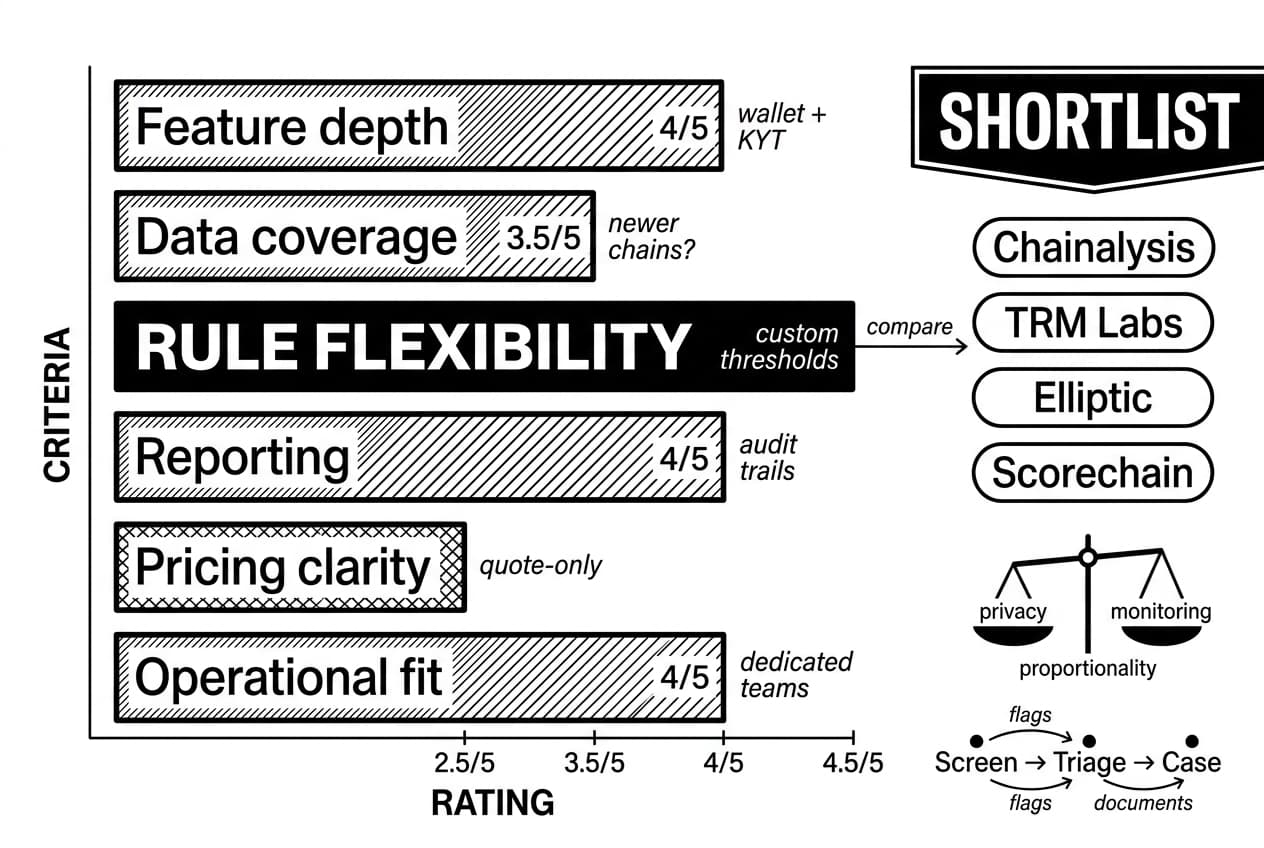
Criteria | Assessment | Rating |
|---|---|---|
feature depth | wallet screening, KYT, monitoring and case management are well aligned | 4/5 |
data coverage | major-chain support is solid, but newer networks need confirmation | 3.5/5 |
rule flexibility | custom thresholds are a clear differentiator | 4.5/5 |
reporting | case exports and audit trails are useful for regulated teams | 4/5 |
pricing clarity | quote-only model slows budget comparison | 2.5/5 |
operational fit | best for dedicated compliance teams, not casual users | 4/5 |
Bottom line: shortlist Merkle Science if your team needs configurable AML controls, meaningful alert triage and documented investigations. Compare it closely with Chainalysis, TRM Labs, Elliptic and Scorechain using the same sample transactions. If the quote is fair and the chain coverage matches your corridors, it can be a strong compliance platform for 2026.
The caveat is privacy and proportionality. Strong monitoring can protect users and satisfy regulators, but overly aggressive screening can also create poor user outcomes. That tension is covered in our guide to crypto privacy and regulation tradeoffs.
Frequently Asked Questions
- Who is the CEO of Merkle Science?
- Merkle Science was co-founded by Mriganka Pattnaik, who has served as CEO. However, executive roles can change over time, so always verify current leadership through Merkle Science's official website or LinkedIn profile before citing this information in any formal due diligence or business research.
- Where is Merkle Science located?
- Merkle Science is headquartered in New York, with offices in Singapore and other regions. As a global compliance vendor, their operational footprint spans multiple jurisdictions. Buyers should confirm local support availability, regional regulatory expertise, and data-processing terms directly with the company before committing to a contract.
- What is a Merkle proof?
- A Merkle proof is a cryptographic technique that verifies a specific piece of data belongs within a Merkle tree without downloading or exposing the entire dataset. It is a foundational blockchain concept and has no direct connection to Merkle Science, the crypto risk and compliance analytics company.
- What is the purpose of a Merkle root?
- A Merkle root is a single hash that represents every transaction or data entry within a Merkle tree. Blockchains use it to verify data integrity efficiently — if any transaction is altered, the root hash changes immediately, making tampering detectable without having to inspect each individual record.
- What is a Merkle tree used for in blockchain?
- Merkle trees help blockchains organize transactions, verify data inclusion, and reduce bandwidth requirements for lightweight clients. They protect data integrity by linking all records through hashing. Note that this is a cryptographic data structure, entirely separate from Merkle Science's blockchain compliance and transaction monitoring platform.
- Is Bitcoin still using proof of work?
- Yes, Bitcoin continues to use proof of work as its consensus mechanism. Miners compete to solve complex puzzles to add new blocks, securing the network. Inside those blocks, Merkle trees organize and verify transaction data — a complementary but distinct cryptographic function from the consensus process itself.
Sources
Author

Crypto analyst and blockchain educator with over 8 years of experience in the digital asset space. Former fintech consultant at a major Wall Street firm turned full-time crypto journalist. Specializes in DeFi, tokenomics, and blockchain technology. His writing breaks down complex cryptocurrency concepts into actionable insights for both beginners and seasoned investors.