Wallet Screening: How Crypto Address Checks Work in 2026
Wallet Screening: How Crypto Address Checks Work in 2026
What is wallet screening?
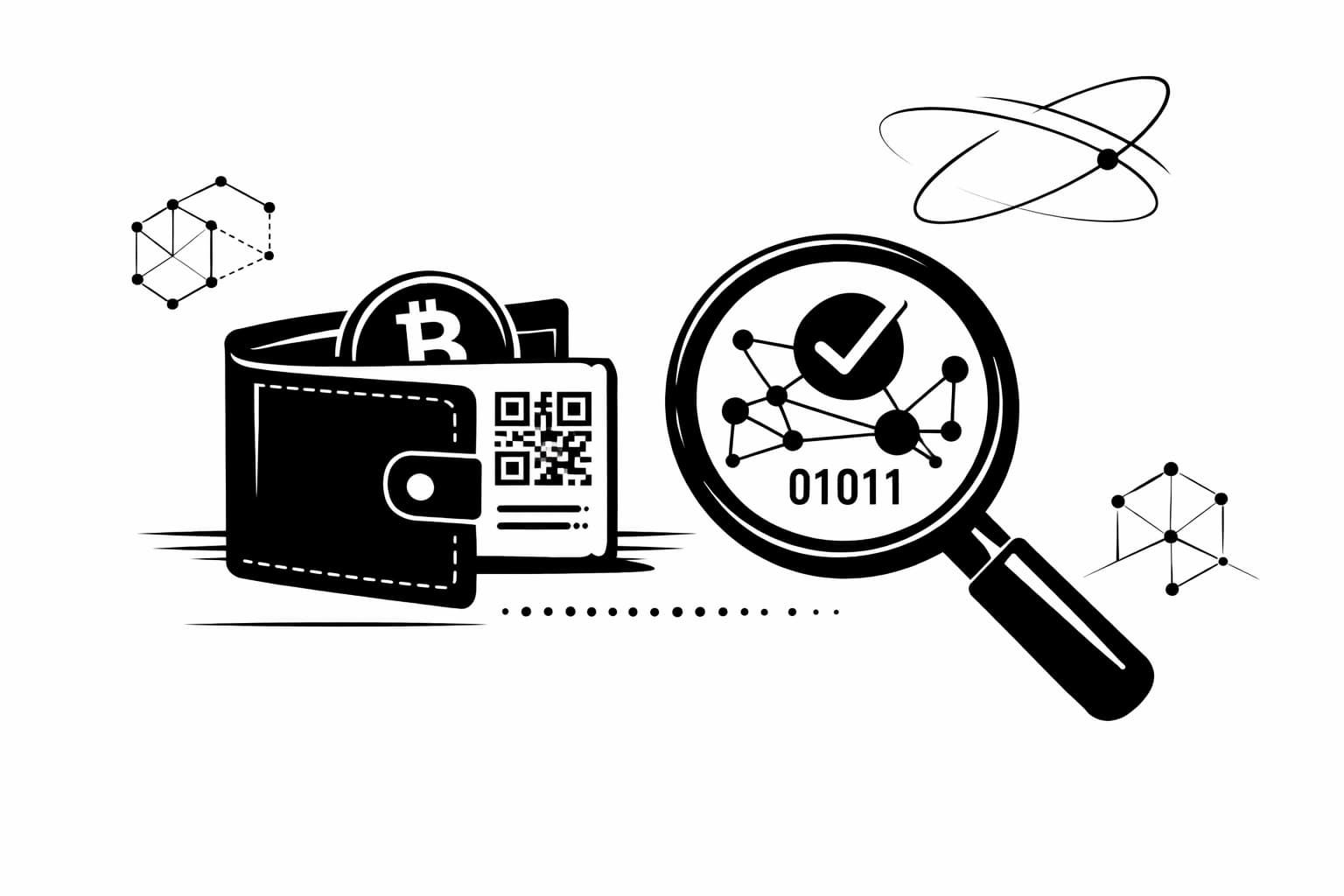
Wallet screening is the process of checking a crypto address against sanctions, scam and blockchain-history signals before a platform accepts, rejects or reviews a transaction. In practice, wallet screening and crypto address screening turn a public address into a risk prompt, not a final verdict.
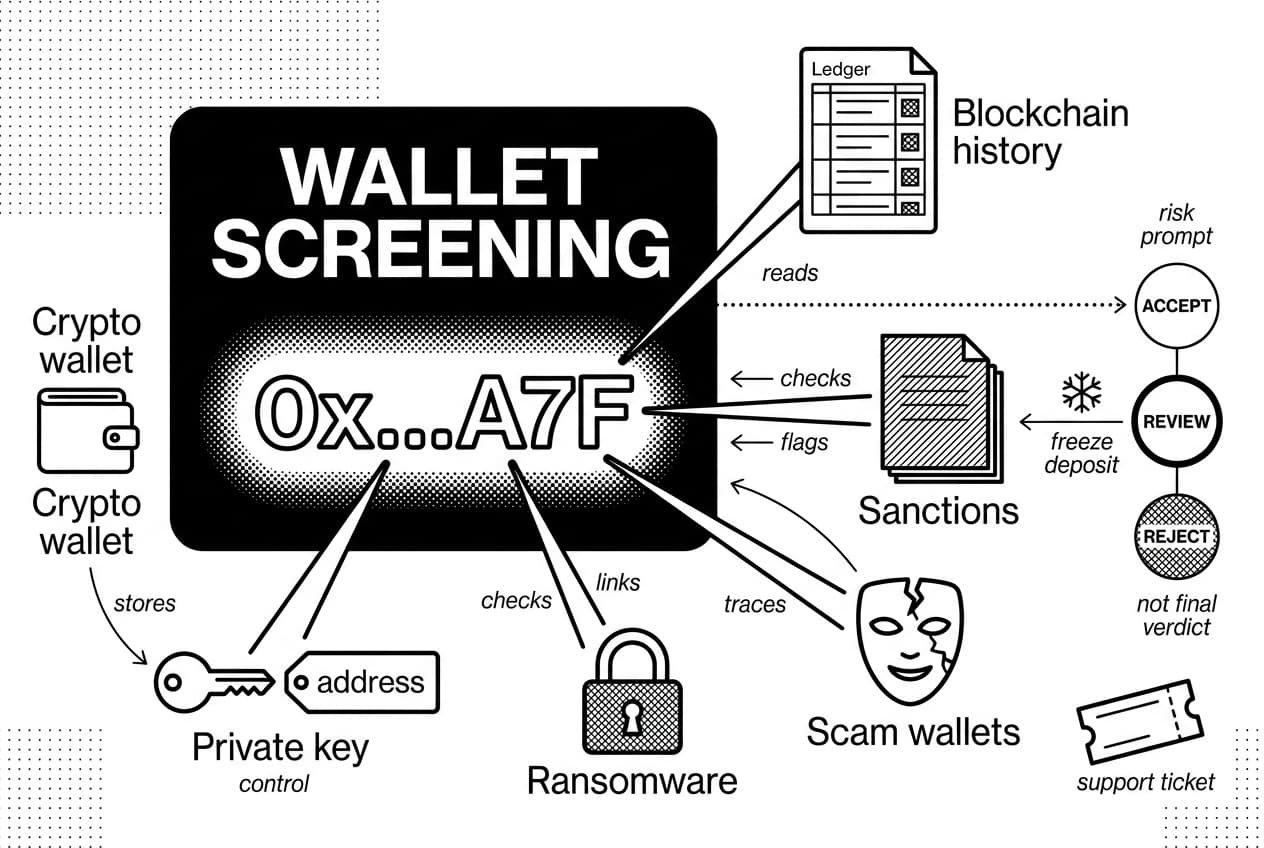
Why it matters: if you receive funds from an address linked to theft, sanctions evasion or ransomware, an exchange may freeze the deposit while a compliance team investigates. For a business, that can mean delayed payments and licensing risk. For an individual, it can mean a locked account and a long support ticket.
Plain-English definition
A crypto wallet is software or hardware that stores the private keys needed to control funds on a blockchain. A wallet address is different. It is the public string of letters and numbers that receives assets. Knowing an address does not give anyone control of the funds; control requires the private key or seed phrase.
Wallets, addresses and blockchains explained
A blockchain is a shared ledger maintained by many computers. Think of a blockchain like a shared online spreadsheet that nobody can quietly edit after saving. Each transaction between addresses is written to that ledger, which lets compliance tools read address history and compare it with sanctions lists, known scam wallets and other risk records.
The key point for 2026 is that screening is not a magic blacklist. It is risk triage. Attribution can be probabilistic, old or wrong. A clean-looking address can receive tainted funds after an earlier check. A flagged address can belong to a legitimate user caught by a broad clustering rule. Good programs pair automated screening with context, appeal paths and ongoing monitoring.
Why wallet screening matters in 2026
As of September 2026, wallet screening matters because crypto payments, stablecoin transfers and self-custody withdrawals move faster than manual compliance reviews. Once risky funds reach a platform, the options become harder: freeze the account, ask the user for proof, file an internal report or reject the transfer after the user expected access.
Public enforcement data explains the pressure. OFAC identified two bitcoin addresses in a November 2018 sanctions action (U.S. Treasury, November 2018), making address-level screening a regulatory expectation rather than a niche investigator task. Chainalysis estimated $24.2 billion in illicit crypto transaction volume for 2023 (Chainalysis, January 2024). The FBI reported $5.6 billion in cryptocurrency-related losses during 2023 (FBI, September 2024).
The reader-level benefit
For a business, screening helps avoid accepting funds that later trigger a withdrawal freeze, bank inquiry or regulator question. For an individual, it helps explain why an exchange may ask for source-of-funds documents after a deposit. It also supports crypto money transmitter compliance, since licensing regimes expect documented anti-money-laundering controls.
The compliance-level benefit
AML, short for anti-money laundering, is the set of controls financial institutions use to detect and report suspected criminal finance. FATF guidance on virtual assets (FATF, updated guidance page accessed 2026) expects crypto firms to understand customer and transaction risk. Wallet screening helps turn a raw blockchain address into a reviewable risk file.
Background: from block explorers to AML analytics
Wallet screening began with manual checks. An investigator copied an address, pasted it into a public block explorer and followed each transfer by hand. A block explorer is a website that displays blockchain transactions, balances and block data. It shows the trail, but it does not decide whether the trail is suspicious.
Early manual checks
Manual review works for one or two addresses. It breaks down when a platform processes thousands of deposits and withdrawals. An analyst would need to inspect incoming funds, outgoing funds, counterparties, timestamps, token movements and possible links to known bad actors. The problem was not lack of public data; the problem was turning that data into repeatable decisions.
Modern automated screening
Modern tools automate the first pass. Providers such as Chainalysis, TRM Labs, the platform covered in this compliance platform review, Scorechain compliance analytics and AML Watcher combine public blockchain data, sanctions lists, entity labels and investigator research. The result is a risk score, alert category and case record that a human reviewer can inspect.
Attribution still matters. A regulated exchange led by a public executive such as Brian Armstrong at Coinbase may be easy to identify on-chain because large services reuse patterns, publish compliance material and interact with known banking partners. A newly created self-custody address is harder to interpret because it may have no long history.
How wallet screening works step by step
Wallet screening is a short chain of checks that converts a raw address into a decision: allow, pause, reject or review. Below is the snippet-friendly version of the process.
- Submit address. A user enters a deposit or withdrawal address, or an API sends it to the screening system.
- Read blockchain history. The tool pulls transactions, counterparties, timestamps, token types and amounts from the relevant chain.
- Attribute entities. It tries to link addresses to exchanges, bridges, mixers, darknet markets, scam wallets or sanctioned actors.
- Check sanctions. The system compares direct and attributed addresses with live sanctions lists and internal block rules.
- Calculate exposure. It measures direct exposure and indirect exposure across one or more hops.
- Assign risk score. Signals are converted into low, medium, high or prohibited risk categories.
- Trigger review. Medium and high alerts go to a trained reviewer with case notes and supporting evidence.
What the risk score actually measures
A risk score is not a simple yes-or-no check. It weighs direct exposure, meaning the address transacted with a risky address, and indirect exposure, meaning the address touched funds that passed through risky counterparties earlier. Direct exposure usually carries more weight because the connection is clearer.
Example: if a user deposits 0.5 BTC from a regulated exchange address with no risky hops, the deposit may clear automatically. If 10% of that 0.5 BTC previously passed through a known scam wallet two hops back, the system may pause the credit and ask a reviewer to check context before acting.
The seven-signal triage framework
For this editorial review, we built a disclosed synthetic teaching set of 12 wallet-screening scenarios. The goal was not to rate any real person or live wallet. It was to show how a careful compliance team can separate address risk from user guilt. We call the resulting model the seven-signal triage framework.
Signal | Question the reviewer asks | Why it matters |
|---|---|---|
Direct match | Is the address itself listed? | Direct matches can require an immediate block. |
Hop distance | How many transfers away is the risk? | Distant exposure is weaker than direct exposure. |
Amount share | What share of funds is exposed? | A dust transfer should not equal a full balance. |
Timing | Did exposure happen recently? | Recent risk is more actionable than old dust. |
Asset and chain | Which network carried the funds? | Stablecoins, bridges and privacy tools behave differently. |
User context | Does the user have a plausible source of funds? | Documents can explain lawful activity. |
Appeal evidence | Can the user challenge the label? | Due process reduces false positives. |
In the synthetic set, a direct sanctions match produced a prohibited outcome, while old three-hop exposure with a small amount share produced a review note rather than an automatic freeze. That difference is the heart of good crypto address screening: the tool flags risk, and the reviewer decides what the risk means.
What crypto address screening detects
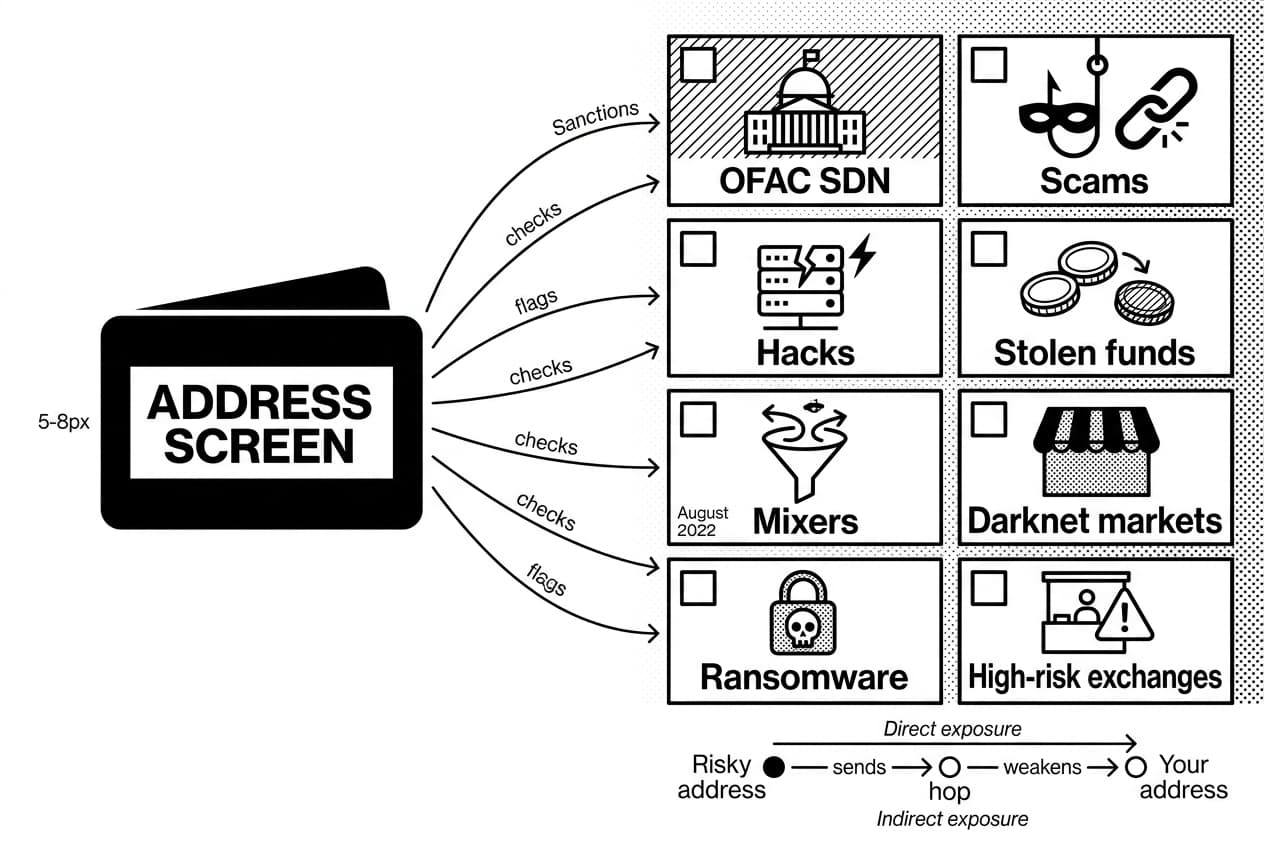
Crypto address screening checks several overlapping risk categories at once. The categories below are the ones most users and compliance teams encounter first.
Sanctions and blocked entities
Sanctions are government restrictions that prohibit dealing with named people, entities or jurisdictions. In crypto, the list may include wallet addresses. A screening tool compares incoming and outgoing addresses against the OFAC SDN list and similar lists in other jurisdictions. The U.S. Treasury also designated a major crypto mixing service in August 2022 (U.S. Treasury, August 2022), showing that service-level labels can matter as much as single-address labels.
Scams, hacks and stolen funds
Tools also flag wallets connected to common crypto scams, phishing campaigns, rug pulls, exploit proceeds and exchange thefts. If stolen funds move from one address to another, the trail remains visible. The open question is whether the next holder is a thief, a broker, an exchange customer, a victim or an unrelated recipient.
Direct vs indirect exposure
Direct exposure means your address received funds straight from a risky address. Indirect exposure means the risky address sent funds to another address first, and that later address sent funds to you. Hop depth matters because risk weakens as the trail becomes longer and more ambiguous.
Tools also flag addresses connected to crypto mixer legal status issues, darknet markets, ransomware wallets, high-risk exchanges, terrorist-financing indicators and sanctioned infrastructure. Each category should have a different risk weight. Treating every alert the same creates unnecessary false positives.
Wallet screening vs transaction monitoring, KYT and KYC
Compliance teams use several tools that sound similar but answer different questions. Wallet screening checks an address. Transaction monitoring watches patterns over time. KYT, short for know-your-transaction, reviews a transfer. KYC, short for know-your-customer, verifies identity.
Simple comparison table
Term | What it checks | When it happens | Example |
|---|---|---|---|
Wallet screening | Address risk | Before or during transfer | Check deposit address |
Transaction monitoring | Behavior patterns | Continuously | Flag 50 small withdrawals |
KYT | Specific fund flow | At transfer time | Trace mixer exposure |
KYC | User identity | At onboarding | Verify passport |
When screening is not enough
A wallet can pass screening today and become risky tomorrow. Chainalysis has repeatedly noted in its public crypto crime research that illicit labels can appear after funds have already moved. That delay is why regulated firms layer pre-transaction screening with ongoing monitoring, case review and periodic customer checks.
In practical terms, wallet screening answers "is this address risky right now?" Monitoring answers "has the pattern changed since the last check?" KYC answers "who is the customer?" A mature program needs all three because none of them covers the full risk picture alone.
Screening across assets, chains and risk signals
Different chains record value in different ways, so a screening method that works well for bitcoin may miss risk on an account-based smart-contract chain.
Bitcoin vs Ethereum-style chains
Bitcoin uses the UTXO model, short for unspent transaction output. Each coin fragment has its own transaction history. Ethereum-style networks use an account model, where each address has a changing balance and can interact with smart contracts. A smart contract is code stored on a blockchain that runs when conditions are met.
This difference matters. A bitcoin screening tool traces coin fragments. An Ethereum-style tool reads token transfers, contract calls, approvals and decentralized exchange swaps. Compliance teams that support several assets need chain-specific parsing, not one generic address checker.
Stablecoins, bridges and smart contracts
Stablecoins such as USDT add another layer because the same token brand can exist on several networks. A cross-chain bridge is a protocol that moves value between blockchains. If funds move from one chain to another, a single address check on the original chain may not show the later destination.
Smart contracts also fragment the trail. Funds can pass through lending pools, decentralized exchanges, bridge contracts and token approvals in minutes. That is why modern screening tools increasingly rely on multi-chain clustering, contract labeling and bridge detection. The goal is not perfect certainty; the goal is enough context for a defensible review.
Asset or technology | Screening challenge | Why it complicates triage |
|---|---|---|
Bitcoin | Coin-fragment tracing | Each fragment has its own history. |
Ethereum-style chains | Smart-contract activity | One transaction can trigger many events. |
USDT | Multi-chain issuance | The token exists on several networks. |
Cross-chain bridges | Chain hopping | Source and destination sit on different ledgers. |
Non-EVM chains | Different formats | Generic parsers can miss chain-specific data. |
The practical lesson is simple: chain coverage matters. If a tool screens bitcoin and Ethereum-style assets but ignores major stablecoin corridors, it can miss the path funds actually used.
Limits: accuracy, false positives and privacy
Screening tools are useful, but they are not proof machines. Every score depends on address labels, clustering assumptions, timing, sanctions updates and human interpretation. Treating a risk score as a final judgment can harm innocent users.
Why risk scores are not proof
A high-risk score should trigger review, not automatic blame. Labels can be stale. Address clusters can be too broad. A user can receive a tiny unsolicited transfer from a risky wallet, sometimes called dust, without having any relationship to the sender. A user can also inherit old exposure from funds that passed through many addresses before arrival.
Hester Peirce, commissioner at the SEC, has often warned in public policy discussions that financial regulation should leave room for fairness, innovation and individual recourse. That concern applies directly to wallet screening. If a platform blocks users without explaining the issue or offering an appeal path, the tool becomes a blunt gatekeeper rather than a compliance aid.
FATF risk-based guidance also points in this direction: automated tools should support judgment, not replace it. A defensible case file should show the address, the source of the label, the exposure path, the reviewer decision and any user evidence submitted during the appeal.
Privacy and due process concerns
Wallet screening creates privacy tension because public blockchains expose transaction history. A person who used a lawful privacy tool years ago may still face questions today. Indirect exposure makes this harder. If your address receives funds that passed through a risky service several transfers earlier, a strict system may flag you even if you had no knowledge of the source.
This is the wider conflict covered in crypto privacy vs regulation. Compliance teams need controls, but users deserve clear explanations, correction paths and proportional treatment. Screening is strongest when it is paired with documented thresholds and human review.
- Review trigger: a high score should start a case, not end it.
- Stale labels: old attribution can misrepresent current ownership.
- Dust risk: tiny unsolicited transfers should be treated carefully.
- Appeals: users need a way to submit source-of-funds evidence.
- Documentation: each decision should record data source, date and reviewer rationale.
Frequently Asked Questions
- Can the FBI track a BTC wallet?
- Bitcoin transactions are publicly recorded on the blockchain, so investigators can trace fund movements between addresses. Identifying the actual person behind a wallet is a separate challenge — it typically requires off-chain evidence like exchange KYC records, court subpoenas, IP logs, or data from seized devices.
- Can the IRS see your crypto wallet?
- The IRS can analyze public blockchain data and receives transaction reports from regulated exchanges, brokers, and payment processors. A self-custody wallet has no automatic link to your identity, but that changes once its addresses interact with KYC-verified platforms or accounts that have already been reported to tax authorities.
- Can someone steal my crypto if they have my wallet address?
- A public wallet address alone cannot authorize any transaction — knowing it is similar to knowing someone's email address without having their password. Actual theft requires access to the private key or seed phrase, a malicious token approval, a phishing signature, a compromised device, or direct access to an exchange account.
- Can stolen crypto be traced?
- Stolen crypto can often be traced because blockchain records are public and permanent. Recovery is far harder than tracing — thieves routinely move funds through mixers, bridges, DeFi protocols, and exchanges to obscure the trail. Successful recovery usually depends on quick reporting, law enforcement involvement, and cooperation from relevant platforms.
Sources
Author

Crypto analyst and blockchain educator with over 8 years of experience in the digital asset space. Former fintech consultant at a major Wall Street firm turned full-time crypto journalist. Specializes in DeFi, tokenomics, and blockchain technology. His writing breaks down complex cryptocurrency concepts into actionable insights for both beginners and seasoned investors.