Blockchain Oracle Development: Architecture Guide for Devs
Blockchain oracle development: architecture guide for developers
What is a blockchain oracle?
A blockchain oracle is software that moves information from offchain sources into a blockchain, so smart contracts can react to real-world data such as prices, weather, identity checks, shipment status, or random numbers through a controlled offchain-to-onchain data transfer process.
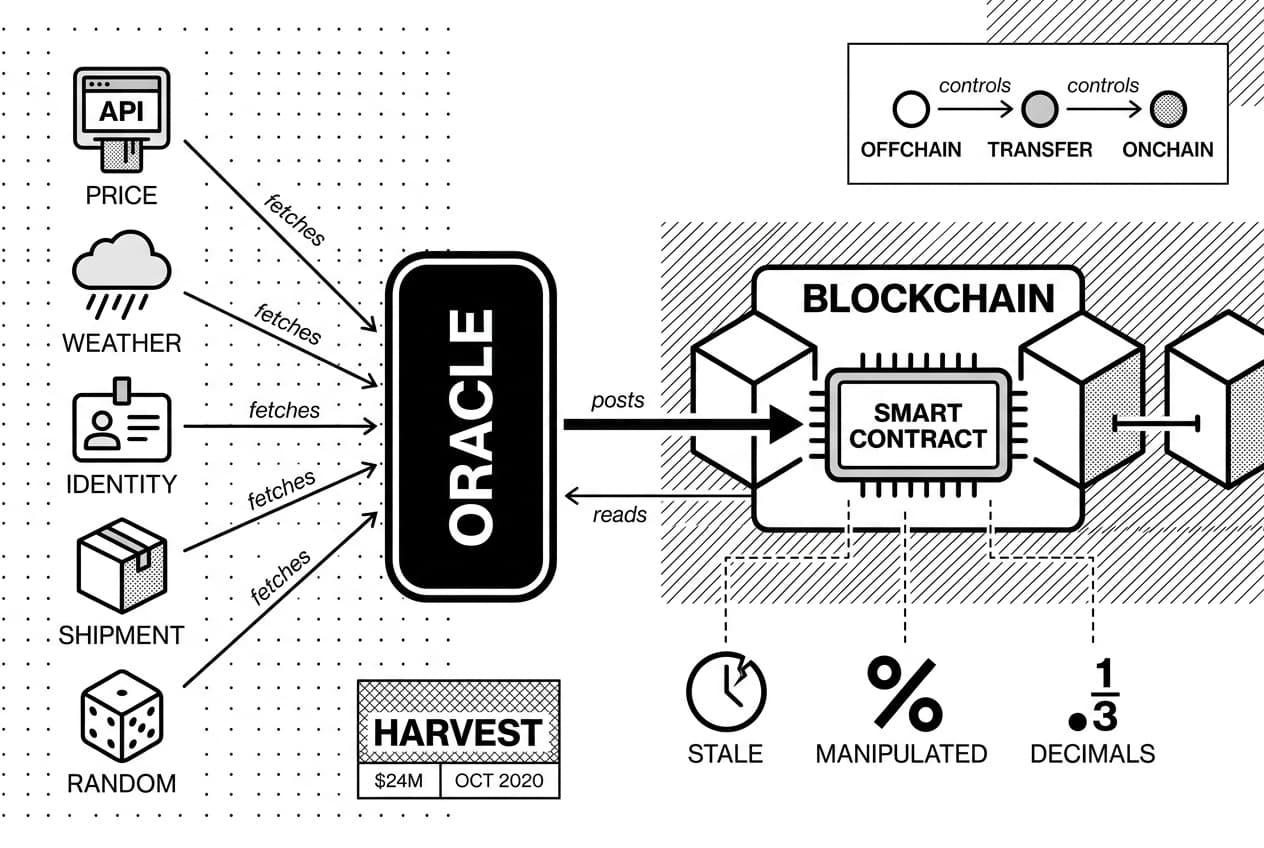
Why it matters: if you are building a lending app, insurance contract, game, bridge, or tokenized asset system, the smart contract is only half the architecture. The other half is the data path that tells the contract what happened outside the chain.
A useful analogy: a blockchain is like a shared cloud document that nobody can edit after it is saved. Everyone can inspect the same record, but the record cannot browse the web, call an exchange API, or check whether a flight landed. The oracle is the controlled input channel.
For developers, blockchain oracle development means designing, integrating, testing, and monitoring that input channel. Clean Solidity code will not protect a protocol if the value it reads is stale, manipulated, or formatted with the wrong decimals.
Background: how oracles evolved
Early oracles were simple. One server posted one value to one contract. That design was easy to reason about, but it created a single point of failure. The Harvest exploit, about $24 million lost according to Rekt News in October 2020, showed how fragile price-dependent DeFi systems could be when data assumptions were weak.
Decentralized oracle networks grew from that failure mode. Instead of one server, multiple node operators fetch, sign, and submit reports. Sergey Nazarov, co-founder of Chainlink Labs, has repeatedly framed oracles as the layer that connects deterministic smart contracts with non-deterministic real-world data. That framing is useful, but it is not a complete safety guarantee.
Vitalik Buterin, co-founder of Ethereum, has long emphasized Ethereum's deterministic execution model: every node must be able to compute the same result from the same inputs. Oracles exist because facts from outside the chain are not part of that deterministic state until someone submits them.
Oracle systems are not Oracle Corporation
Blockchain oracles and Oracle Corporation's blockchain products are different things. Oracle Corporation is an enterprise software company. A blockchain oracle is a data infrastructure pattern used by smart contracts. When a developer asks which oracle to use, the question is about trust, latency, cost, and integration model.
Our take for 2026: decentralization reduces one failure mode, a single dishonest node, but it does not eliminate bad source data, latency gaps, governance capture, or economic manipulation. A network of many nodes that all read the same corrupted exchange API can still deliver a corrupted answer.
Why smart contracts need oracles
A smart contract is code stored on a blockchain that runs when defined conditions are met. A blockchain node must be able to verify that code using only chain data. That security model is why contracts cannot simply call a weather API, bank database, flight database, or exchange endpoint during execution.
Oracles solve this limitation by writing external facts onto the chain in a format the contract can read. A wallet is the software or hardware used to hold keys and sign transactions. Gas fees are the transaction costs paid to write data onchain. Consensus is the rule set that lets blockchain nodes agree on the same state.
Why it matters for application design
DeFi liquidity pools need asset prices. Insurance contracts may need rainfall or wind readings. Cross-border payment systems need foreign exchange rates. Tokenized property protocols need valuation and ownership attestations. Games need random numbers that players cannot predict. In each case, the oracle becomes a load-bearing dependency.
Nick Szabo, originator of the smart-contracts concept, described smart contracts as protocols that execute agreed terms. Oracles are how those protocols learn whether an external condition in the agreement has happened.
Simple example: ETH price in a lending app
Alice deposits 1 ETH into a lending protocol when ETH is worth $3,000. She wants to borrow $1,500 in stablecoins, or roughly 50 percent of her collateral value. Before approving the loan, the contract must know the current ETH/USD price.
The contract cannot visit an exchange website. Instead, it reads an oracle feed. The feed aggregates prices from offchain sources, posts the result onchain, and exposes a function that the lending contract can call. If the oracle says 1 ETH is worth $3,000, the loan can proceed under the protocol's collateral rules.
If the oracle reports $300 or $30,000 because of bad data, decimal mismatch, or market manipulation, the protocol may wrongly liquidate users or release too much debt. The Mango exploit, roughly $114 million according to Rekt News in October 2022, remains a clear example of how price manipulation can turn an oracle-dependent design into a loss event.
Blockchain oracle architecture: from offchain data to onchain state
Oracle architecture is a data pipeline with a trust boundary at every step. The pipeline starts with offchain data, such as an exchange price, sensor reading, or database record. It ends with onchain state, which is data written to a block and readable by smart contracts.
For this guide, we use two original developer frameworks. The first is the Oracle Trust Stack, which separates execution trust, source trust, and incentive trust. The second is the three-axis oracle fit test, which scores value at risk, latency tolerance, and update frequency before choosing a provider pattern.
Core components in an oracle system
- Data sources: external APIs, exchange endpoints, databases, sensors, signed documents, or another blockchain's state.
- Adapters: small services that parse a source response, handle authentication, normalize units, and reject malformed data.
- Oracle nodes: offchain servers that fetch data, validate it, sign reports, and submit or relay the answer.
- Aggregator contracts: onchain contracts that combine reports from many nodes, often with a median so one outlier does not control the answer.
- Consumer contracts: your application contracts that read the final oracle value and act on it.
Step-by-step oracle data flow
- Request or trigger: a contract emits an event, a scheduler detects a stale feed, or a user action asks for fresh data.
- Fetch: one or more oracle nodes call the external source, such as a REST endpoint, signed feed, sensor gateway, or chain indexer.
- Validate: each node checks timestamps, ranges, status codes, signatures, and expected units before accepting the response.
- Aggregate: the network combines valid reports, commonly by taking the median or using a weighted rule.
- Submit transaction: a node or relayer pays gas and writes the result to the blockchain in a signed transaction.
- Smart contract consumes data: the consumer contract reads the onchain value and executes logic such as liquidation, settlement, minting, or payout.
Where gas fees and finality matter
Gas cost and finality are architecture inputs, not footnotes. Ethereum uses slots of about 12 seconds according to Ethereum.org, accessed March 2026. A contract that reacts before enough confirmation time has passed may expose itself to reorg or timing risk on chains with weaker finality.
Feed frequency also has direct cost impact. A feed updated every 60 seconds performs 1,440 writes per day before redundancy. On a high-fee chain, that can make a push model too expensive for low-value data. On a low-fee chain, the same cadence may be acceptable.
The oracle problem: why data bridges can break trust
The oracle problem is simple to state: a blockchain can verify that code executed correctly, but it cannot independently prove that an external fact was true before the fact was submitted onchain.
This is the garbage-in, garbage-out boundary of smart contract security. The EVM, or Ethereum Virtual Machine, can execute a liquidation formula exactly as written. It cannot prove that the price passed into the formula reflects a fair market price unless the oracle design gives it enough reason to trust the input.
This matters because the attack surface may sit outside your contract. A smart contract access control design can be strong while the data source remains weak, slow, or easy to manipulate.
Common oracle failure modes
- Stale prices: the value was accurate earlier, but market movement made it unsafe by the time the contract read it.
- API outages: a provider goes offline and the feed freezes on the last known value.
- Thin-market manipulation: an attacker moves a low-liquidity market that the oracle reads, then profits before the price normalizes.
- Single-node downtime: one server crash stops the whole feed when the architecture depends on a single reporter.
- Incorrect decimals: a feed returns 8-decimal data while the consumer contract assumes 18 decimals.
- Bridge failures: cross-chain oracle messages inherit bridge, relayer, and governance risk.
- Governance capture: an admin process can change sources, thresholds, or aggregation logic without enough delay or review.
The Oracle Trust Stack
layer | what you are trusting | can code enforce it? |
|---|---|---|
code execution | the runtime runs your contract exactly as written | yes, this is the chain's main guarantee |
source quality | the external providers report accurate, available data | no, use redundancy and source diversity |
operator incentives | nodes prefer honest reporting over collusion | partly, staking and slashing help but do not remove collusion risk |
governance process | feed rules and admin controls cannot change silently | partly, timelocks and multisigs make changes observable |
The practical lesson is to document oracle assumptions the same way you document admin keys, upgradeable proxies, and custody risk. An oracle integration is not safe just because the interface compiles.
Types of blockchain oracles and update mechanisms
Not all oracles deliver data in the same way. The main design choices are data direction, source type, update trigger, and trust model. Choose the model before writing the contract interface, because each model changes your latency, gas cost, and failure behavior.
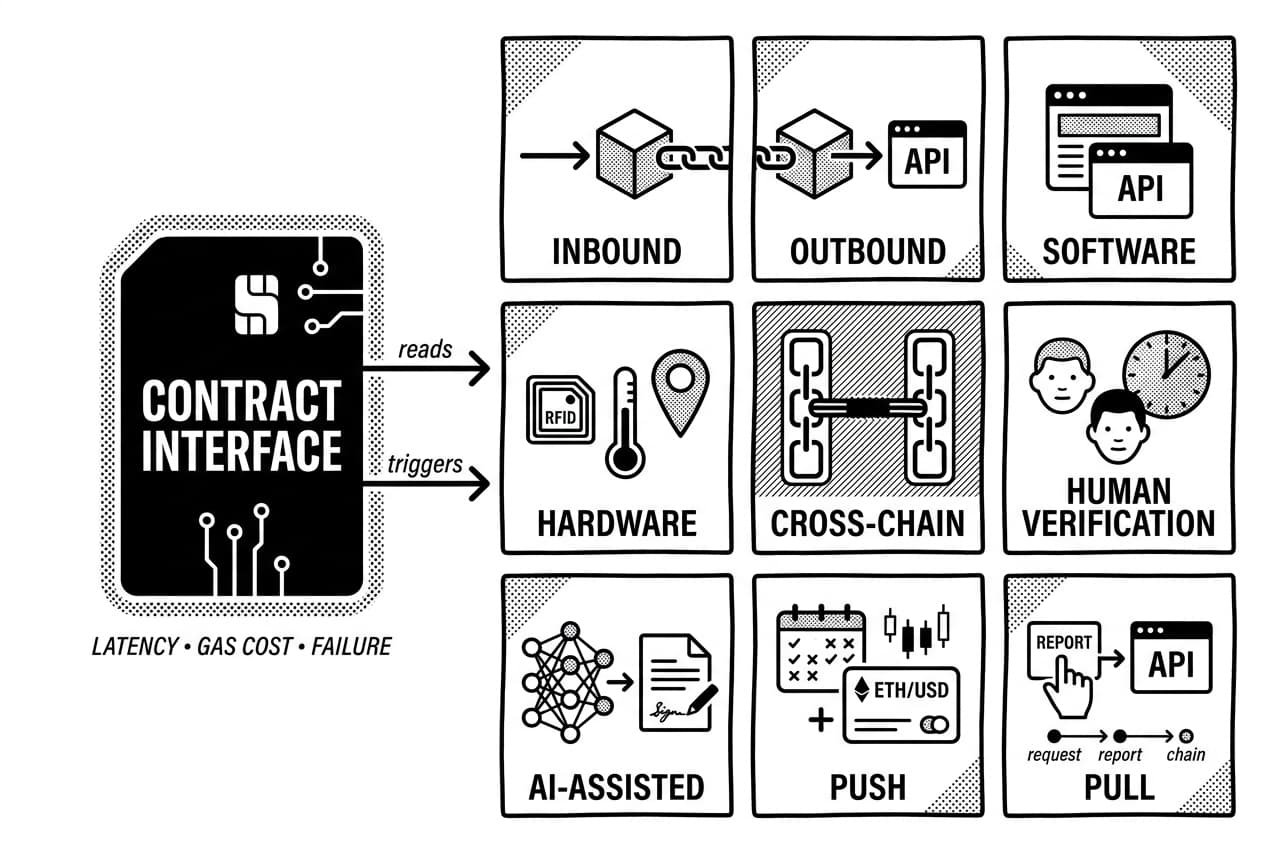
Main oracle categories
- Inbound oracles: move outside data into a contract, such as a price, weather reading, or match result.
- Outbound oracles: let a contract trigger an external action, such as sending an instruction to a payment API.
- Software oracles: read digital sources such as APIs, websites, and databases.
- Hardware oracles: read physical sensors such as RFID tags, thermometers, cameras, GPS units, or industrial devices.
- Cross-chain oracles: report state from one blockchain to another.
- Human verification oracles: rely on people to resolve subjective facts, usually with dispute periods.
- AI-assisted pipelines: use a model to preprocess or classify raw data before a signed result reaches the chain.
Push-based oracles
A push-based oracle writes updates automatically, either on a schedule or when a value moves past a threshold. A lending protocol might read the latest stored ETH/USD price without requesting a new report. This pattern is common for DeFi because many users depend on the same shared feed.
The tradeoff is cost. Someone pays for updates even when no user is interacting with the app. Push feeds work best when many contracts share the same frequently needed value.
Pull-based oracles
A pull-based oracle provides data when the application asks for it. This can lower cost for apps that need occasional data, such as travel insurance or one-off game settlement. The tradeoff is asynchronous design. Your contract may need one transaction to request data and another to consume it.
Common framing says pull oracles are just cheaper push oracles. The better framing is that they move the trust moment. A pull model trusts a snapshot at request time, while a push model trusts a continuously maintained feed.
Oracle type comparison table
oracle type | data source | common use case | latency | main risk |
|---|---|---|---|---|
inbound push | aggregated APIs and price feeds | collateral pricing | low | stale value between updates |
inbound pull | on-demand APIs or signed reports | insurance triggers and metadata | medium | async flow and front-running window |
outbound | contract state | external payment or device command | depends on external system | offchain execution failure |
hardware | physical sensors and devices | supply chain and parametric insurance | medium to high | sensor tampering |
cross-chain | another chain's state | bridging and multi-chain apps | finality dependent | relay or bridge compromise |
human verification | human judgment | disputes and prediction markets | high | collusion or slow response |
AI-assisted | model output plus raw sources | anomaly filtering and content checks | low to medium | opaque model behavior |
Decentralized oracles, consensus, and provider ecosystem
A decentralized oracle is a network of independent nodes that fetch or verify data separately and combine their answers so one machine cannot control the final value.
Several providers serve this role in production. Chainlink reported more than 1,700 oracle networks across 20 plus blockchains on its ecosystem page, accessed March 2026. Pyth network focuses on first-party market data. UMA and Tellor use dispute-driven models. DIA, RedStone, and API3 make different tradeoffs around sources, delivery, and governance.
How oracle nodes reach agreement
The most common rule is medianization. Each node reports a value, and the network uses the middle result. If one node reports an extreme outlier, the median tends to ignore it. Some systems add weighted aggregation, where nodes with stronger track records or larger stake receive more influence.
Staking means operators lock collateral. Slashing means that collateral can be reduced if the operator behaves badly under the protocol's rules. Reputation scoring adds history, so nodes that perform well over time may receive more work.
Decentralization tradeoffs
factor | fewer nodes | more nodes |
|---|---|---|
latency | lower because fewer reports are needed | higher because aggregation waits for more participants |
cost | lower operator and gas expense | higher operator and transaction expense |
manipulation resistance | lower because fewer nodes must be corrupted | higher because an attacker must corrupt more participants |
governance | simpler coordination | slower coordination and more stakeholders |
More decentralization is not always better. It usually improves manipulation resistance, but it can also raise latency and cost. The right design depends on what the data secures.
The three-axis oracle fit test
- Value at risk: how much money, reputation, or operational impact depends on this value?
- Acceptable latency: can the app wait minutes, or does it need seconds?
- Update frequency: does the value need constant refreshes, or only event-based checks?
High value at risk pushes you toward more independent nodes, source diversity, and stronger governance controls. Low latency pushes you toward fewer hops or pull-based delivery. High update frequency makes gas and operator fees a central design constraint.
Blockchain oracle development blueprint for smart contract developers
Blockchain oracle development is production engineering. It touches contract interfaces, data quality, operational monitoring, access control, fallback design, and incident response.
Prerequisites before you build
- Smart contract language: know Solidity or Vyper, including mappings, modifiers, events, and error handling.
- ABI encoding: understand how function selectors and calldata work. The Solidity ABI encoding and decoding guide is a useful reference.
- Wallet setup: use a funded development wallet on a testnet before mainnet deployment.
- Gas fee model: know who pays for oracle updates and callbacks.
- Testing: mock stale values, zero values, bad decimals, and delayed callbacks locally.
- Deployment process: automated release steps reduce human error. See smart contract CI/CD testing.
- Monitoring: set alerts before value enters the system.
Production readiness checklist
- Data freshness: reject answers older than your threshold. For many low-frequency feeds, teams use thresholds around 3,600 seconds, based on Chainlink data feed documentation accessed March 2026, but high-volatility markets need tighter limits.
- Decimals and units: confirm whether the feed returns 8 decimals, 18 decimals, basis points, timestamps, or fixed-point integers.
- Access control: restrict who can update oracle addresses, change thresholds, pause feeds, or trigger privileged callbacks.
- Circuit breakers: pause or revert when a value moves beyond an expected range in one block or one update window.
- Monitoring: alert on stale feeds, missing events, large deviations, failed callbacks, and unusual gas spikes.
- Fallback behavior: define whether the contract should revert, pause, use a secondary feed, or enter manual review when data is unavailable.
- Source diversity: avoid relying on one exchange, one API provider, or one bridge path for high-value flows.
- Front-running review: oracle updates may be visible before execution. Use the front-running prevention for developers guide when designing settlement rules.
Security controls to add early
Sergey Nazarov, co-founder of Chainlink Labs, has argued that oracle security is part of architecture rather than a plug-in. For developers, that means writing controls into the first version, not after mainnet launch.
- Use a timelock or multisig for feed address changes.
- Emit events on every oracle read and every parameter change.
- Write unit tests for stale timestamps, negative values, zero values, and wrong decimals.
- Document your trust assumptions in the repository and audit package.
- Run a limited-value pilot before removing caps.
Blockchain oracle use cases in 2026
Every oracle use case starts with one question: what offchain fact does the contract need, and how fast must that fact be right? The answer drives the data source, update mechanism, decentralization level, and fallback design.
By March 2026, DeFiLlama showed DeFi total value locked above $120 billion. Much of that value depends on price feeds, liquidation checks, and collateral calculations. DeFi is still the dominant oracle category, but the use cases are broader.
use case | data needed | data type | latency need |
|---|---|---|---|
DeFi price feeds | asset spot price | numeric | seconds |
tokenized real-world assets | valuation and ownership proof | structured document | minutes to hours |
parametric insurance | weather or seismic readings | sensor numeric | minutes |
gaming randomness | verifiable random number | cryptographic proof | seconds |
stablecoin reserves | custodian balance or attestation | financial report | hours to daily |
AI content verification | model provenance or output hash | cryptographic hash | on demand |
cross-chain messaging | source-chain transaction status | block or event proof | seconds to minutes |
enterprise compliance | identity, sanctions, or audit status | credential | near real time |
Tokenized real-world assets, including tokenized real estate DeFi lending, need slower but legally meaningful attestations. Parametric insurance may pay when wind speed exceeds 120 km/h, so sensor integrity matters more than millisecond speed. AI content verification on blockchain needs hashes and provenance records that can be audited later.
Developer pattern by use case
- DeFi price feeds: decentralized push or pull feeds with medianization and deviation checks.
- Tokenized real-world assets: authenticated push oracle with permissioned attestations and legal review.
- Parametric insurance: multi-source sensor oracle with threshold logic and manual dispute option.
- Gaming randomness: verifiable random function, or VRF, which produces a random value with proof that it was not chosen after the fact.
- Stablecoin reserves: scheduled attestation oracle tied to auditor or custodian reports.
- AI content verification: hash-commitment oracle, possibly paired with zero-knowledge machine-learning proofs as that tooling matures.
- Cross-chain messaging: light-client, relayer, or oracle network model matched to the finality rules of the source chain.
- Enterprise compliance: permissioned oracle with identity controls, audit logs, and restricted data access.
Frequently Asked Questions
- What is a blockchain oracle and what does it do?
- A blockchain oracle is middleware that bridges offchain data — such as asset prices, weather conditions, identity records, or payment status — with a blockchain. Because smart contracts cannot call external APIs directly, oracles fetch, verify, aggregate, and publish that data onchain so contracts can act on it reliably.
- Who is oracle's biggest client?
- It depends on which "oracle" you mean. Oracle Corporation serves large enterprise cloud and database customers globally. Blockchain oracle networks like Chainlink serve protocols and institutions, with notable integrations including DeFi platforms, Swift's cross-chain experiments, JPMorgan-related tokenized asset pilots, and Coinbase's wrapped-asset infrastructure.
- What is blockchain development?
- Blockchain development covers building smart contracts, decentralized applications, wallets, infrastructure, and integrations that run on or interact with a blockchain network. Oracle development is a specialized discipline within this field, focused specifically on connecting smart contracts to trusted, verifiable external data sources.
- Does oracle have crypto?
- Oracle Corporation does not issue a public cryptocurrency for its enterprise blockchain products. Blockchain oracle networks, however, often have native tokens — Chainlink uses LINK, for example — which handle payments to node operators, staking, and governance depending on how each network is designed.
Sources
Author

Crypto analyst and blockchain educator with over 8 years of experience in the digital asset space. Former fintech consultant at a major Wall Street firm turned full-time crypto journalist. Specializes in DeFi, tokenomics, and blockchain technology. His writing breaks down complex cryptocurrency concepts into actionable insights for both beginners and seasoned investors.