Smart Contract Auditor Salary: Skills and Career Path 2026

Introduction: what you'll learn about smart contract auditor salary and career growth
This guide gives you a practical path to become smart contract auditor job-ready in 2026. You will learn what auditors do each day, what the smart contract auditor salary range looks like by level, which skills raise pay, and what portfolio proof you need before applying for junior, freelance, or senior security work.
The main point is simple: smart contract auditing is not a shortcut. The salary premium is real, but it usually goes to people who can show public evidence of exploit-level judgment. A certificate can help you structure study, but verified findings, proof-of-concept tests, and clear reports carry more weight in hiring and freelance negotiations.
For this update, we built a source-based compensation map from public salary pages, audit contest platforms, bounty disclosures, and security job listings available as of January 2026. We treated base salary, contest income, bounty rewards, and token grants separately because they behave differently in real budgets.
The demand signal is clear. Smart contract exploits drained more than $1.8 billion from protocols in 2023 (DefiLlama, 2023). That risk is why credible auditors remain valuable even when the broader crypto market cools.
Contrarian angle: Smart contract auditing is often sold as a high-salary Web3 shortcut. A better frame is return on proof. Your earning power rises when you can prove you found real bugs in public, explain impact, and help teams fix the issue without vague claims.
Who this guide is for
This guide is for Solidity developers, cybersecurity learners, Web3 job seekers, and traditional audit professionals who want a realistic path into blockchain security. You do not need to be senior today, but you do need to be willing to publish work where other people can inspect it.
You will see a step-by-step plan, salary bands, portfolio milestones, and common mistakes. Keep the guide open while you plan your first 90 days.
What does a smart contract auditor do?
A smart contract auditor reviews blockchain code before deployment, looking for flaws that could let attackers steal funds, bypass permissions, manipulate accounting, or break protocol rules. The job combines manual code review, automated testing, threat modeling, exploit reproduction, and a written report with prioritized fixes.
Day to day, you read unfamiliar code, run tools such as Slither or Foundry tests, trace value flows, and ask how an adversary could make the system behave incorrectly. You then document each issue with impact, likelihood, affected code, reproduction steps, and a recommended fix.
The stakes keep rising. DeFi protocols held more than $91 billion in total value locked as of April 2026 (DefiLlama, April 2026). That means one missed access control bug or oracle bug can create losses far above the cost of the audit. Understanding crypto insurance and protocol risk also helps you see how teams compare audit cost with potential loss.
Smart contract auditing vs traditional IT auditing
Traditional IT auditing often focuses on policies, access logs, control evidence, and compliance programs. Smart contract auditing focuses on code that may hold money directly. You are not only checking whether a process exists. You are checking whether an attacker can force a financial system into an unsafe state.
Three differences matter most. First, attackers can inspect public code and prepare attacks before launch. Second, deployed contracts can be hard or impossible to patch. Third, DeFi threat models include flash loans, liquidity manipulation, governance attacks, and oracle dependencies.
Vitalik Buterin, co-founder associated with ethereum.org, has often emphasized that public blockchains combine code, money, and adversarial incentives. That mix is why smart contract security requires more than normal software testing.
Common vulnerabilities you will investigate
In public audit reports and contest writeups, the same bug families appear again and again. Learn each one in real Solidity code, not only as a definition.
- Reentrancy: A contract calls an external address before updating its own accounting. The 2016 DAO exploit involved about 3.6 million ETH (ethereum.org history, 2016).
- Access control failures: A privileged function can be called by the wrong account. Study smart contract access control patterns before you review admin logic.
- Oracle manipulation: A protocol trusts a price source that an attacker can move during the same transaction.
- Arithmetic issues: Older compiler versions and unchecked math can create overflow, underflow, or rounding problems.
- Signature replay: A valid signature is reused in a different context than the signer intended.
- Upgrade bugs: Proxy systems can suffer from storage collisions, missing initialization, or unsafe migration steps.
- Economic attacks: Incentive flaws allow profitable abuse even when the code compiles and tests pass.
A credible junior auditor can explain the attack path, write a small test that proves the issue, and suggest a fix with trade-offs. That is the standard you are building toward.
Prerequisites: what you'll need before you become a smart contract auditor
Before you apply for roles or pitch clients, you need a technical base and a security mindset. The goal is not to memorize every exploit. The goal is to read code carefully, predict failure modes, and prove your claims with tests.
Core technical requirements
Solidity is the starting point, but auditing requires deeper reading than normal app development. You should be able to trace storage changes, external calls, modifiers, upgrade paths, and edge cases across several files.
- Solidity and EVM basics: Learn storage, memory, calldata, events, ABI encoding, opcodes, and
delegatecall. - JavaScript or TypeScript: Many projects still use Hardhat scripts and test suites.
- Git and terminal workflows: You will clone repositories, inspect commits, run tests, and compare branches daily.
- Testing frameworks: Foundry and Hardhat remain common choices in public repositories as of January 2026 (Foundry repository).
- DeFi mechanics: Learn automated market makers, lending pools, vaults, bridges, liquidations, and oracle feeds.
Security mindset requirements
Security thinking means you stop asking only whether the code works. You ask who can call each function, what inputs they can choose, what external systems the function trusts, and what the worst outcome would be.
When you find a possible issue, write a reproducible proof of concept. A report that says a function might be unsafe is weak. A report with a failing test, exact impact, and a code-level mitigation is useful.
Use this finding format from the start: description, affected code, attack path, impact, likelihood, proof-of-concept test, and recommended fix. If you build that habit early, your work will be easier for judges, clients, and hiring managers to trust.
Helpful but optional credentials
Courses and certificates can help you organize study, especially if you are new to cryptography or Solidity. Treat them as scaffolding, not proof that you are ready for paid audits.
Andreas Antonopoulos, author and educator, has long argued through his public teaching that open technical proof matters more than status signals in crypto. Smart contract audit hiring reflects that idea. A verified medium-severity finding usually beats a certificate with no public work.
Your first target should be a portfolio that a reviewer can run locally. If your GitHub repository includes the vulnerable code, the exploit test, and the remediation note, you are far ahead of candidates who only list course names.
Smart contract auditor salary in 2026: realistic ranges by level
Smart contract auditor salary depends on level, proof of findings, protocol complexity, location, and work model. The table below uses public job-board ranges, audit platform data, and security firm listings visible during our January 2026 editorial review.
Experience level | Typical role | Likely compensation structure | Key salary drivers |
|---|---|---|---|
0 to 1 year | Junior auditor or triage analyst | $60,000 to $110,000 base, based on Web3.career listings, January 2026 | Public writeups, contest results, Solidity depth |
1 to 3 years | Mid-level auditor | $110,000 to $180,000 base, based on CryptoJobsList postings, January 2026 | Severity history, protocol variety, tool fluency |
3 to 6 years | Senior auditor | $180,000 to $280,000 base, based on Web3.career security roles, January 2026 | Business-logic skill, mentoring, client trust |
6 or more years | Lead or principal auditor | $250,000 to $400,000+ total pay, based on CryptoJobsList senior roles, January 2026 | Specialization, firm leadership, reputation |
Variable | Independent auditor | $0 to $500,000+ annual income, based on Code4rena public contests, January 2026 | Leaderboard rank, bounty wins, direct clients |
Use these ranges as planning bands, not promises. Token grants can raise total compensation in strong markets, but illiquid tokens can also become worth far less than the offer letter suggests.
Entry-level and junior auditor salary expectations
Junior roles can pay more than many entry-level developer jobs, but the hiring funnel is narrow. A $60,000 to $110,000 base is realistic only if you show proof of work, not just course completion.
Your best entry paths are contest participation, triage work, security-focused developer roles, and internships. If you have one accepted medium-severity finding and two strong public writeups, your first interview becomes much easier.
Mid-level and senior auditor salary expectations
At the mid and senior levels, pay rises because you reduce existential protocol risk. Senior auditors catch business-logic bugs, review cross-protocol integrations, mentor juniors, and write reports that clients can act on quickly.
The highest premiums usually go to auditors who specialize in lending systems, bridges, rollups, account abstraction, oracle design, or MEV-sensitive protocols. A general Solidity reviewer is useful. A specialist trusted with high-value protocol categories is far more valuable.
Freelance, contest, and bug bounty earnings
Freelance income can be high, but it is uneven. A contest may pay nothing if your findings are duplicates or low severity. A strong private review can pay well, but you must manage sales, scope, taxes, and legal risk.
Bug bounty upside is real. Immunefi reported more than $100 million in total bounty payouts by 2024 (Immunefi, 2024). That number proves budget exists, but it does not mean every beginner should quit a salary role. Build a cash buffer before depending on bounty income.
What affects a smart contract auditor's salary?
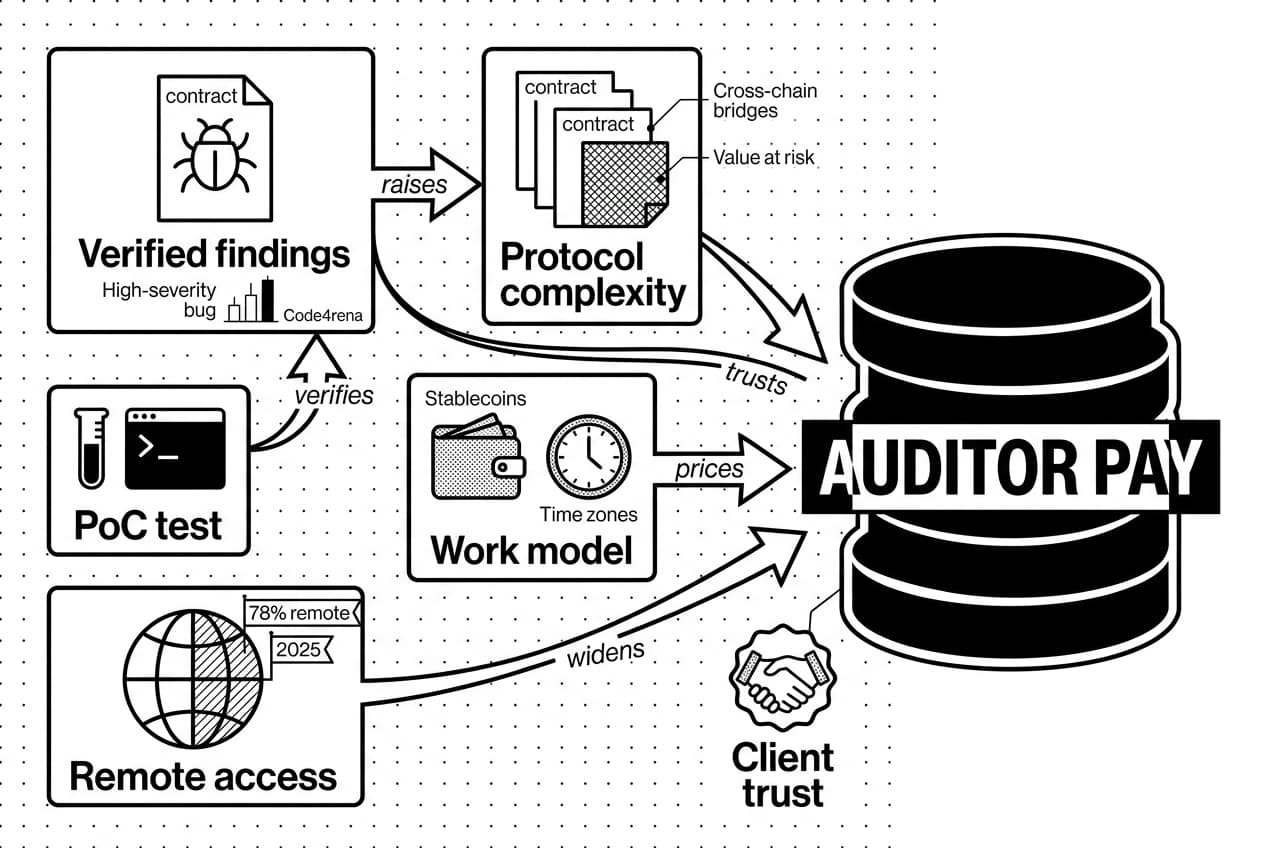
Two auditors with the same title can earn very different amounts. The difference usually comes from verified findings, specialization, client trust, location, work model, and the value at risk in the systems they audit.
Experience and verified findings
Years of experience help, but verified findings move pay faster. A public high-severity bug in a real protocol tells a hiring manager that you can reason under uncertainty and produce useful evidence.
As a working rule, one strong public finding with a proof-of-concept test can be more persuasive than months of private study. Contest platforms such as Code4rena timestamp results and make your work easier to verify.
Location and remote work
Smart contract auditing is highly remote-friendly. Many firms pay in US dollars or stablecoins and hire across regions, although local employment laws and time-zone expectations still matter.
Remote access changes the salary math. Web3.career reported that about 78% of smart contract security roles posted in 2025 were remote or remote-first (Web3.career, 2025). That gives skilled candidates outside high-cost cities more access to global pay bands.
Specialization and protocol complexity
Not all contracts carry the same risk. A simple token review is easier than a cross-chain bridge, a lending market, or a rollup-related system. Pay tends to rise with complexity because mistakes are more expensive.
- Cross-chain bridges: Large attack surface and severe failure modes.
- Account abstraction: Newer patterns and fewer deeply experienced reviewers.
- Layer 2 and rollup systems: Custom assumptions around sequencing, proofs, and upgrades.
- MEV-aware protocols: Requires understanding mempool behavior and transaction ordering.
- Oracle integrations: Sergey Nazarov, co-founder at the official Chainlink site, has repeatedly highlighted oracle security as a major DeFi risk area.
- Upgradeable systems: Proxy patterns create storage and initialization risks that beginners often miss.
If you are choosing a niche, review the DeFi protocols by TVL. High-value protocol categories often have the strongest audit demand.
Use the complexity compensation ladder as your planning framework: learn one additional high-risk system at a time, publish a focused writeup, then seek work that uses that new skill. Do not claim bridge expertise after reading one article. Build evidence first.
Step 1: learn Solidity, the EVM, and DeFi basics
Your first action is to become comfortable enough with Solidity that a 2,000-line repository no longer feels unreadable. You do not need to be a perfect developer, but you do need to understand what the developer intended.
Build small contracts before auditing large ones
Start with contracts you can understand in one sitting. Write an ERC-20-style token, a vesting contract, a simple staking contract, and a small lending pool. Then write tests that try to break your own assumptions.
Two useful practice projects are to build a token vesting contract in Solidity and study Solidity ABI encoding and decoding. Vesting teaches time-based edge cases. ABI work teaches calldata and low-level interaction mistakes.
Contract type | Skill it builds | Bug category to watch |
|---|---|---|
ERC-20-style token | Storage and allowances | Approval races and bad math |
Token vesting | Time logic | Early claims and rounding |
Role-based access | Permission checks | Privilege escalation |
Staking contract | Reward accounting | Reentrancy and reward inflation |
Simple lending pool | Collateral logic | Oracle and liquidation errors |
Pro tip: learn how protocols fail economically
Some of the worst DeFi losses were not simple syntax mistakes. They were incentive and accounting failures that passed normal tests.
The Euler exploit in March 2023 drained about $197 million (Immunefi, March 2023) by abusing donation mechanics and a missing health check. That case is worth studying because the lesson is economic reasoning, not only Solidity syntax.
For every contract you write, ask one question: what could an attacker do with a large flash loan, perfect timing, and no interest in being polite? That question will train the mindset that raises your value.
Step 2: practice auditing with tools, checklists, and public reports
After you can build small contracts, start practicing the audit workflow. Your goal is to move from reading vulnerability explanations to finding issues in unfamiliar code.
Use automated tools without depending on them
Start each practice audit by running static analyzers and tests. Slither can flag common patterns quickly. Echidna and Foundry fuzz tests can break invariants that normal unit tests miss.
Pair your tests with a smart contract CI/CD testing workflow so regressions are caught on every commit. Tools are a first pass, not the final verdict. They rarely understand business logic, incentives, or protocol-specific accounting rules.
Create your personal audit checklist
Professional auditors do not rely on memory. Build a checklist and update it after every practice report.
- Access control: Who can call privileged functions?
- Accounting: Are balances updated before external calls?
- External calls: Are return values checked and reentrancy risks controlled?
- Upgrade safety: Is storage layout preserved and initialization protected?
- Token assumptions: Does the code assume 18 decimals or standard transfer behavior?
- Oracle dependencies: Can prices be stale, manipulated, or zero?
- Emergency controls: Can pausing or admin action create a new failure path?
Read public reports from reputable security firms and contest platforms. Each report will add one more pattern to your checklist.
Warning: don't submit vague findings
Common mistake: Submitting a finding that says a function may be vulnerable without proof. Judges and clients often reject that because they cannot reproduce the issue.
Every finding should include impact, likelihood, affected code, reproduction steps, and a mitigation. Trail of Bits states that it has worked on more than 1,000 security assessments and related projects (Trail of Bits blog, 2025), and public reports from mature firms show the same pattern: clear evidence beats dramatic wording.
Step 3: build a portfolio that proves you can find real issues
Your portfolio is the bridge between learning and paid work. A claim on a resume is easy to ignore. A repository with a working exploit test, a clear report, and a remediation note is much harder to dismiss.
Portfolio assets hiring teams actually trust
The assets below are the ones reviewers can verify quickly. Build them in public whenever the rules of the contest or program allow it.
- Proof-of-concept tests: Foundry or Hardhat tests that reproduce a vulnerability from start to finish.
- Audit writeups: Reports with scope, severity, affected code, reasoning, and fixes.
- CTF results: Solved security challenges with step-by-step explanations.
- Contest placements: Public results from Code4rena, Sherlock, Cantina, or similar platforms.
- GitHub repositories: Organized code, tests, and notes that a reviewer can run locally.
- Remediation notes: Clear fixes with trade-offs, not only attack descriptions.
How many projects should you show?
Do not chase volume. Three deep examples beat twenty shallow summaries. A strong writeup explains what you checked first, what tools you ran, what looked suspicious, how you confirmed the issue, and how you would fix it.
Use the depth over breadth portfolio rule: one high-quality finding with a working proof of concept and a remediation note is worth more than ten informational notes with no supporting code.
Start with one CTF writeup, one self-directed audit of a small open-source contract, and one contest submission. That three-piece foundation is enough to begin applying for junior roles or small freelance reviews.
Step 4: find smart contract auditor jobs, clients, and extra income
Once your portfolio shows real evidence, job searching becomes more direct. You are no longer asking someone to trust your interest. You are pointing them to work they can inspect.
Where to look for full-time auditor roles
Start with crypto-native job boards such as Web3.career and CryptoJobsList. Also check the careers pages of audit firms and protocol security teams. To land a remote Web3 job, treat community channels as early signal sources because roles often appear there before job boards.
Direct outreach can work if it is specific. Send a short message with one public finding, the affected pattern, and the type of review you want to do. Avoid generic pitches that could be sent to any firm.
Additional income options for smart contract auditors
Full-time employment is not the only path. These income streams can supplement a salary, and senior independent auditors may combine several of them.
Income stream | Platform or channel | Realistic earning range in 2026 |
|---|---|---|
Audit contests | Code4rena, Sherlock, Cantina | $500 to $50,000+ per contest, based on public prize pools in January 2026 |
Bug bounties | Immunefi | $1,000 to $1,000,000+ per valid report, based on Immunefi program pages in January 2026 |
Private reviews | Direct client outreach | $150 to $400 per hour, based on public freelance security listings in January 2026 |
Security training | Courses and workshops | $2,000 to $15,000 per cohort, based on public course pricing in January 2026 |
Technical writing | Protocol blogs | $200 to $800 per article, based on Web3 writing listings in January 2026 |
Retainer consulting | Protocol security committees | $3,000 to $10,000 per month, based on public contributor proposals in January 2026 |
How to evaluate an offer
Do not evaluate an offer by base salary alone. Use this six-layer offer test before you sign.
- Base pay: Compare it with the level ranges in this guide.
- Token pay: Check vesting, cliff, liquidity, and tax treatment.
- Workload: Ask how many audits you will review each month.
- Legal exposure: Read liability, indemnity, and confidentiality terms.
- Learning support: Confirm whether senior reviewers will mentor you.
- Side work rules: Check whether freelance work is allowed.
A $180,000 base can be safer than a $120,000 base plus $80,000 in illiquid tokens with a long cliff. If you do not understand a compensation term, ask before signing.
Summary and next steps: your 90-day smart contract auditor roadmap
You now know what drives smart contract auditor salary, how to become smart contract auditor job-ready, and which portfolio assets matter most. The next step is to turn the plan into scheduled work.
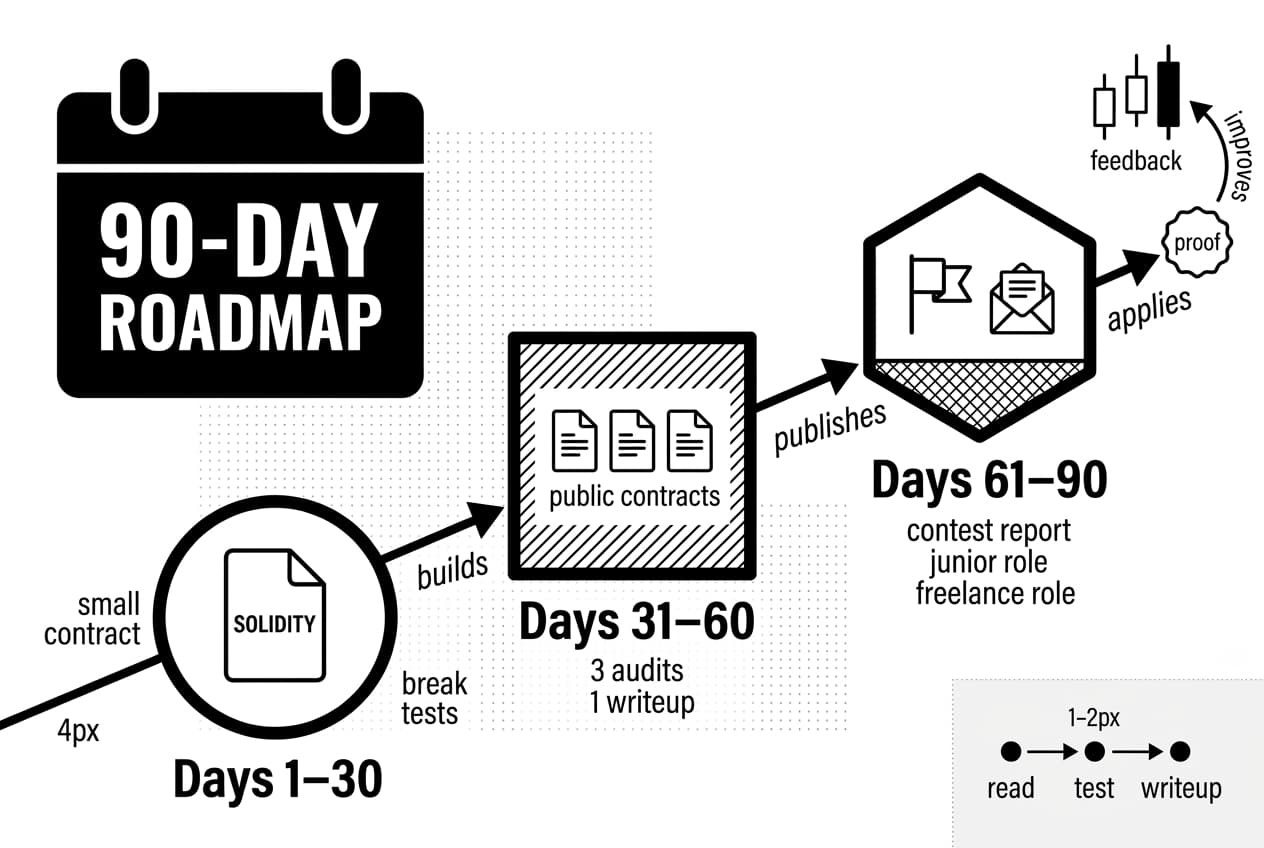
- Days 1 to 30: Build one small Solidity contract and write tests that try to break it.
- Days 31 to 60: Audit three small public contracts and publish one detailed writeup.
- Days 61 to 90: Submit one contest or bounty report and apply to one junior or freelance role.
The path rewards visible output. You do not need permission to start. Pick a small contract today, read it carefully, write down one possible failure mode, and turn that note into your first public writeup.
Your next action
Open one small Solidity repository and run its tests. Then add one adversarial test of your own. Even if the test does not reveal a bug, the exercise teaches you how auditors think.
The auditors who progress fastest are not always the people who studied longest. They are the people who published clear work, accepted feedback, and improved their proof with each review.
Frequently Asked Questions
- What is a smart contract auditor?
- A smart contract auditor is a security professional who reviews blockchain code before it goes live. The work involves manual code review, automated testing, exploit simulation, and detailed written reports. The role blends software engineering, cybersecurity, and blockchain-specific risk analysis to catch vulnerabilities before real funds are at stake.
- How much does a smart contract auditor make?
- Compensation varies widely based on experience, location, and employment model. Full-time roles at established firms can range from $120,000 to over $300,000 annually. Independent auditors earn additional income through bug bounties, audit contest prizes, and token grants. Auditors with a public record of critical findings consistently command higher rates.
- How much do contract auditors make?
- Traditional contract auditors who review financial, legal, or compliance documents operate in a different market from smart contract auditors. Their salaries reflect corporate audit experience, not blockchain security expertise. Smart contract auditors typically earn more because the technical skill set is rarer and the consequences of missed vulnerabilities are immediate and financial.
- Which auditor has the highest salary?
- The highest-paid auditors are usually senior security engineers, lead auditors, and independent specialists with verified critical findings on high-value protocols. DeFi, bridge, and cross-chain auditors working on systems with large total value locked often earn the most, since technical risk, protocol complexity, and proven expertise all drive compensation upward.
- What is a smart contract audit?
- A smart contract audit is a structured security review covering code, test coverage, architecture, and economic assumptions. The goal is identifying vulnerabilities before deployment or an upgrade. Auditors deliver a report with categorized findings, severity ratings, proof-of-concept examples, and clear remediation recommendations the development team can act on directly.
- How much does it cost to audit a smart contract?
- Audit pricing depends on codebase size, complexity, urgency, and auditor reputation. A straightforward token contract may cost a few thousand dollars, while a lending protocol, bridge, or custom DeFi system can run into six figures. Lower-cost options exist, but they may not provide the depth needed to catch sophisticated vulnerabilities.
- How much does a CIA auditor make?
- A Certified Internal Auditor follows a different career path entirely. CIA compensation is tied to corporate audit, risk management, and compliance experience within traditional organizations. Smart contract auditor salary is driven by blockchain security expertise and a track record of finding real vulnerabilities, making direct salary comparisons between the two roles misleading.
Sources
Author

Crypto analyst and blockchain educator with over 8 years of experience in the digital asset space. Former fintech consultant at a major Wall Street firm turned full-time crypto journalist. Specializes in DeFi, tokenomics, and blockchain technology. His writing breaks down complex cryptocurrency concepts into actionable insights for both beginners and seasoned investors.