Front Running Prevention for Smart Contract Developers 2026
Front running prevention for smart contract developers in 2026
This guide shows you how to turn MEV theory into a practical workflow you can run before launch. You will map where your smart contract exposes value, choose contract-level safeguards, test them with adversarial simulations, and document the tradeoffs your users need to understand.
What you will build: A practical front running prevention workflow
Front running prevention is the practice of designing smart contracts, transaction flows, and economic rules so mempool visibility cannot be turned into profit through transaction ordering. The goal is to reduce MEV by hiding sensitive intent, bounding execution, and removing incentives for bots, builders, validators, or competing users to reorder your transaction.
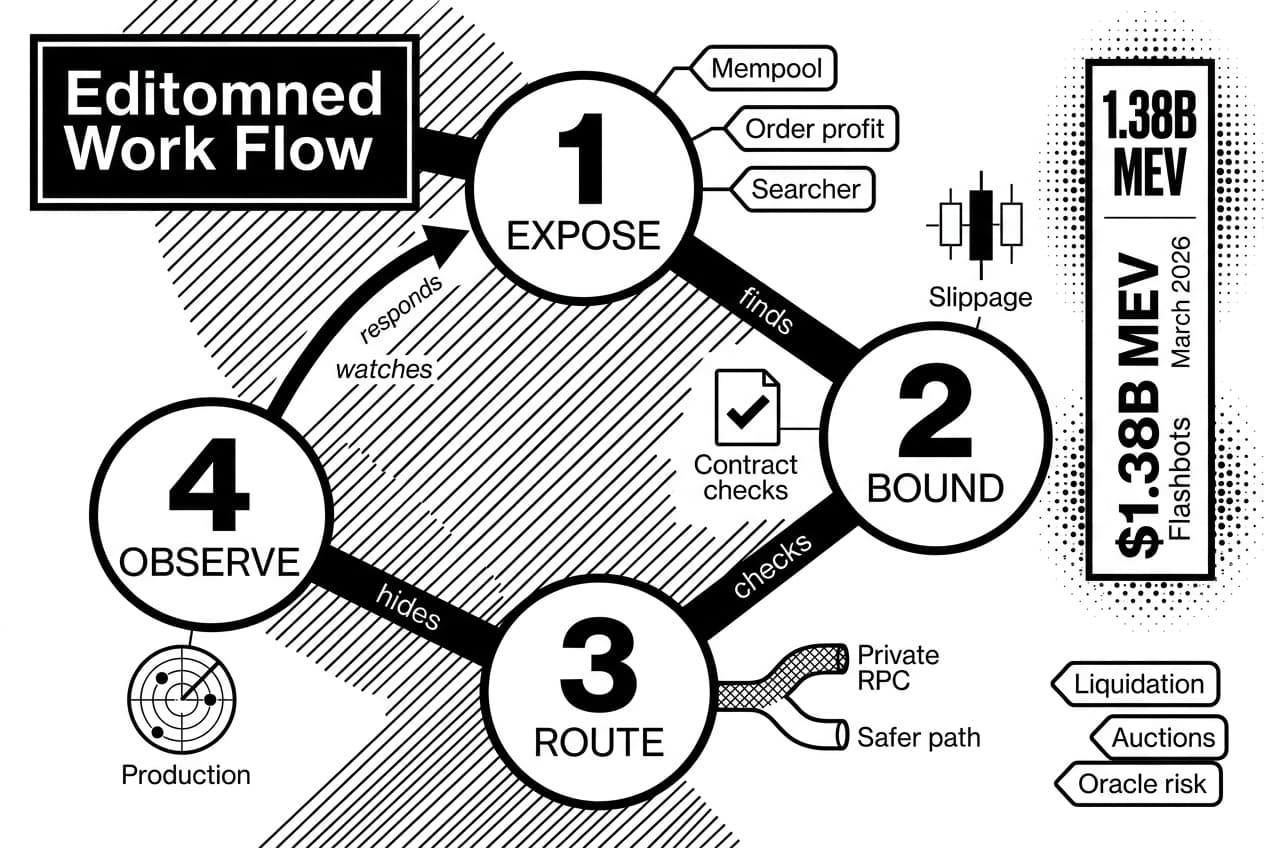
The workflow in this article is called Expose-Bound-Route-Observe. First, you expose the parts of your protocol where ordering creates profit. Then you bound execution with contract checks. Next, you route sensitive transactions through safer architecture. Finally, you observe production behavior and respond when extraction appears.
As of $1.38 billion in cumulative Ethereum MEV was tracked by the flashbots explorer in March 2026, front-running is not a rare edge case. Treat it as part of your protocol design, not as a wallet setting you can add later.
Vitalik Buterin, co-founder of the Ethereum Foundation, has repeatedly framed MEV as a structural transaction-ordering problem rather than a simple gas-price problem. That view matters for developers: a private RPC helps, but it cannot fix a liquidation rule, auction design, or oracle dependency that creates free value for searchers.
Who this guide is for
This guide is for Solidity developers, smart contract auditors, protocol founders, and DeFi engineers building systems where transaction order changes outcomes. It applies to swap routers, NFT mints, auctions, lending markets, liquidation engines, staking contracts, and games with on-chain reveals.
What changes in 2026
Common advice treats front-running prevention as a short checklist: add commit-reveal, send through a private endpoint, and set slippage. Those tools are useful, but the bigger risk is often application-level economics. If a function creates a predictable profit when called before or after another transaction, someone will try to capture it.
The practical target for a MEV protection smart contract is not zero MEV. The target is smaller extractable value, clearer execution limits, safer order routing, and monitoring that catches live patterns before they become protocol incidents.
Prerequisites: What you need before you defend against MEV
Before you write protection code, set up tools that let you reproduce ordering attacks. If you cannot simulate a sandwich, back-run, or replay attempt locally, you cannot prove your mitigation works.
Developer tools
- Foundry or Hardhat: Use Foundry for fast fuzzing, invariant tests, and mainnet forks. Use Hardhat if your team already depends on a JavaScript test stack.
- Archive RPC access: Alchemy or Infura archive endpoints let you pin a mainnet block and replay real liquidity conditions.
- Block explorer access: Etherscan and EigenPhi help you inspect sandwich clusters, arbitrage paths, and liquidation races.
- Mempool visibility: A pending-transaction viewer is useful for learning what searchers can see, but do not depend on it as your only test method.
Remix is fine for a quick syntax check. It is not enough for production MEV testing because it lacks realistic fork simulation and adversarial order control.
Concepts to understand first
- Mempool: The public waiting area where transactions sit before inclusion. Standard wallet submissions expose calldata before execution.
- Priority fees: After EIP-1559 went live in August 2021, users pay a base fee plus a tip. Searchers can bid a higher tip to land first.
- Builders and validators: Builders assemble blocks and validators propose them. Private orderflow changes where transactions are seen, not whether economic incentives exist.
- AMM slippage: Automated market makers change price as trade size moves pool balances. Loose slippage creates room for sandwich profit.
- Oracle timing: If settlement depends on a price feed, the order of oracle updates and user actions can change who wins.
Warning: Do not start with commit-reveal code before you know what value an attacker can extract. First list the functions, the exposed signal, the attacker action, and the user or protocol harm. Code that protects the wrong surface gives you false confidence.
Step 1: map where your contract exposes value
Your first action is to inventory every public or external function that moves value, updates price-sensitive state, or gives someone a claim. Read your code as a searcher would: if this transaction appears before execution, what can be copied, beaten, delayed, or followed?
Identify publicly profitable transactions
For each function, ask one question: if a bot sees this calldata in the mempool, what profitable action can it take? The answer usually falls into a small set of patterns: buy first, sell first, sandwich, copy calldata, trigger a liquidation, or trade around an oracle update.
Swaps are obvious, but they are not the whole surface. Fixed-price mints expose scarce allocation. Dutch auctions expose a user’s acceptable price. Deposits and withdrawals reveal portfolio changes. Governance execution can expose a pending parameter change before the new rule applies.
Separate user harm from protocol harm
User-level harm makes one transaction worse. A sandwich attack gives the user a worse swap price while the protocol continues to function.
Protocol-level harm can break system assumptions. Oracle manipulation, liquidation ordering, and stale price settlement can push a lending market or vault into losses. Prioritize protocol-level harm first because it can become insolvency, not just poor execution.
Use this working threat dataset
The table below is a six-row starter dataset for your review. Copy it into your threat model, replace the functions with your own, and score impact from 1 to 5. This small dataset gives your team a repeatable baseline rather than a loose discussion.
Function | Exposed signal | Likely attacker action | User impact | Protocol impact | First mitigation |
|---|---|---|---|---|---|
swap() | Pair, size, slippage | Sandwich | High | Low | Slippage, deadline, private routing |
mint() | Fixed price, scarce supply | Priority gas race | Medium | Low | Commit-reveal or randomized allocation |
liquidate() | Visible unhealthy position | Liquidation race | Low | High | Partial liquidation caps or auction |
updateOracle() | Incoming price change | Trade before settlement | Medium | High | TWAP and freshness checks |
claim() | Reward parameters | Calldata copy | High | Medium | Signatures, nonces, sender binding |
executeProposal() | Known parameter update | Trade around rule change | Low | Medium | Delay, rate limit, staged activation |
Sergey Nazarov, co-founder of Chainlink Labs, has often argued that reliable oracle design is a security dependency, not a convenience feature. Apply that mindset to every row in the table: if external state affects value, ordering around that state is part of your threat model.
Step 2: understand the main types of front-running attacks
You can now connect each exposed function to a specific attack type. Early academic work measured $18.7 million in miner extractable value in a 2019 Ethereum study, and production MEV has grown far beyond that early sample. The pattern matters because each defense blocks a different path.
Main attack categories:
- Classic front-running: the attacker copies or competes with your transaction and pays to execute first.
- Sandwich attacks: the attacker trades before and after your swap to capture price movement.
- Back-running: the attacker profits immediately after your transaction changes state.
- Liquidation MEV: bots race to capture liquidation bonuses from unhealthy positions.
- Oracle manipulation: an attacker moves or times a price source before settlement.
- Copy-trading: a bot replays calldata with changed recipient or sender assumptions.
Classic front-running
A classic front-run starts when your transaction reaches the public mempool. A bot reads the calldata, builds a competing transaction, and bids a higher priority fee. Your transaction then executes in a changed state or reverts.
The bot does not need private information. Public calldata and faster transaction submission are enough. Your defense is to remove the profit, hide the intent, or make execution fail unless the user’s exact bounds still hold.
Sandwich attacks
Sandwich attacks target AMM swaps. If you understand how liquidity pools work, you already know why: a trade moves the pool price along a curve. The attacker buys before your trade and sells after it.
Loose slippage gives the attacker room to move price while keeping your trade valid. Thin liquidity increases price impact. Hayden Adams, founder of Uniswap Labs, has publicly emphasized user-controlled slippage as a key defense because the contract cannot know each user’s acceptable execution price.
Back-running and liquidation MEV
Back-running does not need to beat you. The attacker waits for your transaction to change state, then executes the next profitable action. Common examples include arbitrage after a large swap and liquidation after a price update.
Liquidation MEV is especially sensitive because it can affect protocol solvency. If the design rewards the first caller without considering fairness, gas races decide who captures collateral and which positions are cleared first.
Copy-trading and function cloning
Copy-trading targets functions that accept external parameters too freely. A bot can read your calldata, replace a recipient field, and submit the modified transaction with a higher fee.
Bind eligibility to the signer or sender. Do not trust a user-supplied recipient for reward ownership unless the signed intent and nonce prove that recipient was authorized.
Step 3: add contract-level guards for front running prevention
This step turns the threat model into code-level controls. Choose guards based on the function’s risk, transaction frequency, and user experience cost. Do not add every pattern everywhere.
Use slippage, deadlines, and minimum output checks
Every swap or price-sensitive function should accept explicit bounds such as minAmountOut, maxAmountIn, and deadline. Revert when the output, input, or timestamp falls outside the user’s signed intent.
Warning: Never default minAmountOut to 0. That turns the user’s transaction into a free option for searchers. Deadlines also matter because a transaction that sits pending for a long time may execute against stale market conditions.
Apply commit-reveal only when it fits
Commit-reveal splits sensitive actions into two phases. The user first submits a hash of the action, then later reveals the real parameters. Searchers cannot easily front-run parameters they cannot read.
The cost is two transactions, extra latency, and reveal-phase griefing risk. Use commit-reveal for high-value, lower-frequency actions such as sealed auctions, NFT mints, and governance votes. Avoid it for routine AMM swaps unless the UX cost is acceptable.
Batch or auction orders instead of first-come execution
First-come execution rewards gas bidding. Batch auctions collect orders over a fixed window and clear them at a shared price, which removes most benefit from jumping ahead inside the batch.
The CoW protocol has used batch-style settlement since March 2021, according to its public launch history. This design adds latency, but it can be a better fit for auctions, token launches, and low-liquidity markets where ordering fairness matters more than instant execution.
Protect oracles and price-sensitive functions
Use time-weighted prices, freshness checks, liquidity thresholds, and circuit breakers for settlement logic. A spot price from one thin pool is not enough for lending, derivatives, or high-value mint pricing.
For Chainlink-style feeds, check the returned timestamp and reject stale data. For AMM-derived prices, prefer a time-weighted average and set a minimum observation window that matches your market’s liquidity and volatility.
Avoid sender and calldata copy pitfalls
Attackers can copy calldata directly once it appears in the mempool. Understanding Solidity ABI encoding and calldata helps you see exactly what a bot can replay.
Use EIP-712 typed signatures with domain separation, chain ID, contract address, expiry, and incrementing nonces. Pair this with smart contract access control so only authorized callers can reach sensitive functions.
Mitigation pattern quick reference
Mitigation pattern | Best use case | Benefit | Drawback | Developer warning |
|---|---|---|---|---|
Slippage checks | AMM swaps and liquidity moves | Caps sandwich profit | Users need realistic bounds | Never set minimum output to zero |
Deadlines | Any time-sensitive action | Blocks stale execution | Transactions can expire | Use user-supplied deadlines, not hidden defaults |
Commit-reveal | Auctions, mints, votes | Hides intent before reveal | Two transactions and griefing risk | Design the reveal phase before launch |
Batch auctions | Token launches and order settlement | Reduces gas-priority races | Adds latency | Publish exact batch window rules |
TWAP oracles | Lending, vaults, derivatives | Resists single-block price moves | Lags spot price | Always check data freshness |
Signatures with nonces | Claims, permits, meta-transactions | Stops replayed calldata | Adds offchain signing | Include chain ID and contract address |
Private routing | High-value transactions | Reduces public mempool exposure | Relies on relay behavior | Build a public fallback with tight bounds |
Use the guard-fit test before adding a pattern: does it match transaction frequency, does the UX cost make sense, and does it add a new attack surface? If one answer is no, adjust the design before writing code.
Step 4: choose an MEV protection smart contract architecture
Contract guards reduce damage, but architecture decides how intent reaches block builders. Your choice should follow the threat table from Step 1, not a generic preference for private routing or batching.
Route sensitive transactions privately
Private RPCs submit transactions directly to participating builders rather than the public mempool. The flashbots private RPC went live for Ethereum users in January 2022, according to flashbots writings, and similar protected routes are now common in wallets and trading interfaces.
You can pair private routing with gasless transactions and relayers so users do not need to change wallet settings manually. Still, private routing only reduces visibility. It does not guarantee inclusion, fairness, or zero extraction.
Warning: Always design a fallback. If private submission is not included within your chosen block window, resubmit through a secondary route or public mempool with stricter slippage and a fresh deadline.
Use intents and solvers carefully
Intent-based systems let users sign the outcome they want, such as receiving at least a minimum amount, while solvers compete to execute it. This can move execution risk away from users and toward professional fillers.
The risk is solver concentration. If only one solver regularly wins, you have not removed extraction; you have changed who captures it. Require transparent scoring, open participation rules, and on-chain settlement checks where possible.
Consider sequencing or batch settlement
Some protocols should avoid raw block ordering for core settlement. Batch auctions, app-specific sequencing, or rollup-level ordering rules can reduce gas-priority games.
Use the sequence-price-settle rule: define ordering first, price discovery second, and settlement third. If you design settlement first, you may accidentally create a profitable ordering gap. Review the privacy tradeoffs in Ethereum privacy solutions before hiding user intent.
Pro tip: Test three architecture failures before mainnet: failed private submission, delayed inclusion, and reorg reversal. A transaction that looks accepted by one route may still fail to settle safely.
Step 5: test your MEV defenses with simulations
A mitigation you have not tested is only a hypothesis. Your test suite should prove that attackers cannot profit from the sequences you identified in Step 1.
Write an attacker contract
Create a test contract that can call before, after, or around a victim transaction. Measure the attacker’s token balance before and after the sequence. If the attacker profits while the victim loses value outside declared bounds, the defense failed.
A minimal test assertion is simple: attacker profit must be zero or negative after gas-adjusted execution, and protocol invariants must still hold. Use clear names such as test_sandwich_reverts_when_minOut_is_tight().
Run mainnet fork scenarios
Mock tests miss thin liquidity, stale feeds, and gas pressure. Use Foundry or Hardhat to fork a specific Ethereum block and run the attacker contract against live pool and oracle state.
Pin the block number in CI so results are reproducible. A fork test that passes today but depends on moving state will become noise next week.
Check economic invariants, not just reverts
Passing revert tests is not enough. Add invariant tests for economic rules that must always hold:
- No user receives less than their declared
minAmountOut. - No trade settles against stale oracle data.
- No reward can be claimed twice for one qualifying event.
- No copied calldata can redirect a user-owned claim.
- No attacker sequence can increase attacker balance by taking value outside user-approved bounds.
Use the three-layer invariant check: state correctness, price correctness, and value correctness. All three must pass before deployment.
Keep a reproducible test transcript
Store a short transcript in your repository for each attack class. For example:
scenario: sandwich_swap_minOut
action 1: attacker buys before victim
action 2: victim swap executes with minAmountOut
action 3: attacker sells after victim
expected: victim receives at least minAmountOut
expected: attacker profit is not positivestatus: pass on pinned fork block
This is not a substitute for tests. It is evidence that reviewers, auditors, and future maintainers can follow without guessing what the test intended to prove.
Integrate MEV tests into CI/CD
Add attacker tests, fork tests, and invariants to your build pipeline. For setup details, see automated smart contract testing and deployment.
Fail the build if an attacker balance increases from a protected path, if a fuzz run finds a counterexample, or if a fork scenario behaves differently from the saved transcript. Treat MEV regressions as security regressions.
Step 6: monitor, respond, and document tradeoffs after deployment
Deployment is not the end of front running prevention. Searchers scan new contracts quickly, and your monitoring should tell you when expected behavior changes.
Track MEV symptoms
Set up blockchain transaction monitoring alerts for patterns that match your threat table:
- Same-block buy and sell patterns around your pool.
- Repeated reverts from the same addresses near user transactions.
- Price impact spikes that still pass user slippage checks.
- Abnormally high priority fees around your functions.
- Unusual builder concentration for blocks that include your calls.
Use EigenPhi, Tenderly, Forta, custom indexers, or your own event pipeline. The tool matters less than having threshold alerts before users report losses.
Prepare a response plan
- Pause risky functions if a guardian role or circuit breaker exists.
- Tighten parameters such as max trade size, oracle freshness, or slippage defaults.
- Rotate relayers if private orderflow appears delayed or unreliable.
- Patch upgradeable settings through the documented governance path.
- Publish a user notice within 72 hours when funds, execution quality, or assumptions changed.
Be specific in the notice. Tell users which functions were affected, what changed, and what settings they should use until the issue is closed.
Document known limitations
Your README or security page should say what you mitigated and what remains. Use a table like this:
Threat | Status | User action |
|---|---|---|
Sandwich attacks on swaps | Mitigated with slippage checks and optional private routing | Use tight slippage for large trades |
Oracle manipulation | Partially mitigated with TWAP and freshness checks | No manual action |
Calldata replay | Mitigated with signatures and nonces | Do not sign unknown messages |
Private route failure | Not fully preventable | Watch wallet status and retry if needed |
Honest documentation reduces support load and helps users choose safe defaults. It also gives auditors a clear record of design intent.
Regulatory and ethical context: Is MEV good or bad?
MEV is not one thing. Some extraction is harmful to users, while some activity keeps markets functioning. Developers should explain which type their system permits and which type it tries to reduce.
Front-running vs insider trading
Front-running means acting ahead of a known or observable order. In crypto, that order is often visible because it sits in the public mempool. Insider trading usually means trading on material nonpublic information in a regulated market.
The categories can feel close to users even when the legal treatment differs. This guide is technical guidance, not legal advice. If your protocol serves regulated users or securities-like assets, speak with qualified counsel before launch.
Vitalik Buterin, co-founder of the Ethereum Foundation, has described harmful MEV as a hidden tax on users, while recognizing that arbitrage and liquidations can support market health. That distinction is useful: reduce extraction that harms ordinary users, but avoid breaking mechanisms that keep prices aligned and loans solvent.
Why developers should care about market integrity
Users often react to MEV losses as unfair execution, not as normal market behavior. That makes front-running prevention a trust problem as much as a technical problem.
Regulatory attention around crypto market structure increased after the SEC’s October 2022 crypto-asset promotion enforcement announcement and continued as MiCA and FCA crypto rules developed. Even when MEV is not illegal, repeated user harm can create reputational and compliance risk.
Summary and next steps
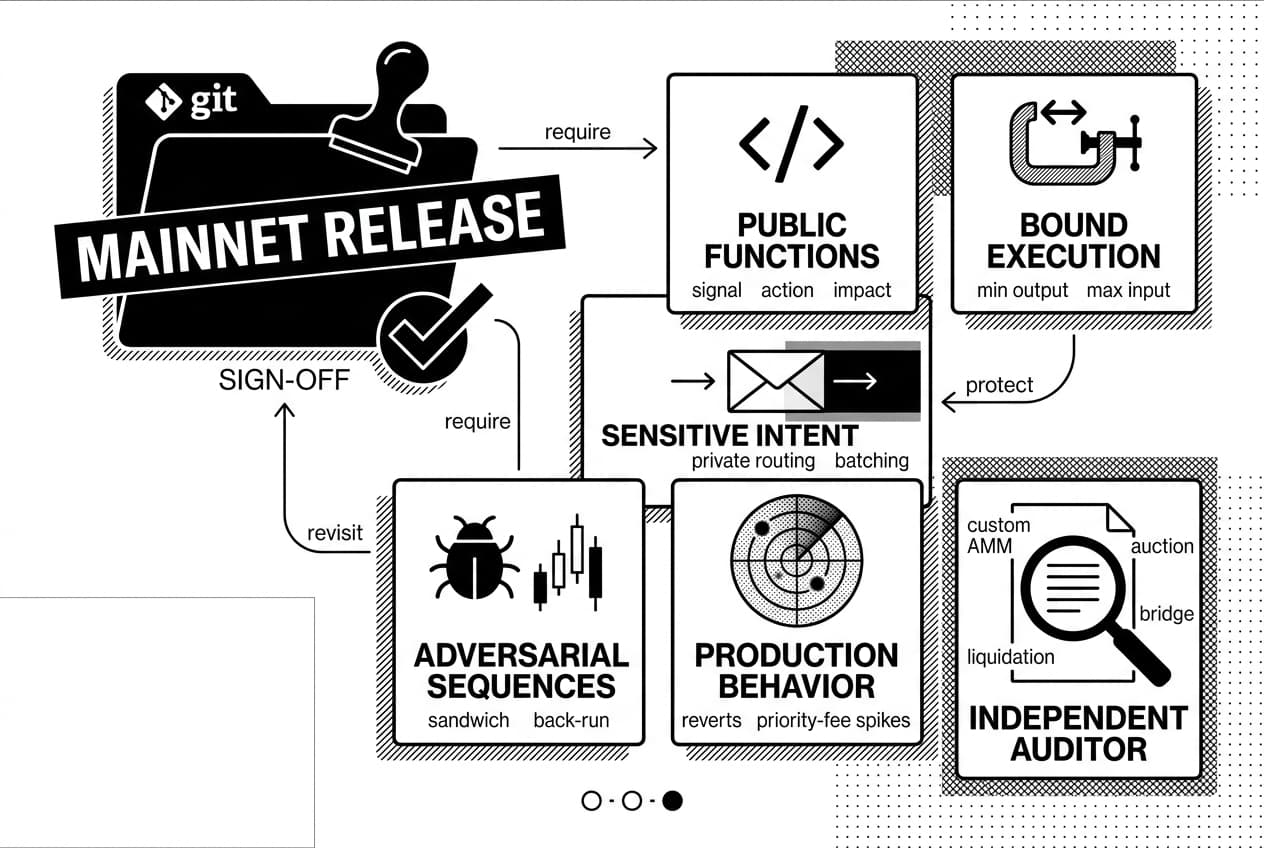
You now have a developer workflow for front-running prevention: expose value, bound execution, route sensitive intent, test adversarial sequences, and observe production behavior. Keep the checklist below in your repository and require sign-off before each mainnet release.
Developer checklist
- List every public value-moving function. Add exposed signal, attacker action, and impact.
- Add slippage limits. Require user-supplied minimum output or maximum input.
- Add deadlines. Reject stale transactions with explicit timestamp checks.
- Evaluate commit-reveal. Use it for auctions, mints, and votes when the UX cost is justified.
- Audit oracle usage. Check freshness, liquidity, and manipulation resistance.
- Bind signatures to nonces. Include chain ID, contract address, expiry, and recipient.
- Run fork simulations. Test sandwich, back-run, liquidation, and calldata-copy sequences.
- Choose routing architecture. Document whether you use private routing, batching, intents, or public mempool fallback.
- Set monitoring alerts. Track reverts, same-block patterns, priority-fee spikes, and abnormal slippage.
- Document tradeoffs. Tell users and auditors what is protected and what is not.
Revisit the checklist whenever you add a function, change an oracle, update routing, or alter incentives. MEV protection is not a one-time task. It is part of maintaining a safe protocol.
When to bring in an auditor
Bring in an independent auditor if your protocol has a custom AMM, liquidation engine, auction, bridge, upgradeable vault, or expected total value locked above $1 million in the first month. Internal review is helpful, but ordering bugs often sit between code correctness and economic design.
Schedule the audit when features are complete but before the launch date is fixed. Give your team at least two weeks to respond to findings, update tests, and rerun fork simulations.
Frequently Asked Questions
- What is frontrunning in crypto?
- Crypto front-running is a transaction-ordering attack where someone observes a pending transaction in the public mempool and submits their own transaction first by bidding higher gas fees. Bots target DEX trades, NFT mints, and liquidations this way. Smart contract developers must explicitly design around transaction-order dependence to protect users.
- What is frontrunning?
- In traditional finance, front-running means trading ahead of a known incoming order to profit from the price movement it causes. In crypto, public mempools and programmable execution make this automated. Bots and MEV infrastructure can detect pending transactions and act before them, often within milliseconds, at scale.
- What's the difference between front-running and insider trading?
- Front-running typically involves acting ahead of an observable or known order, while insider trading involves material nonpublic information unavailable to the market. The legal treatment of each varies by jurisdiction and market context. This article provides technical developer guidance only and should not be read as legal or compliance advice.
- Should I enable MEV protection?
- For most users submitting swaps or price-sensitive transactions, yes. MEV protection reduces public mempool exposure and limits sandwich attacks. However, it can affect transaction inclusion speed, routing, and execution guarantees. Developers should implement safe defaults and design clear fallback behavior so users are never left in an ambiguous state.
- How to check if a smart contract is legit?
- Review verified source code, published audits, access controls, admin key custody, upgradeability mechanisms, oracle design, and test coverage. Transaction history and community reputation also matter. Keep in mind that legitimacy and MEV safety are separate concerns — even well-intentioned, honest contracts can contain exploitable transaction-ordering vulnerabilities.
- What are the downsides of smart contracts?
- Smart contracts carry risks including immutability, undiscovered bugs, oracle dependence, upgrade complexity, variable gas costs, composability failures, and transaction-ordering attacks like front-running and MEV extraction. Careful design, thorough testing, continuous monitoring, and independent audits reduce these risks meaningfully, but no combination of measures eliminates them entirely.
- Is MEV good or bad?
- MEV is genuinely mixed. Sandwich attacks and harmful ordering extract value directly from users and are difficult to justify. Arbitrage and timely liquidations, however, help keep markets efficient and protocols solvent. The practical goal for developers is not eliminating all MEV, but designing systems that minimize harmful extraction while preserving beneficial activity.
Sources
Author

Crypto analyst and blockchain educator with over 8 years of experience in the digital asset space. Former fintech consultant at a major Wall Street firm turned full-time crypto journalist. Specializes in DeFi, tokenomics, and blockchain technology. His writing breaks down complex cryptocurrency concepts into actionable insights for both beginners and seasoned investors.