Build DAO Guide: Smart Contracts and Governance in 2026
Build DAO guide: smart contracts and governance in 2026
This guide shows you how to build DAO infrastructure as a working operating system, not as a token launch. You will define the mission, choose a legal and technical stack, deploy treasury and voting contracts, test the full proposal flow, and set post-launch metrics that tell you whether governance is actually working.
The contrarian rule is simple: start with reversible governance, treasury controls, and member accountability before you lock decisions into code. Tokens and voting contracts matter, but most early DAO problems come from weak coordination, low turnout, unclear authority, and poor security habits.
What you'll build: a DAO architecture in 2026
A DAO is a group that manages shared resources through agreed rules. Those rules live partly in smart contracts and partly in written process. Members propose actions, vote, and then a treasury or execution contract carries out the result.
Use the minimum viable governance model, or MVG, before you deploy anything permanent. MVG has four gates: purpose, custody, voting, and execution. You pass each gate only when the rule is written, tested, and understood by the people who must use it.
As of May 2026, the practical beginner stack is usually safe for treasury custody, snapshot for gasless signaling, tally or aragon for binding governance, and an L2 when vote cost matters. L2Beat listed $42.3 billion in Ethereum L2 value secured in April 2026 on L2Beat, which is why serious DAO teams now test L2 deployment before assuming mainnet is required.
DAO components at a glance
DAO component | Purpose | Common tool | Beginner option | Common mistake |
|---|---|---|---|---|
Treasury | Holds shared funds | safe | 3 signer safe on an L2 | One signer controls funds |
Off-chain voting | Runs gasless polls | snapshot | Token or allowlist strategy | Treating polls as automatic execution |
On-chain voting | Executes approved proposals | tally with a governor | Template deployment first | No timelock before execution |
No-code setup | Deploys without Solidity | aragon | Template DAO on an L2 | Skipping testnet rehearsal |
Operations | Coordinates people and work | Forum, docs, chat | Forum plus weekly notes | Confusing chat agreement with a vote |
What this guide will not do
This guide is educational. It is not legal, tax, investment, or security advice. DAO law is still uneven by jurisdiction. Wyoming's DAO supplement took effect on July 1, 2021, according to Wyoming SF0038, 2021, but many regions do not have an equivalent wrapper.
Legal risk also depends on token design, treasury activity, and member expectations. The SEC published its DAO report on July 25, 2017, warning that some token sales can fall under securities rules according to the SEC release, July 2017. Get qualified advice before raising funds or selling tokens.
Warning: Calling a project a DAO does not remove liability. If you pool funds, promise returns, or let anonymous voters control customer assets, you need a legal review before launch.
What you'll need before you build DAO contracts
Before you open a deployment app, write the operating rules. Your first deliverable is not a token. It is a one-page charter that says who can join, what they can decide, how money moves, and what happens in an emergency.
You do not need Solidity for a basic DAO. No-code tools can create a treasury and voting process. You do need Solidity knowledge, developer review, and an audit budget if you change governor logic, token minting, vesting, or execution rules.
What you need to build a DAO
- Mission: one sentence that says what the DAO exists to do.
- Members: a founding group that will vote, sign, and be accountable.
- Treasury wallet: a safe wallet created before funds move.
- Governance model: token voting, reputation voting, allowlist voting, or a hybrid.
- Chain: ethereum mainnet, arbitrum, optimism, base, polygon, or another network.
- Voting tool: snapshot for signaling, tally or aragon for execution.
- Security plan: hardware wallets, testnet rehearsal, signer backups, and audit budget.
Also add a compliance checkpoint. Membership and voting rights can create tax, securities, or crypto compliance and licensing considerations. Map those risks before your public launch page goes live.
Tools, wallets, and accounts
Set up signer wallets first. A browser wallet is fine for testing, but production signers should use hardware devices. Tell each signer to write down the exact account address they will use, then confirm it in a live call before you create the treasury.
In the safe app, click Create new account, choose the network, paste signer addresses, and set the threshold. A small DAO can start with 2 of 3 signers. A larger treasury should use 4 of 7 or 5 of 9 so one lost device cannot freeze operations.
Create accounts in snapshot, tally, aragon, and your forum tool. Save every contract address and admin role in a shared launch document. If a new member cannot find the treasury address in under 30 seconds, your operating system is too hard to use.
Budget, fees, and timeframes
Path | Typical timeframe | Rough cost range |
|---|---|---|
No-code setup | 1 day to 1 weekend | Gas plus setup time |
Safe plus snapshot | 2 to 4 hours | Usually low gas on an L2 |
Custom governor contracts | 2 to 8 weeks | Developer cost plus audit scope |
Professional audit | 2 to 8 weeks | Often the largest security cost |
Gas changes by network. L2Fees showed simple transfers under $0.05 on several L2 networks in May 2026 on L2Fees, while ethereum mainnet fees can be much higher during congestion. Start on an L2 unless your users and assets are already mainnet-native.
Vitalik Buterin, co-founder listed at ethereum.org, has repeatedly argued that governance quality depends on more than token-weighted voting. Treat that as a design warning. If your rules require constant participation from thousands of passive holders, the design will fail under normal human behavior.
Pro Tip: If you cannot afford a full audit yet, keep the first treasury small, use standard templates, and delay custom contracts. A limited launch is not failure. It is a safety pattern.
Step 1: define the DAO's purpose and governance model
Open a blank document and write the charter before touching code. Keep it short. Your goal is to remove ambiguity, not to impress people with legal language.
Answer six questions: what is the mission, who can join, what can members vote on, what is delegated to working groups, what can the treasury fund, and what makes a proposal valid. If founders disagree on any answer, pause deployment until the disagreement is resolved.
Nick Szabo, the computer scientist associated with the smart contract concept, framed smart contracts as promises embedded in code. For a DAO, the promise should be clear before it is encoded. Code cannot rescue a vague charter.
Choose membership: token, NFT, reputation, or allowlist
Membership type | Liquidity | Sybil resistance | Voter quality | Best use |
|---|---|---|---|---|
Liquid token | High | Low | Variable | Large open protocols |
Membership NFT | Medium | Medium | Medium | Clubs and creator communities |
Reputation | None | High | High | Contributor DAOs |
Allowlist | None | High | High | Early groups and committees |
Most beginner DAOs should start with allowlist or reputation voting, then add a token only after the member base has real participation. Liquid tokens are useful, but they also invite speculation, bribery, and low-information voting.
Warning: token voting can be captured
Warning: Token voting can be captured by whales, borrowed voting power, inactive delegation, and paid vote markets. Reduce that risk with quorum, delegation rules, address caps where lawful, a public discussion window, and a timelock before execution.
For a new DAO, use staged decentralization. Start with a public charter, a multisig treasury, and off-chain voting. Move treasury execution on-chain only after the community has completed several clean governance cycles.
Step 2: choose the chain, DAO framework, and wallet stack
Now choose where the DAO will live, how it will vote, and how funds will move. Do not pick the fanciest stack. Pick the stack your members can use without constant support.
Pick your deployment path
Build path | Best for | Setup time | Coding needed |
|---|---|---|---|
Aragon | No-code launch | 1 to 2 days | No |
Safe plus snapshot | Early voting and treasury control | 2 to 4 hours | No |
Tally plus a governor | Binding on-chain voting | 1 to 3 days | Some Solidity |
Custom contracts | Novel voting or token rules | Weeks to months | Yes |
For most first-time builders in 2026, start with safe plus snapshot. Graduate to tally and a governor when proposals are frequent, voters understand the flow, and the treasury justifies automatic execution.
Use L2s when participation cost matters
High voting cost kills turnout. If a member must bridge, pay high gas, and sign a confusing transaction, they will skip routine proposals. An L2 lowers that friction.
Before your first vote, publish a short network guide. Include the chain name, RPC link, block explorer, bridge path, and the exact token needed for gas. For a deeper comparison, see our guide on choosing between Ethereum and Layer 2 networks, then review ways to reduce DAO voting and execution gas costs.
Pro Tip: start with testnet and a small treasury
Deploy to a testnet first. Create a mock proposal, vote, queue the action, execute it, and paste the transaction hash into the proposal thread. This catches wrong signer addresses, broken voting strategies, and bad timelock settings before money is at risk.
When you move to production, fund the treasury with a small amount first, such as $500 to $2,000. Run one harmless transaction. Only then transfer the main treasury. Use the three gate launch check: testnet execution, signer verification, and limited-fund confirmation.
Step 3: deploy tokens, treasury, and voting smart contracts
To build DAO smart contracts, you typically deploy a token or membership module, a treasury module, a governor module, a voting module, a timelock module, and an execution module. The token defines who can vote, the treasury holds assets, the governor counts proposals, the timelock delays action, and execution sends the approved transaction.
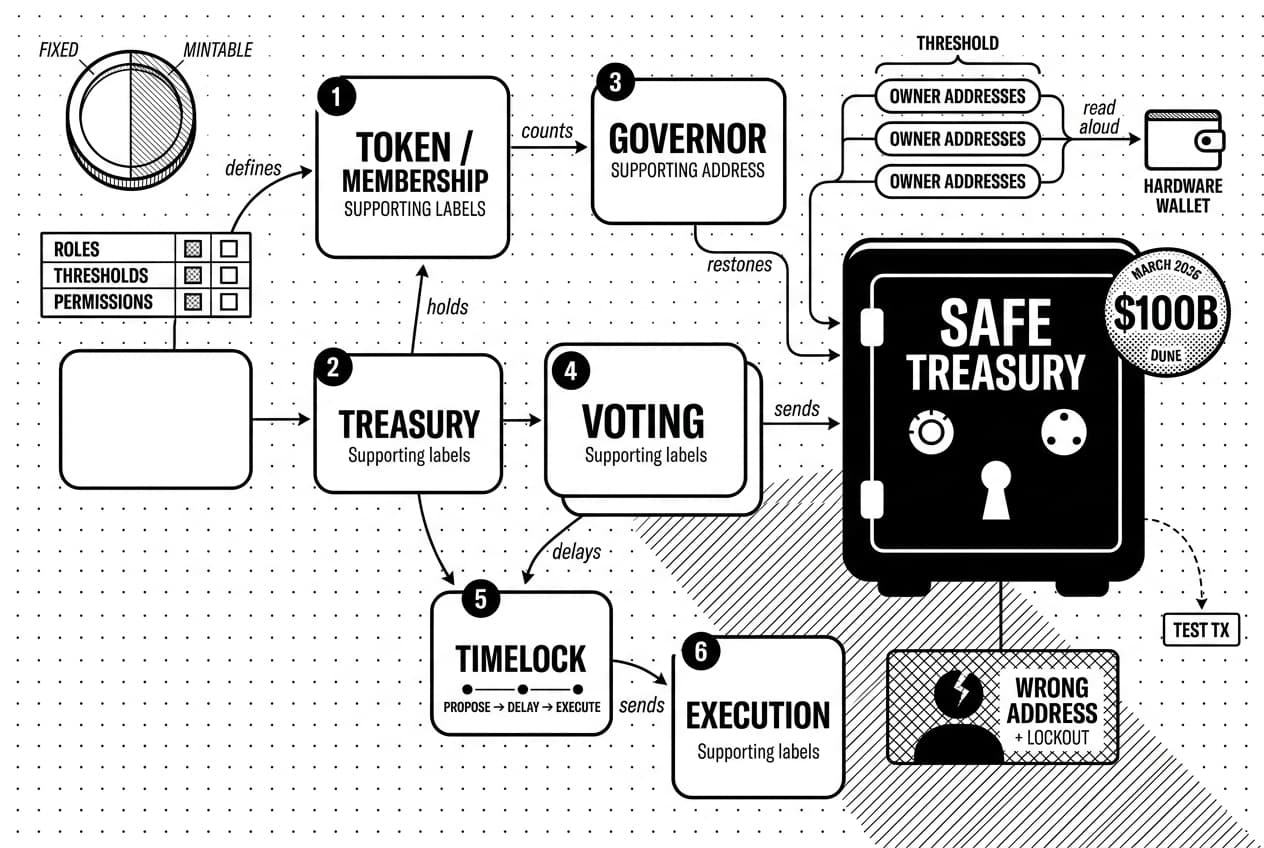
This is where your DAO becomes code. Standard modules reduce risk, but they do not remove it. You still need to understand every role, threshold, and permission before you click deploy.
Create the treasury with safe
Go to the safe app, click Create new account, choose your network, paste owner addresses, and set the threshold. Ask every signer to read their address aloud from their hardware wallet or wallet app before you confirm.
Safe dashboards showed more than $100 billion in protected assets in March 2026 on Dune. That scale is a strong adoption signal, but configuration still matters. A safe with one careless signer is not safe enough for a DAO treasury.
If the treasury will grow, pair safe with MPC wallets and threshold signatures for extra key protection. This is especially useful when signers are spread across time zones and devices.
Warning: A wrong owner address can lock a signer out. Check addresses twice before deployment, then run a small test transaction before moving meaningful funds.
Choose token supply and distribution rules
Before deploying a token, decide whether supply is fixed or mintable. Fixed supply is simpler. Mintable supply is flexible, but only if new minting requires a public proposal and timelock.
Allocation bucket | Typical range | Common vesting |
|---|---|---|
Core contributors | 15 to 25% | 2 to 4 years with 1 year cliff |
Treasury reserve | 30 to 50% | Governed by proposals |
Community rewards | 10 to 20% | Short lock or none |
Early backers | 10 to 20% | 1 to 3 years with cliff |
Grants | 5 to 15% | Milestone based |
Publish this table before launch. If contributors receive tokens, lock vesting on-chain where possible. A private promise in a document will not protect members from insider dumping.
Connect voting to execution
Snapshot votes are off-chain signals. They are cheap and easy, but a signer still needs to execute the result. Use them for polls, grants, and early decisions that can tolerate manual follow-through.
On-chain voting is binding. A passed proposal enters the timelock queue, waits for the delay, and then executes the encoded transaction. Use tally if you want a clean interface for governor proposals without building a custom front end.
Pro Tip: A 48 hour timelock is a useful default for many DAOs. It gives members time to react without freezing normal operations.
Step 4: configure proposals, quorum, and execution rules
Governance settings decide whether your DAO can act. Write each rule in plain English, then mirror it in the tool or contract. Do not let defaults make the decision for you.
Set proposal and voting parameters
- Proposal threshold: minimum token balance, reputation score, or member count needed to submit a proposal. Start around 0.1 to 1% for token systems.
- Discussion period: forum review before voting opens. Use 3 to 7 days for most proposals.
- Voting period: time the vote stays open. Use 5 to 7 days so less-active members can participate.
- Quorum: minimum eligible voting power required. Many token DAOs start between 4 and 10%.
- Approval threshold: yes-vote share needed to pass. Routine items can use majority, while large treasury spends can require 66% or more.
- Timelock: delay between approval and execution. Start with 48 to 72 hours.
- Execution process: define whether a contract executes automatically or a signer triggers the final call.
- Emergency controls: list who can pause, when they can act, and when that authority expires.
Publish these settings in your charter and proposal template. Voters should not need to read contract code to know how a decision becomes a transaction.
Design for participation, not just decentralization theater
A DAO with thousands of holders and 2% turnout is governed by whoever shows up. That may be acceptable for minor polls. It is dangerous for treasury control.
- Require a forum post before every binding vote.
- Use a proposal template that asks what, why, cost, risk, owner, and deadline.
- Encourage delegation to active voters.
- Send vote-open and vote-closing reminders.
- Publish turnout after every vote.
Review turnout after the first five proposals. If participation is low, simplify proposals, reduce jargon, improve reminders, or revisit quorum. Do not lower quorum as the first reaction.
Warning: emergency powers must expire or be constrained
Warning: Emergency powers are safety tools, not permanent rule. If admin keys, guardians, or pause rights have no sunset date, they become hidden centralization. Put the authority in writing, require public reporting within 24 hours after use, and renew it only through a vote.
Use emergency controls like a fire extinguisher. They should be visible and ready in a crisis, but not used for normal decisions.
Step 5: test, audit, and launch the DAO safely
Before the first real vote, rehearse the entire system. Bugs in live treasury contracts do not give you a reset button. Your launch plan should prove that members, signers, and contracts can complete the full loop.
Start with a low-risk proposal, such as approving a public contributor page or a $50 grant. Members learn the interface without pressure. Save major treasury votes until the DAO has completed two or three clean cycles.
Run a full governance rehearsal
- Draft the proposal in your forum. Include purpose, amount, recipient, transaction target, and deadline.
- Create the test vote in snapshot or your governor interface. Check quorum, vote length, and strategy.
- Cast votes from at least three wallets, including one wallet that should fail because it lacks voting power.
- Simulate execution in safe or a transaction simulator. Confirm the calldata matches the proposal.
- Collect confirmations from the required safe signers. Each signer should verify details on the hardware device.
- Verify the result on a block explorer and paste the transaction hash into the proposal thread.
Also test any front-running prevention for smart contract developers settings, including timelocks, commit-reveal logic, or guarded execution paths.
Sample rehearsal transcript
2026-05-08 14:00 UTC: proposal posted in forum. 2026-05-08 14:15 UTC: test vote opened with 5 day voting period. 2026-05-08 14:22 UTC: wallet below threshold rejected as expected. 2026-05-08 14:40 UTC: safe simulation matched proposal calldata. 2026-05-08 15:10 UTC: 2 of 3 signers confirmed test execution. 2026-05-08 15:18 UTC: transaction hash posted back to proposal thread.
Pro Tip: Record a short screen capture of the rehearsal. Post it beside the first real proposal so new members know what each click and wallet prompt should look like.
Create a security and incident plan
- Audits: Use a professional audit for custom code. Standard templates still need configuration review.
- Bug bounties: Create a bounty through a reputable program before public launch.
- Signer backups: Every signer needs an offline recovery plan and a documented replacement process.
- Hardware wallets: Require hardware devices for treasury signers.
- Phishing training: Teach signers to spot fake vote links and malicious attachments. Share this guide to protect DAO members from crypto phishing attacks.
- Approval revocation: Document how to revoke token approvals if a wallet is compromised.
- Incident channel: Create one public channel with the safe address, pause function, signer contacts, and reporting rules.
Do not announce a large treasury balance before this plan is live. Public money plus unclear incident response attracts attackers.
Summary and next steps: operate, measure, and improve
Deployment is the start, not the finish. You now have a mission, charter, treasury, voting process, security plan, and launch path. The next job is operating the DAO with enough discipline that members trust the system.
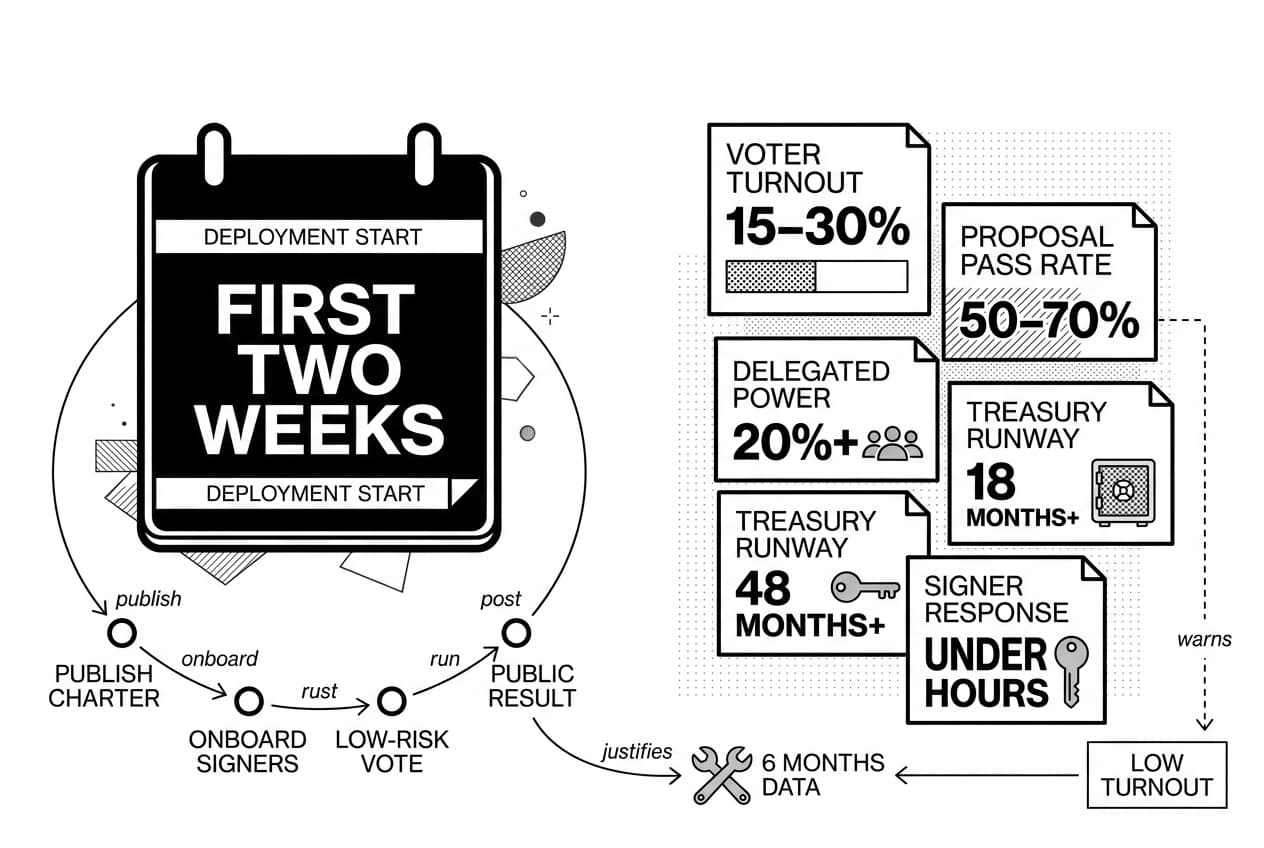
Your first two weeks matter. Publish the charter, onboard signers, run one low-risk vote, and post the result publicly. That creates a record of action instead of a community that waits for someone else to lead.
Post-launch metrics to track
Metric | What it tells you | Healthy 2026 target |
|---|---|---|
Voter turnout | Whether members engage | 15 to 30% on major votes |
Proposal pass rate | Whether thresholds fit reality | 50 to 70% |
Delegation activity | Whether passive holders assign power | 20% or more delegated |
Treasury runway | How long funds last | 18 months or more |
Signer response time | How quickly execution happens | Under 48 hours |
Forum activity | Whether debate happens before voting | 5 unique commenters per major proposal |
Contributor retention | Whether builders stay | Track 90 and 180 day cohorts |
Proposal to execution time | Whether governance is usable | Under 14 days for routine proposals |
Low turnout is an early warning sign. It usually points to confusing proposals, poor reminders, weak delegate programs, or quorum set too high. The lessons from DeFi protocol failures show that ignored metrics often appear before visible damage.
When to upgrade governance
Keep the first version simple. After six months of real data, add features only when a recurring problem justifies them.
- Working group budgets: give teams spending limits without a full vote for every invoice.
- Reputation weighting: reward contribution history, not only token balance.
- Shielded voting: hide votes until the period ends to reduce herd behavior.
- Optimistic governance: let routine proposals pass unless members veto during a challenge window.
- Delegate programs: ask delegates to publish goals, votes, and conflicts.
- More automation: move execution from multisig to contracts after the community proves it can govern safely.
Treat your DAO like a living organization. Publish metrics monthly, review parameters quarterly, and make rule changes through the same process members are expected to use.
Frequently Asked Questions
- How much does it cost to build a DAO in 2026?
- Costs vary widely depending on the chain, tooling, and complexity. A basic Safe plus Snapshot setup mainly requires gas fees and setup time, but custom smart contracts, security audits, legal structuring, and front-end development can run into tens of thousands of dollars. Always budget for ongoing security and operations, not just initial deployment.
- Do you need to know Solidity to build a DAO?
- Not necessarily. No-code and low-code tools like Aragon, DAOhaus, Safe, Snapshot, and Tally make it possible to launch without writing any smart contracts. Solidity becomes essential when you need custom voting logic, bespoke token mechanics, or advanced treasury automation. Any custom code should be thoroughly tested and professionally audited before going live.
- What smart contracts does a DAO need?
- A typical DAO stack includes a governance or membership token, treasury wallet, governor contract, voting module, timelock, and proposal execution logic. Optional additions include vesting and delegation contracts. Not every DAO needs all of these on day one — many start simply with a multisig combined with off-chain voting and expand from there.
- Should a DAO use off-chain or on-chain voting?
- Off-chain voting is cheaper and more accessible for early-stage communities, though execution still relies on trusted signers to follow through. On-chain voting is more transparent and automatically enforceable but costs more and demands tighter security. Many DAOs start off-chain for routine decisions and migrate critical governance actions on-chain as the community matures.
- Does a DAO need a legal entity?
- It depends on your jurisdiction, activities, token design, treasury size, and whether the DAO handles customer funds or sells products. Some DAOs operate through foundations, LLCs, or cooperatives for liability protection and compliance. Before issuing tokens, raising funds, hiring contributors, or generating revenue, consult a qualified legal professional familiar with blockchain regulations.
Sources
Author

Crypto analyst and blockchain educator with over 8 years of experience in the digital asset space. Former fintech consultant at a major Wall Street firm turned full-time crypto journalist. Specializes in DeFi, tokenomics, and blockchain technology. His writing breaks down complex cryptocurrency concepts into actionable insights for both beginners and seasoned investors.