AI Content Blockchain Guide: Proving What Is Real Online
AI Content Blockchain Guide: Proving What Is Real Online
What Is AI Content Blockchain?
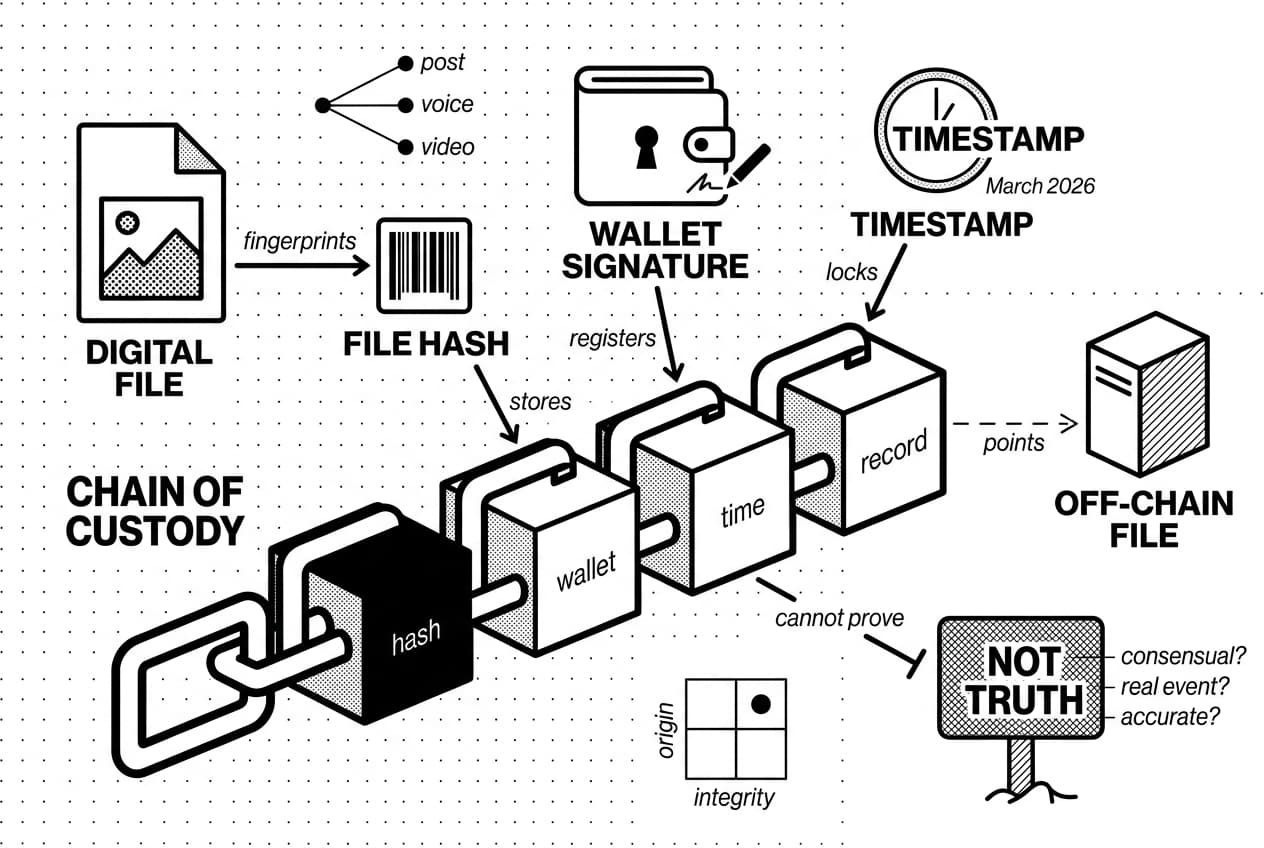
ai content blockchain means using provenance records, cryptographic signatures and tamper-resistant blockchain entries to show who registered a digital file, when it was recorded and whether the file has changed since. It helps verify origin and integrity, but it does not prove that the content is true.
Why It Matters in 2026
As of March 2026, synthetic media is no longer a specialist problem. Readers see AI-written posts, cloned voices, generated product screenshots and realistic video clips inside normal social feeds. The practical question is not "Can software spot every fake?" The better question is "Can this file show a trustworthy chain of custody?" That is the gap AI crypto sectors in 2026 are trying to fill.
The contrarian point matters: blockchain is not a truth machine. A timestamped signature can show that a file was registered by a wallet at a certain time. It cannot prove that a video was consensual, that an image depicts a real event or that a written claim is accurate. Provenance and truth are related, but they are not the same.
A Plain Analogy: A Shared Record That Cannot Be Quietly Edited
A blockchain is similar to a shared Google Doc where each saved entry is copied across many independent computers, then locked so later edits are visible rather than hidden. For content verification, the file itself usually stays off-chain. The chain stores a compact fingerprint of the file, the signer and the time.
Andreas Antonopoulos, author and educator, is useful for beginners because his public education work explains public-key cryptography in practical terms: a private key signs, a public key verifies and the network checks whether the record follows the rules. Vitalik Buterin, co-founder of the Ethereum Foundation, is relevant because Ethereum is one of the public networks where timestamped records, wallets and smart contracts became widely used for non-payment applications.
Background: From Digital Cash to Content Provenance
Public blockchain history began with Bitcoin, whose network launched in January 2009 (Bitcoin whitepaper). The early use case was peer-to-peer money, not media verification. Later, non-fungible tokens showed that a blockchain could attach records to digital objects. The next step is more practical: proving the origin and change history of media files.
The Content Authenticity Initiative, launched in 2019, helped popularize content credentials, which are cryptographic metadata attached to media files. The C2PA 2.0 specification, published in January 2024, describes a standards-based way to package claims about who made or edited a file. Blockchain timestamps and content credentials can work together: one signs the file at the source, while the other can anchor proof to a public record.
Our Provenance Reliability Matrix
For this guide, we generated a small editorial dataset called the Provenance Reliability Matrix. It scores four common content states against twelve checks: source identity, signing key, timestamp, hash match, content credential, storage availability, wallet history, domain match, earlier copies, licensing claim, platform context and human corroboration. The matrix is not a legal test. It is a beginner-friendly way to separate strong chain-of-custody evidence from weak signals.
Content state | Checks usually passed | Reliability reading |
|---|---|---|
Signed original from a known publisher | 10 to 12 of 12 | Strong provenance, still needs fact-checking |
Signed file from an unknown wallet | 5 to 7 of 12 | File integrity may be good, source trust is weak |
Viral copy with no credential | 1 to 3 of 12 | No reliable chain of custody |
Deepfake registered before publication | 4 to 6 of 12 | Timestamp is real, underlying content may still be false |
Why AI-Generated Content Is Hard to Trust in 2026
Modern AI tools can produce a convincing article, voice clip, photorealistic image or full video in minutes. Most readers do not have the time, tools or media-forensics training to inspect every file before sharing it.
The speed is documented. The Stanford AI Index 2025 report describes rapid gains in generative AI capability, falling costs and wider public access to advanced systems. That means the barrier to creating deceptive media is much lower than it was only a few years ago.
For everyday readers, the risk is direct: fake news can spread before corrections arrive, impersonation scams can steal money, campaign disinformation can appear at the worst moment and creators can lose credit for work copied into AI-generated remixes. The trust problem is not only technical. It is social, legal and economic.
Deepfakes, Synthetic Screenshots and Fake Authority
A deepfake is AI-generated or AI-altered media that imitates a real person, place, event or statement. The term once referred mainly to manipulated face-swap videos. In 2026, it also covers cloned voices, generated screenshots, fake executive announcements and text written in another person’s style.
The crypto market is vulnerable because screenshots, wallet addresses and timestamps already look authoritative. A forged exchange notice or fake blockchain explorer image can be used to push a token narrative before anyone checks the source. Even a small example, such as a fake post claiming that a public wallet bought 0.5 BTC (Bitcoin whitepaper context, January 2009), can create urgency if readers do not verify the underlying transaction.
Detection Is Not the Same as Proof
An AI detector and a blockchain record do different jobs. An AI detector estimates whether a file resembles machine-made content. It can be helpful, but it is probabilistic. It may be wrong, especially when text is edited, translated or written by a human in a formulaic style.
A blockchain record does not analyze whether the content looks natural. It proves a narrower claim: this exact file fingerprint was signed by this wallet and recorded at this time. Detection asks, "What does this resemble?" Provenance asks, "Where did this version come from?"
That difference is why ai content blockchain tools work best when built into the creation workflow. If the first signed file is the raw photo, source video or original AI output, later verification is much stronger. If the media was never registered, blockchain cannot recover a chain of custody after the fact.
How Blockchain Proves Content Provenance Step by Step
Provenance means the record of where something came from and what happened to it over time. In digital media, provenance asks who created a file, which version is being viewed, whether it was changed and whether the claimed source can be checked.
- Create the content. Produce the image, video, text or audio file and keep the original version.
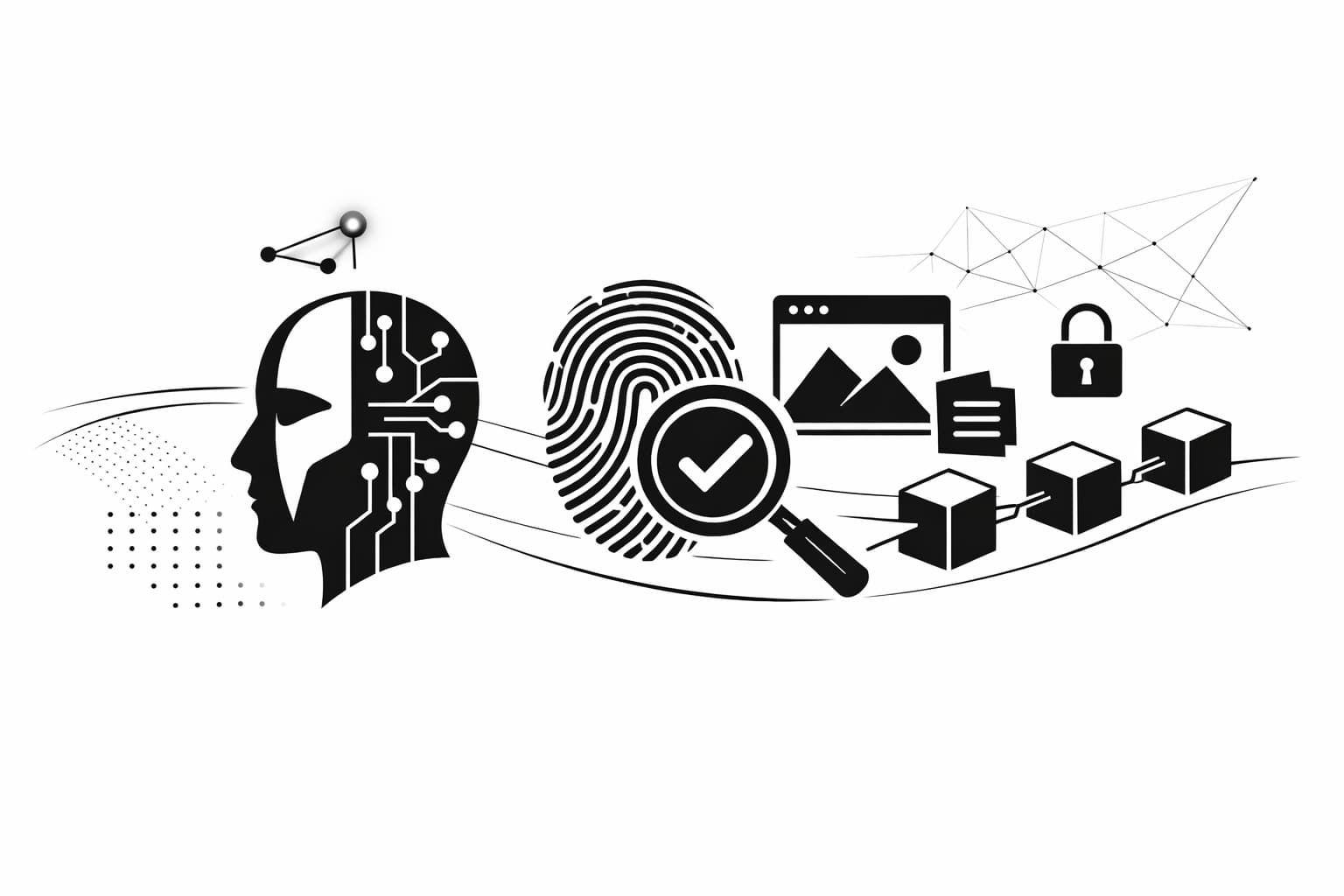
- Hash the file. Run the file through a hashing algorithm to create a unique digital fingerprint.
- Sign with a wallet. Use a crypto wallet to attach the creator’s cryptographic identity to that fingerprint.
- Record proof on-chain. Store the signed hash in a blockchain transaction so it has a public timestamp.
- Verify later. Re-hash the file and compare the result with the on-chain record.
Step 1: Create a Fingerprint With a Hash
A hash is a fixed-length string produced by a mathematical function. The same file creates the same hash every time. If one pixel, frame or word changes, the hash changes. SHA-256 produces a 256-bit output, commonly shown as 64 hexadecimal characters (NIST FIPS 180-4, August 2015), no matter whether the input is a short note or a long video.
Step 2: Sign the Fingerprint With a Wallet
A crypto wallet is software or hardware that controls cryptographic keys. A private key is the secret value used to approve signatures. A public address is the visible identifier others can check. When a publisher signs a file hash, anyone can later verify that the matching public address produced the signature, without seeing the private key.
Step 3: Timestamp the Proof On-Chain
A blockchain transaction is a recorded action stored by the network. Recording a signed hash gives the file a timestamp that is hard to rewrite later. On many chains, the sender pays a gas fee, which is a network charge for processing and storing the transaction. Ethereum’s move to proof of stake in September 2022 (Ethereum Foundation) is a useful dated example of how public chains coordinate validators around shared records.
Step 4: Verify the File Later
Verification is the payoff. A reader, platform or newsroom can take the suspicious file, generate a new hash and compare it with the blockchain entry. If the hashes match and the signing wallet belongs to a trusted source, the file has stronger provenance than an unsigned copy.
The qualifier matters. Stronger provenance is not proof of truth. The chain confirms that a specific file was signed by a specific key at a specific time. It does not confirm that the file is accurate, ethical or lawful.
Deepfake Blockchain Tools: What They Can and Cannot Prove
Deepfake blockchain tools are chain-of-custody tools, not lie detectors. They can help prove timestamp, signer and file integrity. They cannot prove truth, consent or legal ownership. That distinction should shape every claim made by vendors, platforms and creators.
The C2PA 2.0 specification, January 2024, frames content credentials as provenance information rather than a universal truth label. That is the right mental model. A verified credential can show the history of a file, but viewers still need to judge the claim inside the file.
What Blockchain Can Prove
When media is properly registered, blockchain can prove that a particular hash existed at a particular time and was signed by a particular wallet. It can also preserve recorded transfers, license references or later edits if the system logs them. This is valuable for newsrooms, creators, archives and compliance teams.
Can prove | Cannot prove |
|---|---|
Timestamp: when the hash was recorded | Truth: whether the claim inside the media is accurate |
Signer: which wallet approved the record | Consent: whether a person shown or imitated agreed |
File integrity: whether the viewed file matches the registered hash | Legal ownership: who owns copyright or publicity rights |
Recorded custody: later transfers or edits if logged | Good intent: why the content was created or shared |
What Blockchain Cannot Prove
A dishonest source can register dishonest media. If a bad actor creates a deepfake and records it first, the timestamp will still be valid. The chain proves priority of registration, not reality. That is the central limit of every ai content blockchain workflow.
Key compromise is another weak point. If a private key is stolen, an attacker may sign files that appear to come from the rightful owner. Blockchain records can show that a key signed something, but they cannot always show whether the rightful person still controlled the key at that moment.
This is why provenance works best as one layer. AI detection can flag visual or audio anomalies. Watermarking can embed signals inside media. Human verification can compare claims with reporting, public records and context. Blockchain confirms the cryptographic trail. People still have to evaluate the story.
The Building Blocks: Wallets, Signatures, Storage and Consensus
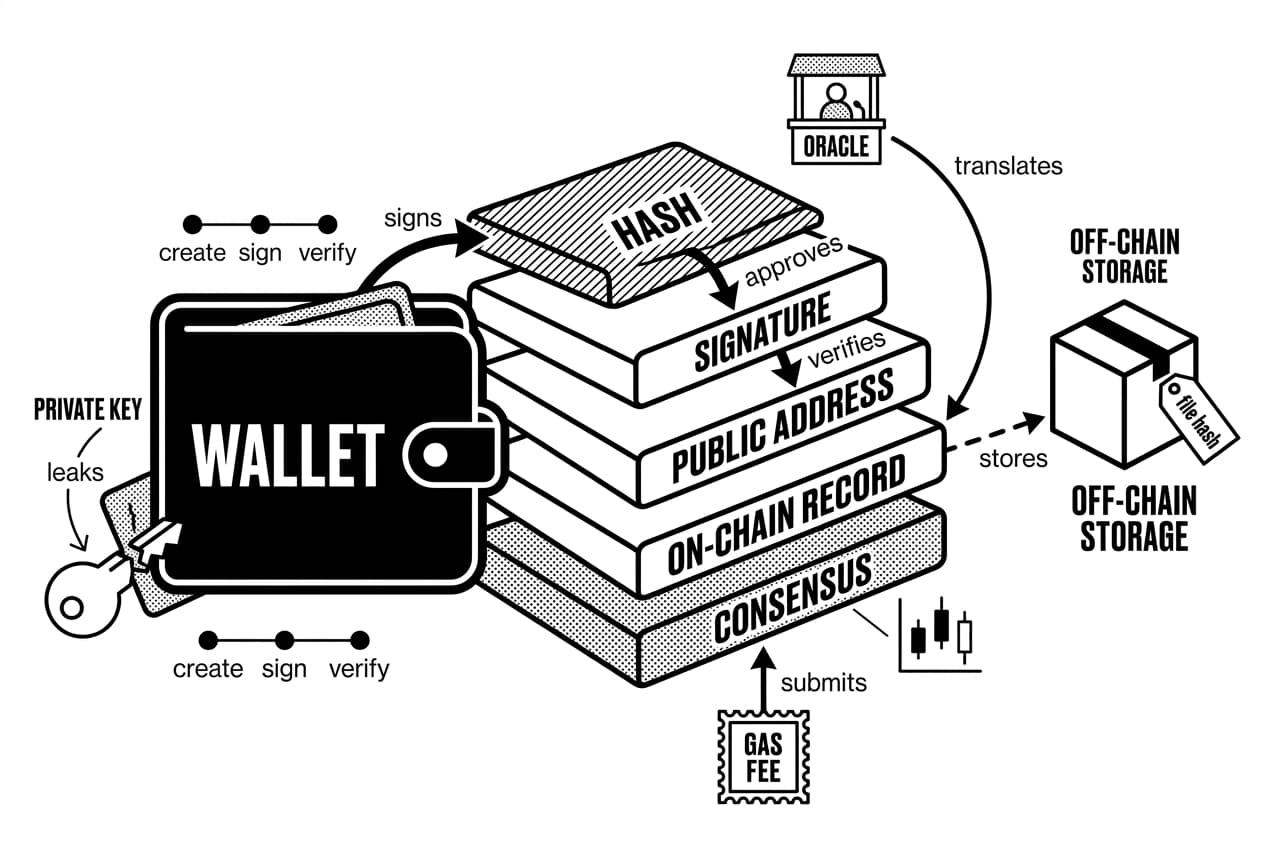
Before you trust any ai content blockchain system, learn what each component does. A chain-of-custody record is only as strong as its keys, signatures, storage and identity checks.
Component | What it does | Beginner analogy |
|---|---|---|
Wallet | Controls signing keys and shows a public blockchain address | A passport holder for digital identity credentials |
Private key | Secret value used to approve signatures and transactions | The PIN for a bank card |
Hash | Unique fingerprint generated from the file’s exact contents | A barcode that changes when the package changes |
Signature | Proof that a specific wallet approved a specific record | A notarized signature on a document |
Gas fee | Payment made to the network for processing a transaction | A postage stamp for submitting a record |
Consensus mechanism | Rules computers follow to agree on valid blockchain records | A jury where no single juror controls the verdict |
Oracle | Service that brings outside data into blockchain systems | A translator between external records and the ledger |
Off-chain storage | External storage for large files, while the hash stays on-chain | A warehouse, with the blockchain holding the inventory tag |
Wallets and Private Keys
A wallet does not hold media files in the same way a folder holds photos. It controls keys. When a newsroom or creator signs a content hash, the private key creates the signature and the public address lets others verify it. If the key leaks, someone else can sign misleading content. That is why why self-custody matters applies to provenance as well as funds.
Consensus Mechanisms
A consensus mechanism is the rule set that lets many computers agree on the same ledger. In proof-of-stake systems, validators risk capital to participate in ordering and confirming records. The practical benefit for content provenance is resistance to quiet edits. A single company should not be able to rewrite yesterday’s timestamp without the network rejecting the change.
Off-Chain Storage and Content Identifiers
Large files usually stay off-chain because storing video directly on a public blockchain is expensive. The file may live in decentralized storage, a cloud archive or a publisher’s own server. The blockchain stores the hash, sometimes paired with a content identifier, which is a label pointing to one exact version of a file.
If the storage link breaks, verification becomes harder even if the on-chain hash survives. A strong system keeps redundant copies, documents which version was signed and makes the original file available for comparison.
Oracles and Identity Layers
An oracle connects outside information to a blockchain system. For media verification, an oracle might reference publication time, device attestation or archive data. An identity layer links a wallet address to a real-world source, such as a newsroom, artist or company. Without identity, a signature proves only that some wallet registered the file.
Real-World Use Cases for AI Content Blockchain
The theory becomes useful when it is built into normal publishing, licensing and audit workflows. The strongest systems register content early, preserve the original file and make the signing identity easy to check.
Newsrooms and Public Figures
A news organization can sign a raw image or video file at capture, then timestamp the hash before editing or publication. If a cropped or altered version spreads later, readers can compare the circulating copy with the signed original. The Content Authenticity Initiative, launched in 2019, has pushed this source-first model for signed media packages.
Creators, NFTs and Licensing
Artists using AI tools can register a finished piece on-chain, attach a license reference and show which version came first. That can help in licensing disputes. It does not automatically transfer copyright. Buying a token is not the same as buying all rights unless the license says so. For more on how AI creates and validates digital art, the NFT guide explains the ownership mechanics.
Enterprise and Compliance Records
Companies can timestamp audit logs, model-output records and customer communications. A compliance team may not need a blockchain to prove that every statement is correct. It may only need to prove that a record existed on a certain date and has not been silently changed. The European Union’s AI Act entered into force in August 2024 (EU AI Act timeline), making record-keeping and AI governance more visible for businesses.
Some infrastructure projects tracked among the top AI crypto coins by market cap aim at content verification, data provenance or decentralized compute. Token performance is a separate question. For this article, the useful test is whether the system makes verification easier for real users.
- Newsrooms can sign media at the point of capture, giving readers a chain back to the source.
- Creators can register AI-assisted works, while keeping copyright and token ownership separate.
- Enterprises can timestamp audit logs and disclosures to reduce disputes.
- Readers can use provenance as a signal, not as the final answer.
Limits, Risks and Legal Questions
Blockchain provenance is useful, but it has sharp limits. The weak points are dishonest originals, stolen keys, missing storage, privacy exposure and unclear law.
Garbage In, Immutable Garbage Out
The biggest misconception is that "on-chain" means "true." It does not. A chain can preserve a false record permanently. If a deepfake is registered before a correction exists, the timestamp will still be valid. The system proves that the file existed at that time, not that the event inside the file happened.
This is where the Provenance Reliability Matrix helps. A signed file from a known organization with matching storage, history and independent corroboration is much stronger than a signed file from a fresh wallet with no context. Both may be on-chain. They do not deserve the same trust.
Privacy and Surveillance Tradeoffs
Public provenance creates metadata. A wallet can reveal when a creator publishes, how often a newsroom registers sensitive files and which records are linked over time. Understanding how blockchain surveillance works shows why public records can expose more than intended.
Privacy-preserving designs, including selective disclosure and zero-knowledge proofs, may reduce exposure. They also make public checking harder. The crypto privacy and regulation tradeoffs remain unresolved because regulators want accountability while journalists, creators and users may need safety.
Legal Status of Deepfakes
Deepfake law depends on location, consent, intent and content type. In the United States, the proposed DEFIANCE Act was introduced in 2024 (U.S. Congress) to address non-consensual intimate deepfakes through civil remedies. Other legal issues may involve fraud, defamation, elections, copyright or harassment.
A blockchain timestamp does not make a deepfake legal. It does not grant copyright. It does not prove consent. If you face a real dispute, speak with a qualified lawyer in your jurisdiction. This article is educational and is not legal advice.
- Key takeaway 1: Registration proves priority, not honesty.
- Key takeaway 2: Public chains can expose metadata that matters for safety and privacy.
- Key takeaway 3: Deepfake legality varies by country, state, content and intent.
- Key takeaway 4: Use provenance as one signal among several.
How to Verify AI Content Yourself
You do not need to be a blockchain developer to run a basic check. Use a repeatable process whenever a suspicious image, audio clip, video or screenshot asks you to believe or act quickly.
A Beginner Verification Checklist
- Find the original source. Search the creator’s official website, verified profile or publication page. A viral copy with no origin is a warning sign.
- Look for content credentials. Use Content Credentials Verify, 2024 or a similar C2PA viewer to inspect embedded provenance data.
- Compare the hash. If the publisher provides an on-chain hash, download the file and generate your own hash. A mismatch means the file is not the same version.
- Verify the signing wallet. Check whether the wallet has public history, a verified domain or a known identity layer. A brand-new wallet deserves caution.
- Check the timestamp. A record created after the content went viral is weak evidence. A record made at capture or publication is stronger.
- Search for earlier versions. Reverse image search and the Internet Archive web archive can reveal copies that predate the claimed original.
- Apply human context. Compare the claim with reputable reporting, official statements and the incentives of the person sharing it.
Red Flags That Still Matter
Verified provenance is a data point, not a verdict. A wallet may be anonymous. A file may be signed correctly and still be misleading. A hash may match a deepfake that was synthetic from the start. Blockchain confirms what existed and when. It does not replace judgment.
- Mismatched domains, such as a lookalike news URL instead of the official site
- Pressure to act fast or spot fake crypto drops before you can think
- Anonymous signers with no transaction history before the content appeared
- Claims no reputable institution has independently confirmed
- Links asking for a seed phrase, private key or wallet approval unrelated to verification
The safest habit is slow verification. Check the source, check the credential, check the hash, then check the story. Provenance can make forgery harder and corrections faster, but skepticism remains part of the workflow.
Key Takeaways
- Blockchain proves provenance, not truth. It records who signed a file, when it was recorded and whether the file changed.
- Deepfake blockchain systems raise the cost of forgery. They catch tampering when a registered original exists, but they do not catch every synthetic original.
- Identity matters as much as the hash. A signature from a known publisher is more useful than a signature from an unknown wallet.
- Storage and privacy are real design issues. Off-chain files can disappear, and public records can reveal sensitive metadata.
- Human judgment remains necessary. Use credentials, timestamps and hashes, then still ask whether the claim itself is credible.
Frequently Asked Questions
- What is the 30% rule in AI?
- There is no universal legal or technical "30% rule" for AI content. Some schools, publishers, or platforms set internal thresholds for acceptable AI-generated text, but those are policy decisions, not blockchain standards. Always check the specific institution or platform you are working with for their actual guidelines.
- Which blockchain is best for AI?
- No single blockchain wins for every AI use case. The right fit depends on transaction costs, security, speed, identity support, developer tools, and storage integrations. For content provenance specifically, low fees, reliable timestamping, and a strong ecosystem often matter more than which token has the loudest marketing.
- What are the top AI crypto projects?
- Rankings shift constantly with market cap, usage, and narrative cycles. Rather than chasing token lists, focus on categories: decentralized compute, AI agents, data marketplaces, model verification, and AI infrastructure. Understanding what a project actually does is far more useful than where it ranks on any given day. This is not investment advice.
- Is blockchain a part of AI?
- They are separate technologies. AI generates predictions, text, images, or decisions, while blockchain records shared, tamper-resistant data. The two can work together effectively when AI-generated content needs provenance records, audit logs, automated payments, or decentralized infrastructure — but neither technology requires the other to function.
- Are deepfakes actually illegal?
- Deepfakes are not automatically illegal everywhere, but they can become illegal when used for fraud, impersonation, defamation, election interference, harassment, copyright infringement, or non-consensual sexual imagery. Laws vary significantly by country and state. If you are involved in a serious case involving deepfakes, consult a qualified legal professional.
- Is blockchain real or fake?
- Blockchain is real technology — a shared digital ledger maintained by computers following agreed rules, with a genuine track record across finance, supply chains, and content provenance. That said, not every project using the word is trustworthy. Separate the underlying technology from exaggerated marketing, weak implementations, and outright scams.
- Is there an AI blockchain?
- Yes, several projects combine AI and blockchain, though the phrase covers very different things: AI-focused tokens, decentralized GPU networks, autonomous AI agents, data marketplaces, and content provenance systems. This article focuses specifically on using blockchain to verify the origin and integrity of AI-generated content.
- Can a blockchain system be hacked?
- Strong blockchains are extremely difficult to rewrite, but the systems surrounding them are more vulnerable. Wallet keys, smart contracts, bridges, front-end websites, storage services, and user devices are all common attack points. Blockchain reduces certain risks meaningfully, but it does not make an entire system immune to compromise.
Sources
Author

Crypto analyst and blockchain educator with over 8 years of experience in the digital asset space. Former fintech consultant at a major Wall Street firm turned full-time crypto journalist. Specializes in DeFi, tokenomics, and blockchain technology. His writing breaks down complex cryptocurrency concepts into actionable insights for both beginners and seasoned investors.