Verifiable Compute: Proving AI Results On-Chain in 2026
Verifiable compute: proving AI results on-chain in 2026
What is verifiable compute?
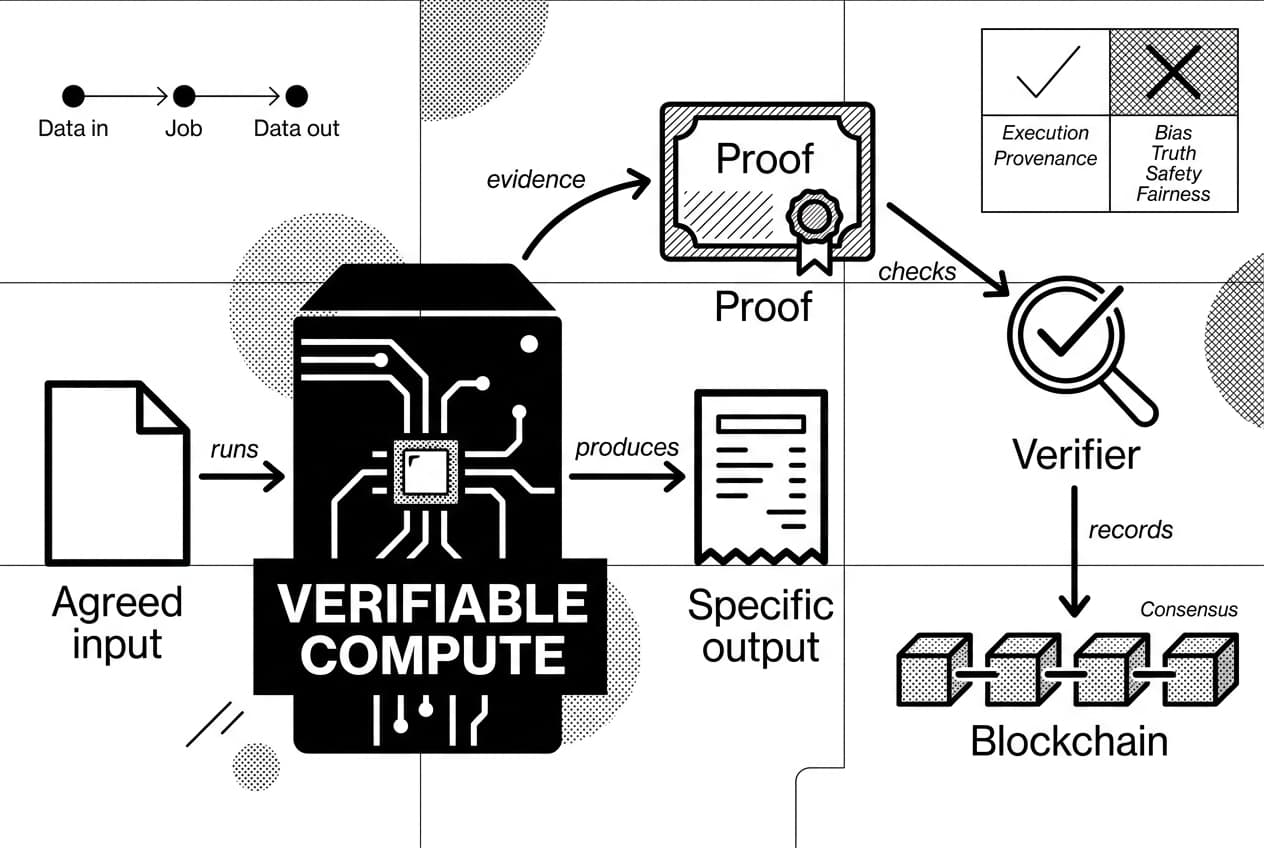
Verifiable compute is a way to prove that a specific calculation ran on agreed inputs and produced a specific output, so another person or program can check the result without trusting the computer, company, or AI service that performed the work.
Why it matters: AI systems now trigger payments, score risk, summarize evidence, and route user decisions. If a smart contract pays based on an AI result, the user should be able to ask a plain question: did the approved model really run on the approved input? Verifiable compute gives that question an auditable answer.
A computation is any process that takes data in and returns data out. A worker is the machine that runs the job. A proof is evidence that the job ran as claimed. A verifier checks that evidence. A blockchain is a shared record maintained by many computers that agree on the same history through a process called consensus. Think of a blockchain like a shared document that nobody can quietly edit after saving, because every accepted version is recorded for others to check.
The practical point is narrower than the hype. Verifiable compute can prove execution and provenance. It cannot prove that a model is unbiased, truthful, safe, or fair. A biased model can run correctly and still produce a biased result. This guide treats verifiable AI as evidence about process, not a magic stamp of truth.
For blockchain context, Vitalik Buterin, co-founder of Ethereum Foundation, helped create the Ethereum ecosystem where smart contracts made verifiable off-chain computation commercially useful. For the broader culture of checking rather than trusting, Andreas Antonopoulos, author and educator, has spent years teaching why users should verify systems instead of relying only on operators.
Verifiable compute vs. verifiable AI
Verifiable compute is the broader category. It covers financial calculations, database queries, scientific simulations, game logic, and AI inference. Verifiable AI applies the same idea to model outputs, agent actions, content provenance, and machine learning workloads.
- Verifiable compute proves that a calculation followed agreed rules on agreed inputs.
- Verifiable AI proves facts about an AI run, such as model version, input commitment, hardware attestation, or proof circuit.
- A blockchain can store a compact proof, timestamp, or certificate so later users can audit the record.
- The proof covers execution. It does not judge whether the model is wise, factual, or ethical.
Why verifiable AI compute matters in 2026
As of March 2026, the trust problem around AI is no longer only about chatbots giving bad answers. It is about software agents and smart contracts acting on outputs that users cannot easily inspect.
For AI crypto sectors across agents, compute, and data layers, blind trust creates a weak link. A protocol may claim that an approved model checked a data feed, ranked a borrower, or summarized a legal document. Without verifiable compute, users only see the final answer. They cannot confirm which model ran, which input was used, or whether an operator changed the result.
The trust gap in autonomous AI
Autonomous AI agents can sign transactions, call tools, submit governance votes, and trigger contract logic. That creates a record-keeping burden. A user needs to know which policy allowed the action, which model produced the recommendation, and whether the output reached the chain unchanged.
The gap is simple: a smart contract cannot interview a server. It receives data and either acts or refuses to act. Verifiable AI compute adds a proof layer between the off-chain model and the on-chain action, so the contract can check evidence instead of trusting a backend service.
Trust across the AI supply chain
Before an AI output reaches a user, it may pass through a model registry, prompt builder, retrieval system, compute provider, oracle, and smart contract. Each link can fail or be manipulated. A useful audit trail should answer five questions:
- Model provenance: Which exact model version ran?
- Input provenance: Which prompt, image, file, or data feed was committed before the run?
- Execution integrity: Did the agreed code run without tampering?
- Delivery integrity: Did the output change before reaching the chain?
- Settlement record: Which on-chain transaction stored the proof or acted on it?
A short history of verifiable computation
Verifiable computation predates modern blockchains. The core idea is that one party performs expensive work while another party checks a short proof instead of repeating every step.
From outsourced computing to blockchain proofs
Computer scientists studied interactive proofs and related proof systems decades before crypto networks became mainstream. The motivation was practical: a small client wanted a powerful server to compute something, but the client still needed a way to check the result.
Blockchains made the idea urgent because on-chain computation is expensive. Smart contracts are programs that run on a blockchain. Every network participant must be able to verify their rules, so heavy workloads usually run off-chain. Verifiable compute became the bridge: do the expensive job elsewhere, then settle a compact proof on-chain.
The history has useful milestones. The 9-page Bitcoin white paper was published on October 31, 2008, introducing a public payment system built around verification by network participants. The Ethereum mainnet launched on July 30, 2015, extending that verification model to programmable contracts. Those two dates explain why verifiable off-chain work matters today: blockchains are good at checking compact evidence, not running every heavy AI task directly.
Why AI made the problem harder
A normal calculation can often be rerun and compared. AI inference is harder. A model may use billions of operations, private inputs, large weights, and hardware-specific numerical behavior. Some systems also use sampling, where the same prompt can produce different valid outputs.
That means verifying AI is not only a larger version of verifying arithmetic. The system must prove which model ran, which inputs were committed, how randomness was handled, and whether the result was delivered unchanged. This is why trusted execution environments, zero-knowledge proofs, replication, and oracle attestations all appear in modern designs.
How verifiable compute works step by step
At its core, verifiable compute is a pipeline. A client requests work, a worker runs it off-chain, a proof is generated, and an on-chain verifier decides whether the result should be accepted.
The main actors: client, worker, verifier, and chain
The client requests the job and supplies input data. The worker is the computer or service that performs the computation. The verifier checks the proof. The chain stores the proof, result hash, or final settlement action.
A hash is a short digital fingerprint of data. If the underlying data changes, the hash changes too. A gas fee is the payment users make to have a blockchain process a transaction. Because AI inference is expensive, the chain usually stores only hashes and proofs, not the full model run.
Inputs, outputs, proofs, and certificates
Consider a clinic that wants a model to classify 1,000 medical images. The clinic does not want to expose patient data publicly, and it does not want to trust an unknown compute provider blindly. The system can first commit a hash of the image batch and the approved model version. After the worker runs the model, it returns the classifications plus a certificate tying the outputs to the committed input and model.
For a deeper look at how the inference step actually runs in these environments, see how AI inference on blockchain works.
What goes on-chain and what stays off-chain
The heavy AI work stays off-chain. The chain stores compact evidence: input hash, model hash, proof or attestation, output hash, and settlement transaction. This keeps costs manageable while preserving an audit trail.
The full process is:
- Request: The client submits a job and funds payment in a smart contract.
- Commit input: The input hash and approved model hash are recorded before computation starts.
- Run off-chain computation: The worker runs the AI model outside the blockchain.
- Generate proof: The worker produces a cryptographic proof, hardware attestation, or signed certificate.
- Verify proof: A verifier checks that the proof matches the committed input and model.
- Record on-chain: The proof hash, result hash, or verification status is stored on-chain.
- Act on result: The smart contract releases payment, triggers a workflow, or rejects the output.
We call this the commit, compute, certify framework. Commit before the run, compute off-chain, certify the result, and settle only after the evidence checks out.
Main ways to prove AI results
As of March 2026, our proof-choice matrix groups production designs into five methods. Each method answers the same question in a different way: what must the user trust for this AI result to be acceptable?
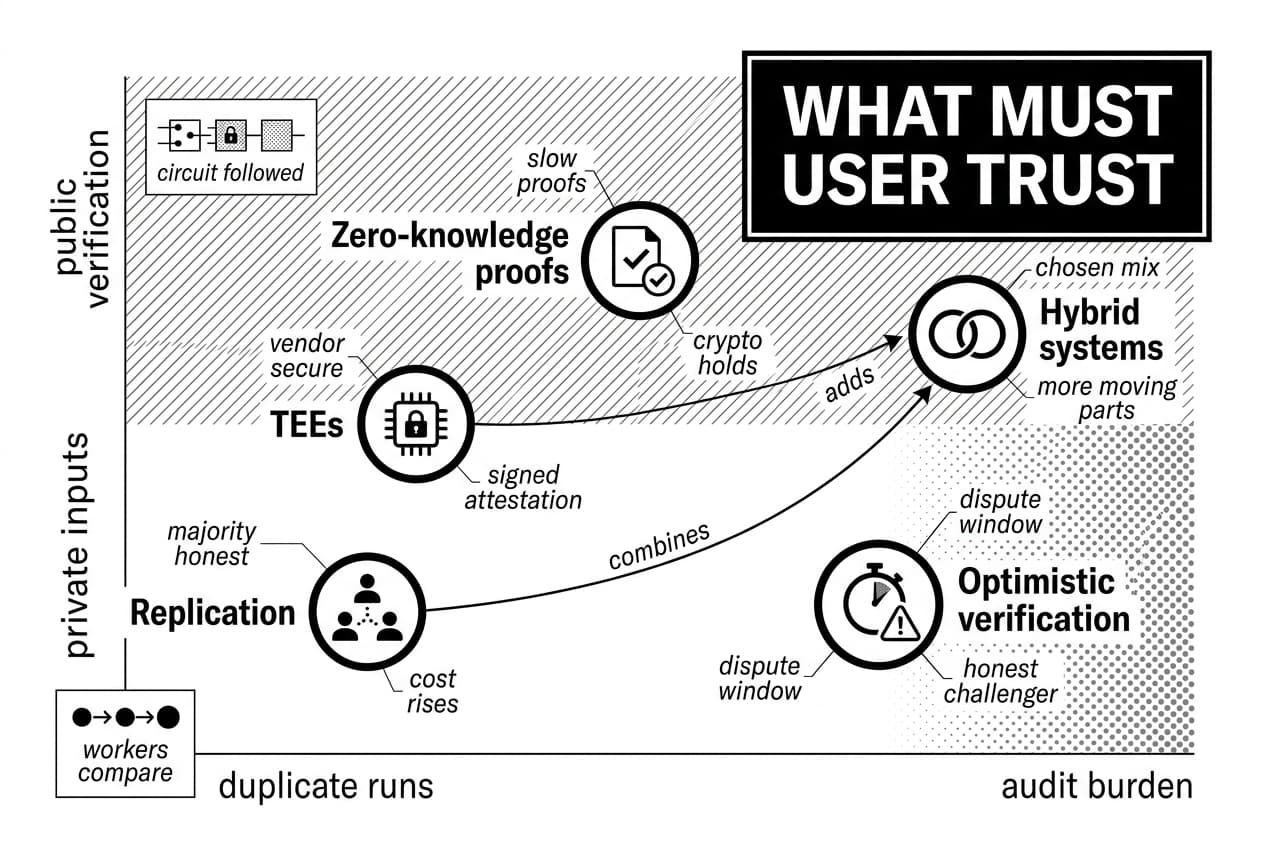
Method | How it works | Best use case | Main weakness | Trust assumption |
|---|---|---|---|---|
Replication | Several independent workers rerun the job and compare outputs | Deterministic, smaller models | Cost rises with each duplicate run | A majority of workers are honest |
Trusted execution environments | Protected hardware runs code and signs an attestation | Private inputs and enterprise audits | Relies on chip and firmware security | The hardware vendor and enclave remain secure |
Zero-knowledge proofs | A proof shows the computation followed the circuit without revealing all data | High-value public verification | Proof generation can be slow for large models | The cryptographic assumptions hold |
Optimistic verification | A result is accepted unless someone challenges it within a dispute window | High-volume, lower-risk jobs | Bad results can pass if no one watches | At least one honest challenger is active |
Hybrid systems | Two or more proof methods are combined | Regulated or high-stakes deployments | More moving parts to audit | Depends on the chosen mix |
Verification by replication
Replication is the easiest method to understand. Multiple workers run the same job and compare results. It works well when outputs are deterministic, meaning the same input should always produce the same output.
The weakness is cost and disagreement. Running a large model three or five times multiplies the bill. If the model uses randomness or hardware-specific behavior, honest workers may produce slightly different outputs. Replication is best for small, repeatable tasks where public checking matters more than privacy.
Trusted execution environments
A trusted execution environment, or TEE, is a protected area inside a processor that isolates code and data from the rest of the machine. After running the job, the environment produces an attestation, which is a signed statement about what code ran and what output it produced.
TEEs are useful when inputs are sensitive. A hospital, bank, or enterprise team may want an audit trail without posting private data to a public chain. The tradeoff is clear: the guarantee depends on hardware security, firmware, and the vendor attestation system.
Zero-knowledge proofs and zkML
A zero-knowledge proof is a cryptographic proof that a statement is true without revealing every underlying detail. In AI, zkML means applying zero-knowledge proofs to machine learning inference.
The advantage is public verifiability. A smart contract can check a compact proof without trusting the worker. The challenge is proof generation. For small models, zkML is increasingly practical. For frontier-size models, proving the full run remains expensive and technically demanding. For readers interested in a related privacy tool, fully homomorphic encryption for encrypted smart contracts explains how computation can happen on encrypted data.
Optimistic verification and challenge windows
Optimistic verification starts by accepting the result, then gives watchers time to challenge it. A challenge window is the period when someone can submit evidence that a result was wrong or invalid.
This design is cheap in normal operation. It is also risky when the value at stake is high. A system that works for low-value content tagging may be unsafe for credit decisions or large financial transfers unless watchers are paid, available, and technically able to detect fraud.
Architecture: proving AI results on blockchain
A working verifiable AI architecture connects six layers: model registration, input commitment, off-chain compute, proof generation, oracle delivery, and on-chain verification.
The end-to-end flow
- Model registration: The model weights or model package are hashed and registered as the approved version.
- Input commitment: The prompt, image, file, or data feed is hashed before the run.
- Off-chain compute: The model runs in a TEE, zkML circuit, replicated worker set, or hybrid environment.
- Proof generation: The system creates an attestation, proof, or certificate that binds the output to the model and input.
- Oracle delivery: AI oracles that connect smart contracts to AI results carry the output and evidence to the chain.
- On-chain verification: A verifier contract checks the evidence and allows the smart contract to act.
The oracle layer matters because blockchains cannot fetch outside data on their own. For more on relay and aggregation design, see the blockchain oracle architecture guide.
A control layer for autonomous AI agents
Agents that spend funds or update contracts need a record of authorization. A verifiable compute layer can prove that an approved model, approved policy, and approved tool sequence produced the action request before funds move.
This is where the contrarian point matters. A valid proof does not mean the agent made a good decision. It means the agent followed the documented process. Governance, limits, human review, and data quality still determine whether the process is safe.
Verified certificates and audit trails
A verified certificate translates machine proofs into a record humans can inspect. It should answer four questions: what model ran, what input was committed, what environment ran the job, and what result was returned.
Certificate field | What it records | Who uses it |
|---|---|---|
Model hash | Exact approved model package or weights | Developers and auditors |
Input commitment | Hash of the prompt, file, image, or data feed | Incident responders |
Execution evidence | TEE attestation, ZK proof, or replication signature | Security teams |
Output hash | Fingerprint of the final result | Users and smart contracts |
Block reference | Where the evidence was recorded on-chain | Compliance and legal teams |
Real-world use cases for verifiable compute
Verifiable compute is most useful when someone who was not present for the AI run still needs evidence about how the result was produced.
AI oracles and smart contracts
A crop insurance protocol could use satellite imagery and an AI classifier to decide whether flood damage passed a payout threshold. The image stays off-chain. The model runs in a protected or proven environment. The smart contract receives only the result and proof.
The benefit is faster settlement and a clearer audit trail. The limit is just as important: if the model is poorly calibrated, a valid proof can still support a wrong payout decision.
AI content and provenance
Content provenance asks whether a file existed at a certain time, whether it changed, and which system produced it. Verifiable compute can record a hash of generated media, the model identifier, and a timestamp. It cannot prove that the content is accurate.
This is the same problem covered in using blockchain to prove what is real online. The C2PA 2.0 specification was published in February 2024, showing how signed content credentials can help establish media provenance. On-chain attestations can extend that chain of custody, especially when many parties need a shared record.
Enterprise and regulated AI
Regulated organizations need audit trails without exposing private data. A bank, hospital, or public agency can run inference inside a TEE, keep the raw data private, and place only an attestation hash on-chain.
The regulatory backdrop is moving quickly. The EU AI Act entered into force on August 1, 2024, and it increased attention on documentation, risk controls, and accountability for high-risk AI systems. Verifiable compute does not solve compliance by itself, but it can provide tamper-evident records that support audits.
- AI oracles can feed verified AI results into contracts while keeping heavy inference off-chain.
- Content provenance can show when a file existed and which system generated it.
- Regulated AI can use hashes and attestations without exposing customer data publicly.
- Compute marketplaces can attach proof-of-execution to job completion so buyers rely less on operator promises.
Limits, risks, and how to choose the right approach
Verifiable compute is evidence about process. It is not a truth machine. The best design starts by naming the risk you are actually trying to reduce.
What verifiable compute can and cannot prove
Verifiable compute can prove that a specific model processed a specific committed input, that agreed code ran, and that the output matches the proof or attestation. It can also make the record tamper-evident once the proof is anchored on-chain.
It cannot prove that the training data was representative, that the prompt was honest, that the model was fair, or that the answer is factually correct. If the input is bad, the model is biased, or the policy is poorly designed, the proof will faithfully certify a flawed process.
Tradeoffs: cost, speed, privacy, and trust
User need | Recommended proof method | Why it fits | Main tradeoff |
|---|---|---|---|
Low cost | Optimistic verification | Most results settle without expensive proof work | Needs active challengers |
High privacy | Trusted execution environment | Private data can stay inside protected hardware | Trusts hardware and firmware security |
Fast settlement | Zero-knowledge proof after proof generation | On-chain verification is compact | Generating the proof can be slow |
Public auditability | Replication or ZK proof | Independent parties can check the result | Replication can be costly, ZK can be complex |
Regulated enterprise deployment | TEE plus permissioned audit logs | Balances private data with traceable evidence | More operational overhead |
Deployment options in 2026
Public chains offer open auditability but limited throughput. Rollups and app-specific chains can lower fees and tune performance. Enterprise networks can restrict access for compliance. Hybrid cloud designs keep model execution private while anchoring proof hashes on-chain.
The right environment depends on who must verify the result, how sensitive the inputs are, and how quickly settlement must occur. A public prediction market and a bank fraud model should not use the same proof stack. The deployment choice should be tested early, much like automated smart contract testing and deployment catches problems before production.
For teams starting in 2026, a practical baseline is a TEE-based design on a rollup, with optimistic challenges for disputed outputs and a migration path toward ZK proofs where public verification becomes worth the added cost.
Key takeaways: verifiable AI is evidence, not magic
Verifiable AI gives users a stronger record of how an output was produced. It does not remove the need for model testing, data governance, security reviews, or human judgment.
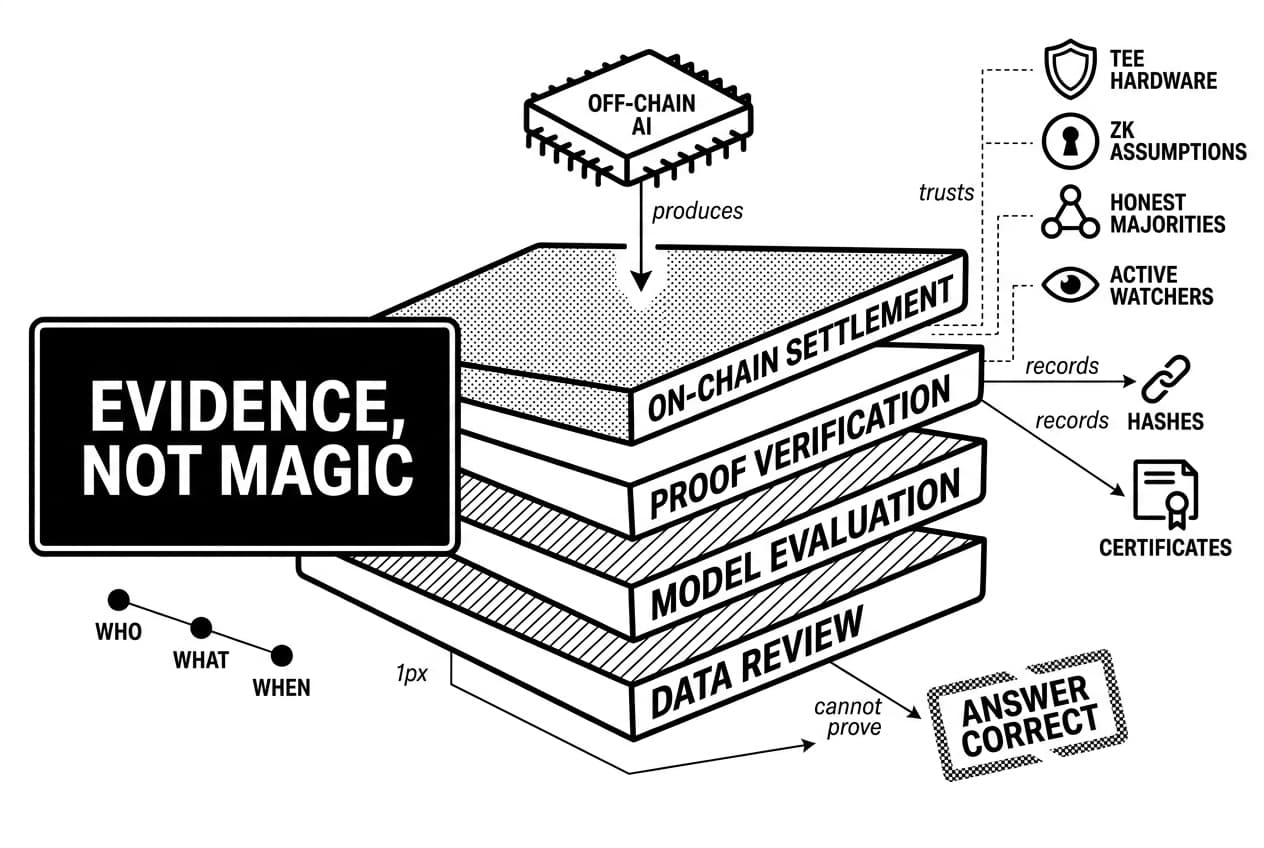
- Process proof is not truth proof. The evidence can show that the right model ran, not that the answer is correct.
- Trust assumptions differ. TEEs trust hardware, ZK proofs trust cryptographic assumptions, replication trusts honest majorities, and optimistic systems trust active watchers.
- Blockchains are settlement layers. Heavy AI work runs off-chain while compact proofs, hashes, and certificates go on-chain.
- The best systems layer controls. Model audits, input checks, proof verification, and human oversight each solve a different problem.
- Use verifiable compute when the process matters to someone outside the room. That is the clearest signal that the added cost is justified.
What readers should remember
The safest way to use verifiable compute is to treat it as an accountability layer. It helps prove who ran what, when, and under which rules. It does not decide whether the rules were good. In practice, verifiable AI should sit beside model evaluation, data review, access controls, and clear governance.
Frequently Asked Questions
- What is verifiable computing?
- Verifiable computing lets a client delegate work to a worker and receive a proof that the computation ran correctly — without rerunning it from scratch. A separate verifier checks that proof instead. Applied to AI and blockchain, this means models can produce outputs alongside cryptographic evidence that the work was done as claimed.
- What is verifiable AI?
- Verifiable AI applies verifiable compute principles to AI systems, making it possible to prove which model, input, hardware configuration, or code path produced a given output. This improves auditability and accountability, but it does not automatically make AI outputs truthful, unbiased, or correct — it simply proves they came from a specific, documented process.
- How does blockchain help prove AI results?
- Blockchains provide tamper-resistant records and programmable smart contracts that can verify proofs or store attestations about AI outputs. Because AI inference is computationally heavy, it runs off-chain. Only compact proofs or certificates get recorded on-chain, creating a permanent, auditable link between a result and the process that produced it.
- Which AI is most trustable?
- The most trustable AI is not simply the largest or most capable model. Trust comes from transparent governance, independently tested performance, clear data controls, regular security reviews, and verifiable records of how outputs were produced. A smaller, well-documented model with strong audit trails can be far more trustworthy than a powerful but opaque one.
- How far away is AGI realistically?
- Timelines for artificial general intelligence remain genuinely uncertain, and credible expert estimates vary by decades. That said, verifiable compute matters right now — today's narrow AI systems already make consequential decisions in healthcare, finance, and law. Building audit trails for current systems is urgent regardless of when, or whether, AGI arrives.
Sources
Author

Crypto analyst and blockchain educator with over 8 years of experience in the digital asset space. Former fintech consultant at a major Wall Street firm turned full-time crypto journalist. Specializes in DeFi, tokenomics, and blockchain technology. His writing breaks down complex cryptocurrency concepts into actionable insights for both beginners and seasoned investors.