AI Oracle Guide: Connecting Smart Contracts to AI Results
AI Oracle Guide: Connecting Smart Contracts to AI Results
What Is an AI Oracle?
An AI oracle is middleware that brings an off-chain AI result, such as a risk score, classification, or model attestation, into a smart contract so the contract can use external machine intelligence without running the model on the blockchain itself.
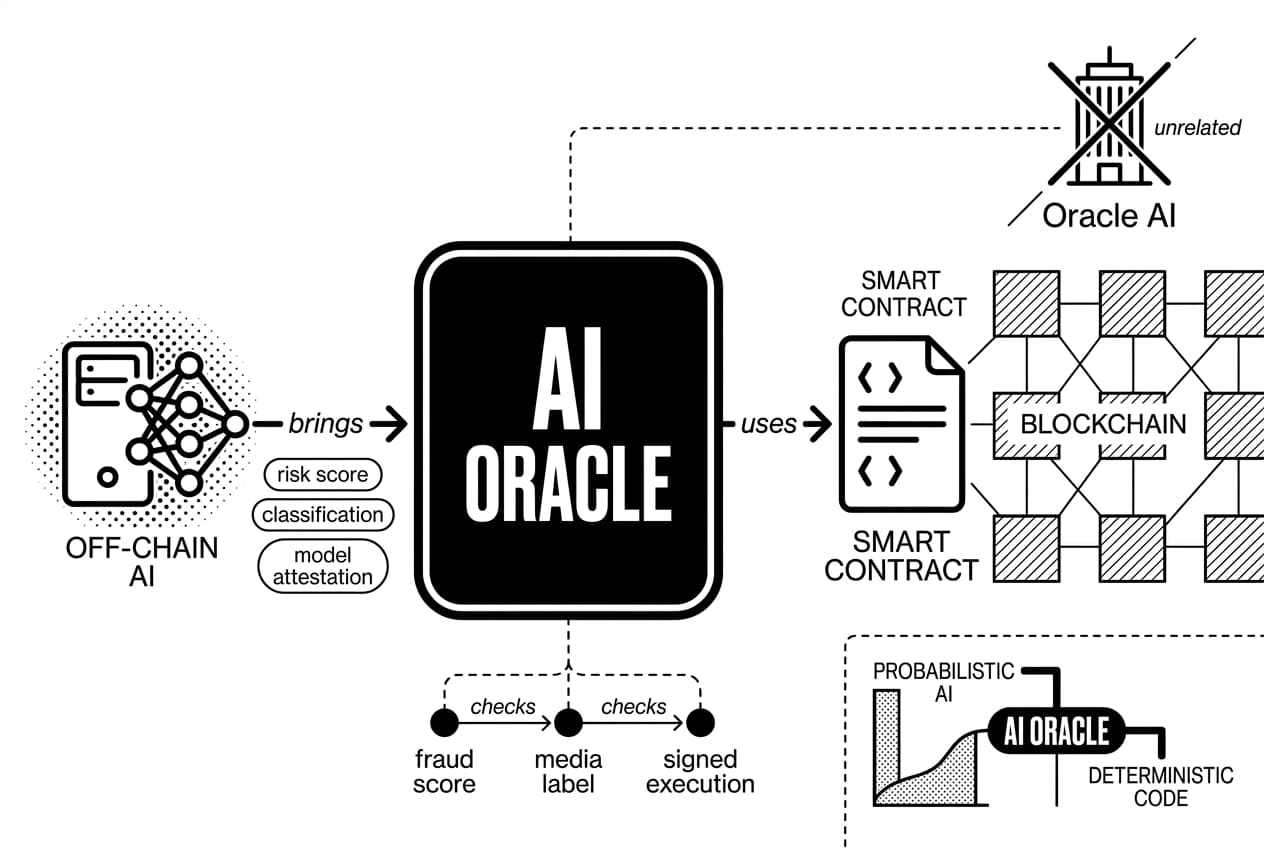
Plain-English version: an ai oracle is the messenger between an AI system that runs outside a blockchain and code that runs on-chain.
Quick note: this article is about crypto oracle infrastructure. It is not about Oracle AI, the enterprise artificial intelligence product line from Oracle. The similar wording causes confusion, but the systems are unrelated.
Why It Matters
Smart contracts are programs stored on a blockchain that execute when predefined conditions are met. They can move tokens, settle loans, mint assets, or pay insurance claims, but they cannot browse the internet, call an AI API, inspect a photo, or judge whether a wallet looks risky. If a contract needs outside intelligence, it needs an oracle. If that outside intelligence is produced by a machine learning model, it needs an AI oracle.
The common pitch says AI oracles will let smart contracts use any AI output and enable fully autonomous on-chain apps. Our narrower view is more practical: the safest near-term value comes from constrained, attestable outputs. A bounded fraud score, a yes-or-no media label, or a signed model execution record is easier to verify than an open-ended agent instruction. Deterministic blockchains need clear inputs. Probabilistic AI systems need guardrails before their results can trigger irreversible transactions.
AI Oracle vs Traditional Blockchain Oracle
A blockchain oracle is any system that delivers outside information to a smart contract. A price oracle, for example, reports ETH/USD from external markets so a lending protocol can decide when collateral is unsafe. Sergey Nazarov, Co-founder at Chainlink Labs, is one of the best-known public figures associated with this oracle problem: how to bring external data into trust-minimized blockchains without reintroducing a single trusted server.
An AI oracle performs the same delivery role, but the payload is not just a price or timestamp. It is the output of an AI computation: a fraud likelihood score, document classification, credit-risk estimate, image label, or signed proof that a specific model ran on a specific input.
Feature | Traditional oracle | AI oracle |
|---|---|---|
Typical source | Exchange, API, weather station, sensor | Machine learning model, neural network, large language model |
Typical output | Price, event result, timestamp | Score, label, prediction, proof of inference |
Main trust question | Did the data come from the claimed source? | Did the claimed model run on the claimed input? |
Result style | Usually stable and numeric | Often probabilistic and confidence-based |
Maturity marker | Chainlink went live on Ethereum mainnet in May 2019 (Chainlink Labs, May 2019) | Still early, with most production-ready designs focused on bounded outputs |
A Useful Analogy
A useful analogy is a sealed court filing. The blockchain is the courthouse record: once filed, everyone sees the same permanent entry. The AI model is an outside expert who reviews evidence elsewhere. The AI oracle is the signed filing service that brings the expert result into the record, with metadata showing who produced it, when it was produced, and whether it was altered in transit.
That analogy matters because it points to the real design issue. The smart contract is not deciding whether the AI model is wise. It is deciding whether a particular result arrived from the expected system under the expected rules.
Why Smart Contracts Need Off-Chain AI Results
Blockchains are isolated by design. Every node in the network must be able to replay the same transaction and reach the same result. That property, called consensus, is how a blockchain keeps one shared state without a central operator. The tradeoff is that smart contracts cannot call external web services directly.
AI systems usually live off-chain because they need large files, fast graphics processors, private data, and frequent updates. Running those models directly on a public chain is usually too slow and too expensive. Ethereum operates around 12-second slots (Ethereum.org, accessed March 2026), while modern AI inference is normally handled in specialized off-chain environments. An ai oracle crypto stack exists because those two worlds have different engineering needs.
Deterministic Blockchains vs Probabilistic AI
Deterministic means the same input always returns the same output. Blockchains require that property because thousands of computers are checking the same code. Probabilistic means a system returns a likely answer, often with a confidence score, rather than a single guaranteed truth. Many AI systems work this way.
That mismatch is manageable only when the contract receives a specific committed result. A contract settling an insurance claim cannot act on maybe. It needs a declared output, a confidence threshold, and a verification trail. Nick Szabo, computer scientist and originator of the smart-contracts concept, helped frame why automated agreements need objective inputs. AI outputs make that old requirement harder because the answer may be probabilistic even when the transaction outcome is final.
Why Not Just Run the Model On-Chain?
On-chain AI can make sense for tiny deterministic models, but most AI workloads still belong off-chain. The obstacles are practical:
- Cost: simple transfers can vary from under $0.10 to several dollars depending on gas conditions (Etherscan Gas Tracker, accessed March 2026). Large model inference would require far more computation.
- Latency: contracts wait for blocks, while AI systems often need fast off-chain processors.
- Storage: model weights can be too large to store economically on-chain.
- Hardware: public blockchain nodes are not built to provide graphics processor capacity for every inference.
- Private inputs: medical, credit, identity, and API data often cannot be published to a public ledger.
The practical pattern is simple: run the AI where it is efficient, then deliver a verifiable result to the contract.
A Brief History: From Price Oracles to AI Oracles
Oracles did not start with AI. They started with a simpler problem: how can a smart contract know the current market price of an asset?
Early DeFi protocols needed price feeds for collateral, liquidations, and trading. A single API feed could work, but it created a single point of failure. If the feed was wrong, offline, or manipulated, the contract could execute bad trades or liquidations automatically.
Decentralized oracle networks reduced that risk by collecting answers from multiple independent nodes and aggregating them before publishing the result on-chain. Chainlink's Ethereum mainnet launch in May 2019 (Chainlink Labs, May 2019) is a useful dated marker for the move from simple feeds toward production oracle networks.
How Crypto Oracles Evolved
After price feeds came weather data, sports results, proof of reserves, cross-chain messages, random numbers, and off-chain computation. AI oracles are a continuation of that path. The blockchain still needs information it cannot produce itself. The difference is that the information is now a model output rather than a raw fact.
Verifiable compute methods help close that gap. A trusted execution environment is an isolated hardware area that can run code and produce an attestation, which is a signed statement about what ran. A zero-knowledge proof is a cryptographic method that can prove a computation was performed correctly without revealing all underlying data. For a deeper architecture view, see our guide on blockchain oracle architecture.
Era | What moved on-chain | Main trust method | Period |
|---|---|---|---|
Single-source feeds | Asset prices from one provider | Operator reputation | 2016 to 2018 |
Decentralized oracle networks | Prices, weather, event outcomes | Multiple node reports and aggregation | 2019 to 2021 |
Off-chain compute oracles | Custom calculations and cross-chain state | Signatures, attestations, proofs | 2022 to 2024 |
AI inference oracles | Scores, labels, predictions, model attestations | Versioned models, attestations, proof systems | 2025 to 2026 |
The trust problem grows as the output becomes more complex. A price can be checked across exchanges. A model label may depend on training data, prompt wording, model version, and inference environment.
How an AI Oracle Works Step by Step
An AI oracle moves a prediction from an off-chain model into a smart contract through four repeatable stages.
- Request: The smart contract posts the task, input reference, model policy, and payment.
- Compute: Oracle nodes run the model or call an approved AI service off-chain.
- Verify: Nodes attach signatures, attestations, proofs, or threshold agreement to the result.
- Deliver: The verified AI result is written on-chain for the contract to use.
Step 1: A Smart Contract Requests an AI Result
The contract emits an event that says what it needs. The request should specify the model policy, accepted data source, output format, confidence threshold, and fee. A vague request such as classify this case is risky. A safer request is classify this document hash with model version X and return one of three allowed labels.
Step 2: Off-Chain Nodes Run or Query the AI Model
Oracle nodes pick up the request. A node is an independently operated computer that watches the blockchain, performs the off-chain work, and returns the result. The node may run the model locally or call an AI service through an API, which is a software interface that lets one system request data from another.
Step 3: The Result Is Verified and Sent On-Chain
The verification layer should answer four questions: which model ran, which input was used, which environment produced the result, and which nodes signed it. Some systems use signed logs. Others use hardware attestations or zero-knowledge proofs. Research on adversarial examples, including Szegedy et al. (arXiv, December 2013), shows why this matters: small input changes can cause machine learning systems to make confident mistakes.
Example transcript format builders should require:
request_id: crop-claim-2026-03-18-004 model_version_hash: 0x91f... input_hash: 0xa44... output_label: eligible confidence_band: high attestation: tee-signed node_signatures: threshold-met action_allowed: payout-review-window
This is not a real claim record. It is an audit template showing the fields a smart contract team should capture before allowing money to move.
Step 4: The Smart Contract Acts on the Result
Once the verified result is on-chain, the contract applies its rule. It might release an insurance payout, block a high-risk transaction, mint an asset, or route the case to manual review. The AI does not need custody of funds. The contract keeps final authority.
Core Components of an AI Oracle Crypto Stack
An AI oracle is not one tool. It is a chain of components, and every component adds a trust assumption.
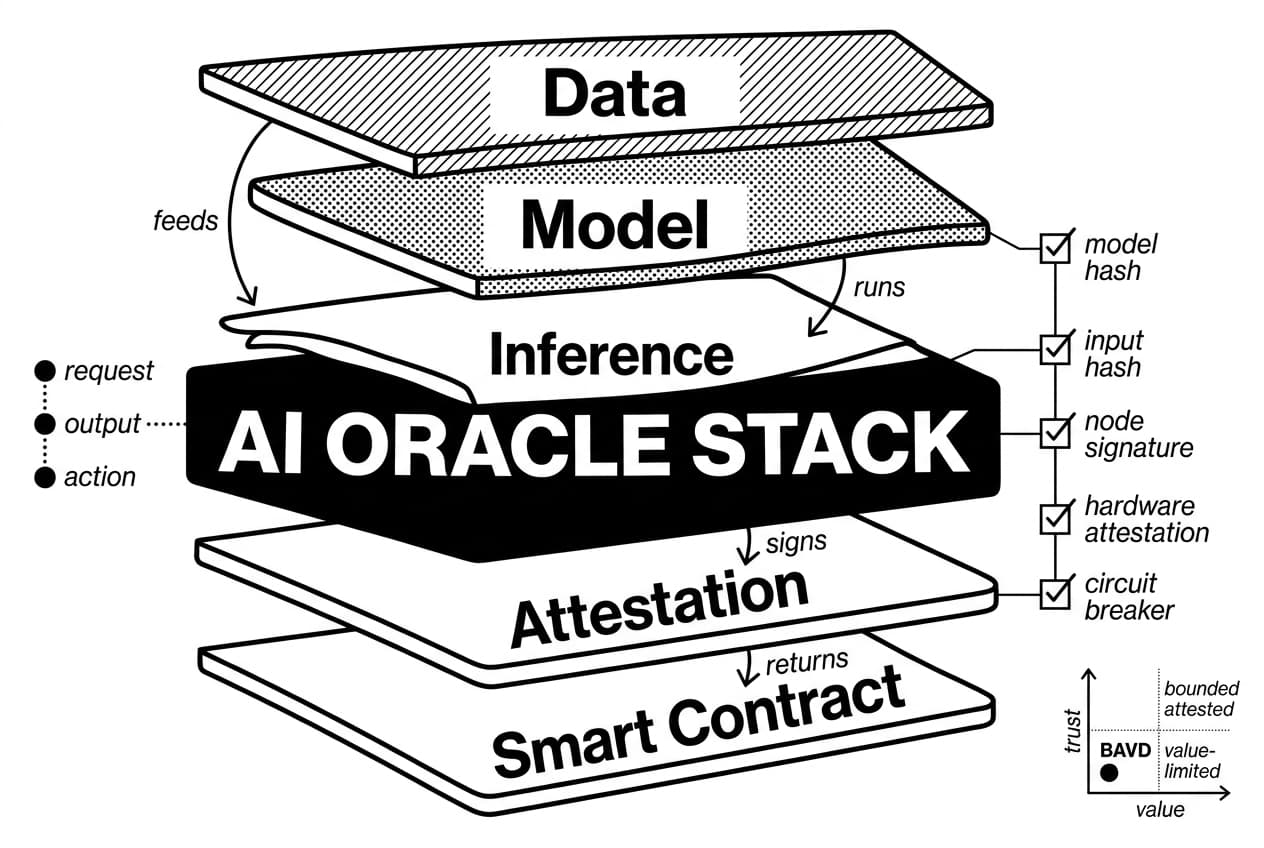
Model, Data, and Inference
- Model: the trained AI system that recognizes patterns or produces predictions.
- Data: the training material that shaped the model, plus the live input submitted for the current request.
- Inference: the act of running a new input through the finished model to get an output.
A safe design tracks all three. If the model changes silently, the contract may behave differently. If the input is tampered with, the output can be wrong. If inference happens in an untrusted setting, the result may not come from the claimed model at all.
Verification and Attestation
An attestation is a signed statement about an execution. In an AI oracle context, it might say that a specific model hash received a specific input hash and produced a specific output inside an approved environment. Vitalik Buterin, co-founder of the Ethereum Foundation, has written about the promise and limits of cryptographic verification for machine learning, including the cost and complexity of proving model execution.
The strongest designs combine several checks: model version hashes, input hashes, node signatures, optional hardware attestations, and circuit breakers. No single check proves everything. Together, they make quiet substitution harder.
The BAVD Safety Framework
For this March 2026 review, we use a simple original framework called BAVD: bounded, attested, value-limited, deterministic fallback. It helps separate AI oracle ideas that are buildable now from ideas that still depend on too much trust.
BAVD check | Question to ask | Safer answer |
|---|---|---|
Bounded | Can the model return only allowed labels or score ranges? | Yes, the output is constrained before deployment |
Attested | Can builders verify model version, input hash, and execution path? | Yes, with signatures, attestations, or proofs |
Value-limited | Can one bad result drain major funds? | No, caps and review windows limit loss |
Deterministic fallback | What happens when the AI result is uncertain or unavailable? | The contract pauses, uses a fallback, or requests review |
Our constrained-use-case matrix favors credit flags, media labels, and insurance eligibility checks over open-ended AI agents. The reason is not that agents are uninteresting. It is that bounded results are easier to audit and safer to wire into money-moving contracts.
Real AI Oracle Use Cases
The strongest AI oracle use cases share one pattern: the AI provides advice in a narrow format, and the smart contract applies a predefined rule. Across AI crypto sectors, this separation is what keeps automation from becoming uncontrolled delegation.
DeFi Risk and Credit Scores
A borrower requests a stablecoin loan. Before funds are released, an AI oracle reviews wallet age, transaction history, repayment behavior, and known fraud signals. It returns a bounded risk band such as low, medium, or high. The contract then applies its rule: approve, reduce the borrowing limit, reject, or send to review.
This is a better design than letting an AI agent move funds directly. Sergey Nazarov, Co-founder at Chainlink Labs, has consistently framed oracle infrastructure as a way to connect external systems to on-chain logic while preserving verifiability. In lending, that means the contract should remain the final decision engine.
Content, NFT, and Media Verification
An AI oracle can classify whether media appears AI-generated, duplicated, or connected to a verified creator identity before an NFT is minted or listed. The contract receives a limited label, not a free-form essay. For a deeper look at this problem, see our guide on proving AI content authenticity on-chain.
Insurance and Real-World Event Checks
Parametric insurance pays when predefined conditions are met. A crop policy, for example, could ask an AI oracle to evaluate satellite imagery and weather data, then return an eligibility label. The contract can pay, reject, or request manual review based on the label and confidence band. This is one of the cleanest AI oracle patterns because the output is narrow and the contract rule is clear.
- DeFi lending: AI scores risk; the contract sets limits.
- NFT minting: AI classifies media; the contract approves or blocks the mint.
- Insurance: AI reviews evidence; the contract triggers or reviews a payout.
- Best practice: the AI output should be a score, label, or attestation, not direct control over funds.
Security Risks and Trust Tradeoffs
AI oracles do not remove trust. They move trust into model selection, data quality, node incentives, execution environments, and verification methods.
The main risks include model manipulation, poisoned training data, prompt injection, bad input data, API downtime, node collusion, privacy leaks, and over-automation. The oracle problem still applies: a blockchain cannot directly verify the outside world. AI makes the problem harder because the outside result may be a probability estimate rather than a simple fact.
Sergey Nazarov, Co-founder at Chainlink Labs, has often emphasized that oracle security depends on economic incentives as well as technical checks. That point is sharper for AI results. A signed bad inference is still bad if the model, input, or node set is compromised.
The Oracle Problem Still Applies
The oracle problem is the challenge of making external information safe enough for smart contracts to use. A price feed can be compared across liquid markets. An AI sentiment label, fraud score, or identity risk flag is shaped by the model and its data. Pair that with encrypted smart contracts, and the audit surface becomes even harder because some inputs or outputs may be hidden by design.
How Builders Can Reduce Risk
- Use multiple oracle nodes and require threshold agreement before high-value actions execute.
- Pin model versions on-chain with hashes so silent model swaps are visible.
- Use bounded outputs such as labels, bands, or numeric ranges instead of open-ended instructions.
- Route uncertain outputs to review rather than forcing the contract to act on low confidence.
- Cap automated value transfer so one bad result cannot drain a protocol.
- Add circuit breakers that pause the contract when results become abnormal or unavailable.
- Restrict admin powers for model updates, oracle submitters, and emergency controls.
Good smart contract access control is part of oracle safety. Only authorized addresses should update model references, submit oracle results, or trigger emergency paths.
Our contrarian view is that AI oracles are not automatically safer because they are smarter. Adaptive models introduce attack surfaces that simple price feeds do not have. The safer path is narrow automation with strong verification.
AI Oracle vs On-Chain AI: Which Should Developers Use?
Once developers understand AI oracles, the next question is whether the AI should run directly on-chain instead. On-chain AI inference can be valuable when the model is small and every step must be publicly verifiable. Most real applications still need off-chain compute.
Quick Decision Framework
Use the BAVD framework here as well. If the result is bounded, attested, value-limited, and has a deterministic fallback, an AI oracle is usually the practical choice. If the model is tiny, fixed, and must be verified by every node, on-chain AI may be worth the cost.
Approach | Best for | Main benefit | Main tradeoff |
|---|---|---|---|
AI oracle | Large models, private inputs, real-world data, frequent updates | Fast off-chain compute with on-chain delivery | Requires trust-minimized verification layers |
On-chain AI | Small deterministic models and public verification | Every inference can be checked on-chain | High cost and limited model size |
Vitalik Buterin, co-founder of the Ethereum Foundation, has discussed why cryptographic verification of AI computation is promising but still resource-intensive. That is the developer tradeoff: maximum transparency costs more, while oracle-based AI needs stronger assumptions about off-chain execution.
For fraud detection, media checks, insurance review, and shifting risk scoring, an ai oracle is usually the better starting point. For a tiny model with fixed weights and public inputs, on-chain AI can make sense.
Key Takeaways
- An AI oracle connects AI to smart contracts. It delivers an off-chain AI result so on-chain code can act without running the model itself.
- Smart contracts need oracles because blockchains are isolated. That isolation protects consensus, but it prevents contracts from calling web APIs or AI systems directly.
- The main risk is verification. Builders must prove the model, input, execution environment, and node signatures are what they claim to be.
- The best 2026 use cases are constrained. Risk scores, media labels, insurance eligibility, and attestations are safer than open-ended AI agents controlling funds.
Frequently Asked Questions
- What is an AI oracle?
- An AI oracle is crypto middleware that carries AI-generated results from outside a blockchain directly to smart contracts. It can deliver scores, classifications, predictions, or attestations produced by machine learning models, giving on-chain code reliable external intelligence to trigger transactions or enforce logic automatically.
- What is an oracle in crypto?
- A crypto oracle is a service that feeds blockchains with external data they cannot retrieve on their own. Common examples include asset prices, weather readings, sports outcomes, and AI model outputs. Oracles are foundational infrastructure for DeFi protocols, real-world asset platforms, and any smart contract that depends on off-chain information.
- What is the best oracle crypto?
- There is no single best oracle network for every situation. The right choice depends on your target blockchain, required data types, decentralization level, security track record, latency needs, and cost tolerance. Evaluate network architecture and real adoption carefully rather than letting token price alone guide your decision.
- What is the most promising AI crypto?
- Rather than one guaranteed winner, several sectors show genuine momentum: AI compute networks, decentralized data marketplaces, agent infrastructure, proof-of-inference protocols, and AI oracles. When assessing any project, prioritize token utility, actual revenue, security audits, and real user adoption over marketing hype.
- Is Oracle AI the same as an AI oracle in crypto?
- No, these are different things. Oracle AI typically refers to Oracle Corporation's enterprise artificial intelligence and cloud computing products. An AI oracle in crypto is blockchain infrastructure designed to deliver machine learning model outputs to smart contracts. The similar names cause frequent confusion, but the two are unrelated.
- How much does an AI oracle cost?
- Costs vary widely depending on blockchain gas fees, oracle network charges, model complexity, data source licensing, verification method, and request volume. A simple classification request can be quite affordable, while GPU-intensive inference jobs or cryptographic proof generation — such as zero-knowledge proofs — carry significantly higher price tags.
Author

Crypto analyst and blockchain educator with over 8 years of experience in the digital asset space. Former fintech consultant at a major Wall Street firm turned full-time crypto journalist. Specializes in DeFi, tokenomics, and blockchain technology. His writing breaks down complex cryptocurrency concepts into actionable insights for both beginners and seasoned investors.