AI NFT Guide: How AI Creates and Validates Digital Art in 2026
AI NFT Guide: How AI Creates and Validates Digital Art in 2026
What Is an AI NFT?
An AI NFT is a blockchain token linked to digital art created, assisted, or checked by artificial intelligence, so the image can be displayed online while ownership, mint date, and transfer history are recorded on a public ledger that collectors can inspect.
Why it matters: if you are an artist, an AI NFT can turn a rough idea into a sellable digital object faster than a manual-only workflow. If you are a collector, the NFT gives you a public ownership trail. If you are a builder, the token can carry access rights, royalties, or membership rules in software.
A few terms make the rest of this guide easier. An NFT, or non-fungible token, is a unique digital record that points to a specific asset. A blockchain is a public database shared across many computers. A wallet is the app or hardware device that controls your blockchain address. A private key is the secret credential that proves you control that address. Minting means creating the token on-chain. Metadata is the structured file that tells marketplaces the artwork name, description, image link, traits, and creator details.
A blockchain works like a public notebook with numbered pages: anyone can read the entries, new entries are added in order, and changing an old page would be visible to the whole network.
Why It Matters for Artists, Collectors, and Builders
The common sales pitch says AI NFT generators make digital art valuable because anyone can produce thousands of images quickly. That is the weakest part of the value story. In 2026, the stronger case is lifecycle quality: clear human direction, documented model use, durable storage, transparent rights, and a community that cares about the work.
The market is no longer treating every image drop as scarce. DappRadar reported $8.8 billion in NFT trading volume in 2024 (DappRadar, January 2025), but volume alone does not prove that a new collection will sell. It proves that buyers still exist and that they have become more selective.
For this 2026 review, we use a named lifecycle framework: the Prompt-to-Provenance Chain. It checks an AI generated NFT across six stages: prompt record, model and license review, human editing notes, metadata quality, storage persistence, and on-chain provenance. The framework is designed for beginners who need a practical way to judge whether an AI artwork is more than a quick output file.
- For artists: AI speeds up drafting, but curation, editing, and rights review still define the final work.
- For collectors: blockchain provenance shows mint date and ownership history, but not automatic legal ownership of the image.
- For builders: NFTs can attach artwork to membership, licensing, access control, or royalty logic.
- For beginners: the safest first project is one carefully documented mint, not a large collection produced overnight.
A Brief History of AI, Generative Art, and NFTs
AI art did not begin with NFT marketplaces. Artists and programmers were using algorithms to create drawings, patterns, and interactive visuals decades before blockchains became popular. Early generative art relied on rules written by humans: rotate a line, repeat a pattern, change a color, or randomize a shape inside set boundaries.
NFTs brought a new piece to that older tradition: a public ownership record for a digital file. The sale most people remember is Beeple's Everydays: The First 5000 Days, which sold for $69.3 million at Christie's in March 2021 (Christie's, March 2021). That sale introduced digital ownership to a mainstream audience, but it should be treated as a rare historical event, not a normal pricing benchmark.
From Algorithmic Art to AI Generated NFT Collections
Early profile-picture NFT collections usually mixed human-drawn traits. A script selected a background, eyes, clothing, and accessories from a fixed set, then assembled a unique character. The machine combined ingredients, but the ingredients were still drawn in advance.
An ai generated nft can work differently. A model can generate a new image from a text prompt, a reference image, or custom training data. The output does not exist until the model predicts it. That shift creates new creative options and new disputes over training data, similarity, authorship, and commercial rights.
How AI Creates NFT Art
The creative pipeline starts with a prompt and ends with a finished file that can be linked to a token. A prompt is a text instruction that describes the image you want. A model is software trained to find patterns between words and images. A diffusion model starts with random visual noise and repeatedly refines it until the image matches the prompt.
The human role is not optional. A creator writes the prompt, chooses settings, rejects weak outputs, edits details, and decides which image deserves to be minted. Artists running larger batches may use decentralized GPU networks for AI generation to rent computing power instead of buying expensive hardware.
Training data matters because it shapes what the model can produce. If a tool was trained on licensed stock images, public-domain art, or opt-in creator datasets, the rights risk may differ from a tool trained on broad internet scraping. A January 2023 report covered artist lawsuits against major image-generation companies over training-data use, and the dispute was still influencing AI art policy in 2026 (January 2023 report).
Prompting, Iteration, and Curation
Professional AI art is rarely one prompt and one click. A creator may test 20 drafts, keep 5, edit 2, and mint 1. A seed number controls the random starting point of a generation, which can help reproduce a result later. A negative prompt tells the model what to avoid, such as extra fingers, distorted text, or blurry backgrounds.
After generation, creators often upscale the file. Upscaling means increasing resolution while preserving detail. Manual editing may follow to fix hands, text, lighting, borders, or artifacts. This is where the Prompt-to-Provenance Chain begins: save the prompt, model name, seed if available, editing notes, export settings, and license terms before minting.
Trait-Based PFP Collections vs One-of-One AI Art
AI NFT art usually falls into two broad categories. A PFP, or profile-picture collection, is a set of avatar-style tokens with different traits. A one-of-one is a single unique artwork represented by one token.
Type | How it is made | Typical supply | Main value driver |
|---|---|---|---|
Trait-based PFP collection | AI creates or refines trait layers, then software combines them | 1,000 to 10,000 pieces | Rarity, community access, and project trust |
One-of-one AI art | Creator generates, edits, and mints one final artwork | 1 token per artwork | Artist reputation, visual strength, and provenance |
PFP projects can build communities quickly because many holders share the same collection identity. One-of-one art depends more on the creator's reputation and the strength of a single piece. Neither format is automatically better. The better choice depends on your goal, budget, audience, and ability to maintain trust after mint.
- Prompts guide the model, while seeds and settings help document how the image was made.
- Human curation is where judgment enters the workflow.
- Training data can affect legal risk and buyer confidence.
- PFP collections scale community ownership, while one-of-one art focuses on individual scarcity.
How AI Art Becomes an NFT on a Blockchain
Once an AI model produces an image worth keeping, the file must be prepared, stored, described, and minted. The image itself usually is not stored directly on-chain because that can be expensive. Instead, the NFT points to metadata, and the metadata points to the artwork file.
Image, Metadata, IPFS, and the Token
The image file is the artwork. The metadata file is a structured description, usually written in JSON, a simple text format that stores labeled fields such as name, description, image link, and traits. The token is the blockchain record that points to that metadata.
Many creators store images and metadata on IPFS, a distributed file-storage network where files are addressed by content rather than by a normal website location. If the file changes, its content address changes too. That makes IPFS useful for proving that the displayed file matches the file originally referenced by the metadata, provided someone continues pinning the file.
Storage choices can decide whether a collection still works years later. If a normal web server disappears, the image can break. If metadata is incomplete, marketplaces may show the wrong traits or fail to display the artwork. A durable AI NFT needs both a valid token and a stable file path.
Once the image and metadata are prepared, they can be attached to a token on a blockchain such as Ethereum, Polygon, Solana, or another network supported by the minting platform.
Wallets, Gas Fees, and Minting Costs
To mint an NFT, you need a crypto wallet. A wallet does not store coins like a leather wallet stores cash. It stores the keys that let you approve blockchain transactions. Beginners can compare browser wallets and hardware wallets in our guide to how self-custody wallets work.
A gas fee is the payment made to process a blockchain transaction. Ethereum gas can change quickly when the network is busy. Polygon fees are usually lower for basic transactions; for example, PolygonScan transaction records commonly showed sub-cent fees during low-congestion periods when checked for this guide in February 2026 (PolygonScan, February 2026). Some marketplaces also support gasless transactions, where a platform or relayer pays the network fee and may recover it elsewhere.
The full minting process has seven core steps:
- Save the final AI image in a marketplace-supported format such as PNG, JPG, GIF, or MP4.
- Pin the image file to durable storage such as IPFS.
- Create the metadata JSON file with name, description, image link, traits, and rights notes.
- Pin the metadata file and copy its content address.
- Connect your wallet to a minting platform or your own smart contract.
- Submit the metadata link, review the transaction, and approve the mint.
- Check the live token, the image display, and the transaction record on a block explorer.
Choosing a chain affects fees, buyer reach, marketplace support, and long-term provenance. Low fees help beginners test, while higher-liquidity chains may offer a larger collector base.
How AI and Blockchain Validate Digital Art
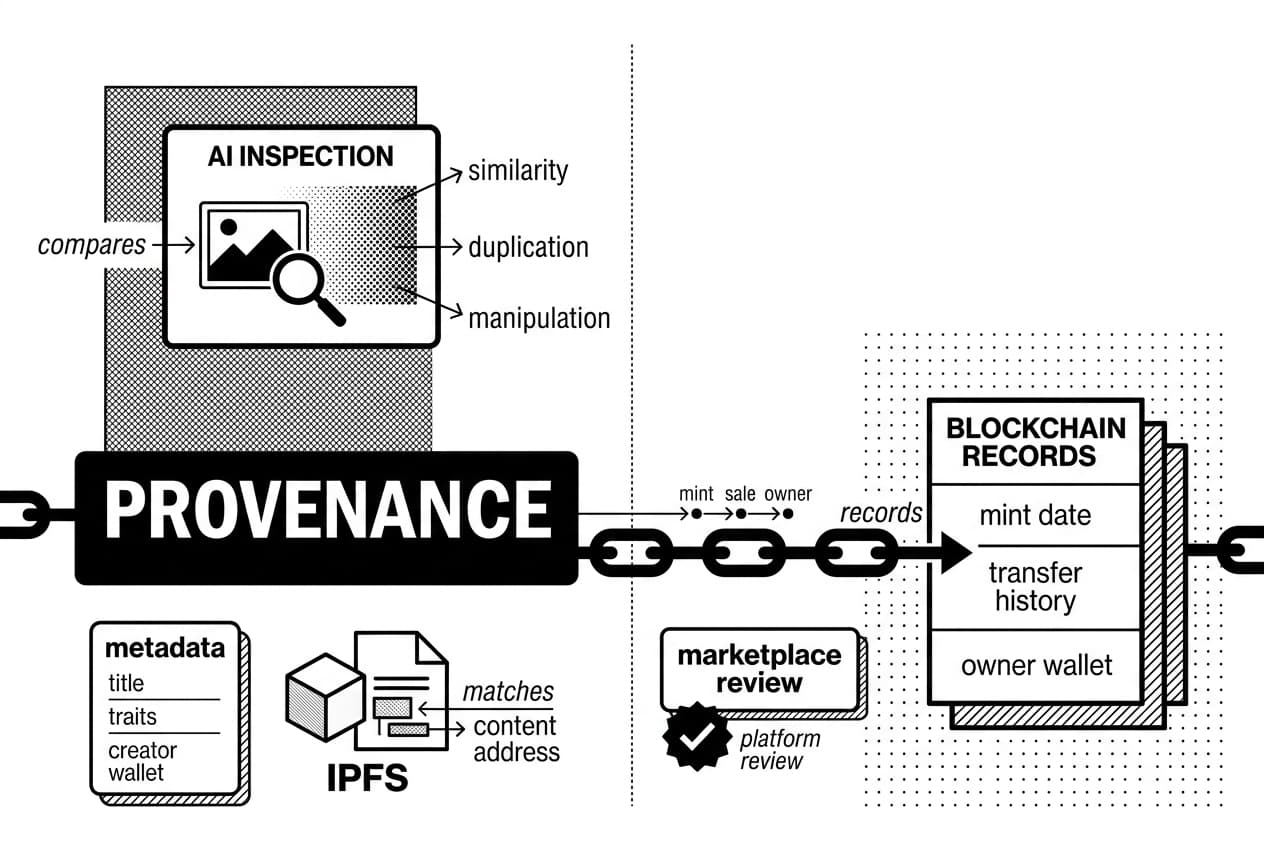
Validation combines two different checks. AI tools inspect the image for similarity, duplication, or manipulation. Blockchain records show when a token was minted, which wallet minted it, and how it moved between wallets. The safest review uses both because each method answers a different question.
Validation method | What it proves | What it does not prove |
|---|---|---|
Blockchain provenance | Mint date, transfer history, and current owner wallet | Legal authorship, copyright ownership, or artistic originality |
Metadata | Stated title, traits, image link, collection name, and creator wallet | That every statement is accurate or legally cleared |
IPFS storage | The referenced file matches its content address | That the file was original when uploaded or will stay pinned forever |
AI similarity checks | Statistical overlap with known images or collections | A final legal finding of plagiarism or fair use |
Marketplace verification | The creator or collection passed a platform-level review | Full rights clearance, future enforcement, or resale value |
Provenance: The Ownership Trail
Provenance means the documented history of creation, ownership, and transfer. In NFTs, provenance is written as blockchain transactions. A collector can see the minting wallet, sale history, and current owner without asking the seller to provide a private receipt.
This matters more for AI art because similar prompts can create similar images. If two artworks look almost identical, the token history may help show which collection minted first or whether a seller is using a copied file. It cannot, by itself, answer every legal question.
AI Detection, Similarity Checks, and Authenticity Signals
AI similarity tools compare a new image against known works or collections. They may inspect pixels, composition, embeddings, trait patterns, or file behavior. A marketplace can use these signals to flag copied images, spam collections, or suspicious listings before buyers interact with them.
The limitation is important: similarity tools produce probabilities, not court rulings. A high similarity score can support further review, but it does not prove intent, license status, or copyright infringement. A low score also does not guarantee originality if a copy was heavily altered.
Balaji Srinivasan, author and investor and former Coinbase technology leader, often frames crypto's public-ledger strength around verifiability. That idea applies well here: NFTs are strongest when buyers can check records themselves instead of relying only on a seller's claim.
What Validation Cannot Prove
Minting first does not automatically give you copyright in the underlying image. It proves that a wallet created a token at a certain time. Copyright and commercial licensing depend on human creative input, tool terms, training data disputes, and local law.
The U.S. copyright agency stated in March 2023 policy guidance (U.S. copyright agency, March 2023) that copyright protection requires human authorship and that purely machine-generated material is not protected by copyright. That guidance still shapes platform policies and creator risk in 2026.
Marketplace rules also matter. A platform may remove listings that violate its content policy, even if the token remains visible on a block explorer. Smart contract access control can also give contract owners powers such as pausing transfers or changing contract settings, depending on how the contract was written.
- Blockchain provenance proves token history, not complete legal authorship.
- AI similarity checks can flag duplicates but cannot decide legal disputes alone.
- Metadata should disclose model use, rights terms, and storage links clearly.
- Storage must be durable because broken image links reduce collector trust.
AI NFT Generators, Tools, and Advanced Features
An AI NFT generator is software that can create images, batch variants, assign traits, export metadata, preview a collection, and sometimes help deploy a token contract. The best tool is not always the one with the prettiest sample images. The better question is whether the tool supports the full Prompt-to-Provenance Chain.
Which Generator Is Right for You?
Use the Eight-Point Selection Test before paying for a tool: image quality, commercial rights, metadata export, blockchain support, network fees, IPFS support, collection-size limits, and beginner usability. If a tool creates beautiful art but gives unclear commercial rights, do not mint the output until the license is clear.
Selection criterion | Why it matters | What to check |
|---|---|---|
Image quality | Low resolution can weaken collector appeal | At least 1024px output or a clean upscaling option |
Commercial rights | You need permission to sell the output | Clear commercial-use language in the terms |
Metadata export | Marketplaces read metadata to display NFTs | JSON compatible with common NFT standards |
Blockchain support | Chain choice affects fees and buyers | Support for the network where your audience trades |
Storage support | Broken files damage long-term value | Built-in IPFS pinning or clear export paths |
Collection size | Batch limits can block large drops | Enough capacity for your intended supply |
Ease of use | Beginners need fewer places to make mistakes | Guided setup, preview tools, and clear warnings |
Network fees | High gas can exceed likely revenue | Lazy minting, low-fee networks, or gas estimates |
OpenSea's creator fee policy, for example, has changed over time, which shows why creators should not rely on assumptions about royalties. The marketplace described its fee and creator-earnings approach in a 2023 creator-fee update (OpenSea, August 2023). Always check current platform terms before launch.
Why Better AI Models Change the Workflow
Newer image models can draft, edit, describe, and refine artwork in fewer steps. That saves time, especially for creators testing mood, color, character design, animation, or layout. This broader model progress is also changing AI crypto sectors, where compute markets, data networks, and autonomous agents are becoming part of Web3 product design.
Better models do not solve the harder business problems. A project still needs rights review, public provenance, thoughtful metadata, collector education, and security. A weak project with better images is still weak if buyers cannot understand who made it, what they receive, and whether the files will remain accessible.
Risks, Copyright, and Market Reality in 2026
Creating an AI NFT is easier than selling one. The biggest risks are oversupply, unclear rights, phishing, misleading profit claims, and fragile metadata. A beginner should treat the first mint as a learning exercise, not a guaranteed investment.
Is an AI Generated NFT Automatically Valuable?
No. Value depends on scarcity, creator reputation, community, rights clarity, aesthetics, and trust. If a tool can generate 10,000 similar images in one session, scarcity has to come from curation, access, story, or verifiable origin rather than raw image count.
Lyn Alden, Founder of Lyn Alden Investment Strategy, has written widely about how durable digital assets need credible scarcity and network effects. That view is useful for AI NFTs: if a collection has no clear reason to exist beyond easy generation, buyers have little reason to keep valuing it.
Collections promising fixed returns or risk-free profit should be treated as scam risks. Read NFT and crypto scam warning signs before connecting a wallet to any mint site. A malicious approval transaction can give a scam contract permission to move tokens from your wallet.
Copyright and Training Data Questions
Copyright is still unsettled for AI art in 2026. The key issue is whether the output reflects enough human creative authorship and whether the tool's training or output violates someone else's rights. A January 2023 federal complaint about image-generator training data remains a useful legal reference point for creators watching the issue (CourtListener, January 2023).
Creators should check the commercial license of the AI tool, avoid prompts that imitate living artists or branded characters, save proof of their own editing choices, and describe AI use honestly in metadata or collection notes. If a collection is marketed as an investment, also review how crypto securities rules apply.
- Value is not automatic: the market rewards trust, rights clarity, and community more than volume.
- Copyright risk remains: tool terms and human authorship both matter.
- Security comes first: verify mint links, contract addresses, and wallet approvals.
- Metadata quality matters: missing files or vague rights terms can hurt resale confidence.
How Beginners Can Create an AI Generated NFT
The safest beginner path is to mint one AI generated NFT on a low-fee network, verify every detail, then decide whether to scale. Do not start with a 10,000-piece collection. Start with a single image, a clear license, and a clean metadata record.
Beginner Workflow: From Prompt to Mint
- Choose a concept. Write one sentence explaining the theme, audience, and reason the artwork should exist.
- Generate draft images. Create 15 to 20 options with varied prompts, settings, and seeds where the tool provides them.
- Edit the best outputs. Fix visible errors, crop carefully, and keep notes on human changes.
- Export the final file. Save the highest accepted resolution and record the file type and size.
- Add metadata with title, description, traits, model disclosure, license notes, and image link.
- Upload the image and metadata to durable storage such as IPFS, then copy the content addresses.
- Connect wallet only on the official minting site, and fund it with a small test amount.
- Mint the token by submitting the metadata link and approving the transaction.
- Verify the listing, image display, metadata fields, creator wallet, and block-explorer transaction.
After the test mint, review the result as a collector would. Does the page explain what was made by AI? Are rights stated clearly? Does the image load from durable storage? Is the creator wallet easy to verify? If any answer is no, fix that before launching a larger drop.
Frequently Asked Questions
- Is NFT still a thing in 2026?
- Yes, NFTs are still active, but the market is far more selective than during the 2021 frenzy. They appear in digital art, gaming items, event tickets, memberships, and collectibles. Generic image collections face weak demand, while projects with real utility, strong communities, and credible creators continue to attract buyers.
- Who paid 69 million for an NFT?
- Vignesh Sundaresan, known as MetaKovan, purchased Beeple's "Everydays: The First 5000 Days" for approximately $69.3 million at Christie's in March 2021. It was a landmark moment for digital art, but it represents a rare historical outlier rather than anything close to a typical NFT transaction today.
- Is NFT worthless now?
- Many speculative NFT collections did lose significant value, but that does not apply across the board. NFTs tied to genuine art quality, gaming utility, access rights, or active communities still hold real worth. The token format itself is not the problem — weak projects with no lasting purpose tend to fade.
- How do I start with NFTs as a beginner?
- Start by learning wallet security, then choose a low-cost blockchain or beginner-friendly marketplace. Make sure you own the rights to any artwork you plan to mint. Prepare your files and metadata, then mint one test NFT before committing real money. Watch out for gas fees and phishing scams from the start.
- Can I create NFTs using AI?
- Yes, you can use AI tools to generate or refine artwork, then mint it as an NFT — provided the tool's terms permit commercial use. Minting creates a blockchain token linked to your file, but it does not automatically resolve copyright questions or confirm that you hold full ownership of the underlying work.
- Are NFTs made with AI?
- Some are fully or partly AI-generated, while others are hand-drawn, photographed, coded, or mixed-media. AI can assist with image creation, trait generation, animations, music, metadata writing, and even fraud validation. Even so, human creators typically handle direction, editing, and curation throughout the process.
Sources
Author

Crypto analyst and blockchain educator with over 8 years of experience in the digital asset space. Former fintech consultant at a major Wall Street firm turned full-time crypto journalist. Specializes in DeFi, tokenomics, and blockchain technology. His writing breaks down complex cryptocurrency concepts into actionable insights for both beginners and seasoned investors.