zkML Guide: Zero-Knowledge Machine Learning Explained Clearly
What Is zkML? A Plain-English Definition
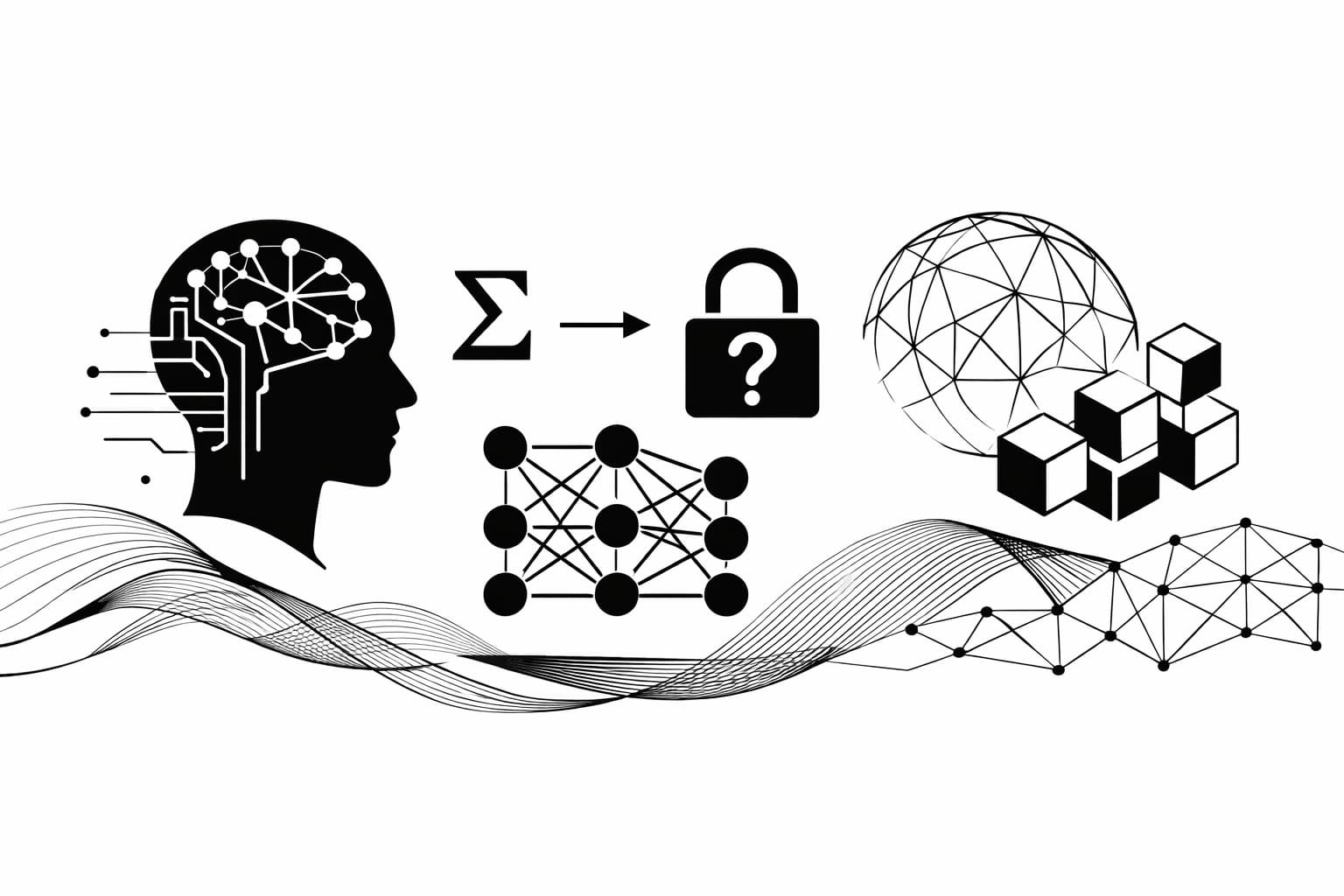
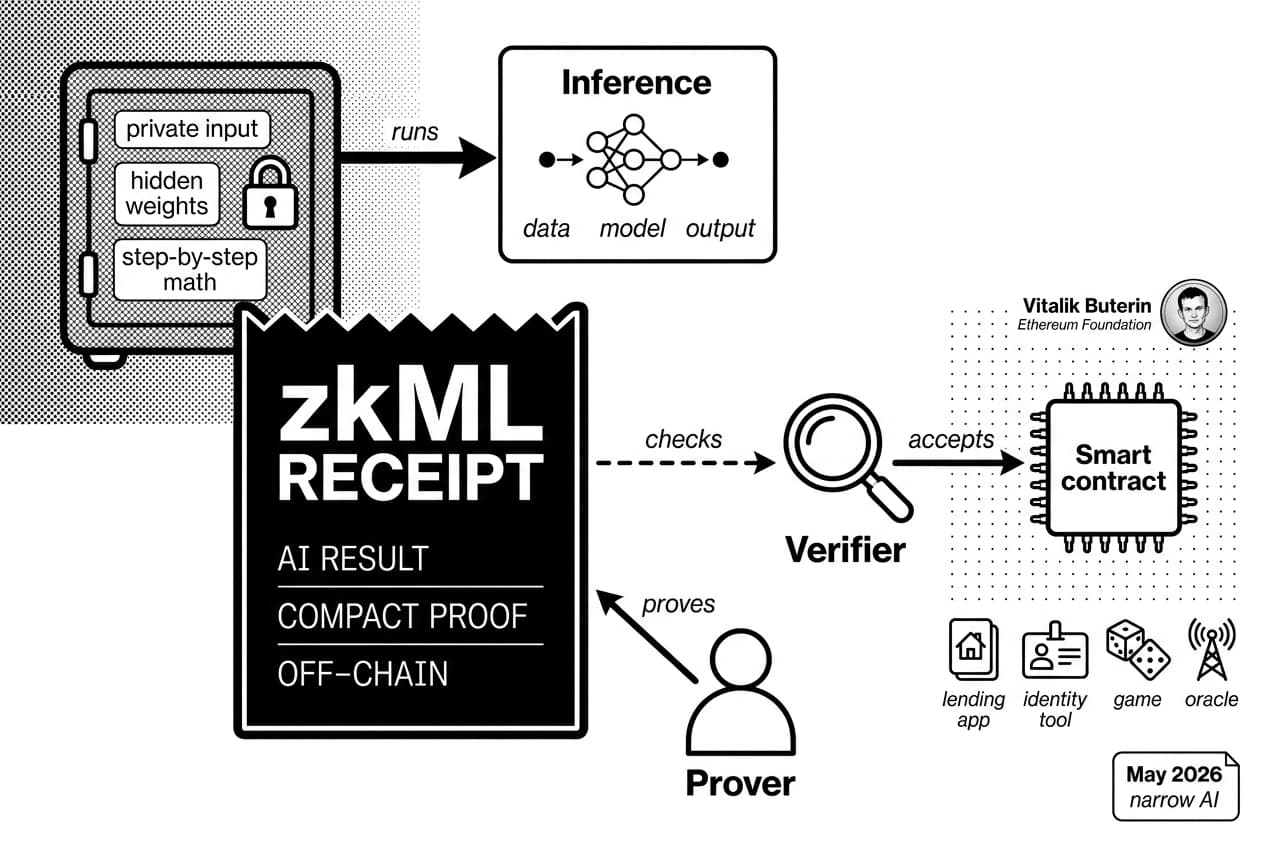
zkML, short for zero knowledge machine learning, is a way to prove that an AI model produced a result correctly without revealing the private input, the model's hidden weights, or the step-by-step math used to reach the answer to anyone checking it. A zero-knowledge proof is a cryptographic method that lets a prover convince a verifier that a statement is true without showing the secret data behind that statement. Machine learning is software that learns patterns from training data and then makes predictions on new data. Inference means running that trained model to get an output.
Why It Matters
As of May 2026, the practical value of zkML is not science-fiction privacy for giant AI systems. It is a verifiable receipt for smaller AI tasks that affect money, identity, reputation, or access. A lending app, identity tool, game, oracle, or model marketplace can check that an approved model produced a result without trusting the server operator to be honest.
Vitalik Buterin, Co-founder at Ethereum Foundation has repeatedly framed cryptographic verification of off-chain computation as a core building block for trust-minimized applications. zkML applies that idea to AI inference. Instead of asking a smart contract to run an expensive model itself, the model runs off-chain and the chain checks a compact proof.
Our editorial view is deliberately practical: zkML's first mainstream wins will come from integrity and accountability for narrow AI inferences. Proving a fraud classifier, age threshold check, bot score, or content provenance classifier is far more realistic in 2026 than proving a full large language model response end to end.
A Practical Analogy: The Tamper-Evident Lab Result
A useful analogy is a tamper-evident lab result. The clinic does not publish every private detail about a patient or every instrument reading. It gives the patient and verifier a signed result that can be checked for authenticity. zkML plays a similar role for AI work: the proof does not reveal everything, but it lets a verifier confirm that the approved computation produced the stated result.
This receipt framing is the simplest way to understand zkML. The output says what the model decided. The proof says the result followed the agreed rules. The verifier can check the proof without rerunning the model or seeing the hidden input.
The Receipt-First zkML Framework
For evaluating zkML projects in 2026, we use the Receipt-First zkML Framework. It asks four questions before a team writes circuits or buys proving hardware:
- What receipt is needed? Define the exact claim to verify, such as score above a threshold or model version produced this label.
- What must stay private? Decide whether the hidden item is the user's data, the model's weights, both, or neither.
- Who verifies the receipt? The verifier may be a smart contract, an auditor, a marketplace, or a user wallet, meaning a blockchain account controlled by a private key.
- What latency is acceptable? A proof that takes minutes may work for credit scoring but not for a real-time game action.
- What happens if the model is bad? A valid proof confirms execution, not fairness, accuracy, or social value.
The Background: From Zero-Knowledge Proofs to AI Verification
Zero-knowledge proofs were formalized in 1985 in the academic paper on knowledge complexity (ACM, 1985). The early idea was simple but powerful: prove knowledge of a secret without revealing the secret itself. Blockchain systems later gave the technique a public proving ground because open networks need ways to verify claims without exposing every private detail.
History: From Private Transactions to Verifiable Compute
Zcash launched in 2016 as an early blockchain system centered on zero-knowledge proofs for private payments (Zcash, 2016). Ethereum scaling later pushed ZK proofs toward another job: proving that off-chain computation was executed correctly. That shift matters for zkML because AI inference is also computation that often happens away from the chain.
A smart contract is blockchain code that runs automatically when its conditions are met. A gas fee is the transaction cost paid to a blockchain network for processing activity. Because machine learning inference can be expensive, most zkML systems do the heavy work off-chain and put only the proof on-chain.
Zero-Knowledge Proofs in One Minute
A zero-knowledge proof has four basic parts. The prover creates the proof. The verifier checks it. The public input is information everyone can see, such as a score threshold. The witness is the private information, such as a user's actual income or wallet history.
The key security property is soundness. Soundness means a dishonest prover should not be able to create a valid proof for a false claim. In plain English, the math should block fake receipts.
Why AI Needed a Proof Layer
AI systems often run behind an API on a server that users do not control. The provider may claim that model version A produced a result, but the user cannot easily tell whether version B was used, whether the input was changed, or whether the model ran at all. That is a verification gap, not just a privacy gap.
This is where zero knowledge machine learning changes the trust model. Instead of trusting the operator, a verifier checks a proof attached to the output. The same principle appears in verifiable compute for AI results, where off-chain work is made auditable through cryptographic evidence.
- ZK proofs began as academic cryptography. Their formal roots go back to 1985 (ACM, 1985).
- Blockchains made verification useful in public systems. Zcash used ZK proofs for private payments after its 2016 launch (Zcash, 2016).
- AI creates a new verification problem. Outputs may matter, but the model often runs on infrastructure the user cannot inspect.
- zkML attaches a receipt to AI inference. The receipt proves the agreed computation produced the result.
How zkML Works Step by Step
At its core, zkML turns an AI model's computation into a checkable proof. The user or application does not need to rerun the model. It only needs to verify that the proof matches the claimed computation.
- Choose your model. Pick the trained AI model you want to make verifiable, such as a small classifier or scoring model.
- Convert it to a circuit. Translate the model's math into an arithmetic format that a proof system can check.
- Run inference. Feed the input data through the model and record the output.
- Generate the proof. The prover creates a compact cryptographic proof that the computation followed the circuit.
- Verify the proof. A verifier checks the proof faster than rerunning the full model.
Step 1: Choose a Model That Fits the Job
Not every model is a good zkML candidate. A lightweight model that checks whether a wallet looks like a bot is a better first project than a large chatbot. The reason is cost: each model operation must be represented in proof-friendly math, so small, fixed computations are easier to prove.
Step 2: Convert the Model Into Provable Math
Neural networks usually use floating-point numbers, activation functions, and framework-specific code. Proof systems work with arithmetic circuits, which are collections of addition and multiplication constraints over finite fields. A finite field is a fixed number system where arithmetic wraps around after a limit, making it easier for proof systems to check.
ONNX, short for open neural network exchange, is a common model format for moving models between machine learning tools. Version 1.0 was announced in December 2017 (ONNX, Dec. 2017). In a zkML pipeline, a model can be exported to ONNX and then compiled into a circuit by tools such as EZKL. Public EZKL releases were active through December 2024 (GitHub releases, Dec. 2024).
Step 3: Run Inference
Inference is the actual AI run. For example, a model may receive private transaction features from a user's wallet and output a risk score. If the app only needs to know whether the score is above 700, the circuit can expose that yes-or-no result while hiding the raw features.
Step 4: Generate the Proof
The prover runs the model and creates a proof. In many designs, the proof is a SNARK, meaning a succinct non-interactive argument of knowledge. Succinct means the proof is small relative to the original computation. Non-interactive means the prover can send one proof without a long back-and-forth conversation.
Research on zkML systems has shown active work on making neural network proofs smaller and faster. One example is the 2023/1272 research entry on zero-knowledge machine learning systems (IACR ePrint, 2023). The takeaway for builders is not that all models are cheap to prove. It is that small and medium inference tasks are moving from research into developer tooling.
Step 5: Verify the Proof
The verifier checks the proof against public parameters and public inputs. The verifier may be a server, a user-facing app, or a smart contract. If the proof passes, the verifier accepts that the approved circuit produced the claimed output. If the proof fails, the app rejects the result.
This off-chain proving and on-chain verification pattern mirrors how many blockchain scaling systems work. Ethereum's documentation explains that rollups execute transactions outside the base chain and post data or proofs back to Ethereum (Ethereum.org, 2026). zkML applies a similar split to AI inference.
What zkML Can Prove: Data Privacy, Model Privacy, and Output Integrity
zkML is not a single privacy button. It is a design space. Before choosing tools, ask what must stay hidden and what must be verified. The answer determines the cost, circuit design, and trust assumptions.
zkML goal | What stays hidden | What is verified | Example use case | Main tradeoff |
|---|---|---|---|---|
Private data, public proof | User's raw data | The model output or threshold result is correct | Credit scoring without exposing income | The user or prover pays extra compute cost |
Private model, verifiable output | Model weights and business logic | The output matches a committed model | Proprietary DeFi risk model | Hiding weights increases circuit size |
Output integrity only | Nothing, or very little | The claimed model actually ran | AI oracle audit trail | No privacy benefit, but lower complexity |
Private Data, Public Proof
In this pattern, the user keeps sensitive information private while proving a result. A lending protocol does not need to see every salary deposit or transaction. It may only need to know that the model score clears a threshold. The proof can confirm that result without exposing the underlying data.
This connects directly to broader Ethereum privacy solutions. The shared theme is selective disclosure: prove what is needed, reveal as little as possible.
Private Model, Verifiable Output
A model owner may want users to trust outputs without copying the model weights. In zkML, the owner can commit to a model in advance, often by publishing a cryptographic fingerprint. Later proofs show that outputs match that committed model.
This is useful for model marketplaces and AI risk engines, but it is harder than hiding user inputs alone. When weights are private, more of the model must be represented inside the proof system. That raises proving cost and makes performance tuning more important.
Output Integrity Without Full Privacy
The simplest zkML setup hides nothing. The input is public, the output is public, and the proof only confirms that the approved model ran correctly. This may sound modest, but it is often the most useful starting point.
For on-chain AI, integrity can matter before secrecy. A smart contract may only need to know that a specific model produced a number. It does not care whether the input is hidden. This is the lightest receipt-first design and a practical first step for many Web3 teams.
May 2026 zkML Readiness Scorecard
The following editorial scorecard is our May 2026 implementation dataset. It is not a market-size forecast. It is a practical readiness rating based on model size, proof latency tolerance, privacy need, and verification value.
Use case | Model size fit | Privacy need | Verification value | 2026 readiness |
|---|---|---|---|---|
Bot or sybil score threshold | Small classifier | Medium | High | High |
DeFi credit risk score | Small to medium model | High | High | Medium-high |
Content provenance classifier | Small to medium model | Low to medium | Medium | Medium |
Full chatbot response proof | Very large model | Variable | High | Low |
Practical zkML Use Cases in Web3 and Beyond
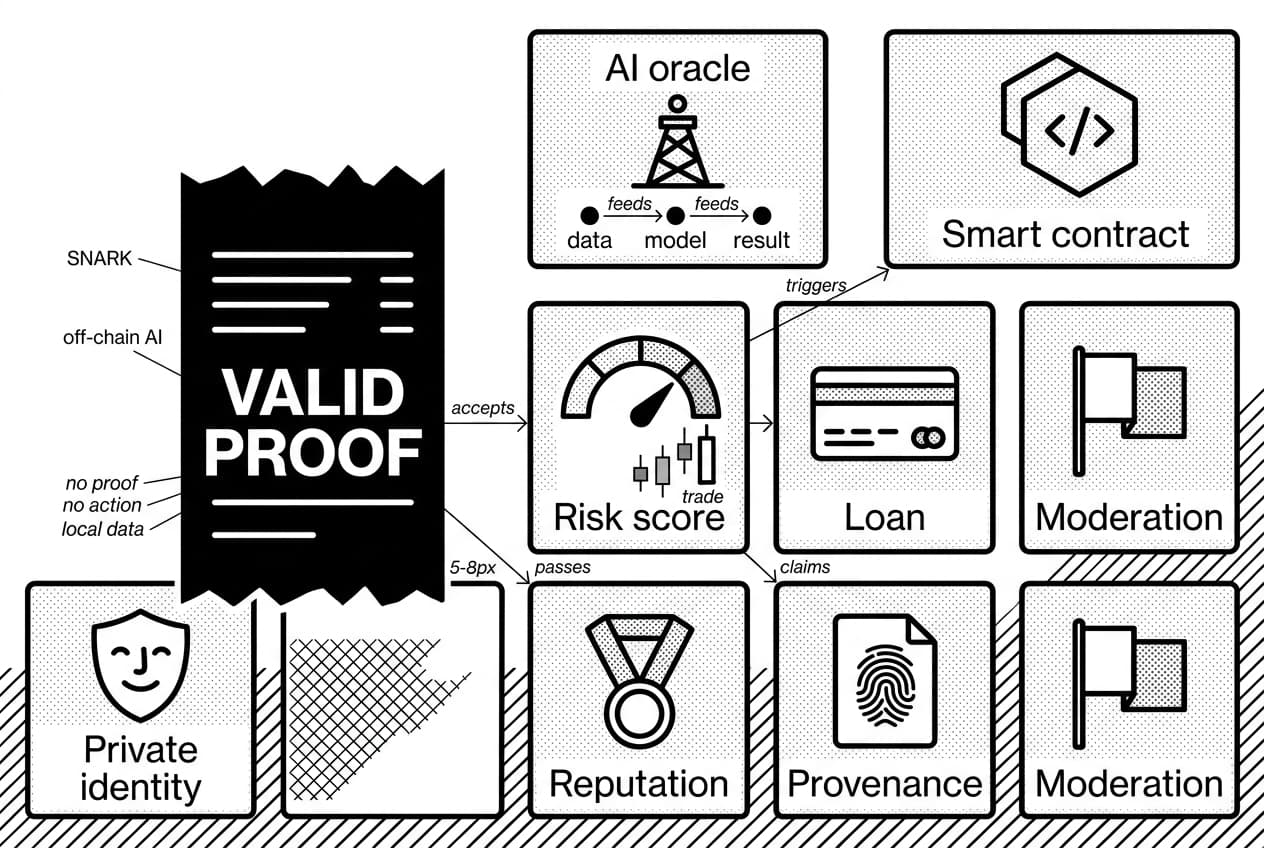
The strongest zkML use cases share one feature: an AI result changes what another system does. If a score triggers a loan, badge, payment, moderation decision, or trade, a proof can reduce blind trust in the operator.
AI Oracles and Smart Contracts
A smart contract cannot directly inspect an off-chain AI server. It can, however, accept a result only when a valid proof comes with it. For example, a lending protocol could require a SNARK proof before accepting an AI-generated risk score. No proof means no automated action.
This is the direction described in AI oracles for smart contracts. Sergey Nazarov, Co-founder at Chainlink Labs has argued that trust-minimized external data is a missing layer between blockchains and real-world activity. zkML extends that idea from data feeds to AI-computed conclusions.
Private Identity and Reputation Scores
Identity and reputation systems often need a result, not the raw evidence. A user might prove that a wallet passes a human-behavior check without publishing the browsing history or transaction graph used by the model. The proof can say the user meets the rule while keeping the private data local.
This use case fits zkML because the models can be narrow. A classifier that outputs pass or fail is much easier to prove than a free-form generative model. It also gives users a stronger privacy story than sending all personal data to a centralized API.
AI-Generated Content and Provenance
zkML can support a narrow provenance claim: a specific model classified a specific piece of content and produced a specific label. That can help publishers, marketplaces, or social apps build audit trails around synthetic-media checks.
It does not prove that the classifier is accurate. A weak model can still produce a valid proof of a weak decision. The broader issue of proving what is real online with blockchain therefore requires model evaluation, provenance records, and human policy choices alongside cryptographic proofs.
Model Marketplaces
Model owners may want to sell access without exposing weights. Buyers may want proof that they received the result from the promised model. zkML can let a marketplace verify inference results while keeping the model itself private. That creates a cleaner separation between model ownership and model accountability.
Across these cases, the pattern is the same: zkML separates the question of execution from the question of trust. It helps answer did this model run as claimed? That is a narrower claim than is this model good?, but it is still valuable for on-chain AI inference.
- AI oracles: Smart contracts can require a proof before acting on an off-chain model output.
- Identity and reputation: Users can prove a threshold result without exposing all source data.
- Content provenance: zkML can verify which model made a classification, not whether the model was wise.
- Model marketplaces: Sellers can protect weights while buyers verify that promised inference occurred.
zkML Tools, Architectures, and Implementation Patterns
Developers usually build zkML systems as pipelines. The model is prepared, converted, proven, and verified. Each step has a different job, and confusing those jobs is a common source of bad architecture.
Common Components in a zkML Stack
- Model file: A saved trained model, often exported to ONNX so other tools can read its structure and weights.
- Circuit compiler: Software that converts the model's operations into arithmetic constraints a proof system can check.
- Proving key: A cryptographic file used by the prover to create proofs for a specific circuit.
- Proof generator: The software that runs inference and outputs the cryptographic receipt.
- Verifier: Code that checks whether the proof is valid.
- Verifier contract: A smart contract that checks proofs on-chain when a Web3 app needs public verification.
Off-Chain Proving, On-Chain Verification
Generating a proof is the expensive part. Verifying it is the cheap part relative to rerunning the model. That is why most zkML systems prove off-chain and verify on-chain only when public settlement is needed.
The pattern is similar to rollups: perform heavy computation elsewhere, then post enough cryptographic evidence for the chain to check. It keeps blockchains from becoming AI servers while still letting them enforce verified results.
Where FHE, TEEs, and zkML Differ
Fully homomorphic encryption, or FHE, lets computation happen on encrypted data. A trusted execution environment, or TEE, runs code inside a protected hardware area. zkML proves that a specific computation happened correctly. These tools overlap, but they do not make the same promise.
Fully homomorphic encryption in blockchain is strongest when data must remain encrypted during computation. TEEs are useful when teams accept a hardware trust assumption. zkML is strongest when public verification of execution matters.
Approach | Trust assumption | Privacy strength | Verification strength | Typical Web3 use |
|---|---|---|---|---|
zkML | Cryptographic proof | High if inputs or weights are hidden by design | High for the proven computation | Verifiable AI inference and AI oracles |
FHE | Cryptographic encryption scheme | Very high for data in use | Medium, depending on protocol checks | Encrypted smart contracts and private queries |
TEEs | Hardware and attestation process | Medium, depending on hardware security | Medium, because attestation is not the same as a proof | Confidential compute and oracle networks |
Traditional AI APIs | Provider reputation | Low, because the provider sees the data | Low, because users cannot independently verify execution | Off-chain AI services without native trust minimization |
A production design can combine these approaches. For example, FHE may protect data during processing, a TEE may isolate an execution environment, and zkML may produce the public receipt that a smart contract can verify.
Challenges and Limits: Why zkML Is Still Hard
zkML is useful, but it has sharp limits. The biggest mistakes come from treating a proof as a guarantee that the whole AI system is good. A proof only covers the statement encoded in the circuit.
Large Models Are Expensive to Prove
Every layer, multiplication, activation function, and comparison must be represented in proof-friendly form. Small classifiers and scoring models are realistic. Large language models with billions of parameters remain difficult for routine end-to-end zkML proofs in 2026.
Quantization can help. Quantization means converting model weights from high-precision numbers into smaller integers. That reduces circuit cost, but it can shift outputs. Builders must test whether the compressed model still behaves acceptably for the use case.
A Valid Proof Does Not Mean a Good Model
A proof can confirm that a model ran correctly while the model itself remains biased, outdated, or poorly trained. If a loan model was trained on unfair data, zkML may produce a perfect proof for an unfair result.
This is the boundary every reader should remember: cryptography verifies execution. It does not validate training data, model quality, governance, or ethics. Audits and evaluation still matter.
Privacy Is a Design Choice, Not Automatic
Using zkML does not automatically hide everything. The circuit designer chooses which inputs are private and which values are public. Outputs, metadata, repeated queries, and timing patterns can still leak information if the system is careless.
Vitalik Buterin, Co-founder at Ethereum Foundation has warned in public writing that cryptographic tools need careful system design to deliver their intended guarantees. That warning applies directly to zkML. The proof system can be sound while the surrounding application leaks data.
Operational Complexity
zkML also adds engineering work. Teams need model conversion, proof key management, circuit audits, prover infrastructure, verifier contracts, and monitoring. A simple API call is easier. zkML earns its cost only when independent verification has clear value.
- Proving cost scales with model complexity. Smaller models are the realistic starting point.
- Quantization trades accuracy for efficiency. Lower-cost proofs may slightly change outputs.
- Proofs verify execution, not model quality. Bad models can still be proven correctly.
- Privacy depends on circuit design. Hidden inputs, public outputs, and metadata must be planned carefully.
- Operations matter. Prover infrastructure and verifier contracts add real maintenance burden.
The Future of zkML: Trustworthy AI, Not Magic AI
zkML will not make AI truthful by itself. It will make a narrower and valuable promise: a verifier can check that a specific model computation produced a specific result under specific rules.
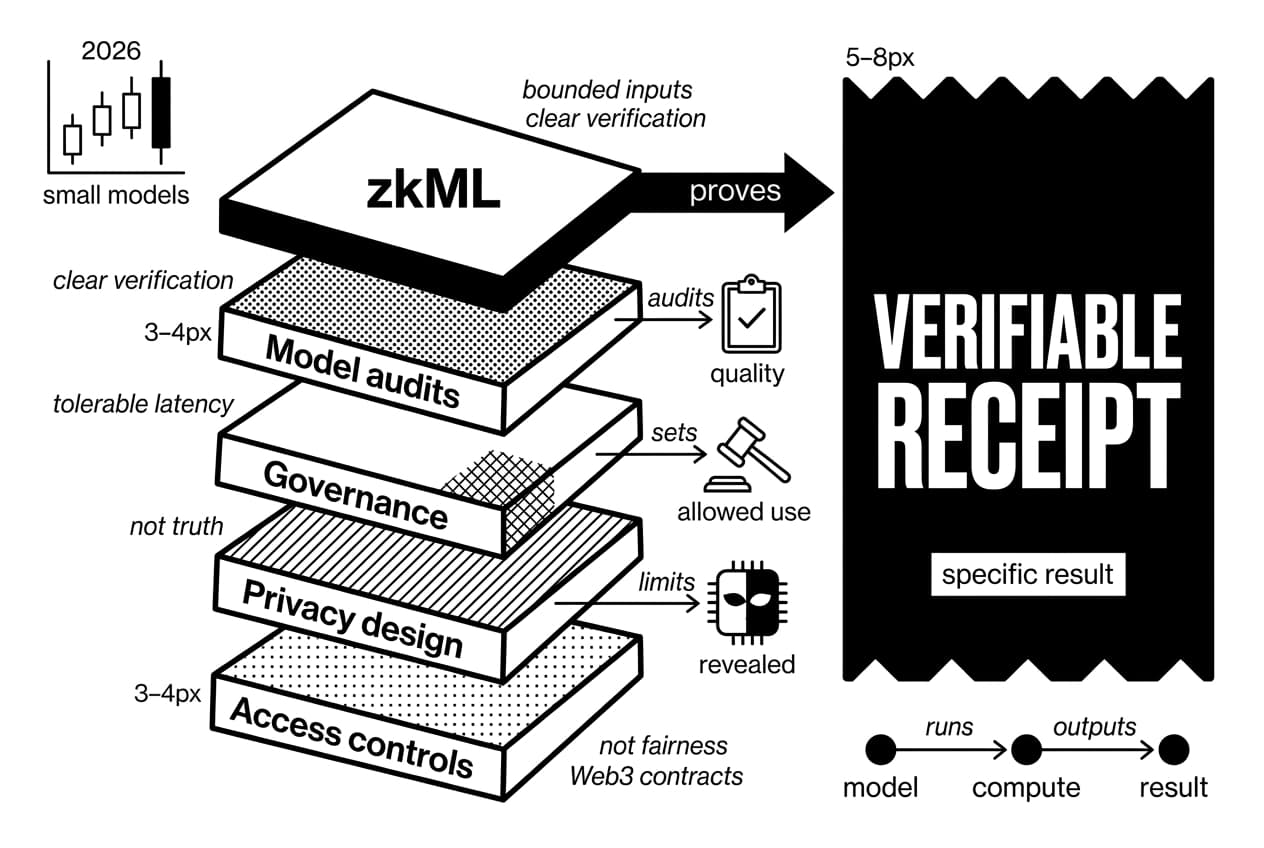
The near-term future belongs to receipt-first systems. Small classifiers, risk scores, identity checks, AI oracle outputs, and model marketplace proofs are better matches than open-ended chatbot proofs. These applications have bounded inputs and outputs, clear verification needs, and tolerable latency.
In our analysis, the best 2026 architectures treat zkML as one layer in a trust stack. zkML handles computation integrity. Model audits handle quality. Governance handles what the system is allowed to do. Access controls and privacy design limit what gets revealed.
The contrarian point is worth repeating: zkML is not mainly about private AI in the abstract. Its first broad wins are more likely to come from accountable AI, where users, contracts, and marketplaces need receipts for small but important inferences.
Key Takeaways
- zkML creates verifiable receipts for AI work. It proves that a model computation happened as claimed.
- Zero knowledge machine learning can hide inputs, weights, or both. Privacy depends on the circuit and product design.
- Small models are the practical starting point. Classifiers and scoring systems are more realistic than full chatbot proofs in 2026.
- A valid proof is not a quality certificate. zkML checks execution, not fairness or accuracy.
- Web3 use cases fit naturally. Smart contracts, oracles, identity systems, and model marketplaces all benefit from independent verification.
Frequently Asked Questions
- Is XRP a ZKP?
- No, XRP is a cryptocurrency that runs on the XRP Ledger blockchain network — it is not a zero-knowledge proof. A ZKP is a cryptographic method that lets one party prove a statement is true without revealing supporting data. While blockchains can integrate ZK technology, an asset like XRP is not itself a ZKP.
- Can you give me an example of a zero-knowledge proof?
- A classic example is proving you are over 18 without disclosing your birth date, address, or ID number. In zkML, this idea scales up: a machine learning model can prove it reached a specific decision or result without ever exposing the user's private input data to the verifier.
- What is a zero-knowledge proof algorithm?
- It is a cryptographic protocol involving a prover, a verifier, a public statement, and a hidden witness. The prover demonstrates knowledge without revealing it. Systems like zk-SNARKs generate compact, efficiently verifiable proofs, making them practical for smart contracts and zkML applications where computation happens off-chain.
- What are zk proofs in blockchain?
- In blockchain, zk proofs let users or applications confirm facts without publishing all underlying data on-chain. Common uses include private transactions, identity verification, regulatory compliance, and layer-2 scaling. In zkML specifically, they allow AI model outputs to be verified on-chain without exposing sensitive training data or user inputs.
Sources
Author

Crypto analyst and blockchain educator with over 8 years of experience in the digital asset space. Former fintech consultant at a major Wall Street firm turned full-time crypto journalist. Specializes in DeFi, tokenomics, and blockchain technology. His writing breaks down complex cryptocurrency concepts into actionable insights for both beginners and seasoned investors.