What Is Ether? ETH, Gas Fees and Ethereum Explained 2026
What is ether? ETH, gas fees and Ethereum explained 2026
What is ether (ETH)? A plain-English definition
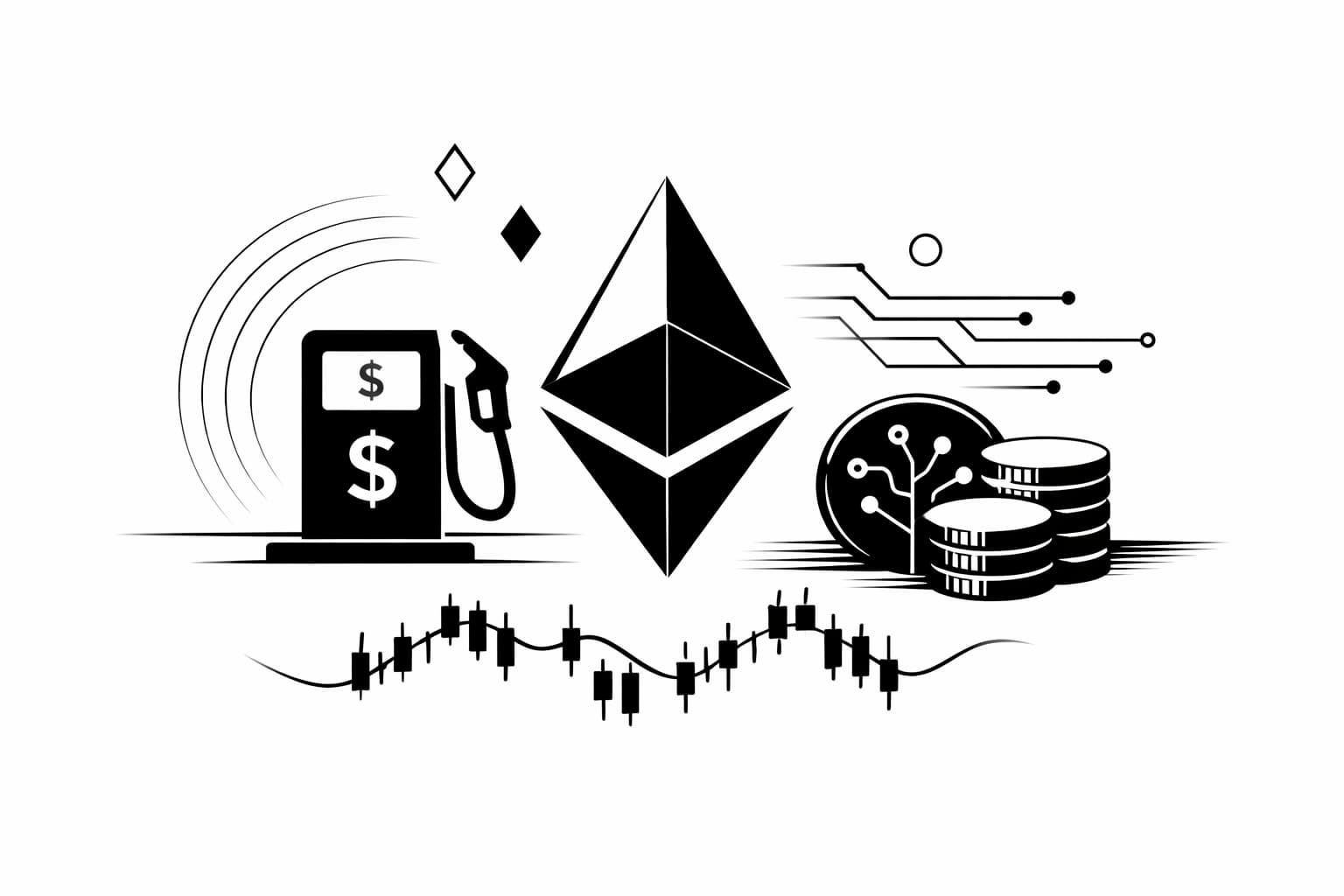
Ether, also called ETH, is the native cryptocurrency of the Ethereum blockchain, used to pay transaction fees, secure the network through staking, transfer value between wallets, and interact with apps that run on Ethereum.
Why it matters
If you are trying to understand crypto in 2026, ETH is one of the first assets you will meet. It pays network fees, acts as collateral in decentralized finance, backs validators who secure Ethereum, and often sits behind stablecoin transfers, NFT purchases, token swaps, and layer-2 activity.
Ether in one sentence
If you searched what is ether, the clearest answer is this: ether is not the chemical solvent, not a biblical reference, and not a spiritual element. In crypto, ether is the digital asset built into Ethereum, and ETH is the ticker you see in wallets and exchanges.
The 3C test for understanding ETH demand
A common shortcut says ETH is just gas for Ethereum. That is incomplete. As of May 2026, a better beginner framework is the 3C test: ETH pays for computation, serves as staking collateral, and helps clear settlement across Ethereum apps and layer-2 networks. That means demand can come from using apps, securing the chain, and settling activity, not only from paying transaction fees.
Vitalik Buterin proposed Ethereum as a programmable blockchain, and ETH became the economic asset inside that design. Hayden Adams, founder of Uniswap, helped show why ETH matters in practice: decentralized exchanges need a reliable settlement asset and fee asset for users moving between tokens.
Ether vs. Ethereum vs. ETH: what is the difference?
These terms are often mixed together, but each one has a separate job. Ethereum is the network. Ether is the asset built into that network. ETH is the market ticker for the same asset.
Term | Meaning | Simple analogy |
|---|---|---|
Ethereum | The programmable blockchain network that runs smart contracts and apps. | The payment rail and app platform. |
Ether | The native cryptocurrency required to pay fees and secure the network. | The asset used inside the system. |
ETH | The ticker symbol for ether in wallets, charts, and exchanges. | The label you see on a market screen. |
Ethereum is the network
A blockchain is a shared digital ledger, meaning a record of transactions copied across many independent computers. Ethereum goes beyond simple payments because it runs smart contracts, which are programs stored on-chain that execute when their conditions are met. Ethereum for beginners explains the wider network for readers who want the next step.
Ether is the native cryptocurrency
Native cryptocurrency means the asset is built directly into the protocol rather than issued by a company account. ETH is required because every Ethereum action consumes computing resources. Without a fee asset, attackers could spam the network at no cost. With ETH fees, every action has an economic cost.
ETH is the ticker
When someone asks what is ETH, they are asking about ether. ETH is simply the abbreviation used by exchanges, wallets, price charts, tax tools, and portfolio trackers. By April 2026, CoinGecko listed ETH among the largest crypto assets by market capitalization, so the ticker is usually what beginners see first.
A brief history of ether
Vitalik Buterin published the Ethereum idea before the network launched, arguing that blockchains could run general-purpose programs rather than only record payments. Ethereum mainnet launched on July 30, 2015, according to ethereum.org history, accessed May 2026. Ether existed from the start because every program execution needed a way to price computation and reward network participants.
Why Ethereum needed its own coin
A decentralized network has no single company paying server bills or deciding which transactions are valid. Ether solved two problems at once. It rewarded participants who maintained the ledger, and it made spam expensive. If every action were free, an attacker could flood the network with pointless transactions.
From mining to staking
Early Ethereum used proof of work, a security method where miners spent computing power to compete for new blocks. On September 15, 2022, ethereum.org says Ethereum completed the Merge and moved to proof of stake, where validators lock ETH as collateral instead of mining. The same ethereum.org Merge page reports that the change reduced Ethereum energy use by about 99.95%, September 2022. That upgrade changed ether from a miner reward into the collateral asset used to secure the network.
How ether works on Ethereum
Every Ethereum action follows a clear sequence. A wallet creates a transaction, the user approves it, ETH pays for the work, validators check the result, and the confirmed record becomes part of the chain.
Blockchain analogy
Think of a blockchain as a shared document that many people can read, but nobody can secretly change after a line is accepted. Ethereum adds a payment rule to that shared record: changing the record requires a valid transaction and a fee paid in ETH. You can inspect real transactions through a block explorer, which is a public search tool for blockchain data.
What gas fees are
A gas fee is the price paid for Ethereum computation. Sending ETH is simple computation. Swapping tokens or minting an NFT is more complex computation. If a user sends 0.05 ETH to another wallet, the user also pays a small ETH fee so validators have an economic reason to include the transaction.
Here is how a transaction moves from request to confirmed record:
- Create transaction: The wallet prepares the recipient address, asset, amount, and network details.
- Sign with wallet: The wallet uses a private key, which is a secret cryptographic credential, to prove the owner approved the action.
- Pay gas in ETH: The transaction includes an ETH fee to pay for the computation.
- Validator checks it: A validator confirms that the signature, balance, and transaction rules are valid.
- Block is added: Valid transactions are grouped into a block and added to Ethereum history.
What validators do
Validators are participants who help confirm Ethereum transactions under proof of stake. Running one validator requires 32 ETH, according to ethereum.org staking guidance, accessed May 2026. That ETH acts as collateral. If a validator breaks rules, part of the stake can be penalized through slashing, which means losing some locked ETH.
What is ETH actually used for in 2026?
ETH is the working asset of Ethereum, not only something people trade. In 2026, its main uses are:
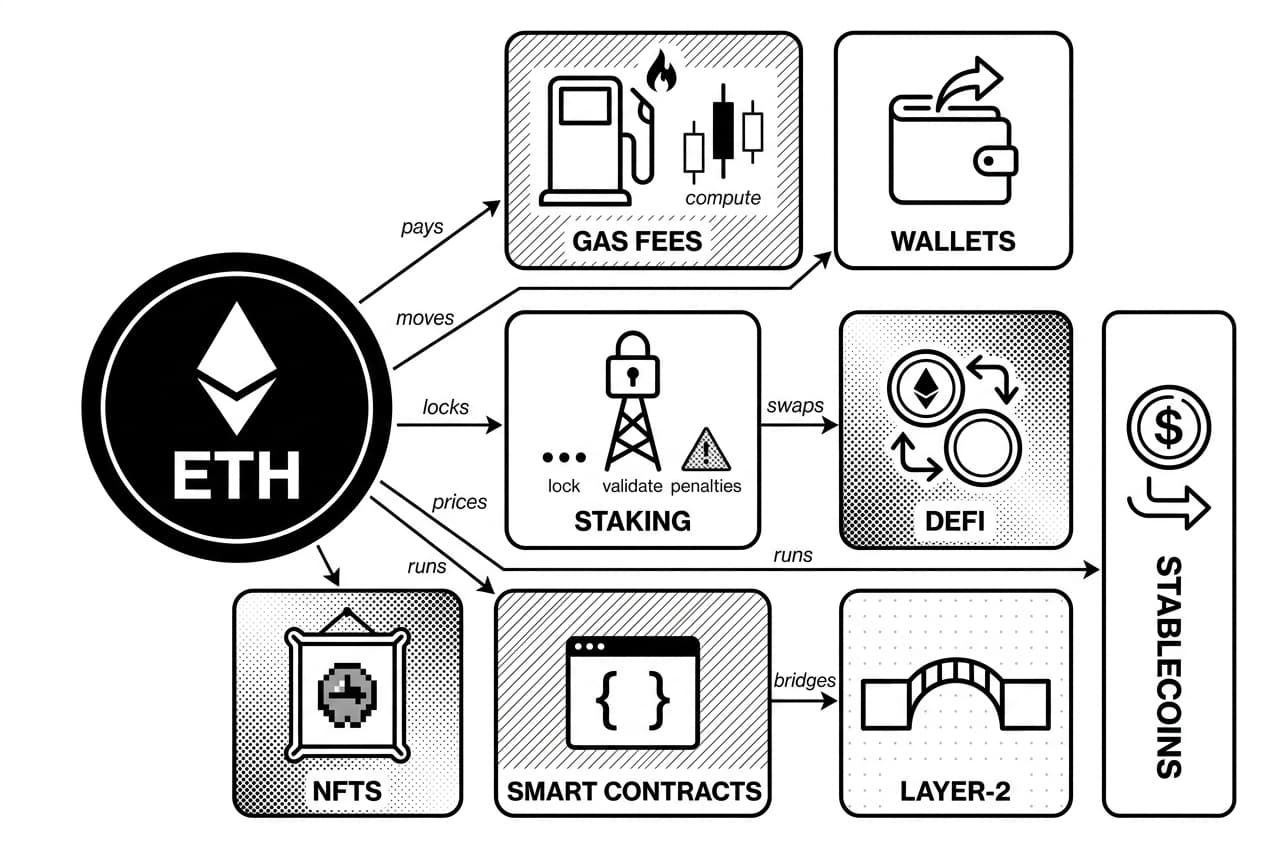
- Pay gas fees for Ethereum transactions.
- Transfer value directly between wallets.
- Stake ETH to help secure the network and earn rewards.
- Interact with decentralized finance, including lending and exchange protocols.
- Buy and sell NFTs on marketplaces that price items in ETH.
- Deploy smart contracts that run decentralized applications.
- Bridge to layer-2 networks for cheaper or faster activity connected back to Ethereum.
Paying gas fees
Every Ethereum action, including sending a token, swapping assets, or creating an NFT, needs ETH for gas. This is true even when the token being moved is not ETH. For example, sending a stablecoin on Ethereum still requires a small ETH balance because Ethereum uses ETH to pay for computation.
Staking and network security
Since Ethereum moved to proof of stake, ETH holders can lock tokens to help validate transactions through staking cryptocurrency. Staking can earn rewards, but it is not a savings account. Funds can be locked, rewards can change, and validator mistakes can create penalties. Vitalik Buterin has consistently framed Ethereum security around incentives, meaning validators should earn more by acting honestly than by attacking the network.
Lending, collectibles, stablecoins, and layer 2s
ETH also moves through decentralized finance, NFT markets, stablecoin transfers, and layer-2 systems. In lending apps, users may post ETH as collateral. In NFT markets, sellers often list assets in ETH. On layer-2 networks, ETH commonly remains the fee or bridge asset. This is why ETH in 2026 is best viewed as a settlement and security asset, not just a payment token.
Ether's supply, fees, and value drivers
ETH supply is shaped by two forces working in opposite directions. New ETH is issued to validators as a reward, while part of certain transaction fees is burned, meaning permanently removed from circulation.
Is there a maximum ETH supply?
Bitcoin has a fixed maximum supply design, but ETH does not have the same hard cap. Ethereum issues ETH to validators, yet the protocol also burns part of the base transaction fee. The fee-burn design came from EIP-1559, which activated with the London upgrade in August 2021, according to EIP-1559.
What fee burning means
Fee burning means a portion of the ETH paid in transaction fees is sent to an address that cannot be spent from. It is not paid to a company, a founder, or a treasury. It is removed from the circulating supply. That ties Ethereum usage directly to ETH supply mechanics.
Why ETH's price changes
No article can reliably predict ETH's future price. Still, the drivers are understandable. More activity can mean more fees. More staking can mean more ETH locked as collateral. Broader crypto cycles, regulation, interest rates, and investor appetite can push prices up or down regardless of Ethereum fundamentals. Lyn Alden often emphasizes that macro conditions matter for risk assets, and that reminder is especially useful for beginners looking at ETH.
- No fixed ETH cap: Supply depends on issuance and burning.
- Fee burning: Part of the base fee is removed from circulation.
- Network use matters: More activity can increase fee burn.
- Staking matters: Locked ETH helps secure Ethereum and can reduce liquid supply.
- No guarantee: Low activity or weak market demand can still pressure price.
How to get, store, and send ether safely
Once you understand what ETH is, the next step is learning how people get it and protect it. The basic paths are buying it on an exchange, receiving it from another wallet, earning it for work, or receiving staking rewards.
Buying or receiving ETH
A common beginner flow is simple: choose a reputable exchange, complete identity checks if required, buy ETH, and withdraw it to a wallet you control. Before any withdrawal, confirm the destination address and the selected network. MetaMask support documentation, 2024 warns that custom networks and wrong-network choices can confuse users, so beginners should slow down before sending funds.
Wallet basics
A wallet does not hold ETH like a leather wallet holds cash. It manages private keys that control blockchain addresses. A seed phrase is a human-readable backup, usually a set of words, that can restore access to a wallet. Store it offline, never photograph it, and never type it into a website you did not deliberately choose.
You will also choose between a custodial vs non-custodial wallet. A custodial wallet means a platform controls the keys for you. A non-custodial wallet means you control the keys yourself, which gives more control but also more responsibility.
Common beginner mistakes
- Phishing sites: Fake exchange or wallet pages steal logins and seed phrases.
- Malicious approvals: Some scam apps ask for broad permission to spend tokens. Learn how to revoke token approvals before you need it.
- Sharing seed phrases: No legitimate support team needs your seed phrase.
- Wrong-network transfers: Always confirm the chain before sending.
If a wallet action feels suspicious, stop and check if your wallet is compromised before approving anything else. Acting before a second approval often matters more than trying to recover funds later.
Is ether a good investment?
ETH may be useful, but usefulness does not make it risk-free. Whether it belongs in a portfolio depends on your goals, time horizon, security habits, and ability to handle volatility. Nothing here is financial advice.
Potential reasons people buy ETH
Some investors buy ETH because they want exposure to Ethereum activity. App usage can create fee demand. Staking can create yield. Lending markets can create collateral demand. ETH is also one of the most liquid crypto assets, which makes it easier to buy and sell than smaller tokens. The positive case is that ETH connects to a real network with measurable activity.
Risks to understand before buying
ETH can fall sharply. From its 2021 peak to its 2022 low, ETH fell roughly 80%, based on CoinGecko historical pricing, 2022. Other risks include phishing, lost seed phrases, smart contract bugs, protocol upgrade errors, tax complexity, and local regulatory limits. Checking Ethereum resistance levels may help with timing research, but no chart removes the risk of loss.
What about buying $100 of Ethereum?
A small purchase can be an educational starting point, but it still deserves care. Fees can matter on small buys. A $100 position can still lose half its value or more. Before buying, compare exchange fees, understand wallet security, and decide in advance whether the money is truly affordable to lose.
- Staking yield is not guaranteed profit: Rewards do not protect against market losses.
- Volatility is normal: Large price swings are part of crypto markets.
- Fees matter: Small purchases are more sensitive to exchange and network costs.
- Security is personal: A lost seed phrase can mean permanent loss.
- Start with understanding: Know what ETH does before deciding how much to buy.
Key takeaways
- Ether (ETH) is Ethereum's native asset. It pays fees, moves value, and supports applications on the network.
- ETH is more than gas. The 3C test explains ETH as computation payment, staking collateral, and settlement asset.
- Staking changed ETH's role. Since the Merge, ETH helps secure Ethereum through proof of stake.
- Fee burning links usage to supply. Since EIP-1559 launched in August 2021, part of the base fee has been burned.
- Risk remains real. Price swings, scams, smart contract bugs, and regulation can all affect ETH holders.
Frequently Asked Questions
- What exactly is ether?
- Ether (ETH) is the native cryptocurrency of the Ethereum blockchain. It powers the network by paying transaction fees, transferring value between wallets, securing Ethereum through staking, and enabling interaction with decentralized applications. It has no connection to chemical ether, which is an entirely different substance used in laboratories and medicine.
- What is ETH actually used for?
- ETH covers Ethereum gas fees, sends value between users, and is staked to help validate the network. It is also used to buy NFTs, access DeFi protocols, deploy smart contracts, and bridge assets across Ethereum layer-2 networks. Even when an app uses other tokens, ETH is often still needed to pay fees.
- How much is 1 ETH worth right now?
- ETH's price shifts constantly based on supply, demand, liquidity, and broader market conditions. No fixed price stays accurate for long. Before making any decision, check a live tracker like CoinGecko, CoinMarketCap, or a reputable exchange for the most current and accurate ETH price in your local currency.
- Is ETH a good investment?
- ETH offers exposure to Ethereum's growing ecosystem, staking rewards, and broader crypto adoption, but it is also highly volatile and carries real risk of loss. Whether it suits you depends on your time horizon, risk tolerance, portfolio diversification, and financial situation. This is not financial advice — consult a qualified professional.
- Is it worth buying $100 dollars of Ethereum?
- A $100 position can work as a small, educational entry point for some beginners, but it is not right for everyone. Transaction fees, exchange costs, local regulations, and your personal risk tolerance all matter. Even a modest amount can drop sharply in value, so only invest what you can genuinely afford to lose.
- What is ether the drug?
- Outside of cryptocurrency, "ether" can refer to chemical compounds such as diethyl ether, historically used as a surgical anesthetic and industrial solvent. This article focuses exclusively on ETH — the native digital asset of the Ethereum blockchain — and has no connection to any medical, chemical, or pharmaceutical meaning of the word.
- What is an ether in the Bible?
- Biblical references to "Ether" are entirely separate from Ethereum. In some scriptural contexts, Ether appears as a place name or proper noun in religious texts. ETH is a modern cryptographic asset created in 2015 and has no historical, theological, or literary relationship to any biblical or religious usage of the word.
- What is ether spiritually?
- In various spiritual and philosophical traditions, "ether" describes a subtle element, celestial space, or unseen medium thought to permeate existence. This meaning is completely distinct from ETH, which is a cryptographic digital asset secured by mathematics and used on the Ethereum blockchain — not a concept rooted in spirituality or metaphysics.
Sources
Author

Crypto analyst and blockchain educator with over 8 years of experience in the digital asset space. Former fintech consultant at a major Wall Street firm turned full-time crypto journalist. Specializes in DeFi, tokenomics, and blockchain technology. His writing breaks down complex cryptocurrency concepts into actionable insights for both beginners and seasoned investors.