How to Buy Ethereum Classic: Step-by-Step ETC Guide 2026

How to buy Ethereum Classic: step-by-step ETC guide 2026
Quick answer: how to buy Ethereum Classic in 2026
This guide shows you how to buy Ethereum Classic from start to finish: compare platforms, pass verification, fund your account, place an ETC order, and decide whether to keep the coins on an exchange or withdraw them. If you want background on the broader Ethereum ecosystem first, read our guide to Ethereum for beginners.
The short version
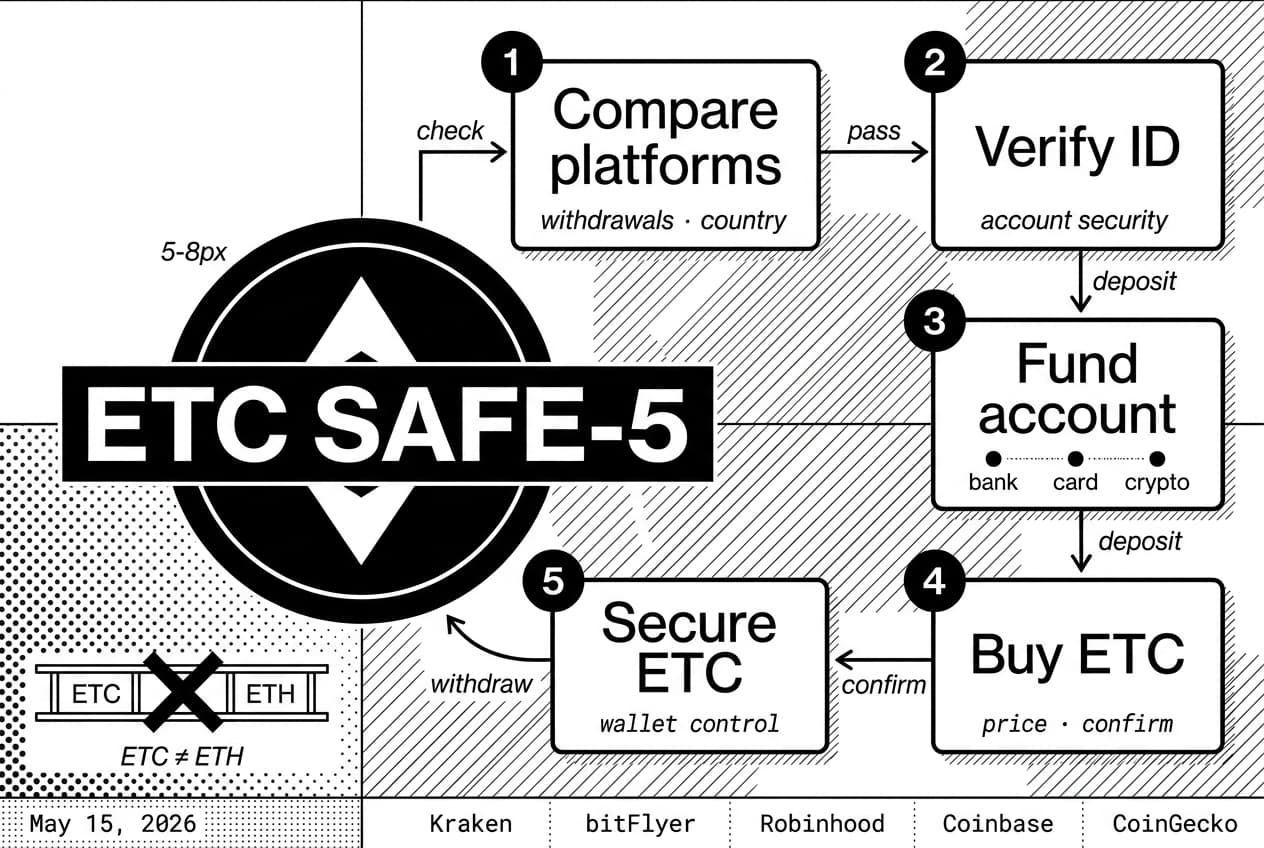
- Choose a reputable exchange that lists ETC and supports withdrawals to an external wallet.
- Verify your account with an ID check before you deposit money.
- Deposit cash by bank transfer or card, or deposit crypto you already own.
- Buy Ethereum Classic by selecting ETC, reviewing the price, and confirming the order.
- Secure your ETC by enabling account protection and, for larger balances, withdrawing to a wallet you control.
Our buying rule is the ETC SAFE-5 framework: support, account security, fees, execution, and final custody. In plain English, do not pick an app only because the first purchase is fast. First confirm that ETC withdrawals work, that the exchange is available in your country, that the total fee is acceptable, and that you can avoid the ETC-versus-ETH network mistake.
Audit note: On May 15, 2026, we reviewed public fee, asset, and wallet-support pages for Kraken, bitFlyer, Robinhood, Coinbase, and CoinGecko. We recorded whether each source showed ETC trading availability, fiat funding, fee disclosures, or withdrawal information. This is not a ranking and not financial advice; it is a practical checklist for a first purchase.
ETC trading volume averaged below $200 million per day on several early-2026 windows, according to CoinGecko, May 2026. That is liquid enough for ordinary retail orders, but it still means spreads, pairs, and withdrawal terms can vary more than they do for larger assets such as Bitcoin or ETH.
For context, Vitalik Buterin and Gavin Wood are both associated with early Ethereum history, while Ethereum Classic is a separate chain with its own ticker, miners, and network rules. Treat ETC and ETH as different assets every time you buy, deposit, or withdraw.
What you'll need before you start
Before you search for a place to buy ETC, gather your account details, ID, and preferred payment method. Having these ready can cut the sign-up process from about 30 minutes to roughly 5 to 10 minutes on exchanges with automated checks, although manual reviews can still take longer.
Account, ID, and payment requirements
Most regulated exchanges require KYC, which means customer identity checks. You will usually upload a government-issued photo ID, such as a passport or driver's license, and complete a selfie or liveness check. Some locations restrict certain exchanges, so confirm your country and state or region before you create the account.
- Email address and phone number: You need these for account notices and two-factor authentication.
- Identity document: Use a clear, unexpired ID. Blurry photos are a common reason verification gets delayed.
- Payment method: Bank transfers are usually cheaper. Cards are faster but often cost more.
- Starting amount: Many platforms set card or bank purchase minimums around $10 to $50; check the exchange's current order screen before funding.
KYC approval can take from a few minutes to 48 hours depending on the platform, your location, and document quality. Coinbase says identity verification is required before many account functions, according to its user agreement, updated 2023.
Optional: a wallet for self-custody
If you plan to withdraw ETC, you need a wallet that explicitly supports the Ethereum Classic network. Do not assume an Ethereum wallet automatically supports ETC withdrawals in the way your exchange requires. Similar-looking addresses are one reason beginners send coins to the wrong network.
Hardware wallets such as Ledger, Trezor, or Tangem are better for long-term storage because the private keys stay offline. Mobile software wallets can be convenient for smaller amounts, but you must confirm ETC network support inside the wallet before sending funds. To compare hardware formats, see our Tangem vs Ledger hardware wallet comparison.
You do not need a separate wallet to complete your first exchange purchase. Still, decide now whether you want exchange custody or self-custody, because that choice affects which platform is best for you.
Step 1: choose an exchange that supports ETC
Start by choosing a platform that lists Ethereum Classic and serves your location. Not every crypto app lists ETC, and not every app that lists it lets you withdraw it to your own wallet.
Compare fees, funding options, and withdrawal support
Check four items before opening an account: country support, deposit methods, trading cost, and ETC withdrawal support. A platform can look cheap at the buy screen but still be a poor fit if it blocks withdrawals or charges a large spread.
As of May 2026, Kraken listed ETC pairs and showed maker fees starting at 0.25% on its public schedule, according to Kraken's fee schedule, May 2026. Other platforms, including bitFlyer and Robinhood, may show different fees, country rules, and wallet features. Always check the current page for your region before you deposit.
Use this table as your comparison worksheet:
Platform type | Payment methods | Typical fees to check | ETC withdrawal support | Best for |
|---|---|---|---|---|
Full-featured centralized exchange | Bank transfer, card, crypto | Trading fee, spread, card surcharge, withdrawal fee | Usually yes, but confirm the ETC network page | Buyers who may want self-custody later |
Regional exchange | Local bank transfer, card, supported fiat balance | Spread, deposit fee, withdrawal fee | Often yes, but region rules vary | Users who want a licensed local option |
Broker app | Linked bank account, card, cash balance | Spread, instant-buy markup, withdrawal limits | Sometimes limited or unavailable | Small first purchases where convenience matters |
Peer-to-peer marketplace | Bank transfer, online payment app, cash arrangement | Price premium, escrow fee, withdrawal network fee | Usually yes through direct wallet transfer | Buyers in regions with limited exchange access |
The hidden cost many beginners miss is the funding surcharge. A card purchase can add 1.5% to 3.99% before the trading fee or spread, based on examples shown in Coinbase fee disclosures, May 2026. For a $300 purchase, that can mean about $4.50 to $11.97 in card cost before any market movement.
Warning: not every crypto app lets you withdraw ETC
Warning: Some broker-style apps let you buy price exposure to ETC but do not give you a normal on-chain withdrawal path. If you later want to move ETC to a hardware wallet, you may have to sell, transfer cash, and buy again elsewhere.
Self-custody means you control the private keys. Exchange custody means the platform controls them. If a platform freezes withdrawals, suffers a hack, or fails, your access can be delayed or lost. CoinDesk's FTX coverage is a useful reminder that exchange failure risk is not theoretical, based on events reported after the 2022 FTX collapse, CoinDesk.
A quick test: search the platform help center for ETC withdrawal or Ethereum Classic network. If you find a fee page and wallet-address instructions, keep checking. If you only find a trading page with no wallet instructions, treat that as a red flag.
Step 2: create and verify your account
Once you choose a platform, open the account from the official website or verified app-store listing. Type the URL yourself or use a saved bookmark. Do not click exchange links from ads, social posts, or unexpected emails.
- Open the official sign-up page: On many exchanges, the button is in the top right of the homepage. If the app uses different wording, confirm the domain before you tap it.
- Enter your email: Use an email account that already has strong protection and account recovery enabled.
- Create a unique password: Use a password manager and do not reuse a password from another site.
- Confirm your email: Click the verification link from the exchange. If it does not arrive within two minutes, check spam and confirm the sender domain.
- Complete the ID check: Upload your ID, complete the selfie step, and wait for approval before depositing funds.
Secure your login before depositing money
Enable two-factor authentication with an authenticator app rather than SMS if the exchange allows it. SMS codes are vulnerable to SIM-swap attacks, where a criminal convinces a carrier to move your phone number to another device.
Also create an anti-phishing habit. Bookmark the exchange after your first verified login. If an email tells you to log in urgently, close the email and open the exchange from your bookmark instead.
Pro tip: verify first, fund second
The most avoidable beginner problem is depositing money before KYC is finished. Verification can clear in minutes, but some reviews take up to 72 hours during busy periods or when documents are unclear. If funds arrive while your account is under review, you may be unable to trade or withdraw until approval is complete.
Wait until your dashboard shows that buying and withdrawals are enabled. Then add money. That small pause can prevent a much longer support ticket.
Step 3: deposit cash or crypto
With verification complete, add funds using the lowest-cost method that fits your timing. Your funding choice affects both speed and total cost.
Choose the cheapest funding method
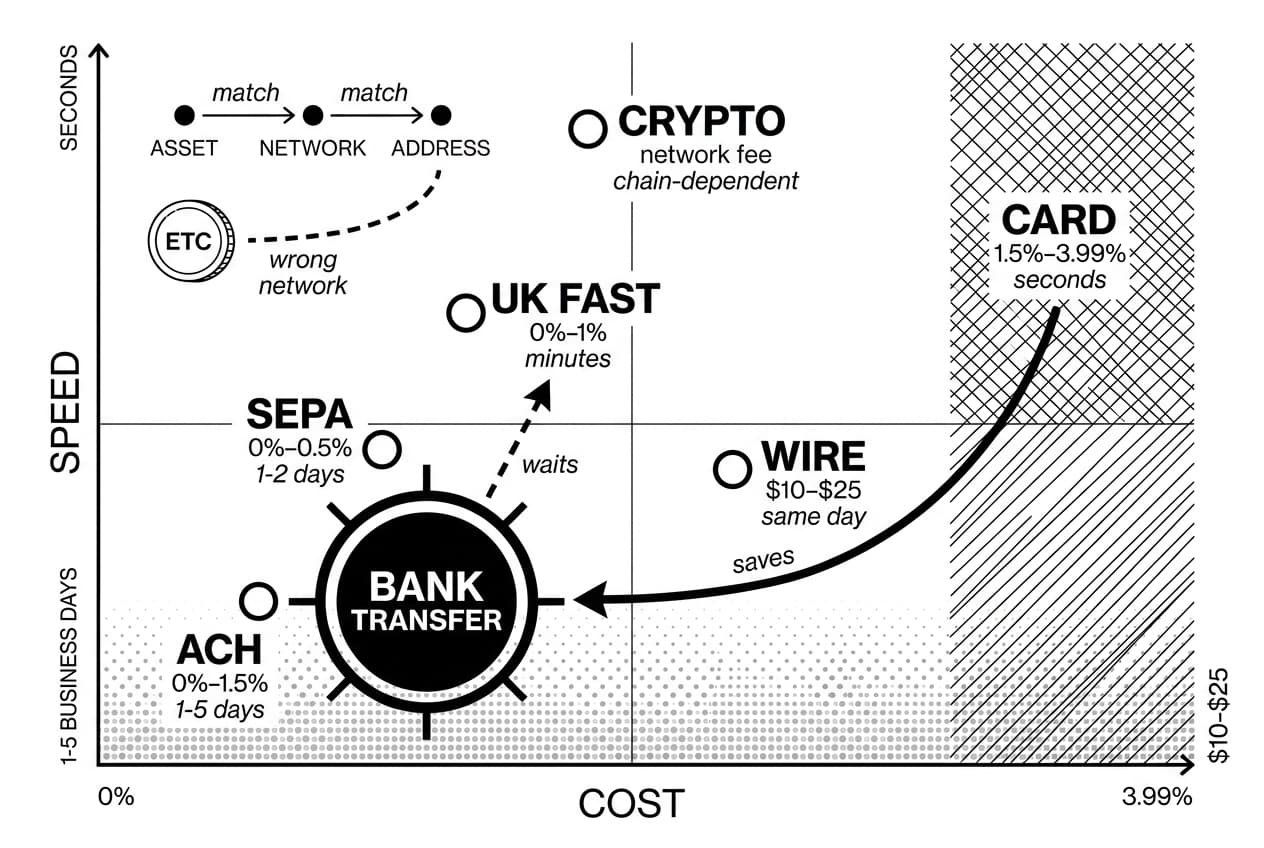
Bank transfers are usually the cheapest option for new buyers. ACH in the US and SEPA in Europe often cost 0% to 1.5%, while card purchases can cost 1.5% to 3.99% depending on the platform and region, according to Coinbase fee disclosures, May 2026. Wire transfers may be faster for large amounts, but bank fees of $10 to $25 can make them poor value for small purchases.
Method | Typical fee | Speed | Best for |
|---|---|---|---|
ACH in the US | 0% to 1.5% | 1 to 5 business days | Low-cost bank funding |
SEPA in Europe | 0% to 0.5% | 1 to 2 business days | EU bank transfers |
UK fast bank transfer | 0% to 1% | Minutes to 1 business day | UK bank funding |
Wire transfer | $10 to $25 flat bank fee | Same day to 2 business days | Larger deposits |
Debit or credit card | 1.5% to 3.99% | Seconds to minutes | Speed over cost |
Crypto deposit | Network fee only | Minutes, chain-dependent | Users who already hold crypto |
For most first-time buyers who are not in a rush, a bank transfer plus a normal trading screen is the better deal. You may wait longer, but your break-even price is lower because fewer fees are deducted at the start.
Warning: deposit on the correct network
If you fund your account by sending crypto from another wallet, match three things exactly: asset name, network name, and deposit address. A deposit address is not just an account number. It is tied to a specific blockchain network.
For example, sending a stablecoin on one chain to a deposit address for another chain can leave the funds stuck or unrecoverable. If you are moving more than a small amount, send a $5 to $10 test transfer first and wait for confirmation.
Warning: Ethereum Classic and Ethereum are separate networks. Never send ETH to an ETC deposit address, and never send ETC to an ETH-only address. Check the asset ticker and network label before you confirm.
Step 4: buy Ethereum Classic (ETC)
After your cash or crypto balance arrives, you can place the order. The exact screen differs by exchange, but the review process is similar: select ETC, enter the amount, choose an order type, review fees, and confirm.
Use a market order for simplicity
A market order buys ETC immediately at the best available price. On a simple buy screen, choose Ethereum Classic or ETC, enter the amount you want to spend, click the preview or review button, then read the final quote before you confirm.
The price on the first screen and the final fill can differ slightly. That gap is called the spread. For a small purchase it may be minor, but it still counts as part of your total cost.
Use a limit order for price control
A limit order lets you name the maximum price you are willing to pay. For example, if ETC trades near $20 and you set a buy limit at $18.50, the order only fills if the market reaches your price.
ETC has had wide short-term ranges, as shown in CoinGecko historical data, May 2026. A limit order can help you avoid overpaying during a sudden spike, but it may never fill.
Consider a recurring buy only if it fits your plan
Recurring buys, often called auto-buy or DCA, purchase a fixed amount on a schedule. This can reduce the pressure of picking one perfect entry price.
Watch the fee math. If an exchange charges $1.99 on a $10 recurring buy, the fee is almost 20% before spread. Recurring buys make more sense when the per-order amount is large enough that fixed fees stay near 1% or less.
Before confirming, read the review screen line by line. Confirm the asset says ETC or Ethereum Classic, not ETH. Then check the total fee, the expected amount of ETC, and whether the order is market or limit.
Step 5: store or withdraw your ETC safely
After the trade fills, decide where the ETC should live. The right choice depends on your balance size, trading plan, and comfort with self-custody.
Exchange custody vs self-custody
Leaving ETC on the exchange is easier. You can log in with your password and 2FA, and account recovery is usually possible if you lose access. The risk is that the exchange controls the private keys.
Self-custody means you move ETC to a wallet where only you control the keys. A hardware wallet is the safer option for amounts that would hurt to lose. Before withdrawing, read our guides on how to set up a Ledger wallet or how to set up a Trezor wallet.
Approach | Key benefit | Key risk | Best for |
|---|---|---|---|
Exchange custody | Easy access and account recovery | Exchange controls the keys | Small balances and active traders |
Self-custody software wallet | You control the keys | No support desk can recover a lost seed phrase | Moderate balances and regular transfers |
Self-custody hardware wallet | Keys stay offline | Device cost and setup responsibility | Long-term storage and larger balances |
A reasonable path is to start with exchange custody for a small first purchase, then move to a hardware wallet once the balance becomes meaningful. Write your seed phrase offline and never store it in cloud notes, email, or a photo gallery.
Warning: ETC is not ETH
Critical mistake alert: Ethereum Classic and Ethereum are separate blockchains. Sending ETC to the wrong network can result in permanent loss.
This is the withdrawal error to fear most. The two networks can use similar-looking address formats, so you must rely on the network label, not only the address shape. If you are unsure about how ETH and Ethereum work versus ETC, read that explainer before withdrawing.
Send a test withdrawal first. For example, send a small amount, wait for the wallet to show the deposit, and only then send the rest. Withdrawal fees on major exchanges often ranged from 0.001 to 0.01 ETC in early 2026, as reflected by exchange and market data reviewed against CoinMarketCap, May 2026.
Double-check the first four and last four characters of the destination address. One wrong character can make the transaction unrecoverable.
Costs, timing, risks, and common mistakes
Before you click the final confirm button, run through the costs and risks. A few minutes of checking can save you more than the trading fee itself.
Fees to check before buying ETC
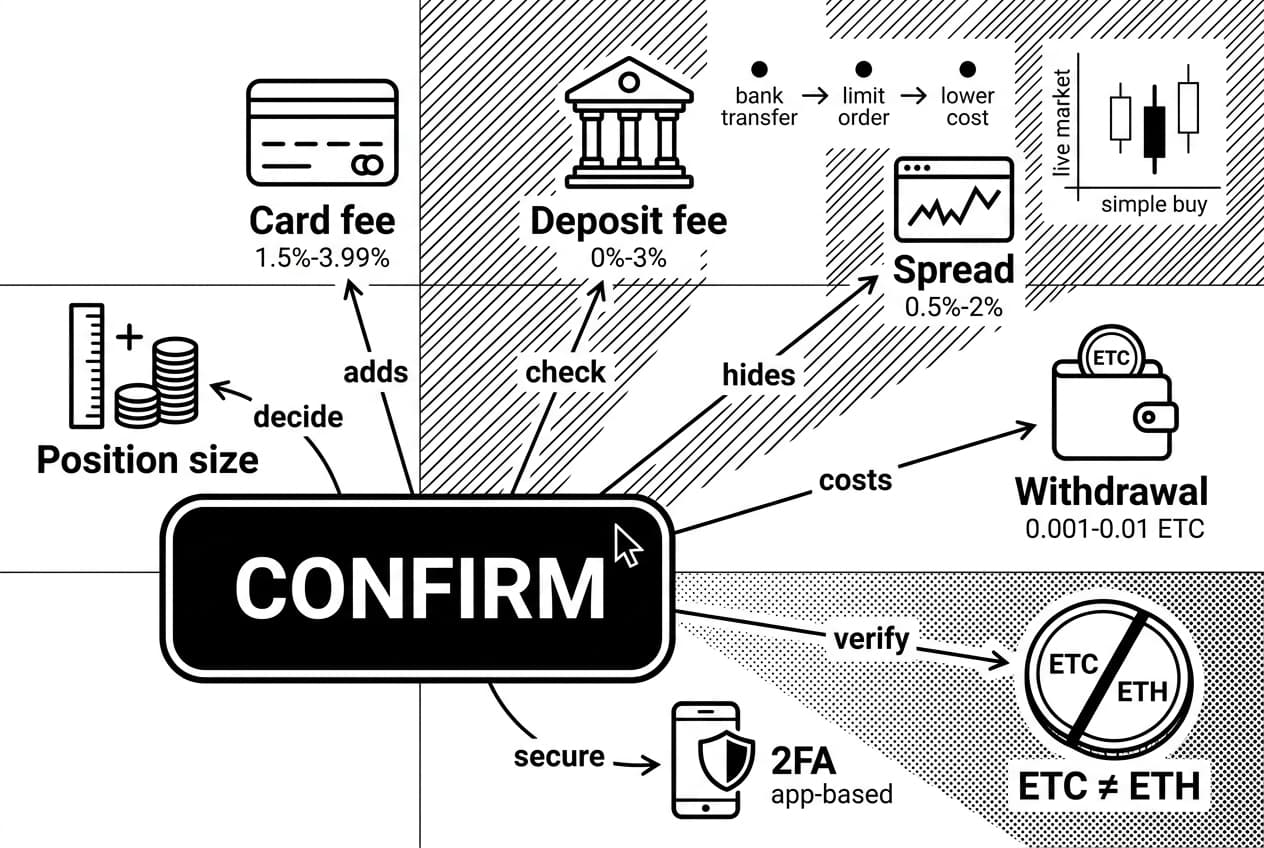
- Deposit fee: Some platforms charge 0% to 3% depending on payment method and region.
- Card fee: Card purchases often cost 1.5% to 3.99%, according to Coinbase fee disclosures, May 2026.
- Trading fee: Coinbase's help page showed a 0.60% taker fee for some lower-volume advanced trades, according to Coinbase help page, January 2026.
- Spread: Simple buy screens may quote a worse price than the live market. This can add 0.5% to 2% on some trades.
- Withdrawal fee: Moving ETC off an exchange can cost a flat fee, often shown as 0.001 to 0.01 ETC on exchange fee pages in 2026.
- Network fee: The ETC chain also charges a small transaction fee when coins move on-chain.
On a $200 card purchase through a simple buy screen, a 3% card fee plus a 1.5% spread would cost about $9 before any withdrawal fee. A bank transfer and limit order can reduce that cost, especially once your purchase size grows.
Common beginner errors
- Confusing ETC with ETH: Ethereum Classic and Ethereum have different tickers, prices, communities, and networks. Check the ticker before every order.
- Using the wrong withdrawal network: Always choose the Ethereum Classic network when sending ETC.
- Skipping two-factor authentication: Turn on app-based 2FA before depositing money.
- Buying with no plan: Decide your position size before you buy. ETC supply is capped at about 210.7 million coins, according to ethereumclassic.org, May 2026, but scarcity alone does not remove market risk.
- Ignoring volatility: ETC fell more than 60% in parts of the 2022 bear market, according to CoinGecko historical data, 2022. Do not buy with money you need for bills.
- Forgetting tax records: Purchases, sales, and swaps can create tax records in many jurisdictions. Save order confirmations from day one. If you need help, read our guide to finding a crypto tax accountant.
- Leaving a large balance on an exchange: If the amount matters to you, consider a wallet withdrawal. After self-custody, watch for the warning signs your wallet is compromised.
- Falling for giveaway scams: No legitimate project asks you to send ETC to receive more ETC back.
For market-cycle context, Willy Woo publishes on-chain models that remind buyers to think in probabilities, not price promises. Use data to size risk, not to convince yourself that a trade cannot go wrong.
Frequently Asked Questions
- Where can I buy Ethereum Classic?
- Ethereum Classic is listed on many major exchanges, including Kraken and bitFlyer, and some broker apps like Robinhood where available. Before signing up, compare trading fees, accepted payment methods, country restrictions, available liquidity, and whether the platform lets you withdraw ETC to your own wallet.
- Is it worth buying Ethereum Classic?
- ETC may interest investors who want exposure to a proof-of-work smart contract network, but it is highly volatile and not right for everyone. Consider your risk tolerance, investment horizon, and portfolio size, and make sure you understand how ETC differs from Ethereum before putting any money in.
- How much will Ethereum Classic be worth in 5 years?
- No one can reliably predict ETC's price five years out. Its value will depend on broader market cycles, developer activity, miner incentives, network usage, regulatory changes, and demand for proof-of-work assets. Rather than banking on a single forecast, build a few scenarios — conservative, moderate, and bullish — to guide your thinking.
- Will Ethereum Classic hit $1,000?
- Reaching $1,000 per ETC is theoretically possible under very bullish conditions, but it is far from guaranteed and would require a substantially higher market capitalization than ETC has ever achieved. Before treating that target as realistic, look at the implied market cap relative to current supply, adoption trends, and historical price cycles.
Sources
Author

Crypto analyst and blockchain educator with over 8 years of experience in the digital asset space. Former fintech consultant at a major Wall Street firm turned full-time crypto journalist. Specializes in DeFi, tokenomics, and blockchain technology. His writing breaks down complex cryptocurrency concepts into actionable insights for both beginners and seasoned investors.