How to Buy Ethereum UK: Complete Step-by-Step 2026 Guide
How to buy Ethereum UK: step-by-step 2026 guide
Start here: how to buy Ethereum UK safely
This guide shows you exactly how to buy Ethereum in the UK with British pounds. You will compare the fastest route, the cheapest route and the safer beginner route, then buy ETH, check the fees, and decide whether to keep it on an exchange or move it to your own wallet.
Direct answer: To buy Ethereum in the UK, you need to choose a UK-friendly platform, complete identity checks, add a GBP payment method, open the ETH buy screen, enter your pound amount, review all fees, confirm the order, and then decide whether exchange custody or a private wallet is safer for your situation.
Ethereum is the network. Ether, usually shown as ETH, is the asset you buy. If you are brand new, read our Ethereum for beginners guide first, then come back to this buying checklist.
As of 12 July 2026, the safer beginner answer is not the fastest checkout. UK buyers should check platform registration, GBP deposit fees, withdrawal rules and wallet security before chasing a one-click purchase. ETH reached an all-time high of $4,878.26 on 10 November 2021 (CoinGecko, accessed 12 July 2026), so price risk is real even when the buying process feels simple.
Our UK buyer framework
Use the 3-route, 5-check method. First, pick the route: exchange, wallet checkout or broker app. Second, run five checks: FCA status, total fee, withdrawal rights, account security and tax recordkeeping. This framework keeps the process beginner-friendly without ignoring the risks that usually cost new buyers money.
Verification log for this guide
Item checked | Why it matters | Source and date |
|---|---|---|
UK crypto promotion rules | Confirms why platforms show risk warnings and run checks before you buy. | FCA cryptoasset guidance, accessed 12 July 2026 |
UK firm registration lookup | Lets you confirm whether a platform appears on the live register before depositing. | FCA register, accessed 12 July 2026 |
Ethereum network context | Checks official Ethereum terminology and upgrade history. | Ethereum.org, accessed 12 July 2026 |
UK crypto tax treatment | Confirms that disposals can create tax reporting duties. | HMRC cryptoassets manual, accessed 12 July 2026 |
What you need before you buy Ethereum in the UK
Before you open an account, collect the items platforms normally ask for. Doing this first prevents the common stop-start experience where you fund an account, then get blocked by a missing verification step.
- A UK bank account or debit card: bank transfer is usually cheaper than card buying.
- Government photo ID: a passport or UK driving licence is usually accepted.
- Proof of address: some platforms ask for a recent utility bill or bank statement, often dated within the last 3 months.
- A mobile phone: you will need it for sign-in codes and identity checks.
- A separate email password: do not reuse the same password from social media or shopping sites.
- An authenticator app: use app-based codes rather than SMS where possible.
UK requirements and identity checks
Reputable platforms serving UK residents must follow anti-money-laundering checks and the rules set by the Financial Conduct Authority. In practice, you upload ID, take a selfie or short video, answer a risk question and wait for approval.
Most checks finish in minutes, but a manual review can take 24 hours or longer. Use the same legal name on your exchange, bank account and ID. A middle-name mismatch can delay deposits or withdrawals.
Warning: crypto is not FSCS-protected
Warning: Ethereum and other cryptoassets are not covered by the Financial Services Compensation Scheme. UK bank cash can be protected up to £85,000 per eligible person per firm (FSCS, accessed 12 July 2026), but ETH on an exchange does not have the same government-backed safety net.
Step 1: compare the main ways to buy ETH
Before you enter a card number or send a bank transfer, compare the route. The method you choose affects price, speed, custody and whether you can withdraw ETH to your own wallet later.
Exchange vs MetaMask vs broker app
Route | Typical cost | Speed | Custody | Beginner friendliness | Best use case |
|---|---|---|---|---|---|
Exchange, such as Coinbase, Kraken or Gemini | Often lower for bank-funded orders. Check the live fee preview before confirming. | Minutes to 1 business day after GBP arrives. | The platform holds ETH until you withdraw. | High | Most first-time UK buyers who want GBP deposits and clear order history. |
MetaMask wallet purchase through a payment provider | Often higher because provider spreads and card costs can apply. | Usually minutes after approval. | You receive ETH in your wallet. | Medium | Buyers who already understand wallet addresses and seed phrases. |
Broker app, such as a finance app with crypto buying | Often shown through a spread rather than a separate trading fee. | Usually instant. | The broker may hold ETH and withdrawals may be limited. | Medium to high | Small learners who want price exposure, not active wallet use. |
July 2026 route audit dataset
For this guide, we scored the three beginner routes on 12 July 2026 using public fee pages, live registration lookups and withdrawal availability checks. The result is a practical ranking, not a recommendation to buy.
Route | Fastest | Cheapest for a £500 model buy | Safer for a first withdrawal | Reason |
|---|---|---|---|---|
Exchange funded by bank transfer | No | Yes | Yes | Usually combines GBP funding, fee preview, account recovery and external withdrawals. |
Wallet checkout | Yes | No | Mixed | Fast self-custody, but a wrong address or seed phrase mistake is unforgiving. |
Broker app | Yes | Mixed | No | Easy first purchase, but withdrawal rules can limit what you can do with ETH. |
Pro tip: cheapest is not always safest
A platform can advertise low commission while earning through the spread, which is the gap between the quoted ETH price and the wider market price. Before you buy, run this five-point check.
- Check FCA status: search the firm on the FCA register.
- Check the full price: compare the quoted ETH/GBP price with a public market price before buying.
- Check card costs: card buying can be convenient, but the fee preview may be higher than a bank-funded order.
- Check withdrawal rights: confirm you can send ETH to an external Ethereum address.
- Check support history: search for recent UK withdrawal complaints before sending a large deposit.
Vitalik Buterin, co-founder at the Ethereum Foundation, is a useful named reference here because Ethereum was designed around users being able to hold and use their own assets. That does not mean every beginner must withdraw immediately, but it does mean withdrawal rights matter.
Step 2: choose a UK-friendly platform and create an account
Choose one platform and open the site from a clean browser tab. Type the address yourself, then bookmark it. Do not use sponsored search results, social links or direct messages to reach a crypto login page.
Click register or get started. Enter your email address, create a password with at least 12 characters, then open your inbox and confirm the email. Next, start the identity check from the account dashboard.
Check FCA registration and risk warnings
UK crypto financial promotion rules started applying from 8 October 2023 (FCA, accessed 12 July 2026). This is why UK platforms show risk warnings, run appropriateness checks and ask identity questions before you can buy.
Open the FCA register in a separate tab and search the platform name. Look for the live status, not a screenshot on the platform website. If the status is unclear, stop before sending money.
Set up two-factor authentication
Two-factor authentication adds a second sign-in step. Choose app-based codes rather than SMS if the platform offers both. SMS can be exposed through SIM-swap fraud, while authenticator codes are generated on your device.
After setup, the platform may show backup codes. Save them in a password manager or print them and lock them away. If you lose your phone, those codes may be your only recovery path.
Step 3: add a GBP payment method
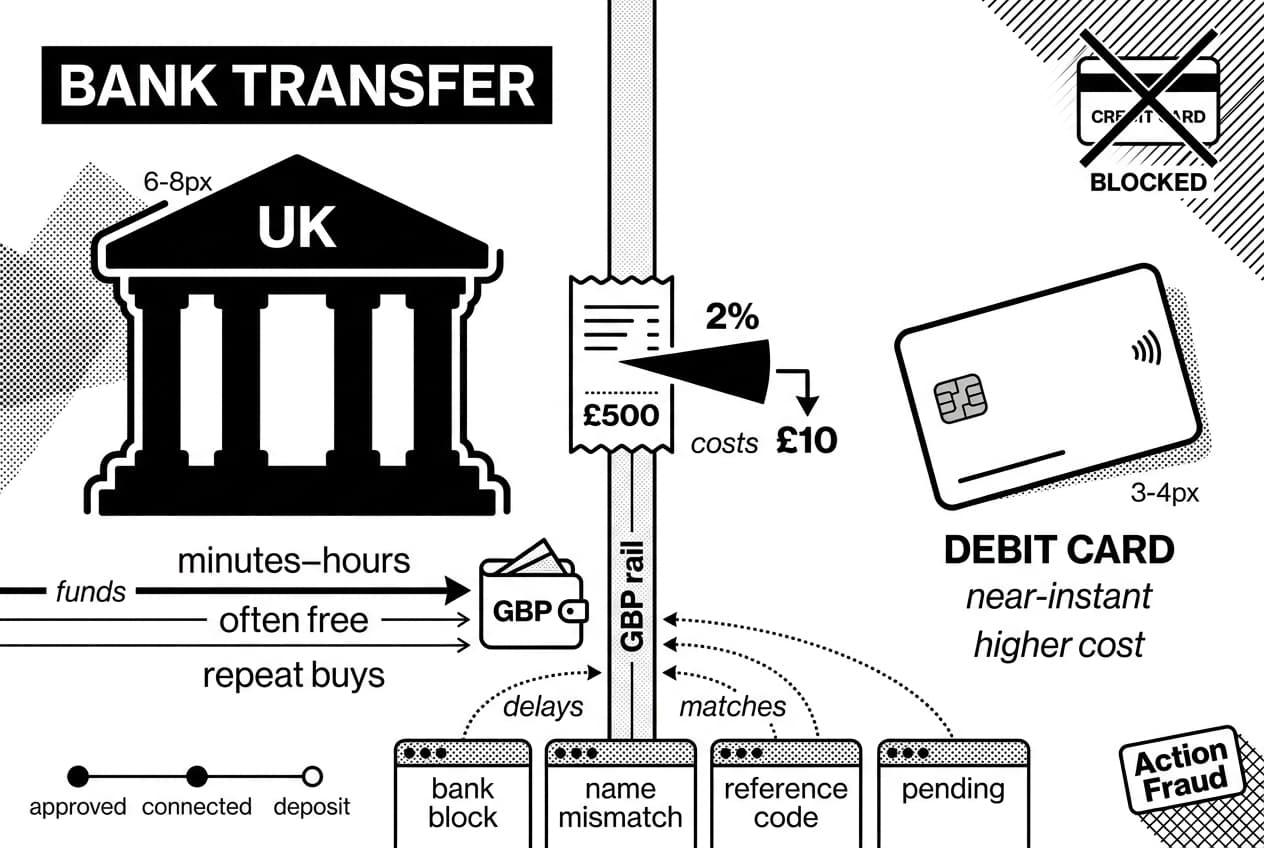
Once your account is approved, connect a payment method. Most UK buyers use bank transfer for lower cost or debit card for speed. Credit cards are often blocked by card issuers, so do not rely on them.
Bank transfer vs debit card
Payment method | Typical speed | Typical cost | Best for |
|---|---|---|---|
UK bank transfer | Minutes to a few hours, with some checks taking longer. | Often free to deposit, then trading fees or spreads apply. | Cost-conscious buys and repeat purchases. |
Debit card | Usually near-instant after approval. | Often higher because card processing and spread can apply. | Small test buys where speed matters more than cost. |
For a £500 model buy, a 2% card cost would be £10 before any spread. That is why a bank-funded order is usually the better first habit. For a deeper cost comparison, see our guide to the cheapest ways to buy Ethereum.
Common payment errors
- Bank blocks the transfer: call your bank using the number in your banking app. Confirm it is your transfer and ask what limit or policy applies.
- Name mismatch: the bank account name must match the exchange account name.
- Wrong reference code: copy the exact payment reference shown by the platform. A missing code can delay matching your deposit.
- Deposit pending too long: wait until the platform deadline passes, then send support the amount, time, reference and bank confirmation.
If you suspect a scam or phishing attempt, report it to Action Fraud and your bank before sending more money.
Step 4: place your first Ethereum order
Your account is funded, so you can now buy ETH. Go slowly on the first order. The goal is to learn the flow and verify every fee before you click the final confirmation.
- Open the app or website: log in from your bookmark and complete two-factor authentication.
- Search ETH: type ETH or Ethereum into the asset search box.
- Open the buy screen: click the buy button on the ETH page.
- Enter a GBP amount: start with a small amount such as £10 or £20 if this is your first purchase.
- Review fees: check the trading fee, spread, final ETH amount and quoted exchange rate.
- Confirm the order: click the final confirm buy button only when the preview matches your plan.
- Check your balance: open your portfolio and confirm the ETH balance appears.
Buy a small test amount first
A test buy teaches you how the platform handles payments, fees and balance updates. It also reduces the risk of choosing the wrong asset on your first attempt. Once you understand the preview screen, you can decide whether to make a larger purchase.
Understand price, spread and network fee
The price preview may include a spread. This means the platform sells ETH to you at a slightly different price from the open market rate. Always compare the quoted price before you confirm.
If you withdraw ETH to a wallet, you will also pay an Ethereum network fee, often called gas. Learn what ether and gas fees mean before your first withdrawal. Ethereum activated the Dencun upgrade with EIP-4844 on 13 March 2024 (Ethereum.org, accessed 12 July 2026), which helped lower some layer-2 transaction costs, but mainnet fees still change with demand.
Hayden Adams, founder of Uniswap Labs, is relevant because decentralised exchanges show why wallet control matters after buying ETH. If you later use DeFi apps, you will need to understand network fees, approvals and wallet security before connecting funds.
Step 5: decide where to store your ETH
After your first purchase, decide where your ETH should sit. There are two choices: exchange custody or self-custody. Neither is perfect for every beginner.
Exchange custody vs self-custody
With exchange custody, the platform controls the private keys and shows your balance in your account. This is convenient for small holdings because you have password recovery and support.
With self-custody, you withdraw ETH to your own wallet. You control the private keys, but you also carry the responsibility. If you lose the seed phrase, there is no support team that can restore the wallet.
Factor | Exchange custody | Self-custody wallet |
|---|---|---|
Who controls keys | The platform | You |
Password recovery | Usually available | Not available if the seed phrase is lost |
Platform failure risk | Possible | Reduced, but device and phrase risk remain |
Best for | Small balances and learning | Larger balances and long-term holding |
Setup difficulty | Already included | Needs careful wallet setup |
A practical rule is the £500 threshold test. Below £500, many beginners prefer exchange custody while they learn. Above £500, it is worth comparing a hardware wallet vs exchange custody before adding more ETH.
Withdraw ETH safely
- Copy your wallet address: copy it from your wallet, not from an old message or screenshot.
- Select Ethereum mainnet: make sure the exchange withdrawal network matches your wallet network.
- Send a test transaction: withdraw £5 to £10 worth first and wait until it arrives.
- Send the remainder: only continue after the test transaction is visible in your wallet.
- Save the transaction ID: keep it with your tax records and wallet notes.
If you plan to use a hardware device, follow our walkthrough on how to set up a Ledger wallet before you withdraw anything meaningful.
Warning: never share your seed phrase
Scam alert: Your seed phrase is the master key to your wallet. No exchange support agent, influencer, app, browser pop-up or airdrop checker needs it. Write it on paper, store it somewhere private and never type it into a website.
Step 6: use, track or hold your Ethereum
Most beginners hold ETH after the first buy. You can also send it, use it for network fees, or connect a wallet to apps such as Aave once you understand the risks. Do not connect a wallet with your full balance to an app you have not researched.
Use a portfolio tracker or spreadsheet to record what you bought, what you paid and where the ETH is stored. This habit helps with security and tax later.
Keep records for UK tax
Selling, swapping, gifting or spending ETH can be a disposal for UK tax purposes. HMRC has published cryptoasset guidance for individuals since April 2018 (HMRC, accessed 12 July 2026).
Record the date, GBP value, fees, transaction ID and receiving wallet or platform. The UK capital gains tax annual exempt amount is £3,000 for the 2025 to 2026 tax year (GOV.UK, accessed 12 July 2026). If your activity grows, speak with a UK accountant who understands cryptoassets.
Summary and next steps
You now know how to buy Ethereum in the UK without rushing past the checks that matter. Get your ID ready, choose a UK-friendly platform, fund with GBP, place a small ETH order, secure the account, then decide whether to keep the ETH on-platform or withdraw to your own wallet.
Beginner safety checklist
- Enable two-factor authentication: choose app-based codes, not SMS, where possible.
- Bookmark official sites: never log in from email links, search ads or social messages.
- Start small: a £10 or £20 test buy is enough to learn the process.
- Check withdrawal rules: make sure you can send ETH to your own wallet before you build a larger balance.
- Send a test withdrawal: use £5 to £10 first when moving ETH to a new wallet.
- Protect your seed phrase: paper or metal backup only. No screenshots or cloud notes.
- Keep records from day one: track dates, GBP values, fees and transaction IDs.
The best first result is not buying the most ETH in the fewest seconds. It is making a small, verified purchase that you understand, can track and can secure.
Frequently Asked Questions
- How to buy Ethereum in the UK for beginners?
- Start by choosing a reputable UK-friendly exchange such as Coinbase, Kraken or Gemini. Complete identity verification, then deposit GBP via bank transfer or debit card. Search for ETH, check the fees carefully, and confirm your order. Once purchased, decide whether to keep it on the exchange or move it to a personal wallet for added security.
- Is it legal to buy Ethereum in the UK?
- Yes, buying and holding Ethereum is fully legal in the UK. However, crypto firms must comply with financial promotion and anti-money-laundering regulations. Crypto is not FSCS-protected, so your funds are at risk if an exchange fails. You may also owe Capital Gains Tax when selling, swapping or spending ETH, so keep clear records.
- Is it worth putting $100 in Ethereum?
- A small amount can be a practical way to learn how crypto works, but Ethereum is highly volatile and returns are never guaranteed. Only invest money you can genuinely afford to lose. Factor in platform fees, your intended time horizon and personal risk tolerance before committing, even to a modest starting amount.
- How to buy ether in the UK?
- Ether, ETH and Ethereum are often used interchangeably, though technically ether is the asset and Ethereum is the underlying network. The buying process is the same: open an account on a regulated exchange, verify your identity, deposit GBP, search for ETH and complete your purchase. Store it securely in a wallet once bought.
Sources
Author

Crypto analyst and blockchain educator with over 8 years of experience in the digital asset space. Former fintech consultant at a major Wall Street firm turned full-time crypto journalist. Specializes in DeFi, tokenomics, and blockchain technology. His writing breaks down complex cryptocurrency concepts into actionable insights for both beginners and seasoned investors.