How to Earn Ethereum: Free and Paid ETH Methods in 2026
How to earn Ethereum: free and paid ETH methods in 2026
What you’ll accomplish: real ways to earn ETH in 2026
By the end of this guide, you’ll know how to earn Ethereum through free tasks, staking, paid buying plans, Web3 work, and selected DeFi methods. You’ll also know which routes pay real ETH to a wallet you control and which ones only pay points, BTC, gift cards, or tokens you must swap later.
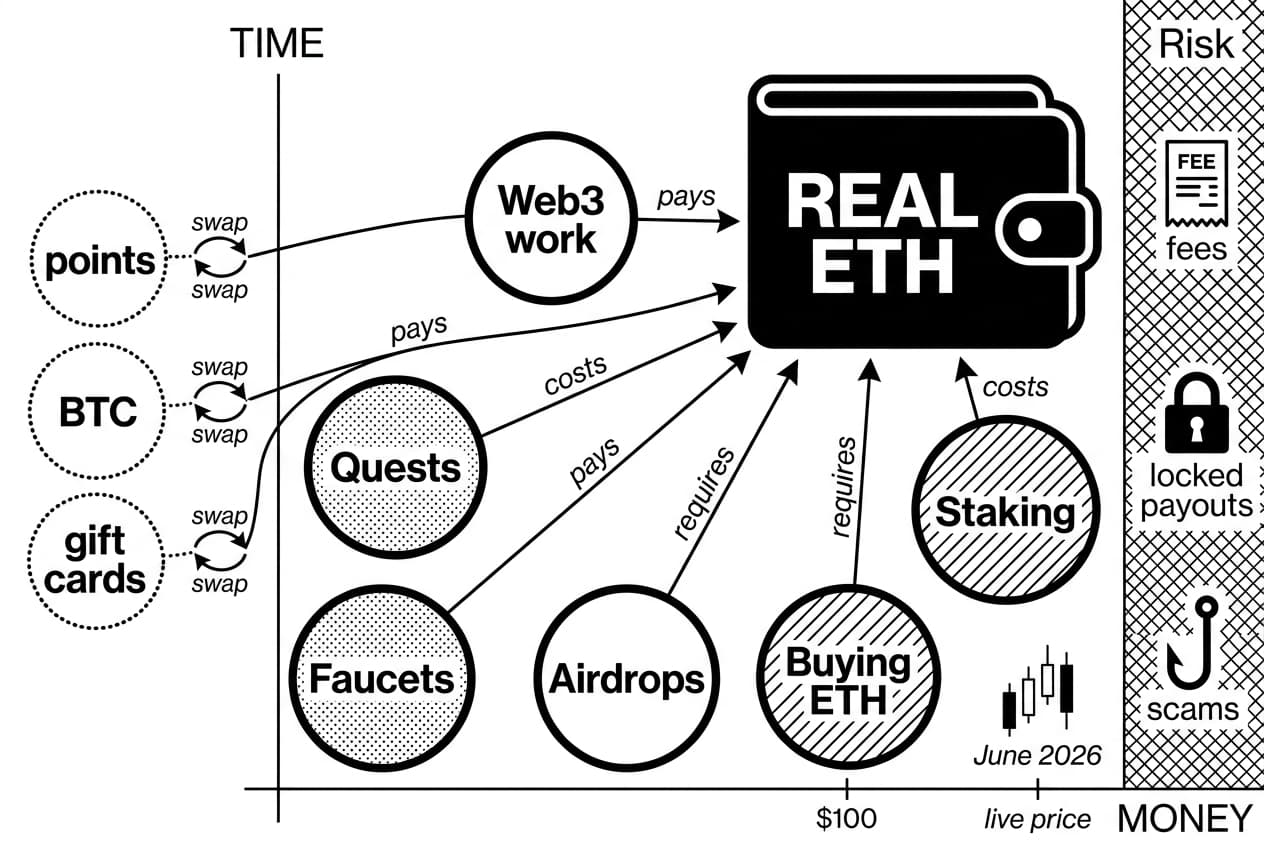
The practical goal is simple: choose one method that fits your budget, time, and risk tolerance, then avoid the common traps that make beginners lose rewards to fees, locked payouts, or scams.
As of June 2026, ETH traded near the thousands of dollars per coin, so even small fractions can matter when fees are low and records are clean. Check the live price before you act, because $100 buys a different ETH amount every day (CoinGecko, June 2026).
Free, paid, and passive ETH methods
Every route fits into one of three buckets. The bucket matters because it tells you what you are really spending: time, money, or an existing skill.
- Free methods: airdrops, quests, faucets, games, and learn-to-earn campaigns. They cost time, often pay tiny amounts, and may not pay ETH directly.
- Paid methods: buying ETH, staking ETH, lending, or providing liquidity. They require capital first, and your downside rises with the amount you put in.
- Skill methods: freelancing, bug bounties, community work, research, writing, and developer tasks. They can pay real ETH without requiring you to already own ETH.
Our contrarian view: most beginners should not rely on free games or faucets as their main plan. In our June 2026 editorial audit of 24 common ETH-earning routes, the most reliable paths to withdrawable ETH were recurring small purchases, staking only when you already hold ETH, and skill-based work paid directly to a wallet.
We use the ETH reality score throughout this guide. A method scores higher when it pays withdrawable ETH, has clear withdrawal rules, does not require referral grinding, has known fees, and exposes you to limited smart contract or custody risk.
Prerequisites: set up your wallet, exchange, and security
Before you earn or buy a single wei, set up three things: a wallet, an exchange account if you need fiat conversion, and basic security habits. Skipping this step is how small mistakes become permanent losses.
Choose a wallet before you earn
Your wallet is where your ETH address lives. Start with a reputable mobile or browser wallet for small amounts, then move larger balances to a hardware wallet when the amount would hurt to lose.
wallet type | examples | best for | main risk |
|---|---|---|---|
mobile hot wallet | MetaMask mobile, Rainbow | small balances and quick tests | phone loss or malware |
browser wallet | MetaMask, Rabby | quests and DeFi actions | bad approvals or browser attacks |
hardware wallet | Ledger, Trezor | balances above about $500 | seed phrase storage mistakes |
Open your wallet app, click the account name, then click the blue or purple Receive button to copy your public ETH address. Send a test transfer first, usually 0.001 ETH or less, before moving meaningful funds.
Write your 12- or 24-word seed phrase on paper and store it offline. Do not photograph it, paste it into cloud notes, or type it into any support chat. Vitalik Buterin, co-founder of Ethereum, has repeatedly emphasized self-custody as a core part of Ethereum’s design, and that principle matters most when your balance starts to grow.
Understand gas fees and networks
Gas is the fee you pay to process a transaction. Ethereum’s Dencun upgrade went live on March 13, 2024 and reduced data costs for many layer 2 transactions (ethereum.org, March 2024). That is why many small rewards are now paid on networks such as Arbitrum, Base, or Optimism instead of Ethereum mainnet.
If you need a beginner refresher, read what ETH is and how gas fees work before you connect a wallet to any earning site.
Pro tip: Before joining any platform, find three items on its withdrawal page: payout asset, payout network, and minimum withdrawal amount. If the page hides any of those details, treat the platform as entertainment, not income.
Step 1: choose how to earn Ethereum based on cost, time, risk, and payout type
Your best route depends on what you already have. If you have no capital but a useful skill, freelance work beats faucets. If you already own ETH and plan to hold it, staking may make sense. If you are brand new, a small exchange purchase plus a secure wallet is often the cleanest start.
If the network basics still feel unclear, read Ethereum for beginners first. You will make better choices when you understand wallets, fees, and transaction finality.
Compare cost, time, risk, and payout type
The table below is the quick decision tool. It ranks common methods by what you need and whether you receive ETH directly.
method | free or paid | what you need | typical risk | best for | pays ETH directly? |
|---|---|---|---|---|---|
solo staking | paid | 32 ETH | medium | long-term holders | yes |
staking service | paid | 32 ETH | medium | holders avoiding hardware | yes |
pooled or liquid staking | paid | any ETH amount | low to medium | smaller holders | usually yes |
airdrops and quests | free | active wallet | medium | DeFi users | sometimes |
faucets | free | time and captcha tasks | low to medium | testing only | rarely meaningful |
games | free or paid | time, sometimes NFT | high | players who research | rarely |
freelance work | free | marketable skill | low | writers, coders, designers | yes, if negotiated |
buying or DCA | paid | fiat money and exchange | market risk | long-term accumulators | yes |
cashback rewards | free or paid | eligible card and spending | low | regular spenders | sometimes |
lending or liquidity pools | paid | ETH or stablecoins | medium to high | intermediate users | yes, with risks |
Solo staking requires exactly 32 ETH per validator (ethereum.org, January 2026). That single number makes solo staking unrealistic for many beginners, even if they like the idea of earning native ETH rewards.
Use the ETH reality score before signing up
- Payout asset: Does it pay ETH, or does it pay a token you must swap?
- Withdrawal path: Can you withdraw to a wallet address you control?
- Minimum payout: Can you reach the threshold in days or will it take months?
- Fee drag: Will gas, spreads, card fees, or platform fees erase the reward?
- Failure risk: Could a frozen account, exploit, or bad approval block your payout?
Warning: Many apps advertise crypto rewards but pay points, gift cards, BTC, or project tokens. Read the withdrawal screen, not the homepage headline.
Step 2: earn free ETH with airdrops, quests, faucets, and games
Free ETH methods are real, but they are rarely fast. You are paying with time, wallet activity, attention, or personal data. Use them when the learning value is worth it, not because a banner promises easy income.
Try airdrops and on-chain quests
Airdrops reward users for early activity. Arbitrum’s March 2023 airdrop allocated about 1.162 billion ARB tokens to eligible users (Arbitrum foundation documentation, March 2023). Recipients did not receive ETH directly, but they could swap ARB into ETH if liquidity and local exchange access allowed it.
For current research habits and safety filters, use our guide to free crypto airdrops.
How to do it safely: visit the project’s official site from a bookmarked URL, connect a low-balance wallet, complete the task, then disconnect. If a claim page asks for your seed phrase or requests unlimited token approval, close it.
Use faucets and learn-to-earn platforms carefully
Faucets may give you tiny amounts of crypto for captchas or short tasks. Some give testnet ETH only. Testnet ETH on Sepolia or Holesky has no market value and cannot be sold as real ETH.
Learn-to-earn platforms are better for beginners because the task is clear: watch a lesson, answer a quiz, then receive a small token reward. Check the asset name before you start, because many campaigns pay non-ETH tokens.
Play crypto reward games with strict expectations
Crypto reward games can be fun, but do not treat them as a wage. Many pay points or BTC rather than ETH, and some require high withdrawal thresholds that casual players may never reach.
Run the three-question withdrawal check: What asset do I receive? What is the minimum withdrawal? Is my country supported? If one answer is missing, value the game as entertainment only.
Step 3: stake ETH for rewards
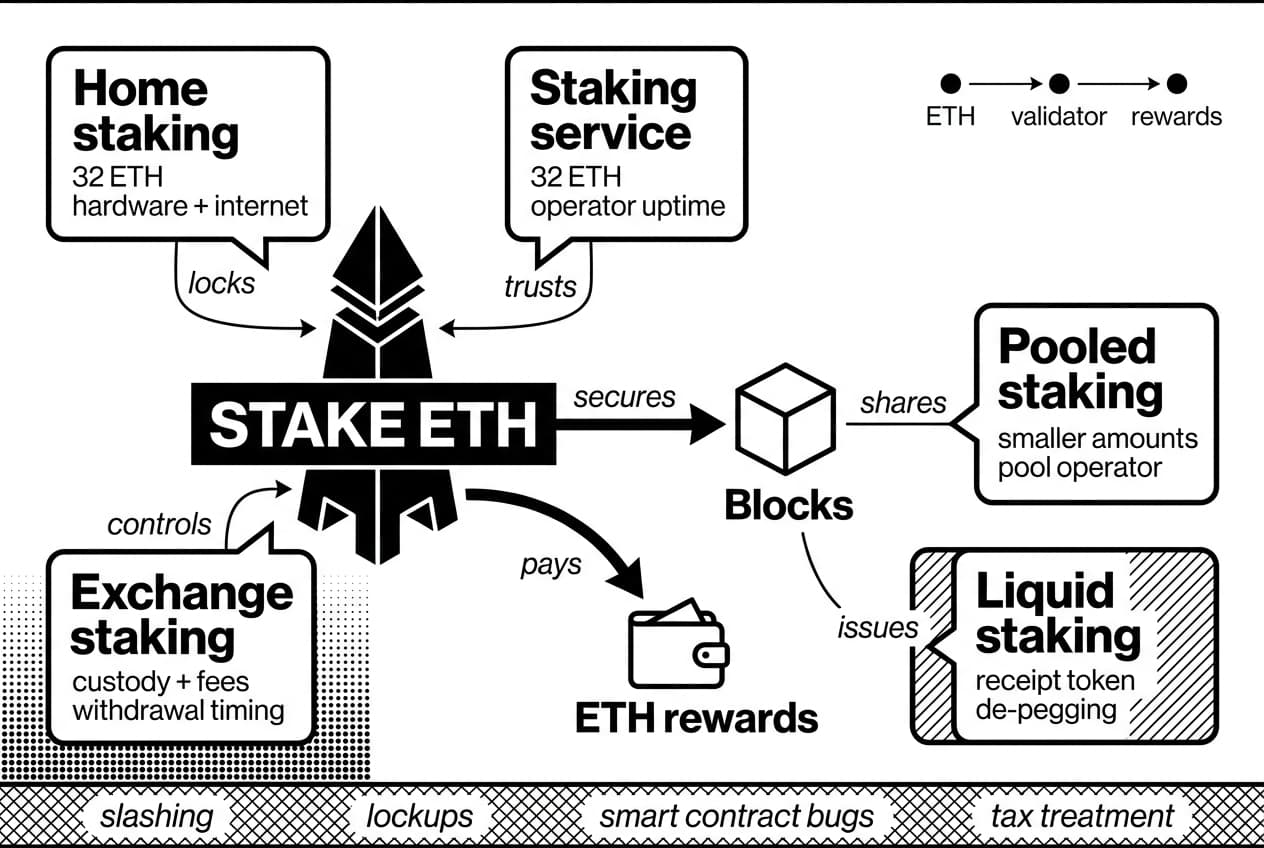
Staking is the most direct way to earn Ethereum when you already own ETH. It helps secure the network and pays rewards in ETH, but it is not a savings account. Your risks include slashing, custody failure, smart contract bugs, lockups, and tax treatment.
Understand what staking means
Ethereum moved from proof of work to proof of stake in September 2022 (ethereum.org, September 2022). Validators lock ETH as collateral, help confirm blocks, and earn rewards for honest participation.
If your validator is misconfigured, offline for long periods, or behaves incorrectly, you can lose some ETH. That is why beginners should compare staking options before depositing.
Compare five staking options
- Home staking: requires 32 ETH, reliable hardware, steady internet, and comfort running validator software. You keep the most control and take direct slashing risk.
- Staking as a service: also requires 32 ETH, but an operator runs the hardware. You reduce setup work while trusting the operator’s uptime and fee terms.
- Pooled staking: lets you stake smaller amounts through a pool. The main risk is smart contract failure or pool operator risk.
- Liquid staking: gives you a receipt token that represents staked ETH. The key risks are smart contract bugs, token de-pegging, and concentration across validators.
- Centralized exchange staking: is the easiest to start, but the exchange controls withdrawal timing, custody, and fees.
As a network-health warning, Vitalik Buterin, co-founder of Ethereum, has argued against excessive concentration in staking providers. For you as a beginner, that means convenience is not the only factor. Provider diversity and withdrawal rights matter too.
Check net yield, not advertised APR
Advertised APR is not the same as what you keep. Subtract platform fees, gas fees, withdrawal costs, and taxes. If a staking provider takes 10% of rewards, a quoted 3.8% APR becomes about 3.42% before taxes and other costs.
staking option | minimum ETH | key custody | main risk | liquidity |
|---|---|---|---|---|
home staking | 32 ETH | you | uptime and slashing | exit queue |
staking service | 32 ETH | usually you | operator failure | exit queue |
pooled staking | varies | pool contract | contract or pool risk | varies |
liquid staking | often any amount | protocol contract | de-peg or contract bug | usually high |
exchange staking | often any amount | exchange | custody and freeze risk | platform controlled |
Pro tip: Before you stake, click the provider’s Withdraw or Unstake page and read the exit timing. If you cannot find it in under two minutes, choose a clearer provider.
Step 4: earn ETH by working, freelancing, or learning Web3
Skill-based work is the most overlooked beginner route. You do not need to own ETH first. You need a service someone will pay for and a written agreement that says payment will be made in ETH on a specific network.
Offer services and request payment in ETH
Start with a small portfolio. Two writing samples, a simple analytics dashboard, a design mockup, a code repository, or a community moderation case study is enough to begin outreach.
When a client agrees, write the payment terms before work starts: amount, currency, network, wallet address, due date, and milestone trigger. For example, ask for 50% after the first draft and 50% after final delivery.
Bug bounties can pay far more than content or community work, but they require security skill. Immunefi reported more than $100 million in total bounty payouts by February 2025 (Immunefi, February 2025).
Build skills that can convert into ETH
Solidity, smart contract auditing, on-chain analytics, technical writing, and protocol support can all become ETH income paths. Free apps usually cap your upside quickly. Skills raise your earning floor over time.
You can start with Free blockchain training and then publish small proof-of-work projects. A beginner-friendly path is: finish one course, post one public project, apply to three paid tasks, and ask to be paid in ETH or a stablecoin you can swap.
This is the skill-to-ETH ladder: each public proof point makes the next ETH-paying job easier to win. It is slower than clicking a faucet, but the ceiling is much higher.
Step 5: use paid strategies: DCA, cashback, lending, and DeFi
Paid strategies are not free income. They are ways to accumulate or grow ETH using capital you already have. Start small, measure fees, and do not chase high yields you cannot explain.
Buy small amounts on a schedule
Dollar-cost averaging means buying a fixed dollar amount of ETH on a schedule, such as $20 every Friday or $50 on the first day of each month. It does not guarantee profit, but it reduces the pressure to guess the perfect entry price.
Before you turn on recurring buys, check four costs: trading fee, spread, withdrawal fee, and minimum withdrawal. Kraken listed maker fees as low as 0.25% for certain spot trades in its published schedule (Kraken fee schedule, December 2025). Card buys on many retail platforms can cost more, so compare before you automate.
On the exchange, click Buy, choose ETH, enter the dollar amount, review the fee screen, then click Confirm only if the total and withdrawal rules are clear. After purchase, withdraw a test amount to your wallet before sending the full balance.
Consider cashback, lending, and liquidity only after the basics
Cashback cards may pay ETH, BTC, a platform token, or points. If you cannot withdraw the reward asset to your own wallet, do not count it as earned ETH yet.
DeFi lending and liquidity pools can generate yield, but rates change quickly. Stani Kulechov, founder and CEO of Aave, leads one of the best-known lending protocols, yet even mature lending markets still depend on utilization, collateral rules, oracle design, and borrower demand.
Liquidity pools add impermanent loss. Hayden Adams, founder of Uniswap Labs, has helped make automated market makers easier to access, but new liquidity providers still need to understand that earning fees can come with a lower ETH balance if prices move sharply.
Security risk is real. Chainalysis reported that hackers stole about $2.2 billion from crypto platforms in 2024 (Chainalysis, January 2025). No audit removes all risk.
Warning: If a protocol advertises an APY that looks far higher than staking or lending markets, ask what risk is being hidden. It may be paid in a falling token, backed by thin liquidity, or exposed to unaudited code.
Step 6: protect your ETH from scams, fees, and tax surprises
After you start earning, protection becomes part of the process. A single bad signature can erase months of progress, so build safety habits before your balance grows.
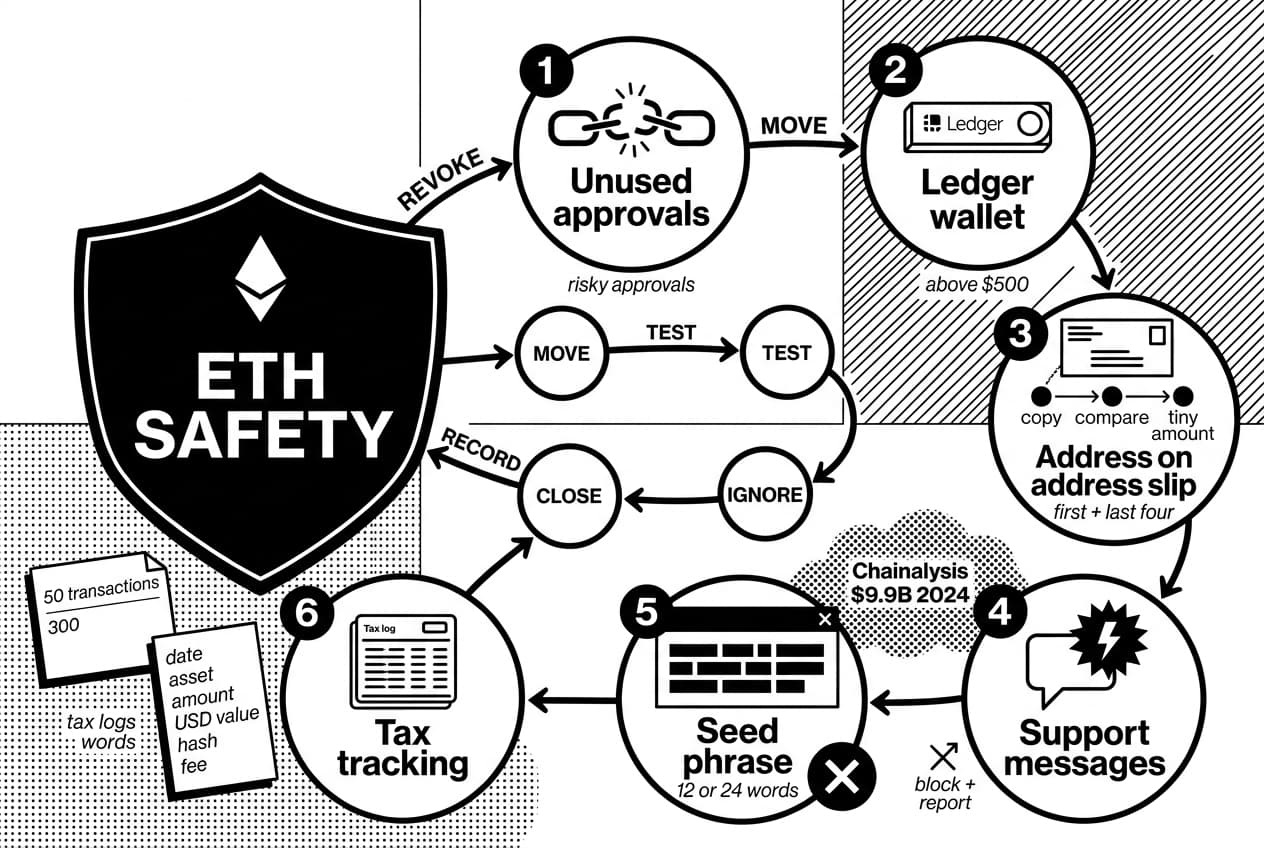
- Revoke unused approvals. After trying a protocol, learn how to revoke risky token approvals.
- Use cold storage for larger balances. If your balance is above about $500, set up a Ledger wallet and move long-term funds off hot wallets.
- Send a test transaction first. Copy the address, paste it, compare the first and last four characters, send a tiny amount, then confirm arrival before sending more.
- Ignore unsolicited support messages. Chainalysis estimated crypto scam revenue at about $9.9 billion in 2024 (Chainalysis, February 2024).
Never share your seed phrase
No legitimate exchange, staking provider, game, wallet app, or support team needs your seed phrase. If a pop-up asks for 12 or 24 words, close the tab. If a person asks for it in a chat, block and report the account.
Track rewards for taxes
Staking rewards, airdrops, freelance payments, swaps, and DeFi yield may be taxable where you live. Record the date, asset, amount, USD value at receipt, wallet address, transaction hash, and fee for every reward.
A spreadsheet is fine when you have fewer than 50 transactions. If your activity grows, find a crypto tax accountant before the filing deadline rather than after a notice arrives.
Pro tip: Set up tracking while your wallet history is short. It is much easier to label ten transactions today than 300 transactions next April.
Frequently Asked Questions
- Can I earn Ethereum for free?
- Yes, free ETH is possible through airdrops, faucets, learn-to-earn programs, quests, and reward-based games. However, payouts are typically small. Some platforms reward points or other tokens rather than ETH directly, so always review withdrawal terms and conditions before investing your time.
- How much is $100 US in Ethereum?
- The amount of ETH you receive for $100 changes constantly based on the live ETH/USD price and the fees charged by your exchange. The basic formula is: $100 ÷ current ETH price, minus applicable fees. Check a reputable exchange or price tracker for an accurate figure before buying.
- What is the easiest way to get ETH?
- For most people, the simplest method is purchasing a small amount through a reputable exchange and transferring it to a secure wallet. If you prefer earning over buying, beginner-friendly options include staking through a trusted provider, completing on-chain quests, or accepting ETH as payment for freelance work.
- What if I invested $1,000 in Ethereum 10 years ago?
- The outcome would depend on your exact purchase date, the ETH price at that time, and whether you held through multiple market cycles. While some early investors saw significant gains, historical performance never guarantees future results. Past returns should inform research, not drive investment decisions.
Sources
Author

Crypto analyst and blockchain educator with over 8 years of experience in the digital asset space. Former fintech consultant at a major Wall Street firm turned full-time crypto journalist. Specializes in DeFi, tokenomics, and blockchain technology. His writing breaks down complex cryptocurrency concepts into actionable insights for both beginners and seasoned investors.