How to Buy Ethereum Without Fees: Cheapest 2026 Options
How to buy Ethereum without fees: cheapest 2026 options
This guide shows you how to buy ETH at the lowest practical cost in 2026. You will learn how to compare the advertised trading fee, the spread, the payment surcharge, withdrawal fees, and Ethereum gas before you click the final buy button.
The key point is simple: a no-fee label is not enough. Your goal is to pay the lowest all-in price while using a safe platform and a payment method you can verify.
Can you really buy Ethereum without fees in 2026?
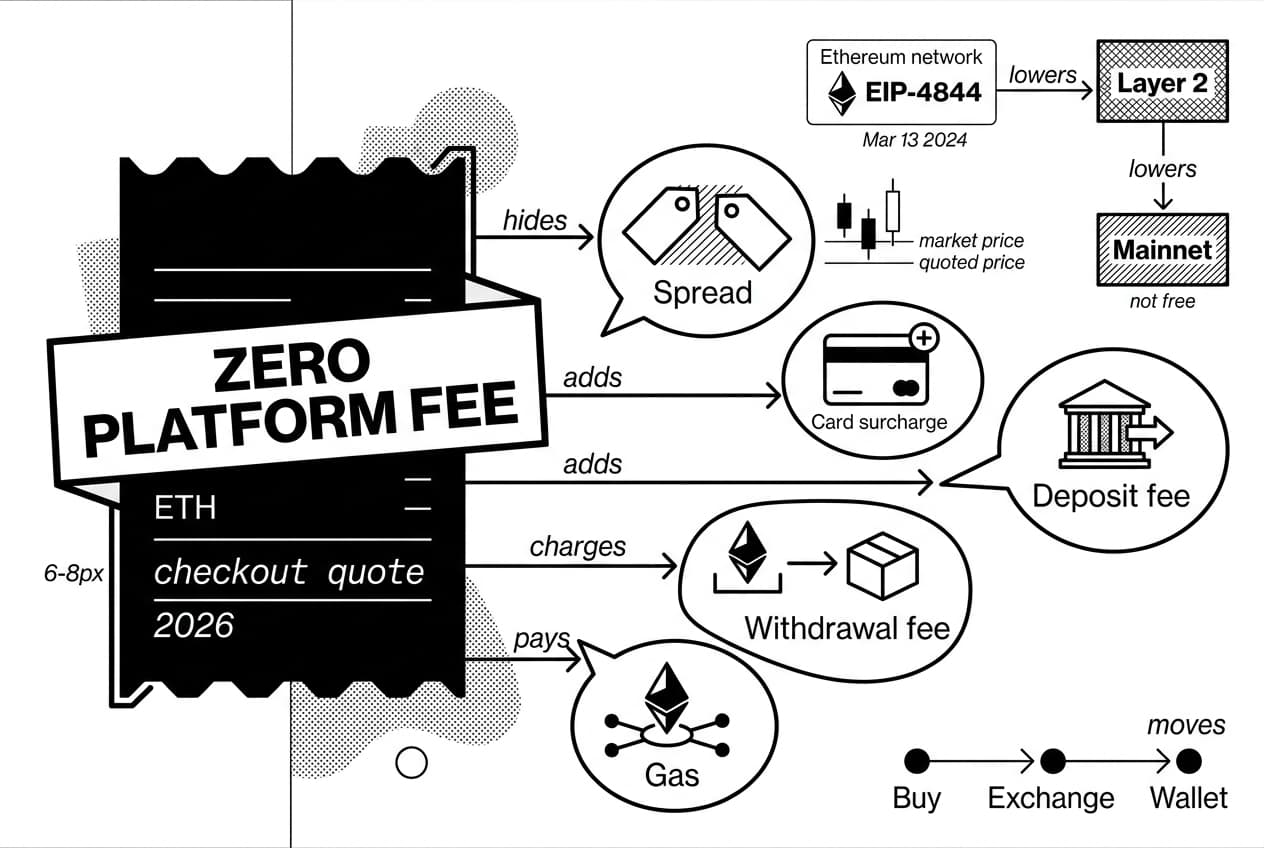
You can sometimes buy Ethereum with no visible trading commission, but you should not expect a truly free purchase. In 2026, spreads, debit card fees, withdrawal charges, and Ethereum gas can still raise your final cost even when the checkout screen says the platform fee is zero.
The difference between zero-fee and low-cost
When a platform advertises zero fees, it usually means there is no separate trading commission. That can help, but the real price depends on the full checkout quote.
- Spread: the gap between the market price and the price quoted to you.
- Payment surcharge: the extra cost for card, wallet, or third-party payment processing.
- Deposit fee: the cost to add dollars, euros, or another local currency to your account.
- Withdrawal fee: the platform charge to send ETH to your own wallet.
- Gas: the Ethereum network cost for on-chain transfers.
Ethereum fees changed after the Dencun upgrade. EIP-4844 went live on mainnet on March 13, 2024 (Ethereum Foundation, Feb. 27, 2024), mainly lowering data costs for layer 2 networks rather than making every mainnet transfer free.
Vitalik Buterin, co-founder at the Ethereum Foundation, has repeatedly pushed Ethereum scaling toward cheaper transaction capacity. For ETH buyers, the practical lesson is that buying on an exchange and moving funds on-chain are separate cost events.
Hayden Adams, founder at Uniswap Labs, built one of the best-known on-chain trading systems, where users see network fees before a swap. That same fee-aware mindset helps when you buy ETH from a retail app: the visible fee is only one line in the quote.
Our 2026 fee stack audit method
Use the six-line fee stack audit before every purchase. It is our working framework for separating a cheap-looking ETH quote from a genuinely low-cost ETH quote.
Audit line | What you record | Why it matters |
|---|---|---|
1 | Reference ETH price | Shows the market baseline |
2 | Quoted ETH price | Reveals the spread |
3 | Trading fee | Shows the stated platform charge |
4 | Payment fee | Captures card, bank, or wallet costs |
5 | Withdrawal fee | Shows the cost to leave the platform |
6 | Network gas | Shows the on-chain transfer cost |
For a reproducible 2026 scorecard, use a $500 test basket and write down the quote from two exchanges and one wallet on-ramp before buying. Public fee pages show why this matters: the first listed spot tier on Kraken is 0.25% maker and 0.40% taker (Kraken, July 2026), while Coinbase advanced trade lists an entry taker fee up to 0.60% (Coinbase, July 2026). A zero-fee quote must beat those transparent fees after the spread and payment cost are included.
What you'll need before you buy ETH
Set up the basics before you fund anything. A little preparation prevents the most common beginner errors: paying with an expensive card, buying on the wrong platform, or sending ETH to a wallet before you understand the network selector.
- A verified account: choose a regulated exchange or a well-known wallet on-ramp that supports your country.
- Photo ID: most exchanges require identity checks before higher limits or withdrawals.
- A low-cost payment method: bank transfer is usually cheaper than debit or credit card.
- Two-factor authentication: use an authenticator app rather than SMS when possible.
- An optional wallet: use self-custody only after you understand seed phrase storage and test transfers.
Some limits are much higher after verification. For example, Coinbase states that weekly buy and deposit limits can reach $25,000 for some US bank-linked accounts, depending on account history and region (Coinbase limits, July 2026).
If you are completely new, read our Ethereum for beginners guide before you commit funds. It explains what ETH is, why it has gas fees, and how wallets fit into the process.
Choose your custody setup
Custody means who controls the private keys for your ETH. Leaving ETH on an exchange is easier for a first purchase because the platform handles wallet operations for you.
Self-custody gives you more control, but it also gives you more responsibility. If you lose your seed phrase or approve a bad transaction, there may be no support team that can reverse it.
Custody setup | Example | Setup cost | Main risk |
|---|---|---|---|
Exchange custody | Major exchange account | Usually free | Platform risk and withdrawal limits |
Software wallet | Browser or mobile wallet | Usually free | Lost seed phrase or phishing |
Hardware wallet | Offline signing device | About $149 for a popular retail model (Ledger shop, July 2026) | Device loss, bad backup, or wrong setup |
For many beginners, the safest order is to buy on a reputable exchange, learn how withdrawals work, then move a test amount to your own wallet. Do not rush the self-custody step just to avoid a small exchange balance.
Know your payment method limits
Your payment method often decides whether a no-fee offer is actually cheap. Bank transfers usually cost less, but they can take longer to settle.
Payment method | Typical cost level | Settlement time | Best use |
|---|---|---|---|
ACH bank transfer | Low | 1 to 5 business days | Patient buyers in the US |
SEPA bank transfer | Low | Often 1 business day | Buyers in the euro area |
Wire transfer | Medium flat cost | Same day to 1 day | Larger purchases |
Debit card | Medium to high | Usually instant | Urgent small buys |
Credit card | High | Usually instant | Rarely worth it |
PayPal | Medium to high | Usually instant | Convenience-first buyers |
Pro tip: if speed is not urgent, default to a bank transfer. Paying even 3% extra on a $1,000 purchase means $30 is gone before ETH moves at all.
Step 1: compare the real cost, not just the fee
Before you click buy, spend 60 seconds recording the full quote. Use this numbered checklist every time:
- Market price: check a reference source such as CoinGecko or another live index.
- Quoted price: record the exact ETH price shown inside the app.
- Platform fee: note the trading commission or flat fee at checkout.
- Payment fee: add any debit, credit, PayPal, wire, or on-ramp surcharge.
- Withdrawal fee: check the cost to send ETH off the platform.
- Gas fee: estimate the network cost before moving ETH to a wallet. See our guide to ETH gas fees explained.
Check the ETH quote against a live market price
Open CoinGecko in a second tab before you confirm. If the app shows a higher ETH price than the reference price, the difference is part of your cost even if the trading fee says zero.
Here is a clean quote transcript to copy into your notes: time checked, market ETH price, platform ETH price, dollars entered, ETH received, fee line, payment method, withdrawal cost, and final effective price. Keep that note with your tax records.
Watch for hidden spread
A spread is not always shown as a fee. If the market price is $2,600 and your quoted price is $2,650, the extra $50 per ETH is still a cost.
Warning: do not compare only the platform fee line. A platform with a 0% trading fee and a wide spread can cost more than a platform that charges a clear 0.40% taker fee.
Remember that small purchases feel fees more
Flat costs hit small purchases hardest. A $2.99 withdrawal charge on a $25 buy equals almost 12% before you count spread or card fees.
If you are buying only $25 to $100, it may be cheaper to leave the ETH on the exchange until your balance is large enough to justify a withdrawal. That is not a permanent storage plan; it is a cost-control decision.
Step 2: choose the cheapest way to buy Ethereum
For most beginners, the lowest-cost route is a bank transfer into a high-liquidity exchange, followed by a limit order or a clearly priced market order. Instant methods are faster, but they usually charge for that speed.
Method | Typical cost level | Speed | Best for | Main warning |
|---|---|---|---|---|
Bank transfer | Low | 1 to 5 business days | Most buyers who can wait | Funds may be held until the deposit clears |
Debit card | Medium to high | Instant | Urgent small purchases | Surcharges can erase the no-fee benefit |
Credit card | High | Instant | Rare cases only | Your issuer may treat it as a cash advance |
PayPal | Medium to high | Instant | Convenience-first buyers | Withdrawal rules and spreads vary by region |
Wallet on-ramp | Medium to high | Minutes | Buying ETH for immediate wallet use | Provider quotes can differ widely |
P2P | Variable | Minutes to hours | Regions with limited exchange access | Scam risk is higher; use escrow only |
Use a bank transfer when you can wait
On most major exchanges, bank deposits are the cheapest way to fund your account. Click deposit, choose your local currency, select bank transfer, copy the reference code, and send funds from your banking app.
Do not skip the reference code. If the code is missing or wrong, your deposit may be delayed while support manually matches the payment.
Avoid card buys unless speed matters
Cards are convenient because the order can execute right away. The trade-off is that card processing and wider retail spreads often make them the expensive route.
Use a card only when you need ETH quickly and you have checked the final quote. If the quote screen does not show the ETH amount, the fee, and the exchange rate, stop and use another route.
Use wallet on-ramps only after comparing providers
Wallet apps often show several third-party providers. Click each quote, compare the ETH received, and check whether the payment method is card, bank, or local transfer.
A wallet on-ramp can be reasonable if you plan to use ETH on-chain immediately. If you are only buying to hold, an exchange plus bank transfer is usually cheaper.
Step 3: fund your account with the lowest-fee method
After verification, deposit money before placing the ETH order. This avoids rushed card purchases and gives you time to compare quotes.
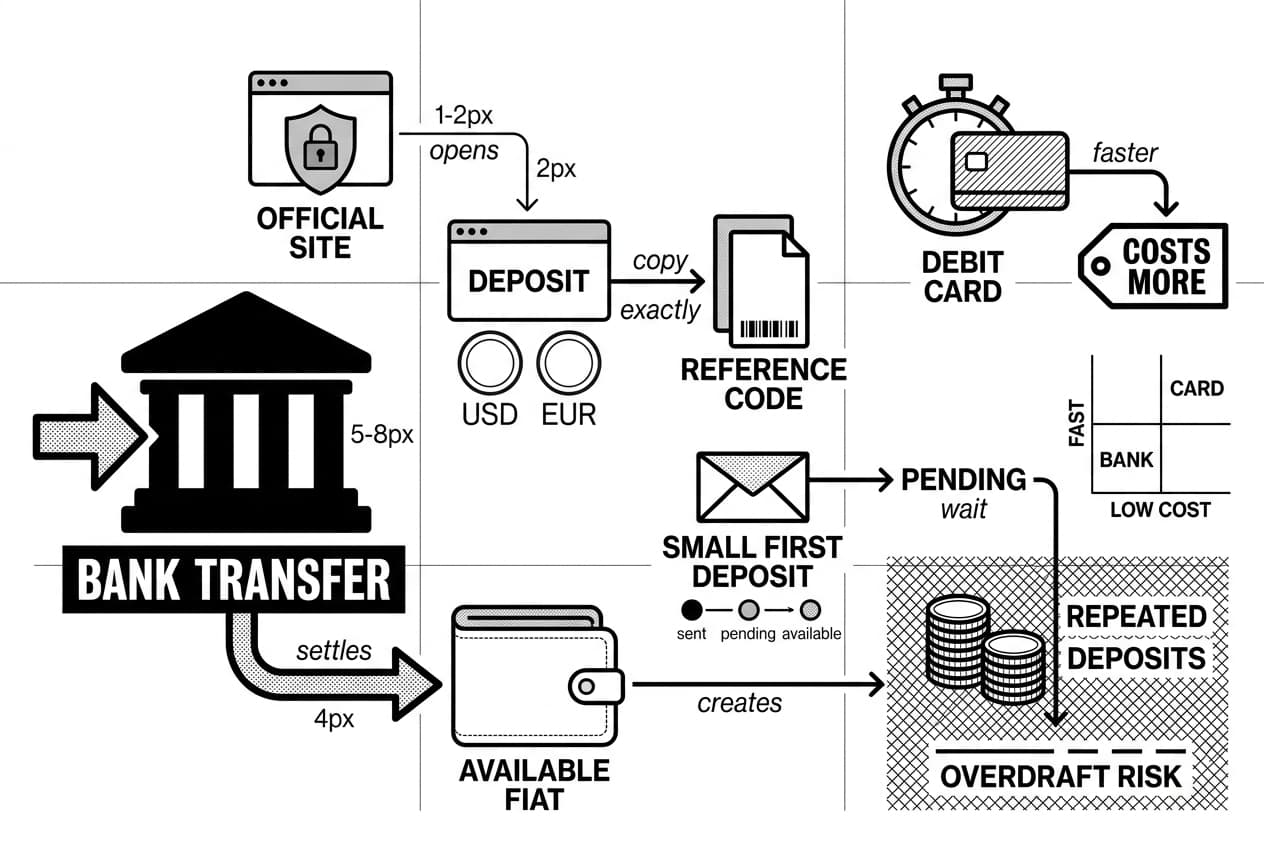
- Log in from the official website or app, not from an ad link.
- Click deposit in the account dashboard.
- Select your local currency, such as USD or EUR.
- Choose bank transfer if you can wait for settlement.
- Copy the account details and reference code exactly.
- Send a small first deposit if this is your first time using that exchange.
Wait for settled funds if withdrawal matters
Some exchanges let you buy before the bank transfer fully settles, but they may block withdrawals until the money clears. That is normal fraud control, not necessarily a problem.
If your plan is to withdraw ETH to a wallet the same day, check the deposit hold rules before you buy. A debit card may be faster, but it can cost more.
Confirm that the deposit arrived
Open the balances page and make sure the fiat amount appears as available to trade. If it is pending, do not place a second deposit unless you know the first one failed.
Warning: sending repeated deposits while impatient can create duplicate purchases or overdraft risk. Wait for the status to update, then continue.
Step 4: buy ETH and confirm the final quote
Now you are ready to buy. Select Ethereum, enter the amount you want to spend, and open the order preview before you confirm.
The preview should show the ETH amount you will receive, the exchange rate, and every visible fee. If the app has an advanced trade screen, compare it with the simple buy screen because the simple flow may include a wider spread.
Use a limit order if the platform supports it
A market order fills immediately at the available price. A limit order lets you set the highest price you are willing to pay for ETH.
For a $50 learning purchase, a market order is usually fine if the quote is clear. For larger buys, set a limit order a little below or near the current reference price so you do not overpay during a fast move.
Screenshot the quote before confirming
Take a screenshot before you click the final confirm button. Capture the timestamp, ETH price, fee line, payment method, and ETH amount.
This screenshot helps you check your cost basis later. It also gives you proof if the final confirmation differs from the preview.
Warning: many quote screens refresh quickly. If the timer expires, read the new quote from the top before you confirm.
Start with a small test purchase of $10 to $20 if this is your first time. Once you know the deposit, quote, and confirmation flow work, place the full order.
Step 5: decide whether to withdraw ETH to your wallet
Buying ETH cheaply and moving ETH cheaply are separate decisions. A low purchase fee can be wiped out if you immediately pay a high withdrawal or gas cost on a small balance.
Check the withdrawal screen before sending anything. Ethereum mainnet gas changes minute by minute, and you can monitor the live estimate in gwei (Etherscan, July 2026).
When self-custody is worth the extra cost
Self-custody is more attractive when the ETH balance is meaningful to you and you plan to hold it for a long time. You remove exchange counterparty risk, but you take on private-key risk.
If you choose self-custody, use a wallet setup you understand. Our hardware wallet setup guide explains the steps, and our wallet compromise checklist helps you review common warning signs.
Send a test withdrawal first
Before sending your full balance, withdraw a small test amount such as 0.002 ETH. Confirm that it arrives in the correct wallet before you send the rest.
- Check the address: compare the first four and last four characters, then scan again.
- Check the network: use Ethereum mainnet unless you intentionally chose a supported layer 2.
- Check the transaction: open Etherscan and verify the transfer before sending more.
Warning: Arbitrum, Base, and mainnet may all use addresses that look similar. The address alone is not enough; the network selector must match your wallet support.
Summary: the lowest-cost ETH buying checklist
Use this checklist whenever you want the lowest practical cost, not just the lowest advertised fee.
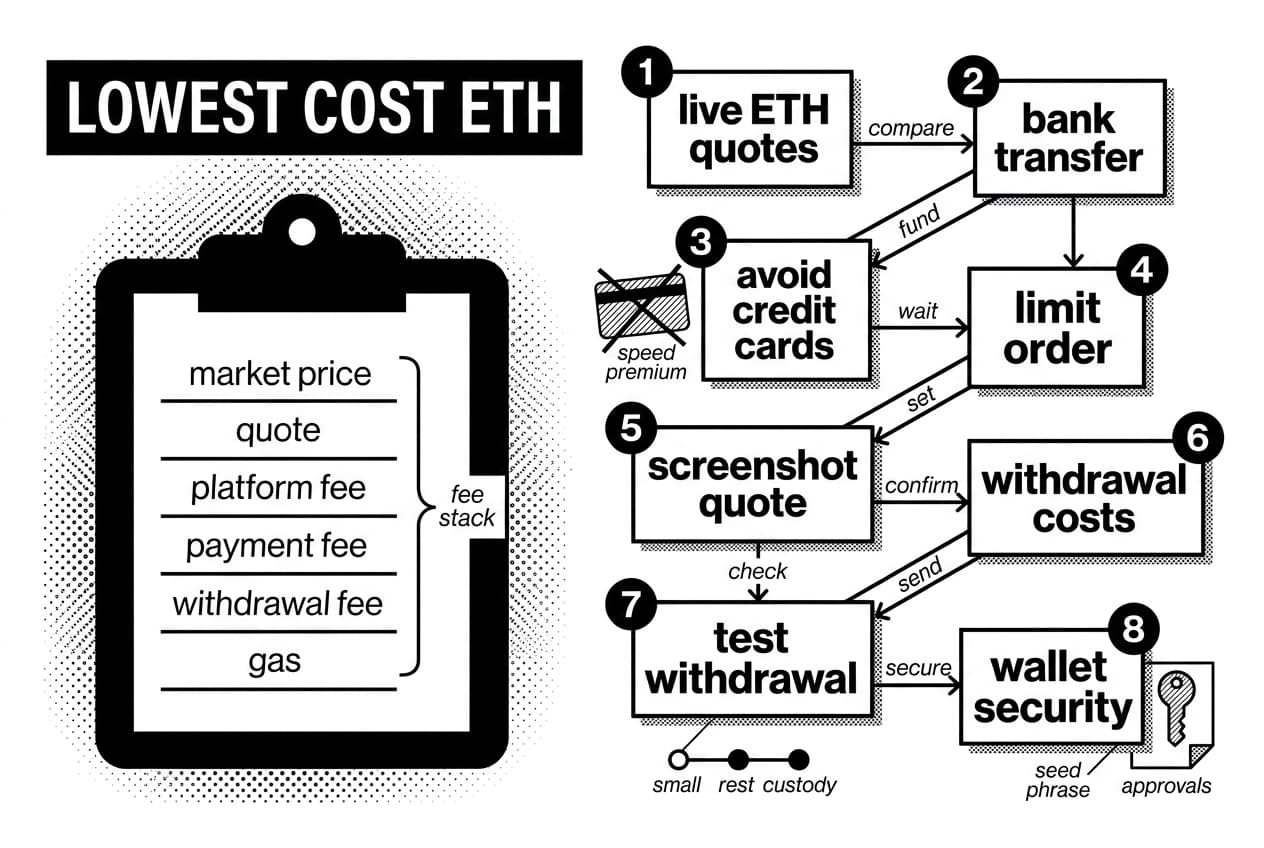
- Compare at least two live ETH quotes before buying.
- Use the six-line fee stack audit: market price, quote, platform fee, payment fee, withdrawal fee, and gas.
- Fund with bank transfer when you can wait.
- Avoid credit cards unless the speed premium is worth it.
- Use a limit order for larger buys when available.
- Screenshot the quote before the final confirm click.
- Check withdrawal costs before moving small balances.
- Send a test withdrawal before transferring the rest.
The cheapest safe method depends on your country, payment method, purchase size, and custody plan. In most cases, a bank transfer to a low-spread exchange beats a zero-fee wallet or card quote once you count the full cost.
Next steps after buying Ethereum
After your purchase, learn how gas fees work before sending ETH anywhere. Then review wallet security, seed phrase storage, and token approvals so you do not lose funds through a preventable mistake.
If you want to build your ETH position without only buying more, read our guide to ways to earn Ethereum. Keep the same cost discipline there too: rewards, lockups, gas, and taxes all affect the real outcome.
Frequently Asked Questions
- Where is the safest place to buy Ethereum?
- A reputable, regulated exchange with strong security practices, transparent fees, and proper KYC verification is generally your safest starting point. After purchasing, moving your ETH to a self-custody wallet adds another layer of protection — provided you know how to securely manage your private keys and seed phrase.
- What's the cheapest way to buy Ethereum?
- Funding a low-fee, high-liquidity exchange via bank transfer and placing a limit order typically gives you the lowest total cost. Be cautious of zero-fee apps, as they often embed spreads into the price. On-chain withdrawals can also add meaningful costs, so factor those in before committing.
- Where can I buy Ethereum with the lowest fee?
- There's no single universal winner — the cheapest option depends on your payment method, location, and purchase size. Before confirming any transaction, compare the trading fee, spread, deposit fee, payment method surcharge, and withdrawal fee across several exchanges and wallet on-ramps to find your true total cost.
- Is it worth buying $100 dollars of Ethereum?
- Buying $100 of ETH can make sense for learning the process or building a position gradually, but fees hit harder on smaller amounts. Stick to low-fee bank transfers and avoid card purchases where surcharges are steep. Keep in mind that ETH prices are volatile, so only invest what you can afford to lose.
Sources
Author

Crypto analyst and blockchain educator with over 8 years of experience in the digital asset space. Former fintech consultant at a major Wall Street firm turned full-time crypto journalist. Specializes in DeFi, tokenomics, and blockchain technology. His writing breaks down complex cryptocurrency concepts into actionable insights for both beginners and seasoned investors.