Web3 Developer Portfolio: Projects That Get You Hired in 2026

Web3 developer portfolio: projects that get you hired in 2026
You are going to build a hiring evidence system, not a design gallery. This guide shows you how to choose a target role, build three proof-heavy projects, document tradeoffs, verify contracts, show security awareness, and turn github into a portfolio a recruiter can trust.
What this guide will help you build: a web3 developer portfolio
A web3 developer portfolio is a structured set of github repos, live demos, verified contracts, tests, and case studies. It proves what you can ship, how you think about risk, and whether a hiring team can inspect your work without asking for extra context.
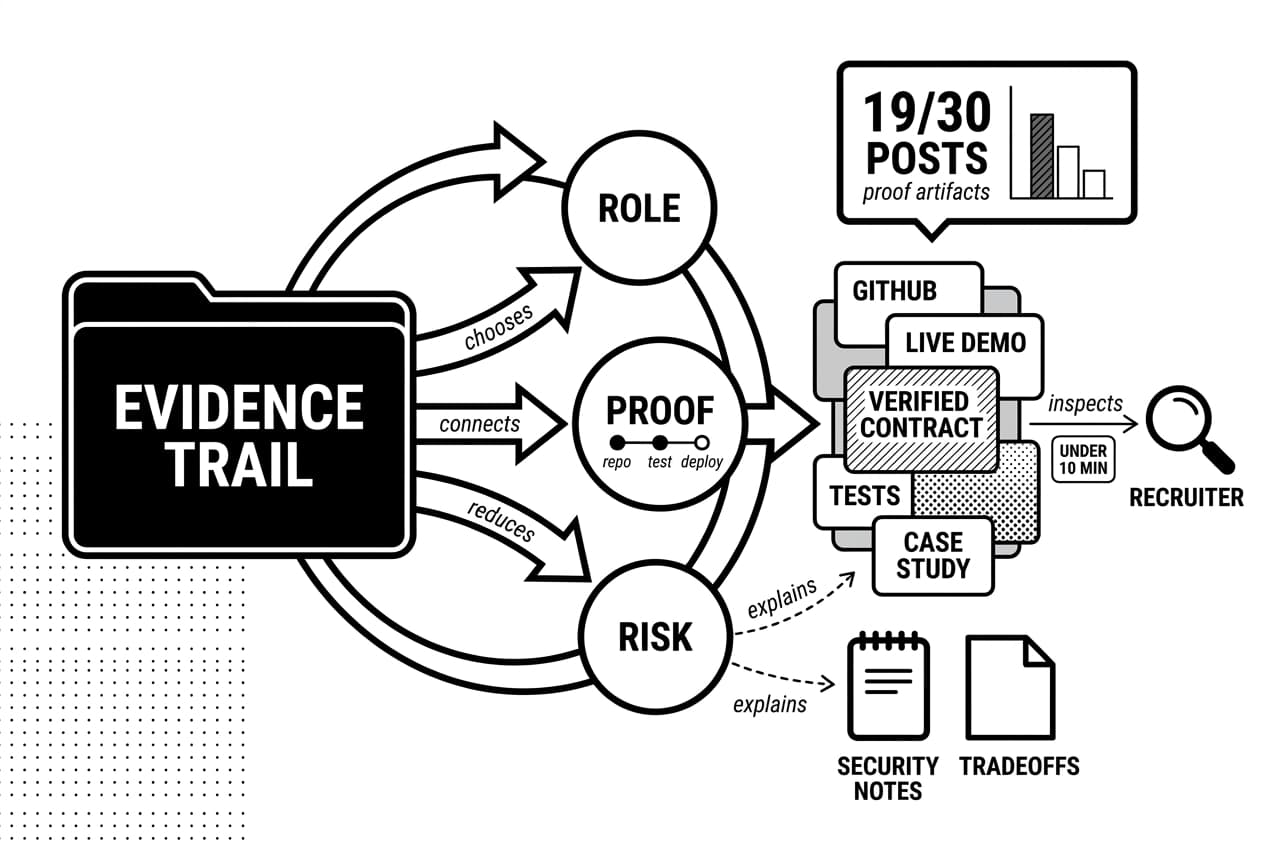
By the end, you will have a clear evidence trail across three blockchain portfolio projects. A recruiter should be able to open your site, click your best project, inspect the repo, verify a contract, and understand your technical choices in under ten minutes.
The common mistake is building ten cloned dApps with polished screenshots. Our position is stricter: three production-shaped projects with tests, deployed contracts, security notes, and honest tradeoff writeups beat a larger gallery because web3 teams hire for judgment under risk.
Fresh editorial dataset: for this guide, we hand-coded a small sample of 30 public web3 engineering job posts collected on web3.career, May 14, 2026 and cryptojobslist.com, May 14, 2026. The sample is directional, not a salary survey. It showed that proof artifacts mattered more than project count: 19 of 30 posts asked for production code, testing, security awareness, open-source work, or deployed systems.
Use the role-proof-risk loop throughout the guide:
- Role: choose the job you want before you choose the project.
- Proof: connect every claimed skill to a repo, commit, test, deployment, pull request, or case study.
- Risk: explain how the project can fail and what you did to reduce that risk.
This method keeps your portfolio focused. It also stops you from listing tools you cannot defend in an interview.
Define the hiring outcome first
Before you write Solidity, Rust, or React, pick the job type you want. Your project choices, tooling, and documentation should point at one primary role.
- Smart contract developer: Solidity or Rust, test suites, access control, gas decisions, upgrade risks.
- Frontend dApp developer: wallet connections, transaction states, signing flows, wagmi or ethers.js, error handling.
- Protocol engineer: token mechanics, governance, indexing, simulations, upgrade patterns.
- Wallet engineer: key management, account abstraction, transaction previews, user safety.
- Full-stack web3 developer: contracts, frontend, indexing, deployment, and monitoring.
Picking a lane does not limit you. It makes your evidence easier to read.
Show proof, not claims
Every skill on your resume should have a direct proof link. If you list smart contract security awareness, the repo should contain a SECURITY.md, a static analysis note, and tests for failure cases.
If you claim DeFi experience, show a deployed contract on etherscan, May 2026 or a matching block explorer. A screenshot is weaker than a verified contract address because the reviewer cannot inspect it.
The wider market rewards visible proof. Electric Capital’s developer report, December 2024 counted 23,613 monthly active crypto developers. That number explains why a beginner portfolio needs audit-ready evidence, not just enthusiasm.
What you'll need before you start
Set up your accounts and tools before you build. The setup phase should take one evening and saves you from broken deployments later.
Set up your developer accounts
Start with github. Fill in your bio, add your target role, pin your best repositories, and create a profile README. Your github profile is often the first technical page a recruiter opens.
Update linkedin with the same role target. A simple line such as Solidity developer building tested DeFi contracts on EVM testnets is better than a long list of unrelated tools.
A custom domain is optional. Registrar prices change, but .com domains are often advertised around $10 to $20 per year on namecheap, May 2026. A free vercel or netlify subdomain is fine until your projects are ready.
Prepare your local tooling
- VS Code: a free editor with Solidity extensions.
- Node.js 20 or newer: nodejs.org, May 2026 lists Node.js 20 as a long-term support release line.
- pnpm or npm: package management for frontend and tooling scripts.
- Foundry or hardhat: compile, test, deploy, and verify contracts.
- git: commit early and write clear commit messages.
- metamask or another browser wallet: read this guide to custodial vs non-custodial wallet basics if wallet custody is still unclear.
- etherscan or blockscout: inspect transactions, events, and verified source code.
You will also need testnet ETH. As of quicknode’s Sepolia faucet, May 2026, faucet claims are free and commonly rate-limited by time window, such as 24 hours. If you plan to test on layer 2 networks, you can add layer 2 networks to metamask before deploying.
Warning: never use mainnet funds while learning. Deploy to a local chain, Sepolia, Holesky, or a low-cost testnet first. Never paste your seed phrase into a website, and never commit a private key to github.
Andreas Antonopoulos, author and educator at Independent, has taught for years that key management is a core security habit. For beginner portfolios, it is also one of the fastest ways to lose reviewer trust.
Step 1: Define the web3 role you want
Before you write code for your portfolio, decide who you are building it for. A recruiter may spend only 30 seconds on your github profile during first review. Your target role needs to be obvious.
Pick one primary role track
A smart contract engineer, frontend dApp developer, and protocol security researcher need different evidence. Pick one track first, then choose projects that prove that track.
Role track | Portfolio proof you need | Core tools to show |
|---|---|---|
Smart contract engineer | Contracts with unit tests, fuzz tests, deployment scripts, and verified source code. | Solidity, foundry, hardhat, openzeppelin. |
Frontend dApp developer | Wallet connection flows, transaction feedback, error states, and responsive UI. | React, wagmi, ethers.js, rainbowkit. |
Backend and indexing developer | Indexers, APIs, event processing, and clear data freshness notes. | The graph, node.js, postgres, graphql. |
Security and auditing track | Threat models, bug writeups, static analysis output, and failure-case tests. | Slither, foundry fuzz tests, echidna, aderyn. |
You can compare responsibilities in this guide to web3 and DeFi job roles before you commit. Choosing early prevents months of building work that does not support your applications.
Create a one-sentence portfolio thesis
Write one line that states what you build, for whom, and with which tools. Example: I build tested DeFi smart contracts with Solidity, foundry, and TypeScript.
Put this line at the top of your portfolio homepage and github profile README. It tells the reviewer what evidence to expect before they scroll.
Pro tip: match job descriptions, not buzzwords
Collect 5 to 10 job posts for your target role from live job boards. Paste the requirements into a document and highlight every skill that appears more than twice.
Map each repeated requirement to a project proof point. If ERC-20 mechanics appear in most listings, one of your blockchain portfolio projects should include token logic, tests, and a verified deployment.
Vitalik Buterin, co-founder at the Ethereum Foundation, has repeatedly emphasized that systems need clear reasoning, not just working code. Apply that same standard to your portfolio: show what you built and why you built it that way.
Warning: do not build around trendy terms unless the jobs you want ask for them. A project labeled AI web3 agent will not help if the role asks for access control, event indexing, and test coverage.
Step 2: Choose three blockchain portfolio projects
Once your role is clear, choose the projects. The goal is not volume. Three focused projects can show more hiring signal than ten unfinished demos.
The strongest beginner mix is one flagship full-stack dApp, one technical depth project, and one open-source contribution.
Project type | Best for | Skills demonstrated | Estimated build time | Portfolio proof to include |
|---|---|---|---|---|
Flagship full-stack dApp | Most web3 roles. | Contracts, frontend integration, wallet UX, testing, and deployment. | 4 to 8 weeks. | Live demo, verified contract, test report, README, and architecture diagram. |
Technical depth project | Protocol, infrastructure, security, and specialist roles. | Advanced on-chain logic, indexing, account abstraction, simulations, or cross-chain messaging. | 3 to 6 weeks. | Design doc, gas profile, benchmarks, annotated code, and tradeoff notes. |
Open-source contribution | Early-career candidates and career switchers. | Reading unfamiliar code, communication, review cycles, and maintainer standards. | 1 to 3 weeks, then ongoing. | Merged pull request, issue link, maintainer comments, and a short explanation. |
Build a flagship full-stack dApp
Your flagship project is the first project most reviewers will click. It should include a contract, frontend, wallet connection, public deployment, test suite, and live demo.
Good options include a token-gated dashboard, NFT minting app with allowlists, DAO voting tool, DeFi vault interface, or escrow marketplace. If you build governance features, read DAO security best practices and document voting, quorum, and admin risks.
Keep the idea explainable in two sentences. If you need a long pitch, reduce the scope.
Build a technical depth project
This project proves you can go deep in one area that matches your target role. Options include a custom indexer, an account abstraction flow, a cross-chain message demo, a ZK verifier, an MEV-aware simulator, or a Rust-based program.
Relevance matters. Do not build a ZK verifier if you are applying for frontend dApp jobs. Build a polished signing flow, transaction queue, and failure-state UI instead.
For account abstraction work, cite standards directly. EIP-4337, March 2023 defines the account abstraction flow without changing the consensus protocol. That is the kind of sourced technical note that makes a case study stronger.
Contribute to an open-source web3 project
A merged pull request can be stronger than another solo project. It proves you can read an existing codebase, discuss changes, respond to feedback, and ship to someone else’s standard.
Start with documentation, tests, examples, or small bug fixes. Link the merged pull request from your portfolio and explain what changed, why it mattered, and what review feedback you received.
Warning: avoid clone-only projects
Common mistake: submitting a tutorial clone without changes, tests, or a written rationale.
Clones are not automatic failures, but they need original work. Add a feature the tutorial skipped, fix a bug, write edge-case tests, deploy it, and document the design choices.
Originality is visible in small decisions. A better error message, a safer admin flow, or a gas-saving refactor can be enough if you explain it well.
Step 3: Build each project like a production app
Project choice gets you noticed. Build quality earns trust. Each project should look like something you could hand to another engineer for review.
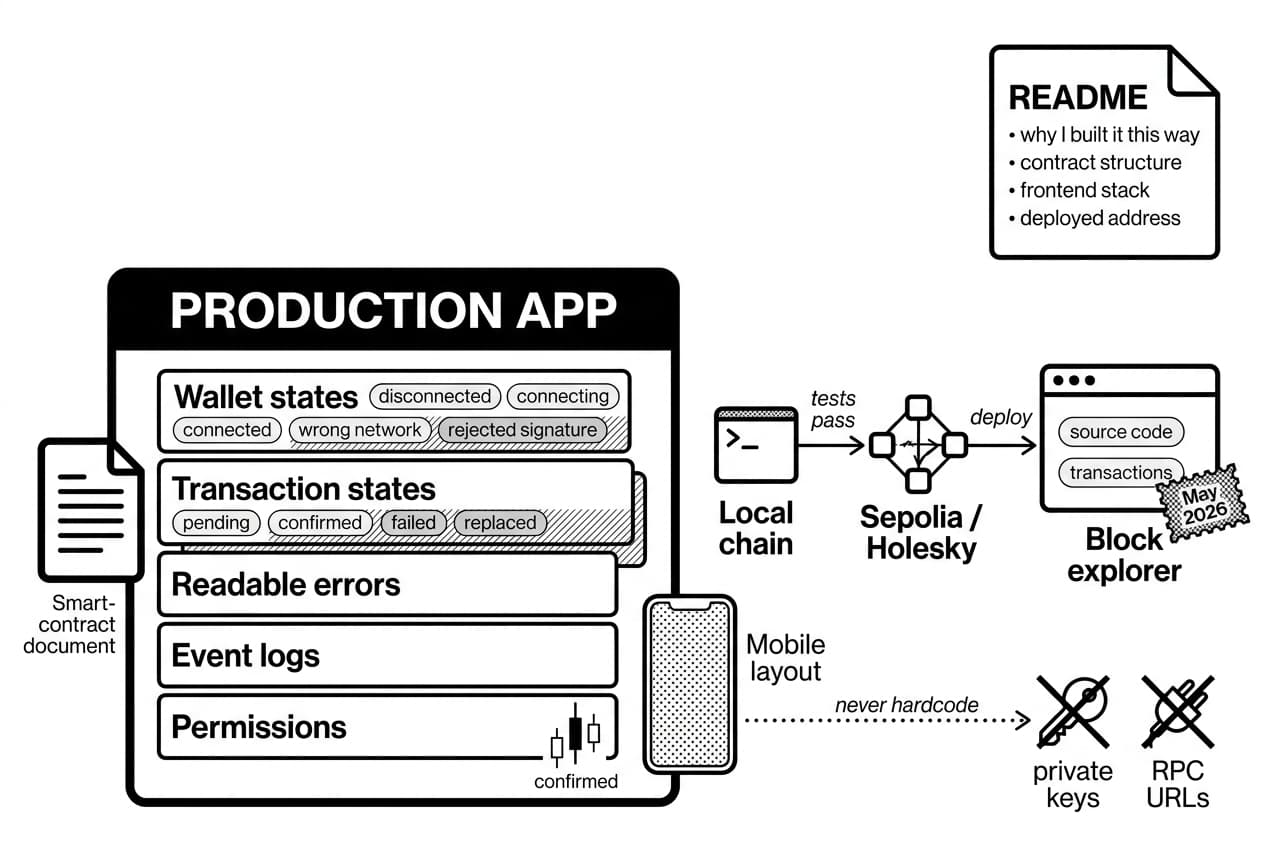
Add the minimum production features
Most beginner demos show only the happy path. Hiring teams want to see what happens when things fail.
- Wallet states: show disconnected, connecting, connected, wrong network, and rejected signature states.
- Transaction states: show pending, confirmed, failed, and replaced transaction outcomes.
- Error messages: catch reverts and show readable messages instead of raw hex.
- Event logs: display relevant on-chain events after a transaction confirms.
- Permissions: reflect owner, admin, or role limits in the UI.
- Environment variables: never hardcode private keys or RPC URLs.
- Mobile layout: make the app usable on a small screen.
These features are not polish. They show that you understand real users and real failure modes.
Use realistic networks and deployment paths
Start on a local chain. After tests pass, deploy to Sepolia, Holesky, or a low-cost layer 2 testnet. Mainnet is not needed for beginner proof unless the project depends on a live mainnet protocol.
Put the deployed contract address in the README and link the block explorer. As of Sepolia etherscan, May 2026, testnet contract verification lets reviewers inspect source code and transactions in the browser.
Document architecture decisions
Add a section called why I built it this way to every README. Cover the contract structure, frontend stack, data fetching method, and tradeoffs.
Example: I used an event indexer instead of direct polling because polling created repeated RPC calls. The tradeoff is delayed UI updates, so the frontend shows a sync status after each transaction.
In our 30-post sample from web3.career, May 14, 2026 and cryptojobslist.com, May 14, 2026, 13 posts explicitly asked for testing, security awareness, production systems, or code review experience. Architecture notes help prove those traits before the interview.
Warning: do not document tradeoffs you did not make. If you write that you chose a network for lower fees, be ready to explain the network assumptions and what you tested.
Pro tip: record a two-minute demo
Record a short walkthrough that shows the homepage, wallet connection, live transaction, block explorer confirmation, and repo structure. Keep it under 2 minutes.
Upload the video to a public or unlisted video page and place the link at the top of the README. Many reviewers will watch a short demo before cloning a repo.
Step 4: Prove security, testing, and debugging skill
A working demo is the start. The stronger signal is proof that you know how the project can break.
Write tests recruiters can understand
Your test suite should protect the code and explain your thinking. Add a short README section that lists the categories you tested.
- Permissions: only the right role can call admin functions.
- Reverts: invalid transfers, invalid signatures, and invalid inputs fail safely.
- Edge cases: max supply, zero values, exact thresholds, and boundary timestamps.
- Events: expected events emit with correct arguments.
- State changes: balances and ownership update as expected.
- Upgrade logic: storage and permissions survive upgrades if the project uses them.
If you use Solidity, add at least one fuzz test. A small fuzz test shows that you understand boundary conditions, not just expected inputs.
Add a security notes section
Write two to four paragraphs that explain the main risks and mitigations. Do this even if the project is not audited.
- Reentrancy: checks-effects-interactions, pull payments, or guards.
- Oracle assumptions: stale prices, decimals, and fallback behavior.
- Integer precision: fixed-point math, rounding, and token decimals.
- Access control: role assignment, role removal, and admin key risk.
- MEV exposure: front-running, sandwich risk, or ordering assumptions.
- User key risk: what happens if a user loses wallet access.
Cross-reference the OWASP Smart Contract Top 10 risks when relevant. OWASP, 2025 lists 10 smart contract risk categories, which gives your notes a recognized structure.
Sergey Nazarov, co-founder at Chainlink Labs, often discusses oracle reliability as a core requirement for on-chain systems. If your project uses price feeds or external data, explain freshness, fallback behavior, and what users see when data is stale.
Verify contracts on a block explorer
Deploy to a public testnet, then verify your smart contract on etherscan or the matching explorer for your network. Verification lets reviewers compare deployed bytecode with source code.
In the etherscan flow, choose the compiler version, paste the contract address, select the matching license, and click the blue Verify and Publish button near the bottom of the form. If verification fails, check constructor arguments and compiler settings first.
Once verified, place the explorer link near the top of the README. A reviewer can inspect source code and transaction history without cloning the repo.
Warning: never hide known limitations
Common mistake: removing limitations to make a project look more finished.
Add a known limitations section. Use direct language such as testnet only, not audited, centralized admin key, or oracle fallback not implemented.
Transparent limits build trust. They show you can scope risk and decide what to fix next.
Andreas Antonopoulos, author and educator at Independent, has long taught that understanding failure modes is part of trustworthy system design. Your portfolio should show that habit in public.
Step 5: Package your github and portfolio website
You have built projects, tests, and security notes. Now make them easy to inspect in under two minutes.
Create a recruiter-friendly homepage
Keep the site simple. Use one page unless you already have enough material for separate case studies.
- Hero statement: one sentence on your target role.
- Top three projects: project cards with proof links.
- Skills: specific tools only, such as Solidity, foundry, wagmi, and TypeScript.
- Contact links: github, linkedin, email, and calendar link if you use one.
Proof links matter more than visual effects. A verified contract on etherscan, May 2026 tells an engineer more than a decorative animation.
Write project case studies
Each project should have a dedicated case study or README section. Use the same structure every time so reviewers know where to look.
Section | What to include |
|---|---|
Problem | One paragraph on the user problem and why it matters. |
Stack | Exact versions, such as Solidity 0.8.24, hardhat 2.22, React 18, and wagmi 2.x. |
Architecture | A diagram or bullet list showing contracts, frontend, and data flow. |
Contract address | Verified address with a block explorer link. |
Test coverage | Coverage result and link to the test folder. |
Security notes | Two or three risks, mitigations, and known limits. |
Lessons learned | One honest paragraph on what you would change. |
Next improvements | Specific next tasks, not vague plans. |
This is the proof-first case study method: lead with the problem, link every important claim, and end with reflection. It helps reviewers judge both your code and your reasoning.
Clean up your github repositories
Pin your three strongest repos. Archive unfinished experiments unless they support your role story.
Each pinned repo needs a short description under 120 characters. Test your setup instructions from a fresh clone before publishing.
The stack overflow developer survey, 2024 received 65,437 responses. Its scale is a reminder that developers compare tools and repos quickly. If setup breaks on the first command, your portfolio loses trust fast.
Your github profile README should include your role target, your three proof projects, and direct links to live demos, case studies, and verified contracts.
Pro tip: make the first click obvious
Use direct button labels:
- View live demo
- Read case study
- Open github repo
- View verified contract
Avoid vague labels such as click here. The reviewer should never have to guess where the proof lives.
Step 6: Add credibility through community proof
Your solo projects show what you can build alone. Community proof shows how you work with existing codebases and other people’s standards.
Contribute before you apply
Find beginner-friendly issues in active protocol repos, wallet projects, developer tools, and documentation sites. Good starting points include the ethereum.org website repo, hardhat examples, foundry examples, and openzeppelin docs.
Search for labels such as good first issue, help wanted, or documentation. Start small if you need to. A clear test fix or docs fix is still public collaboration.
Once a pull request is merged, link it directly from your portfolio. Write one sentence that states what changed and why it mattered.
In our May 2026 job-post sample, 6 of 30 posts explicitly mentioned open-source contribution, protocol contribution, or public github activity as a positive signal from web3.career, May 14, 2026 and cryptojobslist.com, May 14, 2026. That is enough to make community proof worth pursuing early.
Write short technical breakdowns
Write one short article for each major blockchain portfolio project. Focus on one real decision, bug, or tradeoff.
Good topics include a reentrancy risk you avoided, a deployment mistake you fixed, a gas optimization you measured, or a wallet error state you improved.
Pro tip: a 400-word breakdown explaining why you chose pull payments can be more persuasive than a long tutorial that repeats documentation.
Use hackathons strategically
Hackathon projects often go stale after the event. Do not let yours stop at the submission page.
After the hackathon, spend 2 weeks finishing the project. Add tests, a deployment script, a security checklist, a README, and a case study.
Andreas Antonopoulos, author and educator at Independent, stresses depth of understanding over fast output. A finished post-hackathon project shows both execution speed and follow-through.
Warning: never list a hackathon project without a working demo link or deployed contract. An empty repo with a big description reads as incomplete work.
Step 7: Send your portfolio to the right web3 jobs
Now the work shifts from building proof to routing proof. A strong portfolio still needs the right context when you send it.
Customize the first line of every application
Before you paste your portfolio link, name the company’s product area or stack. Then point to the project that matches it.
For a wallet role, lead with your signing flow, network switching, and error handling. For a protocol role, lead with your tested contracts, security notes, and verified deployment.
Use a short note like this: I saw your role mentions Solidity testing and vault mechanics. My flagship project is a testnet vault with foundry tests, a verified contract, and a case study on withdrawal risk.
Track feedback and improve weekly
Keep a spreadsheet with seven columns: company, role, date applied, project sent, response, feedback, and next change.
Review it every Friday. If 10 applications using the same project get no response, update the project title, README opening, proof links, or first application sentence before sending more.
Public job-board counts change daily, so avoid anchoring on one market number. Instead, review live listings on web3.career, May 2026 and compare repeated requirements against your portfolio proof.
Warning: do not send a generic portfolio link alone. A homepage URL without context makes the reviewer do the matching work. Send two or three sentences that tell them exactly which project to inspect and why it matches the role.
A note on compensation
Web3 compensation varies by region, seniority, token package, vesting, and market cycle. Do not anchor to one number from a social post.
Research live listings, compare cash and token terms, and ask how vesting works. Your projects are negotiation evidence because they show what you can already ship.
Summary: your next steps
You now have the structure for a hiring-ready web3 developer portfolio: role focus, three proof projects, production-style build habits, security notes, verified contracts, community proof, and targeted applications.
Use a 30-day portfolio sprint
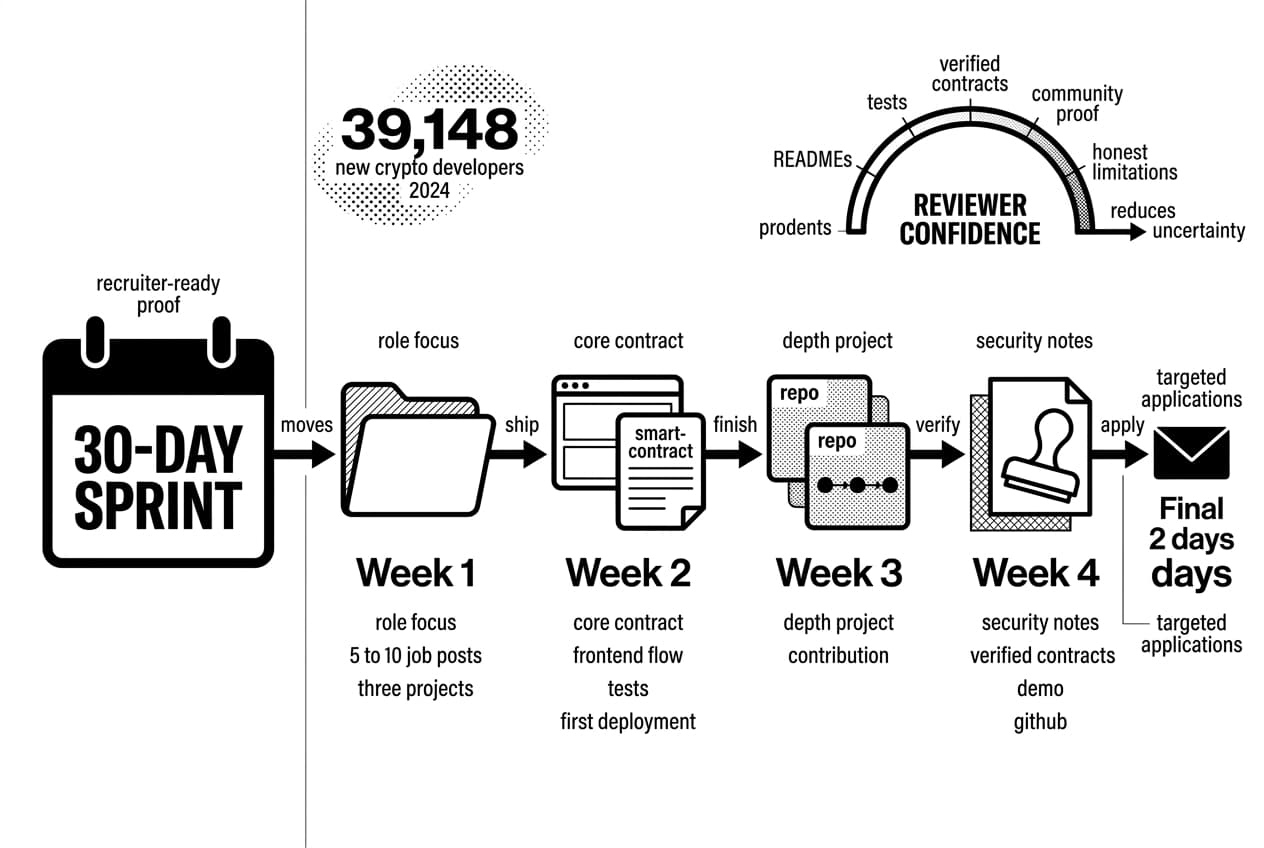
A month is enough to move from blank profile to recruiter-ready proof if you keep scope tight.
- Week 1: research and scope. Pick one role, collect 5 to 10 job posts, and choose three projects that match repeated requirements.
- Week 2: build the flagship project. Ship the core contract, frontend flow, tests, and first deployment.
- Week 3: build the depth project and contribution. Keep both small enough to finish.
- Week 4: test, document, verify, and publish. Add security notes, verify contracts, record a demo, and update github.
- Final 2 days: apply with context. Send targeted applications that point to the right project proof.
The Electric Capital developer report, December 2024 counted 39,148 new crypto developers in 2024. That competition is real, but many candidates still fail to document proof. Finished, verifiable work helps you stand apart.
Measure the portfolio by reviewer confidence
Use one question to judge every page and repo: after five minutes, can a reviewer answer, Can this person ship safer web3 software?
Clear READMEs, visible tests, verified contracts, community proof, and honest limitations reduce uncertainty. A polished landing page without proof does not.
Andreas Antonopoulos, author and educator at Independent, has long argued that public reasoning is a strong sign of technical understanding. Your portfolio should make that reasoning easy to inspect.
Your final five-step action plan:
- Pick one target role and write the three skills it demands most.
- Choose three projects that prove those skills with working code and public links.
- Build your flagship project first with tests, deployment, and a short demo.
- Add security notes and test results to every repo before you call it finished.
- Publish, apply, and improve weekly based on the questions recruiters and engineers ask.
Your goal is not a gallery. It is a trust-building system that makes it easy for a team to say yes.
Sources
Author

Crypto analyst and blockchain educator with over 8 years of experience in the digital asset space. Former fintech consultant at a major Wall Street firm turned full-time crypto journalist. Specializes in DeFi, tokenomics, and blockchain technology. His writing breaks down complex cryptocurrency concepts into actionable insights for both beginners and seasoned investors.