OWASP Smart Contract Top 10 (2026): A Ranked Guide to Risks
What Is the OWASP Smart Contract Top 10?
The OWASP Smart Contract Top 10 is a standard awareness document that identifies and ranks the ten most critical security risks affecting smart contracts, serving as an essential guide for developers, auditors, and security professionals building on the blockchain.
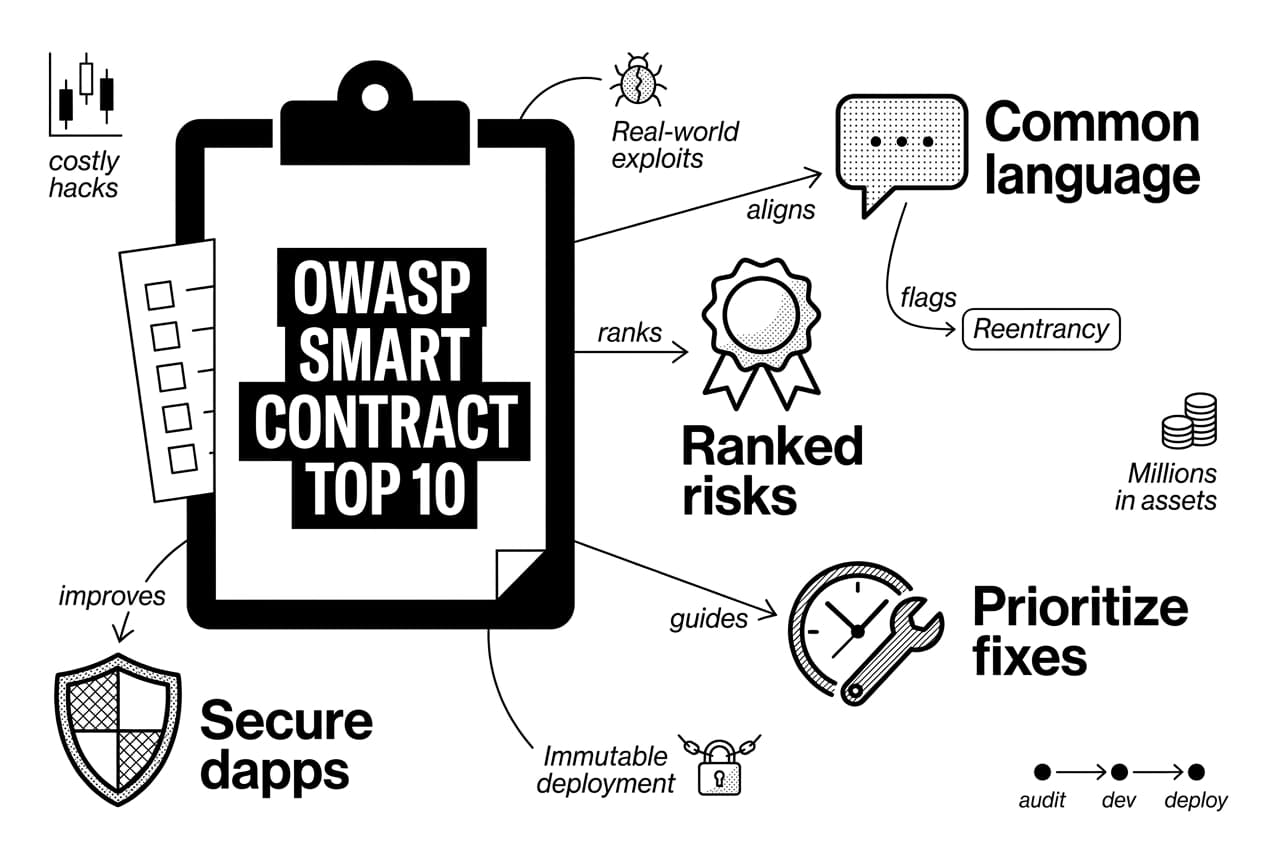
But why does this list matter so much? Think of it as a pilot's pre-flight checklist for your code. In the world of Web3, where smart contracts often manage millions of dollars in assets and are deployed immutably, a small oversight can lead to a catastrophic failure. This isn't just an academic exercise; it's a practical toolkit forged from the analysis of real-world exploits and costly hacks. The project provides a common language for the entire community. When an auditor flags a potential reentrancy bug, for example, they can reference a specific category from the list, allowing developers to immediately understand the context and severity of the threat.
By focusing on the most common and dangerous pitfalls, this smart contract vulnerability ranking helps teams prioritize their security efforts. It guides you to spend your limited time and resources fixing the problems that are most likely to occur and cause the most damage. For anyone writing or reviewing code that will live on-chain, mastering the OWASP Smart Contract Top 10 is a foundational step toward building more secure, reliable, and trustworthy decentralized applications.
The 2026 OWASP Smart Contract Top 10: Ranked Vulnerabilities
Having understood the importance of a standardized security framework, let's explore the list itself. This updated smart contract vulnerability ranking for 2026 highlights the most critical threats developers face. Each entry in the owasp smart contract top 10 includes an explanation, a look at the potential damage, and practical code examples to help you secure your dApps.
SCS-1: Reentrancy Attacks
A reentrancy attack occurs when an external contract call is able to call back into the original function before it has finished executing. Think of it like a bank transaction: you ask the teller for $100. Before they can update your balance in their ledger, you somehow manage to get back in line and ask for another $100. The teller, still thinking you have your original balance, gives you more money. This continues until the account is drained, and only then is the balance updated.
The impact is almost always catastrophic financial loss, as seen in the infamous 2016 DAO hack which led to the Ethereum hard fork. The attacker repeatedly calls the withdraw function, draining the contract's funds before it can update the attacker's balance.
Vulnerable Code Example:
// SPDX-License-Identifier: MIT
pragma solidity ^0.8.20;
contract VulnerableVault {
mapping(address => uint) public balances;
// ... deposit function ...
function withdraw() public {
uint amount = balances[msg.sender];
require(amount > 0, "No funds to withdraw");
// Vulnerability: External call is made BEFORE the balance is updated.
// The malicious contract can call this function again (re-enter)
// before the next line is executed.
(bool sent, ) = msg.sender.call{value: amount}("");
require(sent, "Failed to send Ether");
// State change happens last, which is too late.
balances[msg.sender] = 0;
}
}
Mitigation Strategy: The best defense is the Checks-Effects-Interactions pattern. First, perform all checks (e.g., `require` statements). Second, apply all effects to the contract's state (e.g., update balances). Finally, interact with external contracts. This ensures your internal state is secure before giving control to an unknown contract.
Secure Code Example:
// SPDX-License-Identifier: MIT
pragma solidity ^0.8.20;
contract SecureVault {
mapping(address => uint) public balances;
// ... deposit function ...
function withdraw() public {
// Check: Is there a balance?
uint amount = balances[msg.sender];
require(amount > 0, "No funds to withdraw");
// Effect: Update the balance first.
balances[msg.sender] = 0;
// Interaction: Perform the external call last.
// Even if the attacker's contract calls back, their balance is already 0.
(bool sent, ) = msg.sender.call{value: amount}("");
require(sent, "Failed to send Ether");
}
}
SCS-2: Access Control Vulnerabilities
Access control, or authorization, is about ensuring that only the right people can call certain functions. Vulnerabilities arise from mistakes like unprotected admin functions, incorrect use of modifiers like `onlyOwner`, or using `tx.origin` for authentication.
The impact can range from changing a contract's settings to a complete takeover, including transferring ownership or draining user wallets of all funds. This is like leaving the key to the entire building under the doormat.
Vulnerable Code Example (using `tx.origin`):
// SPDX-License-Identifier: MIT
pragma solidity ^0.8.20;
contract VulnerableWallet {
address public owner;
constructor() {
owner = msg.sender;
}
// Vulnerability: `tx.origin` checks the original initiator of the entire
// transaction chain. If an owner is tricked into calling a malicious
// contract, that contract can then call this function, and `tx.origin`
// will be the owner's address, granting the malicious contract access.
function transferOwnership(address newOwner) public {
require(tx.origin == owner, "Not the owner");
owner = newOwner;
}
}
Mitigation Strategy: Always use `msg.sender` for authorization, as it refers to the immediate caller. Follow the principle of least privilege, granting only the minimum permissions necessary. Use well-audited access control libraries like OpenZeppelin's `Ownable`.
Secure Code Example:
// SPDX-License-Identifier: MIT
pragma solidity ^0.8.20;
import "@openzeppelin/contracts/access/Ownable.sol";
// By inheriting from Ownable, we get a secure `onlyOwner` modifier
// and transferOwnership function that correctly use `msg.sender`.
contract SecureWallet is Ownable {
constructor() Ownable(msg.sender) {}
// Example of a protected function
function doSomethingCritical() public onlyOwner {
// ... critical logic here ...
}
}
SCS-3: Oracle and Data Source Issues
Smart contracts often need real-world data, like the current price of ETH/USD, to function. They get this data from "oracles." An oracle issue arises when the contract relies on a single, manipulatable data source. It's like a referee in a championship game who can be easily bribed.
The most common impact is financial exploitation. For instance, an attacker could use a flash loan to manipulate the price of an asset on a single decentralized exchange (DEX), then cause a lending protocol that uses that DEX as a price oracle to liquidate other users' positions at an unfair price.
Conceptual Vulnerable Logic:
// This is pseudo-code for conceptual understanding.
function getAssetPrice() internal view returns (uint) {
// VULNERABLE: The price is sourced from a single, easily manipulated
// on-chain AMM (Automated Market Maker) pool.
// An attacker can skew this pool's ratio with a large trade.
return ISingleDex(poolAddress).getPrice();
}
function liquidate(address user) public {
uint price = getAssetPrice();
// If the attacker manipulates the price down, this check might wrongly pass.
if (getUserCollateralValue(user, price) < getUserDebt(user)) {
// ... liquidation logic ...
}
}
Mitigation Strategy: Do not rely on a single data source, especially one with low liquidity that can be moved by a single large transaction. Use decentralized oracle networks like Chainlink, which aggregate data from multiple independent sources, making them far more resilient to manipulation.
SCS-4: Transaction Order Dependence (Front-Running/MEV)
Because transactions on a public blockchain sit in a public waiting area (the mempool) before being confirmed, anyone can see them. Transaction Order Dependence, often called front-running, is when an attacker sees a pending transaction and submits their own transaction to be processed first for a profit. This is possible because miners or block builders can choose the order of transactions. This profitable reordering is a form of Maximal Extractable Value (MEV).
Imagine you're about to buy the last concert ticket online for $100. A scalper sees your pending purchase, quickly buys it for $101, and then offers to sell it to you for $200. The impact is direct financial loss for users and an unfair market environment.
Conceptual Vulnerable Logic (DEX):
// In a simple DEX, a large user purchase is submitted to the mempool.
// An attacker sees this transaction.
// Attacker's Actions:
// 1. Submit a `buy` transaction for the same asset with a higher gas fee.
// This transaction gets mined first, slightly raising the asset price.
// 2. The original user's `buy` transaction is then mined at the new, higher price.
// This pushes the price even higher (slippage).
// 3. The attacker immediately submits a `sell` transaction, profiting from the
// price increase they helped create.
Mitigation Strategy: This is a difficult problem to solve completely. Strategies include using a commit-reveal scheme, where the details of a transaction are hidden until after it's been ordered. Another emerging solution is the use of services that offer encrypted mempools, which prevent attackers from seeing transaction details before they are finalized.
SCS-5: Integer Overflow and Underflow
Integer types in Solidity, like `uint256`, have a fixed size and thus a maximum and minimum value. An overflow happens when a number is incremented above its maximum value, causing it to wrap around to zero. An underflow is the opposite, where subtracting from zero wraps the number around to its maximum value. Think of a car's odometer: if it's a six-digit counter at 999,999, driving one more mile makes it roll over to 000,000.
The impact can be severe, especially in token contracts. An attacker could trigger an underflow when transferring tokens to receive a massive, unintended balance, effectively minting tokens out of thin air.
Vulnerable Code Example (Solidity <0.8.0):
// SPDX-License-Identifier: MIT
pragma solidity <0.8.0;
contract VulnerableToken {
mapping(address => uint256) public balanceOf;
function transfer(address _to, uint256 _value) public {
// VULNERABILITY: If balanceOf[msg.sender] < _value, this will underflow,
// giving the sender a massive balance instead of reverting.
balanceOf[msg.sender] -= _value;
balanceOf[_to] += _value;
}
}
Mitigation Strategy: The best and simplest mitigation is to use a modern Solidity compiler version (0.8.0 or newer). Starting with version 0.8.0, Solidity automatically checks for overflow and underflow and will cause the transaction to revert if one occurs. For older codebases, use a well-audited SafeMath library to perform arithmetic operations.
Secure Code Example:
// SPDX-License-Identifier: MIT
// By simply using 0.8.0 or newer, the arithmetic is safe by default.
pragma solidity ^0.8.20;
contract SecureToken {
mapping(address => uint256) public balanceOf;
function transfer(address _to, uint256 _value) public {
uint256 senderBalance = balanceOf[msg.sender];
require(senderBalance >= _value, "Insufficient balance");
// This arithmetic is now safe from overflow/underflow.
balanceOf[msg.sender] = senderBalance - _value;
balanceOf[_to] += _value;
}
}
SCS-6: Denial of Service (DoS)
A Denial of Service attack aims to make a smart contract unusable, preventing legitimate users from accessing its functions or funds. This can happen when an attacker exploits a design pattern that can be manipulated to make transactions fail or become too expensive to execute.
It's like someone jamming the lock on a community vault. The money is still inside, but no one can open the door to get it. The impact is often locked funds and a complete loss of utility for the protocol.
Conceptual Vulnerable Logic:
// This contract pays out to an array of investors.
contract VulnerableDistributor {
address[] public investors;
function payout() public {
// VULNERABILITY: This loop's gas cost grows with the number of investors.
// An attacker can create many small investor accounts, making the array
// so large that the gas required to run the loop exceeds the block gas limit.
// As a result, the payout() function can never successfully run.
for (uint i = 0; i < investors.length; i++) {
// ... send payment to investors[i] ...
}
}
}
Mitigation Strategy: Avoid looping over data structures that can be artificially inflated by external users. Instead of the contract pushing payments out to an array of users, implement a pull-over-push pattern. This means each user becomes responsible for calling a `claim()` or `withdraw()` function to pull their funds from the contract individually.
SCS-7: Logic Errors
Logic errors are flaws in the contract's intended behavior. The code is syntactically correct and doesn't revert, but it produces an incorrect or unexpected outcome because the business logic was improperly designed or implemented. These are often the hardest vulnerabilities to detect with automated tools.
Think of building a calculator where the '+' button was accidentally wired to perform subtraction. The calculator doesn't crash, but every addition gives the wrong answer. The impact can range from minor bugs to catastrophic failures like the Parity Wallet freeze, where a logic flaw allowed an attacker to permanently lock hundreds of millions of dollars.
Conceptual Vulnerable Logic:
// A contract for a private sale where users can claim a refund if the goal isn't met.
contract FlawedSale {
uint public goal = 100 ether;
bool public goalMet = false;
function finalize() public {
// VULNERABILITY: The check is incorrect. It should be '>='.
// If the contract raises exactly 100 ether, goalMet will remain false,
// allowing everyone to claim a refund even though the sale was successful.
if (address(this).balance > goal) {
goalMet = true;
}
}
function claimRefund() public {
require(!goalMet, "Goal was met, no refunds");
// ... refund logic ...
}
}
Mitigation Strategy: There is no single fix for logic errors. Defense requires a multi-layered approach: write simple, modular code; add extensive code comments explaining the *intent* of each function; create a reliable test suite with 100% code coverage that checks for all edge cases; and, most importantly, undergo one or more professional security audits.
SCS-8: Improper Initialization
This vulnerability occurs when a contract is not deployed with its state variables, such as the owner or other critical settings, configured correctly. This is a particularly high risk for upgradeable contracts that use an `initialize` function instead of a `constructor`.
It's like installing a new safe but forgetting to set the combination. The safe is left with the factory default (e.g., 0-0-0-0), and anyone who knows this can walk up and open it. The impact is often a complete contract takeover, as an attacker can call the unprotected initializer function to make themselves the owner.
Conceptual Vulnerable Logic (Upgradeable Contract):
// This is the implementation contract for a proxy.
contract MyToken_V1 {
address public owner;
// VULNERABILITY: This function acts as the constructor but has no protection
// to ensure it's only called once. After the proxy deploys this implementation,
// anyone can call initialize() and become the owner.
function initialize() public {
owner = msg.sender;
}
}
Mitigation Strategy: For standard, non-upgradeable contracts, always set critical variables inside the `constructor`. For upgradeable contracts, protect initializer functions to ensure they can only be called once. Use well-audited libraries like OpenZeppelin's `Initializable` contract, which provides a modifier to lock an initializer after its first run.
SCS-9: Outdated or Vulnerable Dependencies
Smart contracts rarely exist in a vacuum; they often import code from external libraries or inherit from other contracts to handle common tasks like token standards (ERC-20) or access control. This vulnerability arises when a contract relies on a dependency that has a known security flaw.
This is like building a brand new bank vault door but using a lock design from the 1920s that every modern thief knows how to pick. The security of your contract is only as strong as its weakest dependency. The impact is that your contract inherits the vulnerability, making it susceptible to well-known exploits.
Conceptual Vulnerable Logic:
// SPDX-License-Identifier: MIT
pragma solidity ^0.6.0;
// VULNERABILITY: Importing a very old version of OpenZeppelin contracts.
// This version might have known vulnerabilities that have since been patched
// in newer releases (e.g., versions 4.x or 5.x).
import "@openzeppelin/[email protected]/token/ERC20/ERC20.sol";
contract MyOldToken is ERC20 {
constructor() ERC20("MyOldToken", "MOT") public {}
}
Mitigation Strategy: Diligently manage your dependencies. Always use the latest stable versions of libraries like OpenZeppelin. Before installing, check their official channels for any security advisories. Use automated tools like Slither, which can scan your project and flag the use of dependencies with known vulnerabilities.
SCS-10: Unchecked External Calls
When a contract makes an external call to another contract, especially using low-level functions like `.call()`, `.delegatecall()`, or `.send()`, these functions do not automatically cause a revert if they fail. Instead, they return a boolean value (`false`) indicating failure. If your code does not explicitly check this return value, it will continue executing as if the call succeeded.
It's like sending a critical package by mail but never checking the tracking number to confirm delivery. You just assume it arrived safely. The impact is that your contract can enter an inconsistent or corrupt state, leading to unexpected behavior or locked funds.
Vulnerable Code Example:
// SPDX-License-Identifier: MIT
pragma solidity ^0.8.20;
interface IRecipient {
function receiveEther() external payable;
}
contract VulnerableSender {
function sendTo(address payable recipient, uint amount) public {
// VULNERABILITY: The return value of the .call() is not checked.
// If the recipient contract reverts (e.g., its receive function fails),
// the 'sent' boolean would be false, but the code doesn't check it.
// This function will complete successfully even if the Ether was not sent.
(bool sent, ) = recipient.call{value: amount}("");
}
}
Mitigation Strategy: Always check the return value of low-level calls and use a `require` statement to revert the transaction if the call failed. For simple Ether transfers, consider using the `.transfer()` method, which automatically reverts on failure, although it has gas limitations. A better practice is to wrap low-level calls in a `require` statement to handle potential failures explicitly.
Key Changes in the 2026 OWASP Top 10 List
The security area for smart contracts is anything but static, and the OWASP list evolves to reflect this reality. Think of it less like a stone tablet and more like a living document, updated by the community to address the most current and impactful threats. The 2026 update brings several important adjustments from previous versions, highlighting new attack vectors and refining our understanding of existing ones.
One of the most significant changes is the introduction of a new category specifically for MEV (Maximum Extractable Value) related exploits, such as sandwich attacks and front-running. In recent years, the financial impact of these on-chain reordering attacks has skyrocketed, making them a top-tier concern for DeFi protocols. Their inclusion shows a direct response to data from real-world exploits that have cost users millions.
You'll also notice that some familiar items have been merged or re-prioritized. For instance, several granular access control issues from the 2024 list have been consolidated into a single, broader category. This shift in the smart contract vulnerability ranking encourages developers to think about access control more holistically, rather than just patching isolated symptoms. Understanding these changes in the owasp smart contract top 10 is key, as it tells us exactly where attackers are focusing their efforts today.
How to Use the OWASP Top 10 for Proactive Security
The OWASP smart contract top 10 is much more than an informational list; it's a practical toolkit for embedding security directly into your development lifecycle. Rather than waiting for a security incident, you can use this guide as a roadmap to identify and neutralize threats before your code is ever deployed. Think of it as a pre-flight checklist that helps ensure your smart contracts are ready for the mainnet.
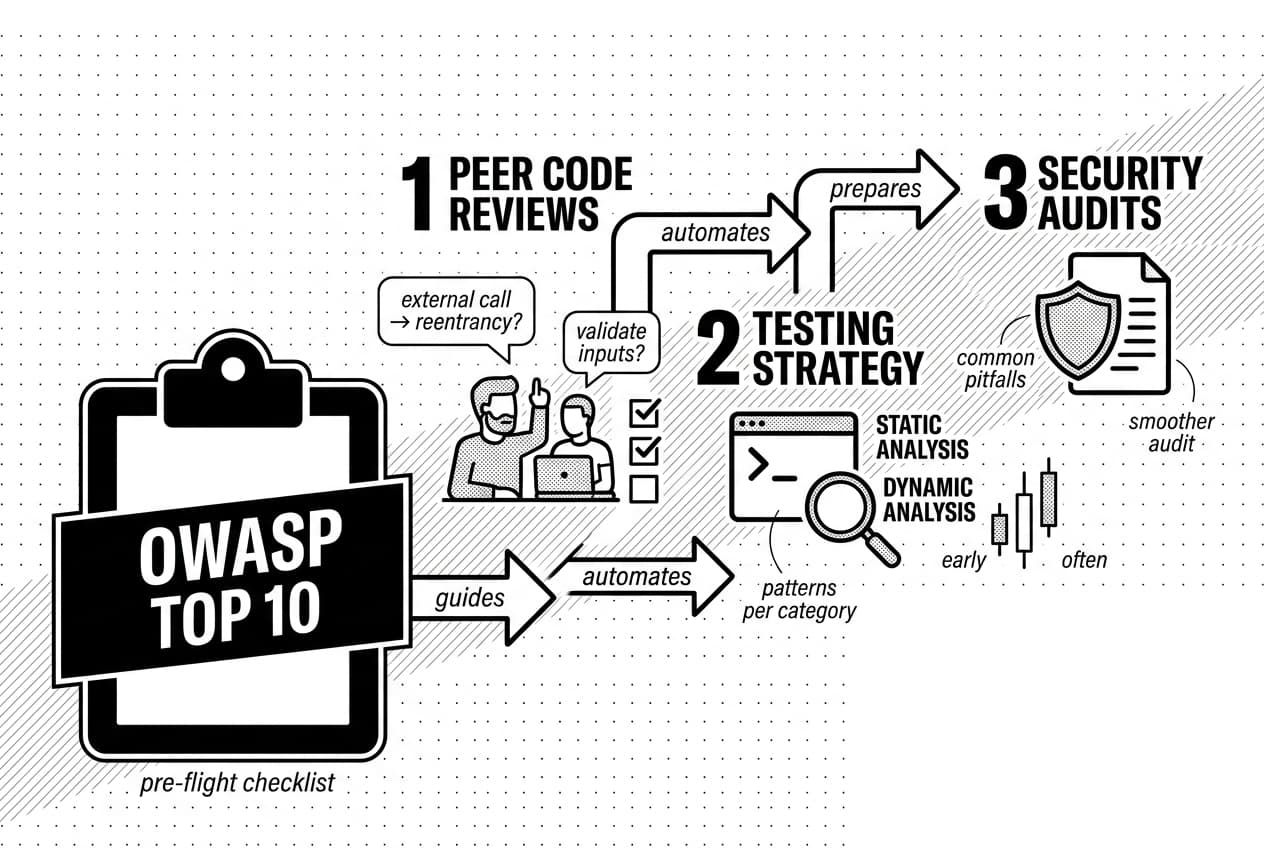
You can start by integrating the list into your team's daily practices. During peer code reviews, use the Top 10 as a concrete checklist. Encourage developers to ask specific questions like, "Does this external call introduce a potential reentrancy risk?" or "Are we validating all inputs to prevent unexpected logic flows?" This simple habit transforms every code review into a focused security session.
The guide also provides a clear blueprint for your testing strategy. Configure your static and dynamic analysis tools to specifically search for patterns associated with each vulnerability category. This creates an automated safety net that catches common coding errors early and consistently. Finally, use the smart contract vulnerability ranking to prepare for professional security audits. Understanding these common pitfalls allows your team to address likely issues in advance, leading to a smoother audit process and a stronger final product.
How the OWASP Top 10 List is Compiled
Having explored how to apply the list, it's helpful to understand where it comes from. The OWASP Smart Contract Top 10 isn't an academic theory; it's a reflection of real-world data gathered from the front lines of Web3 security. Think of it as a threat report compiled by the entire security community, not just a single organization. This collaborative, data-driven approach is what gives the list its authority and practical value for developers.
The compilation process relies on a massive pool of incident data. Security firms like SlowMist and BlockSec, along with many others, contribute findings from thousands of security audits, bug bounty programs, and post-mortems of actual exploits. By analyzing the frequency and severity of vulnerabilities found in the wild, the community creates a practical smart contract vulnerability ranking. This ensures the list focuses on the most prevalent and impactful threats that developers face right now, making it an indispensable tool for building secure applications.
About the OWASP Smart Contract Security Project (SCS)
The list we've been exploring is the flagship publication of the OWASP Smart Contract Security (SCS) Project. This is a global, community-led initiative with a clear mission: to provide the tools and knowledge developers need to build safer decentralized applications. Led by a team of security professionals and supported by countless volunteers, the project creates more than just the well-known smart contract vulnerability ranking.
They also develop testing guides, checklists, and other best practices. Think of the SCS Project as a non-profit research group working to create the safety standards for the emerging world of blockchain technology, making it more secure for everyone.
Key Takeaways for Securing Your Smart Contracts
Working through the complex world of smart contract security is a continuous journey, not a one-time task. As we've explored the OWASP Smart Contract Top 10, a few core principles have emerged that can dramatically improve the resilience of your code. Keep these key points in mind as you build, deploy, and maintain your decentralized applications.
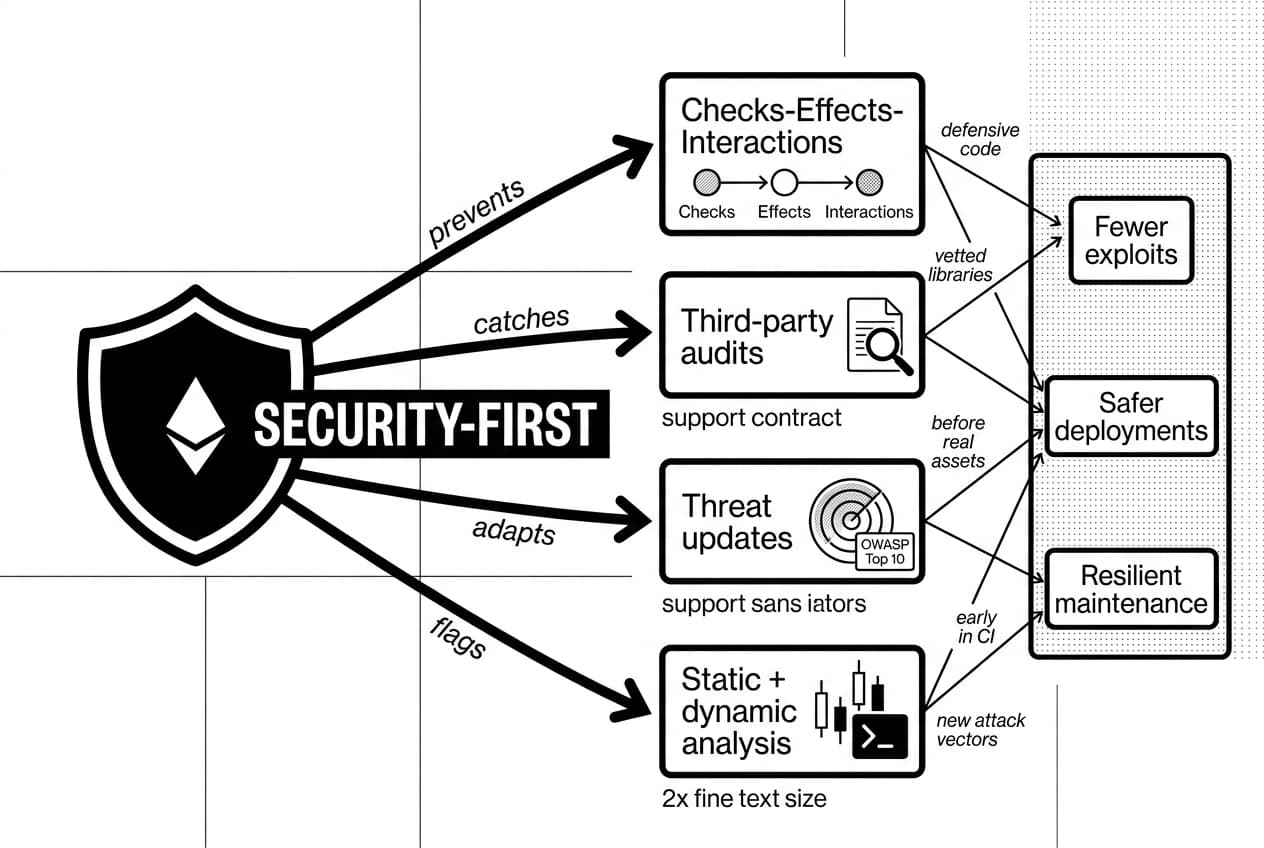
- Adopt a Security-First Mindset: Always write code defensively. Consistently apply secure coding patterns like Checks-Effects-Interactions and use established, well-vetted libraries to avoid introducing new risks.
- Make Audits Mandatory: Professional, third-party security audits are not optional. They are a critical step to catch subtle flaws that automated tools might miss before your code handles real assets.
- Stay Continuously Informed: The threat field is always changing. Keep up with the latest attack vectors and updates to the smart contract vulnerability ranking to adapt your defenses proactively.
- Use Modern Tooling: Integrate static and dynamic analysis tools directly into your development lifecycle. These can automatically flag common issues early in the process, saving time and preventing costly mistakes.
Sources
Author

Crypto analyst and blockchain educator with over 8 years of experience in the digital asset space. Former fintech consultant at a major Wall Street firm turned full-time crypto journalist. Specializes in DeFi, tokenomics, and blockchain technology. His writing breaks down complex cryptocurrency concepts into actionable insights for both beginners and seasoned investors.