USB Miner Review (2026): A Guide to Hobby Bitcoin Mining
Quick Verdict: Are USB Miners Worth It in 2026?
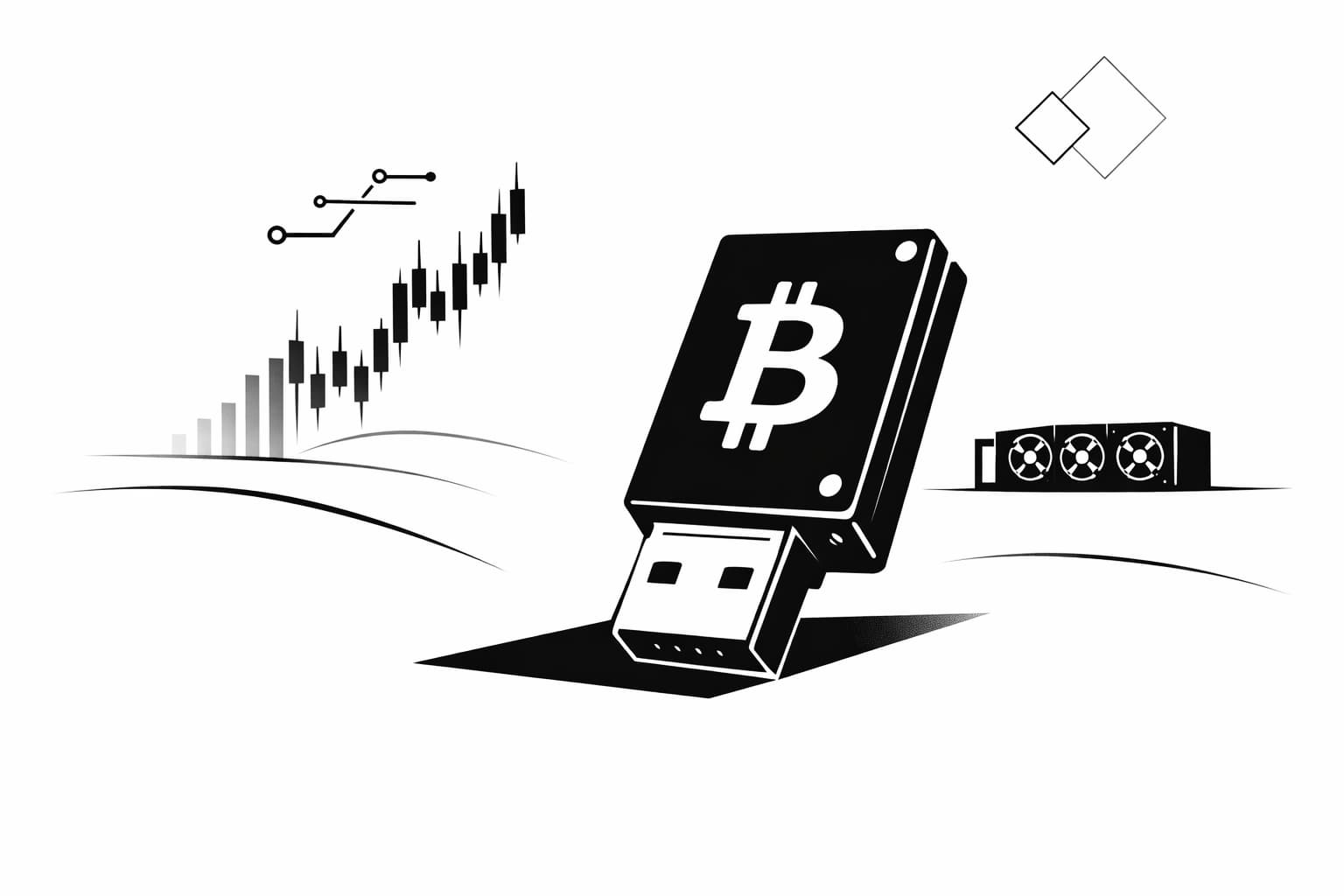
Let's get straight to the point: a usb miner will not make you any money. With network difficulty at today's levels, their hashing power is simply too low to generate a profit or even cover electricity costs. However, if your goal is to learn the fundamentals of crypto mining without a significant investment, these tiny devices are absolutely fantastic tools for the job.
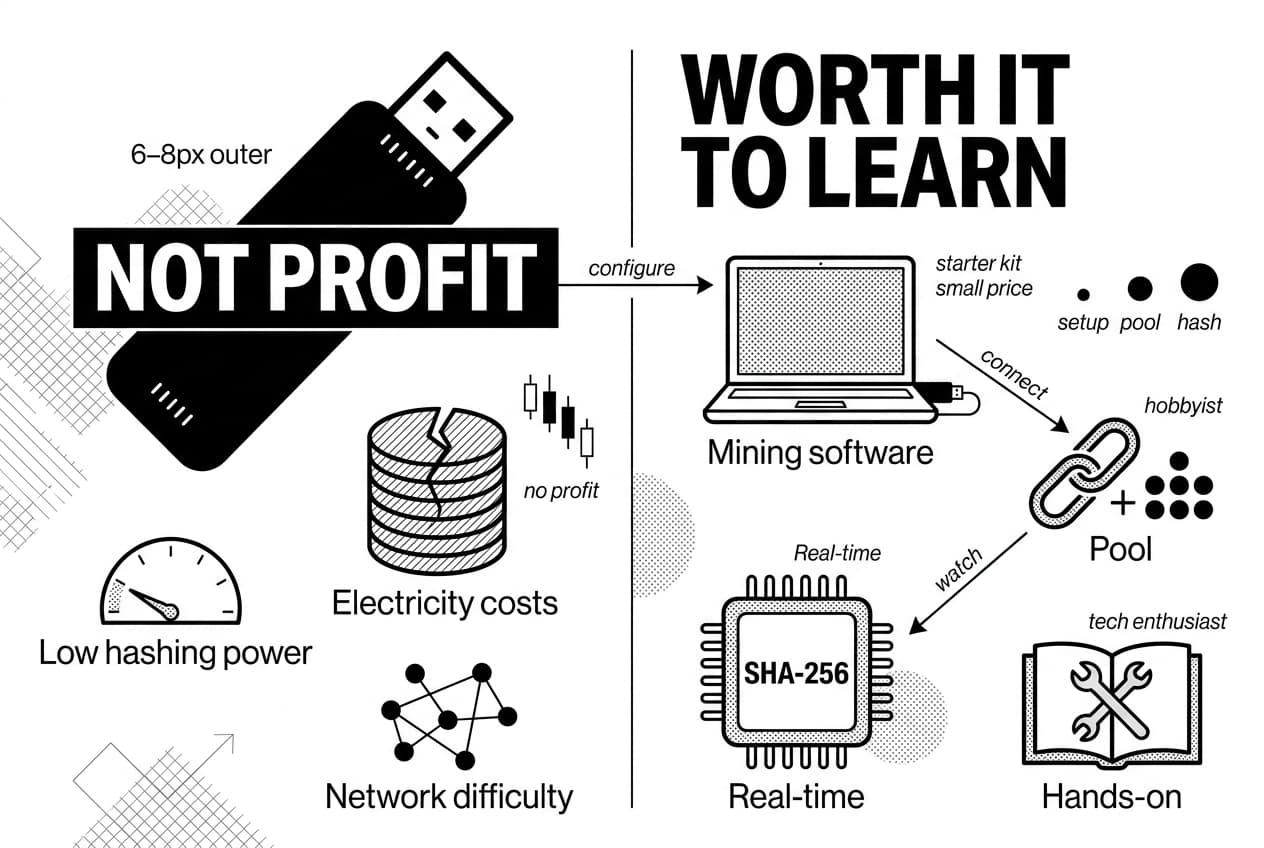
For a very small price, a usb bitcoin miner offers a hands-on education in a way reading articles cannot. You get practical experience configuring mining software, connecting to a pool, and watching the SHA-256 hashing algorithm work in real-time. Think of it as an affordable starter kit for a future hobbyist or tech enthusiast, not as a financial investment.
What Is a USB Miner? (And Who Is It For?)
A USB miner is a small, low-power ASIC (Application-Specific Integrated Circuit) device that mines cryptocurrencies by plugging into a computer's USB port. They are designed for hobbyists, students, and developers who want to understand the mechanics of crypto mining without a significant investment. Think of it as a hands-on learning kit rather than a money-making machine. In 2026, their hashing power is far too low to generate any real return, but their value lies in education. They provide a tangible way to interact with mining software, connect to a mining pool, and see the process in action on a micro scale.
The target audience for a usb bitcoin miner is very specific. If you're a computer science student learning about network protocols, a developer testing mining software, or simply a curious individual who wants to see what hashing looks like, these devices are perfect. They are not for anyone looking to earn Bitcoin or supplement their income. Their power consumption is minimal, and the setup is straightforward, making them an accessible entry point into the technical side of cryptocurrency.
A Brief History: From CPU to Tiny ASICs
To understand why the usb miner is now a novelty, it helps to look at the history of Bitcoin mining. In the earliest days, enthusiasts could mine Bitcoin effectively using their computer's standard CPU. As the network's difficulty increased, mining shifted to more powerful GPUs (Graphics Processing Units). Soon after, the industry developed ASICs—chips designed for the single purpose of mining. This innovation made CPU and GPU mining obsolete for Bitcoin. USB miners were among the first generation of consumer-grade ASICs. They represented a massive leap in efficiency at the time, but they have since been completely overshadowed by the large, powerful, and dedicated mining rigs that secure the network today.
How Do USB Bitcoin Miners Work?
At its core, a USB miner is a very simple, single-purpose machine. It’s a tiny Application-Specific Integrated Circuit (ASIC) designed exclusively to perform the SHA-256 hashing algorithm used by Bitcoin. When you plug it into a host computer—like a laptop or even a Raspberry Pi—the computer provides power and an internet connection. From there, you run special software, such as CGMiner, which tells the device what calculations to perform.
The device then gets to work, churning through hashing calculations. But we have to be realistic about its output. In 2026, the total Bitcoin network hashrate is immense. A single usb bitcoin miner contributes such a tiny fraction of that power that your chance of ever finding a block on your own is statistically zero. Think of it less as a serious mining operation and more as a "lottery miner"—you're buying a ticket with astronomically long odds.
The Role of Mining Pools
Because solo mining with one of these devices is impractical, connecting to a mining pool is absolutely essential. A mining pool is a service that allows thousands of miners to combine their hashing power and work together as a single unit. This drastically increases the group's chances of solving a block and earning the Bitcoin reward.
When the pool successfully finds a block, the reward is split among all the participants. Your share of the reward is proportional to the amount of valid work your tiny usb miner contributed. While your individual earnings will be very small, joining a pool is the only way to transform an impossible solo lottery into a slow but consistent trickle of satoshis. It’s an excellent, low-risk way to understand how pooled mining actually functions.
Key Features & Popular Models Reviewed
While the market for USB miners isn't flooded with new models every year, a few key devices have become staples for hobbyists and educators. These aren't designed to compete with large-scale mining farms; instead, they offer a low-cost entry point for understanding the mechanics of cryptocurrency mining. Let's look at two popular examples that represent different ends of the hobbyist spectrum in 2026.
Pricing for these devices is generally low, reflecting their status as novelties. You can often find older models like the Block Erupter on secondary markets for $10 to $30. More powerful units like the GekkoScience Compac F typically range from $50 to $80, depending on the seller and availability.
GekkoScience Compac F (BM1397)
If you're looking for the most "powerful" usb miner available today, the GekkoScience Compac F is likely your best bet. It's built around the efficient BM1397 ASIC chip, the same technology once found in some of Bitmain's larger Antminer models. This allows it to mine SHA-256 cryptocurrencies like Bitcoin. Out of the box, you might see a hashrate around 200-300 GH/s, but its real appeal is for tinkerers. With active cooling (a simple fan) and some frequency adjustments, users often push this device well over 400 GH/s. Its low power consumption of about 10-15 watts makes it manageable, but it's still a device best suited for those who enjoy tweaking hardware for optimal performance.
Classic USB Block Erupter
On the other end of the spectrum is the classic USB Block Erupter. You should consider this a piece of living history rather than a functional miner. First released over a decade ago, these devices were among the first ASIC miners available to the public. Their hashing power is a mere 333 MH/s—that's mega hashes, not giga hashes. To put that in perspective, the GekkoScience Compac F is thousands of times more powerful. So, why would anyone buy one? Purely for education and nostalgia. It’s an incredibly cheap way to learn how to install drivers, configure mining software, and connect to a mining pool without any real performance expectations. Think of this usb bitcoin miner as the perfect tool for a weekend project to understand the process from start to finish.
Pros and Cons of USB Mining
Having explored what these tiny devices are and how they operate, it's time to weigh their distinct advantages against their significant drawbacks. For anyone considering picking up a usb miner, understanding this balance is essential for setting realistic expectations and avoiding disappointment.
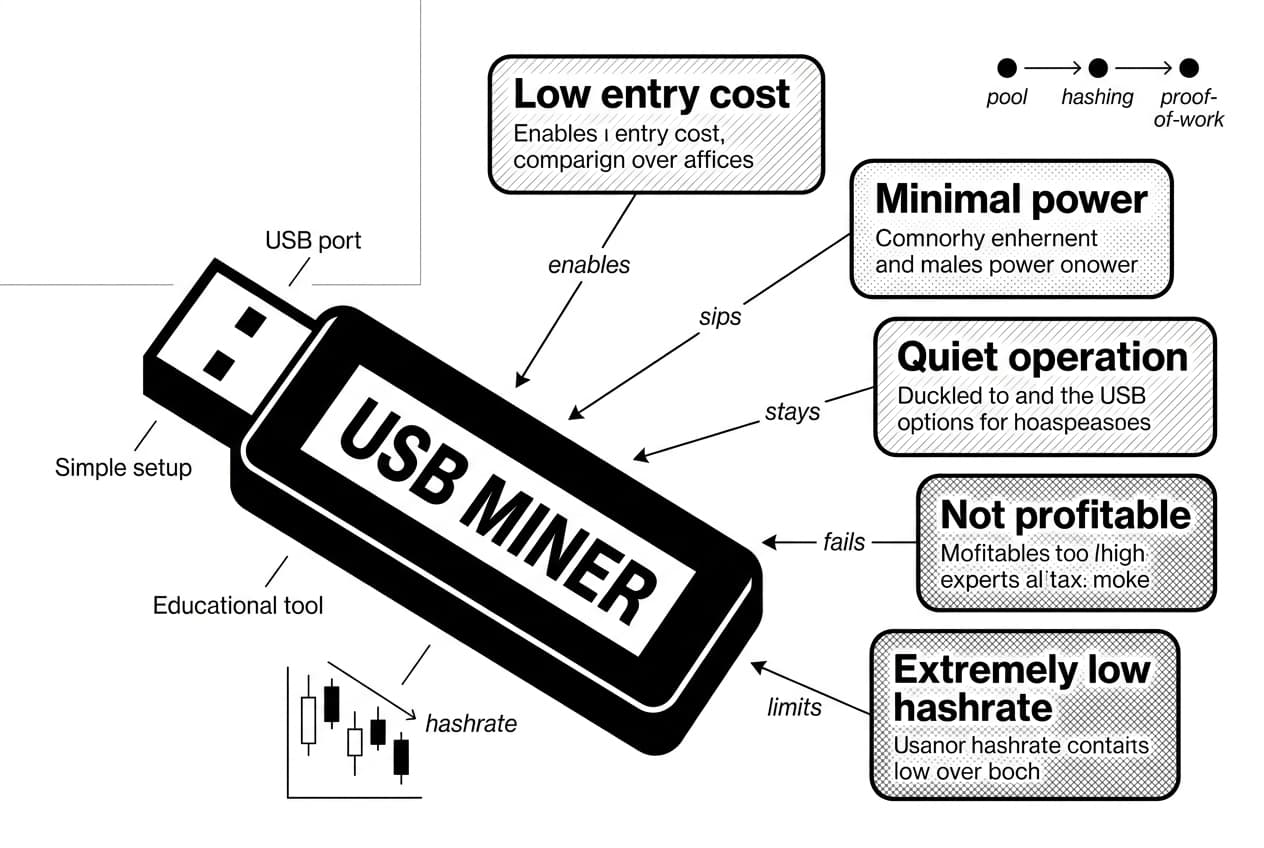
Pros
- Low entry cost: These devices are incredibly affordable, offering one of the cheapest ways to get hands-on experience with real mining hardware without a major investment.
- Minimal power consumption: A usb miner sips power directly from a standard USB port. You won't have to worry about a shocking electricity bill, unlike with full-scale mining rigs.
- Great educational tool: There's no better way to learn about hashing, mining pools, and proof-of-work concepts than by doing it yourself in a low-risk environment.
- Quiet operation: Most models are fanless and run silently. You can have one plugged into your desktop without creating any distracting noise.
- Simple setup: Getting started is often as easy as plugging the device in and configuring some software, making it far more accessible than a complex mining farm.
Cons
- Not profitable: To be perfectly clear, you will not make money with a usb bitcoin miner in 2026. Network difficulty is far too high for their output to ever earn a return.
- Extremely low hashrate: Their hashing power is a drop in the ocean. We're talking kilohashes or megahashes when major networks require many orders of magnitude more power to find a block.
- Limited algorithm support: Most devices are built for a single hashing algorithm (like SHA-256). You can't switch them to mine different types of coins.
- Can become e-waste quickly: As novelties with no earning potential, they often end up unused in a drawer once the initial curiosity fades.
- Requires a host computer: The miner cannot operate alone. It must be plugged into a powered-on computer, Raspberry Pi, or similar device to function.
The Profitability Question: Can You Make Money?
Let's address the most common question right away: you will not make a profit with a USB miner in 2026. The primary reason is the immense scale and competition on the Bitcoin network. The network's difficulty, which measures how hard it is to solve a block, is set so high that it requires enormous computational power. Your small device is up against global operations running warehouses full of sophisticated, high-powered ASIC machines.
To think of it another way, attempting to solo mine a block with a single usb bitcoin miner is like trying to win a national lottery with a single ticket. While technically possible, the odds are so vanishingly small you could run the device for a lifetime and never succeed. It's a fun thought experiment, but not a financial strategy.
Even if you join a mining pool, which combines your power with others, your contribution is a tiny drop in a vast ocean. Your share of any block rewards would likely amount to a few cents per year, far less than the cost of the electricity to run the device. Any potential earnings would be measured in Satoshi, the smallest fraction of a Bitcoin. Treat any return as a fun bonus, not an income stream.
Getting Started: A 4-Step Setup Guide
Now that you understand the realistic expectations for a usb bitcoin miner, you might be ready to try one out for educational purposes. The good news is that setting them up is far simpler than assembling a full-scale mining rig. Here is a straightforward guide to get your device hashing in just a few minutes.
- Choose and purchase your miner. Based on your budget and goals, select one of the popular models we reviewed earlier. Ensure you have the correct USB port available on your computer.
- Download and configure mining software. You'll need a program like CGMiner to communicate with your device. Find a version compatible with your specific usb miner and operating system, and be sure to install any necessary drivers for your computer to recognize the hardware.
- Join a mining pool. Solo mining with these devices is impossible. Sign up for a mining pool, create a "worker" account, and keep the login details handy for your software configuration.
- Plug in and start hashing. Connect your device, run your configured software, and you should see it begin to accept and work on shares from the pool.
Keep in mind that these tiny ASICs can get surprisingly hot. Even a small desk fan can make a difference, but for more advanced setups, you may want to explore other cooling considerations to ensure longevity.
Final Verdict: Our Take on USB Miners for Hobbyists
So, what's the bottom line on USB miners in 2026? Let's be perfectly clear: if you are looking to make a profit, you must look elsewhere. The hashing power of a USB bitcoin miner is a tiny drop in a vast ocean, and you will spend more on electricity than you could ever hope to earn. As a financial investment, these devices are a non-starter.
However, judging them on profitability misses their true value. As an inexpensive, tangible tool for learning the ropes of cryptocurrency mining, they are fantastic. For a small price, you get a hands-on education in mining pools, software configuration, and the raw mechanics of hashing. A USB miner is less of an investment and more of a fascinating piece of hardware for any tech enthusiast's desk.
Frequently Asked Questions
- Is USB mining profitable in 2026?
- No, USB mining is not profitable and is unlikely to ever be again. The global Bitcoin network's hashrate is incredibly high, so a USB miner's contribution is statistically zero. Any potential earnings would be fractions of a cent, failing to cover the hardware cost or the electricity used to power it.
- What is the fastest USB Bitcoin miner?
- Models like the GekkoScience Compac F are among the fastest, capable of over 300 GH/s. However, this is extremely slow compared to modern, dedicated ASIC rigs which operate in the terahash range (TH/s). Even the fastest USB miner is best viewed as a fun educational tool, not a serious mining device.
- How long would it take to mine 1 Bitcoin with a USB miner?
- It is practically impossible to mine 1 Bitcoin with a USB miner. The odds are astronomically low, and a single device running 24/7 would likely take thousands, if not millions, of years to find a block on its own. It's a fun lottery ticket but not a viable method for earning BTC.
- Do USB bitcoin miners work for other coins?
- Most USB miners are ASICs designed for the SHA-256 algorithm. This means they can mine Bitcoin (BTC), Bitcoin Cash (BCH), and other SHA-256 coins. They are completely incompatible with coins using different algorithms, so you cannot use them to mine currencies like Litecoin, Dogecoin, or Ethereum.
Sources
Author

Crypto analyst and blockchain educator with over 8 years of experience in the digital asset space. Former fintech consultant at a major Wall Street firm turned full-time crypto journalist. Specializes in DeFi, tokenomics, and blockchain technology. His writing breaks down complex cryptocurrency concepts into actionable insights for both beginners and seasoned investors.