Top AI Crypto Coins by Market Cap: 10 Tokens to Watch 2026
Top AI crypto coins by market cap: 10 tokens to watch in 2026
This guide ranks the top AI crypto coins by market-cap relevance, then filters them through a stricter question: does the token capture real demand from AI, or is it mainly trading on a label? The ranking is informational only and is not financial advice. Market caps move daily, so verify live figures on CoinGecko or CoinMarketCap before making any decision.
Freshness note: this editorial snapshot was updated for July 2026. It uses a market-cap-first screen, official project documentation, public dashboards and our own scoring matrix. The useful contrarian point is simple: the largest AI tokens are not automatically the safest AI bets. Fully diluted valuation, unlocks and weak token value capture can matter more than branding.
How we ranked the top AI crypto coins
We used a named framework called the AI Value-Chain Lens. Each project is mapped to one AI layer: decentralized model networks, GPU compute, agents, data, storage, cloud or inference. We then ask whether the token is needed for the service, or whether the network could keep running with stablecoins and still leave token holders with little value.
- Market capitalization: live market cap is the entry filter and rank anchor, checked against CoinGecko and CoinMarketCap in July 2026.
- Liquidity: we prefer tokens with deep exchange access and enough daily trading volume to reduce slippage.
- AI utility: the token should pay for, stake against or govern a real AI-related service.
- Real usage: we look for active users, nodes, leases, inference jobs, model activity or fee data.
- Tokenomics: circulating supply, fully diluted valuation and open up timing are weighed against market cap.
- Developer activity: protocol upgrades, live dashboards and ecosystem grants matter more than AI slogans.
- Risk: we penalize regulatory exposure, low-float launches, weak revenue links and unclear token demand.
The evidence base is mixed by design. Some projects publish strong dashboards; others offer only exchange data and product claims. Where live figures can change quickly, we link to the source rather than freezing a stale number. For context, AI infrastructure demand has been real outside crypto: Nvidia reported $47.5 billion in data-center revenue for fiscal 2024 (Nvidia annual report, Jan. 28, 2024). The question is how much of that demand actually reaches each token.
Lyn Alden, founder of Lyn Alden Investment Strategy, has repeatedly warned that low-float, high-FDV token structures can transfer risk to public buyers. That lens is especially useful in AI crypto, where fast narratives can hide future supply pressure. Balaji Srinivasan, author and investor, has also argued in public writing that durable crypto networks need real on-chain demand, not only speculative demand.
Quick comparison: top 10 AI crypto coins in 2026
The table below is built for quick extraction. It lists the top 10 AI crypto coins in this editorial screen, grouped by AI role and ranked by market-cap relevance at the time of review. Treat the market-cap column as a live check, not a fixed quote.
Rank | Coin | Ticker | AI category | Market cap source | Main use case | Key risk |
|---|---|---|---|---|---|---|
1 | Bittensor | TAO | Decentralized model network | CoinGecko, July 2026 | Subnet incentives for machine intelligence | Emissions can reward low-quality output |
2 | Render | RENDER | GPU compute | CoinGecko, July 2026 | GPU rendering and compute jobs | AI workload share is hard to isolate |
3 | ASI alliance | FET / ASI | Agents, data and models | CoinGecko, July 2026 | Combined token for AI agent and data ecosystems | Migration and integration complexity |
4 | NEAR | NEAR | AI-enabled Layer 1 | CoinGecko, July 2026 | Chain abstraction and AI-ready apps | AI exposure is indirect |
5 | ICP | ICP | Decentralized cloud | CoinGecko, July 2026 | On-chain applications and small AI inference | Large-model compute remains expensive |
6 | Worldcoin | WLD | AI identity | CoinGecko, July 2026 | Proof-of-human identity for AI-era apps | Privacy and regulatory scrutiny |
7 | Virtuals | VIRTUAL | AI agents | CoinGecko, July 2026 | Agent launches and agent-token markets | Speculative demand can fade quickly |
8 | Akash | AKT | Decentralized cloud compute | CoinGecko, July 2026 | Open marketplace for CPU and GPU workloads | Token value capture is not automatic |
9 | AIOZ | AIOZ | Storage, CDN and data | CoinGecko, July 2026 | Decentralized delivery and storage rails | AI exposure is adjacent, not direct |
10 | iExec | RLC | Confidential compute | CoinGecko, July 2026 | Private compute and data markets | Specialized adoption curve |
Pattern to notice: compute and agent tokens dominate the shortlist, while data and storage tokens need extra scrutiny. GPU scarcity is easy to understand; token value capture is harder. The best AI crypto research starts by separating those two ideas.
Top 10 AI crypto coins by market cap
Each entry uses the same test: what AI demand does the token touch, how directly does the token capture that demand, and what could break the thesis? The order favors market-cap relevance, liquidity and fit with the AI value chain rather than short-term price momentum.
1. Bittensor (TAO): Best for decentralized AI networks
Bittensor is the cleanest large-cap bet on decentralized machine intelligence. The protocol rewards subnet participants for producing useful machine-learning outputs, with validators scoring work and emissions flowing to competing subnets. That design gives TAO a direct role in the network rather than treating the token as a loose governance wrapper.
The distinguishing stat is supply. TAO has a 21 million maximum supply according to project documentation (Bittensor docs, accessed July 2026). That scarcity narrative is one reason crypto-native investors compare TAO to earlier proof-of-work assets. The stronger reason it ranks first is developer gravity: Bittensor has become the reference point for decentralized model markets.
The risk is output quality. Emissions can still reward subnets that score well internally but have limited external revenue. TAO deserves its place among the top AI crypto coins, but buyers should track subnet usage and validator behavior instead of relying only on market cap.
Metric | Why it matters |
|---|---|
AI layer | Decentralized model networks |
Hard cap | 21 million TAO (Bittensor docs, July 2026) |
Token role | Rewards, staking and network incentives |
Main risk | Emissions without enough paid external demand |
2. Render (RENDER): Best for GPU rendering and AI compute demand
Render made the list because it has real infrastructure, a clear buyer-seller loop and direct exposure to GPU demand. The network began with distributed rendering for 3D artists, then expanded its positioning toward generative AI and GPU compute as demand for parallel processing surged.
RENDER is used to settle work between customers and node operators, which gives the token a clearer utility path than many AI-branded assets. The project completed a migration toward Solana-based infrastructure in 2023, a move intended to reduce costs and improve throughput (Render official site, 2023). Readers interested in the supply side should also compare it with ways to rent GPU power to AI networks.
The skeptical point is that rendering demand is not identical to large-language-model inference demand. Render can benefit from AI workflows, but investors should not assume every GPU job is AI revenue. The token is strongest when job volume, payment demand and node economics all rise together.
3. ASI alliance (FET / ASI): Best for the combined AI ecosystem thesis
The ASI alliance combines Fetch.ai, SingularityNET and Ocean into a broad AI crypto stack covering agents, model services and data markets. Its merger plan was announced in 2024 (Fetch.ai blog, May 2024), making it one of the sector's most visible consolidation events.
The bull case is breadth. Instead of betting on one layer, FET or ASI exposure gives investors access to several AI crypto categories at once. That can be useful if agents, data marketplaces and model services grow together. It also explains why the token remains prominent in most top 10 AI crypto coins screens.
The weakness is the same breadth. Multi-community migrations create ticker confusion, governance friction and unclear reporting. Before buying, verify the active ticker on your exchange and review current migration details from official sources. This is a wide AI bet, not the cleanest single-product bet.
4. NEAR (NEAR): Best Layer 1 with AI optionality
NEAR is not a pure AI token. It is a high-throughput smart-contract network that earns a place here because of its chain-abstraction roadmap and AI-agent positioning. If agents need to act across many chains, account abstraction and simple user flows become valuable infrastructure.
The activity base is a real differentiator. NEAR crossed 1 million daily active accounts in early 2024 according to public block-explorer data (NearBlocks, early 2024). That usage gives NEAR more substance than many AI narratives built on roadmaps alone.
The trade-off is purity. NEAR's revenue and token demand still come from a broad app ecosystem, not mainly from AI inference. Treat it as a liquid Layer 1 with AI upside, not as a direct substitute for TAO, RENDER or AKT.
5. ICP (ICP): Best for on-chain AI and decentralized cloud
ICP is the most ambitious cloud-style entry on this list. Its smart-contract architecture can serve web content, store data and run applications without relying on standard centralized hosting. That makes the AI thesis different: instead of renting external GPUs, ICP aims to bring more application logic on-chain.
The network's public market history also matters. ICP began trading in May 2021 (CoinMarketCap, May 2021), and its early price collapse still shapes investor perception. The current AI angle is more technical than promotional: smaller models and inference workflows can be tested on decentralized application infrastructure.
The limitation is compute intensity. Large-scale AI inference remains better suited to specialized GPU clusters. ICP belongs in the ranking because the architecture is distinct, but its AI value case depends on proving that on-chain execution can handle useful workloads at competitive cost.
6. Worldcoin (WLD): Best for proof-of-human identity in an AI internet
Worldcoin is not an AI compute token. It is included because identity becomes more valuable as AI-generated content, bots and autonomous agents grow. Its core pitch is proof-of-human infrastructure for a web where distinguishing people from machines gets harder.
The project has meaningful scale but also unusually high policy risk. The World App reported millions of users after launch, while regulators in several jurisdictions examined biometric data practices. Always verify the latest country restrictions and token distribution data through the official project site (World official site, accessed July 2026).
WLD's token case is less direct than compute or model networks. Identity demand may grow in an AI-heavy internet, but investors still need to ask how much value accrues to the token versus the application layer. This is a high-profile AI-adjacent bet with real regulatory overhang.
7. Virtuals (VIRTUAL): Best for AI agent tokens
Virtuals is the most direct bet on AI agents as consumer-facing crypto assets. The platform lets creators launch agents with tokenized economies, turning attention, revenue sharing and community ownership into a single product loop. For a deeper peer comparison, see our guide to AI agent tokens compared.
The opportunity is clear: if agent personas become a durable category, VIRTUAL can capture platform activity rather than relying on one agent to win. The risk is also clear. Agent tokens often trade like culture coins with software attached, which means liquidity can evaporate when attention moves elsewhere.
VIRTUAL ranks below larger infrastructure names because its market is younger and more reflexive. It is still one of the most important tokens to watch if your thesis is that AI agents become crypto-native apps rather than background services.
8. Akash (AKT): Best for decentralized cloud compute
Akash is an open compute marketplace where providers can offer CPU and GPU capacity to developers. The AI link is practical: teams need affordable compute for inference, testing and smaller model workloads. Unlike Render, Akash is general-purpose cloud infrastructure rather than a rendering-first network.
The project has published live network statistics showing leases, providers and GPU availability through its public dashboard (Akash stats, accessed July 2026). AKT supports staking, governance and marketplace economics, though many users prefer stablecoin payments for predictable cloud costs.
That payment design is both user-friendly and tricky for token holders. If marketplace revenue grows but value does not flow clearly to AKT, price may not track usage. Akash is one of the stronger real-utility entries, but investors should separate product adoption from token accrual.
9. AIOZ (AIOZ): Best for storage, streaming and AI data rails
AIOZ provides decentralized infrastructure for content delivery, streaming and storage. That makes it AI-adjacent rather than AI-native. Large AI systems need data movement and storage, but AIOZ is not primarily a model network or inference marketplace.
The project reports a node-based system where participants contribute bandwidth and storage in exchange for token rewards (AIOZ official site, accessed July 2026). Its strongest case is infrastructure resilience: distributed delivery can support data-heavy apps that do not want to depend entirely on centralized platforms.
The ranking is deliberately conservative. AIOZ has real infrastructure, but its AI exposure is indirect. It should be evaluated as a storage and delivery token that may benefit from AI data growth, not as a pure AI coin competing with TAO or RENDER.
10. iExec (RLC): Best for confidential compute and private data markets
iExec is the smallest and most specialized entry in this list, but it has a real AI angle: confidential computing. Sensitive AI workloads may need privacy guarantees for medical, financial or enterprise datasets, especially when data owners do not want infrastructure providers to see raw inputs.
The project has been building decentralized compute since 2017 (iExec official site, 2017). That long operating history separates it from short-lived AI narratives. RLC is tied to compute and data-market services, with privacy-preserving workflows as the main technical hook.
The drawback is adoption speed. Confidential compute is important, but it is a narrower market than agents or GPU rental. RLC belongs on the list for technical differentiation, not because it is likely to be the highest-liquidity AI token in 2026.
AI crypto coins grouped by type
Not all top AI crypto coins compete with each other. A model-network token, a GPU token and an identity token respond to different demand signals. Grouping them by type makes portfolio construction cleaner.
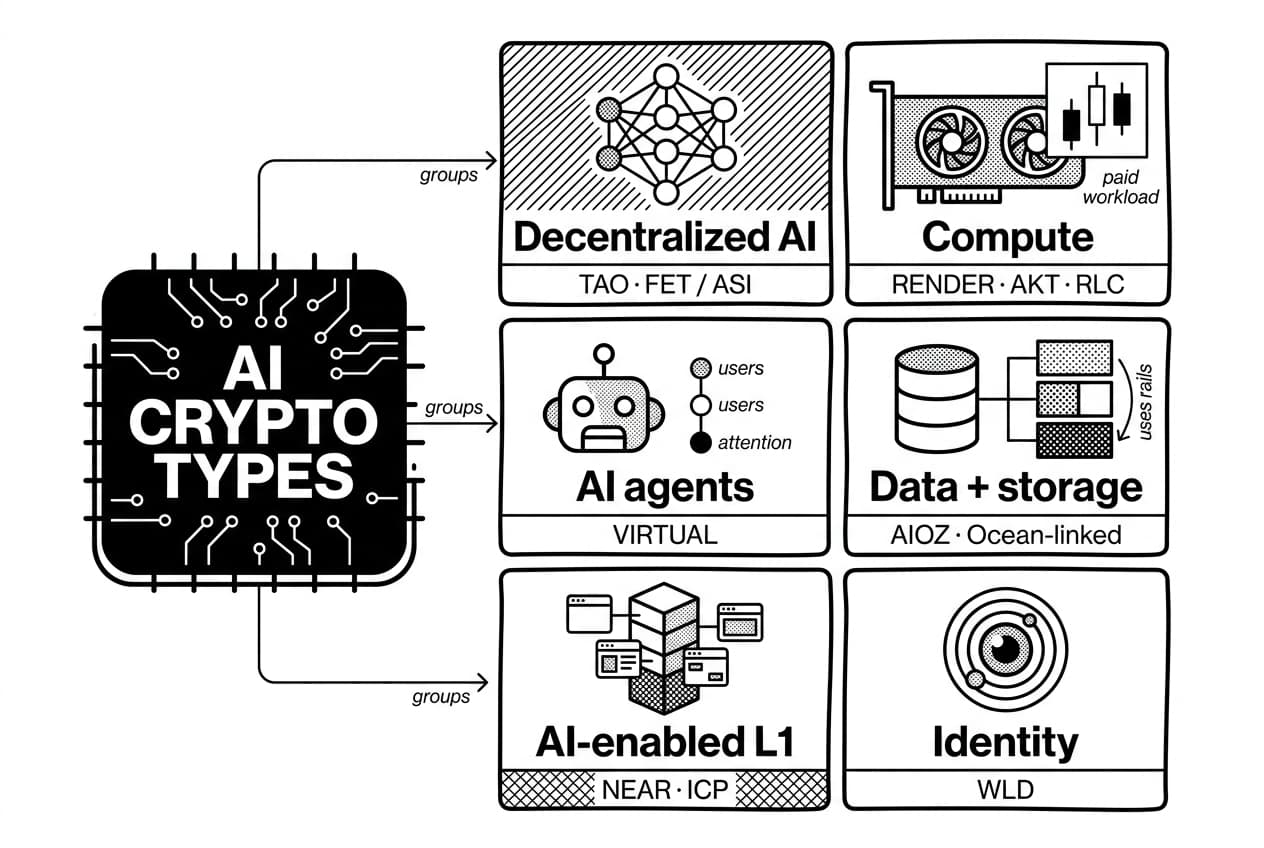
- Decentralized AI networks: Bittensor (TAO), ASI alliance (FET / ASI).
- Compute: Render (RENDER), Akash (AKT), iExec (RLC).
- AI agents: Virtuals (VIRTUAL), plus related agent-token ecosystems.
- Data and storage: AIOZ (AIOZ), Ocean-linked assets within the ASI merger.
- AI-enabled Layer 1 ecosystems: NEAR (NEAR), ICP (ICP).
- Identity for AI-era apps: Worldcoin (WLD).
This grouping changes how you read risk. Compute tokens depend on paid workload demand. Agent tokens depend on users, creators and attention. Data and storage tokens depend on whether AI workflows actually use decentralized rails. There are also ways to earn AI crypto that differ by category, from staking hardware to completing agent tasks or contributing data.
Market cap is not enough: metrics to check before buying
Market cap alone does not determine whether an AI crypto coin is a good investment. It prices only circulating tokens, while future unlocks, insider allocations, inflation and weak fee capture can change the risk profile. A smaller token with real revenue can be healthier than a larger token with heavy dilution ahead.
Market cap vs FDV vs real usage: a three-point evaluation framework
Use the FDV-Revenue-Utilization check before buying. First, compare circulating market cap with fully diluted valuation. Second, check whether protocol revenue is growing. Third, confirm that compute, inference, identity, data or agent activity requires the token rather than bypassing it.
Metric | What to check | Red flag |
|---|---|---|
Market cap vs FDV | Prefer more than 60% circulating supply where possible | FDV above 5x circulating market cap (token.unlocks.app, July 2026) |
Open up schedule | Gradual vesting over several years | Large cliff unlocks within 6 to 12 months (token.unlocks.app, July 2026) |
Revenue and fees | Fees rising with real usage | Price rising while revenue stays flat |
Utilization | GPU hours, leases, inference calls or agent activity | Token demand separated from the actual AI service |
Liquidity | Multiple liquid venues and narrow spreads | Low float with aggressive market-maker dependence |
Raoul Pal, CEO and co-founder of Real Vision, has discussed AI and crypto as a source of new financial primitives. That thesis is useful, but it does not cancel valuation discipline. A token can sit in the right sector and still be a poor buy if unlocks, fees and token demand do not line up.
Our take: use market cap to build the watchlist, then use FDV and usage to cut it down. A token with 80% of supply circulating and rising fees is a different asset from one with 25% circulating supply and a major open up next quarter (token.unlocks.app, July 2026).
Key risks with AI crypto tokens in 2026
Strong AI demand does not protect every token. Many buyers lose money by choosing the right macro theme at the wrong valuation or with the wrong token structure. Before acting on a token, or chasing AI crypto airdrop opportunities, review these three risks.
Narrative risk, open up risk and utility risk
Narrative risk: a token can rise because traders associate it with AI, not because the protocol has usage. When sentiment turns, that premium can disappear quickly. This is the main risk for agent tokens and broad AI-branded assets.
Open up risk: future supply can overwhelm good news. A project may have real utility and still fall if investor or team allocations vest into thin liquidity. Always check the open up calendar before sizing a position.
Utility risk: ask whether the token must be held, staked or spent. If users can get the same service through stablecoins, dollars or a centralized API, token demand may stay weak. This question also matters when considering whether OpenAI will launch a crypto token: centralized AI platforms do not need tokens to capture value.
How to choose the best AI crypto coin for your thesis
The best AI crypto coin depends on what you want exposure to. Do not buy an agent token if your real thesis is GPU scarcity. Do not buy a storage token if you want direct model-network demand. Match the token to the AI layer first, then review liquidity and tokenomics.
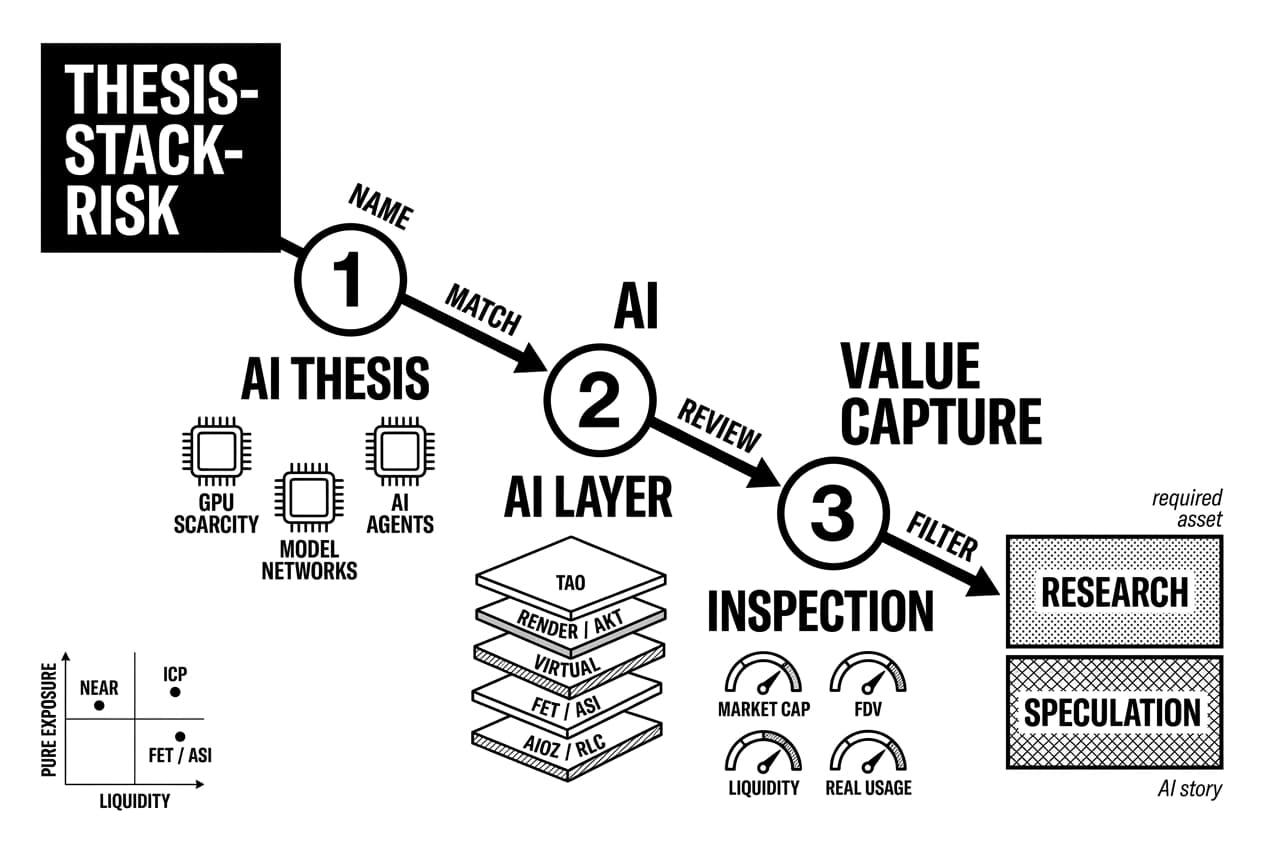
Match the token to your AI thesis
Use the Thesis-Stack-Risk test. First, name your AI thesis. Second, choose the token closest to that layer of the stack. Third, compare market cap, FDV, liquidity and real usage before buying.
Your AI thesis | Best-fit token | Risk profile |
|---|---|---|
Decentralized model networks | TAO | High: subnet economics and emissions |
GPU rendering and compute | RENDER, AKT | Medium to high: tied to workload demand |
AI agents | VIRTUAL, FET / ASI | High: early adoption and attention cycles |
Broad AI crypto exposure | FET / ASI, NEAR, ICP | Medium: larger liquidity, less pure exposure |
Data, storage and privacy | AIOZ, RLC | Medium to high: narrower demand signals |
Conservative readers should start with liquidity, source data and custody basics. If you want an easier on-ramp, review AI coins available on Coinbase. If you plan to move tokens off an exchange, read our guide to self-custody wallet rules first.
The decisive filter is value capture. If a token is the required asset for a service people need, it deserves deeper research. If it is only attached to an AI story, treat it as speculation. That single distinction removes many weak candidates from a top 10 AI crypto coins watchlist.
Frequently Asked Questions
- Which AI coin will boom in 2026?
- No one can guarantee which AI coin will perform best in 2026. Tokens like TAO, RENDER, ASI/FET, NEAR, ICP and VIRTUAL could attract significant attention if AI crypto demand grows, but actual performance depends on market conditions, tokenomics, real usage, liquidity and how strong each project's narrative remains.
- Which coin has 1000x potential?
- 1000x claims are speculative and typically apply only to very small, high-risk tokens rather than established market-cap leaders. Smaller AI agent or data tokens can move more dramatically, but they carry far higher risks of failure, low liquidity and aggressive token dilution. Treat any 1000x promise with serious skepticism.
- What crypto will AI agents use?
- AI agents will likely rely on several types of crypto infrastructure simultaneously — agent platforms like Virtuals, payment rails on major blockchains, decentralized compute networks, data networks and DeFi protocols. Expecting one inevitable winner is unrealistic. Agent economies will almost certainly operate across multiple chains rather than consolidating around a single token.
- What is the most promising crypto right now?
- Rather than naming one token, it helps to think by category. For AI-specific exposure, market leaders like Bittensor, Render, ASI/FET and Virtuals are widely followed. For broader crypto infrastructure, compare liquidity, real adoption, protocol revenue and long-term use cases before deciding where a project fits your investment goals.
- Which is the best AI crypto coin?
- There is no single best AI crypto coin for every investor. TAO suits decentralized AI network exposure, RENDER and AKT target compute demand, ASI/FET fits the AI alliance narrative, and VIRTUAL aligns with AI agent ecosystems. The right choice depends entirely on your risk tolerance, time horizon and specific investment thesis.
- What crypto has 1000x potential?
- 1000x potential is largely a marketing phrase rather than a sound investment thesis. Readers chasing asymmetric upside need to carefully evaluate tiny market caps, upcoming token unlocks, team credibility, exchange liquidity, genuine product traction and — critically — the realistic probability of permanent capital loss before committing any funds.
- What is the best AI crypto to buy right now?
- The best AI crypto to research depends on what you actually want: large-cap liquidity, compute exposure, AI agent ecosystems, data infrastructure or early-stage high-risk tokens. Before buying anything, compare market cap against fully diluted valuation, check exchange availability, and verify that real network usage exists beyond speculative trading volume.
Sources
Author

Crypto analyst and blockchain educator with over 8 years of experience in the digital asset space. Former fintech consultant at a major Wall Street firm turned full-time crypto journalist. Specializes in DeFi, tokenomics, and blockchain technology. His writing breaks down complex cryptocurrency concepts into actionable insights for both beginners and seasoned investors.