Quantum Resistant Crypto: Top Blockchains Preparing for Q-Day
Quantum Resistant Crypto: Top Blockchains Preparing for Q-Day
Updated June 2026. This ranked guide separates projects with real post-quantum design, signature agility, or credible migration work from projects using quantum language as branding. The key point is not just whether a chain says it uses a post-quantum algorithm. Q-Day readiness depends on exposed public keys, wallets, bridges, custody systems, upgrade governance, and whether users can migrate before a cryptographically relevant quantum computer appears.
How We Ranked Quantum Resistant Crypto Projects
Q-Day is the point when a sufficiently capable quantum computer can break today’s public-key signatures fast enough to threaten live blockchain balances. Bitcoin, Ethereum, XRP, Solana, and most major chains still depend on elliptic-curve signatures somewhere in their stack. If a wallet has already revealed its public key on-chain, that public key becomes the target.
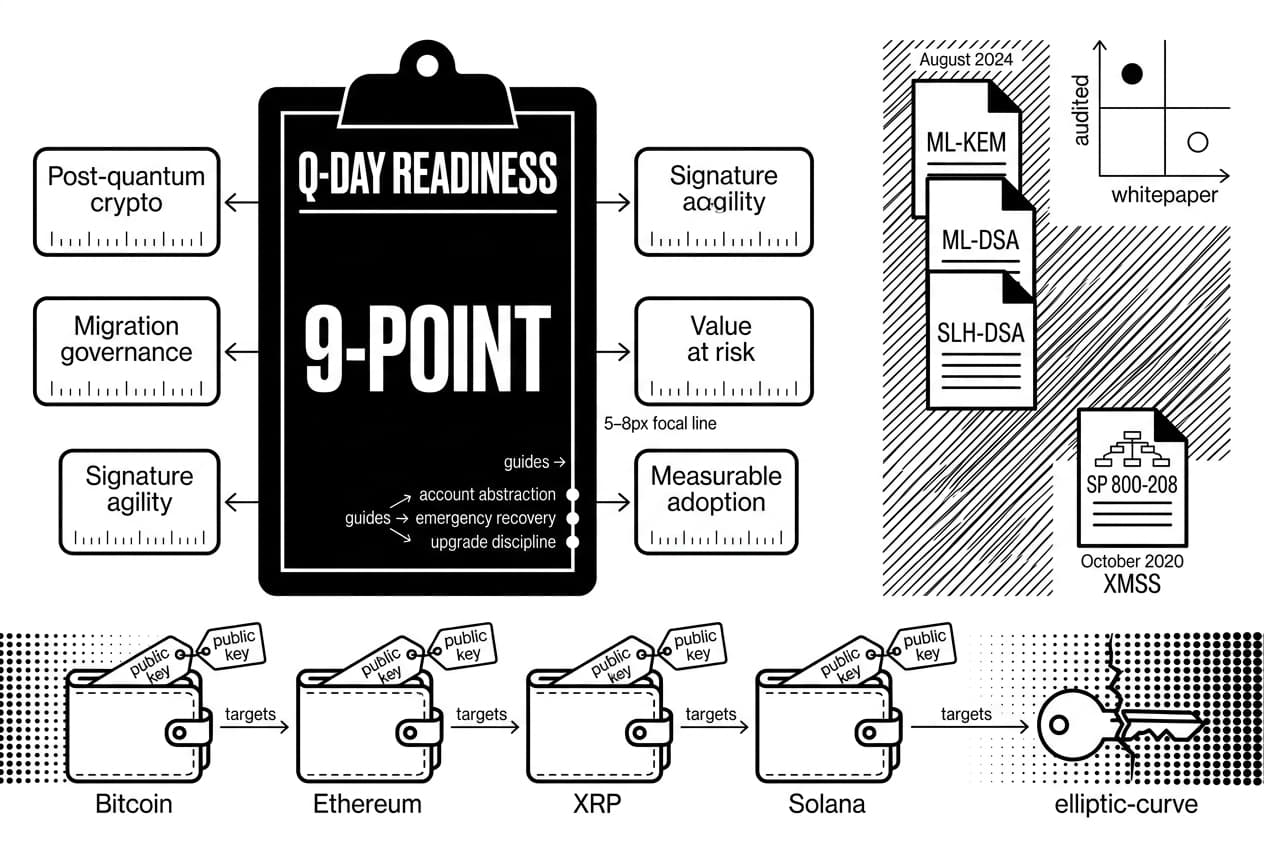
Our ranking uses the Q-Day Readiness Scorecard, an original 9-point framework built for this review. We scored each project on five dimensions: live post-quantum cryptography, migration governance, signature agility, ecosystem value at risk, and measurable adoption. Projects earned more credit for audited or standards-aligned implementation than for whitepaper language.
The standards baseline matters. NIST released 3 finalized post-quantum encryption and signature standards in August 2024, including ML-KEM, ML-DSA, and SLH-DSA. NIST also published SP 800-208 for stateful hash-based signatures in October 2020, which is relevant for XMSS-style designs. Those dates give crypto projects a concrete benchmark rather than a vague promise.
We also weighted migration more heavily than marketing. Vitalik Buterin, co-founder of Ethereum, has helped push public discussion toward account abstraction and emergency recovery thinking, which is the right frame for large networks. Andreas Antonopoulos, Bitcoin educator, has long emphasized that protocol security is inseparable from social coordination and upgrade discipline. That is exactly where many Q-Day plans are weakest.
What Quantum Resistance Means in Crypto
Quantum resistant crypto is a category of cryptographic systems designed to remain secure against known quantum attacks on public-key schemes, especially attacks that could break elliptic-curve signatures. It is more precise than a vague quantum proof blockchain claim because it depends on named algorithms, parameter choices, audits, wallet migration, and real deployment.
Most blockchains are not broken today. The near-term risk is not that a laptop quantum computer drains wallets tomorrow. The risk is that public keys already exposed on-chain may become vulnerable once a cryptographically relevant quantum computer can run Shor’s algorithm at scale. For a deeper timing discussion, see our guide to the quantum computing threat to Bitcoin.
Quantum Resistant vs Quantum Proof Blockchain
“Quantum proof” is usually marketing. Serious teams use “quantum resistant” because no algorithm can promise permanent safety against every future attack. A credible claim should identify the signature scheme, reference standards or peer-reviewed research, disclose implementation limits, and explain how existing users will migrate.
The Three Main Attack Surfaces
Signatures are the primary target. ECDSA, EdDSA, and related elliptic-curve systems are vulnerable in principle to Shor’s algorithm once a large enough fault-tolerant quantum computer exists.
Hash functions face a softer threat. Grover’s algorithm gives a quadratic speedup, so a 256-bit hash can be treated roughly like 128-bit security against an ideal quantum attacker. That remains strong, but it still affects conservative design choices.
Key exposure is the underpriced risk. Reused addresses, old multisig wallets, bridge keys, validator keys, and inactive wallets cannot all be upgraded by changing one line of protocol code. This is why migration planning deserves as much attention as the algorithm label.
Quick Comparison: Best Projects Preparing for Q-Day
The table below is a curator snapshot, not investment advice. It favors real design choices and migration paths over market capitalization. Live market data should be rechecked on publication day, because liquidity changes faster than cryptographic architecture.
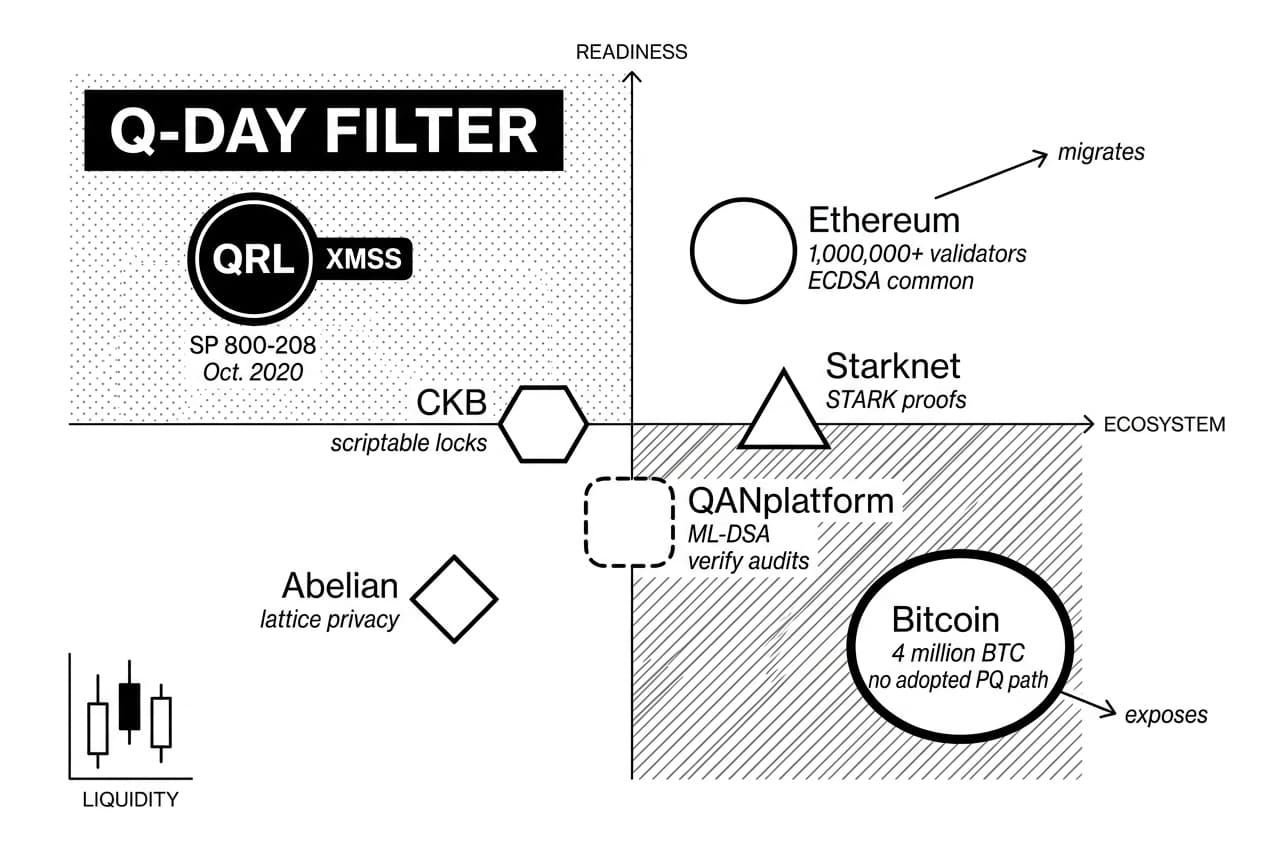
Project | Token | Readiness status | Approach | Best for | Key metric | Main caveat |
|---|---|---|---|---|---|---|
QRL | QRL | Live post-quantum design | XMSS hash-based signatures | Native quantum-resistant value storage | SP 800-208, Oct. 2020 | Small ecosystem |
Ethereum | ETH | Migration roadmap | Account abstraction and future PQ wallets | Large smart-contract economy | 1,000,000+ validators, Apr. 2024 | ECDSA still common |
CKB | CKB | Signature-agile design | Scriptable lock model | Flexible asset storage | Mainnet documentation, 2019 | No default PQ signing |
Starknet | STRK | Hash-based proof strength | STARK proof system | ZK ecosystem monitoring | TVL tracked by DefiLlama, June 2026 | Wallets still matter |
QANplatform | QANX | Claims PQ EVM path | ML-DSA style signatures | EVM developers | ML-DSA finalized, Aug. 2024 | Verify live audits |
Abelian | ABEL | PQ privacy candidate | Lattice-based privacy design | Privacy research watchlist | NIST PQ project, 2024 | Liquidity and regulation |
Bitcoin | BTC | High-risk migration case | Possible future soft fork | Reserve-asset risk tracking | 4 million BTC exposure estimate, 2020 | No adopted PQ path |
Top 7 Quantum Resistant Crypto Projects Preparing for Q-Day
Rankings below combine cryptographic readiness, migration practicality, ecosystem weight, and evidence quality. The list is intentionally skeptical. A small chain with real post-quantum signatures can rank above a giant chain on native readiness, while a giant chain can still rank highly if its governance and wallet roadmap look credible.
1. QRL, the Quantum-Resistant Ledger — Best Native Post-Quantum Chain
QRL ranks first because it was built around post-quantum signatures from the start. Its core distinction is XMSS, a stateful hash-based signature approach aligned with the hash-based family described in NIST SP 800-208, October 2020. That means QRL does not rely on elliptic-curve hardness for basic transaction authorization.
The tradeoff is adoption. QRL is a serious cryptographic design, but it has a much smaller application base than Ethereum, Bitcoin, or major L2s. Thin exchange access, fewer wallet choices, and limited developer tooling reduce practical usefulness. It is the cleanest native quantum resistant crypto example, not the most used network.
Key stats: XMSS is the defining design feature; check live QRL market cap, exchange depth, node count, and 24-hour volume on publication day. Curator caveat: Technical purity does not equal network effect.2. Ethereum — Best Major-Chain Post-Quantum Migration Roadmap
Ethereum is not quantum-resistant by default in 2026. It ranks this high because it has the strongest combination of developer depth, account abstraction work, wallet experimentation, and public migration thinking among major smart-contract chains. Account abstraction makes it easier for wallets to support new signature schemes without forcing every user into the same migration path at once.
The scale is the problem. Ethereum passed 1,000,000 active validators in April 2024, and its DeFi, L2, bridge, stablecoin, and custody layers create many separate migration surfaces. Before judging ETH as a Q-Day candidate, understand how Ethereum and ETH work, because account design and gas economics affect upgrade rollout.
Key stats: Validator count, ETH market cap, L2 TVL, and wallet adoption are the live numbers to track. Curator caveat: Ethereum has credible migration tools, but secp256k1 signatures remain part of the user stack today.3. CKB — Best Signature-Agility Architecture
CKB makes the list because its cell model and scriptable locks are built for cryptographic flexibility. Instead of hardwiring one signature scheme forever, the chain can support different lock scripts. In a Q-Day context, that matters because post-quantum standards may keep changing and because migration may happen in stages.
This is a governance and developer bet, not a claim that CKB is quantum-safe today. The architecture can make a future ML-DSA, SLH-DSA, or other post-quantum lock easier to deploy, but wallets and applications still need to use it. The project’s own documentation has tracked the CKB mainnet since 2019, giving observers a long operating history to review.
Key stats: Track active addresses, developer commits, supported lock scripts, and live CKB market cap. Curator caveat: Signature agility is readiness infrastructure. It is not the same as default post-quantum protection.4. Starknet — Best ZK/STARK Ecosystem to Watch
Starknet earns a place because STARK proofs rely on hash-based assumptions rather than elliptic-curve pairings. That makes its proof layer more attractive for a post-quantum future than many pairing-based ZK systems. For readers comparing proof models, our explainer on zero-knowledge and private compute is the better starting point.
The caveat is important: a hash-based proof system does not make the whole chain quantum-safe. User accounts, bridges, sequencers, and off-chain infrastructure still have separate signing assumptions. Starknet TVL and adoption are tracked live by DefiLlama, accessed June 2026, which makes it easier to monitor whether the ecosystem has enough activity to justify serious migration work.
Key stats: Watch STRK market cap, TVL, active users, and account-signature upgrades. Curator caveat: The proof layer is a strength, but end-to-end quantum resistance needs more than STARKs.5. QANplatform — Best EVM-Compatible Quantum-Safe Claim to Verify
QANplatform is interesting because it targets a practical gap: developers want EVM compatibility without inheriting every classical-signature risk. The project’s public positioning references post-quantum signatures in the family standardized by NIST when ML-DSA was finalized in August 2024. If implemented and audited as claimed, that combination would be useful.
The word “if” carries weight. EVM compatibility plus quantum-safe branding is attractive, so it also needs extra scrutiny. Review mainnet status, third-party audit reports, transaction activity, and whether the post-quantum signing path is live in production rather than described in documentation.
Key stats: Track QANX market cap, live dApps, audit dates, and 24-hour volume. Curator caveat: This is a verify-first candidate. Do not treat a standards reference as proof that the full chain is safe.6. Abelian — Best Post-Quantum Privacy Candidate
Abelian combines post-quantum design goals with privacy. That makes it unusual, because privacy systems often carry larger proofs, heavier verification costs, and greater exchange-listing risk. Its lattice-based direction fits the broad mathematical family behind several post-quantum schemes covered by the NIST post-quantum project, 2024.
The benefit is also the risk. A privacy-focused quantum resistant crypto project must prove more than cryptographic ambition. It needs usable wallets, liquid markets, reliable transaction performance, and a path through regulatory pressure. In 2026, that is a high bar for any privacy coin, even before quantum migration is considered.
Key stats: Review ABEL trading volume, exchange listings, transaction size, and wallet support at publication. Curator caveat: Privacy plus post-quantum design is technically appealing, but market access may be the limiting factor.7. Bitcoin — Biggest Q-Day Risk, Weakest Adopted Migration Path
Bitcoin belongs on this list because of the value at risk, not because it is ready. Deloitte estimated that about 4 million BTC could be vulnerable to quantum attack in 2020 due to exposed public keys. Bitcoin’s fixed supply is 21 million BTC, described in the 2008 white paper, so even a minority of vulnerable coins would represent a major market event.
The proof-of-work layer is not the main target. The signature layer is. Bitcoin can theoretically upgrade, but the social process is slow by design. That conservatism is part of Bitcoin’s strength, yet it also makes emergency cryptographic migration hard. Hardware wallet support will matter too, so compare current device tradeoffs in our hardware wallet security guide.
Key stats: Track exposed public-key balances, BTC market cap, hash rate, and soft-fork proposals. Curator caveat: Bitcoin is the benchmark Q-Day risk case, not a quantum proof blockchain today.
Why Q-Day Readiness Is Harder Than Swapping Signatures
The easy version of the story says a blockchain can become quantum-safe by replacing ECDSA with a post-quantum signature. The real version is messier. Wallets, contracts, exchanges, custodians, validators, bridges, and old accounts all have different migration paths.
Exposed public keys are the first problem. Any address that has spent funds may already have its public key on-chain. Lost keys make that worse because the owner cannot sign a migration transaction. Custody systems add another layer because exchanges and funds must rotate keys without breaking withdrawal systems, audit trails, or internal controls.
Smart contracts add still more friction. Some contracts assume specific signature formats, address lengths, or verification costs. A post-quantum signature can be much larger than an ECDSA signature, which affects fees, block space, and verification logic. Our guide to smart contract security risks explains why hardcoded assumptions often become upgrade failures.
Our Q-Day Readiness Scorecard treats the signature algorithm as only one part of readiness. Wallet migration, exposed-key cleanup, bridge rotation, contract compatibility, and governance timelines are the parts most likely to fail under pressure.
This is why the best watchlist is not simply “coins with post-quantum in the name.” The stronger approach is to track projects that can rotate cryptography without losing users, liquidity, or security guarantees.
How to Choose a Quantum Resistant Crypto to Watch
Use this checklist before adding any quantum resistant crypto project to a research list. It is designed to catch the gap between real post-quantum preparation and token marketing.
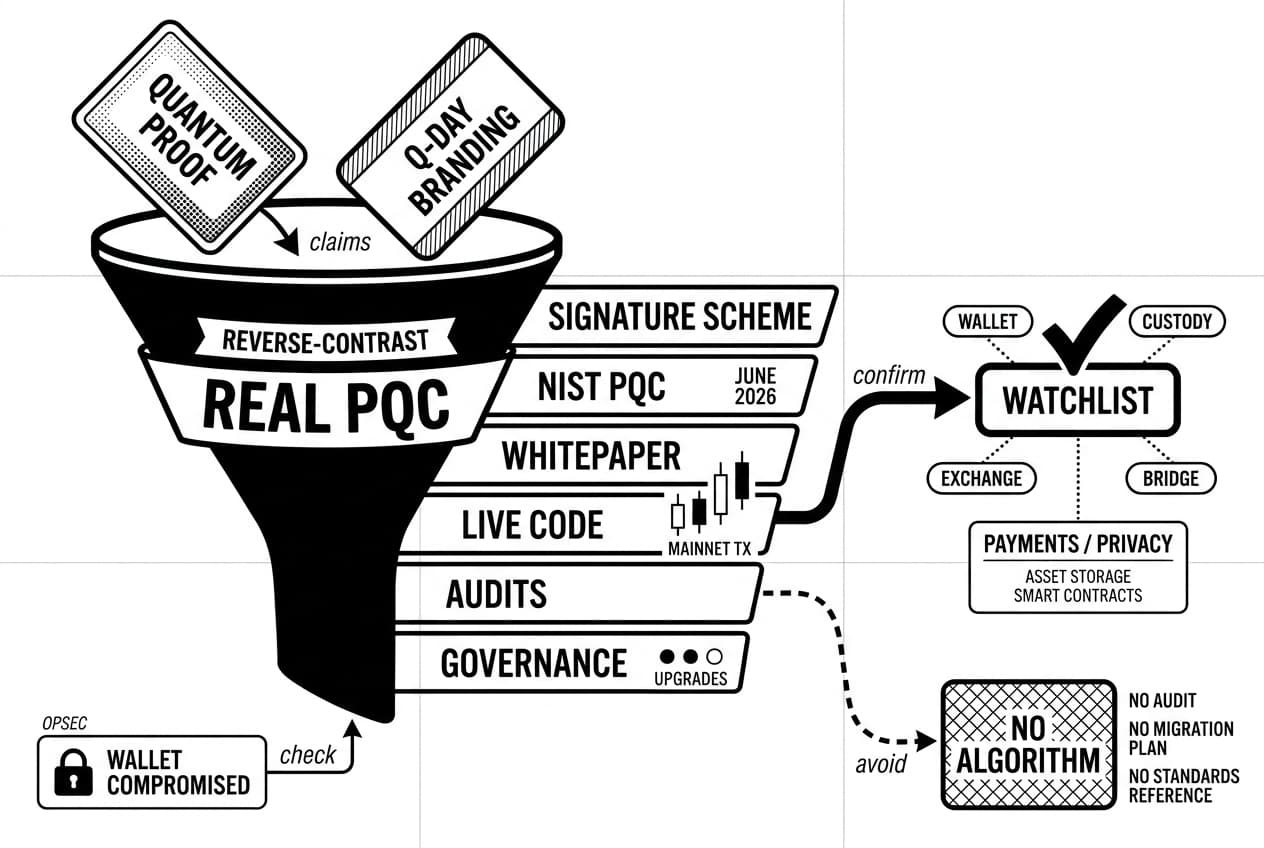
- Verify the exact signature scheme and compare it with NIST’s post-quantum cryptography project, accessed June 2026.
- Compare the whitepaper with live code, wallet behavior, and testnet or mainnet transactions.
- Check whether security audits cover the post-quantum components, not just the consensus layer.
- Review governance history to see whether the project has shipped difficult protocol upgrades before.
- Confirm wallet, custody, exchange, and bridge support before treating the asset as usable at scale.
- Confirm that the project has a reason to exist beyond Q-Day branding, such as payments, privacy, asset storage, or smart contracts.
- Avoid projects that say quantum proof blockchain but publish no algorithm, audit, migration plan, or standards reference.
- Check your own operational security before moving funds; start with our guide on how to check if your wallet is compromised.
Frequently Asked Questions
- What crypto coins are quantum-resistant?
- Notable examples worth researching include QRL, Abelian, and QANplatform, which are purpose-built for quantum resistance. Ethereum, Bitcoin, Nervos CKB, and Starknet are exploring or planning upgrades. Before investing, verify each project's live code, independent audits, signature schemes, and actual adoption progress rather than marketing claims alone.
- Is XRP quantum-resistant?
- XRP currently relies on conventional cryptography and should not be considered fully quantum-resistant without a confirmed protocol-level migration. Large networks like XRP Ledger could potentially upgrade, but real readiness depends on governance decisions, validator coordination, wallet migration support, and managing risk from wallets with already-exposed public keys.
- What is quantum resistance in crypto?
- Quantum resistance means a blockchain's wallets, signatures, consensus mechanisms, and supporting infrastructure can withstand attacks from powerful quantum computers. Achieving it typically requires post-quantum signature schemes, lattice-based or hash-based cryptography, and a credible migration plan for existing users and keys already on-chain.
- What is quantum safe crypto?
- Quantum safe crypto refers to cryptographic systems designed to resist attacks from known quantum algorithms. The phrase is often used loosely in token marketing, so look beyond the label. Meaningful indicators include specific named algorithms, defined security parameters, third-party audits, alignment with NIST standards, and a realistic upgrade roadmap.
- What is the quantum blockchain?
- There is no single blockchain called "the quantum blockchain." The phrase can describe blockchains using post-quantum cryptography, projects branded around quantum themes, or theoretical systems involving quantum networks. For practical purposes, the key question is whether a project's signature schemes and wallets genuinely protect against quantum-level attacks.
- Where can I buy Qtum crypto?
- Worth clarifying first: Qtum is a separate blockchain project, and its name does not mean it is quantum-resistant. If you are looking to purchase QTUM tokens, major centralized exchanges and supported wallets may list it depending on your region. Always confirm current availability, regulatory status, and exchange support before proceeding.
Sources
Author

Crypto analyst and blockchain educator with over 8 years of experience in the digital asset space. Former fintech consultant at a major Wall Street firm turned full-time crypto journalist. Specializes in DeFi, tokenomics, and blockchain technology. His writing breaks down complex cryptocurrency concepts into actionable insights for both beginners and seasoned investors.